03/29/2017 - Paul Brodsky: “A Socialized Market With Guaranteed Positive Returns For All Must Fail”

“When we step back and look at the broad macroeconomic setup, characterized by aging populations in the world’s largest economies, declining overall birth rates among the world’s wealth holders, record sovereign and household leverage, the continued economic emphasis of finance over production, the reliance on over-accommodating central banks (even during the Fed’s current rate hike phase), historically high equity, bond and real estate prices and record low asset and liability values (in real terms); we cannot help but conclude that asset prices are generally rising due mostly to inertia, in spite of unreason, and that the most likely outcome will be something unexpected and disappointing.

Even though it is a rejection of the established secular bull market in assets and the social, economic, political and financial cultures established and tweaked over the span of our career (almost to the day), our heart and mind (not to mention the vast sweep of investment and economic history) tell us structural change is coming. We can use our experience to forecast specific events and new trends that might occur, and we have, but we cannot know exactly what form structural change will take or when it might begin.

A socialized market framework with implicitly guaranteed perpetual positive returns for all must fail.”

LINK HERE to the article


Disclaimer: The views or opinions expressed in this blog post may or may not be representative of the views or opinions of the Financial Repression Authority.


03/29/2017 - Yra Harris: The Swiss Central Bank Is Performing Financial Alchemy, Printing Money To Buy Real Assets

“SNB President Thomas Jordan regularly opines that is Swiss currency is overvalued. The SWISS bank reserves are not increasing because of robust Swiss exports. However, the SNB regularly turns on the printing presses to produce Swiss francs to sell and purchase other currencies in an effort to meet the insatiable demand for the Swiss foreign currency. Currently, SNB foreign reserve holdings are equivalent to the entire GDP of the Swiss economy. The SWISS FRANC represents the fragility of the global financial and political system as investors are willing buy Swiss assets with negative yields out to over TEN years. The Swiss are doing nothing more than printing more SWISS FRANCS to meet the demand. When they use the fiat francs to purchase other currencies the SNB converts those currencies into EQUITY AND BOND assets in a symphony of some of the most high-quality worldwide corporations. THIS IS FINANCIAL ALCHEMY OF THE HIGHEST ORDER. The SNB owns almost $2 billion of APPLE Corporation .. No wonder the Swiss are so happy. They are laughing as the world keeps willing to swap its banknotes for real assets, helping Swiss citizens become the world’s largest hedge fund .. The SNB has discovered the PHILOSOPHER’S STONE and lo and behold it is a printing press. The VIX may represent investor complacency but the SNB’s attempts at financial alchemy represent something else. Not sure as of yet but if I were a Swiss national I would be voting for the SNB to be increasing its GOLD RESERVES.”

“The SNB reinforces my point and what reader Asherz wrote last night in the blog post: The Swiss are running the largest hedge fund in world and they can’t hedge because it would only put upward pressure on the Swiss franc. So the SNB needs to begin purchasing a basket of commodities, especially large amounts of GOLD as the ultimate hedge against global financial uncertainty. Just imagine the political uproar in Switzerland if global equity markets depreciated over the next five years. It’s alchemy at its finest.”

LINK HERE to the one article

LINK HERE to another article


Disclaimer: The views or opinions expressed in this blog post may or may not be representative of the views or opinions of the Financial Repression Authority.


03/23/2017 - Financial Literacy Day – Mark Your Calendar – Live Stream on March 30th – Link From Here


LINK HERE to get the Live Stream


Financial Literacy Day

Mar 30, 2017

Event Navigation

Cumberland Advisors and the University of South Florida Sarasota-Manatee are proud to invite you to our Financial Literacy Day being held on March 30, 2017. This event will feature panel discussions by experts on:

  • Fiduciary/Trustee Roles and Responsibilities
  • Women’s Financial Issues
  • Investment Options/Outlook for Investors and Financial Markets
  • The Global Economic Outlook

The keynote remarks will be given by William C. Dudley, President and CEO of the Federal Reserve Bank of New York.


Location:
USF Sarasota-Manatee at the Selby Auditorium
8350 N. Tamiami Trail
Sarasota, FL 34243

Parking Information:
Please use the parking lots on the south side of Seagate Drive. You will not need a parking permit if you’re attending this event.


Schedule of Events


 Tickets


Speakers:

  • David Kotok, Chairman & CIO, Cumberland Advisors
  • David BersonSenior Vice President and Chief Economist, Nationwide Mutual
  • Michael ChrisztVice President & Public Affairs Officer, Federal Reserve Bank of Atlanta
  • Tracy CollinsAssistant Professor of Economics, New College of Florida
  • Neal D. ColtonFormer Shareholder (retired), Cozen O’Connor (Philadelphia, PA) 
  • Ray Dillon, President & CEO, Deltic Timber Corporation (Retired)
  • Michael DruryChief Economist, McVean Trading & Investments, LLC.
  • Megan Greene, Managing Director and Chief Economist, Manulife Asset Management
  • Edward F. Keon, Jr.Managing Director and Portfolio Manager, QMA 
  • Kozo KoideChief Economist, Asset Management One Co. Ltd. (Japan)
  • Ramiro Lopez Larroy, Partner & Director, Integras Capital
  • Cheryl LoefflerRealtor & Former Chairman Board of Trustees of Ringling College of Art & Design
  • Laura Mattia PhD., CFP ®Financial Planning Program Director, University of South Florida
  • Michael McNiven, PhD., Managing Director & Portfolio Manager, Cumberland Advisors
  • John Mousseau, CFA, Executive Vice President and Director of Fixed Income, Cumberland Advisors
  • Dr. Donal O’SheaPresident & Professor of Mathematics – Natural Sciences, New College of Florida
  • Kimberly Walker, Attorney specializing in Labor & Employment, Williams Parker

Moderators:

  • Judy Hangartner, CPAAssistant Professor, State College of Florida
  • Alison GardnerFirst Vice President — Wealth Management, Morgan Stanley
  • Michael McKee, Radio Host and Economic Editor for Bloomberg Television
  • Janet SperlingSenior Vice President, Investments, WMS, Raymond James (Sarasota, FL)

Dedication of the
David Kotok/Cumberland Advisors Financial Information Laboratory

The day will also feature the dedication of the new David Kotok/Cumberland Advisors Financial Information Laboratory equipped with Bloomberg Professional Services. This new Lab will provide access to the same data and analysis used by financial experts and managers around the world to students across the Sarasota-Manatee region. David Kotok and Cumberland Advisors were recently featured in the October 2016 edition of SCENE Magazine (pg. 50 – 51), explaining the importance of having these services accessible to financial professionals and students in the Sarasota-Manatee area.


Disclaimer: The views or opinions expressed in this blog post may or may not be representative of the views or opinions of the Financial Repression Authority.


03/22/2017 - McAlvany: Printing Money To Save The System Will Not Work Anymore

Who’s absorbing the liquidity from international money printing? The FED’s grand stimulus experiment has lost its effectiveness, Negative consequences soon to be felt. Inflation risks create key changes in the market that could lead to 2017 being an inflection year.

Disclaimer: The views or opinions expressed in this blog post may or may not be representative of the views or opinions of the Financial Repression Authority.


03/21/2017 - Alasdair Macleod: Exporting Nations Are Aligning With Sino-Russia Trade Policies And Selling U.S. Dollars

“Most exporting nations accumulating foreign currency reserves are turning into sellers of dollars. This is either for strategic reasons, such as in the case of Russia and China, or because their commercial interests are becoming increasingly aligned with Sino-Russian trade policies. China, Russia, Japan and the Middle East are therefore all future sellers of the dollar, and of the underlying US Treasuries and T-bills in their possession. All other central banks will also be aware of these developments by now, and should be re-examining their exposures accordingly .. The coming months will almost certainly see a further deterioration of the Eurozone’s survival prospects, and an objective analysis must embrace the consequences of its demise and that of the whole euro financial system. The only way capital flight within the system can be reconciled is by a systemic collapse. That puts two major reserve currencies on the sell list of most central banks: the dollar and the euro .. Together, they are the world’s reserve currency and the currency for the world’s next largest economic area. They account for 40% of the world’s GDP, the part that represents the world of yesterday. Therefore, there is a sea-change underway in nearly all central banks attitude to gold, if only because other than the yen, yuan, sterling and the Swiss franc, what else is there?”

LINK HERE to the essay

Disclaimer: The views or opinions expressed in this blog post may or may not be representative of the views or opinions of the Financial Repression Authority.


03/21/2017 - Felix Zulauf: Rising Inflation Is A Global Phenomenon

“France could be a game changer, and very late this year or early next year, Italy could be a game changer .. The problems in Europe started with … the introduction of the euro .. The currency is not right for anybody. It is cheap for Germany, it is too expensive for Italy, and it creates all sorts of messes.”

If Marine Le Pen wins in France, who wants to pull out of the EU, Zulauf believes we’ll see a selloff in the the euro and European assets .. He also predicts: The world will be very fearful of Europe entering the next stage of a slow, decaying process of the current institutional architecture, which will cause capital to move out.

Zulauf says what we are seeing is the beginning stages of monetary policy changes towards less easy-money and even toward some tightening. That means the major force behind this bull market is going to disappear.

Inflation — specifically core inflation and not headline inflation — is coming back, he said, and will continue to creep upward during the rest of this year and next year. This is a global phenomenon .. “The impact could be quite dramatic .. Inflation will continue to creep up, and inflation in many countries is already above declared target levels.”

“Because of the excesses we see today, I think we will see an above-average bear market that will probably bottom in 2020 – I cannot say how deep it will go – I just want to first see the highs in place and all the non-confirmations, which may be seen in the next six months.”

link here to the reference

Disclaimer: The views or opinions expressed in this blog post may or may not be representative of the views or opinions of the Financial Repression Authority.


03/21/2017 - Sweden’s Central Bank – Another Example Of The Failure Of Negative Interest Rates

“It is clear that the negative rate experiment is neither sustainable nor helpful to economic growth. It only inflates bubbles while widening the wealth gap in Swedish society. A once prudent and financially conservative people are now getting drunk on debt, wrecking their futures. The very premise of Swedish society is under attack. Nevertheless, it does not appear that this policy will abate anytime soon. There seems to be one lever in the Central Banker’s control room: interest rates. If anything, they may get more aggressive with it.”

LINK HERE to the article

Disclaimer: The views or opinions expressed in this blog post may or may not be representative of the views or opinions of the Financial Repression Authority.


03/17/2017 - Paul Brodsky: “Stagflation On The Horizon”; Coordinated Currency Devaluation Ahead

“We argue the US economy, US assets, the Fed and US fiscal policy makers are displaying obvious signs of late-stage fatigue associated with protecting the current global regime at all costs. As in the 1970s, the triggers for goods and service inflation within a slowing global economy will be currency related and a dearth of supply flowing through the trade channel, but rather than oil, this time the world will lack an adequate supply of increasingly scarce dollars needed for debt service.

Milton Friedman famously noted “inflation is always and everywhere a monetary phenomenon”. In the post-Bretton Woods monetary system, the pricing and supply of money and credit are not determined by production, but rather by monetary and currency exchange policies. Central banks and treasury ministries manufacture inflation through policy administration .. The organic need for more production in the US (and everywhere else) is falling, as evidenced by declining global output growth. The only lever US policy makers will soon have left to pull, if they want to maintain the USD-centric global system, will be coordinated currency dilution (i.e., devaluation) .. The Fed will have to turn on the spigots and create dollars for US and foreign creditors and, if they are lucky, debtors too. Stagflation will appear. The markets should begin getting a whiff of this soon.”

LINK HERE to the essay

Disclaimer: The views or opinions expressed in this blog post may or may not be representative of the views or opinions of the Financial Repression Authority.


03/12/2017 - Bill Gross: The Financial System Is Like A Truckload Of Nitroglycerin On A Bumpy Road

“In 2017, the global economy has created more credit relative to GDP than that at the beginning of 2008’s disaster. In the U.S., credit of $65 trillion is roughly 350% of annual GDP and the ratio is rising. In China, the ratio has more than doubled in the past decade to nearly 300%. Since 2007, China has added $24 trillion worth of debt to its collective balance sheet. Over the same period, the U.S. and Europe only added $12 trillion each. Capitalism, with its adopted fractional reserve banking system, depends on credit expansion and the printing of additional reserves by central banks, which in turn are re-lent by private banks to create pizza stores, cell phones and a myriad of other products and business enterprises. But the credit creation has limits and the cost of credit (interest rates) must be carefully monitored so that borrowers (think subprime) can pay back the monthly servicing costs. If rates are too high (and credit as a % of GDP too high as well), then potential Lehman black swans can occur. On the other hand, if rates are too low (and credit as a % of GDP declines), then the system breaks down, as savers, pension funds and insurance companies become unable to earn a rate of return high enough to match and service their liabilities.

Our highly levered financial system is like a truckload of nitro glycerin on a bumpy road. One mistake can set off a credit implosion where holders of stocks, high yield bonds, and yes, subprime mortgages all rush to the bank to claim its one and only dollar in the vault. It happened in 2008, and central banks were in a position to drastically lower yields and buy trillions of dollars via Quantitative Easing (QE) to prevent a run on the system. Today, central bank flexibility is not what it was back then. Yields globally are near zero and in many cases, negative. Continuing QE programs by central banks are approaching limits as they buy up more and more existing debt, threatening repo markets and the day to day functioning of financial commerce.

The U.S. and indeed the global economy is walking a fine line due to increasing leverage and the potential for too high (or too low) interest rates to wreak havoc on an increasingly stressed financial system. Be more concerned about the return of your money than the return on your money in 2017 and beyond.”

Disclaimer: The views or opinions expressed in this blog post may or may not be representative of the views or opinions of the Financial Repression Authority.


03/12/2017 - Rob Arnott On Why Valuations Matter, Contrarian Investing And The Unintended Consequences Of The New U.S. Administration’s Policies

Rob Arnott Of Research Affiliates:

Disclaimer: The views or opinions expressed in this blog post may or may not be representative of the views or opinions of the Financial Repression Authority.


03/11/2017 - THE SHILLER CAPE, RATE CYCLES & FINANCIAL REPRESSION

THE SHILLER CAPE, RATE CYCLES & FINANCIAL REPRESSION

The Shiller CAPE (Cyclically Adjusted Price-Earnings) Ratio is found to be inversely correlated to interest rates over long periods of time. Generally you would expect PE’s  as well as the 10 year Shiller CAPE to expand as interest rates fall and to contract as they rise.
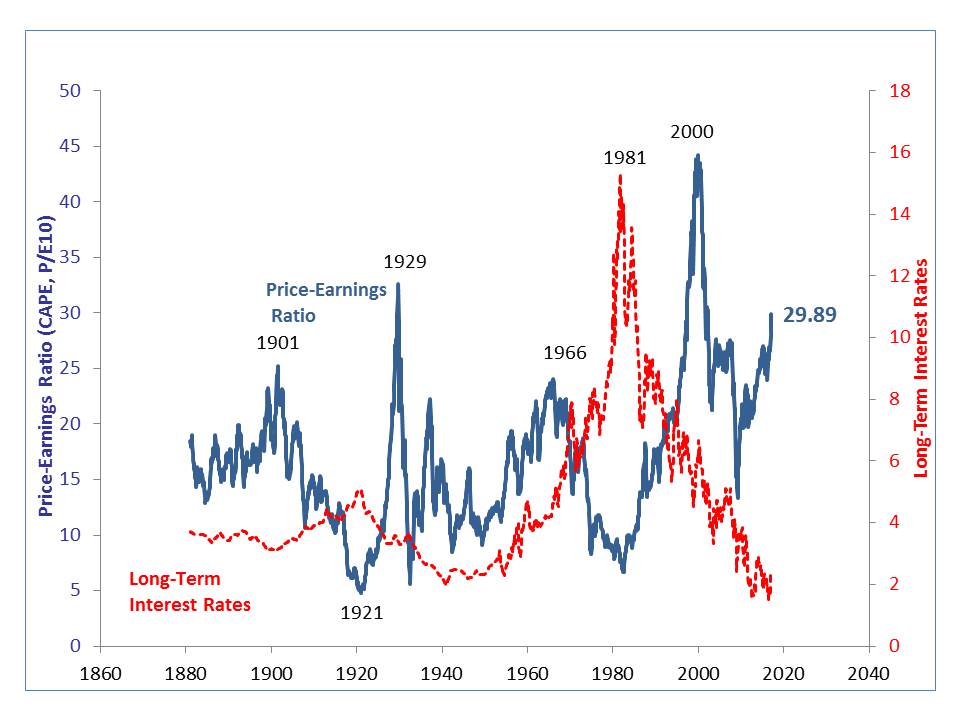
What may be more important is that in periods of stability interest rates trend higher or lower for long stretches of time. The chart below “blocks” those periods when the inverse correlation was followed.
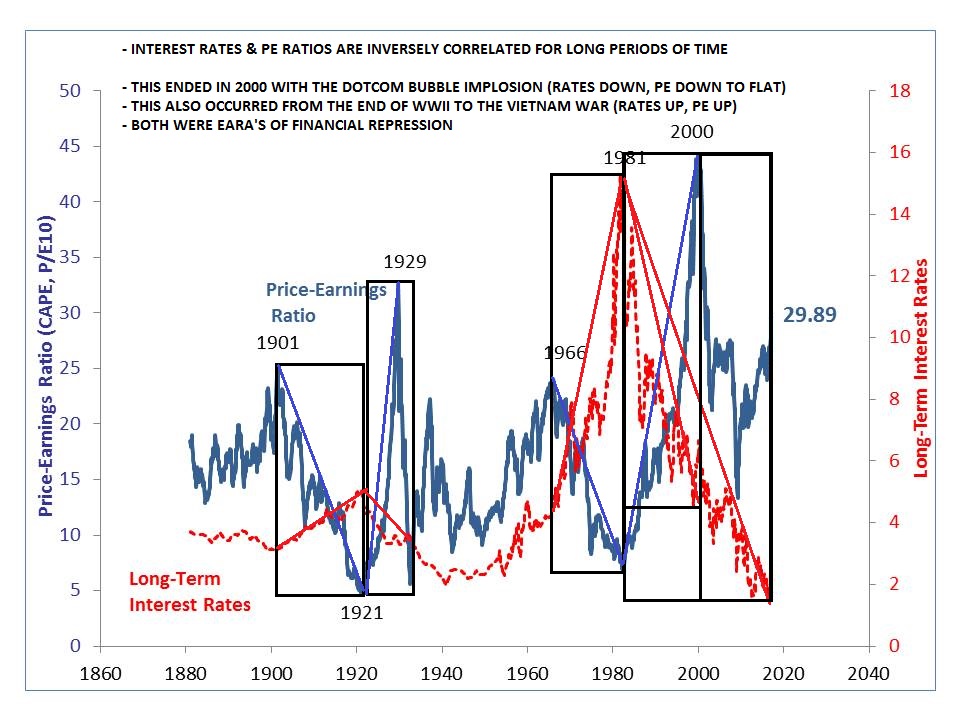
You will notice above that there are two periods when interest rates and the Shiller CAPE were not inversely correlated but followed the same direction:

  1. The 1930’s through to the Vietnam War.
  2. After the Dotcom Bubble in 2000 through to the 2008 financial crisis.

What we know about these two eras is that Macroprudential policies of Financial Repression were followed by the US Federal Reserve to address excessive government debt buildup as well as a period of very slow to contracting economic growth.

Following 2008 the Shiller CAPE and Long Term Interest Rate ratio appears on the surface to have established its inverse relationship.

Does this mean Financial Repression has ended  or is the expansion in PE’s since 2008, while rates fell,  something else and in fact we are still in an Era of Financial Repression which will continue for an extended period into the future? Our chart correlation appears to become somewhat confusing?
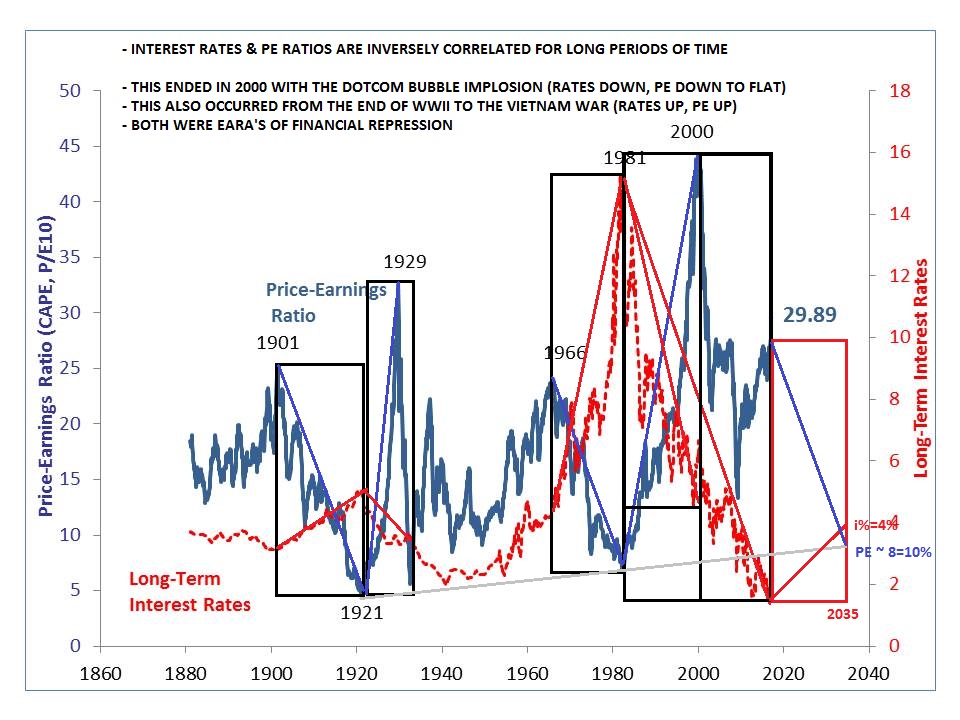
The way to clarify where we are and what is likely to unfold is to consider the Shiller CAPE in isolation. When we do this it is pretty evident that we are very close or approaching a top and subsequent reversal in expansions in the Shiller CAPE

If this is the case, then it suggests the Federal Reserve will soon ‘lose out’ to market or political forces in controlling Financial Repression policies regarding interest rate policy. The grey trend lines below suggest major secular waves are hard for central bankers to overcome.
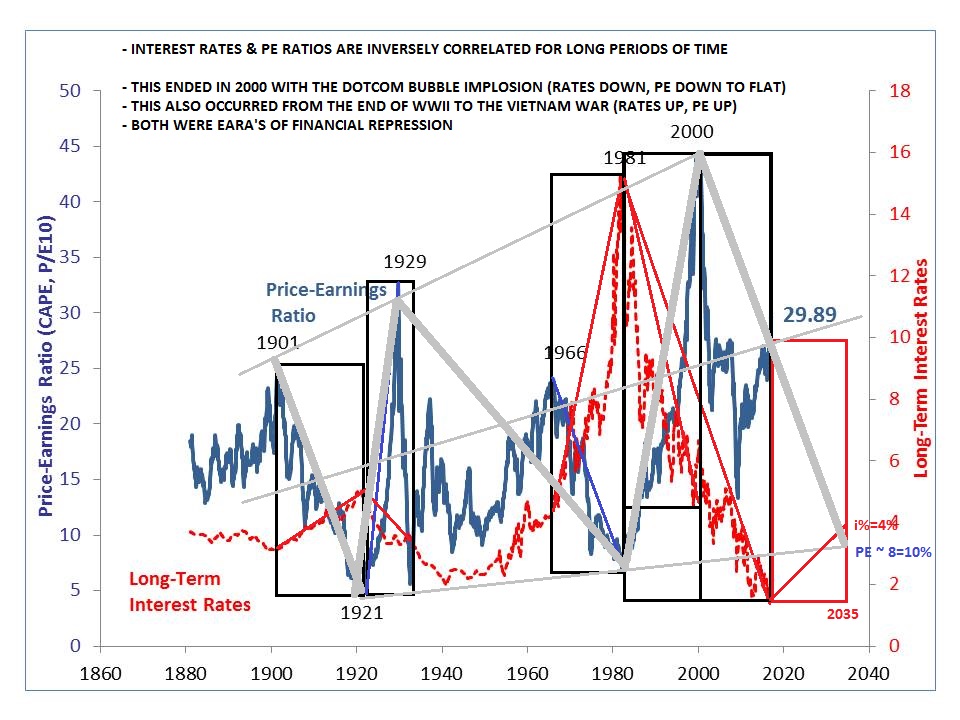
Our Financial Repression interviews with cycle experts such as Harry Dent and Martin Armstrong,  as well examination of the Kondratieff Cycle, suggests this to likely be the case.
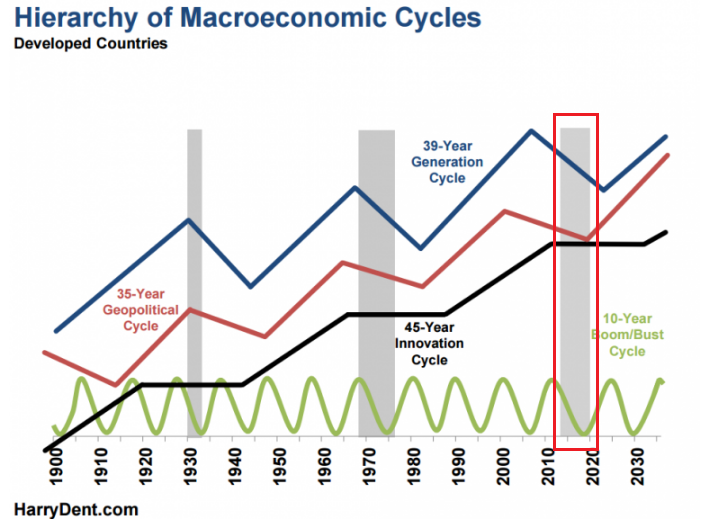
The chances are now high that by 2020 when most of our long cycles reverse that the gig will be up for the central bankers!

This also correlates with the end of the Trump administrations first term who clearly have issues with the role of the Federal Reserve as they begin to assume power.

The charts suggest that the Shiller CAPE may possibly begin a return to its historical levels of 8-10% while Long Term Interest rates move towards their  more historical norms of 4%

Maybe we are simply reading too much into the charts but it is an interesting set of correlations to consider during this period of maddening market messages!

Disclaimer: The views or opinions expressed in this blog post may or may not be representative of the views or opinions of the Financial Repression Authority.


02/25/2017 - Yra Harris Warns Of Massive Global Slowdown If U.S.$ Appreciates 20% On Top Of A 20% Border Adjustment Tax

Disclaimer: The views or opinions expressed in this blog post may or may not be representative of the views or opinions of the Financial Repression Authority.

02/22/2017 - Satyajit Das: Financial Engineering Is Masking The Global Economy’s Precarious Health

“It is time that businesses and governments focus on helping the real economy to solve large problems including debt, lack of growth, industrial stagnation, slowing innovation and productivity, aging demographics, income inequality, resource scarcity, and environmental threats. Financial engineering masks the true performance and health of companies and nations. But the damage goes much deeper, deluding decision-makers into thinking that things are better than they are, and that solutions to problems can be deferred.”

LINK HERE to the essay

Disclaimer: The views or opinions expressed in this blog post may or may not be representative of the views or opinions of the Financial Repression Authority.


02/22/2017 - Will A Trump Administration Cause Rising Inflation And Rising Interest Rates?

Disclaimer: The views or opinions expressed in this blog post may or may not be representative of the views or opinions of the Financial Repression Authority.


02/14/2017 - Thorsten Polleit: The Major Central Banks Are Coordinating To Provide, As Needed, Unlimited Amounts Of Liquidity To The Financial System

“All major central banks around the world — the European Central Bank, the Bank of Japan, the Chinese central bank, the Bank of England, and the Swiss National Bank — have joined the liquidity swap agreement club. They also have agreed to provide their own currencies to all other central banks — in actually unlimited amounts if needed. It is no wonder, therefore, that credit default concerns in financial markets have declined substantially. Investors feel assured that big banks won’t default on their foreign currency liabilities — as such a credit event is considered politically undesirable, and central banks can simply avoid it by printing up new money .. The close cooperation and coordination among central banks under the Fed’s tutelage amounts to an international cartelization of central banking — paving the way toward a single world monetary policy run by a yet to be determined single world central bank .. The Fed’s policy has made the world’s financial system addicted to ever greater amounts of US dollars, easily accessible and provided at fairly low interest rates. From this the US banks benefit greatly, while average Americans bear the brunt: they pay the price in terms of, for instance, boom and bust and an erosion of the purchasing power of the US dollar .. Ludvig von Mises’s sound money principle calls for ending central banking once and for all and opening up a free market in money. Having brought to a halt political globalism for now, the new US administration has now also a once in a lifetime chance to make the world great again — simply by ending the state’s monopoly of money production. If the US would move in that direction — ending legal tender laws and giving the freedom to the American people to use, say, gold, silver, or bitcoin as their preferred media of exchange — the rest of the world would most likely have to follow the example.”

Dr. Thorsten Polleit, Chief Economist of Degussa, Honorary Professor at the University of Bayreuth, and Partner of Polleit & Riechert Investment Management.

LINK HERE to the essay

https://mises.org/blog/what-will-trump-do-about-central-bank-cartel

Disclaimer: The views or opinions expressed in this blog post may or may not be representative of the views or opinions of the Financial Repression Authority.


02/12/2017 - Jim Rickards: Real Assets Can Mitigate Risks During Financial System Lockdown Periods

“Central banks have printed so much money already, it’s not obvious that they can do it again from the current levels without destroying confidence in the dollar, and all major currencies. The question is, where will the liquidity come from in the next financial crisis if it can’t come from the central banks? The answer is the IMF. The International Monetary Fund has the only clean balance sheet out of the major financial institutions. It can print money. They call it the SDR, the Special Drawing Rights. I call new world money .. When it comes time for the IMF to issue world money (SDRs) to reliquify the world, there’s going to be a negotiation period. It will to take months to complete. During the last crisis this took 11 months. That was when the crisis hit in September, 2008 we saw Lehman Brothers hit a crisis, the IMF began to issue SDRs in August 2009 .. Even though they react on a case basis, it’s going to take, an estimated 3 or 4 months at least to get SDRs issued. In that interim period between the crisis and the time the IMF can react, central banks will be paralyzed. They’re likely going to lock down the system.

When I say lock down, they’ll start with money market funds. I can’t think of a greater misnomer than the money market funds .. If you lock down money market funds, people are just going to take their money out of the banks. Then you’re going to have to close the banks. Then people are going to sell their stocks, then you’re going to have to close the stock market. Every time you shut one path to liquidity, people are going to turn to another path.”

LINK HERE to the essay

Disclaimer: The views or opinions expressed in this blog post may or may not be representative of the views or opinions of the Financial Repression Authority.


02/12/2017 - Danielle DiMartino Booth: An Insider Exposes The Fed

Danielle DiMartino Booth, former analyst at the Federal Reserve Bank of Dallas, has just released the book Fed Up: An Insider’s Take On Why The Federal Reserve Is Bad For America.

The Federal Reserve is controlled by 1,000 PhD economists .. The Fed continues to enable Congress to grow  the U.S.’s ballooning debt and avoid making hard choices, despite the high psychological and monetary costs. And the addiction to the “heroin” of low interest rates is pushing America’s economy towards yet another collapse ..

“That’s the trillion-dollar question. We didn’t used to call it that did we? We used to call it the million-dollar question. But it’s now the trillion-dollar question. The punditry up there will tell you that The Fed has been in tightening mode since the taper began several years ago, but I say hooey to that. What we have today is absolute fungibility with central bank purchases on a global basis. You’re talking about something upwards of $200 billion every single month. What the global bond market now revolves around, and relies upon, is the assumption that somebody somewhere will be conducting quantitative easing. As long as they do that, we’re operating in a bond market that is assuming that every single bond purchased by a central bank globally has been expired permanently .. You’re taking supply out of the system, which is the only thing that could get you to justify where bond yields are and, therefore the mirror image of that, where bond prices are, which is at record highs or close to record highs. That I think is at the crux of central bankers’ global dilemma. The first central bank that even hints that they are going to reduce the size of the balance sheet or even worse, sell off a single bond, it is game over at that point for the world bond market.”

On The Ticking Pension Time-Bomb: “The problem with pensions is that the sins are compounding over time. They are piling up. Every single fiscal year that goes into the history books with a 6%+ gap between what was assumed versus what was returned piles on to the next year of equal, if not worse, relative underperformance .. You’re talking about having to make up for all of that lost time, but in spades — at multiples of what the current rate of return assumptions are. Going forward, on an ongoing basis for years to come. Which is highly unrealistic when you are staring down the barrel of an almost 40-year bull market in bonds and the second longest bull market in US history. The assumptions are simply Herculean in magnitude and impossible to achieve. That’s why you’re seeing rate of return assumptions begin to come down. This is all good, fine and well until you completely square the circle and understand that every time a municipality or a state pension plan reduces their rate of return assumptions, some entity, whether it be the state, the school district, some entity has to write a bigger check in order to make up for the cash flow that is no longer being assumed in by the actuaries via rate of return investments. It doesn’t work. You can’t do it for very long when you’re not bringing money in as a state municipality.”

Disclaimer: The views or opinions expressed in this blog post may or may not be representative of the views or opinions of the Financial Repression Authority.


02/11/2017 - Alasdair Macleod: Central Banks Are Creating Economic Distortions & Inequalities

“Central banks must be increasingly aware that critics of monetary policy are getting some traction in their arguments, that not only have monetary policies failed in their objectives, but they are creating counterproductive economic distortions as well. Chief among these is the transfer of wealth that comes with monetary debasement .. An expansionary monetary policy rewards spendthrifts and penalizes savers. The benefits and costs are distributed unevenly, and are economically and socially disruptive. We have moved a long way from the Keynesian concept of deficit spending being limited to when the economy appears to be failing. Today, intervention has become continual, with the emphasis on monetary policy. Inevitably, the consequences must be distributional, otherwise the policy would not have been embarked upon in the first place .. The headline statement, that there is little or no evidence that monetary policy since 2008 has contributed to social inequality, is misleading, and deflects blame for society’s ills away from monetary policy. The implication is blame must lie with fiscal policy or free markets themselves. And while central banks and finance ministries apportion responsibility for policy failure, it never occurs to either party that ordinary people do far better running their own lives with sound money.”

LINK HERE to the essay


Disclaimer: The views or opinions expressed in this blog post may or may not be representative of the views or opinions of the Financial Repression Authority.


02/09/2017 - McAlvany Commentary On The Uncertainty Hedge

The “Uncertainty Hedge” Gold up 6.6% so far this year. Stock Market Price/ Earnings Alarm sounds…Highest since Tech Stock Bubble. Hussman says stocks are Overvalued, Overbought & Over-Bullish… sees 50% possible drop.

Disclaimer: The views or opinions expressed in this blog post may or may not be representative of the views or opinions of the Financial Repression Authority.


02/09/2017 - Bill Gross On The Financial Methadone Provided By Central Banks

“What’s wrong with financial methadone? What’s wrong with a continuing program of QEs or even a rejuvenated U.S. QE if needed? Well conceptually at first blush, not much. The interest earned on the $12 trillion is already being flushed from central banks back to government fiscal authorities. One hand is paying the other. But the transfer in essence means that monetary and fiscal policies have joined hands and that the government, not the private sector, is financing its own spending. At an expanding margin, this allows the private sector to finance its own spending and fails to discriminate between risk and reward. $600 billion in the U.S. for instance goes into the repurchase of company stock, whereas before, investment in the real economy might have been a more lucrative choice. In addition, individual savers, pension funds, and insurance companies are now robbed of the ability to earn rates of return necessary to maintain long-term solvency. Financial Armageddon is postponed as consumption is brought forward and savings suppressed and deferred .. While a methadone habit is far better than a heroin fix, it has created and will continue to create an unhealthy capitalistic equilibrium that one day must be reckoned with. Yields will likely gradually rise (watch 2.60% on the 10-year Treasury), yet they will stay artificially low due to the kindness of foreign central bank quantitative easing policies. But that is not a good thing.”

LINK HERE to his Outlook

Disclaimer: The views or opinions expressed in this blog post may or may not be representative of the views or opinions of the Financial Repression Authority.