05/05/2017 - Chris Whalen: Investment World Is Skewed By The Latest Round Of Monetary Policy Experimentation By The Fed

“We live in an age of asset bubbles rather than true economic growth. The investment world is skewed by the latest round of monetary policy experimentation by the Fed, including years of artificially low interest rates and trillions of dollars in ‘massive asset purchases,’ to paraphrase former Fed Chairman Ben Bernanke .. These bubbles are caused and magnified by supply constraints, not an abundance of credit. Whether you look at US stocks, residential homes in San Francisco or the dollar, the picture that emerges is a market that has risen sharply, far more than the underlying rate of economic growth, due to a constraint in the supply of assets and a relative torrent of cash chasing the available opportunities .. Likewise with the dollar, the image of the financial markets is one of constraints rather than policy ease. Since the middle of 2014, the value of the dollar against major currencies has risen sharply, suggesting a shortage of liquidity or at least a relative preference for dollars vs other fiat currencies .. Regards the prospect of a dollar drop, Megan Greene tells us on Twitter that ‘Only way I see it in the short-run is if everyone else gets in trouble and the Fed opens swap lines w other CBs to supply QE #unlikely’ .. We hear all of that, but can’t help but ask the question. All things do come to an end, including the seeming ability of the FOMC to painlessly levitate the fortunes of heavily indebted nations on a sea of easy dollar credit. This works really well when the dollar is strong, otherwise not so much.”


LINK HERE to the article

Disclaimer: The views or opinions expressed in this blog post may or may not be representative of the views or opinions of the Financial Repression Authority.


05/04/2017 - Kyle Bass: “All Hell Is About To Break Loose” In China

Danielle Park: “Advised and led by their US trained finance types, China has followed the same hide-your-debts-playbook that brought down Enron, Worldcom and global financial markets in 2001-03, as well as Bear Stearns, Lehman and global markets again in 2007-09. The difference this time is the unprecedented scope and scale: China is a whole country, the world’s largest population and the second largest economy. The main benefactor of credit-fueled cash flows from the west over the past 15 years, China forgot that credit expansion is a finite cycle and spent like a drunken sailor throughout. Now it’s left holding a leverage on leverage bomb of unprecedented proportions, with sketchy debts oozing out of every crack and crevice .. We should expect that the liquidity and solvency problems there will be felt though highly connected world markets. This is a necessary part of the great cleanse and reset so needed to reboot asset prices and the economy. So, long-run positive, but short to medium term dangerous for capital.”

LINK HERE to the article

Kyle Bass: “Some of the longer-term assets aren’t doing very well .. As soon as liabilities have problems – meaning the depositors decide to not roll their holdings – all hell breaks loose.” .. The wealth management products, or WMPs, have swelled to $4 trillion in assets in the last few years, he says., on a $34 trillion banking system .. “Think about this – in the US, our asset-liability mismatch at the peak of our subprime greatness was around 2%! … China’s mismatch is more than 10% of the system.”

LINK HERE to the article

Disclaimer: The views or opinions expressed in this blog post may or may not be representative of the views or opinions of the Financial Repression Authority.


05/01/2017 - Former Federal Reserve Chairman Alan Greenspan: What Is Trump Going To Do When Inflation Hits

Greenspan thinks U.S. President Donald Trump has a math problem with his budget .. Greenspan says that interest rates will have to rise because of very large budget deficits if big programs are not cut .. Interest rates and inflation will go up right along with it.

LINK HERE to the article

Disclaimer: The views or opinions expressed in this blog post may or may not be representative of the views or opinions of the Financial Repression Authority.


05/01/2017 - Frank Shostak: Central Bank Policies Are Leading To Economic Instability

“Increases in money supply lead to a redistribution of real wealth from later recipients, or non-recipients of money to the earlier recipients. Obviously this shift in real wealth alters individuals demands for goods and services and in turn alters the relative prices of goods and services .. Central bank policy amounts to the tampering with relative prices, which leads to the disruption of the efficient allocation of resources.”

LINK HERE to the article

Disclaimer: The views or opinions expressed in this blog post may or may not be representative of the views or opinions of the Financial Repression Authority.


04/30/2017 - Hedge Fund CIO Eric Peters: What Central Banks Have Done Is “Stunning, Unprecedented”

“Since 1955 we’ve experienced uninterrupted annual inflation. It’s a stunning fact, unprecedented. To an economist in 1955, the coming 60yr inflation would have appeared less probable than a catastrophic meteor impact .. We created history’s greatest volatility-suppressing machine, and it delivered breathtaking stability .. Minsky taught us that stability begets instability. And it stands to reason that our volatility-selling machine will break one day. We saw a glimpse of this in 2008-09 .. But volatility suppression at the lows is much easier in many ways than at the highs. In a crisis, our central banks simply go full-throttle. At the highs though, they seek the unattainable, which is perfect economic balance in a world that is inherently unstable – they attempt to crystallize the entire ecosystem. Which is as arrogant as it is impossible.”

LINK HERE to the article

Disclaimer: The views or opinions expressed in this blog post may or may not be representative of the views or opinions of the Financial Repression Authority.


04/28/2017 - David Rosenberg: The Bond Market Is Reacting To The Facts On The Ground

The stock market is at a critical juncture, and it may be time reduce risk, strategist David Rosenberg says .. He predicts economic growth will slow even more as the Federal Reserve resumes its tightening policy.

“The reckoning will be which market has the story right: Is it the stock market that is de facto pricing in double-digit earnings growth or is it the Treasury market with the 10-year yield at 2.3 percent? .. The bond market is really pricing in a completely different nominal GDP growth world .. The bond market is actually reacting to the facts on the ground. The facts on the ground are this: Year-over-year growth on a nominal GDP cycle already peaked at 4.9 percent. We have never before in the post-World War II period ever have seen year over year nominal GDP growth peak below 5 percent. That happened two years ago.”

LINK HERE to the article

Disclaimer: The views or opinions expressed in this blog post may or may not be representative of the views or opinions of the Financial Repression Authority.


04/28/2017 - Governments Keep Spending, Now Addicted To Cheap Interest Rates

“This is a confidence game .. Back in 2007, the Fed only had to worry about its policy and the contracting economy. The problem they created is that government just keeps going like the Energizer Pink Bunny – it never stops spending regardless of the level of interest rates .. The Fed cannot neutralize the fiscal spending of government .. Government has become addicted to cheap interest rates. If rates go back just to 5%, we are looking at a fiscal deficit explosion the Fed cannot overcome .. The crisis has to hit before a politician would ever act. Once the crisis begins, you cannot restore confidence. The whole thing will have to play out. Moreover, the crisis in Europe helped to send capital to the USA easing the economic pressure here. This is why the USA is holding up the entire world economy right now and a stiff wind will blow over the European banking system. I seriously doubt that anyone can stop the next crisis and whatever they do will then be seen as a failure.” – Martin Armstrong

LINK HERE to the article

Disclaimer: The views or opinions expressed in this blog post may or may not be representative of the views or opinions of the Financial Repression Authority.


04/28/2017 - Incrementum Advisory Board Meeting Minutes: Central Bankers Cannot Afford To Let Risk Assets Decline

Heinz Blasnik:
“If I may add a quick point, I’m not actually as long-term bearish on gold as Frank. I’m just saying that many of the short-term macro economic drivers for gold do not look supportive, but the gold price is strong anyway. And I believe that these macro economic factors will probably become supportive in the not too distant future and that the market is already discounting this view. So I’m actually quite positive on the gold price in the medium to long-term. And I’m not even negative in the short term because the demand is there and the price is holding up. There is one more aspect to this, the assets that are most vulnerable to a sharp slowdown in credit and money supply growth are stocks and junk bonds because these assets have become the most expensive on the back of the expanding money supply. And if there is upheaval in these risk assets we will have problems in the banking system and regardless of what the money supply is doing people will look to gold because it’s the one asset that is not dependent on promises and is an effective hedge against trouble in the banking system.”

LINK HERE to download the Meeting Minutes


Disclaimer: The views or opinions expressed in this blog post may or may not be representative of the views or opinions of the Financial Repression Authority.


04/28/2017 - Dr. Albert Friedberg: Bullish On Risk Assets, Federal Reserve Will Only Shrink Its Balance Sheet When It Sees Accelerating Inflation

LINK HERE to the Quarterly Conference Call – MP3 Podcast

**********************************

From the Quarterly Report

“In sum, we see a global expansion gathering strength and being liberally financed by politicians, politically influenced bankers and academics with little feel for reality. It is these academics who are now floating the idea of raising the inflation target to 4% from 2% on the pretext that it will be easier to achieve negative real rates without having to breach the zero-interestrate bound — the next time they are called on to save the world!

There is good reason to believe, then, that we are still early, that the bull is proceeding as it always has, confounding the great majority of experts, defying the well-armed but uncritical skeptics and taking its sweet time. So what is needed is patience (don’t switch lanes — you will always regret it), blindness and deafness (to experts’ concern about valuations, presumed political gridlock, Brexit, etc.) and discrimination (persist with active managers, for their time has come).”

LINK HERE to the latest Friedberg Quarterly Report

Disclaimer: The views or opinions expressed in this blog post may or may not be representative of the views or opinions of the Financial Repression Authority.


04/27/2017 - Macquarie’s Research Team: Financial Repression Is Here To Stay As Governments Run Out Of Options

“Today’s financial repression is set to last for decades (and possibly forever) as policymakers are seeking to keep government funding costs low .. – that’s according to a new report from Macquarie’s economics research team. Since the financial crisis, central banks around the world have embarked on an unprecedented monetary policy experiment. Interest rates have been pushed down to artificially low levels in an attempt to stimulate economic growth and stave off a deep financial depression. Unfortunately, while these policies have worked to some degree, they have also punished savers. This is the very definition of financial repression .. Macquarie argues that governments have made an implicit fiscal policy choice by pursuing this strategy .. Artificially low-interest rates have imposed a tax on savings while at the same time keeping funding costs low, allowing for more borrowing on favorable terms. With this being the case, the analysts argue that rather than signaling a global slump, low bond yields reflect a conscious policy choice to minimize public debt funding costs .. As Macquarie’s analysts point out, financial repression is a headwind to real GDP growth as it involves a transfer of wealth from savers to debtors (in this case the government). Japan is a real-life example of how ineffective this policy really is. Savers have responded to financial repression by increasing the household savings ratio, which has resulted in weekly consumption growth and anemic economic growth.”

LINK HERE to the article


Disclaimer: The views or opinions expressed in this blog post may or may not be representative of the views or opinions of the Financial Repression Authority.


04/26/2017 - Dr. Marc Faber: Indebted Western World Economies Are More Fragile Than Ever Before

Marc Faber thinks there will be 20 – 40% pull back in the markets, we are still in the Trump euphoria stage. He goes on to say that Trump will beg Janet Yellen not to raise interest rates and to keep on printing. Tax reform will not really help the U.S. The U.S. and western economies are terminally sick. The Debt loads are huge and the economic conditions are more fragile than ever before.

Disclaimer: The views or opinions expressed in this blog post may or may not be representative of the views or opinions of the Financial Repression Authority.


04/24/2017 - John Mauldin On The Pension Fund Crisis

“Many, perhaps most, current city and state workers simply aren’t going to get anything like the pension
benefits they have been led to expect” .. Fred Sheehan: ‘We are promised… is the haphazard refrain often encountered when the reduction of pension claims is mentioned. Promised or not, one distinguishing feature of non-federal government spending commitments stands out: only the United States has a printing press. States cannot print money. They can earn returns on their pensions’ invested assets, they can sell city hall, lay off the public works department, and tax, but an underfunded pension plan can only pay claims with dollars that exist.’ .. This list of options is actually too generous. Sell city hall? That presumes someone will buy it. Lay off the public works department? Not good for property values. Raise taxes? Right, on all the people in those houses without sewage service .. Repeat Sheehan’s last line and burn it into your brain: ‘An underfunded pension plan can only pay claims with dollars that exist.’ No one gets anything if the money isn’t there, and in a disturbing number of places it isn’t.

We know that pension plans typically have only 40–50% of their assets in equities, something like 40% in bonds, and the rest in real estate and alternative asset classes. How do you get 8% from that mix? Keeping 40% in bonds at 3% (if you’re lucky) means everything else has to make 15%. Marc Faber, who is even better at scaring people than I am, points out something that should be obvious but apparently is not: Pension plan funding ratios have been declining even as financial markets have posted impressive gains: ‘I find the deteriorating funding levels of pension funds remarkable because post-March 2009 (S&P 500 at 666) stocks around the world rebounded strongly and many markets (including the US stock market) made new highs. Furthermore, government bonds were rallying strongly after 2006 as interest rates continued to decline sharply.’

Like state and local pension obligations, US federal government pension obligations are also basically unfunded. They are expected to come from future tax revenues. Those obligations are the bulk of the over $100 trillion in unfunded liabilities that show up in the estimates of how much the United States is really in debt. That money is going to have to come from somewhere. But just as the United States will never default on its actual debt, I truly don’t believe we will default on US government pension obligations.”

LINK HERE to the article

Disclaimer: The views or opinions expressed in this blog post may or may not be representative of the views or opinions of the Financial Repression Authority.


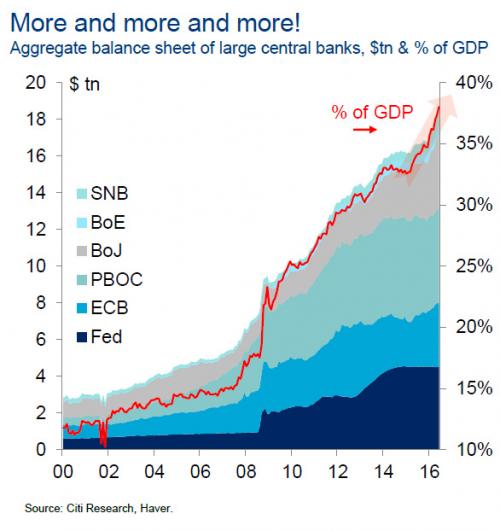
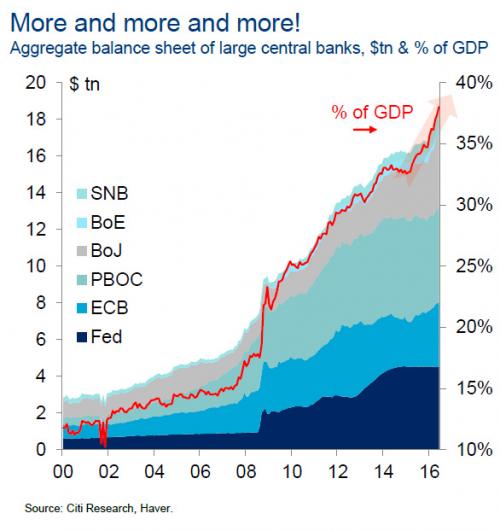
04/23/2017 - Central Banks Have Bought A Record $1 Trillion In Assets In 2017

LINK HERE to the article and source of images

Disclaimer: The views or opinions expressed in this blog post may or may not be representative of the views or opinions of the Financial Repression Authority.


04/23/2017 - Accommodative Monetary Policy Is Encroaching On Fiscal Policy

“We believe that the ECB is presently using monetary policy in effect to conduct fiscal, as well as monetary policy. Elected politicians should be up in arms; that they are not would imply either that they do not understand this or that they simply accept it. This may provide an interesting pointer as to the future of the EU itself .. Private-asset QE purchases by the ECB is a big deal, because the selection and execution of these asset purchases benefits some elements of the private sector at the expense of others .. The absence of any objection from the vast majority of eurozone governments implies acceptance of this usurpation of power by the ECB. Perhaps this portends a pathway to federalization among those countries (unlikely to include Germany) who have chosen happily to acquiesce.”

by ,

LINK HERE to the article

Disclaimer: The views or opinions expressed in this blog post may or may not be representative of the views or opinions of the Financial Repression Authority.


04/23/2017 - Allianz’ Mohamed El-Erian On Financial Repression

Mohamed El-Erian, chief economic adviser at Allianz SE and a Bloomberg View columnist, discusses global economic risks with Tom Keene and Francine Lacqua at the IMF and World Bank meetings. (Source: Bloomberg)

Disclaimer: The views or opinions expressed in this blog post may or may not be representative of the views or opinions of the Financial Repression Authority.


04/21/2017 - Alan Greenspan: Stagflation Is Here And Rising, “It’s A Fiscal Issue”

Former Fed Alan Greenspan discusses U.S. entitlements growing 9% a year and that no one wants to attack that. On Stagnation he says we have a slow growth economy where you end up with inflation and slow growth just like the 70s.


Disclaimer: The views or opinions expressed in this blog post may or may not be representative of the views or opinions of the Financial Repression Authority.


04/21/2017 - Adam Andrzejewski: The Open-Government Movement – How Posting All Public Spending Online Can Transform U.S. Politics

“Sunlight is said to be the best of disinfectants; electric light the most efficient policeman,” wrote Louis Brandeis in 1914. Today, the Freedom of Information Act and internet make it possible to post online all spending at the federal, state, and local levels. This kind of radical transparency can transform U.S. politics.

Since 2011, American Transparency, a nonprofit, has built and operated OpenTheBooks.com, the largest private repository of U.S. public-sector spending. The ultimate goal: post “every dime, online, in real time.” To date, OpenTheBooks.com has captured 3.5 billion government-spending records, including nearly all disclosed federal government spending since 2000; 48 of 50 state checkbooks; and expenditures in 60,000 localities across America.

Disclaimer: The views or opinions expressed in this blog post may or may not be representative of the views or opinions of the Financial Repression Authority.


04/21/2017 - Richard Duncan: The Return Of Crowding Out Threatens Your Wealth

“It has long been understood that when the government borrows excessively, it pushes up interest rates and crowds out the private sector .. the government’s demand for money will exceed the supply of money from capital inflows and Quantitative Easing. The resulting drain of liquidity is likely to put upward pressure on US interest rates and downward pressure on US asset prices .. Crowding out is back. Liquidity is already negative. Any policy that would make it even more negative could cause a very significant correction in the stock market and the property market, where prices are already very stretched. A combination of policies that produced a much larger liquidity drain would almost certainly cause asset prices to CRASH.”

HEADS UP – we just interviewed Richard and the interview podcast will be posted up shortly ..


The Return Of Crowding Out Threatens Your Wealth

Disclaimer: The views or opinions expressed in this blog post may or may not be representative of the views or opinions of the Financial Repression Authority.


04/20/2017 - Patricia Healy: Taxation Of Municipal Bonds In The U.S.? Heavily Indebted Governments Are Desperate For Revenue

“Tax-exempt municipal bonds play an important role in our building of infrastructure – we see the results every day in roads and bridges, airports, mass transit systems and affordable housing, hospitals and universities. Tax exemption results in lower interest expense for issuers, thus reducing property or other taxes and fees for residents .. Some lobbyists have suggested that everything is on the table, including taxation of municipal bonds .. The fear that municipal bond interest will be taxed has been one factor contributing to the muni–Treasury ratio’s being higher than average. Additionally, Treasury bonds may have lower yields than usual due to their attractiveness in a world of low-to-negative interest rates. They may also be benefiting from a flight to quality .. We do not think municipal bonds will lose their tax-exempt status .. If certain deductions are not allowed at the personal and corporate levels, municipal bonds will be one of the few tax breaks that remain. However, it is clear that the exemption is in play and that there are folks fighting hard for its continuation.”

LINK HERE to the article

Disclaimer: The views or opinions expressed in this blog post may or may not be representative of the views or opinions of the Financial Repression Authority.


04/20/2017 - Ontario Canada Announces 15% Tax On Foreign Property Buyers; Saying No To Accepting China’s Capital Outflows

“The government will ban speculators from ‘assignment flipping’ in the pre-construction housing market. The move is targeted at investors who put deposits on multiple units at pre-construction prices — typically in condominiums, but sometimes in new subdivisions — then sell the title for profit before the building is complete, a process known as assignment .. Anyone who buys real estate in Ontario will have to reveal their citizenship and place of residence .. What this really means is that as two of China’s favorite targets of capital outflows shut their doors to more Chinese ‘investment’, the local oligarchs will simply have to find a new willing recipient. We expect that cities along the US West Coast – not to mention Warren Buffett, who as we reported earlier this week is now selling US houses to Chinese buyers – will be more than delighted to greet China’s trillions in capital outflows with open arms.”

LINK HERE to the article

Disclaimer: The views or opinions expressed in this blog post may or may not be representative of the views or opinions of the Financial Repression Authority.