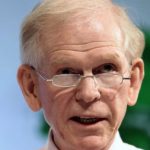
05/25/2017 - David Rosenberg: The Fourth Industrial Revolution Is Having A Profound Impact On Worker Anxiety

“The yield curve is flat enough that if the Fed raises rates four more times, that’s all it takes. We probably will have a recession next year .. Politics, to me, unless it has a substantive impact on the earnings outlook or the economy, is just short-term noise .. What’s happening in terms of artificial, robotic intelligence and the shared economy… Right now, we’re going through the fourth Industrial Revolution, and it’s having a profound impact on worker anxiety .. How is it that we have 23 million Americans between 25 and 54, in their prime working age, that are out of the labor force? .. There’s some real structural things happening here that really transcend the need to cut taxes or what’s happening in terms of immigration policy.”


Disclaimer: The views or opinions expressed in this blog post may or may not be representative of the views or opinions of the Financial Repression Authority.


05/25/2017 - Danielle DiMartino Booth: Beware Of Central Bankers Bearing Gifts

“The bottom line is we still have too much debt and precious little to show for it.

It’s critical to note that Corporate America is also drowning in record levels of debt – nonfinancial corporate debt within a hair of $6 trillion. And though it was nary mentioned in the campaign by either party, at $20 trillion, Uncle Sam himself is up to his eyeballs in hock.

Hopefully you can see Trump’s once in a century chance to reshape the warped thinking inside the Fed. He has the tremendous power to redirect the meme by draining the debt swamp that makes our government beholden to foreign lenders, our corporations less competitive on the global stage and our households seething at their inhibited upward mobility. Talk about Making America Great Again, for ALL Americans.

Without a doubt, this will be one of Trump’s toughest tests, and yes, the Fed can easily take down the stock market in retaliation; they could even follow through on threats to shrink the balance sheet. It would be as if someone flipped a switch and we veered from Quantitative Pleasing to Quantitative Plaguing.

And what politician in their right mind wants plague visited upon their economy on their watch? Ask any of Trump’s predecessors and they’ll shoot you straight. Passing legislation with ultra-easy monetary policy and fluffy stock prices on your side sure as heck beats the alternative.

But in the end, it just buys time, not Greatness.

Artificially low interest rates might be as alluring as that Trojan Horse was to the people of Troy. But let’s put their experience to better use and not dismiss Laocoön’s words as the tragic Trojans did. Let us all Beware of Central Bankers Bearing Gifts.”

http://dimartinobooth.com/beware-central-bankers-bearing-gifts/

Disclaimer: The views or opinions expressed in this blog post may or may not be representative of the views or opinions of the Financial Repression Authority.


05/24/2017 - Charles Hugh Smith On The Ongoing Permanent Keynesian Stimulus To The Economy – The Failure Of The Keynesian Coloring-Book Plan

“What do we call a status quo in which ’emergency measures’ have become permanent props? A failure. The ’emergency’ responses to the Global Financial Meltdown of 2008-09 are, eight years on, permanent fixtures. Everyone knows what would happen if the deficit spending, money-printing, zero interest rates, shadow banking, asset purchases by central banks and all the rest of the Keynesian Cult’s program stopped: the status quo falls apart .. Nothing has worked as the Keynesians expected. Instead, state/central bank measures that were supposed to be temporary are now permanent, and the expansion of private-sector debt has failed to ‘trickle down’ to earnings .. The Keynesian solution—borrowing from future earnings to ‘bring consumption forward’—has expanded consumption at the cost of enormous increases in debt throughout the economy, which has exacerbated income-wealth inequality and declining real incomes .. Can we finally admit that eight years of following the Keynesian coloring-book plan have not just failed, but failed spectacularly, and not just failed spectacularly, but made the economy even more vulnerable and fragile, as more and more future income must be devoted to service the skyrocketing debts? .. Isn’t it obvious that there are deeply structural problems in the economy that inflating yet another credit/asset bubble won’t fix? .. Clearly, the real-world economy does not function like the simplistic Keynesian coloring-book model.”

LINK HERE to the article

Disclaimer: The views or opinions expressed in this blog post may or may not be representative of the views or opinions of the Financial Repression Authority.


05/22/2017 - Russell Napier Fears The Dark Ages Of Government Allocating Resources And Capital To Run The Financial System

“The central banks try to manipulate markets to deliver growth, that’s effectively what they do by manipulating the price of money. If it doesn’t work, then what? Well, it’s pretty straightforward. Well, people the demand the politicians do something, people demand political action. But political action for those people who invest in financial markets means in some way reducing the par of financial markets, reducing the par of price. And yeah, I’ve speak to a lot of people about this. People fear inflation, they fear deflation. I fear something much bigger than that, that the political reaction to this is effectively to go through one of those periods again, what we’ll called ‘dark ages’, where we basically- the politicians can make it and then they run the financial system, or they begin to get directly involved with the allocation of resources and capital and credit and we go back into that, let’s call it the 1950s, 1960s, certainly a in a European context, that type of world is a world that the population demands because they look at central banks and say ‘well you haven’t been able to do this using so-called market forces, so let us use non-market forces.’ So, we’re really dealing with something very existential, here, that this will be a shock to the face and the ability of the market to deliver, not only in the ability of central bankers, but in the ability of the market to deliver in a decided move towards intervention in markets.”

LINK HERE to the transcript

Erik Townsend Interviews Russell Napier:

Disclaimer: The views or opinions expressed in this blog post may or may not be representative of the views or opinions of the Financial Repression Authority.


05/19/2017 - Charles Hugh Smith: Central Planning Based On Central-Bank Inflated Debt-Asset Bubbles Works Until It Doesn’t

“A media mini-industry touts Scandinavia’s ‘happiness’ as the result of its high-tax, generous welfare state-capitalism .. The high-tax, generous welfare model is just as dependent on unsustainable credit bubbles as every other version of state-capitalism .. Take away these unsustainable bubbles, and how ‘happy’ will these economies (or their suddenly impoverished residents) be? Central planning based on central-bank inflated debt-asset bubbles works until it doesn’t. The day of reckoning draws ever nearer in every economy that’s created the illusion of solvency with debt/asset bubbles and export-dependent economies.”

LINK HERE to the article


Disclaimer: The views or opinions expressed in this blog post may or may not be representative of the views or opinions of the Financial Repression Authority.


05/19/2017 - Peter Boockvar: All 5 Major Central Banks Are Going To Turn Off Liquidity

“Some have disagreed with me but I’ve remained steadfast that the post election stock market rally was mostly due to hopes for tax reform and regulatory relief (the Trump put I’ve heard from some) and the positive impact that would have on earnings. I’ve also repeated, likely to your annoyance, that the elephant in the market room in 2017 is that this will be the first year that all 5 major central banks will in some fashion turn off some of the liquidity lights at this party. Thus, the lack of tax and regulatory reform or a watered down version and the tightening of monetary policy would be the two main risks to stocks.”

LINK HERE to the article

Disclaimer: The views or opinions expressed in this blog post may or may not be representative of the views or opinions of the Financial Repression Authority.


05/18/2017 - Jeremy Grantham: Could High Stock Prices Be Here To Stay

“In conclusion, there are two important things to carry in your mind: First, the market now and in the
past acts as if it believes the current higher levels of profitability are permanent; and second, a regular
bear market of 15% to 20% can always occur for any one of many reasons. What I am interested in
here is quite different: a more or less permanent move back to, or at least close to, the pre-1997 trends
of profitability, interest rates, and pricing. And for that it seems likely that we will have a longer wait
than any value manager would like (including me).”

LINK HERE to the PDF

Disclaimer: The views or opinions expressed in this blog post may or may not be representative of the views or opinions of the Financial Repression Authority.


05/18/2017 - HSBC: Cashless Society Is Coming, It Is Just A Matter Of When

“Pomeroy thinks that a cashless society puts another important weapon in the central banker’s toolbox, one that could take negative interest rates to a new dimension. ‘With the removal of cash, the zero-yielding asset, rates could in theory be cut more negatively without some of the limitations that have previously been in place.'”

LINK HERE to the article


Disclaimer: The views or opinions expressed in this blog post may or may not be representative of the views or opinions of the Financial Repression Authority.


05/18/2017 - The World’s Central Banks Are Frozen With Fear

“2016 was supposed to be the year that the Federal Reserve ‘normalized’ its policies. As much as two years ago — after years of a near-zero target rate — the Fed was swearing that it would begin to raise rates back to ‘normal’ levels and cut its balance sheet. That never happened .. Looking at the central banks of Australia, the EU, Canada, Japan, China, and the UK, we find no tightening at all. Since 2012, with the exception of the Fed, it’s been nothing but cuts in the target rate. Excluding the Fed, the last time we saw central banks move was when the Australian central bank and the Bank of England lowered their target rates in August 2016. Meanwhile, the European Central Bank and the Bank of Japan continue to sit in negative territory .. The cumulative effect of all of this is to drive home, yet again, that the central banks are simply too frozen with fear about the true state of the economy to take any hawkish action on interest rates .. the world’s central banks are driving home yet again that we’re in a race to the bottom. Yes, the US is in the midst of an inflationary regime, but the ECB, BOJ, and others appear to have no qualms about keeping their own money spigots wide open.”

LINK HERE to the article

https://mises.org/library/worlds-central-banks-are-frozen-fear

Disclaimer: The views or opinions expressed in this blog post may or may not be representative of the views or opinions of the Financial Repression Authority.


05/16/2017 - David Rosenberg: Investing Around The Latest Trump News? Don’t

Disclaimer: The views or opinions expressed in this blog post may or may not be representative of the views or opinions of the Financial Repression Authority.


05/16/2017 - Michael Pento: Central Banks Are Trapped – Central Bank Crisis Ahead (July 2016)

“As arduous as the path to interest rate normalization will be to the Fed, it will be far more chaotic for the BOJ and ECB to even hint at rate hikes .. By waiting until inflation is well entrenched in the mindset of investors and after pushing sovereign bond yields well into negative territory; the ECB and BOJ have unwittingly backed their sovereign debt markets into death traps. Therefore, even suggesting that it is time to gradually pull back from bond purchases will cause a colossal stampede out of Japanese Government Bonds and European Sovereign Debt .. Traders that have habitually been front-running the central banks’ bids will try to dump their holdings of negative yielding debt as bond prices plunge in response to a 2%–and rising—inflation rate. Throw in debt to GDP ratios that have absolutely soared since the Great Recession of 2008 and the result will be complete chaos in bond markets.”

LINK HERE to the article


Disclaimer: The views or opinions expressed in this blog post may or may not be representative of the views or opinions of the Financial Repression Authority.


05/16/2017 - Capital Controls – The New QE?

“Given the rise of inward-looking and panicked politicians around the globe and the monetary policy extremes after the 2008 crisis, a financial repression via blanket capital control regime could be the policy response to the next crisis. In this process, the global financial system would be totally fragmented, while wealth would be transferred from the private sector to the government. Investors could be caught by surprise; liquidity would evaporate in an instance, with devastating effects for asset prices. In this new paradigm shift, capital mobility will become a thing of the past.”

  • Jason Manolopoulos is the co-founder of Dromeus Capital and author of Greece’s ‘Odious’ Debt

LINK HERE to the article

Disclaimer: The views or opinions expressed in this blog post may or may not be representative of the views or opinions of the Financial Repression Authority.


05/15/2017 - Martin Armstrong: The Coming Central Bank Crisis

“I have warned that whenever a government creates a solution to any crisis, that solution becomes the next crisis. This is what I have called the Paradox of Solution.The unfolding of the exit of the central banks from the Quantitative Easing monetary policy will become a much more serious threat to the financial markets than anyone suspects .. The real problem lies with the European Central Bank (ECB) and the Japanese central bank and when they exit their Quantitative Easing programs, their economies are not the reserve currency and lack a solid bid from international capital. The end of QE will lead to a sharp increase in yields on the bond markets, and thus the financing costs for the states will explode far more rapidly today than at any time in past history. It is also possible that other sectors of the financial system, such as the stock markets and the foreign exchange markets in peripheral economies to the USA, will be cast into turmoil experiencing great difficulties without the financial support of the central banks .. The crisis emerges when governments, who are the ones who have been subsidized since 2008, find no bid for their paper. This will really send rates upward at a rapid pace .. The balance sheets of both the Japanese central bank and the ECB are unlikely to follow the Fed just yet. A withdrawal of the ECB’s purchases of securities could produced the most widespread damage in Europe since the Dark Ages.”

LINK HERE to the article

Disclaimer: The views or opinions expressed in this blog post may or may not be representative of the views or opinions of the Financial Repression Authority.


05/12/2017 - IMF Proposes Capital Levy On Bank Accounts In Europe; Also, IMF Encourages Germany To Raise Property Taxes

“The International Monetary Fund (IMF) .. has told Germany it should raise its property tax, cut social welfare contributions and invest more to reduce income inequality .. The IMF argues for higher taxes on property are in fact necessary and that the government should demand higher wages .. Years ago, Italy simply imposed a tax on money in one’s account. This was called a ‘capital levy’. This was a one-time charge as an exceptional measure to restore the sustainability of the debt. The IMF is also suggesting that measure be invoked to help the coming Sovereign Debt Crisis. .. The IMF has already calculated how much the measure would cost every Eurozone citizen:
‘The amount of the tax would have to bring the European sovereign debt back to the pre-crisis level. In order to reduce the debt to the level of 2007 (for example in the euro area countries), a tax of about 10 percent is needed for households with a positive asset.’ .. As you can see, there is NEVER any discussion about reducing taxes or the size of government. The solution is always to raise taxes and to not even look at the old Italian trick of a 10% seizure of all cash in your account.”

Martin Armstrong

link here to the reference

Disclaimer: The views or opinions expressed in this blog post may or may not be representative of the views or opinions of the Financial Repression Authority.


05/10/2017 - Yra Harris And Rick Santelli: Lessons From Japan & Implications Of France’s Vote

“The global markets have been lulled into an eerie calm–think Minsky—as the recent Dutch and French elections have driven the anti-euro populists back underground. I caution that the economic situation still remains a very serious concern as President Draghi continues to build the ECB balance sheet in an effort to bail-out the fiscally weak states of Italy, Spain, Portugal, France and others. Italy is still a major concern as the non-performing loans plague its domestic banks. Add in that Italy has a debt-to-GDP ratio of 136% and it will take the entire EU to backstop the Italian financial system. I WARN ALL READERS THAT THE GLOBAL DEBT SITUATION IS FAR MORE PERILOUS THAN GLOBAL EQUITY MARKETS REFLECT .. The world’s central banks have been busy adding liquidity to the financial system, which provides the backdrop for a Minsky Moment for complacency in the realm of ZIRP creates instability below the surface. We do not fight markets and therefore have not been sellers of equity markets by battling the power of central bank liquidity creation. But as geopolitics calm markets will return to focus on the fragile financial situation created by mountains of debt.”

LINK HERE to Yra’s related blog post

Disclaimer: The views or opinions expressed in this blog post may or may not be representative of the views or opinions of the Financial Repression Authority.


05/08/2017 - Martin Armstrong: Central Banks Accelerate Buying Of Equities In Efforts To Implement Their Monetary Policies

Martin Armstrong: “I wrote about that explaining that the central banks have been buying equities since 2014. The Swiss National Bank posted its latest 13-F holdings showing it has been buying equities at a stepped up pace during the first quarter 2017. Their total equity holdings have now reached $80.4 billion, up $17 billion from the $63.4 billion at the end of 2016 .. The central banks are trapped. Lowering interest rates to virtually zero reduced their yield on reserves and they cannot sell off government securities. The only viable hedge is US treasuries in the bond world against the chaos of the Eurozone. That offers no diversification just more government debt. The ECB owns 40% of European government debt. The Swiss are buying US equities as a hedge against the Euro and political unrest. This is not manipulation. They lost a fortune trying to maintain the peg the franc with the Euro. They cannot use pegs, so the only alternative to just buying US Treasuries is private equities .. The central bankers understand what our model is warning about. As confidence continues to decline in governments, the central banks can go bankrupt UNLESS they too diversify out of government bonds .. Granted, nobody wants to talk about this yet in public. This is NOT manipulation.”

LINK HERE to the article

Why Central Banks & Buying Equities

Disclaimer: The views or opinions expressed in this blog post may or may not be representative of the views or opinions of the Financial Repression Authority.


05/08/2017 - Dr. Marc Faber: Are High Home Prices [Driven By Repressed Interest Rates] Turning American Millennials Into The New Serfs?

“They are concerned about political correctness, about having the latest-model iPhone and the number of likes their photos receive and how many followers they have on Facebook. But most of all, they are concerned about extracting as much as possible from the government in the form of subsidies and other kinds of benefits. It is a generation that avoids hard work (such as on the factory floor), and is content to work part-time in bars and restaurants, and to live carefree .. It is also the generation whose major contribution to civilization may be the invention of ‘retirement before working’ .. Needless to say, this concept of retirement before working has been fostered and encouraged by governments, which, with their generous transfer payments, make it more economical for some people not to work .. Therefore, compared to the boomers it is only natural and completely understandable that the millennials’ drive for achievement and thriftiness are inferior to the one that their parents had. But can the relative decline of the financial condition of the millennials be satisfactorily explained by their less entrepreneurial spirit? .. ‘The spirit of risk-aversion is also infecting corporate America. The once lavish budgets companies devoted to research and development are now spent on legal compliance and human resources.”

LINK HERE to the PDF

FRA Commentary: The pillars of financial repression like repressed interest rates has resulted in high asset and real estate prices .. this is shaping the views by millennials in many ways – we will explore these ways with Charles Hugh Smith in an interview discussion this week.


Disclaimer: The views or opinions expressed in this blog post may or may not be representative of the views or opinions of the Financial Repression Authority.


05/07/2017 - Alasdair Macleod: International Coordination of Monetary Policies Has Increased The Potential Scale Of The Next Credit Crisis

This article gets to the heart of why central banks’ monetary policy will never succeed. The fundamental error is to regard economic cycles as originating in the private sector, when they are the consequence of fluctuations in credit .. Monetary inflation transfers wealth from savers and those on fixed incomes to the banking sector’s favored customers. It has become a major cause of increasing disparities between the wealthy and the poor .. The credit cycle is a repetitive boom-and-bust phenomenon. The bust phase is the market’s way of eliminating unsustainable debt, created through credit expansion. If the bust is not allowed to proceed, trouble accumulates for the next credit cycle .. Today, economic distortions from previous credit cycles have accumulated to the point where only a small rise in interest rates will be enough to trigger the next crisis. Consequently, central banks have very little room for manoeuver for dealing with future price inflation .. International coordination of monetary policies has increased the potential scale of the next credit crisis, and not contained it as the central banks believe .. The unwinding of the massive credit expansion in Greece, Portugal, Italy, Spain and France following the creation of the euro is an additional risk to the global economy .. Central banks should desist from using monetary policy as a management tool for the economy .. An economy that works best is one where sound money permits an increase in purchasing power of that money over time, reflecting the full benefits to consumers of improvements in production and technology. In such an economy, Schumpeter’s process of ‘creative destruction’ takes place on a random basis. Instead, consumers and businesses are corralled into acing herd-like, financed by artificial credit. The creation of the credit cycle forces us all into cyclical behavior that otherwise would not occur.

LINK HERE to the article

Disclaimer: The views or opinions expressed in this blog post may or may not be representative of the views or opinions of the Financial Repression Authority.


05/07/2017 - Central Banks Injected A Record $1 Trillion In 2017 – “It’s Not Enough”?!

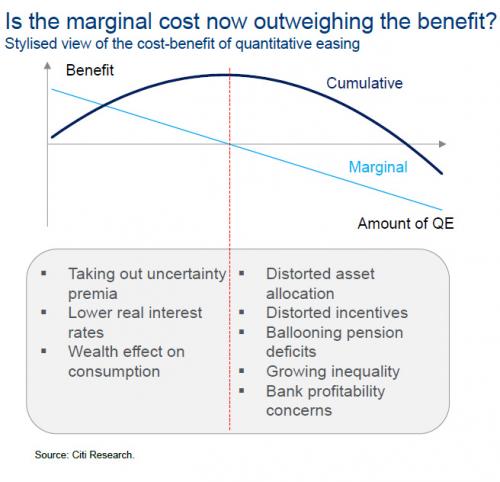
“The latest weekly report by Deutsche’s Credit Strategist Dominic Konstam finds something even more troubling: $1 trillion in central bank liquidity YTD – or roughly $250 billion per month – is not enough .. Konstam’s conclusion is that there are two outcomes: either asset prices drops, or central banks will ultimately be forced to inject even more liquidity .. The bottom line, however, boils down to the following chart first shown by Citi last September, demonstrating that the marginal cost of central bank liquidity injection is now negative…

… and is located in the lower right quadrant, something both markets and policy makers realize.

Which means that when stocks realize just how insufficient the record $1 trillion in central bank liquidity has become, central banks – which have stepped into every single market correction over the past 7 years with some ‘liquidity supernova’ – will, for the first time since the financial crisis – be out of tools… something Janet Yellen appears to have realized some time ago.”

LINK HERE to the article

Disclaimer: The views or opinions expressed in this blog post may or may not be representative of the views or opinions of the Financial Repression Authority.


05/05/2017 - Dr. Thorsten Polleit: The Fed Is Causing A Recurrence Of Boom And Bust

“It is Fed that is causing a recurrence of boom and bust. It initiates a boom through its easy money policy. In an attempt to reign in the excess it has created, the Fed at some point turns the boom into bust. To fight the bust it returns to an excessive monetary policy. The result is not only a volatile economy, but also an unsustainable build-up of ever greater amounts of debt on the part of government, consumers and corporates — making the final bust extremely costly .. The takeaway from the Austrian monetary business cycle theory is this: Either the boom goes on, and interest rates continue to remain at very low levels. Or interest rates move back to normal, and the boom turns into bust. An ongoing boom, accompanied with a return to normal interest rates, however, is the least likely scenario. If the Fed has learned from its most recent past, it wouldn’t be surprising if US interest rates will remain lower for longer.”

LINK HERE to the article

Disclaimer: The views or opinions expressed in this blog post may or may not be representative of the views or opinions of the Financial Repression Authority.