“We have a colossal credit bubble in the world. Can it expand? Yes, but it cannot expand forever. One day there will be a limit and one day there will be another huge crisis because the debt level today is higher than it was in 2007.”


 07/04/2017 - Dr. Marc Faber: There Will Be Another ‘Massive’ Financial Crisis In My Lifetime
 “We have a colossal credit bubble in the world. Can it expand? Yes, but it cannot expand forever. One day there will be a limit and one day there will be another huge crisis because the debt level today is higher than it was in 2007.”
07/03/2017 - Peter Boockvar: Trump Will Perpetuate This Bubble For Political Reasons 07/03/2017 - Dr. Marc Faber: Central Banks Have Fueled A Colossal Asset Bubble Around The World
“I also condemn the ‘monetary madness’ of central banks but I accept that there were then, as there are now, mitigating circumstances.’Monetary madness’ has fueled little consumer goods price inflation, so far, but a colossal asset bubble around the world. The suppression of interest rates (particularly so in Japan and the Eurozone) have also compressed the interest rates on junk bonds to extremely low levels. These securities are bought by investors that are desperate for higher yielding fixed interest securities.
07/03/2017 - Martin Armstrong: The U.S. Stock Markets May Have A Correction But Are Climbing A Wall Of Worry 07/01/2017 - Allianz Global Strategist Neil Dwane: Financial Repression Remains In Place
“Despite reflation optimism, financial repression remains in place and Allianz Global Investors’ long-term view is that global growth can be expected to remain dull, says the firm’s global strategist Neil Dwane .. ‘With low growth and financial repression still plaguing many developed markets, investors need growth potential – which Asia is in a good position to provide, given good valuations, still-positive real interest rates and low sovereign leverage .. Increasing Western populism and trade friction [are] likely to have a smaller impact on Asia, given the growth of intra-regional trade. Moreover, China’s ‘One Belt, One Road’ initiative should, over time, boost economic development throughout the region and across its frontiers. This should increase the size of many markets in Asia, which would give corporations an abundance of choice about where to invest their resources.”
06/29/2017 - Dr. Lacy Hunt: The Federal Reserve Has Undermined The Economy’s Ability To Grow
“Quantitative easing has created a lot of negatives, one of the most glaring is this liquidity which has fueled record leverage of the business balance sheet .. Quantitative easing encouraged a shift from real investment to financial investment. The Fed’s backing your play, engage in financial engineering… buyback shares, raise dividends. The business managers think they can reverse [these actions] .. It’s the investment, the real investment which grows the economy. The Fed has created very significant unintended consequences, which have undermined the US [economy’s] ability to grow and lift the standard of living.”
06/27/2017 - Yra Harris: Maybe The Yield Curves Are Sending A Warning To The Federal Reserve
“Bernanke spoke to in his speech Monday in Sintra, Portugal. Titled, ‘When Growth Is Not Enough,’ Bernanke talked about the rise of antipathy to the existing political elites: ‘If the populist surge we are seeing today has an upside, it is to refocus attention on both the moral necessity and practical benefits of helping people cope with the economic disruptions that accompany growth .. Since 1979, real output per capita in the United States has expanded by a cumulative 80 percent, and yet during that time, median weekly earnings of full-time workers have grown by only 7 percent in real terms. Moreover, what gains have occurred are attributable to higher wages and working hours for women. For male workers, real median weekly earnings have actually declined since 1979. In short, despite economic growth, the middle class is struggling to maintain its standard of living.’ .. Yellen has used her position as Fed chair to discuss stagnant wages but now she is concerned about the sudden desire to squash an incipient rise in wages? Maybe American workers are realizing that too much debt without an increase in wages portends trouble in the near future. The recent flattening may in reality be the market warning the FOMC about raising rates in an effort to halt a beneficial rise in wages, which would help reduce what Bernanke refers to as the ‘SOUR MOOD’ of the developed economies’ electorates. Bernanke’s speech creates a major dilemma for the FED, which has backed itself into a corner by adhering to the antiquated model of NAIRU .. Capital has been absorbing the bounty of Bernanke’s portfolio balance channel powered by QE2 and QE3 in which asset prices have soared while stagnant wages have persisted .. I wonder if the former Fed Chair is warning against raising rates too early. Maybe the YIELD CURVES are sending a similar warning. Maybe the GOLD and DOLLAR are sending a similar signal to the FOMC.”
06/26/2017 - Peter Boockvar: The Global Bond Market Is In A Massive Bubble
06/26/2017 - IceCap: $14 Trillion Of Money Printing, 672 Interest Rate Cuts & Negative Interest Rates Not Enough “Global Stimulus As Thought”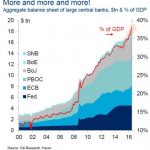
“Whereas the thought that $14 trillion of money printing and 672 interest rate cuts would encourage people to borrow and spend, the thought was that the use of NEGATIVE interest rates would force people to spend … In the end, the combination of steps 1 + 2 + 3 didn’t provide nearly the amount of global stimulus as thought.”
2017.6 IceCap Global Market Outlook by zerohedge on Scribd
06/25/2017 - Former Fed Advisor Danielle DiMartino Booth On Why The Fed Is Bad For America 06/25/2017 - Danielle Park: Central Banks Are Architects Of Global Stagnation And Insolvency
“For the past 20 years, the world has careened from one greater and greater insolvency shock to another. Each time, central banks have been summoned to the ‘rescue’ deploying increasingly more aggressive monetary magic. But after 9 years at near zero rates and trillions in asset buying to extend and pretend the appearance of economic prosperity, reality is dawning once more as the global economy slows and liquidity retreats to reveal even larger debt and sustainability problems.”
Central banks are architects of global stagnation and insolvency
06/25/2017 - Dr. Marc Faber: Massive Wealth Taxation Or Asset Deflation Is Coming
06/16/2017 - Charles Hugh Smith: Debt-Asset Bubbles Implode Either Via Inflationary Collapse Or Via Deflationary Collapse
“When debt-asset bubbles expand at rates far above the expansion of earnings and real-world productive wealth, their collapse is inevitable. The Supernova model of financial collapse is one way to understand this .. Financial supernova collapse has two pathways which we call deflationary and inflationary .. In a deflationary supernova, defaults–and the avoidance of additional debt–are the gravity that overwhelms the forces of expanding debt. Once the losses and risk are visible to all participants, the herd psychology changes, and participants no longer believe that central banks ‘are now the ultimate power in the Universe.’ .. The other pathway to implosion is to print currency with sufficient abandon that debtors have enough money to service their debts. Emitting sufficient new free money to re-set all the unpayable debt destroys the purchasing power of the currency–a supernova implosion that is little different than the deflationary implosion. The inflationary pathway results in the destruction of the currency, impoverishing everyone holding the currency.”
06/16/2017 - Satyajit Das: Policy Makers Are Using Financial Engineering In An Attempt To Maintain Economic Growth
“Rather than reducing high borrowing levels, policy makers use financial engineering, such as quantitative easing and ultra-low or negative interest rates, to maintain them, hoping that a return to growth and just the right amount of inflation will lead to a recovery and allow the debt to be reduced. Rather than acknowledging that the planet simply can’t support more than 10 billion people all aspiring to American or European lifestyles, they have made only limited efforts to reduce resource intensity. Even modest attempts to deal with environmental damage are resisted, as evidenced by the recent fracas over the Paris climate agreement. Short-term gains are pursued at the expense of costs which aren’t evident immediately but will emerge later.”
06/15/2017 - Proposed New Regulation Against Cash, Bitcoin And Ether
“The bill also attempts to drop a major bomb on Bitcoin by including it in the list of monetary instruments that must be reported when entering or leaving the US.”
LINK HERE to the proposed regulation
06/15/2017 - James Grant On The History Of Interest Rates & The State Of Markets
James Grant reflects on the History of Interest Rates, the State of Markets, and the Future of Finance .. About the Interview: We stop to remember a time, in which the extraordinary measures and unprecedented actions of our monetary and fiscal authorities would have seemed unimaginable. We take a hard look at money. How does this shadow of wealth find its value? How is the rate of interest determined, and what is the role of financial markets in facilitating the discovery of that value? What happened, in 2008 and what are the consequences, realized and yet to be discovered, of those very extraordinary and unprecedented actions taken by governments around the world to douse the flames of deflation? What was done in order to contain the contraction and to prevent the discovery of prices? What does the future hold in 2017, what investments does one make and where might one find opportunity in these oceans of uncertainty.
http://marketsanity.com/james-grant-reflects-history-interest-rates-state-markets-future-finance/
06/15/2017 - Bundesbank’s Weidmann: Digital Currencies Will Make The Next Crisis Worse
“Essentially, Weidmann warned that digital currencies – whose flow can not be blocked by conventional means – make an instant bank run far more likely, and in creating the conditions for a run on bank deposits lenders would be short of liquidity and struggle to make loans.”
06/14/2017 - McAlvany Podcast: Will The Free Market Ever Exist Again?
This week a discussion on the manipulated “free market” and if it will truly ever be free again. Central Bank “Buying” of Securities at $300 Billion Per Month!
06/13/2017 - Charles Hugh Smith: The Path To Inflation – “Helicopter Money” “We all know real-world inflation for big-ticket expenses is far above the official rate of around 2% annually .. Yet conventional economists are virtually unanimous that deflation is the danger and inflation is a ‘good thing’ we need to spur so servicing existing debt becomes easier for debtors. Due to the deflationary pressures of technology and stagnant wages for the bottom 90%, the consensus sees low inflation as far as the eye can see. When the consensus is near-100% on one side of the boat, we can safely bet Reality will not conform to expectations. This leads to a question: what could cause official near-zero inflation to surprise the consensus and leap higher? One possible answer is ‘helicopter money’: money created by central banks that is distributed directly to households .. To fund ‘helicopter money,’ governments will have to borrow trillions more from central banks. If this flood of new money pushes inflation higher, the interest rates governments will pay on future ‘helicopter money’ will rise .. The general view in inflation is dead, essentially forever. Maybe. Maybe not.”
06/13/2017 - “Nothing Else Matters”: Central Banks Have Bought A Record $1.5 Trillion In Assets In 2017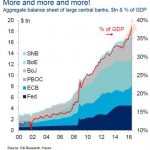
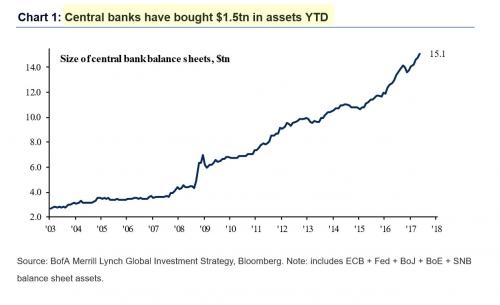
“One month ago, when observing the record low vol coupled with record high stock prices, we reported a stunning statistic: central banks have bought $1 trillion of financial assets just in the first four months of 2017, which amounts to $3.6 trillion annualized, ‘the largest CB buying on record’ according to Bank of America. Today BofA’s Michael Hartnett provides an update on this number: he writes that central bank balance sheets have now grown to a record $15.1 trillion, up from $14.6 trillion in late April, and says that ‘central banks have bought a record $1.5 trillion in assets YTD.'”


The Financial Repression Authority (FRA) educates investors, funds and retirees on the adverse risks resulting from good-intentioned macroprudential central bank policies, government fiscal policies and financial regulations focused on controlling excessive government debt, attempting to stimulate economic growth, and minimizing the potential for financial and economic crises. FRA provides consulting services, lead generation services and retirement solutions.
(*: indicates required .. Click on "Contact Us" once and your email will be sent to us. We will reply to you ASAP.)
Terms of Use and Disclaimer © 2015-2023 - Financial Repression Authority