02/06/2017 - Grant Williams: A Punch To The Face For Central Banks

Peak Prosperity special .. Grant Williams, publisher of the economic blog Things That Make You Go Hmmm and principal of Real Vision TV, returns to the podcast this week to discuss his expectation of a return of volatility to the markets .. Grant warns that over the past seven years, the various financial markets around the globe have melded into a single world market dominated by trading algorithms and the central banks. This new system only knows how to operate effectively in one direction: Up .. Grant is very concerned that a return of volatility will act as a wrench tossed into the gears, quickly throwing the world financial system into panic.

Disclaimer: The views or opinions expressed in this blog post may or may not be representative of the views or opinions of the Financial Repression Authority.


02/04/2017 - Carmen Reinhart: Central Banks Tolerate Higher Inflation To Help Erode Massive Debt In Their Economies

“There may be yet another factor motivating major central banks’ tolerance for higher inflation. But their leaders may be unwilling to acknowledge it openly: as I have argued elsewhere, a steady dose of even moderate inflation will help to erode the mountains of public and private debt advanced economies have built up in the past 15 years or so.”

LINK HERE to the essay

Disclaimer: The views or opinions expressed in this blog post may or may not be representative of the views or opinions of the Financial Repression Authority.

02/04/2017 - Charles Hugh Smith: Central Banks Have Failed To Generate Economic Growth

Charles Hugh Smith: “Rather than be seen to be further enriching the rich, I think central banks will start closing the ‘free money for financiers’ spigots .. The Fed’s QE ‘free money for financiers’ never did ‘trickle down’ to the bottom 95%, and the enormous expansion of bank credit is no longer driving corporate profits higher. There are other factors at work, of course; a global slowdown in trade, for example, a rise in energy costs and a stronger US dollar. All of these impact credit, profits and the share of GDP flowing to labor in wages, salaries and benefits. Whatever the causes, the reality is that the positive results of credit expansion have reached the top of the S-curve and are now declining. Expanding credit, via central bank monetary policy or private-sector bank credit, is no longer boosting profits or wages.”

LINK HERE to the essay

Disclaimer: The views or opinions expressed in this blog post may or may not be representative of the views or opinions of the Financial Repression Authority.


02/04/2017 - Dr. Marc Faber Likes Agricultural & Precious Metal Commodities

Investors may be in for a “year of disappointments” and precious metals may prove to be a useful hedge, this according to famed contrarian investor Dr. Marc Faber. Known as Dr. Doom for his often pessimistic views, Faber shares his 2017 outlook is no different to his previously negative forecasts. “As we come into 2017, investors seem to be extremely optimistic about U.S. equities and about the U.S. dollar .. I think we can have a year of disappointments.” .. Faber says investors should look to have exposure in commodities, especially platinum, which he dubbed his “favorite precious metal for 2017.” “The individual investor will find it difficult to trade commodities where he has to rollover his position every month or every 3 months, which is very costly .. For the normal investor who wants exposure in commodities, the best is to be in precious metals – gold, silver, platinum.” .. like agricultural commodities.

Disclaimer: The views or opinions expressed in this blog post may or may not be representative of the views or opinions of the Financial Repression Authority.


02/03/2017 - Dr. Albert Friedberg: Central Banks Are Lending Against Poor Collateral At Subsidized Rates

Austrian School Economist-based Hedge Fund Manager Dr. Albert Friedberg: “Governments are no longer willing to endure the short-term pain that is necessary to cleanse the economic system of mal-investments and over indebtedness. Lombard Street’s old adage (late 19th century) that central banks should lend freely against good collateral and at prohibitive rates in a financial crisis is no longer the reigning principle. Today, the opposite is true: central banks lend freely against poor collateral at subsidized rates. Andrew Mellon’s austere advice to President Hoover at the onset of the Great Depression to “liquidate labor, liquidate stocks, liquidate farmers, liquidate real estate… it will purge the rottenness out of the system…” — the kind of advice that helped the US recover from the post-WWI depression in record time — was not heeded, and the depression of the ’30s dragged on until the onset of World War II. Today, of course, Mellon’s advice is heresy of the highest order. Increasingly, governments move to abort naturally occurring corrective trends with the result that necessary economic adjustments never occur. The price will one day be paid, but the bearish bet will have expired by then. The practical consequences of this soul-searching examination is to put an important restraint on catastrophic bets, defined as 50% or greater declines in major indices or in systemically important industry sectors like banking that lead to a generalized financial crisis. In short, we will need to exercise extraordinary circumspection before we make bearish bets that hinge on economic and financial upheavals of historic magnitude. These sorts of bets should be considered only when the burden of proof is overwhelming and only if and when limited risk options these conditions not be obtained, a defensive posture, by way of a buildup of cash and near cash instruments, will be adopted.”

LINK HERE to the Quarterly Report


Disclaimer: The views or opinions expressed in this blog post may or may not be representative of the views or opinions of the Financial Repression Authority.


02/01/2017 - Should Cash Be Abolished?

Frank Shostak:

“First, there is the problem that the mandatory switch from physical money to money held as deposits within banks will deprive people of the privacy they may wish in the allocation of their financial resources.
Second, once all cash is transferred to the banking system, there is the real risk that control over that money is progressively ceded to that system and to the governments which thrive upon it. Political or consumption activities that are unpopular with government and/or commercial interests — especially in an environment of growing powers of the ‘security state’ — could result in retributive action via restrictions on access to those monetary balances.
Third, in a purely digital world it would be impossible to withdraw physical money should people believe that their bank (or the banking system as a whole) was at risk of collapse. This could potentially lock people on board a sinking ship, or at least remove the ability of people to make their own judgments and vote with their monetary feet.
The compulsory switch to purely digital cash could well become yet another facet of the growing tendency toward the further centralization of state power and the decline in individual liberty.”

LINK HERE to the article

Disclaimer: The views or opinions expressed in this blog post may or may not be representative of the views or opinions of the Financial Repression Authority.


01/28/2017 - Europe Proposes “Restrictions On Payments In Cash”

Plan 2016 028 Cash Restrictions En by zerohedge on Scribd

Disclaimer: The views or opinions expressed in this blog post may or may not be representative of the views or opinions of the Financial Repression Authority.


01/28/2017 - James Grant: It’s A Different Investment World Now

A different investment world. Financial Thought Leader, James Grant, Editor of Grant’s Interest Rate Observer declares the 35 year bull market over and sees few opportunities to replace it. WEALTHTRACK broadcast on January 27, 2017.

Disclaimer: The views or opinions expressed in this blog post may or may not be representative of the views or opinions of the Financial Repression Authority.


01/18/2017 - McAlvany Commentary: Russell Napier On Financial Repression

Russell Napier: Gold Will Rise With the Dollar 

Financial Repression will increase, just ask Carmen Reinhart, Euro & Yen will devalue as Dollar and Gold will rise, Societies that feel a threat to their private property buy gold. You can find Russell’s Book “Anatomy of the Bear: Lessons from Wall Street’s four great bottoms.”

Disclaimer: The views or opinions expressed in this blog post may or may not be representative of the views or opinions of the Financial Repression Authority.


01/17/2017 - Sprott’s Rick Rule: The U.S. Will Devalue Debt By Devaluing The Dollar

Resource investment expert Rick Rule is asking one very important question about a mountain of U.S. debt? Rule asks, “How on earth are we going to resolve $120 trillion on balance sheet and off balance sheet liabilities before we consider state and local debt and underfunded pensions? .. I think we will have a series of unofficial defaults where we devalue the net present value of the obligations, which is a different way of saying we devalue the . . . currency, gradually like we did in the 1970s. I think that will have the same impact on gold and silver prices.”

Disclaimer: The views or opinions expressed in this blog post may or may not be representative of the views or opinions of the Financial Repression Authority.


01/17/2017 - From Our Archives: Daniel Amerman Gives A Tutorial On Financial Repression

Daniel Amerman Gives a Tutorial on Financial Repression

Disclaimer: The views or opinions expressed in this blog post may or may not be representative of the views or opinions of the Financial Repression Authority.


01/17/2017 - Yra Harris: Financial Repression Is Leveraging The Public Treasury To Maintain The “Animal Spirits” Of Crony Capitalism

Yra Harris: “The conspiracy against the public has been the financial repression of the global middle class in an effort to bail out those who have attached themselves to the public treasury to maintain the ‘animal spirits’ of crony capitalism.”

LINK HERE to the commentary


Disclaimer: The views or opinions expressed in this blog post may or may not be representative of the views or opinions of the Financial Repression Authority.


01/12/2017 - China Employing Financial Repression Obfuscation And Secrecy

To “Prevent Public Panic”, Beijing Orders Banks To Keep Capital Controls Secret

Article: “China is so concerned about the ongoing surge in capital outflows that its forex regulator, SAFE, has taken the unprecedented step of ordering banks to keep its instructions about curbing capital outflows secret and also to ensure that research analysts do not publish any negative views about the yuan according to Reuters. According to bankers from local and foreign banks, both demands are seen as an attempt by the authorities to prevent alarm that could trigger further declines in the yuan .. China has implemented full blown capital controls, without wanting its population to know it has done so, which is understandable: fear of the unknown would lead to panic, would lead to more selling, and more panic and so on. But what we find delightfully ironic is that China is cracking down on the internationalization of its currency, just months after the IMF made the Yuan a fully ‘respected’ member of the SDR – a token of how ‘liberalized’ the currency is.”

link here to the article

Disclaimer: The views or opinions expressed in this blog post may or may not be representative of the views or opinions of the Financial Repression Authority.


01/12/2017 - McAlvany Report: Capital Controls And Financial Repression The New Tools Of Captivity

Disclaimer: The views or opinions expressed in this blog post may or may not be representative of the views or opinions of the Financial Repression Authority.


01/10/2017 - Mish Shedlock On The Fallacy Of Government Free Money Programs

Mish Shedlock: “‘Free Money’ experiments are underway in several places: Canada, California, and Finland .. The alleged studies are all fatally flawed because they do not scale. It’s one thing to give a few hundred people or a few thousand people free money, but it’s another thing to scale the experiment across an entire nation .. Economic illiterates have latched on to the free money scheme. If you pay people to do nothing, there will be masses of people doing nothing and getting paid for doing nothing .. The idea that the government needs to redistribute money to make things affordable is ridiculous in both theory and practice .. Thousands of affordable home programs, tuition programs, and Obamacare prove the ridiculousness of the concept .. If the Fed and governments would just get the hell out of the way, prices would naturally find the right level .. But no! The Fed does not want prices to go down, and when prices go up, economic illiterates scream for ‘living wages’, attacking a symptom of the problem .. The problem is not insufficient wages. The problem is fractional reserve lending coupled with a Fed hell-bent on creating inflation in a technologically deflationary world .. Misguided minimum wages hikes, public unions, and political corruption all exacerbate the problem .. Economically illiterate writers bemoan deflation, as do most economists, central banks, and academia. The final irony in this ridiculous mix is central bank policies stimulate the massive wealth inequality all of the above rail about .. It would behoove ‘living wage’ advocates to consider the possibility the real problem is central bank sponsored inflation, not a failure of government to provide a ‘living wage’ to those doing nothing.”
LINK HERE to the commentary

Disclaimer: The views or opinions expressed in this blog post may or may not be representative of the views or opinions of the Financial Repression Authority.


01/10/2017 - Martin Armstrong On Monetary Devaluations & Cancellations – India Is Repeating History

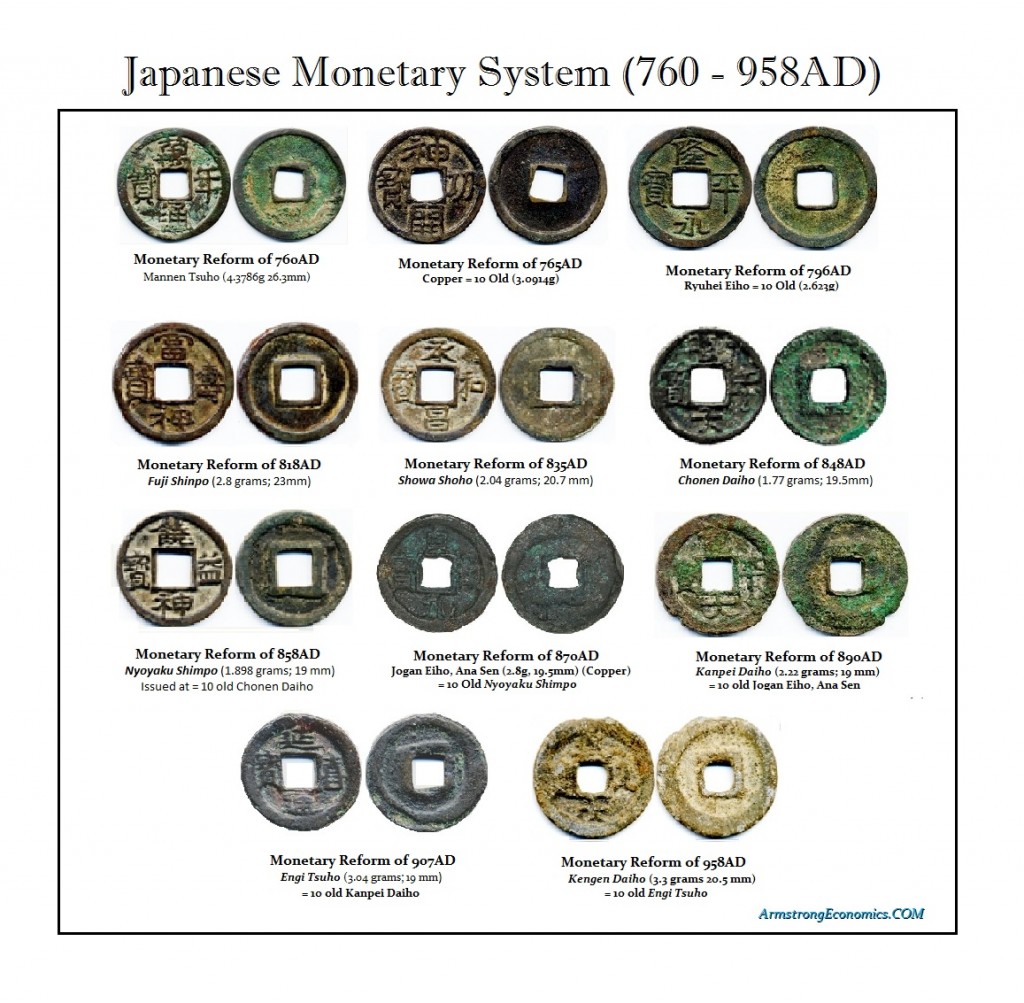
Martin Armstrong: “Since ancient times, many times those in power have cancelled their money supply to make a profit or collect taxes by force .. Three literary passages from antiquity identify the reminting of coinage in ancient Greece that had nothing to do with recycling of worn coinage. The government did what India did, but instead of moving to electronic money, they devalued outstanding coins and recalled them for restriking regardless of their condition, specifically as a means of raising revenue for the state .. Dionysios, we are told ([Arist.] Oec. 1349b27–33), and Leukon (Polyaenus, Strat.6.9.1), recalled in the existing coinage and restruck (or countermarked) it with a new type (character), thereby doubling its original value. This was an effort to cover the expenses of the state by increasing the money supply. Dionysios recalled the coinage and imposed the penalty of death for noncompliance. Leukon followed Hippias and simply demonetized all existing coinage .. Various Japanese emperors engaged in similar tactics but did not recall the existing coinage. Each new emperor just devalued all outstanding coinage to 10% of its value and issued their own coinage for profit. This practice led the population to use Chinese coins and rice. Eventually, nobody would accept a Japanese coin because of this practice. Thus, the end result was that Japan lost the ability to issue coins at all for 600 years after 958 AD. This is why, as we move forward, it will be best to hold assets out of banks and out of currency .. The safest asset may simply be blue chip stocks for they would never make it illegal to own corporations unless you had a full-fledged leftist revolution that seized all private assets as in a communist revolution. That risk would naturally alter everything once again.”


link here to the reference

Disclaimer: The views or opinions expressed in this blog post may or may not be representative of the views or opinions of the Financial Repression Authority.


01/09/2017 - Russell Napier On Financial Repression: “You Are Not Supposed To Know It Is Happening”

Financial Repression – “Put inflation above interest rates and to maintain them there” .. it’s being done by the central banks, and it could be forced by financial institutions upon investors by governments .. it’s all about governments trying to maintain & reduce the burden of government debt .. but now the need to repress is higher than after World War II, since there is also a lot of private debt as well .. “we are at the very early stages of this [financial repression]” .. 

Disclaimer: The views or opinions expressed in this blog post may or may not be representative of the views or opinions of the Financial Repression Authority.


01/09/2017 - Dr. Marc Faber: Federal Reserve Likely To Launch QE4 In 2017

“Let’s say the Fed realizes that the deficits for the U.S. go up and that interest rates increase and that the economy slows down, do you really think that they will increase the Fed funds rate three times in 2017? Never. What they will aim at, then, is to essentially bring interest rates down, especially if by then the dollar is still strong. And so they will probably launch QE4 in 2017. I think that will be a surprise for many people — not for me, but for many people that will be a surprise.”

LINK HERE to the podcast

Also recommend watching the below video interview: Dr. Marc Faber sees emerging markets as outperforming the U.S., the U.S. Treasury Bond Market likely to correct (go higher) in the short term, & the U.S.$ likely peaking in 2017 .. sees the world’s big central banks – Federal Reserve, Bank of England, ECB and Bank of Japan – as coordinating monetary policies together on a global basis.


Disclaimer: The views or opinions expressed in this blog post may or may not be representative of the views or opinions of the Financial Repression Authority.


01/05/2017 - Former Goldman Sachs Managing Director Nomi Prins On Artisanal Money To Support Government Debt

“Why is this all happening? We had a financial crisis. It was scary for a lot of reasons. It was started in the United States. The biggest six banks in the United States have not really suffered in the wake of this financial crisis. The biggest six banks were at the core of the financial crisis are now 86% bigger in terms of assets, they are 43% bigger in terms of deposits. They have more tract in the derivatives market. They have more tract terms of the trading assets market. They are simply more powerful than they were before. They are continuing to be batted with settlements for crimes ranging from mortgage related crimes (the crux of the crisis), to libor scandals, to rigging foreign exchange to scamming customers. These crimes manifest in several ways, as we saw when Wells Fargo, one of the big six U.S banks, charged fees to its customers that they did not even have .. These banks have only been subsidized by, first our Federal Reserve and then internationally the cooperation of central banks – in a way that has never existed before. In the wake of our crisis, when the Federal Reserve brought money down to zero, they created Artisanal Money. It is not actually printing money. It does not require physical activity. It is the idea of creating money in all sorts of different ways to make its availability easy, its cost zero (or negative), of buying bonds (to continue to support government debt). They have made a policy supporting government debt by moving it to the central banks – in terms of purchasing. These central banks have created a whole dislocation of the nature of pricing in every single asset class.”

Disclaimer: The views or opinions expressed in this blog post may or may not be representative of the views or opinions of the Financial Repression Authority.


01/05/2017 - Former Fed Advisor Danielle DiMartino Booth’s “FED UP”

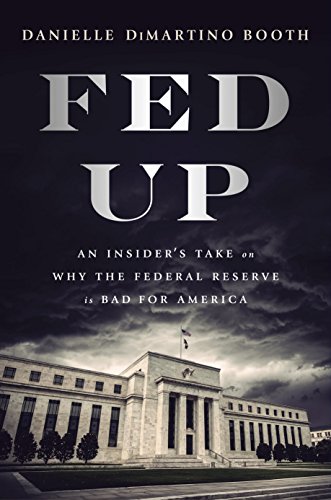
Amazon: “An insider’s unflinching expose of the toxic culture within the Federal Reserve. In the early 2000s, as a Wall Street escapee writing a financial column for the Dallas Morning News. Booth attracted attention for her bold criticism of the Fed’s low interest rate policies and her cautionary warnings about the bubbly housing market. Nobody was more surprised than she when the folks at the Dallas Federal Reserve invited her aboard. Figuring she could have more of an impact on Fed policies from the inside, she accepted the call to duty and rose to be one of Dallas Fed president Richard Fisher’s closest advisors. To her dismay, the culture at the Fed–and its leadership–were not just ignorant of the brewing financial crisis, but indifferent to its very possibility. They interpreted their job of keeping the economy going to mean keeping Wall Street afloat at the expense of the American taxpayer. But bad Fed policy created unaffordable housing, skewed incentives, rampant corporate financial engineering, stagnant wages, an exodus from the labor force, and skyrocketing student debt. Booth observed firsthand how the Fed abdicated its responsibility to the American people both before and after the financial crisis–and how nobody within the Fed seems to have learned or changed from the experience. Today, the Federal Reserve is still controlled by 1,000 PhD economists and run by an unelected West Coast radical with no direct business experience. The Fed continues to enable Congress to grow our nation’s ballooning debt and avoid making hard choices, despite the high psychological and monetary costs. And our addiction to the ‘heroin’ of low interest rates is pushing our economy towards yet another collapse.”

LINK HERE to book review


Disclaimer: The views or opinions expressed in this blog post may or may not be representative of the views or opinions of the Financial Repression Authority.