05/05/2016 - GREENPEACE LEAK: Exposes Corporate “Regulatory Ring Fencing” Through TTIP

LINK TO COMPLETE GREENPEACE TTIP LEAKS


The secret documents represent roughly two-thirds of the latest negotiating text, and in several cases expose for the first time the position of the U.S.

Below Summary Article Published on Monday, May 02, 2016 by Common Dreams

Confirming that the TransAtlantic Trade and Investment Partnership (TTIP) amounts to “a huge transfer of power from people to big business,” Greenpeace Netherlands on Monday leaked 248 secret pages of the controversial trade deal between the U.S. and EU, exposing how

  1. Environmental regulations,

  2. Climate protections, and

  3. Consumer rights

are being “bartered away behind closed doors.”

The documents represent roughly two-thirds of the latest negotiating text, according to Greenpeace, and on some topics offer for the first time the position of the United States.

“Total secrecy was the only way the European Commission could keep the European people from learning the truth about these appalling negotiations, and now the cat is out of the bag.” —John Hilary, War on Want

Before Monday, elected representatives were only able to view such documents under guard, in a secure room, without access to expert consultation, while being forbidden from discussing the content with anyone else. This secrecy runs “counter to the democratic principles of both the EU and the U.S.,” the website ttip-leaks.org declares.

And in the absence of transparency, “hard won environmental progress is being bartered away behind closed doors,” said Faiza Oulahsen, campaigner for Greenpeace Netherlands.

“Whether you care about:

  1. Environmental issues,

  2. Animal welfare,

  3. Llabor rights or

  4. Internet privacy,

you should be concerned about what is in these leaked documents,” Oulahsen said. “They underline the strong objections civil society and millions of people around the world have voiced:

TTIP is about a huge transfer of democratic power from people to big business.

Greenpeace Netherlands zeroes in on four aspects of serious concern in the obtained texts, including:

  1. The apparent omission of the so-called “General Exceptions rule,” which allows nations to regulate trade “to protect human, animal and plant life or health” or for “the conservation of exhaustible natural resources;”

  2. The absence of language about climate protection, plus provisions that would “stimulate imports and exports of fossil fuels—like shale gas from fracking or oil from tar sands—while clean energy production for local communities and associations would be considered unfair competition and a barrier to trade.”

  3. A clear threat to the “precautionary principle,” which requires regulatory caution where there is scientific doubt, shifting the burden of proof on whether a product is safe to public authorities, not on those who seek to sell it;

  4. The heretofore shrouded “high degree” of corporate influence over the talks.

According to the Guardian, which saw the original documents (retyped by Greenpeace and available here):

  • U.S. proposals include an obligation on the EU to inform its industries of any planned regulations in advance, and to allow them the same input into EU regulatory processes as European firms.

  • American firms could influence the content of EU laws at several points along the regulatory line, including through a plethora of proposed technical working groups and committees.

“These leaks confirm what millions of people across Europe have suspected all along—that this toxic trade deal is essentially an enormous corporate power grab,” said Global Justice Now trade campaigner Guy Taylor on Monday.

“It’s no secret that the negotiations have been on increasingly shaky ground,” Taylor continued, citing petitions signed by millions of Europeans and ongoing public protests. “These leaks should be seen as another nail in the coffin of a toxic trade deal that corporate power is unsuccessfully trying to impose on ordinary people and our democracies.”

Similarly, War on Want executive director John Hilary declared: “Today marks the end of TTIP.

Total secrecy was the only way the European Commission could keep the European people from learning the truth about these appalling negotiations, and now the cat is out of the bag.”

“We have long warned that TTIP is a danger to democracy, food safety, jobs and public services,” Hilary continued. “Now we see it is even worse than we feared. Today’s leak shows the European Commission preparing to sell us down the river, doing deals behind closed doors that will change the face of European society for ever.

It is simply unacceptable that a group of unelected officials should be allowed to contemplate such a thing without any public scrutiny.”

The 13th round of TTIP talks took place last week in New York. U.S. President Barack Obama, who was stumping for the deal last month in Germany, had hoped to wrap up negotiations by the time he left office—a timeline that looks increasingly unrealistic.

Public support on both sides of the Atlantic has plummeted; leading U.S. presidential candidates oppose the deal and others like it; and President François Hollande on Sunday became just the latest French official to express skepticism about the deal.


Disclaimer: The views or opinions expressed in this blog post may or may not be representative of the views or opinions of the Financial Repression Authority.


05/03/2016 - ALERT: PIMCO’S Global Economic Advisor, Joachim Fels Suggests QE Should Buy Equities Next

Speaking at a panel in the Milken conference titled “Monetary Policy: Out Of Ammunition” moments ago Pimco’s global economic advisor Joachim Fels, formerly of Morgan Stanley and Goldman Sachs, had a few observations on QE vs NIRP, not surprisingly nudging central banks that explicitly central bank buying, i.e., QE, is far more powerful than the implicit deflationary signal which is NIRP.

  • FELS: QE IS A MORE POWERFUL TOOL THAN NEGATIVE RATES

He then proceeded to point out the obvious;

  • FELS: PROBLEM IS INFLATION IS TOO LOW

By which he was of course referring to wages; as we showed recently rent inflation is currently running at a record 8% Y/Y (ignoring the double digit increases in health insurance costs).

He then had some more big picture ideas of how the world can get rid of its excess debt: central banks should just buy it all up and then “cancel it” (of course by doing so they would also cancel the offsetting balance sheet entry which is bank reserves which also happen to prop up global capital markets).

  • FELS: TO ERASE DEBT, CANCEL IT ON CENTRAL BANK BALANCE SHEET

And finally, he hinted what he, and/or Pimco, would prefer that the Fed should buy next. Stocks.

  • FELS: QE SHOULD FOCUS ON CREDIT AND POTENTIALLY EQUITY BUYING

What he did not note is that by the time it’s all over, central banks will be buying not just credit and equities, but virtually every asset class, both directly and indirectly through helicopter money. That said, we prefer that “other” proposal by Pimco’s Harley Bassman from two weeks ago, according to which the Fed should monetize gold to a price of about $5,000 to “shock” inflation expectations higher. However, somehow we doubt if given the option of buying gold or stocks (directly as opposed to through Citadel), the Fed will pick the former.

Disclaimer: The views or opinions expressed in this blog post may or may not be representative of the views or opinions of the Financial Repression Authority.


05/03/2016 - Better Finance: Financial Repression Destroys Savings – European Savers Bailed In By ECB

BETTTER FINANCE

PRESS RELEASE

At the end of 2013, at the occasion of the publication of its yearly report on the real return of pension savings, Better Finance warned of the risk of a disastrous eradication of European savings across the board. Nearly two and a half years later and the warning goes unheeded, with the European Central Bank intensifying the financial repression of European Savers by further lowering its main interest rate from 0.5 to 0.25 percent. Now this fear is spreading to all actors – savers and retirees, insurers, pension funds, even bankers – threatening the whole edifice of pensions and savings.

Axel Kleinlein, the head of Germany’s Association of Insured Persons (BdV) and member of Better Finance, stresses the fact that lowering interest rates even further effectively crushes all hopes of decent pensions in the future and has started a campaign against the role of the ECB, which was relayed by the media all over Europe.

What is at stake is the entire monetary policy of the European Central Bank. This is the climax of financial repression.

Financial Repression refers to a set of governmental or central bank policies that keep real interest rates artificially low or negative and regulate or manipulate a captive audience into investing in government debt. Central banks started to fund banks at very low interest rates, most often asking for government debt as eligible collateral. Then central banks engaged in quantitative easing campaigns buying up sovereign bonds directly on the market. To complete the picture central banks try to keep inflation alive through quantitative easing policies in an attempt to further reduce the weight of sovereign debt in the EU Member States, but in the process also obliterating the value of all savings.

Indeed, we know that inflation is the weapon of mass destruction of savings and savers. Today, thankfully, the desired inflation has so far failed to materialise. Policymakers believe that low interest rates will encourage consumption but fail to take into account basic human nature: a small saver faced with low or even negative returns, is more likely to brace for hard times, tighten the belt and stow money under the mattress for a rainy day.

As President Jean Berthon says: “It is more than time to oppose by all means this disastrous policy and we call on all Member Associations of Better Finance to actively campaign in their home country to force the central banks to drastically change their policy.”

Disclaimer: The views or opinions expressed in this blog post may or may not be representative of the views or opinions of the Financial Repression Authority.


05/03/2016 - Kroll Bond Rating Agency: “ECB Doubles Down on Financial Repression”

KROLL

The Kroll Bond Rating Agency just released a report Achieving Stability & Growth in Europe.

They preface the report with this interesting comment:

We just posted a comment on the situation in the EU, where financial repression is still increasing.  Big concern from my perspective is that negative rates and central bank market intervention seem to be frightening investors and convincing savers to abandon the financial system.  Look at the earnings reports from UBS and the other large EU banks.  Banks are 80% of the EU balance sheet and virtually all are shrinking.  It is hard to envision how this situation does not end in tears for the nations of Europe given the policy mix.  Or to put it another way, should we worry about Brexit or Gexit?

The economic policy debate seems comprised of a binary choice. On the one hand, we are offered radical action by global central banks including the forced transfer of value from savers to debtors, and on the other, increased fiscal spending funded via either more debt or higher taxes. We believe that there is a third choice, namely to make public policy pro-growth as well as pro-consumer, with a balanced approach that is constructive rather than punitive.  Good luck getting the current cast of characters in the global central banking community to start talking about growth. But if we don’t see a change in policy by the ECB, there could be a German-led political crisis in Europe before end of the year. 

READ FULL REPORT


Disclaimer: The views or opinions expressed in this blog post may or may not be representative of the views or opinions of the Financial Repression Authority.


05/03/2016 - Capital Preservation In The Era Of Financial Repression

Article highlights the views of Saxo Bank in emphasizing gold & silver in your investments to preserve capital in a world beset by negative interest rates ..  “What do you do as a trader or investor in this environment? ,. No one knows how this ends, but one thing is for sure now: it’s now more a game of capital preservation .. There is no holy grail, but from a macro perspective, I think you have to look at precious metals.”

LINK HERE to the article

Disclaimer: The views or opinions expressed in this blog post may or may not be representative of the views or opinions of the Financial Repression Authority.


05/03/2016 - Is The Next Trend A Tax On Wealth?

Keynesian Economics Is In The Insanity Zone
It’s Time To Tax Cash?
Financial Repression Is Intensifying

“It is becoming increasingly clear to us that the level of yields at which credit expansion in Europe and Japan will pick up in earnest is probably negative, and substantially so. Therefore, the ECB and BoJ should move more strongly toward penalizing savings via negative retail deposit rates or perhaps wealth taxes. With this stick would also come a carrot – for example, negative mortgage rates .. Central banks should move more strongly toward penalizing savings, rather than just the institutions that ‘house’ those savings – the banks.”
– Deutsche Bank’s Dominic Konstam

LINK HERE to the article

Disclaimer: The views or opinions expressed in this blog post may or may not be representative of the views or opinions of the Financial Repression Authority.


05/01/2016 - Financial Repression Is Resulting In Stagflation

“We are overdue for a U.S. equity bear market and if we get a bear market it will have ripple effects across other asset classes. But the other thing that worries me even more than that is the central banks losing credibility and losing control .. Let’s suppose that headline inflation, already up to 2.3% in the last 6 – 8 months, hits 3% in the next 6 or 8 months. All of a sudden the central bank (the Fed) has lost control. The central bank can’t keep interest rates down at zero when inflation is running around 3%. That winds up being a massive wealth expropriation from anyone with savings. The government is intentionally engaging in wealth destruction for the affluent savers. That’s the essence of negative real interest rates. But if you are trying to carry zero interest rates in a 3% inflation environment, it stimulates all sorts of crazy behavior on behalf of the general public, and it winds up defeating the purpose of low interest rates, which is to stimulate the macroeconomy. So, ironically, you could have the Fed’s efforts to stimulate the economy with low interest rates having the unfortunate effect of stimulating hoarding instead of stimulating inflation in the macroeconomy. And you could have inflation get out of hand anyway so that you wind up with the worst of both worlds — a stagnation in the macroeconomy and outright recession, paired with renewed inflation. It’s called stagflation. We had that in the 1970s and it was brutal. That’s a risk. It’s certainly possible and if the Fed loses control, watch out.”
– Rob Arnott 

Disclaimer: The views or opinions expressed in this blog post may or may not be representative of the views or opinions of the Financial Repression Authority.


05/01/2016 - Negative Interest Rates Are Destroying The Very Fabric Of Society

“Thanks to negative interest rates destroying pension funds, we have a tempting pot of money government just cannot keep its hands out of. Governments are turning to ‘asset recycling’ – which includes even Canada. The federal government of Canada, for example, is looking at a potential source of cash to reduce the cost of government by shifting Canada’s mounting infrastructure costs to the private sector. They want to sell or lease stakes in major public assets such as highways, rail lines, and ports. In Canada, they sneaked in a line hidden in last month’s federal budget which reveals the Liberals are considering making public assets available to non-government investors, like public pension funds. They will sell the national infrastructure to pension funds .. This latest trick is being called ‘asset recycling,’ which is a system designed to raise money for governments. This idea is surfacing in Europe & the United States (especially among strapped cash States). They are destroying Western Culture because they are simply crazy and people who vote for them blindly are out of their minds. They are destroying the very fabric of society for they cannot see what they are doing nor where this all leads.”
– Martin Armstrong
link here to the reference

Disclaimer: The views or opinions expressed in this blog post may or may not be representative of the views or opinions of the Financial Repression Authority.


05/01/2016 - Everbank VP: First ZIRP, Then QE .. Will NIRP Be Next In The U.S.?

Everbank’s VP considers the progression of financial repression in the U.S. – from zero interest rate policy to quantitative easing to the increasing potential for negative interest rates .. “In response to disappointing growth, many central banks are testing a new monetary tool: NIRP. The European Central Bank (ECB) was the first major institution of its kind to adopt NIRP. Others have joined the party. Sweden, Denmark, Switzerland and Japan have also adopted sub-zero rates.2 In fact, around a quarter of the world economy by output is now experiencing official rates that are less than zero.3 Will the U.S. be the next country to implement a negative interest rate policy? .. It seems monetary authorities agree that NIRP might be implemented in the U.S. if our economy enters a sharp downturn. This would have important implications for the markets. In fact, the current negative rates in other countries are already having a major impact on certain asset classes, especially on precious metals.”

LINK HERE to the article

Disclaimer: The views or opinions expressed in this blog post may or may not be representative of the views or opinions of the Financial Repression Authority.


04/28/2016 - Economist Joseph Stiglitz On The Negative Effects Of Financial Repression

Financial Repression Has
Exacerbated “Extreme Inequality”

Economist Joseph Stiglitz discusses the problem of extreme income inequality in the U.S. & the negative economic impact of macroprudential monetary policy .. 4 minutes

Disclaimer: The views or opinions expressed in this blog post may or may not be representative of the views or opinions of the Financial Repression Authority.


04/28/2016 - The Portfolio Effects Of Holding Gold Or Gold Mining Stocks In A Portfolio

Bullion Management Group Inc.:
Gold & Gold Stocks
In A Portfolio

Report by Nick Barisheff of Bullion Management Group Inc. on the effects of holding physical gold or gold mining stocks in a portfolio .. “Mining shares are an investment that can make up a small portion of the overall tactical equity allocation of a sophisticated investor’s portfolio. However, the facts show that gold mining shares are not a prudent long-term strategic investment for most individuals. Physical gold has a long history that spans thousands of years, and it should make up a portion of every person’s assets. The world’s wealthiest people hold bullion to protect their wealth. As Doug Casey, author and institutional investor, says, ‘The hurricane hit in 2008, we have been sitting in the eye of the storm since the last financial crisis and the full breadth of the storm is beginning to hit us once again.’ Globally, the problems we face today are markedly worse than those of the Great Recession. In the coming years, portfolios without physical gold to offset losses in financial assets and currencies will suffer.”

Disclaimer: The views or opinions expressed in this blog post may or may not be representative of the views or opinions of the Financial Repression Authority.


04/24/2016 - Forced Inflation (1 Of The 4 Financial Repression Pillars) Ahead: Rising Commodity Prices

Will Central Banks Bolster 
Commodity Markets To Generate Inflation?

Commodity Trader: “The stupid FED and other Central Bankers around the world acting in unison to artificially raise inflation so that they can hopefully get out of the mess they got themselves into with this low/negative rate. Call me crazy, and I am not a ‘conspiracy theorist’ – but what is happening has absolutely no ‘reasonable’ explanation. So I have to think outside the box… The FED and other Central Banks have already destroyed the equity and other macro-financial markets… it is now turn for the commodities markets… How about the fact that the main drag on the inflation figures has been what? What? FOOD & ENERGY… So is it so crazy to think that Central Bankers all got together in early 2016 and came up with the following equation??? ARTIFICIALLY RAISE COMMODITY VALUATIONS = HIGHER ARTIFICIAL INFLATION = CLAMORING FOR RATES TO BE RAISED.”
Dr. Albert Friedberg*: “Value considerations have also moved us to establish a long position in a variety of commodities. The value factor here is the proximity of prices to their marginal cost and the concomitant impact on supplies. Slight changes in demand are likely to bring about relatively sustained increases in prices in at least some commodities. Rather than patiently holding on to a group of commodities, a sort of basket approach, we have asked Covenant to select them on the basis of momentum and have given them authority to raise exposure to about 20% of assets. We are quite confident that their time-tested technical abilities will make an excellent contribution if and when our value proposition plays out.”

LINK HERE to the article

Disclaimer: The views or opinions expressed in this blog post may or may not be representative of the views or opinions of the Financial Repression Authority.


04/24/2016 - Jeff Gundlach: “Negative Interest Rates Are The Dumbest Idea Ever”

In an interview on Swiss Finanz und Wirthschaft, fund manager Jeff Gundlach unleashes his frustration on central banks .. “What you see is that the same pattern has been in place since 2012: Hope for growth in the new year that ends up being revised downwards, over and over and over again. But now we have reached the point at which no one bothers anymore about the comedy of predicting 3% real GDP growth. Even nominal GDP growth isn’t probably going to be at 3% this year. Actually, nominal GDP is at a level that has historically been a recessionary level. It isn’t this time because the inflation rate is close to zero. But no one bothers anymore and the Federal Reserve has basically given up.” .. Gundlach thinks the U.S. stock market is overvalued versus other stock markets .. Gundlach likes gold – “Gold is doing fine. It’s preserving capital in the U.S., it’s been making money over the last couple of years for European investors. That’s why I own gold. Because in a negative return environment anything that holds its value or makes a little is good.”

LINK HERE to the article

Disclaimer: The views or opinions expressed in this blog post may or may not be representative of the views or opinions of the Financial Repression Authority.


04/18/2016 - BlackRock’s Larry Fink: The “Biggest Crisis” In The World – Negative & Low Interest Rates

BlackRock’s Larry Fink:
This Is The “Biggest Crisis” In The World

Fink is worried that negative & low interest rates around the world are crushing savers & that those policies are going to become the biggest crisis globally .. “We have become too dependent on central bankers” to boost the global economies, stressing easy money policies were supposed to be a temporary healing .. Over 70% of our clients are retirement plans and insurance plans. Our clients are in pain .. Our clients are very worried how they’re going to be meet their liabilities” because the yields are so low in the bond market.

Disclaimer: The views or opinions expressed in this blog post may or may not be representative of the views or opinions of the Financial Repression Authority.


04/18/2016 - Kyle Bass: The Looming “Run On Cash”

“I think this is where the academics are clashing with the practitioners. On paper, negative rates make a lot of sense if you’re running academic models, but in reality they make no sense. Having seven or eight trillion dollars of debt trading at negative rates, having thirty year JGB’s trading at fifty basis points is absolutely ludicrous. This experiment that’s going on will end poorly at some point in time, I just don’t know when that time is .. I think that one of the fears that they have is a run on cash. If they told you and me that they’re going to tax your deposits by a hundred basis points, well it’s better to put it in a safe or under your mattress. And that’s why you see a resurgence in gold. The more they move to negative rates, the more gold is gonna take off because there’s no carrying cost.”

LINK HERE to the article

Disclaimer: The views or opinions expressed in this blog post may or may not be representative of the views or opinions of the Financial Repression Authority.


04/12/2016 - Bill Gross: Negative Interest Rates Destroy Savers – The Bedrock of Capitalism

“This reality has profound implications for economic growth: consumers saving for retirement need to reduce spending… A monetary policy intended to spark growth, then, in fact, risks reducing consumer spending.”
– Larry Fink, Blackrock
“So where does that leave our economy? In the developed financial economies, as a bloc, lowering interest rates to near zero has produced negative consequences. The best examples of this include the business models of insurance companies and pension funds. Insurers have long-term liabilities and base their death benefits, and even health benefits, on earning a certain rate of interest on their premium dollars. When that rate is zero or close to it, their model is destroyed. To use another example, California bases its current and future pension payments to civil workers on an estimated future return of 8% or so from bonds and stocks. But when bonds return 1% or 2%, or nothing in Germany’s case, what happens? We’ve seen the difficulties that Puerto Rico, Detroit, and Illinois have faced paying their debts. Now consider mom and pop and other people who read Barron’s. They are saving for retirement and to put their kids through college. They might have depended on a historic 8%-like return from stocks and bonds. Well, sorry. When interest rates get to zero—and that isn’t the endpoint; they could go negative—savers are destroyed. And savers are the bedrock of capitalism. Savers allow investment, and investment produces growth.”
– Bill Gross*, Janus

LINK HERE to the article

Disclaimer: The views or opinions expressed in this blog post may or may not be representative of the views or opinions of the Financial Repression Authority.


04/12/2016 - Macroprudential Policy Tool

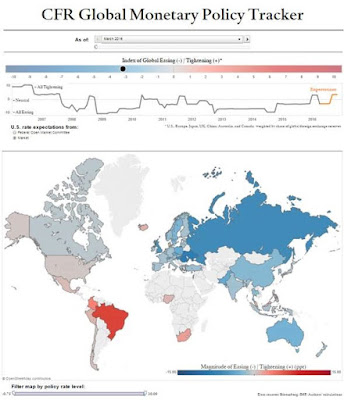
The CFR Global Monetary Policy Tracker is an innovative visual interactive that allows you to see quickly & easily what the world’s central banks are doing at any point in time, individually & in aggregate. All on one screen .. click on the image to activate

Disclaimer: The views or opinions expressed in this blog post may or may not be representative of the views or opinions of the Financial Repression Authority.


04/08/2016 - Economist Satyajit Das On The Implications Of Negative Interest Rates & Banning Cash

Economist Satyajit Das sees negative interest rates as a radical move by central bankers .. Why would investors go along? There are several possible reasons:
1. Security & safety: Government bonds or insured bank deposits are backed by the full faith & credit of a sovereign nation, which has the ability to issue currency to make repayments.
2. Returns are relative: In Europe, for example, purchasing bonds yielding more that the official rate at the central bank — even if it is negative — is the least worst alternative.
3. Speculation: Investors may be attracted by the opportunity for capital gains from price appreciation if they expect yields to become even more negative. Foreign investors also may be attracted by possible currency appreciation.
4. Real returns: Investors may favor real return over nominal return. Bonds with nominal low- or negative return may preserve or increase purchasing power in situations where the expected deflation is greater than the negative yield, providing positive real yield.
5. Investment mandate: Fund managers may be forced to purchase negative yielding bonds, irrespective of the fact that it locks in a loss.
6. Banks’ and insurers’ mandate:Financial institutions may be forced to purchase negative yielding securities, given liquidity regulations that require these entities to hold high-quality securities.
7. Central banks’ mandate: Central banks with restricted investment choices are also buyers of negative-yielding securities.
“The most radical consequence of negative rates would be the abolition of cash itself. In a future economic or financial crisis, current low rates would restrict the effectiveness of monetary policy. Enhancing the ability to use negative rates would provide central banks with additional flexibility and tools to deal with a slowdown. This would be an imaginative, rapid, and durable mechanism for levying negative rates to confiscate savings. Abolishing cash would require a revolutionary change. Despite the increasing acceptance of electronic payment, cash is still extensively used throughout the world In effect, currency remains an important medium of exchange and means of payment for legitimate, legal transactions. Cash use is especially high among both poor and older people. Accordingly, the elimination of currency would have implications for social and financial exclusion. The cost of converting these users to digital payments would be substantial .. Banishing cash would likely meet stiff resistance. People are likely to object to the loss of the anonymity and privacy that cash provides. Where the elimination of cash is linked to negative rates, it would be seen as a tax on savers and the state confiscation of savings. The intrusion of the state and authorities on such a mass scale would undoubtedly become an explosive political issue.”

LINK HERE to the article

Disclaimer: The views or opinions expressed in this blog post may or may not be representative of the views or opinions of the Financial Repression Authority.


04/07/2016 - James Rickards: “The only way every currency can get cheaper at the same time, is not against themselves, but against Gold!”

James Rickards, Chief Global Strategist at West Shore Funds and a widely renowned author is interviewed by FRA Co-founder Gordon T. Long in which they discuss Jim’s just released book The New Case for Gold. They also delve into issues concerning the false perceptions of the world switching back to a Gold Standard and the reasons for a suspected G-20 stealth “Shanghai Accord”.

THE NEW CASE FOR GOLD

James Rickards suggests that there is a new case for Gold and points out that everyone thinks that what they own currently, in terms of stocks, bonds and other financial securities, is actually only “electronic digits” representing claims on assets. The new reality of Cyber war and Cyber attack suggests the real possibility of a single group of people or political regime hacking U.S servers. The potential exists today for investors to lose wealth and there will be almost nothing any one can do to bring back that money, at least in any realistic period of time. Physical Gold cannot be hacked nor simply be erased from the world’s ledger. It is the most tangible and secure way of preserving wealth and James recommends a portfolio with at least 10% being allocated to physical Gold.

Being outside the system, and being non-digital are the two main reasons that smart investors economists suggest will ensure having some sort of security for your wealth. Gold meets both these requirements and in the next big financial crisis will provide you with insurance for the rest of your portfolio.

“They’re not going to bailout the system; they’re going to lockdown the system”

OUTSIDE THE BANKING SYSTEM – The Best Kind if Insurance

The financial system is inherently unstable based on:

1-Complexity Theory and

2- Financialization,

Gold acts as an insurance policy no matter what happens:

1-Inflation,

2-Deflation,

3-Bank failures, and

 4-Bail-ins.

Gold is always gold – It’s outside the banking system, can’t be reproduced by fiat,  It cannot be “hacked”.

“It is one of the few asset classes that perform well in both inflation and deflation. That is the best kind of insurance,”

Jim talks to FRA about methodically dispelling the decades old arguments and fallacies associated with going back to the Gold Standard.  He additionally dispels myths such as:

  • That John Maynard Keynes Called gold a “barbarous relic” (he didn’t),
  • That there is not enough gold to support finance and commerce (there is, it depends on the price),
  • That the gold supply does not grow fast enough to support world growth (it does if we are looking at real growth),
  • That gold caused the Great Depression (it didn’t, it was the Fed in charge of managing the money supply),
  • That gold has no intrinsic value (it doesn’t but neither has the theory of intrinsic value).

GOLD IS STILL A MONETARY ASSET & REAL MONEY

Rickards feels that over 40 years of “un-education or mis-education” has resulted in the new generation of economists and youth not understanding the importance or the value behind why gold is so important for our economy.  We cannot blame the new generation for this gap inn their knowledge. We have not been teaching Gold as money in university curriculum and along with myths created about gold have virtually disowning it from economic thinking.

“The only way every currency can get cheaper at the same time is not against each other, but against Gold.”

Gold is the one form of monetary value that can’t fight back which is why they have completely stopped educating the U.S public on Gold as a whole.

A POST MONETARY RESET – Gold after the Next Crisis

The current financial system is inherently unstable and may soon have to be reformed. Gold will play a prominent role, if that happens.

The IMF is the third largest holder of official gold reserves after the United States. Gold is at the very center of international finance as the International Monetary Fund (IMF) with its Special Drawing Rights (SDR) reserve currency is regaining prominence. In addition, the current valuation of the SDR could not be calculated without using gold, even though one has to go back to the 1970s to understand why.

China is not only acquiring vast quantities of physical gold, it is also going through the hassle of infiltrating the London gold market and simultaneously setting up its own clearing mechanism in Shanghai. Russia has boosted its gold to GDP ratio to 2.7 percent, higher than the United States percentage of 1.7 percent.

All powers are acquiring gold to have some bargaining power when the international financial system will be reformed.

The gold to GDP ratio will be critical when the monetary system collapses because it will form the basis for any monetary reset and the new ‘rules of the game.’”

Why? After redistributing the official gold holdings and having monetized everything from bonds to stocks, the world’s governments and central banks won’t have a choice left other than to devalue paper money compared to gold, the same trick President Roosevelt used during the great depression and with the same objective of getting rid of an unsustainable debt burden.

In a monetary reset, gold will be the chips that are used to play a game of poker. Russians, Chinese and even the Iranians are stock piling gold because of this fear. If Gold has a role in the future monetary system, Gold’s price has to go up. Gold cannot multiply at the alarming rate that we will need it for. But we can always increase the price which is why the current monetary system will fail in terms of Gold in the future and will still hold the parity between money supply and demand. James expects a price target of $10,000 for the future if this falls in line.

“You want some assets in TANGIBLE ASSETS!”

James new book The New Case for Gold is available in stores and online now and provides an in-depth analysis on the old and new reasons for why Gold is a necessity in our upcoming monetary system.  As always for more analysis and interviews follow us on twitter @FRAuthority or Subscribe to our YouTube channel, Financial Repression Authority for weekly interviews.

Abstract Writer: Saad  Gohir  sgohir@ryerson.ca

Video Editor: Min Jung Kim minjung.kim@ryerson.ca

Disclaimer: The views or opinions expressed in this blog post may or may not be representative of the views or opinions of the Financial Repression Authority.


04/07/2016 - Stanley Druckenmiller On The Importance Of Monitoring Central Bank Macroprudential Policies & Global Liquidity When Investing

Global Liquidity Update – 
Japan, Euro Area, & 
Emerging Markets All Negative

Financial Sense posted article quotes Stanley Druckenmiller on the importance of monitoring central bank policies & global liquidity levels/movements in the investment process: “Earnings don’t move the overall market… focus on the central banks and focus on the movement of liquidity… most people in the market are looking for earnings and conventional measures. It’s liquidity that moves markets.” .. the article highlights global liquidity conditions – as measured by BofA Merrill Lynch’s Global Liquidity Tracker, – it shows that global liquidity is still firmly in negative territory as of mid-2015 (bottom panel in the above chart). The most recent data shows a steep drop related to Japan, with 3 of the 4 components (Japan, Euro Area, & Emerging Markets) now below zero. Though the U.S. is fractionally positive at 0.75, the continual tightening of liquidity conditions abroad is the greatest risk currently, aligning with Yellen’s cautious remarks on raising rates.
From Bloomberg:
“Our real-time Global Liquidity Tracker (GLT) is a composite indicator of liquidity conditions in emerging and developed economies. To estimate our GLT indicator, we employ a dynamic factor model used by global central banks. Our Liquidity Tracker extracts a common unobserved factor reflecting the greatest common variation among market spreads, asset prices, monetary and credit data across different frequencies. We combine our US, Euro area, Japan and EM Liquidity trackers into a global composite using financial weights reflecting the average relevance of an economy in terms of market capitalization and private sector credit. All of this allows us to produce timely estimates of liquidity conditions in an effort to assess the state of the global economy. A reading of zero indicates liquidity at its long-run average while activity between -3 and +3 represents the standard deviation from this average.”
Bottom line from the Financial Sense article: “Overall global liquidity conditions are still unfavorable and show increased risks abroad. Japan has seen the greatest deterioration recently, but all components aside from the U.S. are now moving lower into negative (below average) territory. Should this trend continue, the Fed will have ample justification to delay raising rates or, worst-case scenario, eventually be forced to provide liquidity.”
LINK HERE to the article

Disclaimer: The views or opinions expressed in this blog post may or may not be representative of the views or opinions of the Financial Repression Authority.