02/14/2018 - Martin Armstrong: The Sovereign Debt Crisis Is Here
“The Romans never even had a national debt. Today, we have government hawking 100-year bonds. We have pension funds that required 8% returns and then governments ordering that the bulk of such funds if not 100% should be ‘conservative’ and invest in only government bonds. We are reaching a crisis point in longer-dated yields because investors are unwilling to lend money at low rates long-term. Smart money is beginning to wake up to the perpetual mismanagement of the long-term trend by the government. The central banks have been backing off of continually buying government debt and the Fed in the USA has announced it will not reinvest when its holdings of government debt mature .. This is the Sovereign Debt Crisis and Monetary Crises we face in the years ahead.”
Disclaimer: The views or opinions expressed in this blog post may or may not be representative of the views or opinions of the Financial Repression Authority.
02/14/2018 - BIS Chief Sees ‘Strong Case’ For Cryptocurrency Intervention
“There is a ‘strong case’ for authorities to rein in digital currencies because of their links to the established financial system, Bank for International Settlements General Manager Agustin Carstens said.
‘If authorities do not act pre-emptively, cryptocurrencies could become more interconnected with the main financial system and become a threat .. Most importantly, the meteoric rise of cryptocurrencies should not make us forget the important role central banks play as stewards of public trust. Private digital tokens masquerading as currencies must not subvert this trust.'”
Disclaimer: The views or opinions expressed in this blog post may or may not be representative of the views or opinions of the Financial Repression Authority.
01/26/2018 - The Roundtable Insight: Chris Whalen, Yra Harris & Peter Boockvar On 2018 Trends & The Return Of Volatility
FRA: Hi. Welcome to FRA’s Roundtable Insight .. Today we have Yra Harris, Peter Boockvar and a first time guest, Chris Whalen. Yra is an independent trader, a successful hedge fund manager; global macro consultant trading foreign currencies, bonds commodities in equities for over 40 years. He was also CME director from 1997 to 2003. And Peter is the Chief Investment Officer for the Bleakley Financial Group and Advisory at Bleakley and he has a newsletter product called The Boock Report. BoockReport.com. It offers great macroeconomic insight and perspective with lots of updates on economic indicators. Chris Whalen is an investment banker, author and Chairman of Whalen Global Advisors LLC which focuses on financial services, mortgage finance and technology sectors. He was a Co-founder and Principal of Institutional Risk Analytics from 2003-2013. He has held positions in organizations such as the House Republican Conference Committee…
Christopher Whalen: Yeah, talking about that.. (laughs). That’s okay. Most recently I ran and built up the Financial Institutions Group at Kroll Bond Rating Agency which was a lot of fun. Kroll is really an ABS house, first and foremost, commercial real estate and the rest of it. It’s still very small from competing with giants, but it was a lot of fun.
FRA: Great. And also he was on the board of directors for the Global Interdependence Center (GIC) in Philadelphia.
Christopher Whalen: Yes, that was David Kotok’s little project. You know it’s fun to mix business with pleasure. Fishing, central bankers go fishing.
FRA: Yes, I am actually going next month to the GIC conference in Buenos Aires and going fishing before that. There’s also fishing afterwards, sort of the Camp Kotok in Argentina.
Christopher Whalen: Well, some of them go to Maine. Ramiro Lopez Larroy and his kids will just show which is about 15 hours by plane. It’s a lot of fun. They are great people – A very diverse group at GIC. We’re going to Germany this year, the Bundesbank, so if you like monetary policy that would be a very good trip to go on. I would recommend that.
So, what would you like to talk about this morning?
Peter Boockvar: The Bundesbank has disappointed me for the last few years how they give Draghi the license to do what he has done.
Christopher Whalen: Well, they kind of had no choice. I find it amusing that northern Europe is cranking, and my relatives in Holland are having a great year, and yet southern Europe is not. That dichotomy is ultimately going to be very difficult for them to deal with. The Germans look at southern Europe and they just see more checks to be written. The politics of that is slowly undermining Merkel. It’s very interesting to watch. And then Berlusconi coming back in Italy – Isn’t that great?
Everyone: (laughs)
Christopher Whalen: I always tell people to read about Berlusconi and you’ll see where America is headed.
Yra Harris: Draghi will be making trips to Italy.
Christopher Whalen: Yeah. Draghi has been trying to keep Europe on ice by pushing debt cost down to zero, but the debt keeps growing. So, what are we really about here? There’s no fiscal discipline anywhere in the Western world and the Chinese don’t care. It doesn’t matter in China – It’s a political issue. That’s why I was writing about H&A recently because ultimately, whether that company survives or not, will be determined by uncle Xi. That’s how it works in China. There is no church and state, there is just the state.
Peter Boockvar: He may want to set an example though.
Christopher Whalen: Yeah, there were a little ostentatious, a little floppy with the parties, pasting their names on the side of office buildings around the world. I think we have 3 of them in New York. It’s quite fascinating.
FRA: A few weeks ago, Chris, you wrote an article, Bank Earnings & Volatility, I thought we could begin with some thoughts there. How have the Federal Reserve and other central banks’ actions affected the credit market, the financial markets and the economy, in general?
Christopher Whalen: Well, what the central banks have done is that they have removed a lot of assets from the market. They’ve gone out with a variety of new money, in the U.S. case: excess bank reserves, and they’ve bought treasury bonds and they’re bought also mortgage bonds. Of recent vintage, Fannie Mae, Freddie Mac, Ginne Mae paper which have 3, 3 ¼ and 3 ½ coupons with very low pre-payment rates. Those bonds are going to be around for a long time. In fact, one thing I remind people of is that about 30% of the market today is the FHA and Ginnie Mae and those loans are assumable so they will stay with the house. And the house will trade and the loan will be conveyed to the new buyer. It could be very interesting, over time, to see how that affects the portfolio. But essentially, the central banks have taken all of this duration out of the market and since they’re end investors, they are basically buying the paper on credit and they don’t hedge it. So the capital markets activity that you used to see around a lot of these positions when they were held by trading firms, banks and other who were going to trade the assets and cared about mark-to-market every quarter has greatly diminished — There’s no hedging. The Fed’s sought out hedging it’s block and it’s a problem now because the Fed is now illiquid. They can’t sell without creating a loss and they dare not do that because it gets them in trouble with the Republicans and the House who don’t understand monetary policy at all, but have a lot of opinions on it. And so you have this weird situation where the Fed essentially has their hands tied. They’re going to wait for the book to run off which they hope is about $20 billion a month. And I think that they could be wrong. I think that they could too wishful in terms of the runoff rate in terms of the mortgage paper. The mortgage companies are going to be around forever and the pre-payment rate is going to be very low, especially if rates continue to move up. That’s kind of what I see. The trading line on Wall Street, the earning will be greatly diminished by this. Then you have the vote to rule. So all of the books, the investment books that the banks use to trade every day, just the value of the assets are passive now. You put those 2 data points together and you will understand why Goldman Sachs and why all of the banks have seen an enormous reduction in their trading buy-ins.
The other issue is that the mortgage market is down so there is less hedging. The forward market for hedges, what’s called the TBA market, has a lot less activity. We’ll do a $1.5 trillion in mortgages this year which is down. The peak was $4.5 trillion during the 2000’s; we don’t want to do that.
Peter Boockvar: Yes and why aren’t we seeing an CNI loan growth?
Christopher Whalen: The banks had to slow down. They had a pretty good run in 2015/2016. We had a little scare from oil which didn’t really materialize. Most U.S. banks did fine on oil credits. There was some restructuring, but the banks we follow like Cadence, which is a small lender that was built to do energy – They have no problems. But now a lot of banks have run up to a regulatory limit on commercial real estate loans, multi-family…there’s a big shtick now for the smaller banks. They’ve essentially run out of customers in certain markets too. The OCC, for example, is forcing regionals to peel back their multi-family exposure because the prices have gone up so much. They just look at that go whoa, wait a minute. And they’re right. Loss rate on these assets, multi-family assets, are negative. So if the loan defaults, you’re going to sell the property for a lot more than the loan and that’s reflected in the ABS numbers too. It’s an interesting time in terms of different asset classes, but I don’t see a lot of growth in the book. I really don’t. BA had a really good quarter at year end, but that was the exception. Most of the big guys were not growing. And of course PMC had a very good quarter and had a nice tax number. I think overall, don’t look for alpha in the banking industry. Between the regulatory changes and just the tenure of the economy you would be in the bond market, right? Anybody could raise money in the bond market in 2016 and part of 2017. So, we had a bull market in fixed income which has driven a lot of strategies and I’m sure Yra has some thoughts on that.
Yra Harris: Let me ask a question in regards to that. I was really taken by it because it was such a good point. With the ECB, BoJ and certainly the Feds, the dynamic hedges are missing from the market, but they are going to resurrect themselves as more paper winds up in the hands of private holdings whether it be by pension funds or insurance companies. But do you think that Jerome Powell…You know I go back and read some of his earlier stuff and of course his initial position as a Fed governor, he had a lot of issues with the massive build-up of the balance sheet. Do you think that he might be quicker to say that we can hold the rate at 2%…Do you think that it’s a possibility?
Christopher Whalen: I think that the snippets from the minutes that have sudden found people’s attention…which is very funny, right? We only pay attention to chairmen. It’s a cult of personality. So here you have Powell saying some very interesting things, very forthright, not an economist, he’s a financial guy, and I’m told he’s fairly decisive although he’s quiet and he listens. He knows how to make decisions. On this he’s got politics because the congress, if you remember years ago, they confiscated the Fed’s surplus to pay for a highway bill. And the idiots in congress, I wrote about this for the American Conservative, keep permittences from the Fed as revenue. They don’t understand that it’s an expense foregone. It’s not revenue. You’re just making the debt go away. Every year they look at this money coming in and the CBO and everyone else say: Oh look, it’s revenue. But it’s a snake eating its tail because the Fed and the treasury are one. It’s like a Hindu god, but in economic terms they are the same. And Bob Eisenbeis, who I interviewed, is wonderful on this issue – He is very funny. I think that Powell is going to be a lot more straight-talking then the others have been and I fault Yellen and Bernanke on this because they should’ve gone out and said to the congress: “No, you can behave like this. This is ridiculous. You don’t go confiscating our surplus.” It was just part of Washington politics, but the Fed didn’t respond. If Paul Volcker was there he would have been up on the hill kicking the shit out of them. And the problem is, these are bureaucrats, they come from academia. They have no money and so they don’t know how to behave in big league politics – It’s a tragedy. I think Powell will be much better. I am very hopeful about his 10-year as chairman. It desperately needed change. We got to get the economists out of the temple, I’m sorry. I love them, but they can’t make financial decisions. You want them on the staff, Yra, you don’t want them trading.
Peter Boockvar: We wish that was the case 10 years ago and now Powell gets to clean up the mess.
Christopher Whalen: Exactly and you know, Volcker cleaned up a lot of messes too. They always clean up other peoples’ messes so it’s a public service.
Peter Boockvar: And this is the biggest mess the world has ever seen.
Christopher Whalen: Oh yeah. No question.
Yra Harris: And with Bernanke he had the courage not to act.
Peter Boockvar: Right. Bailing out people doesn’t take courage. It’s not bailing them out what is courageous.
Christopher Whalen: Well precisely. And the Fed has not said no in a long time. They haven’t said no to accommodating treasury options and they haven’t said no most recently with this lunacy of QE. I mean the first one was fine. They had to reliquify the banking system as Walker Todd put it out to me a while back, but the rest of it was crazy. Selling all the short-dated stuff and loading up the book with long-dated treasuries so they own mortgage backs with an average life of around 12 years now. They have extended a lot, by the way, over the last 18 months. Even if the portfolio gets smaller, the duration has got to go up.
(laughs) How about that?
Peter Boockvar: Chris, what was their thinking in their models with operation twist to say okay, in their models, let’s flatten yield curve and that will be good for growth. And then today they express worries over the flattening yield curve.
Christopher Whalen: Well I know, but this is the point. When you have central banks take all this duration out of the market, nobody is hedging the position; well obviously it’s going to be hard to get those maturities to back up. There is just nobody selling euro/dollars, nobody doing swaps or anything – There’s nothing. So there is market is in stasis and they’re going to push up the short end, but there’s nobody pushing up the long end. So it’s gone up a bit, but I keep wondering…I wrote about it this week. I’m kind of hedged on my bull market 10-year trade, right? But, there is still nobody out there selling it. So I do think you have a flat curve in prospect, I agree. It’s bond market basics. It’s got to be somebody at that table in Washington who understands the bond market and I think Powell does – There’s hope.
Yra Harris: But in understanding the bond market, Chris, do you think that he will move to try and steepen the curve by maybe holding the front end, by saying hey, we don’t have to raise rates. If I get it to 1.75 on the Feds’ fund rate or 2%, I’m basically in a neutral real yield. That’s where I am. That’s probably about neutral on the front end. Maybe the real yield on the front end goes to 50 basis points positive, but I don’t think he goes there. Would it not be in his optimal mindset to say let’s start shrinking the, as Peter would say, quantitative tightening on the longer end on the duration. If the yield curve steepens out to 120-150 basis points it’s not necessarily a bad thing.
Christopher Whalen: I totally agree with you. If the Fed were acting rationally they would be doing all of that. They would have even been hedging a bit of the buck. Just trade it. Go out and hedge on the duration.
Peter Boockvar: Definitely afraid of affecting its bubbling asset prices.
Christopher Whalen: That’s part of it – True.
Peter Boockvar: That’s behind their entire thinking.
Christopher Whalen: But bureaucratically in Washington terms, they don’t want to take a loss because then the remittance to treasury goes away. And believe it or not, in the small minded world of some of these Fed people, that’s what they worry about. So, vector that into your thinking too because he’s absolutely right – They should be trading the book. They should have been doing a lot of things, but they’re not thinking like market people. They are thinking like Keynesian and academic economists and that’s scary — It really is.
FRA: In your article you mention also that this is likely going to result in a volatility returning to the markets that were all short volatility – Can you elaborate on that?
Christopher Whalen: Well that was the comment from Powell. He said at the end of that snippet from 2012 that they were going to unwind their short volatility position. In classical terms, if you buy a portfolio of RMBS it should give you a relatively short position, but in this case I think the other part of it is our perspective, the market. We’re sitting here and he’s got all the duration and we’re buying. Now, all of a sudden, he says that we aren’t going to buy anymore and we’re going to let it run off. So eventually private market participants are going to take up that duration, think of it as the weight that they have to support with capital, and they’ll have to hedge. So you will see market activity return. I think that the Fed has missed an opportunity to get a little bit more of this done quickly and figure out how much the street is willing to support. That’s the thing that we don’t know. The Fed has been supporting everything.
Peter Boockvar: The Fed lost their opportunity. The Fed had a chance to raise 3 times in 2015, 3 times in 2016, now they’re entering a situation where maybe the Fed fund rate tops out at 2-2 ¼. And they have now an issue with this falling dollar and bubbling inflation pressures. Just imagine when we do hit a wall and they start to cut rates and what the dollar is going to do in that scenario.
Christopher Whalen: I think it’s a lot simpler than you put forward which is: go ahead and keep your little quarter point march and if you see spreads start to widen, you stop. It’s the basic Irving Fisher test, right? That was the playbook for Bernanke.
Peter Boockvar: That is too much of a free lunch for me. I think that there is no free lunch in reversing this policy that they have implemented.
Christopher Whalen: So, you think we go to 6%? That’s what Yellen said years ago.
Peter Boockvar: We don’t need to go to 6% to cause a major problem. All the 10-year has to do is go to 3.5%/4% and you’ve got, I believe, a recession on your hands. I think the sensitivity to changes in interest rates is dramatic, as it’s been. You’ve got duration levels that are as high as they’ve ever been globally – That’s where the risk is.
Christopher Whalen: Well you’ll certainly see defaults go up because we’re hiding a lot of defaults with the artificial manipulation.
Peter Boockvar: And it’s not just that. Well you need a zero interest rate to go back to zero and $9 trillion of paper is going to lose a lot of money mark-to-market
Christopher Whalen: Hey, I know that’s why…
Peter Boockvar: Actually, I take that back. It’s more than mark-to-market — It’s real life losses.
Yra Harris: From a trader’s point of view…That position is enormous that they are carrying and more people have synthetically created that. Now you’ve got to realize that all of this volatility selling is all from people who are mimicking that risk parity trick. You can mimic it whatever way…You can recreate this trade synthetically in a million different ways. So when you have to actually start unwinding it, it’s almost like the long-term capital of 1998, we’re not going to be able to get out of that door because a lot of people are going to be racing out that door at the exact same time that you want to go because they have the same position whether you realize it or not.
Christopher Whalen: Well of course. And the VIX is just a popularity contest – There’s no basis for that contract. It’s just a matter of supply and demand. It’s like CDS. There is no basis on the underlying credit anymore.
Peter Boockvar: Well sure, but the VIX is still being determined by a lot of participants placing their bets and puts and calls.
Christopher Whalen: Absolutely. A lot of them weren’t hedging the past few years. Everyone was leaning in one direction.
Peter Boockvar: Of course.
Christopher Whalen: You would see default rates double in Peter’s scenario, easily. I think that’s from latency in the system. If we see the 10-year go up to like 3%, I think the windows will be shaking.
Peter Boockvar: And I read a stat over the weekend that of the roughly 2,000 companies, 40% of the debt is floating rate. And that cost goes up every single day with what LIBOR is doing. Even the 2-year note yield today is up to 2.12.
Christopher Whalen: That’s what I’ve been wondering about is to imagine the reissuance of equity that was bought in by these guys as they desperately try and pay off this debt. That could be a lot of fun.
Peter Boockvar: Yeah. The 1-year bill today is now where the S&P 500 is.
Christopher Whalen: We’ve had 4 years of amazing record bond market activity of each year in terms of new issuance and I would say 1/3 or ½ of it was to fund stock repurchases. It’s been quite something.
Yra Harris: And you know what, there’s another part…When the BoJ and ECB are busy buying corporate assets, there’s no hedging that goes on there either. And there’s also no stock re-lending. Another issue that I’ve raised…
Christopher Whalen: Yeah, that’s true. They may not lend the assets. That’s right. The Asian central banks are very, very conservative on that stuff. They won’t re-hypop.
Yra Harris: Yeah. There’s no rehypothecation of anything so now all of a sudden the game gets even more interesting and the question becomes: Do all the ETFs rehypothecate? Or does that result then with everything in that basket we get way late off the market and make it even more expensive for short sellers. So we’re not getting any short selling for some of these companies that are involved in ETFs are really miserable companies. So the whole dynamic here is shifted. And I don’t know that the players have really shifted.
Christopher Whalen: I don’t know about the ETFs. I would suspect those assets are available, but the central banks are the big thing. When they buy all of this paper and just put it away, you’re right, it doesn’t come out. It doesn’t get loaned. It reduces liquidity – That is, to me, the key thing.
The fascinating part is to look at the Swiss. Swiss National Bank is now buying stocks. Why? Because if they don’t, the currency will appreciate. That is their chronic problem. They just can’t keep the money out and even with penalty rates, they still can’t manage it. So if they stop, it will go up.
Peter Boockvar: That’s what one of the interesting central bank comments this week was from the deputy governor of the Swiss bank in Sweden, who has also gone down that rat hole of negative interest rates, and she said that they are not going to wait for the ECB to start raising rates. They’re going to probably start doing it this year. So I think that there is an end in sight to this negative interest rate experience over the next 2 years.
Christopher Whalen: Well, the whole system has way too much debt and a lot of debt that is mispriced. So like I said, you’ll see the banks start to lean into this too. I think you’ll see provisions gently go up from where they are. I was surprised to see the credit cards up this much this quarter.
The mortgages are still real quiet. And commercial is still really quiet because the collateral values have gone up so much. A loan you made 2 or 3 years ago, the building will get sold easily for the principle on the loan which is typically a 50 LTV (loan-to-value) loan. Look at the equity that has been created in multi-family and commercial real estate over the past 4 or 5 years – It’s ridiculous. And it was all levered up again.
Look at New York. New York is going to be a lot of fun. We have compression underway right now.
Yra Harris: Will the balance bring back foreign buyers to the U.S. market to hold this mark up a little longer?
Christopher Whalen: I don’t know. I’ve been trying to get some good data on that because it depends on a lot of things. There was certainly a gold rush for a while, but then the Chinese shut the door. They changed the rules rather significantly. That’s what H&A is about. I think that for Europeans too, things have calmed down a bit so you don’t have that crazy flight capital that we saw in New York in 2015 and 2016. But the bid for high-end condos, that foreign big is definitely waned. I know a couple of brokers who just do that market and there’s a lot of stuff for sale.
Peter Boockvar: There are a lot of signs that commercial real estate has peaked out in this cycle.
Christopher Whalen: Oh yeah — Definitely. But you know a lot of markets are completely on fire, just look at Denver, downtown Denver…
Peter Boockvar: Yeah, with certain demographics.
Christopher Whalen: Yeah and they’re leasing them.
Peter Boockvar: A lot of population growth.
Christopher Whalen: Yes. That city has exploded. The city has almost reached the airport. And for those of us who remembered when the airport opened, it was really far away.
Peter Boockvar: Yeah, I was at that airport 2 weekends ago.
Christopher Whalen: Yeah, and now (highway) 70 has expanded to the airport. It’s about a 40 minute run. That whole area with Colorado Springs and everything else has just completed exploded in terms of development.
Yra Harris: When they built that airport I said: Why are they taking away the old stable that said, “Stupid”. What vision I had.
Christopher Whalen: Now people are going to start expanding east away from the airport. That’s already happening.
Yra Harris: Wow. It will be in Nebraska.
Christopher Whalen: Exactly. But anyway, markets are going to be very interesting. I think that the fact that the dollar has been trading off the way that it has been is going to make for a very interesting year…
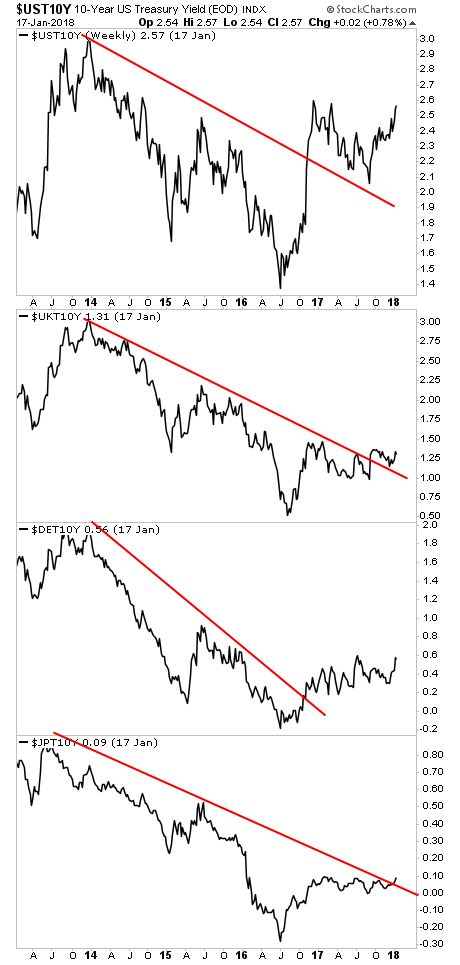
Peter Boockvar: And what we’re seeing in front of our eyes is the air leaking out of the bond bubble. Whether it’s here, whether it’s in Europe with the German 10-year breaking out above this multi-year range. I don’t necessarily know the pace of it from here, but things are changing before our eyes with interest and currencies. If there was going to be a major risk to this whole tranquil environment that it’s perceived to be, it’s the rise in interest rates and certainly a big draw down in the U.S. dollar. I mean commodity prices are at multi-year highs, the CRB printing 200 yesterday and holding them today. I think things are changing and there’s still a lot of nonchalance in the face of that.
Christopher Whalen: Of course. Markets sometime just sort of trade around numbers for a while for no particular reason and then you have an event that wakes everybody up and it moves, like the election. If you look at most charts for the bond market, there’s this big discontinuity around November 2016 and what do you do? Now it’s moved. And it moved again for a variety of reasons. China used to be the excuse, but I don’t think we’ll have that now. It will be a fairly boring inward look at China.
FRA: Chris, on your article you mentioned there could be downward pressure on long-term bond yields as the U.S. treasury concentrates future debt issuance on the short-term majorities.
Christopher Whalen: Yeah, that the schedule. And again, going back to our earlier conversation, you’re the Fed and you see treasury in the market with huge issuance. I can put a lot of pressure on short rates such that they may blow past the targets and keep going. Imagine that. Meanwhile the Fed isn’t going to sell anything outright and they’re not doing anything on the long end. They should be selling the futures at least. You don’t want to sell the cash positions? Fine, but do something because otherwise we’ll flatten just like Peter said. I totally agree with that. And it may happen quickly. It could happen in weeks – Imagine that (laughs).
Peter Boockvar: I still expect a creep higher in long rates.
Christopher Whalen: Yeah, it will bounce up, but it could easily rally. You want to be careful because there is so little paper. If they reopen the old issues which they can do, then you’ll know that somebody is yelling in that building saying, “Hey! You should be issuing longer dated paper.” The pit was planning to take their runoff and invest in the short end stuff the treasury is issuing, right? But their runoff may be so slow that they might not have that much net cash if they want to keep up with that $20 billion decline in the overall portfolio. So, I think it’s a funny situation. It goes to what Peter was saying. We could have a really nasty market environment because the Fed can’t help, the banks can’t help, they’re not allowed to anymore. So the street has no strong hands here that come in and push out a bad auction or push on the dollar if it gets messy. They would just have to intervene.
Yra Harris: And if they were to actually start…If Powell says, “I want to sell off…” to go back to your first point Chris, is that they are going to incur losses. And then they’re going to say, “Hey, we’ve got losses on our books this year because we’re actually taking some losses on the long end stuff that we bought.” So they’re kind of locked in that situation. And the situation on the front end has gotten so interesting that I actually called someone at the CME and said that I think it’s time for them to dust off the old contract and bring it back because it may become useful besides with the euro/dollar.
Christopher Whalen: Well no, this is the thing, the Fed economists in Washington were bragging about the fact that they made money on QE and they don’t understand. To your point though, Yra, what Powell has to do is get up and say, “We’re going to be selling some bits of the portfolio to help accommodate the treasury’s issuance and to rebalance because it’s far too long.” And they can do that in a variety of ways, but then he’s got to look at them square in the eye and say, “By the way, this going to reduce remittances for years.” They have a little account called the negative asset; they came up with it, where they put the losses. The congress capped the Fed’s capital at $40 billion when they confiscated the surplus for highways. So this is the situation you have and they don’t want to be insolvent. If there’s a big number in this contra account and they have $40 billion in equity, people can do the math. That’s the politics of this. It’s very strange. You got to realize that they are central bankers, they are very funny and it’s a big factor.
So, if Powell will change that? That’s a big deal.
Peter Boockvar: I think also a key factor is how much control these central banks can have over their external environment. I am of the belief that markets are going to force their hands. I still believe that cyclical inflation pressures are going to force their hands whether it’s commodity prices, wages or supply chains. I read an article yesterday on the front of the Wall Street Journal on how it’s almost impossible to find a truck to deliver your goods and people are paying hand-over-fist to just try and find drivers. I don’t think it’s necessarily fully in their hands. I mean Powell is going to have to start watching the German 10-year yield every day. Behind the scenes, obviously, a liquidity flow is turning into more of a drip and that all of these central bankers have to look at each other because what one does is really going to influence what the others do both on the upside and downside. When you think about this rise in interest rates, as some of these banks start raising, it gives other central banks cover. So, you’re less inclined to keep rates low if other people are doing it on the upside just as we saw the reverse. Peer pressure cut the rates to nothing and it’s going to do the reverse on the upside. I think that also feeds on itself. I am just amazed at people believing that this is going to be a smooth process and historically it never is.
Christopher Whalen: It’s even worse now because they took cash flow out of the system by forcing rates down. Forcing rates down is a debtor-friendly policy. It’s meant to transfer value from savers to debtors. So now, you have more volatility in the system because it’s less cash flow. People also have very little fat. There’s not a lot of embedded savings in the system from carry because your assets don’t throw off that much cash flow. It’s stunning when you look at Bank of America and the gross yield on their book is 4% — They’re not making money. The whole industry has got a negative risk-adjusted return because the return on assets is so low. In fact, I think that the number for the industry now if 0.75% on earning assets across the board. It used to be over 1.00%. And so the central banks by constantly forcing rates down, they’re taking carry out of the system and it’s not good – It’s deflationary, ultimately.
But I looked at the debt thing, Peter, and I totally agree on it. I’m going to have a lot of fun watching this. I was doing comments today for one of the regulators on whether or not they should allow different credit scores for underwriting loans – What do you guys think? Do you think that’s a good idea to have more than one way of measuring something like that?
Peter Boockvar: It makes sense.
Yra Harris: Yes, it would. I think the whole cycle from a private perspective, you know having my kids go through this stuff, and honestly it’s ridiculous. It’s truly ridiculous in the way that they measure it and they hold everyone accountable to the same standard. I know, it made the banks comfortable with time and there was a need for it, but if I ran a small community bank I would never do business like that. And I know they saddle with them. That’s not how you properly do business.
Christopher Whalen: Well, that’s what I’m telling them Yra. Like you said, the government shouldn’t be in the business of picking one. You let the people who underwrite loans figure this out and then the markets are going to tell them whether they like it or not because they’ll price the pools accordingly. So, I think we can figure this out real fast.
FRA: Just as a final question if you can go around to give your thoughts on where central bank: monetary policy and government fiscal policy is going this year in 2018.
Your thoughts, Chris?
Christopher Whalen: Well, for monetary policy I think that they are going to try and stay on the program as far as rate increases. But you get the 10-year stuck and it keeps moving Fed funds up – You’ll have a flat curve. And I think they’ll have to stop at that point.
Fiscal side: I don’t see any inclination of discipline in Washington – It’s a train wreck. They’re going to have to figure out a way to raise some revenue otherwise we’re staring at some pretty scary deficits. And I think eventually the credibility of the United States will suffer.
FRA: And Peter?
Peter Boockvar: Well, I think the weakness in the dollar is beginning to reflect the worries of those depths and deficits. That maybe we do have a $1 trillion budget deficit again in 2019. Obviously fiscal policies, in terms of tax cuts, are in place. Everyone’s got their fingers crossed that it actually improves economic growth as opposed to just improving earnings per share. We are seeing some wage growth which is a good thing, but one thing that we’ve seen is that the assumption on Wall Street was that the tax cuts all that would flow to the bottom line and we’re seeing that not all that will flow to the bottom line.
Christopher Whalen: Oh yeah. And the repatriation narrative is infantile. I cannot believe that people with PhDs in economics can sit there and go on and on about how cash is going to be brought back and invested in the United States. That’s not the way corporate finance works.
Peter Boockvar: Yeah, and a lot of that cash has been spoken for anyway with all the debt accumulation to buy back stock. So companies have already frontloaded the repatriation by taking on all this debt.
Christopher Whalen: Of course. But if you look at tax shelters like you saw they hit the Goldman because they are the great tax shelter shop. And a lot of that stuff is not going to come to light. You think everybody is going to go to the IRS and turn themselves in? The case with Dow last year that the Supreme Court declined to hear was a big deal. Donald Trump has the same tax lawyers as Dow. Trust me, the IRS now, any corporate they go to sham partnerships with as tax shelters, they basically just have to write a check. They have no appeal. There’s trillions of dollars at stake here. Trust me, these corporates are not going to come forward and say we did this wrong. Nope.
Peter Boockvar: I continue to believe that the other side of the easing mountain is upon and that creates the biggest risk for markets and the economy. People say that we’re not going to have a bear market until the economy goes into a recession and I argue that it’s going to be the rise in interest rates that leads to a decline in stocks that then leads to the recession. A trillion dollars of liquidity coming out from the Fed just in a loan is going to be a big deal as we deeper into the year. That’s what we have to look forward to over the next 2 years. The Fed taking out a trillion in loan the next 2 years after beginning that last year, the ECB ending QE, and that’s a $600 billion reduction in their run rate in 2018. And then the elimination of negative interest rates. So that’s what we have to look forward to over the next 2 years in terms of interest rates and I don’t see risk assets just whistling past that.
Christopher Whalen: Oh no. Look, everything is compressed. The whole curve is going to expand. Yra?
Yra Harris: Yeah, everything that was talked about and then you throw in the infrastructure spending package Trump is going to get through. I mean he’s not only selling the world today. You should watch how he probably hijacked Davos because they couldn’t lick his boots fast enough and he’s disruptive…So he’s got all this more debt coming on. He’s got really got discussions going on, in the United States of course, about financing debt. We are going to find out if his interest rates are going higher. We know the answer to it, but the rate of the world is going to have to find out. You have the ECB who took the Bernanke model and did everything they could to explode it with the amount that he could buy and he’s still…Peter and I know, he’s going to end in September, but it’s going to have a massive amount of assets on that balance sheet in the ECB and with the Germans breathing down their neck…There is nothing good going on there. There is nothing good and it’s going to come back to haunt. Now we have Joe from China and he’s reminding us about Minsky. The Chinese are reminding us about Minsky so we know we are in a very difficult situation and the world is just sleeping through it because you wake up in the morning and you see your stock portfolio is doing a whole lot better so you go, “What’s the difference. We’re all good here.” And they carry on. So, I think it’s going to be this year. I don’t think it’s going to wait for 2019. Some of these issues that people have chosen to pretend don’t exist. And it’s all bound to, we always know it. I think the 3 of us would agree that all crises come up from the debt market. Credit and debt markets determine everything and we’re there. It’s just what’s going to be the actual start that sets it off. I am not sure. I do agree with Peter that it’s going to be central bank oriented and it’s going to come as a change of direction. I think, Christ, you would agree with that too, it’s just how they do it. And Jerome Powell is going to be an interesting guy to see how he reacts to it.
Peter Boockvar: I think a very important question is: Where is the out-of-the-money put strike price right now on the Fed? What level, what percent decline, tells Jerome Powell that he needs to stop his tightening or reverse it? I think that’s going to be an important question.
What’s his tolerance level if these asset markets reverse themselves?
Christopher Whalen: But that’s an important question you’re asking because the tolerance level was very low. In other words, they wouldn’t tolerate any market upset. With Powell, it may be a little different.
Peter Boockvar: Because Powell has more tolerance.
Christopher Whalen: Yeah, I think he does.
Peter Boockvar: I agree.
Yra Harris: …Selloff in the equity markets? I don’t know.
Christopher Whalen: That’s the question Yra.
Yra Harris: Yeah.
Peter Boockvar: The irony is that you get a 20% correction then you’re just back to where you were last year.
Christopher Whalen: Oh, Powell has an easy button on his desk. The question is: Does he push it?
Peter Boockvar: Right.
Yra Harris: Yep, I think that’s absolutely right.
Peter Boockvar: As we speak, interest rates are breaking out today. The 10-year is up to 2.67% now. The 3-year is approaching 2.13%.
Yra Harris: And the Europeans…Today they’re not the catalyst; other times they are the catalysts. I’m interested to see it.
Peter Boockvar: Yeah, the dollar rallied for a couple hours after Trump tried to defend it and went straight back down again.
Yra Harris: And you know what? We didn’t even get into our discussion with the Swiss because they get the alchemy award of the last millennium. The game that they played here and pulled off is unbelievable to me. It tells you about the state of the world…
Christopher Whalen: Well, Peter’s right. They could take a loss on all that corporate exposure that they have. That would be a lot of fun.
Yra Harris: You know what, Richard, they finally admitted now that they are going to be the cryptocurrency capital of the world. They have been the currency capital of the world. But I think that is absolutely right. And it’s interesting, Peter, that is the Yen that turned when Kuroda was speaking at Davos today. The Yen turned very hard.
Peter Boockvar: Yep, it did. He said he’s getting more comfortable as inflation is going to their target.
Yra Harris: Yeah, and I think the Japanese are waking up that the Trump administration is not too happy with the Yen being so relatively weak. And Draghi and Kuroda can pretend all they want…And what was that comment yesterday from that one guy, and I know that they went back to that damn G20 meeting in Washington, which I kind of thought that they would, but he said, “Monetary policies that have a negative effect on currencies, that’s just an effect, that’s not a targeted currency.” Right…And that’s why every central bank when they release the statement about their interest rate intentions cites the level of the currency. Everybody in the United States, that is. Everybody talks about the level of the currency. Everyone discusses the level of their currency as being one variable in determining how they’re going to set interest rates.
FRA: Interesting times and great insight on the credit markets, financial markets and the economy. Thank you very much gentlemen for being on the podcast programmed show.
Great discussion.
Yra Harris: I’d love to do this again. This is great.
FRA: Just as a final word for our interested listeners. How can they find more information about your work, Chris?
Yra Harris: You can find my blog at www.YraGHarris.com and sign up for Notes From Underground which is also free. Whenever I write which is sometimes 4 times a week or sometimes 1 time a week will be sent you. And listen to the FRA podcasts. I think that they are very informative.
FRA: Great, thank you guys and maybe we can all do this together sometime.
Great discussion.
Yra, Peter, Chris: Thank you.
Transcript posted by Daniel Valentin
Disclaimer: The views or opinions expressed in this blog post may or may not be representative of the views or opinions of the Financial Repression Authority.
01/26/2018 - The Roundtable Insight: Yra Harris And Peter Boockvar On The 2018 Trends In The Financial Markets
FRA: Hi welcome to FRA’s Roundtable Insight. Today we have Yra Harris and Peter Boockvar. Yra is an independent trader, a successful hedge fund manager; global macro consultant trading foreign currencies, bonds commodities in equities for over 40 years. He was also CME director from 1997 to 2003. And Peter is the Chief Investment Officer for the Bleakley Financial Group and Advisory and he has a newsletter product called The Boock Report. BoockReport.com. It offers great macroeconomic insight and perspective with lots of updates on economic indicators. Welcome gentlemen.
Yra Harris and Peter Boockvar: Thanks, Richard.
FRA: Great! I thought we’d do a view on your thoughts on 2018 in general; where markets are heading, what the trends are, if you see any geopolitical events happening; effects on financial markets and the economy. And so, maybe we begin with the current rally in equities. Do you think it is sustainable? What are causes of this? Where do you see it going? Maybe start with Peter?
Peter Boockvar: So, what we have is enthusiasm, of course, post-US tax reform combined with optimism about global growth. Generally speaking, that is overwhelmed any concerns with central banks and the tightening or less easing of monetary policy. We went from “Don’t fight the FEDs, don’t fight Central Banks” to “who cares about Central Banks” because everything is fine in the economy and there is disbelief that we’re making the transition from a reliance on monetary policy to the benefits of a fiscal policy and synchronized growth. That is what the market currently believes. I think, this year, that thesis will be tested as monetary policy usually dominates fiscal policy in terms of its impact on markets and the economy because interest rates are such a strong lever and in a highly indebted global economy, that becomes even more so the case.
FRA: And Yra, your thoughts?
Yra: I have to stop and say that things Peter and I have done a lot with you Richard and so much of what we discuss is really coming to fruition. In fact, today is the most important day coming out of Davos (World Economic Forum) I hate this time of the year because I’m just not a big fan of what goes on in Davos. I found it, actually, kind of despicable to tell you the truth that these people gather and there’s so many political powerful people that are from central bankers to treasury secretaries to finance ministers discussing things and it’s an expensive ticket. I think its $650,000 to $700,000 and just what are you paying for? And it’s only going to be my problem and of course, there’s a day like today. We got a double blast; from Wilbur Ross and Steve Mnuchin. Mnuchin is a secretary and was talking about “if the dollar goes down, it’s actually good for U.S trade and Wilbur Ross, found to be more incendiary because he said,” …well, there’s trade wars every day. What was the exact phrase that he used? “Now we’re sending soldiers to the rampart”. Well, that’s a very, very incendiary phrase and I was truly bothered by that. So, everything we just talked about, everything Peter speaks to, this is going on. You know, Richard, I think that the 10-year will close out the year at 3.4%. I heard Richard Fisher today pushing about poor rate increases. Maybe. The more I hear what these people or what this administration are talking about, the more concerned I get as to where this is all going. I think I understand why Mnuchin and why they chose Davos to make these statements. That’ll be an issue for other people to think about. It’s very problematic and it does raise some serious issues for the Fed. It’s going to put Jerome Powell in a very difficult position especially if they keep the dollar down. I think we’d probably agree. The reason they keep it down. If you’re going to attack the Trump administration for starting a trade war, the only other alternative is to mark the dollar down. So, it now becomes open season, as far as I am concerned, on the dollar. So, why not? Richard, today you’re talking to two people. I know Peter has certainly been bearish, for what, $1.08 on the euro?
Peter: Yeah, $1.05.
Yra: Yeah, at $1.05 for sure. So I know these discussions have been going on for almost a year. And, Richard you know the many conversations that we’ve had in fact, I know Peter and I totally found commonalities when Mark Fields came out of the White House and talked about currency manipulation being the mother of all trade barriers. So it’s almost like this administration has adopted to that and said,” Hey, you want to go this route? We can play this game too,” and that’s where that leaves us to today.
Peter: It’s a very dangerous slippery slope. Steve Mnuchin is obviously trying to help the manufacturing sector but that’s 10% of the U.S economy. We are a consumer-based economy. So, damaging the purchasing power of a consumer-based economy is very dangerous. You have potential for rising input prices and certainly higher interest rates and I think that will swamp any benefit to multi-nationals. You have commodity prices, say CRB index, which is at the highest level in about two and a half years have rising inflationary pressure, generally speaking, particularly in wages. Now you have the threat of rising interest rates that will only be exacerbated by a weaker dollar. We import more than we export; highly inflationary. Foreigners own a lot more of our assets than we own of their assets and we rely heavily, particularly in the U.S treasury market on foreign buying of our bonds. If you look at last year, one year ago, a European buyer that wanted to pick up some yield bought a U.S treasury; 10-yr at 2.45%. A year later, not only did they lose some principal, since prices are lower, but they lost 15% by owning the dollar. So this is a very dangerous game. The administration should be focused more on currency and dollar stability, not the basement. There’s a very negative slippery slope.
FRA: Could other central banks, outside of the Federal Reserve, take reaction to this? Could there be currency depreciation intentionally done by other central banks? Do you see that?
Peter: We’ll find out tomorrow when we hear from Draghi.
Yra: There’s a lot of people short Yen or long dollar/Yen here who have been comfortable. That is not a comfortable position that you should be in because if there is somebody out there with a target on their back, it’s the Japanese. The BoJ (Bank of Japan) should’ve ended this policy. That doesn’t mean you have to start tightening and I know they’re not buying as much as they say and as the market thinks that they are because they don’t have to. There’s not that much to sell so whatever you have to clean up to keep that yield curve at that position is certainly not nearly as much as it was a year ago. You don’t really know the full amount of buying but with whatever they want to do they step into the equity market anyway people are buying but whatever they want to do. They step into the equity market anyway. It’s a very slippery slope and I think we’re going to hear from Peter’s executive director or from ECB (European Central Bank) about the strength in the euro. Now in some ways, the strength of the euro helps Draghi because it keeps the Germans at bay. It’s interesting that Jens Weidmann, now all of a sudden started talking more and more. So it does give Draghi some leverage. He could certainly go,” Well, we can afford to be more patient.” It’ll be interesting to see in his press conference how much he discusses the recent strength of the euro.
Peter: I actually think in this counter-intuitive that the strength in the euro actually gives Draghi some license to back away from his policy because inflation pressures are building in Europe as well. What the central bankers want, they have to be very careful as with, because if they achieve the inflation they want, interest rates are not going to be where they are. If Draghi gets us 2% inflation, the German 10-yr is not going to be a basis point, it’s going to be multiples of that. We saw in the market data today, talking about prices pressures intensifying. I want to bring up Japan and I’m going to quote Reid from this press release today from market on Japanese manufacturing. It said,” Strikingly output price inflation accelerated to the fastest rate since October 2008 an inch sharper rise to input cost. With a low rate in unemployment and sustained growth in official GDP data, inflation pressures should continue to mount.” Just imagine if they get the inflation they are hoping for, what’s going to happen to these bond markets? So, by having a little rebound in our currency, they can maybe moderate the inflation pressures. At the same time, giving the central banks an out. Now, of course central banks won’t look at it that way. I’m sure Draghi is going to whine about the stronger dollar is making it difficult for him but I think this is a window that’ll give them the opportunity to back away from their policies because I have to believe that they see the same inflation pressures that we do, particularly in the commodity side, with prices continuing to go up every day seemingly.
FRA: So, for this year, do you see a trend towards quantitative tightening by major central banks?
Peter: Well, the Fed is certainly initiating that. The ECB (European Central Bank) and the BoJ are just buying less but buying less is still a form of tightening. If you blow less air in a balloon, there’s still air going in but less air means a contraction of that balloon.
FRA: And Yra?
Yra: Peter and I have little bit of a different view on this because I still think that Draghi is operating, not just prior to his mandate, his self-declared mandate; is of course the preservation of the euro. I still think that his end game is to put so much debt on those books. Not that he doesn’t have it already, he does. He’s going to push for the creation of a Euro bond. Merkel (Angela Merkel), I can’t tell you what she’s thinking right now. She has got some serious issues. She was chirping about some stuff today about globalization, what they need to get done are they going to divide banking authority. There’s a lot of things in the platter in Europe. It’s just not a straight path and I really think that if inflation takes off in Germany, Draghi and a lot of bosses will be happy because it’s a way for them to punish the Germans for being so intransigent towards Greece, Spain and Portugal. And pushing for fiscal austerity even when unemployment is over 20%. You’re going to have to endure this because right now, the most ridiculously priced asset in the world is certainly German debt. It’s preposterous. Peter keeps pushing it and he’s a 100% right. Right now, the interest by any practical measure, the interest should be about 4 %.
Peter: Yeah
Yra: Right.
Peter: Which should be in line with nominal GDP there.
Yra: Yeah. Maybe 4.5%. It is so preposterous. Let alone all the others but nobody acknowledges that. They all look for reasons. Germany is a land of savers. Every bit as much as the Chinese savers. That’s why the current account surplus is so huge. It’s the largest in the world because Germany saves. They save a lot of money and these savers are being punished because the people who are wrong are not Germans who are investing in the DAX or anything, it’s German pension funds and insurance companies but it’s not individual Germans. They got beat up so bad in the market back in 1999 and 2000. They’re not that invested here. So, most of their money is in fixed income type of instruments — they’re getting killed. We’re speaking on the Financial Repression Authority (FRA), nobody is being as much financially repressed as the German population and that has political notifications.
FRA: Will interest rates tend to rise this year necessarily at different points in the yield curve for yield curves across the major economies? Peter?
Peter: I believe that’s where we’re headed. In the U.S, they keep talking about rising commodity prices and rising wage pressures that are clearly evident everywhere will see whether productivity can offset that or not. The Fed is obviously going to be buying less. You have an enormous amount of supply coming our way as debts and deficits continue to rise. We could have a trillion dollar budget deficit next year. Now, I know the relationships between deficits and interest rates that are somewhat squishy but that was the case in a bull market in bonds. If we’re no longer a bull market in bonds, then the U.S treasury market maybe become more sensitive to U.S debts and deficits. Then you throw in the weaker dollar which can impact foreign purchasing of U.S assets. So I think that interest rates here will continue higher. I think they’ll surprise to the upside. In Europe, I think, interest rates there have only one way to go and that is higher as the ECB will likely end QE (quantitative easing) in September. As they’re currently buying less, or 50% of what they were buying in December and Japan is obviously the wildcard. Actually, before I get to Japan, let’s get back to Europe because this is what bondholders in Europe have to look forward to. Not only do we have a situation where QE is shrinking and going away, but after that they have the end of negative interest rates to look forward to afterwards. So, you had the Riksbank today saying that we’re going to start the path out of negative interest rates even before the ECB starts doing it. So, we are now looking at the barrel of the end of negative interest rates over the next two years. With seven or eight trillion of negative yielding interest rates, there’s going to be a lot of money lost in just getting negative interest rates back to zero. I see only higher interest rates under many different scenarios out of the next couple of years globally.
Yra: I agree wholeheartedly with Peter. I think the 10-yr yield, Peter and I have not discussed targets and I hate choosing targets but when I got pinned down I said,” The 10-yr will be at 3.4% at the end of December of this year. I think I’m going to be low. I think the curve will be back between 130 and 150. I really believe that. If they keep bringing the dollar down, it’s going to come harder and faster as Peter talked about that slippery slope. So, I’m a 100% in agreement and at 2.63 on the 10-year it’s a nice technical level. We could go a lot farther, especially if we have the central bank step back and are not there buying as much.
FRA: Now, one of the economists at Davos we mentioned earlier is Bill White, the former Chief Economist for BIS (Bank for International Settlements). He is now the Head of OECD Review Board. Just wondering on your thoughts, he mentioned because of this rising trend in interest rates, there could be some problems on the horizon due to the problems in servicing debt. So there could be a Central Bank debt trap if you will. Your thoughts on that, Peter?
Peter: Over the last few years, the average duration of credit around the world has gotten to record highs. Which means we’re hugely sensitive to small changes in interest rates. I would have to agree with that. I’ve read some chart from Deutsche Bank saying that,” considering the amount of global debt for every hundred basis points of rise in interest expense or in interest rates, can lead to a loss of 1.2 trillion dollars on paper. We’ve been addicted and accustomed to extraordinarily low interest rates that has dictated behaviour whether it’s the behavior of lending money to a junk credit with almost no covenance to keeping zombie companies alive to buying expensive paintings and hundred million apartments in New York City or buying the S&P 500 at historic valuations compared to 1929 and 2000. Changes in interest rates are higher and it doesn’t have to be a lot higher. It could have dramatic effects on the pricing of a lot of different things because the cost of money is the important price in input to a lot of these things. I think the markets are way too nonchalant with this move in interest rates and this change in behaviour with respect to central banks.
FRA: And Yra?
Yra: You can’t say it better than that. Bill White, whom I have great respect for, as I call him Mr. Lean or Clean because in 2006, he wrote that wonderful paper for BIS talking about the role of central banks and should they be in the business of leaning into spectated bubbles or should they just wait and just clean. He was warning what was coming. We are addicted to this. We’re so addicted to just taking on more debt, more debt, and more debt. What are they using the debt for? To buy back stocks and pay dividends. This is so classic. Ray Dalio, whom I certainly respect as a thinker. I’ve been reading him for almost 35 years and Jeremy Grant also. But it seems to me they’re doing a lot of what I call “chirping” on issues that ought not be discussing such as: if you’re holding cash, you’re going to be sorry. Ok, maybe. But as I think by the time I was down with you, I did something a few weeks ago that I haven’t done in nine years. I took the free cash which is out of my trading account and bought T-bills (Treasury Bills) as my security. My daughter called me and said,” Dad, ninety-day T-bills are 138 basis points.” What am I thinking about? I’m moving and I’m not the only one because Warren Buffett said he’s got a one hundred million in T-bills. These are interesting moments here. I’m not as convinced of this great melt-up as everybody else. I think Peter is getting to where, as usual, things started getting called. We’re very sorry you own a $150 million dollar painting.
FRA: Could there be a slow-down in asset inflation due to the quantitative tightening trend?
Peter: It should. It certainly hasn’t happened yet. The sixty-four thousand dollar question is “when does it matter” and none of us know but I think we’re more confident that it will definitely will matter. I just have to be able to understand that risks are dramatically rising when you have such extreme valuations at the same time you have rising interest rates and a tightening of monetary policy. But again, the question is when does it matter and we won’t know until it does.
Yra: Yeah, and that’s right. People say, if they listen to Peter and I talk, you guys are just crying because you missed it. I have more money in stocks than I ever had. Before the market was at its highest, just by good fortune, started peeling back more. So I’m peeling back into this because I missed the last five percent. I’m not going to be upset because when the break comes, it’s not going to be a five percent break. It may be 15 or even a 20% break. Everybody says,” well that puts you in a bear market.” I don’t know that these rules people really hold in the realm of these Bernanke terminology; zero bond interest rates. I don’t know if any of these old rules hold but we’re going to find out.
FRA: Yeah, exactly.
Peter: We will find out.
FRA: Yeah. If this would’ve happened if they were a significant and fast fall in asset values of asset pricing, could there be a reverse in course by central banks from tightening back to quantitative easing?
Peter: Here is where it gets really difficult for the Fed because they went so extreme and were so slow in removing that accommodation, they left themselves with very little wiggle room. So in the past recessions, they obviously have a lot of bulls to respond. If this selloff is precipitated by higher interest rates, weaker dollar and higher inflation and the Fed decided to start cutting rates that would be a further mess for the U.S dollar and potentially even more inflationary and could lead to even higher long-term interest rates. So then what the Fed is going to do is, they’re potentially really screwed and it also ties hands with QE that could weaken the dollar even more. That gets back to the original discussion on the dollar and the administration wanting a weaker one. It really creates a difficult situation for the Fed if the dollar weakness continues because it completely ties their hands in responding to the next down term here. Because imagine them cutting interest rates with and already weaker dollar, that would be a real mess.
Yra: You know what, if you look at the last the curve steepened out over 180 or 200 baseline, I’m talking about the 210, that was when the second QE2 and everybody was convinced. Now we’re really going to get inflation. So the Fed, of course, wasn’t moving on the long end even though they were buying more. People were selling thinking inflation was really going to take hold. People are smug about the stock market breaking or possibly being negative. The other side of the coin has been where people say,” Where is the inflation?” They started talking about gold but gold is not going to go up because of inflation. Gold is going to go up because the central banks in the world capitulate to the deflationary scare because that is when gold went up the first time. There was no inflation. They would do anything and I mean anything to prevent deflation setting in and that’s what Peter was talking about. If they had to back track here now, look out!
FRA: Did that prompt them to go into extreme negative nominal interest rates so we get real nominal interest rates going into negative territory to an extreme level as if they’re cutting the interest rates on the low end to the same extent they did on the first financial crisis?
Yra: No, that view will certainly have “good friend” on the Fed.
Peter: Yes, no pun intended.
Yra: Pun totally intended. Thank you, Peter
Peter: I’m not convinced we go to negative interest rates. I think you’d blow up the U.S money market industry. I think the banks would go bananas so I don’t see that being a possibility in there. I think that the experiment with Japan and Europe with what they did to the profitability of the banks there. I think there’s a part of negative interest rates that’s been repudiated as a good policy. As the reserve currency of the world, having a negative interest rates, what a disaster that potentially could be.
Yra: I totally agree. I think that point was so well taken. I think Japanese stocks is a safe hiding place for many years. I still hold them. They’re finally starting to move now and they’ve been terrible. It’s like the European banks. Every time I hear people talk about European banks, what Deutsche Bank is trading 19.50? Big deal. They haven’t really responded well. Yeah, they’re well off their lows but that was because there was a question of their sovereignty. Now we’ve got beyond sovereignty at least for a minute until one of the European countries who really have a lot of sovereign debt becomes an issue and our sovereign bond is going to be zero risk rating forever but we’ll get to that question later.
FRA: What are your thoughts on geopolitical risk to the financial markets in the economy, Peter?
Peter: I’m less worried about geopolitical risk. It’s usually more news worthy than economic or market worthy. I don’t think we’re going to war with North Korea. I put that on the backburner, it may happen a day here or a day there. I’m less worried the geopolitics than I am of central banks really screwing this thing up.
FRA: And Yra?
Yra: I couldn’t agree more. To me North Korea, I had trip of my own to North Korea because my son who really knows Japan well. He said,” Look it, as long as the United States isn’t sending air transports and take people out of Seoul, you don’t have to worry about anything because there’s 150,000 Americans living and working in Seoul. We know what happens if the United States were to bomb North Korea. I’m just talking about bunker busters that the retaliation upon Seoul would be so great. There’s nothing going on there. To me, the most dangerous place right now politically is Europe because we have the Italian election coming up and there’s a lot more possible impact coming from there. You can’t show that on television. You can’t take a picture of what’s going on politically in Europe. You can talk about it but it doesn’t have that dramatic effect. The only thing is the Saudi-Russian connection and possibly Turkey but that’s with us at all times. The Mid-East is the Mid-East unfortunately. I don’t see much else.
FRA: What about your thoughts, Peter you recently mentioned, Europe could be the epicentre of the next financial crisis coming out of the European bond market. Do you still feel that way?
Peter: Yeah, we need to remember that the bubble this time around was in central banks and interest rates. Just by having a conversation about negative interest rates tells you the bubble ran because, you know, that’s the epitome of a hot potato market. With Europe flooded with negative interest rates and the ECB reversing themselves, that’s where I think there’s a major, major risk. I think people have to really focus on that. Plenty of risks that could emanate from the U.S but a blow up of the European bond market will have global market interest rate reverberations.
FRA: And Yra, your thoughts on that?
Yra: That says it all. There’s nothing I could possibly add to that.
FRA: Given this view on the horizon, how can investors protect themselves or what asset classes, generically, do you see as making sense in this environment? Peter?
Peter: I remain positive on commodities. Not just initially on the weaker dollar but we’ve seen years of underinvestment. Gold and silver is the way I’m playing the weaker dollar directly. I think that will continue to be a good place to be and I expect much higher prices. I think shorts from bonds, now all of a sudden, pay you something. As Yra said earlier, owning T-bills, you actually get paid in a coupon that is at or above the dividend yield on the S&P 500. Those are two places that is a way to protect yourselves, so to speak, in this kind of environment.
FRA: And Yra?
Yra: Here we are, three sophisticated money people and we’re going to park on T-bills and that’s what I’m doing. We know that real yields are still negative on the short-end but it is far better than where we’ve been. I’m moving more to cash every day. This to me, is one of the greatest gifts we’ve seen. Could it be more rational? Sure, you can. We know that. When the S&P 500 came under pressure today, the break was severe and it actually held at a huge technical level but we still have twenty minutes left and while the S&P’s are hovering at unchanged on the date, it wouldn’t surprise me to see some pressure. Especially Mnuchin and Wilbur Ross, as Peter said, they are on a slippery slope and they are playing in a very dangerous arena here and this isn’t good for equities. The equity markets are much higher ready and as Peter talked about the double-edged sword of a weaker dollar and the impact on corporate properties. It’s not as clear and easy as some people think it is because there is going to be a push back and all you’re going to do is wind up with more uncertainty and disruptions. These are serious disruptions. When you start playing and trying to manipulate financial instruments like currencies, you open up the door to a lot of unintended consequences and we saw it this morning. The first reaction was for the DOW Jones to go up because it’s a large multinational corporation they have been reading this for so long. They see a weaker dollar. “Oh that’s good for you European markets Of course, the European markets never could get up off their behind. In fact, I’m buying DAX this afternoon because they have the DAX under severe pressure but where else are you going to go in Germany? What am I going to buy? Whether the euro goes higher or not, really to me, unless it goes another ten or fifteen percent higher, would I really start to get concerned about it for European corporations. Nothing is going on here. They are playing with, not even dynamite, something that is far more volatile and I’m getting very cautious.
FRA: Great words of wisdom. Thank you very much Yra and Peter. How can I listen more about your work? Peter?
Yra: Turn into Financial Repression Authority or check out my blog www.YraGHarris.com. It’s a good place where you can get thinking. The good thing is people can really do get some trade ideas that you can really act upon. Peter and I are not offering theoretical analysis. I think there’s really bonafide proof to act upon.
FRA: Thank you very much gentlemen. We’ll end it right here and we’ll do it another time as well in another session.
Peter: Thanks guys. We’ll talk in a few days
Yra: Yeah. See you Friday. Thank you.
Karl De La Cruz
Karl.delacruz@ryerson.ca
Disclaimer: The views or opinions expressed in this blog post may or may not be representative of the views or opinions of the Financial Repression Authority.
01/24/2018 - The Roundtable Insight: Graham Summers On The Everything Bubble
FRA: Hi welcome to FRA’s Roundtable Insight .. Today we have Graham Summers. He’s current president and chief market strategist of Phoenix Capital Research, a global investment research firm located in Washington D.C. He’s a graduate MBA of Duke University. With over 15 years’ experience in business strategy investment research, global consulting and business development.
Welcome, Graham.
Graham Summers: Hi Richard it’s nice to be here.
FRA: Great having you on the show. Today we’d like to focus on your new book The Everything Bubble: The Endgame For Central Bank Policy and you got the book divided into two parts; how we got here and what is to come. So maybe we can base the discussion on that if you want to give us some insight into how we got here.
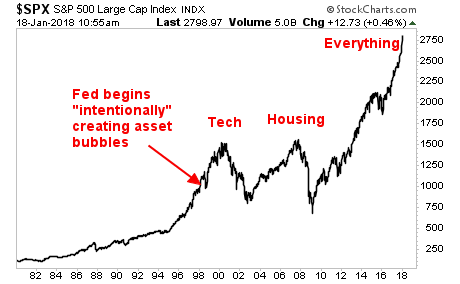
Graham Summers: Sure absolutely. So the idea for the book hit me when I saw that central banks, particularly the Federal Reserve in the United States, because I’m based in the US and most of my clients are, so my focus tends to be on that financial system. But I noticed that central banks were intentionally creating a bubble in sovereign bonds, which in the US we call them treasuries and they did this in response to the 2008 crisis. When I saw that happening it was cause for severe concern because in our current way that our financial system is set up, these bonds are actually the bedrock of the financial system. They’re the most senior asset class that there is. And if you look at what’s happened the last 20 years, we’ve had this kind of period of serial bubbles. In the late 90s, we had a bubble in technology stocks. They called that the “tech bubble”. Then when that burst, the Federal Reserve intentionally created a bubble in housing that was the housing bubble which led to the Great Financial Crisis of ’08. The significance of that is that housing is a more senior asset class than stocks. Then when the Great Financial Crisis hit in ’08, they dealt with that by intentionally creating a bubble in bond. So this is what actually gave me the idea for the title of the book The Everything Bubble because if you create a bubble in the interest rate against which all risk assets are measured, you’re going to end up creating a bubble in everything. It’s like raising the tide of the ocean, every ship going to rise as well. So I started writing the book and essentially what I quickly realized was that in trying to describe these things most people were probably not going to have a good idea of what I was talking about. And they were also probably going to ask why are things this way. So I divided the book into two parts: how we got here and what’s to come. The first half how we got here essentially started with the creation of a Federal Reserve and runs all the way up to about 2016. And I wrote with using a very simple plain language because a personal pet peeve of mine is that finances intentionally kept kind of opaque and confusing because I think it’s meant to keep most people ignorant of how the system actually works. So my goal was to write at least a hundred pages that anybody in the world could read and would instantly be brought up to speed on how did the United States financial system come into being. Why was the Fed created? How does the Fed work? You know, how did we get off the gold standard? And eventually leading up to the current era which is: how did we get into this mess? Where basically every 10 years we’re having these massive financial crises. And why is that the Central Banks are getting away with policies that really are completely insane and which none of us voted for?
I guess that answers your question.
FRA: Yeah that’s interesting. So can you walk us through in terms of the era of serial bubbles beginning, the Fed crossing the financial Rubicon, and leading up to the Everything Bubble?
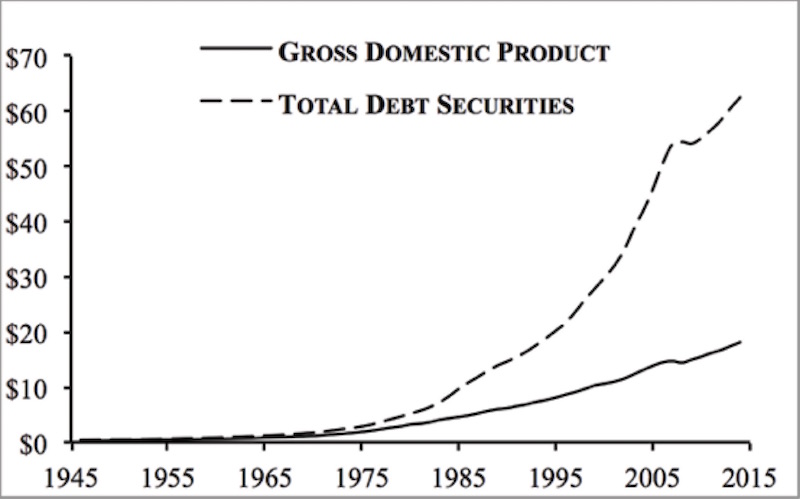
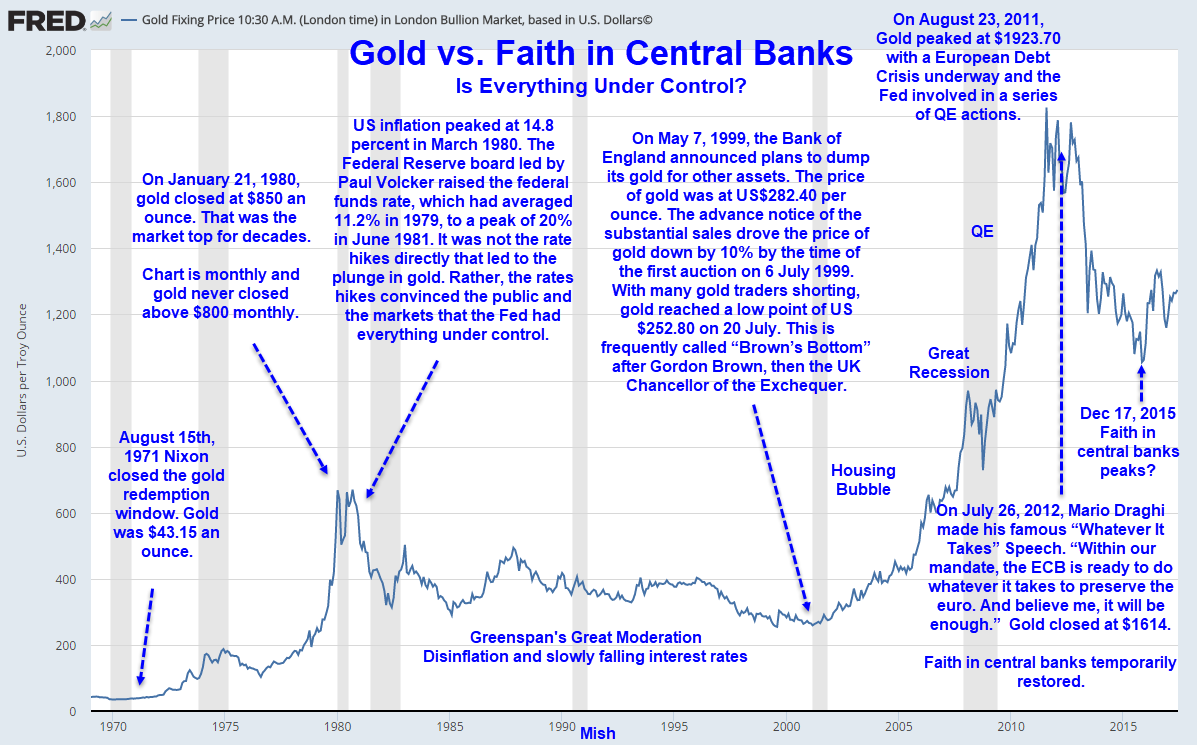
Graham Summers: Sure I’d be happy to. The easiest thing to do by the way is to just if you really want to know about the things, buy the book. It is on Amazon I think they’re running a 10 percent discount. So the stuff you’re interested in, by all means, check the book out. But the kind of the bullet point way I’d run through this would be when the U.S. completely severed from the gold standard in 1971. It did two things. Number one is: it opened the door to endless money printing because up until that point if the Fed chose to print a ton of currency, central banks and foreign governments could still convert their dollars into gold if they wanted to via the Fed. So up until that point while the Gold Standard had technically been ended for most of us in 1933 by Franklin Delano Roosevelt, it wasn’t until 1971 that the gold standard really was rendered moot for everyone including central banks. So when that happened, suddenly the US Federal Reserve and the United States would be paying any and all debt using U.S. dollars. And of course, these are U.S. dollars that the Federal Reserve can print. So what happened at that time was you see a sudden ballooning of debt relative to the actual economy in the United States.
And there’s a chart in the book which shows basically GDP, which is the gross domestic product, which is the annual economic output of the U.S. and the second line is the total debt securities and the financial system. And what do you see in that chart is that starting around in the 70s these two lines are pretty close together, but after 1971 when the world was removed from the gold standard, the trajectory of the deadline was almost parabolic and just keep going up and up and up. Meanwhile, GDP continues kind of in a linear fashion growing. This was that suddenly the system flooded with debt because the debt is paid for by dollars which the Fed can print at any time so there’s no limit to any of that. What this did was it got us to a point where in the late 90’s the amount of debt relative to the economy was so massive that if ever there was a serious period of debt deflation, which is basically a time in which debt prices are falling which means they’re starting to go insolvent, which means that people are going bankrupt. You’re going to have to restructure debt. As soon as that started to happen the Federal Reserve would panic and flood the system with liquidity because the dirty secret for central bankers is that the thing they fear most is debt deflation. When debt deflation hit, which is when debt falls in value, which means its yield goes up. It means it becomes more and more expensive to issue debt. And if most governments in the world have been financing their budgets with debt, the minute the debt deflation hit, that’s essentially the bond market saying, “hold on now it’s going to cost you a lot more if you want to continue financing your budget”. So this is always the focal point for the Federal Reserve, which is why starting in the late 90s. The Fed switched to a policy of intentionally creating asset bubbles because the alternative would be to let the financial system reset by allowing the debt to clear. Nobody is going to go for that because first of all, it is political and career suicide and second of all it’s the complete systemic reset. So Greenspan then Bernanke and ultimately Yellen all engaged in the same policy, which would then create asset bubble and any time that the asset bubble burst and a crisis hit, it will simply flood the system with more money and create another bubble.
FRA: This is quite interesting also in light of the cryptocurrency developments you mentioned the central bank power of printing money, fiat money, this whole monopoly power. Do you think that governments will give up this monopoly power to private-based cryptocurrencies? That this would be something that would not allow them to print money at will.
Graham Summers: No, they won’t endorse that in any way. Cryptocurrency is the result of two things. One is the fact that central banks are basically trashing their currencies by printing so much money and money capital flows to where it’s treated well. And if your alternatives are Swiss Francs or Euros or dollars all of which are being printed by hundreds of billion, you’re going to seek something else. So I view cryptocurrency as the natural kind of reaction to the system being set up the way it is essentially an individual saying well I want to get out of there somehow and I’m going to create an alternative. The secondary effect is capital flight from China, which is that hundreds of billions of dollars are fleeing China and they’re using Bitcoin and other cryptocurrencies to get the money out. We know that 80 percent of the trading volume of Bitcoin is actually in China, but that’s sort of a topic for another time. But no to answer your question the Fed will never endorse cryptocurrencies. What the Fed will most likely do is try to create its own. And we know from an interview that the New York Fed President William Dudley gave back in November that the Fed has actually been examining that and looking into creating their own alternative to Bitcoin and the Fed would love that. Because if the Fed could somehow get the system to go completely electronic meaning physical cash no longer exists, it would allow the regulators to monitor every single transaction that occurs. And it would also remove the systemic risk of cash because physical cash only represents about 1 percent of the actual wealth within the system. And another dirty secret is that if enough people ever went to the bank and demanded their money in physical cash the whole system would blow up, the money is just not there. You know 99 percent of the so-called wealth is just electrons stored on bank servers and none of the banks actually have the money on hand, which is why a big goal for central banks is to get rid of physical cash in the next 10 years or so.
FRA: Yes, I agree with you fully and that gets us into your other section on what is to come. So you do talk about that the war on cash and also I would say it ties into negative interest rate policy because with the abolishing of cash it would allow central banks to more easily implement monetary policy especially if it goes into negative interest rates. Would you agree?
Graham Summers: Absolutely. So if you look at what I call the period of serial bubbles which is the late 90s till today. The Fed’s response to every crisis has been more and more extraordinary. When tech stocks blew up and we had the tech crash, Alan Greenspan kept interest rates down at 1 percent and he kept them there for like three years more than he should have which is what created the bubble in housing. Because if the rate of interest held by the Federal Reserve is lower than the growth rate of economic activity, money is essentially free because you can borrow money at the interest rate investing almost anything in the economy and you’re going to pocket the spread. So that was how the Fed dealt with the tech crash. Then the housing crash happened and the Fed cut interest rates to actual zero, keep them there for 7 years and does something like 3 trillion dollars in quantitative easing, which is basically printing money and then using that new money to buy assets from the banks which is the kind of backdoor bailout essentially the Fed doing a kind of cash for trash for the Wall Street banks. So that’s what happened last time around and we now have a bubble in sovereign bond and those are the most senior asset class in the financial system. The natural logical conclusion would be that when this bubble burst we’re going to have to see even more extreme policies. And the Fed has already hinted that in research papers and in speeches what those policies would be. They would most likely be negative interest rates meaning the rate of interest the bankers and the Fed is charging on the system is negative three or maybe even negative five. We’d also have that combined with nuclear levels of quantitative easing, so quantitative easing of like 100 billion or more per month. And then at the same time they try to ban cash. The way all of this would work is implement negative interest rate. Well that makes it difficult to sit on cash, so you banned cash so that people can get their money out of the banking system and in faith because of banks trying to charge you 3 percent on your deposit. Well heck just put your money in a safe. You don’t have to pay that interest anymore. So the Fed’s going to want to close the loophole that physical cash present. Than nuclear quantitative easing, the goal here is to just buy as much debt as possible to try and stop the debt bubble from deflating in an attempt to reflate it. And then the final policy will probably be some combination of wealth taxes, bail in and capital grab. Then what basically the way I would describe this is think of it this way, if the problem is that there’s too much debt, your goal is going to be to get as much capital as possible. So any money that’s lying around whether it’s in physical cash or in say, a payroll check you haven’t cashed for a couple of years and you just forgot about it. Or perhaps a CD, a certificate deposit, lying around or even savings deposit that you have in a bank. Government regulators are going to want to get their hands on it, much of that is possible because at the end of the day the issue is there’s too much debt. Most of the large entities in the system are financially insolvent as soon as interest rate normalized. And so they’re going to try and seize as much capital as they can.
FRA: Yeah exactly. And the NIRP, the negative interest rate policy, could also be in light of inflation or rising inflation if you have real interest rates as being negative, so nominal minus interest equals real. What exactly do you see playing out in terms of negative nominal interest rates or just negative real interest rates with rising inflation?
Graham Summers: I think we’ll see actual negative interest rates meaning the interest rate is in the negative like negative three in nominal terms. If you look at the history of the Federal Reserve, typically, when they react to a crisis or a recession on average they cut interest rates about five percent from their prior peak. Which following that line, if interest rates are three percent or the next crisis hit, they’re going to cut them five percent. That’s going to get you to negative two. If interest rates are around one, that gets you down to negative four, so this is how it’s been every time for the last 70 years. So I do think we’ll see nominal interest rates. We have them in Japan, we have them in Europe. Both cases demonstrated that nobody who implements them actually gets kicked out of office which is the ultimate fear for politicians and the central banking class. So no one gets kicked out of office for doing it and for whatever reason the system goes along with it. The reason the system goes along with it is if your option is to pay a little bit of money in NIRP and I end up losing that money, but the bond bubble stays intact and the system continues to function. Versus I don’t pay NIRP, I dump my bond. The bond bubble blows up and everything goes systemic reset, you’re obviously going to choose the first one. So this is why Central Banks have been allowed to get away with policies that just defy logic. If the alternative is everything blows up you’re going to go along with it no matter what. And we saw this with NIRP in Europe, we saw with bail-ins, which is when your savings deposits are actually raided by the bank and used to keep the bank afloat. We saw that in Cyprus, they got away with it there. So, currently there’s not really any indication that there’s going to be enough societal unrest to actually stop central banks from doing that. So, obviously they’re going to do it.
FRA: And do you see the Everything Bubble as bursting at some point or will it be more off of a situation where these measures as you mention the financial repression of war on cash, bank bail-ins, and wealth taxes. Do you see those measures as ongoing within Everything Bubble continuing to expand?
Graham Summers: Yes. The second option, they’re continuing. It’s very complicated to answer that because if you have an Everything Bubble, you’re going to have small asset classes blowing up. The real question is what happens when the sovereign bond markets finally blow up. That’s when you get the actual sort of systemic crisis. So if you look at the debt market as different sectors. For instance, the subprime auto loan sector is currently under a lot of duress. So there are little areas in the economy that are already blowing up here and there. My view currently and what we’ve been telling our clients is that we think central banks are going to have to taper and withdraw liquidity this year because inflation is beginning to threaten the bond bubble. What I mean by that, is bonds trade based on inflation. Inflation is rising, and then bond yields will rise to match it. If bond yields rise, then bond prices fall. If bond prices fall enough, then you start to have a debt deflationary collapse. And while we’re starting to see is that the bond yields on the German, Japanese and United States government bonds are beginning to all rise. So the bond market, the sovereign bond market, is beginning to react to a fear of inflation. Now if central banks have a choice: pool liquidity and let stocks drop or continue with the liquidity, let the inflation genie out of the bottle and blow up the bond. They’re going to choose number one. So my current view is that in the near future like the next six months, you’re going to see a lot of central banks pulling back and getting more hawkish and they’re going to let stocks correct in some way to try and keep the Everything Bubble, the bond bubble, intact. Whether or not that works, I don’t know because once inflation starts rising it’s very hard to get it under control.
So that’s where we are right now, but actually timing the Everything Bubble bursting and thing on this day it’s going to blow up. That is impossible. You know what you can do is you can look at what’s developing in the market. That’s what I do in my financial newsletters and assess where we are in things. Currently, we’re starting to get into dangerous territory. And what matters now is to see how central banks react to it. You know if they pull back and get hawkish, they probably can get away with keeping the show going a little longer, but if they just keep printing money, particularly the ECB and the Bank of Japan, and funnelling it into the financial system by tens of billions of dollars. Inflation’s really going to become a major problem and that’s going to really crash the bond market.
So that’s where we are right now.
FRA: What about longer term. How you see that playing out?
Graham Summers: Well longer term at some point the whole thing is going to blow up just like it did in ’08. Timing exactly how that happens, you’re going to have to look for key things. You know what triggered ’08 was the underlying asset class, which the bubble was based on, in that case housing, those prices peaked and began to drop. So that started to happen with sovereign bonds recently. The question is: does that continue to happen? And then you start to see the derivatives markets and the credit markets locking up. Because if you look at ’08, the crisis, in terms of the progression you had housing peak in ’06. Then you had some of the investment funds that were investing in subprime mortgages, which is the riskiest component of the bubble blowing up that was in ’07. In ’08, the derivatives and credit markets were locked up that’s how got the great financial crisis. So if you view that as a kind of template for where we are now. The underlying asset class, in this case sovereign bonds, has peaked and is beginning to turn. The question is: Does it continue to do that and then we start to see investment funds, bond funds, and then the credit markets blow up? We’ve yet to see that and that’s the key thing I’m looking for right now. If that starts to happen that means we’re in late 2007 area of the timing of the next crisis, which would mean the next one would be insane in the next 12 18 months. But again these are the things we’re all looking for. I haven’t seen them yet. There are no definitive signs that the crisis is beginning right now. The only definitive thing is we’re seeing that the bond yields are rising and this is going to start to concern central bankers very shortly.
FRA: Could the sovereign bond debt crisis be catalyzed through Europe? If we look at Europe, what’s happening in terms of a withdrawal of some of the quantitative easing from 60 billion Euro per month to 30 billion Euro per month — Could the actual crisis come out of Europe rather than the US or Japan?
Graham Summers: It could come out of Europe for sure, it could also come out of China. In terms of Europe, the issue there is that you’ve got a lot of distinct countries with their own individual central banks none of which can print the currency anymore. The only bank that can print Euros is the European Central Bank, which is overarching all of the European Union. You know Germany has its own central bank, so does Italy, but they can’t go and print Euros. That’s what actually led to the crisis with Greece and these other countries. Well, let me back up what led to the crisis for those countries have they had too much debt relative to tax receipts. The reason why those crises actually accelerated and became systemic in nature was their central bank could not print currency or engage in bailouts directly to try and prop the system up. They had to go to the European Union and if you go the European Union then you have issues where countries like Germany and France are saying, well why are we bailing you out when we don’t have a crisis ourselves? So Europe is a kind of a weird case of mutually assured destruction. You know on the one hand if a country leaves the Eurozone, and not like Britain did but like an actual country that’s located directly in it like Italy or France, then the whole thing blows up because suddenly the credit markets go because at that point the credit rating for the European Union is different. You start seeing interest rates rising and that will render these countries insolvent. So, Europe is kind of strange case where they’ve sort of cobbled this thing along. A lot longer actually than I thought they would. I thought they were actually a serious risk of going under in 2012-2013, but again it comes back to that original issue, which is if the option is: Do I go along with this insane policy and assist the main is kept the float or do I reject it and the system blows up? Everybody in a position of power whether it’s a politician, large-scale financial firms, and the central banks is going to go number one. But absolutely if you want to look at countries that are at risk of blowing up Europe would be top of the list along with Japan and China. The U.S., while its debt situation is also catastrophic, has the benefit of having the reserve currency of the world and a more diverse and liquid economy. The way I like to put it is the U.S. is kind of the least dirty shirt in the bunch, but the reality is every single one of them is in serious trouble the minute rates normalize and when that happens then it’s anyone’s guess exactly how it goes down.
FRA: And finally, how do investors invest in this environment? How can they protect themselves in what you’re saying is likely to happen just from a generic asset classes point of view?
Graham Summers: You know everyone’s risk profile is different. If you’re looking for sort of active investment advice and sort of being steered through the financial markets on a week by week basis I write a financial product called “Private Wealth Advisory”. That’s the sort of actively involved we’re buying commodities now or selling bonds now kind of thing. That’s more for people who are actively in the market, who want to have their capital directed in a way that they’re going to continue to profit no matter what happens. If you’re someone who’s more just concerned, what do I do in the next crisis hits, you know, how do I prepare? I’m not really looking to invest actively. The best bet is probably to invest in actual hard assets, things like gold, real estate things that you actually can touch with your hand. Things that actually in the case of hard assets real estate produces some cash flows as there are benefits there. But really think of it this way if the whole world is based on paper debt, then actually owning something outright particularly something that has some sort of financial stability and a less volatile price movement that’s probably going to be one of the safer places probably to be. Does that mean that if you put all your money in real estate you’re not going to lose anything when the crisis hit? Absolutely not. Everything will get hit. The question is: how do I preserve my capital in the way that it’s hit less and I emerge from the situation with as much of my wealth intact? The only real way to go about that would be somewhere in the hard asset class is: gold, precious metals, real estate, businesses that have operating cash flow, and stable demand things. I mean there’s a big reason why Warren Buffett’s been loading up on things like Kraft and other businesses that no matter what happens, you know people will continue to eat cheese or continue to drink beer, and Budweiser awhile back. And that’s sort of the way I’d look at it that way. So it really depends on your risk profile I can’t say hey everyone go do X because everyone has a different risk profile. Everyone has a different interest, but the reality is if the big picture way of looking at things is hey there’s too much debt then central banks are going to be forced to devalue their currency to finance that that you’re probably going to want your money in something of tangible value as opposed to something based on that currency which is going to be devaluing.
FRA: Wow that’s great insight, Graham. Thank you very much for being on the Program Show. We will post a link and information on the book on the website as well. And do have a website that our listeners can learn more about your work.
Graham Summers: Sure we have two websites. One is phoenixcapitalresearch.com. That’s our website for our products where if you’re looking to be actively involved in the market you want someone actually directing you to buy and sell a different thing to tell you what symbols to buy and what price to pay. That’s where you want to go. If you’re looking just to get sort of more familiar with our work. You can do two things one is you can buy the book “The Everything Bubble: The Endgame For Central Bank Policy” on Amazon right now. Or you can go to our free e-letter. That’s called gainspainscapital.com. That’s totally free. I send out a daily briefing on what’s happening in the market and assessing some of the big picture things that are going on in the system. And finally we’re on Twitter gainspainscapital, but the Twitter handle is the @GainsPainsCapit ending with the T. And you can find us on Twitter and I am on there most days commenting on what’s happening in the world.
So those are a lot of different ways you can get a hold of us.
FRA: Also we will interweave some slides that you’ll send within the body of the transcript of this podcast on our website as well. That would be great.
Graham Summers: I’m sure they’ve done based on the conversation. I’ve got a couple of charts in mind that should help illustrate some of the things we talked about.
FRA: Thank you very much, Graham, for being on the show.
Transcript submitted by Boheira Manochehrzadeh.<bmanoche@ryerson.ca> and Daniel Valentin
Disclaimer: The views or opinions expressed in this blog post may or may not be representative of the views or opinions of the Financial Repression Authority.
01/18/2018 - Danielle DiMartino Booth: The Consequences Of Rising Interest Rates
Danielle DiMartino Booth Economic and Market Consequences of Rising Interest Rates
Jay Taylor Media, Released on 1/17/18
Danielle DiMartino Booth, former advisor to Dallas Fed Richard Fisher, talks about how rising interest rates could impact the economy.
Disclaimer: The views or opinions expressed in this blog post may or may not be representative of the views or opinions of the Financial Repression Authority.
01/18/2018 - Mark Spitznagel: We Are Living In The Age Of Government-mandated Financial Repression
“Change is the defining feature of our modern age, from science to business to politics, both in its extraordinary speed and magnitude. But you would never know it when surveying today’s financial market landscape. We are also living in the age of government-mandated financial repression – which has created a forced, false financial stability.
These exist like two contradictory, parallel universes.
Thanks to almost a decade of unprecedented market interventions by global central banks (which have collectively acquired assets totaling over $20 trillion), everywhere you look there is repression of yields, repression of market volatility, and their side effects of exploding asset valuations (to heights not seen since shortly before past historic crashes), financial-engineered debt, leverage, stock-buybacks, cryptocurrency-insanity, “short volatility” and all manner of reckless yield-chasing investment schemes.
This is an age of massive artificial economic imbalances and systemic risks.”
Disclaimer: The views or opinions expressed in this blog post may or may not be representative of the views or opinions of the Financial Repression Authority.
01/14/2018 - Chris Whalen: Bank Earnings & Volatility
“So is the Fed short volatility? No, but that is the joke on all of us. Thanks to the Fed’s manipulation of the credit markets, we are all short-volatility.
So while the Fed is certainly long duration, we dear friends are short volatility thanks to QE. Or as Grant’s Interest Rate Observer said so well: “The Fed is selling, you are buying.” As the Fed ends its reinvestment of cash when bonds redeem, volatility will return to the markets, spreads will widen and trading by private investors will rebound. A lot of market participants will get their eyeballs ripped out when the weight of option-adjusted duration shifts back to private investors. Can’t wait.”
Whalen stresses that the Fed will not be selling assets but merely ending “its reinvestment of cash when securities are redeemed .. Yet as we and a growing number of investors seems to appreciate, the Fed cannot force up long-term rates so long as it is sitting on $4 trillion worth of securities that it does not hedge. More given that the Treasury intends to concentrate future debt issuance on short-term maturities, downward pressure on long-term bonds yields is likely to intensify.”
Disclaimer: The views or opinions expressed in this blog post may or may not be representative of the views or opinions of the Financial Repression Authority.
01/12/2018 - David Rosenberg: “The Elephant In The Living Room Remains The Central Banks”
Article: In his forecasts for 2018, David Rosenberg, chief economist and strategist at Gluskin Sheff warned his clients – and our readers – that they should “enjoy the next 12 months” because contemporary market conditions, characterized by investor complacency, volatility, high valuations and a tight labor market, are eerily similar to 1988, 1999 and 2006 – years that immediately preceded major market reversals.
In his note, Rosenberg wondered whether the Fed will “remain a serial bubble blower.”
“The elephant in the living room remains the central banks,” Rosenberg wrote. “The prevailing view is that balance sheet tapering will be mild and that Jerome Powell will prove to be a dove. This may well be the most important psychological driver for the market — that a new and inexperienced Fed will not take the punchbowl away in the coming year.”
Disclaimer: The views or opinions expressed in this blog post may or may not be representative of the views or opinions of the Financial Repression Authority.
01/04/2018 - Mish Shedlock: Debt Deflation Or A Currency Crisis Is In The Cards
“Conventional wisdom says we need more inflation to deflate away the value of of debt on the books. As of November 30, 2017, Treasury Direct reported public debt as $20.59 trillion. That includes $5.67 trillion in debt we owe to ourselves (think Social Security). At higher rates of inflation, interest on the national debt would soar .. What a hoot! Despite massive amounts of QE the Fed could not hits its inflation target using its own measure of inflation as a definition. Somehow they magically believe that setting a higher target will in and of itself cause inflation .. Imagine what 6% mortgages would do to home price affordability .. Throw conventional wisdom in the ash can. In practice, the more debt and leverage the Fed stuffs into the system, the lower interest rates must be to support that level of debt .. Another round of debt deflation. a currency crisis, or both is in the cards. Timing is the only issue. It’s far too late to believe anything reasonable can be done about the mess the Fed has created .. Do yourself a favor, buy gold. It’s a strong favorite to soar when faith in central banks comes into question.”
Disclaimer: The views or opinions expressed in this blog post may or may not be representative of the views or opinions of the Financial Repression Authority.
12/22/2017 - Yra Harris On The Unsustainable Feedback Loop Of Repressed Interest Rates
“There was a very important article published on-line at Project Syndicate by the highly regarded William White. The piece, titled, The Dangerous Delusion of Price Stability, raises several important issues regarding the central banks belief that ‘low inflation is also a sufficient condition for sustained growth.’ White cites the inability to acknowledge that there are many various sources for disinflation. Sometimes there are demand shocks while at other times supply shocks such as when previous controlled economies unleash a massive labor force on the global economy. The effort to fight disinflation keeps interest rates low even when the cost of capital ought to rise in order to prevent a situation of excess capacity on a global scale. By keeping borrowing costs too low the entire financial system increases borrowing which leads to a feedback loop of having to sustain low interest rates. As White said: ‘True, as a matter of arithmetic, deflation increases the real [inflation-adjusted] burden of debt service. But if debt levels are at ONEROUS HEIGHTS AS A RESULT OF EASY-MONEY MONETARY POLICIES, [emphasis mine] it is not obvious that the solution to the problem is still more easy money.’
Policy makers need to wean themselves off the inflation-targeting nature of global monetary policy. Please read the White piece as it sets the agenda for so much of what we will face in 2018. Along with White’s piece is the need to remind ourselves of the warning from Mr. Zhou from the Bank of China: There is far too much complacency as debt-to-GDP ratios rise, creating the environment for a Minsky Moment. As interest rates rise the massive increase in debt on corporate, government and personal balance sheets will have to be serviced. Will there be enough growth to satisfy creditors? The Bernanke FED was an experiment in preventing the onset of deflation as experienced in the 1930s but while the portfolio balance channel boosted asset values the Bernanke plan had no exit strategy. Enjoy the calm as we head into a new year.”
Disclaimer: The views or opinions expressed in this blog post may or may not be representative of the views or opinions of the Financial Repression Authority.
12/22/2017 - Here It Comes: G20 Meeting To Regulate Bitcoin
Germany Joins French-led Moves to Regulate Bitcoin at G-20 Level
Disclaimer: The views or opinions expressed in this blog post may or may not be representative of the views or opinions of the Financial Repression Authority.
12/22/2017 - Druckenmiller: “Central Banks Are The World’s Darth Vader”
This Vader Grows Asset Bubbles Then They Burst. Central Banks Have Repeated The Same Mistake Of 2003-2007. $8.3 Trillion Central Bank Intervention & Only $2.1 Trillion GDP Growth….
Disclaimer: The views or opinions expressed in this blog post may or may not be representative of the views or opinions of the Financial Repression Authority.
12/22/2017 - IMF: Abolish Cash But Don’t Tell Anyone
In a recent paper – The Macroeconomics of De-Cashing, Alexei Kireyev of the International Monetary Fund advises abolishing cash without having the citizens aware of the process.
Disclaimer: The views or opinions expressed in this blog post may or may not be representative of the views or opinions of the Financial Repression Authority.
12/22/2017 - Nomi Prins: How Central Banks Are Influencing The Financial Markets
“The ‘dark money’ comes from central banks. In essence, central banks ‘print’ money or electronically fabricate money by buying bonds or stocks. They use other tools like adjusting interest rate policy and currency agreements with other central banks to pump liquidity into the financial system.”
Disclaimer: The views or opinions expressed in this blog post may or may not be representative of the views or opinions of the Financial Repression Authority.
12/15/2017 - Stan Druckenmiller: Central Banks Are Financial World’s “Darth Vader”, Creating Exploding Asset Bubbles
“If I was ‘Darth Vader’ of the financial world and decided I’m going to do this nasty thing and create deflation, I would do exactly what the central banks are doing now” the billionaire told CNBC Tuesday.
Disclaimer: The views or opinions expressed in this blog post may or may not be representative of the views or opinions of the Financial Repression Authority.
12/11/2017 - Russia & Other Oil Producers To Create Oil-Backed Government Cryptocurrencies?
“The gradual acceptance of digital currencies, with major exchanges about to launch bitcoin futures trading, may prompt some oil producing nations to ditch the US dollar in crude trade in favor of cryptocurrencies, an oil analyst says.”
Disclaimer: The views or opinions expressed in this blog post may or may not be representative of the views or opinions of the Financial Repression Authority.
12/11/2017 - Forbes: What Is Financial Repression?
“Stanford economists Edward S. Shaw and Ronald I. McKinnon coined this term. In short, it means governments essentially use the private sector to service debt ..
Financial repression is also useful for governments to control capital and have its citizens consume the bulk of domestic government debt.”
Disclaimer: The views or opinions expressed in this blog post may or may not be representative of the views or opinions of the Financial Repression Authority.
12/07/2017 - Bill Gross: When Credit Risks Increase, Creditors Increase Preference For Classical Money And The Financial System Can Be At Risk
“High-quality credit can at times take the place of money when its liquidity, perceived return, and safety of principal allow for its substitution.
When the possibility of default increases and/or the real return on credit or liquidity decreases and persuades creditors to hold classical ‘money’ (cash, gold, bitcoin), then the financial system as we know it can be at risk (insurance companies, banks, mutual funds, etc.) as credit shrinks and ‘money’ increases, creating liquidity concerns.
Someone asked me recently what would happen if the Fed could just tell the Treasury that they ripped up their $4 trillion of T-bonds and mortgages.
Just Fugetaboutit! I responded that that is what they are effectively doing. “Just pay us the interest”, the Fed says, “and oh, by the way, we’ll remit all of that interest to you at the end of the year”.
Money for nothing – The Treasury issuing debt for free. No need to pay down debt unless it creates inflation. For now, it is not. Probably later.”
Disclaimer: The views or opinions expressed in this blog post may or may not be representative of the views or opinions of the Financial Repression Authority.
12/06/2017 - Martin Armstrong: Bitcoin To Be Declared A Financial Institution To Avoid Currency Competition With Government Currency and Government Cryptocurrency
“Now comes Bitcoin. The Judiciary Committee of the United States Senate is currently working on Bill S.1241 that aims to criminalize deliberate concealment of property or the control of a financial account. The bill was submitted in June, and the law would change the definition of ‘financial account’ and ‘financial institution,’ and thus also cover digital currencies and digital exchanges. Who is pushing it? None other than California’s Senator Dianne Feinstein, who maintains that the bill is needed to update existing money laundering laws because of terrorists.
This means that the miners of Bitcoin will become a ‘bank,’ .. .
.. They can shut down Bitcoin in the blink of an eye by simply defining anyone who is a miner to be a financial institution.
The bill will change the definition of “financial institution” in Section 53412 (a) of Title 31 , United States Code. The text will read:
“An exhibitor, a redeemer or a cashier of prepaid access devices, digital currency or a digital exchanger or a digital currency.”
The regulation will remove the anonymity of Bitcoin and other cryptocurrencies defeating this idea that there is an alternative-financial-universe separate from government.”
Disclaimer: The views or opinions expressed in this blog post may or may not be representative of the views or opinions of the Financial Repression Authority.


 02/14/2018 - Martin Armstrong: The Sovereign Debt Crisis Is Here