Blog

03/18/2016 - Ty Andros: “ITS A CURRENCY & FINANCIAL EXTINCTION EVENT!”

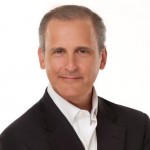
The Financial Repression Authority is pleasured to be revisited by Ty Andros, Chief Investment Officer of the Sanctuary Fund. FRA Co-Founder Gordon T. Long has has a stirring conversation with Mr. Andros on a number of current economic developments and consequently, the things to unfold.

Ty began his commodity career in the early 1980’s and became a managed futures specialist beginning in 1985. Mr. Andros duties include marketing, sales, and portfolio selection and monitoring, customer relations and all aspects required in building a successful managed futures and alternative investment brokerage service. Mr. Andros attended the University of San Diego, and the University of Miami, majoring in Marketing, Economics and Business Administration. He began his career as a broker in 1983, and has worked his way to the creation of TraderView of which he is the CEO. Mr. Andros is active in Economic analysis and brings this information and analysis to his clients on a regular basis. Ty prides himself on his personal preparation for the markets as they unfold. Ty is an expert in applying the indirect exchange method as a principle of the Austrian School of Economics in his investing approach.

THE AUSTRIAN SCHOOL OF ECONOMICS

It consists of 3 major components.

  1. Sound money and private property
  2. Free market capitalism
  3. Human behavior

The cycle we are going through now has happened hundreds of times in history and has led to the rise and falls of empires. It’s because of people forgetting the past and repeating the same mistakes. If you don’t have sound money, you really don’t have protection against the government. They can confiscate your money and they have been doing so since Bretton Woods.

“The money that we hold in banks is a worthless junk bond. The government has essentially become the mafia; they are scheming and transferring property to themselves.”

SOUND MONEY

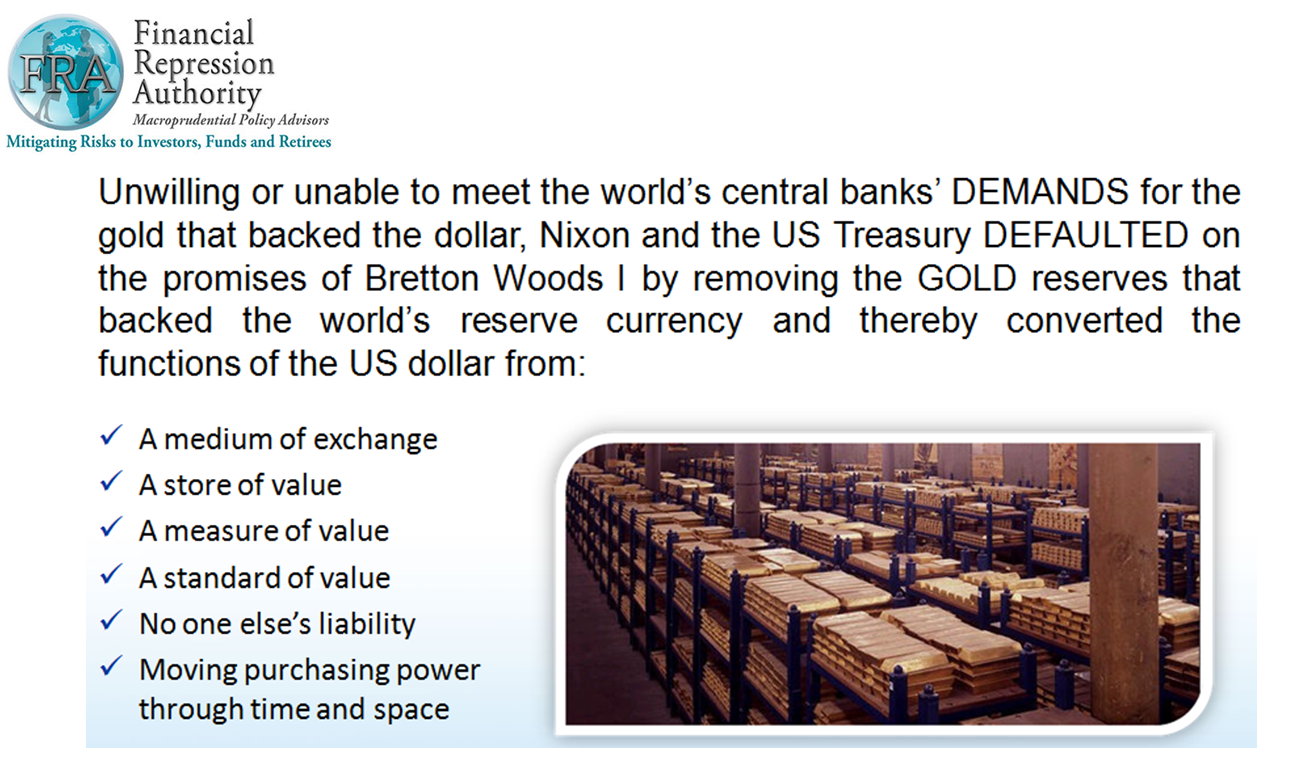
The figure below outlines the specific functions of money:

1.1

If it doesn’t have these components then you’re not holding money. Until 1971 it had all those features, and it has been replaced with an I.O.U of fiscally and morally bankrupt politicians and banks. It is worth no more than the paper it is printed on.

“In my opinion, the gold and silver bear market is over so it is a prime time to start accumulating now.”

MARKET CAPITALISM AND WEALTH CREATION

Capitalism is about getting more for less and three groups of people being rewarded for it: The consumer because he is able to give his family a better life, the company which supplied it, and the employees within the company.

Socialism eats everything. Real wealth and income creation are in freefall. There will be no recovering. The confiscation of wealth is also known as runaway regulations, runaway debt creation, more taxes and currency debasement.

“Its pure confiscation, cannibalism, and slavery. It is eating the golden goose. It’s the people that aren’t self-reliant and don’t produce anything eating those that do.”

It’s pure confiscation, cannibalism, and slavery. It is eating the golden goose. It’s the people that aren’t self-reliant and don’t produce anything eating those that do. Nobody owns their homes, it’s simply a record that’s held in a database and all they have to do is misplace it. Nobody owns their stocks in their name and if you look at your banking agreement you don’t even have title to your money, the bank does. Slowly but surely they have removed everything. They don’t let you hold money because they can’t steal from it; real money has been outlawed.

“Gold is the currency of kings, silver is the currency of merchants, and debt is the currency of slaves.”

CURRENCY EXTINCTION EVENT

1.3

GDP is nothing of the sort, it’s just debt disguised as GDP. It is spending future wealth rather than creating future wealth for proper allocation to productive enterprises.

1.4

“We have nothing; we are just a bunch of debt slaves living in an illusion until we wake up.”

THE EVENTS OF 1971

President Nixon changed from a reserve backed system where the dollar was semi redeemable in gold and silver to a system that has no backing.

“It was the greatest heist in history. It was the greatest transfer of wealth from the public to the ‘bankseters’.”

He did this so that he wouldn’t have to operate in a prudent manner. Prudent manner means have to pass laws and have taxes which gives people a reason to get up in the morning and have the ability to do the capitalism which was discussed earlier. When you have bad laws and bad regulations, the economy will either collapse or they have to print the money to fill the whole; unfortunately they chose the latter.

I believe that banking institutions are more dangerous to our liberties than standing armies. If the American people ever allow private banks to control the issue of their currency, first by inflation, then by deflation, the banks and corporations that will grow up around [the banks] will deprive the people of all property until their children wake-up homeless on the continent their fathers conquered. The issuing power should be taken from the banks and restored to the people, to whom it properly belongs. - Thomas Jefferson

“History has shown what happens to people who try to fix this system.”

Kennedy was taking the central bank back and creating silver backed money, 90 days later he was dead. Of course we will never truly know, everything is so covered up now and the government is incapable of telling the truth.

THE INDIRECT EXCHANGE

“This is how you go through a currency and financial extinction event. Exchange something of uncertain value, fiat money, for something of certain value, real wealth. This is the indirect exchange in simplest terms.”

So much of the ‘financialization’ of the economy is an illusion because it is not the real things going up; it’s the paper that they’re priced in losing its purchasing power

“The greatest applied Austrian economist in the world is none other than Warren Buffet. “

What Warren does is he sells paper which means liabilities are being debased by central bank’s printing presses and credit creation. If he writes an insurance policy for someone for $10 million, he now has a liability of 10 million, if he did this in 2000 that liability may be 5 million and simultaneously he took that money and bought the Burlington Northern Railroad, which is something that will just reprice to reflect the lower purchasing power it is denominated in. If we are in a depression or a boom, regardless the railroads will run. Half of his great track record is inflation that isn’t properly disclosed. He has been doing this since, coincidently 1971. He has been selling paper and buying real things with cash flow ever since.

Gold doesn’t cash flow but it is about to. Because of negative interest rates you’re paying somebody to borrow money from you. If you are able to hold your money without having to pay someone to hold it.The gold and silver bear market is over. As these destructive negative interest rates go deeper and deeper, people will eventually wake up. They’ve already woken up, this is what’s going on with the presidential race and particularly Donald Trump.

“This is the greatest insanity ever. It will be studied and written about for centuries. It is a much bigger example of stupidity and failing to learn the lessons of history. It is much larger in scale than the Great Depression because of the nature of globalization and the nature of man.”

Abstract written by, Karan Singh  Karan1.singh@ryerson.ca

Video Editor: Sarah Tung sarah.tung@ryerson.ca

Disclaimer: The views or opinions expressed in this blog post may or may not be representative of the views or opinions of the Financial Repression Authority.


03/16/2016 - Egon von Greyerz: “THE WAR ON CASH IS REAL!”


Gordon T Long, Co-Founder of FRA interviewed Egon von Greyerz  in Zurick. Egon Von Greherz is the founder of Matterhorn Asset Management who has worked as a financial director for over 17 years in Geneva, and has been advocating for wealth preservation through Gold for over 13 years. MAM now has plans in over 40 countries for investors to place their savings into physical Gold storage for preservation in the world’s largest Gold vault in Switzerland.

Wealth Preservation

Egon says that approximately less than half a percent of assets are invested in Gold today by the people and that most of them do not own any Gold whatsoever. Even with the risky stock market in recent months we have not seen a significant increase in the purchase of Gold as an investment itself. However the increase in Gold purchases is linked more closely to the retail market for public use. Von Greyerz expects the market stocks to drop further down below their current value and is viewing the current spike in stocks as a mere bear trap, insisting that following this we may see a rise in purchases for gold.

“Less than half a percent of world financial assets are of gold today and that’s absolutely nothing!”

It is necessary to understand that gold is not to be viewed as an investment but for insurance purposes against all the property investments and bonds that you may have currently. For over 5000 years the price of gold has only gone up and the value of money has been decreasing ever since. With the expectation of the stock market dropping by at least 50% in its current state, having even 10% of your assets in gold will ensure the safety of your portfolio. The reason being that with the drop in stocks the price of gold compared to the dollar could be at a 1:1 ratio like the 1980’s meaning Gold will outperform all the other assets.

With only a .5% of current assets invested in Gold there is no current risk of a shortage of physical Gold. However, in the near future with the price of Gold expected to rise rapidly there is a certainly a risk of there being a shortage. If institutions, governments and pension funds begin to hedge their assets in gold there will never be enough Gold to satisfy their needs. Alongside rapid printing of money there will be no way to control the rapid increase other than to increase the price of gold itself to purchase smaller amounts of physical gold but for much larger prices to ensure that there is no shortage of real Gold.

“In the next few years it will be hard to get a hold of gold, as there will be a time when there will be no price offered in the market for gold due to its shortage”

Thoughts on NIRP and the cashless society

There are no positive consequences for this situation, Japan had other options but chose this disease which again will make no difference to either economy in the world. The negative interest rate will however stop withdrawals and place cash limits in Europe since people would rather take the money out and hold on to it rather than pay interest on it. But we should still expect more countries to go into negative interest rates even though it is hard to imagine this central bank policy to solve our economic problems.

Unfortunately there are not many other options for investors at the moment to encourage them to place their money elsewhere outside of the collapsing banking system. To avoid possible ‘bailins’ people can invest in property, fine art, and precious metals but not much else to be safe from this risk. Gold on the other hand has not seen a significant price increase and shows just how powerful it can be in the future. It is like holding real money it has the equivalent purchasing power to any currency in its history for the past 5000 years and does not devalue over time.

Even in the event that a bank does not have money to exchange for your gold you may still use it as barter, it has had this function throughout its history and will remain this way. It is an excellent opportunity for insuring your wealth and having liquidity at the same time. This is away from the banking regime and does not need to be declared to the IRS either for further taxation.

Furthermore, there is no safe spot currently to store your wealth other than a select few countries with good law and politics to ensure you get to keep what you’ve earned. Switzerland currently holds 70% of all the gold bars in the world and is by far the most secure location for storing wealth in long term.

Egon does not think that the current primary elections going on in the United States will have any effect on the current economic situation of the world. Referring to the fact that there is simply too much debt at this point and no difference will come from the selection of a new president. He suggests that there needs to be a complete systemic overhaul of the way the economic system works. Egon von Greherz publishes several articles weekly and you can find his research and upcoming investment opportunities online at www.matterhorn.gold or at www.goldswitzerland.com

ABSTRACT BY: Saad Gohir   sgohir@ryerson.ca

VIDEO EDITING BY:  Min Jung Kim minjung.kim@ryerson.ca

Disclaimer: The views or opinions expressed in this blog post may or may not be representative of the views or opinions of the Financial Repression Authority.


03/15/2016 - Egon von Greyerz: Wealth Confiscation Through ZIRP, NIRP, Bank Bailins, Forced Savings, Currency Debasement

Egon von Greyerz explains how ZIRP & NIRP is essentially confiscation of your money & it is happening now .. highlights also the growing potential for more bank bailins across the indebted western world .. negative interest rates leading to a cashless society leading to bank bailin confiscation of bank deposits – it is all related & connected .. “The biggest reason for creating a cashless society is stop bank runs. The banking system is insolvent and leveraged up to fifty times and even more if derivatives are included. This means that there is only enough money in the bank for one client in fifty or two percent of clients in total to take out their money. If more people tried, the bank would have to close its doors because it would be bankrupt. By stopping clients to take cash out, bank runs are no longer possible. In theory clients could transfer their money to another bank but that would also be stopped. So now the bank has your money, it charges you for that pleasure and you can’t get your money out because your money is frozen or confiscated. This is what has become of the bankrupt banking system .. When a bank becomes insolvent, depositors money will be used to save the bank and to pay the bank’s losses .. Another method that bankrupt governments will apply is to use bank deposits for forced savings. Every depositor will be obliged to put some or all of his cash into long term government bonds, probably for at least thirty years. It is easy to imagine that the money will be totally worthless after thirty years .. And if your money hasn’t been lost already after all the above, central banks are guaranteed to print enough money in coming years that most currencies will reach their intrinsic value of zero. Governments will have no other option in their attempt to save the financial system. We know of course that money printing can never save the world. All it will do is to add more debt, thus making the final collapse even bigger.”

LINK HERE to the article

Disclaimer: The views or opinions expressed in this blog post may or may not be representative of the views or opinions of the Financial Repression Authority.


03/15/2016 - Negative Interest Rates Are Driving Demand For Gold

The economic uncertainty & negative interest rate policies being implemented in various economies are a boost to gold, & in turn, asset management firm Sprott. For perspective, BNN is joined by Peter Grosskopf, CEO, Sprott .. 5 minutes

Japan’s Negative Interest Rates
Are Boosting Demand For Gold

Bloomberg reports that Japan’s biggest bullion retailer sees gold demand being driven by deepening negative interest rates in Japan .. “Many customers are wagering that it’s better to turn their savings to gold as a safe asset rather than deposit money at banks that offer low interest rates .. Many customers usually sell gold, but we get the feeling that more customers are buying gold even at prices exceeding 5,000 yen.” .. Bloomberg: “In a bid to stimulate bank lending, the BOJ has joined the European Central Bank in setting rates below zero. While that should also spur investment in higher-yielding assets, it may also have had the unintended consequence of households squirreling away cash — or turning to a traditional store of value such as gold. Sales of safes in Japan are surging, suggesting as much.”
LINK HERE to the article

Disclaimer: The views or opinions expressed in this blog post may or may not be representative of the views or opinions of the Financial Repression Authority.


03/15/2016 - Paul Brodsky: Negative Rates Are A Negative Sign For Investors

Macro Allocation Founder & Chief Strategist Paul Brodsky thinks it’s time investors prepare for this unconventional world .. Brodsky notes it is irrational to expect economic expansion .. “After seven years of major exogenous monetary stimulus concluding in negative rates around the world, investors today would be irrational to expect an economic expansion in the coming years or even a mild recession followed by a garden variety expansion .. If we assume that high and rising global leverage (as measured by debt-to-GDP or debt-to-base money) will eventually crowd-out global consumption and demand growth, then we can also assume that the purveyors of money and credit will be able to selectively apply austerity within their economies.” ..  Negative rates are a negative sign for investors .. “Negative sovereign yields and policy rates (NIRP) might be ringing the proverbial bell.” .. It is time to find value not just in stocks that have been overlooked & are at low valuations, but also time to project into the future & see stocks that are at unsustainably high valuations .. “Longs, shorts and arbitrage opportunities are presenting themselves clearly .. Prudence demands that wealth seeking investors (as opposed to those matching liabilities or trying to beat indexes) position themselves accordingly.”

LINK HERE to the article

Disclaimer: The views or opinions expressed in this blog post may or may not be representative of the views or opinions of the Financial Repression Authority.


03/13/2016 - Yra Harris: Draghi Is Leveraging Policies To Bailout The European Banking System

Draghi Fires A Water Pistol At Global Liquidity
To Bailout The European Banking System
& Indebted Eurozone Governments

“After the smoke had cleared from ECB’s announcement to cut the deposit rate another 10 BASIS POINTS to NEGATIVE FORTY, the central bank ADDED MORE MONEY TO THE SYSTEM VIA AN INCREASE IN QE TO EIGHTY BILLION EUROS A MONTH. The press called this a BAZOOKA but I THINK IT IS A WATER PISTOL .. The ECB is going to pay banks MAYBE 40 basis points to take money and lend it out to borrowers .. The domestic banks in each nation can buy their government’s debt and under the CURRENT BANK FOR INTERNATIONAL SETTLEMENTS (BIS) RULES government debt is given a zero-weighted risk so sovereign debt does not require holding reserves to offset the liability of lending to the government. DRAGHI IS TRYING TO BAIL OUT THE BANKS THROUGH THE BACK DOOR. As I wrote yesterday, the NON-PERFORMING LOANS ON THE BOOKS OF ITALIAN BANKS ARE CONSERVATIVELY ESTIMATED AT 16%. Do you really think that the battered Italian banks are in a hurry to make more loans to zombie firms or will they take the zero-priced money and load up on Italian 10-year notes that yield 150 basis points? .. DRAGHI IS TRYING TO LOAD UP THE ECB WITH DEBT THAT WILL BE SECURED WITH THE GERMAN CREDIT CARD.”
– Yra Harris

LINK HERE to the article

Disclaimer: The views or opinions expressed in this blog post may or may not be representative of the views or opinions of the Financial Repression Authority.


03/13/2016 - Negative Interest Rates On 40% Of Outstanding European Bonds!

Courtesy of Torsten Sløk, Ph.D., Deutsche Bank

Disclaimer: The views or opinions expressed in this blog post may or may not be representative of the views or opinions of the Financial Repression Authority.


03/11/2016 - Jeffrey Snider: US$ STRENGTH IS A MANIFESTATION OF A US$ SHORTAGE

FRA Co-Founder Gordon T.Long and Jeffrey Snider, Head of Global Investment Research at Alhambra Investment Partners discuss a broad array of Global Macro subjects in this 48 minute video discussion with supporting slides.

As Head of Global Investment Research for Alhambra Investment Partners, Jeff spearheads the investment research efforts while providing close contact to Alhambra’s client base. Jeff joined Atlantic Capital Management, Inc., in Buffalo, NY, as an intern while completing studies at Canisius College. After graduating in 1996 with a Bachelor’s degree in Finance, Jeff took over the operations of that firm while adding to the portfolio management and stock research process.

In 2000, Jeff moved to West Palm Beach to join Tom Nolan with Atlantic Capital Management of Florida, Inc. During the early part of the 2000′s he began to develop the research capability that ACM is known for. As part of the portfolio management team, Jeff was an integral part in growing ACM and building the comprehensive research/management services, and then turning that investment research into outstanding investment performance. As part of that research effort, Jeff authored and published numerous in-depth investment reports that ran contrary to established opinion. In the nearly year and a half run-up to the panic in 2008, Jeff analyzed and reported on the deteriorating state of the economy and markets. In early 2009, while conventional wisdom focused on near-perpetual gloom, his next series of reports provided insight into the formative ending process of the economic contraction and a comprehensive review of factors that were leading to the market’s resurrection. In 2012, after the merger between ACM and Alhambra Investment Partners, Jeff came on board Alhambra as Head of Global Investment Research.

Jeff holds a FINRA Series 65 Investment Advisor License.

US TIC REPORT, TREASURY SALES

FRA Podcast TIC2

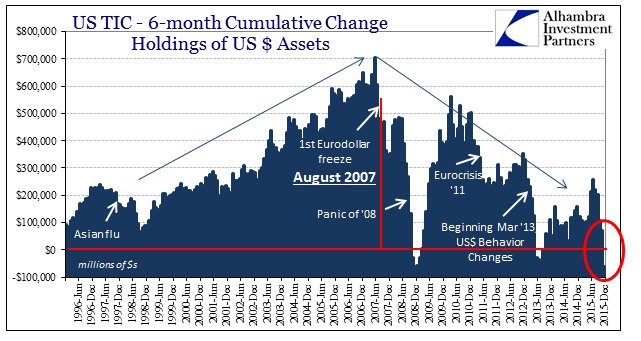
TIC is a compilation done by the US Treasury based on their access to data on foreign accounts and holdings of Dollar accounts and securities, and estimates the foreign Dollar market. Over the last decade or so, it is clear that the Eurodollar market grew steadily at a rapid rate until about August 2007, at which point it pivots and comes back down. The TIC data shows the tendency of dollar markets to essentially be stable, usually addressed through selling Treasury. However, the private dollar markets offshore are in disarray to the extent that central banks around the world are forced to fill the dollar deficiency with their own holdings. Of especial note is China’s reduction of their US Treasuries and foreign currency reserves, and OPEC countries incurring serious Current Account deficits in an attempt to maintain their pegs with the US dollar.  In addition are the emerging markets who borrowed about $7-9T in USD, who now have difficulty paying back debts due to slowing trade and falling currencies.

This all leads to the US dollar strengthening, which is the manifestation of the dollar shortage. In recent days, Japan using NIRP will further disrupt the dollar system.

“US Dollar Strength is a manifestation of a US Dollar Shortage!”

JAPAN: QE FAILURE AND WHAT NIRP MEANS

FRA Podcast Japan2

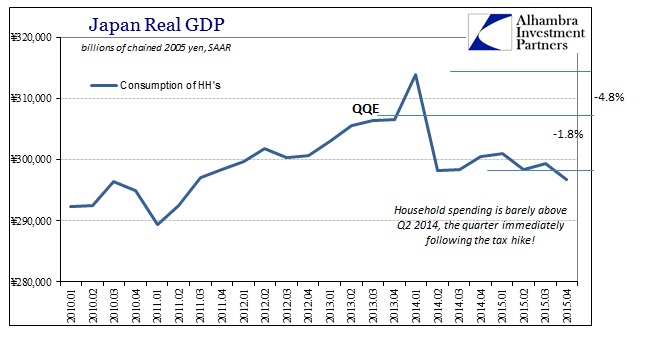
Under QE, Japan obtained a burst of inflation around 2014. Instead of leading to sustained economic activity, household income and spending dropped about 7%, which was also not offset by growth in GDP and demand. The surge in expansion, due to cheaper money, increases supply which then demolishes pricing power. In addition to the reduced value of savings, large companies have also shifted production offshore, thus increasing the effect and emphasizing the failure of QE/QQE to stimulate the economy.

NIRP also carries with it the threat of failing like QE, along with numerous other particle effects that cannot be currently measured or predicted, mostly as this type of system has not existed for over a hundred years. This is an indicator of the lack of power central banks have over the economy, but can be put down to overemphasizing the value of monetary policy over fiscal policy in the developed world. The dollar system has been artificially expanded past any control by banks and monetary policy, globally, over the last decade. The only way to stop it is to focus on other fiscal factors that would allow economic potential to be realized again and to refrain from following Keynesian economics once it has been proven to be ineffective.

“Japan is a test case in almost clinical conditions for QE and QQE, and it failed on every count.”

CHINA: COLLAPSING TRADE AND CREDIT

FRA Podcast China2

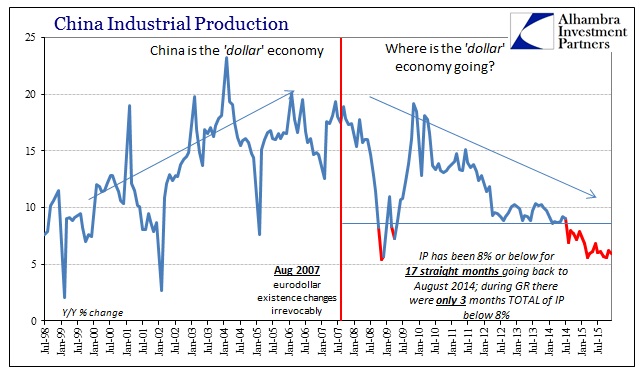
China is both an impediment to growth and a casualty of the rest of the world, but recently more of a reflection of the global dollar economy as they are most sensitive to changes there. The lack of growth over several years forces a fundamental shift toward a Keynesian response of fiscal and monetary stimulation that creates asset buffers at odds with overcapacity. Meanwhile, China still lacks any real method for economic growth and is forced to react to outside influences while juggling the problem of overcapacity with the falling export industry. This then leads to capital flight, which furthers the struggle to grow GDP.

China is clearly attempting to manage the Yuan by selling dollars to strengthen it, but will eventually falter like any pegged currency. Many currencies pegged to the US dollar, Eurodollar, and Petro dollar will likely collapse. Keynesian economists believed that 2007 was the beginning of a temporary deviation from sustainable global growth, but was in fact the structural revaluation of higher economics of the financial system. We are likely headed for a systemic reset and reorientation, which will be disruptive with significant risk but can be adapted to.

“I think we are headed for a systemic reset.”

RETAIL: JANUARY SALES AND CONTINUING TREND

FRA Podcast Retail Sales1

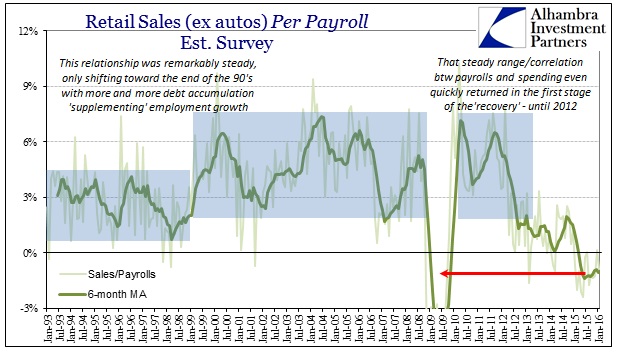
Retail sales have been near recession levels of low, indicating that consumers are under pressure, but inventories are still rising despite manufacturers cutting back. Retail slowing is a fixed trend starting from 2012, amplified in 2014-2015 with the disappearance of the manufacturing industry and loss of export goods. This is likely due to lack of real recovery that slowly eroded US consumers’ ability to continuously expand their activity. The middle class has no savings, so thus the capitalist system that relies on savings to reinvest into productivity.

Over the last several years, companies have been spending on buybacks instead of investing in productive capacity. 1900 of the S&P companies spent more on buybacks and dividends than they were earning, thus creating more debt.

“Recession is a necessary process, like anything else. It’s creative destruction.”

LABOR: FULL EMPLOYMENT – NOT REALLY!

FRA Podcast LaborEmpl1

There is a major disconnect between major unemployment statistics and the rest of the economy, where even having a job is not necessarily enough to support the expected standard of living. There are low prospects for growth in the job market, and people sense that there is a need for a restructuring of the system. Job growth is mostly in low income occupations, which results in potential workers entering college with a loan but failing to actually enter the labour force.

The current economic state is similar to the suppressed state of the 1930’s and 1940’s, and once the systemic reset is allowed to occur, the economic potential released will be tremendous. Recessions are necessary to allow risk to be properly priced, which in turn creates confidence in investment. The resulting reset should shift away from one centered around banks and the value of credit toward a capitalist system that prioritizes “money is money” over “money is credit”.

“Monetary policy is designed for companies to borrow more; it’s just that economists expected they’d borrow more for productive capacity rather than financial capacity.”

Abstract by: Annie Zhoua: zhou108@gmail.com

Video Editing by: Minjung Kim: minjung.kim@ryerson.ca

Disclaimer: The views or opinions expressed in this blog post may or may not be representative of the views or opinions of the Financial Repression Authority.


03/10/2016 - Former ECB Chief Economist: Negative Interest Rates Have Tremendous Negative Consequences For The Financial System

“Low investment is certainly not due to too high interest rates. It’s due to regulation, political uncertainty, global uncertainty, etc. I don’t expect that negative interest rates are really a solution to present problems. The reduction of interest rates, if it could be done, deeper into negative territory would not change anything but it has tremendous negative consequences for the financial system.”

– Otmar Issing, the former Chief Economist of the European Central Bank & a former member of its Board
link here to the reference

Disclaimer: The views or opinions expressed in this blog post may or may not be representative of the views or opinions of the Financial Repression Authority.


03/10/2016 - Negative Rates Are Attempting To Inflate Away The Burden Of Government Debt

Chris Ciovacco article references a recent Wall Street Journal essay on what is the real reason behind negative interest rates .. the surface reason is to get consumers to spend rather than save their money, but the real reason is to reduce the burden of government debt – this is the big driver behind financial repression.

LINK HERE to the links

Disclaimer: The views or opinions expressed in this blog post may or may not be representative of the views or opinions of the Financial Repression Authority.


03/10/2016 - Jim Puplava: Financial Repression Happens When Government Is $20 Trillion In Debt

“Even though government debt continues to climb, by using financial repression they are able to service it cheaper. In the financial crisis, the government spent $450 billion/year interest expense on the debt, which was $10 trillion. Fast forward to where we are today (to the end of the government’s fiscal year ending in 2015) and the annual interest expense on the national debt has fallen by $50 billion even though the national debt has gone up by $9 trillion! How does that happen? Because interest rates have fallen and are being kept at a very low level. To put things in perspective, for every 1% increase in interest rates, the interest expense goes up by $200 billion. If we were to normalize interest rates from 2% to 5%, the interest expense would be $1 trillion, or $600 billion more than what we are spending today. So as long as interest rates remain low and the economy is still growing, albeit slowly, politicians have time to wish this problem away. Once interest rates increase to normal levels, which may not happen for quite some time, or the economy goes back into recession, politicians will be forced to deal with this problem by enacting major entitlement reform, which is the last thing they want to do .. Given the immense size of the national debt, it is very likely that interest rates are going to remain low for much longer than investors anticipate as the government implements financial repression. Financial repression is a way in which high debt levels are gradually inflated away while keeping interest rates artificially low for long periods of time. Not only have we done this in the past, but Japan has had 0% interest rates for two decades. So, from our vantage point, we think interest rates are going to remain low for years to come.”

Disclaimer: The views or opinions expressed in this blog post may or may not be representative of the views or opinions of the Financial Repression Authority.


03/07/2016 - Danielle DiMartino Booth: The Unintended Consequences Of Negative Interest Rates

Former advisor to the Dallas Federal Reserve Bank Danielle DiMartino Booth – president of Money Strong – on the Federal Reserve, highlights the unintended consequences of negative interest rates & global currency wars – the one asset she recommends is gold (imagine that a former advisor to the Federal Reserve!) .. Jim Rickards discusses investments which make sense in this environment – recommends gold, cash & 10-year U.S. Treasury bonds (though emphasizes these bonds are not “risk-free”) .. 1/2 hour total program

Disclaimer: The views or opinions expressed in this blog post may or may not be representative of the views or opinions of the Financial Repression Authority.


03/07/2016 - Martin Armstrong: Negative Interest Rates Are Inducing Banks To Hoard Physical Cash

Martin Armstrong: “Bavarian banks have figured out that negative interest rates are insane. They must pay the ECB to hold their cash. They have decided it is better to store their cash and eliminate deposits at the ECB as reported by Spiegel Online. These people are just braindead. They think negative interest rates will somehow ‘stimulate’ the economy. No, they fail to grasp that people and banks can now be induced to just hoard money and not spend it.”

link here to the reference

Disclaimer: The views or opinions expressed in this blog post may or may not be representative of the views or opinions of the Financial Repression Authority.


03/07/2016 - Jim Rickards On Fiscal Dominance and Financial Repression: Central Bank Capping Interest Rates & Bond Buying To Support Government Spending

“We are now entering a new period of fiscal domination by the Treasury. TheFed will again have to give up control of its balance sheet and interest rate policy to save the U.S. from secular stagnation. The Fed will subordinate its policy independence to fiscal stimulus coordinated by the White House and the Treasury. The implications for you are enormous .. The Fed’s independence is again threatened: not by war, but by secular stagnation .. The central bank money printing and currency wars will not be over soon. Global elites are getting desperate to try something new to stimulate growth. These indications and warnings now are signaling loud and clear that the Fed must again surrender its independence to the big spenders. A new global consensus is emerging from elite voices such as Adair Turner, Larry Summers, Joe Biden and Christine Lagarde. The consensus is that the only solution to stagnation is expanded government spending on critical infrastructure, health care, technology, renewable energy and education. If citizens won’t borrow and spend, the government will! It’s the basic Keynesian idea from the 1930s without the monetarist gloss. More government spending means more government debt. Who will buy these added government bonds? How will the Treasury keep interest rates low enough so that a death spiral of higher deficits and higher rates doesn’t push the Treasury bond market to the point of collapse? The answer is that the Fed and Treasury will reach a new secret accord, just as they did in 1941. Under this new accord, the U.S. government could run larger deficits to finance stimulus-type spending. The Fed will then cap interest rates to keep deficits under control. The popular name for rate caps, and Fed bond buying to support government spending, is ‘helicopter money.’ The technical names are fiscal dominance and financial repression.”

LINK HERE to the article

Disclaimer: The views or opinions expressed in this blog post may or may not be representative of the views or opinions of the Financial Repression Authority.


03/06/2016 - Mish Shedlock: “Gold Remains The Best Hedge Against Central Bank Sponsored Financial Repression”

Mish Shedlock references the BlackRock gold ETF challenges & an a WSJ on how negative interest rates are positive for gold prices .. WSJ: “One of the biggest factors behind gold’s rise has been negative rates. The Bank of Japan last month joined a growing number of central banks, including the Swiss National Bank and the European Central Bank, when it introduced negative interest rates in an effort to spur consumer spending. Sweden’s central bank said on Thursday it was moving interest rates further into negative territory, and warned it could cut again. Canadian officials are also weighing cutting borrowing costs below zero. And Federal Reserve Chairwoman Janet Yellen said this week the U.S. central bank is studying the feasibility of pushing short-term interest rates into negative territory if needed. Gold typically struggles to compete with any yield-bearing investments when interest rates rise, but that disadvantage matters less when borrowing costs are negative, opening the path for more investors to hold the metal.” .. Shedlock summarizes: “Gold remains the best hedge against central bank sponsored financial repression.”

LINK HERE to the article

Read our white paper on the risk-mitigated approach to investing in gold – LINK HERE

Consider some solutions to investing in Gold – see the options best suited to your requirements – LINK HERE

Disclaimer: The views or opinions expressed in this blog post may or may not be representative of the views or opinions of the Financial Repression Authority.


03/04/2016 - Dan Amerman: MARGIN RULE CHANGES FORCE NEW PRIVATE FUNDING OF PUBLIC DEBT

FRA Co-Founder Gordon T.Long and Dan Amerman have an in-depth conversation covering various topics such as financial repression, quantitative easing, devious actions of the Fed and much more. Daniel R. Amerman is a Chartered Financial Analyst, author, and speaker, with BSBA and MBA degrees in Finance, and over 30 years of professional financial experience. As an investment banking vice president in the 1980s he did groundbreaking work in the security originations and asset/liability management areas, including CMO/REMIC originations as part of portfolio restructurings for financial institutions, as well as the creation of synthetic securities for institutional clients. As an independent quantitative analyst in the 1990s and 2000s, he structured mortgage-backed bond financings and provided analytical services for real estate acquisitions by multifamily and commercial real estate owners, investment banks, and tax-exempt issuers.

Mr. Amerman is the creator of a number of DVDs and books on finance, including two books published by McGraw-Hill (and subsidiary): Mortgage Securities, and Collateralized Mortgage Obligations: Unlock The Secrets Of Mortgage Derivatives. He has been a speaker and workshop leader for sponsors including The Institute for International Research, New York University, and many banking groups.

Mr. Amerman has spent a number of years in researching alternatives. Drawing upon his background outside the individual investor industry, he has developed an interrelated group of non-traditional solutions – including asset/liability management strategies – for such concerns as financial crisis, inflation, inflation taxes, low economic growth rates, and pervasive low yield markets.

REVISiTING THE EXPANSION OF FIAT CURRENCY

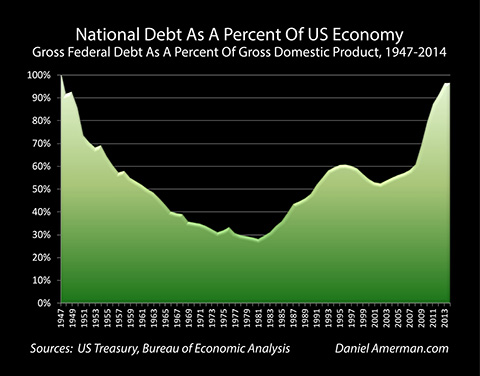
The bigger issue is that we had a change in the national debt super cycle. As of 1947 due to the expense of WWII, the outstanding US debt was approximately equal to the size of the total economy. This is as toxic for a country back in 1947 as it is today.

Historically the growth rate of heavily indebted countries is much slower. It is a slow economic growth and a high interest rate risk environment. This was not just the US alone, this was most definitely global. What world leaders did as a result was get together, and yes Bretton Woods was part of this and they agreed to put rigid financial controls on the population. Effectively the size of national debt was held down for approximately 25 years while the economies experiences periods of substantial growth. Eventually these national debts as a percent of the economy had dropped down to below 30%.

This decline promoted a rapid growth environment, free market interest rate, removal of capital controls, and lifted the limitations on private ownership which we have had since 1973; individuals in the US could not hold gold for investment purposes.

RING FENCING

“You’re not going to keep up with inflation and there is not much you can do about it. That’s the point of ring fencing.”

I split it into two ways. The first is capital controls and second, forcing intermediaries to participate in financial repression. Another component as well is repressing the ownership of precious metals so people do not have an alternative protection from inflation. What’s surprising is that the term financial repression has a conspiracy theory connotation associated with it, when in fact financial repression is an integral part of macroeconomics. It has been a core part of managing financial systems over a long period of time. What’s surprising is that the term financial repression has a conspiracy theory connotation associated with it, when in fact financial repression is an integral part of macroeconomics. It has been a core part of managing financial systems over a long period of time.

In the US in a relatively short period of time, particularly in 2010 all these elements were released for the first time since the 1970s. Interest rates were forced down below inflation by massive government intervention, quantitative easing and forms of capital controls all came out together and as a result dominated the markets ever since. The fascinating part is that there has been a series of developments over the last few months which may be the biggest round of financial repression that we have seen since 2010.

“Ring fencing which I consider as the third pillar is the forced participation of financial intermediaries in the name of public safety. Two key developments were what came out in 2015 was that the Fed has a part of the financial stability board. This board is the G20, the IMF, World Bank combined and all simultaneously agreed to change their money fund policy as well as their margin rules.”

Ring fencing which I consider as the third pillar is the forced participation of financial intermediaries in the name of public safety. Two key developments that came out in 2015 was that the Fed has a part of the financial stability board. This board is the G20, the IMF, World Bank combined and all simultaneously agreed to change their money fund policy as well as their margin rules. They changed regulation on money funds which are apparently done in the name of public safety such that it was an expensive burden for any funds to use anything other than federal debt for their money funds. Effectively creating an enormous financial advantage.

“This is a classic scenario. Take a financial intermediary and in the name of public safety make them hold US government debt.”

This is a classic scenario. Take a financial intermediary and in the name of public safety make them hold US government debt. In doing this you have expanded the market for government debt by whatever the net change is. Essentially locking in an additional trillion dollars of funding for the debt.

“A key thing to make note of is that these are all financial intermediaries, so when people ask who is funding the debt, the answer is all of us are.”

We are essentially financing the government through an intermediary. By changing regulations they are both increasing the relationship and locking into it. At this short term end of the yield curve we are doing this for virtually no yield whatsoever. We are providing the money to the federal government through an intermediary whose participation is forced.

FORCED MACROPRUDENTIAL POLICIES 

“They are forcing ever lower interest rates on more of the population. This is providing larger low-cost funds to the government in an ever more constrained manner where it becomes harder for people to escape.”

On Nov 12, 2015 the financial stability board agreed to implement margin rule changes. They were talking about it being a blast from the past, it was what central banks used to do in the 1970s. This is now brought back out, but in this case it is also an expansion of the mandate of the Fed. Where we are with these changes is that the Fed will be without active congress and expanding their control over the US markets to all investment firms to participate in some sort of secured lending.

Financial firms often need cheap money on a short term basis. They can sell a treasury security to someone else at a given price and agree to buy it back at a higher price; in effect it becomes a short term loan. The difference in price is the interest rate that they are paying, this can be done without an actual sale and instead with the pledge of the securities as collateral.

“Central banks are concerned that these low quality collateral loans are now considered to be at risk for triggering a new financial crisis. That’s why they’re changing the regulations where they have the ability to change margin rules at will.”

The best known forms of margin deal with stock ownership where your borrowings become limited. If this was raised to 60% or 70% to bring down stock values, people will have to scramble to sell these securities or they will have to come up with the additional cash through some other means, otherwise there will be a forced liquidation.

What has been created is a major incentive to use US treasuries securities as collateral for repurchase agreements. Once everyone does this then you get a situation where the Fed is no longer in control of leverage in the market.

PREPARING FOR THE FUTURE

Funding for US national debt has just increased by $2.5 trillion. This is very similar to something that is far controversial and that is quantitative easing. Total US treasuries securities held by the Fed are between 2.4 to 2.5 trillion. They are holding this approximate level because they say they are not doing quantitative easing and rather doing purchases every time they take principal to keep at that level. This was major news and made headlines throughout the world, yet something just as big happened and nobody noticed; this is a forced funding of the federal debt that is just as large as what happened with QE.

“The Fed is in the process of deploying two massive stabilizers. Why are they doing this in 2016 when they hadn’t done so in 2010?”

The logical interpretation would be they are very concerned of what’s to unfold in the future. They are pre-emptively moving major stabilizers in place.


To follow Daniel Amerman and his work, please visit http://danielamerman.com/aHome.htm

Abstract written by, Karan Singh

Karan1.singh@ryerson.ca

Disclaimer: The views or opinions expressed in this blog post may or may not be representative of the views or opinions of the Financial Repression Authority.


03/04/2016 - BlackRock Suspends ETF Issuance Due To “Surging Demand For Gold”

Gold ETF Market Breaks: BlackRock Suspends ETF Issuance Due To “Surging Demand For Gold”

BlackRock’s Gold ETF (IAU) has seen fund inflows every day in 2016 (no outflows at all) and with the stock trading above its NAV for most of the year, the world’s largest asset manager has made a significant decision: It has suspended issuance of Gold Trust shares due to “surging demand for gold.

It appears the huge demand for physical gold (and lack of supply) is finally catching up with the manipulation of paper prices.

======

POSTED AT: ZERO HEDGE

BlackRock’s Gold ETF (IAU) has seen fund inflows every day in 2016 (no outflows at all) and with the stock trading above its NAV for most of the year, the world’s largest asset manager has made a significant decision:

  • *BLACKROCK SAYS ISSUANCE OF GOLD TRUST SHARES SUSPENDED
  •  *BLACKROCK SAYS SUSPENSION DUE TO DEMAND FOR GOLD

BlackRock Statement:

Issuance of New IAU (Gold Trust) Shares Temporarily Suspended; Existing Shares to Trade Normally for Retail and Institutional Investors on NYSE Arca and Other Venues

Suspension results from surging demand for gold, which requires registration of new shares

iShares Delaware Trust Sponsor LLC, in its capacity as the sponsor of iShares Gold Trust (IAU), has temporarily suspended the creation of new shares of IAU until additional shares are registered with the Securities and Exchange Commission (SEC).

This suspension does not affect the ability of retail and institutional investors to trade on stock exchanges. Retail and institutional investors will continue to be able to buy and sell shares in IAU.

IAU holds gold as a physical asset. IAU is an exchange-traded commodity (ETC), which therefore is not eligible for registration as an investment company under the ’40 Act. IAU may only be registered under the ’33 Act as a grantor trust. Under the ’33 Act, subscriptions for new shares in excess of those registered requires additional filings with the SEC.

Nearly all other U.S. iShares are exchange-traded funds (ETFs), registered as investment companies under the ’40 Act. The ’40 Act provides for the continuous offering of shares and does not require registration of additional shares as the fund grows due to investor demand in connection to new subscriptions.

Since the start of 2016, in response to global macroeconomic conditions, demand for gold and for IAU has surged among global investors. IAU has $8 billion in assets under management, and has expanded $1.4 billion year to date. February marked its largest creation activity in the last decade.

This surge in demand has led to the temporary exhaustion of IAU shares currently registered under the ’33 Act.We are registering new shares to accommodate future creations in the primary market by filing a Form 8-K to announce the resumption of the offering of new shares. The ability of authorized participants to redeem shares of IAU is not affected.

It appears the huge demand for physical gold (and lack of supply) is finally catching up with the manipulation of paper prices.

If this is anything other than a brief technical suspension, it could well unleash panic-buying as we already pointed out – there is no physical gold!


As we previously concluded, the reality that there are just two tons of gold to satisfy delivery requsts based on accepted protocols should in itself be troubling, ignoring the latent question why so many owners of physical gold are de-warranting their holdings.

Considering there are now less than 74,000 ounces of Registered gold at the Comex, or just over 2 tonnes, we may be about to find out how right, or wrong, the skeptics are, because at this rate the combined Registered vault gold could be depleted as soon as the next delivery request is satisfied. Or isn’t.

Meanwhile, this is how gold is taking the news – it would appear that some gold is still available… one just has to pay up for it.

Disclaimer: The views or opinions expressed in this blog post may or may not be representative of the views or opinions of the Financial Repression Authority.


03/04/2016 - Negative Interest Rates Are Leading To The End Of Capitalism

John Rubino highlights the recent developments in Japan with increasing negative interest rates there, with Japan’s government debt now requiring the lenders to pay rather than receive interest rates for 10 years .. “The world’s central banks are creating so much excess cash that there seems to be nowhere else for it to go. The longer, but way more interesting and scary explanation is that capitalism as it used to function is over, and the result will be catastrophic.” .. there has been so much quantitative easing going such that now Japan’s central bank is directly funding its government, something once widely understood to be the last gasp of a dying regime but now seen as just part of the new normal .. Pension funds, meanwhile, operate the same way, taking in and investing contributions against future obligations. Many U.S. pension plans are already borderline broke and in a NIRP environment they’ll suffer a mass extinction. Again, big industry, many employees, huge potential impact on both Wall Street and Main Street. The slowing growth that results from negative interest rates is thus profoundly deflationary, which presents another explanation for investors’ willingness to park cash in places that cost rather than generate income: They expect the currency they get back to be worth more than the currency they put in. This is exactly the opposite of what rate-cutting central banks are hoping for — which might in the end be the moral of this tale: Economic laws are like their natural counterparts. You mess with them at your peril.”

LINK HERE to the article

Disclaimer: The views or opinions expressed in this blog post may or may not be representative of the views or opinions of the Financial Repression Authority.


03/04/2016 - Mitigating Risks Of A Bank Bailin

Sovereign Man highlights the trend to negative interest rates across the indebted western world, what to do to mitigate the risks from bank bailins .. “U.S. rates right now are just 0.25%. So even with a tiny cut the Fed is almost guaranteed to take interest rates into negative territory in the next recession .. We can see the effects of this in Europe and Japan where negative interest rates already exist .. Negative interest rates destroy banks. They eat into bank profits and force them to hold money losing toxic assets. Bank balance sheets become riskier, and people start trying to withdraw their money as a result. In Japan (which just recently made interest rates negative), one of the fastest selling items is home safes, which people are buying in order to hold physical cash. In Europe (where negative interest rates have existed for a while longer), bank controls have already been put in place to prevent people from withdrawing too much of their own money out of the banking system. This is a form of capital controls– a tool that desperate governments use to trap your savings within a failed system and steal your prosperity. Wherever you see negative interest rates you are bound to see capital controls close behind. One of the easiest things you can do is withdraw some physical cash out of the banking system.”

LINK HERE to the article

Disclaimer: The views or opinions expressed in this blog post may or may not be representative of the views or opinions of the Financial Repression Authority.


03/03/2016 - The Government’s Real Solution? — “Financial Repression”

QE Absolutely, Positively Must End in Economic Collapse

By Robert Appel, B.A., B.C.L., L.L.B

Published: March 1, 2016  at ProfitConfidential .com

Economic CollapseOver the last century, the central planners who run our world have not only made a mess by their constant interference, but they have made a mess that can only end one way—in total economic collapse.

Will the Tide Stop Coming in Because We Tell It To?

Cycles are arguably the most dominant force in nature. There is a cycle to the planets, crops, radio waves, electricity, tides, people—pretty much everything.

And there is a cycle to economics. This has been known and understood since the days of old. Even the Bible talks about “fat years” and “lean years.”

With all this history, you would think the great economists of our day would understand this principle and work with it, rather than oppose it. You would be wrong. Horribly wrong.

This is not a fairytale; this is the world we live in right now. Inspired by the works of Keynes—a fairly young branch of economic theory that is still largely unproven and theoretical—these men are, in plain view, replacing traditional “free markets” (where price discovery is determined entirely by supply and demand, just like you learned in school) with their own “Frankenmarkets,” where they use their ability to create infinite money at the push of a button to force markets to do what they think is best.

And what is it they think is best? The evidence of the last 100 years suggests that their preference is an economy based on debt; markets dominated by clandestine manipulation from both internal government agencies (e.g., the Treasury) as well as external ones (e.g., the Federal Reserve, the BIS); ongoing cycles of boom and bust; and, most disturbing of all, the ongoing transfer of wealth, on a scale never before seen or imagined, to smaller and smaller groups of individuals and entities. Until we reach the point where the wealthiest one percent own more than the remaining 99% combined—a point, in fact, we have already reached. Based on empirical evidence alone, this seems to be their preferred way of running the world.

But there remains one small problem. This system is imploding. More correctly, to borrow a phrase from Alice Through the Looking Glass, our financial engineers are interfering more and more often simply to keep things in the state they were in already. In other words, as their efforts are failing, so is the distorted financial world they have created for us.

The first detailed, peer-accepted work to point this out was James Davidson’s superb book, The Great Reckoning: Protecting Yourself in the Coming Depression (Touchstone Press, January 1994). In his book, Davidson looked not only at the U.S., but also all the Western nations collectively and concluded that a century of building the trappings of prosperity on debt (borrowing to get what you do not have) rather than savings (working hard to afford what you need) was going to end badly—very badly.

The book was a worldwide bestseller, but lost some credibility when the aforesaid reckoning did not happen precisely on schedule in the last decade of the 20th century, just as Davidson had predicted.

In point of fact, the reason the world avoided an economic catastrophe in the 1990s was because of the so-called computer revolution. Just as with the invention of the steam engine, a new and unexpected technology produced not only observable efficiencies, but also captured the imagination of the public at large and gave them hope.

Hope that unfortunately collapsed in the 1999–2000 Dotcom boom. A period so bizarre that an entrepreneur with a business plan involving the Internet that he had penned on the back of a napkin during an all-nighter was, conceivably, able to secure millions the next day from a wide variety of venture capitalists.

The Dotcom Boom “Smartened the Chumps”

The expression “never give a sucker an even break” entered the common parlance in the 1940s after the launch of the film of the same name starring the top comedian of the era, W.C. Fields. In fact, there were two parts to the quote and the second portion is often overlooked. The lost part of the quote was “…and never smarten a chump.”

The manner in which the 1990s Dotcom boom conveniently delayed the reckoning that Davidson has written about was not lost on our financial planners. Quite the opposite, in fact. As former Washington deep-insider Catherine Austin Fitts explained, the 2007 mortgage-backed securities debacle—a financial catastrophe felt around the world!—was no accident. It was deliberate, it was planned, it was an attempt to mimic the momentum of the computer boom (which ended in a crash!) by creating a brand new “bubble” to give the impression that the economy was strong and self-sustaining (i.e., before the new boom itself also ended in a crash). (Source: “Sub-Prime Mortgage Woes Are No Accident – Fitts,” Solari, August 7, 2007.)

For those who watched the aftermath of the 2007 crisis with eyes open, it was clear that something very significant had suddenly changed in the halls of power. The tipoff? On TV screens all over the world, you had the spectacle of the U.S government declaring that there were banks and financial institutions within its borders that were “too big to fail” and, moreover, needed rescuing at the public’s expense. Nobody seemed to notice that the very concept did violence, simultaneously, to the notions of capitalism, democracy, free markets, and the Rule of Law. In fact, this notion went further than even Keynes himself had ever gone! Nor did government give the public a chance to even catch its breath, to blink, because they immediately followed that announcement with a wide variety of other initiatives—the most memorable of which was quantitative easing or “QE”—which continued the theme touched on above of bending markets to their will.

The Government’s Real Solution? — “Financial Repression”

The overall (and deliberate) impression was that our government had identified a problem and was working hard to fix it with a variety of clever and innovative solutions they had jerry-rigged at the last moment.

Some experts saw things differently, however. Some recognized the “solutions” offered by the government as part and parcel of a known and dreaded economic doctrine called “financial repression,” an insidious back-door method used by governments to extricate themselves from excessive debt by quietly passing the pain along to their own citizens.

The term is not new and was first coined in 1973 by Stanford economists Edward S. Shaw and Ronald I. McKinnon. The clear and visible markers of a “financially repressed” regime, they said, are:

(1) Policies that override supply and demand to artificially drive yields to, or below, zero (think QE, ZIRPs, NIRPs);

(2) Capital controls to limit the ability of money in the regime to leave on short notice (think “cashless,” in many ways the ultimate expression of capital control);

(3) Suppression of the precious metals complex, once again to limit alternatives; and

(4) Suppressing or distorting information so as to give an artificial sense of well-being (think, re-defining “employment” to exclude those who have given up and left the workforce…?)

The ultimate goal of the regime is to foster “policies that result in savers earning returns below the rate of inflation” in order to allow banks to “provide cheap loans to companies and governments, reducing the burden of repayments.” (Source: “Financial Repression Destroys Growth,” Wikipedia, last accessed February 1, 2016.)

The educational site Mises.org adds more detail:

“[…] Financial repression is a revolving set of policies where the government insidiously takes wealth from the private sector, and more specifically makes it easier for government to finance its debt. In today’s environment this includes: ZIRP or ‘zero interest rate policy’ where many of the world’s central banks keep their lending rates to banks at or near zero. Naturally, this makes the interest rate on government debt lower than it otherwise would be; QE or ‘quantitative easing’ is the central bank policy of buying up government debt from banks. This increased demand increases the price of government bonds and reduces the interest rates on those bonds… The combination of the two policies has allowed governments to borrow money, both short- and long-term bonds, at extremely low interest rates. This, in turn, has kept the government’s interest payments on the national debt relatively low.” (Source: Financial Repression, Mises.org, Last Accessed: January 15, 2016.)

Is financial repression the cure for economic ails? The Mises site suggests just the opposite, in fact:

“[…] Financial repression is an outgrowth of bloated government budgets and enormous government debts. It is the worst way of dealing with government debt and actually works against the proper ways of addressing fiscal problems which include: eliminating government programs, eliminating military bases, austerity based on cutting politicians and government employees’ salaries and benefits, and deregulation and privatization to increase economic growth.The effects of financial repression cause economic harm throughout the productive sectors of the economy including workers, savers, entrepreneurs, retirees, and pensions. It hurts the insurance industry that protects our lives, homes, health, and property. The (sole) economic beneficiaries include the big banks and Wall Street, the national government itself, and certain large corporations.” (Source: Ibid.)

Editorialist Daniel Amerman has spent literally years analyzing the impact of financial repression in jurisdictions where it has been deployed.

He writes the following:

“[…] the essence of Financial Repression is using a combination of inflation and government control of interest rates in an environment of capital controls to confiscate much of the purchasing power of a nation’s private savings. Rephrased in less academic terms – the government methodically destroys the value of money over a period of many years, and uses regulations to force a negative rate of return onto investors (in inflation-adjusted terms), so that the real wealth of savers shrinks… Over time Financial Repression can be every bit as destructive to wealth building through savings and retirement accounts as is austerity, default or high rates of inflation.” (Source: “Private Savings Pay Public Debts,” DanielAmerman.com, last accessed January 25, 2016.)

Amerman is also quick to underscore the hidden connection between inflation—something that Washington is forever telling us is “desirable”— and the financial repression regime:

“[…] a government that owes too much money (deliberately) destroys the value of those debts through destroying the value of the national currency itself. It doesn’t get any more traditional than that from a long-term, historical perspective. Without inflation, Financial Repression just doesn’t workthe higher the rate of inflation, the more effective Financial Repression is at quickly reducing a nation’s debt problem.

“[…] The goal…is to make sure that all savers are lending to the government at artificially low interest rates—even though the great majority of them never directly purchase a government security. One way of doing this is savers making deposits which pay very low rates of return, with banks using those very low cost deposits to purchase government debt that also pays a very low rate of return. While little remarked upon, that is exactly what has been happening on a multi-trillion dollar scale in the United States, as part of the Federal Reserve’s Quantitative Easing program.

“[…] There is nothing accidental going on here, all that is in question are the particulars of the strategies for cheating the investors, meaning the collective savers of the world. Again, the time-honored and traditional form that heavily-indebted governments use to cheat investors is to devalue the currency. Create inflation, and tax collections will rise with that inflation but the debts won’t, and meanwhile the savers of the world will be paid back in full with currency that is worth less than what was lent to the governments in the first place.” (Source: Ibid.)

This specific observation is especially important because now we finally have a connectionbetween different government narratives that, to this point, seemed disconnected and almost random. We have a government that admits to being some $17.0+ trillion in debt (not allowing for unfunded, revolving, and contingent liabilities) with no obvious way to repay that debt; and a Federal Reserve that is seemingly using tools designed to weaken the currency and thereby facilitate gradual repayment of the debt by the “hidden tax” of inflation, which, coincidentally, is a term that repeatedly pops up in the many iterations of Fedspeak as, presumably, a goal to be vigorously pursued…? (Note again that only Keynesian theory places any value on inflation in an economic eco-system. Older good-money economics—“Austrian economics” or “hard money economics”— clearly identifies inflation as a dangerous short-term fix that ultimately leads to more serious longer-term problems and, ultimately, collapse.)

“NIRP”—The Sound You Make When Your Money Vanishes

Understand that the above comments were voiced when the regime was limited merely to QE, ZIRP, and clandestine gold bashing (which, as mentioned above, is itself simply another form of capital control right from the financial repression toolkit (see, for example, my recent essay, “A Different Look at the Gold Sector”).

A NIRP—negative rates, you pay the bank for the privilege of guarding your money—is not here yet, but it’s well on its way. The Fed has mentioned (threatened?) it several times, as if testing the temperature of the bathwater before drowning the baby in it. Same, astonishingly, in Canada. These guys are chomping at the bit to try out—AT TAXPAYERS’ EXPENSE—a fresh, new modality that looks great on paper, but somehow fails to pass both the “smell test” and the “would this make sense to a 5th grader?” test.

All of which, of course, begs the question, if the pension system and insurance system (both pillars of the financial world as we know it) could not function at ZIRP, how would they fare at NIRP? (See, for example, “Warning: You May Be Next: 400,000 People Just Had Their Pensions Cut By 50%: ‘Going to Happen To The Rest Of Pensions in the United States’,” Silverdoctors, February 24, 2016.)

In February 2016, The Financial Times made a yeoman effort to explain NIRP to its readers and claimed to have received the highest number of reader responses in their history. This reader response, which focused mainly on the effects of ZIRP—or, simply, a zero rate—was typical and especially articulate:

For any human being making economic decisions, everything changes at 0%. The decision making for savers, consumers, SMEs, etc. grinds to a standstill. If you are prudent and don’t want to speculate on buying various financial assets, 0% kills any reason you may have had to take any positive action. If all you can expect to get from your efforts is to still have the same as when you started, why bother? We as humans need a positive ‘Narrative’ to get out of bed in the morning, work, take risk, etc. Risk free interest at 0% translates into a clear statement that there is no future to discount cash flows over or to believe in. If an individual cannot imagine a positive result from his/her actions, he/she prefers to do nothing. Prolonged periods of 0% rates and no positive (inflation) price movement will lead to reduced economic activity. Not exactly the stated purpose of the QE experiment. QE will go to the history books as one of the greatest mistakes in history.” (Source: “Everything Changes at Zero,” Typepad.com, February 23, 2016.)

NIRP is already in Japan. According to Zerohedge, you cannot buy a safe in Japan; they are completely sold out. The always-practical Japanese would rather store their cash at home than pay a stranger for the privilege. (Source: “Safes Sold Out in Japan,” Zerohedge, February 22, 2016.)

Financial analyst Rob Kirby in a recent interview actually joked about the very idea of a NIRP, calling the name an outright lie: “Of course, the average borrower will never see a negative rate, no bank is going to pay you to take a mortgage, it’s the savers who are going to suffer!” (Source: “The Failure of Fiat Money,” Silverdoctors, February 24, 2016.)

Wait, it gets better. While the central banks of the world are quietly going full-tilt King Canute, some editorialists are starting to wonder if, prior to adopting the central bank system (see my essay, “Who Owns the Fed?”), governments should perhaps have first adopted a failsafe? Something similar perhaps to Asimov’s “First Rule of Robotics,” in order to protect themselves against just the situation we are now in? (The First Rule of Robotics, or AI, is that under no circumstances should your human creators ever be harmed. Presumably, governments should have placed similar constraints on their central planners before the latter woke up one morning and realized they had more in common with each other, and their banking pals, than they did with the citizens of the very countries they were supposed to serve…?)

What a Tangled Web We Weave…

Another problem with a financial repression regime is that once started, there is no “off” button. The governments and their cronies must keep tweaking the formula until the citizenry learns, one way or another, to obey.

For example, in January 2016, the U.S. Federal Reserve proposed a new set of margin rules for trading financial instruments. Most commentators missed the import of these new rules, but Daniel Amerman found a hidden, strategic, underlying purpose, which he explained as follows:

“[…] The key loophole is that when (their own) U.S. Treasury obligations and agency securities are used as the collateral, the borrower will be immune from the new margin regulations. This then creates a split market, with two kinds of secured financings. For those who own Treasuries and agencies and use them as collateral, they are not subject to the planned new rules. According to the US Office of Financial Research, about two thirds of the collateral currently being used is Treasuries and agencies, so this will be true for most of the current market borrowers. For the remaining one third of borrowers, however, there is a potentially substantial increase in risk. The dangers are those of liquidity and market risk. If the Fed increases margin requirements in order to pull leverage from the system, then more or less by definition, that action creates a liquidity crunch for borrowers who were not invested in Treasuries and agencies.

What Amerman has done is to identify a seemingly innocent-looking change in Federal Reserve regulations—one that initially looks like all it wants to do is pull liquidity from the system—and re-classify it as part of the overall financial repression toolkit.

According again to Mises.org, financial repression is most effective when combined with some form of “capital controls” or mechanisms that limit what the average citizen can freely do with his or her own capital.

Indirectly, Amerman says, these proposed regulations will place a burden on all trades not involving government debt. To avoid that burden, traders are being herded, like sheep, to create ever-broadening demand for government debt even at the currently low yields. Amerman classifies this approach as yet another form of capital control, in this case one designed to condition larger players to continually absorb and trade U.S. debt, even as sovereign nations from other parts of the world are divesting it as fast as they can. (Sources: “New Margin Rules Force Investors into Treasuries,” DanielAmerman.com, last accessed January 24, 2016; “China, Russia, Norway, Brazil, Taiwan Dump US Treasuries..,” Wolfstreet, October 8, 2015.)

A World Where the Inmates Now Run the Asylum…

Other commentators examining the Fed’s policies have come to essentially the same conclusion as Amerman. Bill Bonner, the prolific American author and journalist, is especially articulate in his critique of how this drama is playing out:

“[…] (the so-called) the ‘era of price stability’ under the Fed…their inflation targeting theory is not only completely bereft of theoretical and empirical support, it is in fact plainly contradicted by both theory and the empirical studies that do exist, some of which have been undertaken by the Fed’s own economists! In short, it is complete hokum… Interest rates by Fed diktat, for example, send completely phony signals, since they disguise the true cost of credit. The theory goes that low interest rates motivate people to borrow and spend. But where’s the evidence? … There’s a reality, as well as a myth. Reality is that resources are limited. Prices tell us what we’ve got to work with. Falsify prices and you get errors of omission and commission. After a while, the system suffers from things it ‘shouldna, oughtna’ done. As Hjalmar Schacht, Germany’s minister of economics in the 1930s, put it: ‘I don’t want a low rate. I don’t want a high rate. I want a true rate’.” (Source: “The End is Nigh – Bill Bonner,” Zerohedge, January 23, 2016.)

The bottom line? The experts are telling us that what initially seemed like a clever short-term solution (to a problem that, arguably, the central planners themselves created!) is anything but.

They suggest that QE—and its upcoming wicked stepsister, NIRP—are merely individual tools in a much larger arsenal of devices and methodologies that have been shown over time to have one single primary goal—bailing out profligate governments at the expense of the unwary taxpayer.

And one very specific, hi-probability result: financial catastrophe and the end of our financial world and standard of living as we know it.

Just like the 12th Century story of King Canute who, as lord of his realm (Denmark, England, Norway, and parts of Sweden), determined that his power was so great he could sit by the shore and order the tide not to come in—no, the tide didn’t pay any attention—today’s masters of our economic universe are convinced they, too, can abolish cycles and bend the world to their will.

Disclaimer: The views or opinions expressed in this blog post may or may not be representative of the views or opinions of the Financial Repression Authority.