01/17/2015 - Principal Global Investors’ & CREATE Research Report on Investing in Financial Repression
Principal Global Investors’ CEO Jim McCaughan writes the Foreword in this research report by CREATE Research on investing in a debt-fueled world, within a key theme of financial repression .. report: “Investors are also worried about the revival of a long-forgotten phenomenon: financial repression. This is caused when central banks keep the rates artificially low for a long period of time in an effort to help governments finance their debts. It is feared that a combination of low rates and rising inflation will steadily vaporize public debt and erode the purchasing power of the underpinning assets.” .. the report looks at investing in this environment from a retail investor & a pension fund investor perspective .. from last year but still relevant.
Disclaimer: The views or opinions expressed in this blog post may or may not be representative of the views or opinions of the Financial Repression Authority.
01/15/2015 - FINANCIAL REPRESSION IS ACCELERATING TO FIGHT THE POTENTIALLY DEFLATIONARY WINTER
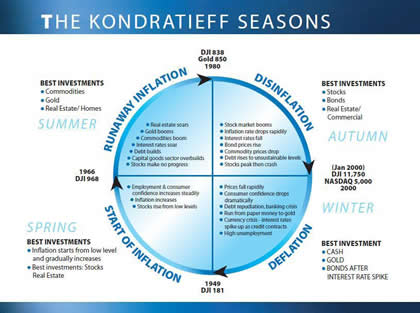
NOTE: FIAT MISINFORMATION IS OBFUSCATING REAL SHRINKING GROWTH THAT IS PART OF THE KONDRATIEFF WINTER
Disclaimer: The views or opinions expressed in this blog post may or may not be representative of the views or opinions of the Financial Repression Authority.
01/11/2015 - European Bank Runs Could Come To America
Interview with Boston University Economics Professor Laurence Kotlikoff .. Kotlikoff says Greece is in financial trouble & that could set off another global financial calamity: “So, you have the same problem. You have a country that is fiscally unsustainable, and they haven’t really been able to get out from under that situation .. It sets up a situation where you could have runs on other banks like in Italy, Spain, Portugal, and that could spread to other banks in other countries, including France and Germany. Remember, the big to do about the Cypriot banks that failed and said they weren’t going to pay off the depositors? That led to a major international panic. It was a small country with two relatively small banks.” .. bank bailins & financial repression .. a daisy chain of defaults and bank runs could happen in Europe: “It could also come to the U.S. If everybody believes the banks are going to be solvent and they can get their money out, that’s fine. But if everybody starts to run on the banks, you want to run before they do because you want to get you money out before it’s all gone.” .. sees the potential for U.S. hyperinflation if there is a loss of confidence in the FDIC deposit insurance system, as depositors take their money out & buy something real .. on the U.S. unfunded liabilities: “Social security is 33% under-financed, according to its own trustees report .. Our entire fiscal enterprise is about 58% under-financed .. the country is really broke.” .. 33 minutes
Disclaimer: The views or opinions expressed in this blog post may or may not be representative of the views or opinions of the Financial Repression Authority.
01/03/2015 - Greek Turmoil Could Spread The Risk of Bail-Ins Globally
GoldCore commentary on the implications of Greece’s recent financial turmoil – it’s affecting Spain & Italy already .. suggests Greece & the risk of a new euro zone debt crisis will again be a key focus for investors in 2015 .. Goldman Sachs recently warned: “In the event of a severe Greek government clash with international lenders, interruption of liquidity provision to Greek banks by the ECB could potentially even lead to a Cyprus-style prolonged ‘bank holiday'” .. GoldCore suggests also that market fears for potential euro exit risks could rise if this happens: “It could be that the fear-mongering of the past few weeks may become self-fulfilling prophecies if Greeks decide that their cash is safer under the mattress than in a risky Greek bank earning little or no interest Then theECB would be confronted with having to ‘bail-out’ Greece or more likely would opt for bail-ins whereby the deposits of Greek savers and companies are frozen in ‘bank holidays’ prior to being seized in a Cyprus style cash grab .. In such a scenario, the ECB would likely be forced to abandon its proposed bond-buying scheme early next year as it could not be seen to be openly buying toxic debt. This in turn could have knock on effects for the global economy as the anticipated liquidity the ECB were to provide evaporates.” .. the commentary raises the awareness of the potential for bail-ins globally in this unfolding era of financial repression.
Disclaimer: The views or opinions expressed in this blog post may or may not be representative of the views or opinions of the Financial Repression Authority.
01/03/2015 - The Confiscation of Bank Deposits
Ellen Brown* explains how the recent G20 meeting rubber stamped new regulations that will make Cyprus style bank bail-ins a worldwide reality .. 24 minutes
Disclaimer: The views or opinions expressed in this blog post may or may not be representative of the views or opinions of the Financial Repression Authority.
01/02/2015 - Lessons on Financial Repression From the 1720 South Sea Bubble
The NY Times article on how the British government was forced to undertake a bailout due to the bursting of the South Sea Bubble back in 1720 .. “Now, prompted by record low interest rates, the British government is planning to pay off some of the debts it racked up over hundreds of years, dating as far back as the South Sea Bubble .. and would repay part of the country’s debt from World War I, and want to pay off other bonds for debt incurred in the 18th and 19th centuries .. The maneuver is also a reminder of how debts incurred by governments are passed down through generations.”
Disclaimer: The views or opinions expressed in this blog post may or may not be representative of the views or opinions of the Financial Repression Authority.
12/29/2014 - Financial Repression: Bank Bailins & Governments Encouraging Government Bond Buying
Mark Nestmann reports on the decisions of the G20 group of nations from last month .. “The world’s megabanks now have official permission to pledge depositor accounts as collateral to make leveraged derivative bets. And if they lose a bet, the counterparty to the contract has first dibs on your money.” .. in addition, the G20 endorsed a proposal entitled Adequacy of Loss-Absorbing Capacity of Global Systemically Important Banks in Resolution – Deposits in banks that are too big to fail will be “promptly recapitalized” with their “unsecured debt.” (mostly bank deposits) .. “Insolvent banks will recapitalize themselves by converting your deposits – checking accounts, but also money market accounts and CDs – into stock.” .. the G20 also declared that derivatives are secured debts – your bank can pledge your bank deposit to a secured creditor so that in case the bank does not win the derivative bet – “heads the bank wins, tails you lose” .. if you have U.S. bank deposits less than the U.S.-federally insured amount – $250,000 – the above treatment won’t be applied, but consider that there is only $54 Billion in the FDIC kitty to insure $6 Trillion in insured deposits, not to mention derivatives contracts with a total value of nearly $300 trillion. The failure of just a single major Wall Street bank could exhaust the fund” .. Nestmann thinks the reason why the G20 is doing this is they hope you will invest in government bonds backed by the “full faith and credit” of its member governments – this financial repression-driven buying will help to keep down interest rates on the high debt level of G20 member governments.
Disclaimer: The views or opinions expressed in this blog post may or may not be representative of the views or opinions of the Financial Repression Authority.
12/29/2014 - How Central Banks Unknowingly Create Their Achilles Heel: Deflation
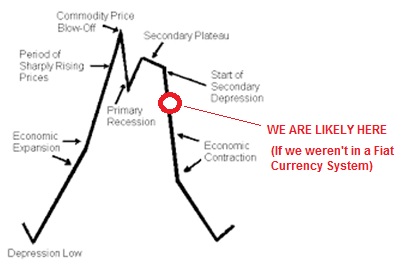
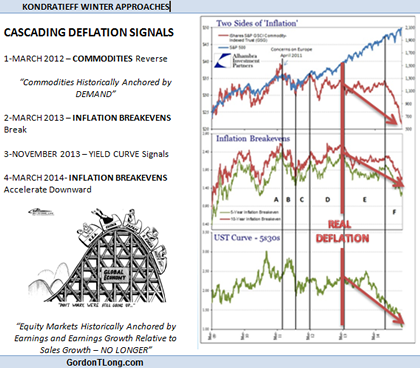
Central Banks by creating ‘Excessive’ INFLATION actually sow their eventual destruction by creating DEFLATION
‘EXCESS’ INFLATION: Inflation creation when the business cycle needs to contract.(ie 2% targets during systemic deleveraging.)
This is because the Prime Directive of central banks is to make it ever easier to service yesterday’s debt.
Excessive inflation results from central banks being forced to push negative real interest rates too low (to protect debt holders) relative to real economic expansion and capital wealth creation.
DEFLATION:
“Any increase in the purchasing power of nominal wages”.
The rise of software, robotics and global wage arbitrage is resulting in wages not rising along with prices. As a result, everyone who depends on earned income is getting poorer.
For the actual real-world the result of central banks easing, money pumping and zero interest rates is Deflation.
Central bank easing and zero-interest rate policy (ZIRP) fuel over-capacity which leads to declining prices: deflation with a capital D.
Central bank easing and zero-interest rate policy (ZIRP) additionally fuels malinvestment which leads to over valued collateral and an eventual collateral collapse as NPL (non-performing loans) debt cannot to “rolled” (ie no one no longer wants to risk financing)
PURCHASING POWER: The store of Purchasing Power is true WEALTH which governments are trasnferring.
All the phantom collateral constructed with mal-invested free money for financiers will also implode.
EASY CREDIT CREATES EXCESS SUPPLY & DEMAND WHICH EVENTUALLY REACH EQUILIBRIUM
BROUGHT FORWARD DEMAND THEN LEAVES A DEMAND RATE VACUUM
INFLATION REDUCES REAL DISPOSABLE INCOME WHICH FURTHER REDUCES DEMAND
SHRINKING AGGREGATE DEMAND THEN REDUCES COMMODITY PRICES WHICH LEADS TO COLLAPSING COLLATERAL VALUES
THE OIL SHOCK IS YOUR FIRST SIGN!
Disclaimer: The views or opinions expressed in this blog post may or may not be representative of the views or opinions of the Financial Repression Authority.
12/27/2014 - The IMF on Financial Repression
Update from the IMF on some of their financial repression tools, so-called as “macroprudential policy tools.”
Disclaimer: The views or opinions expressed in this blog post may or may not be representative of the views or opinions of the Financial Repression Authority.
12/27/2014 - Financial Repression Is About Negative Interest Rates
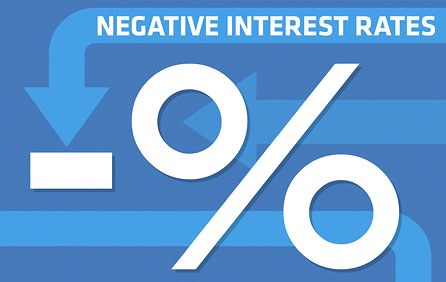
Simon Black highlights how from Sweden to the euro zone to Switzerland, central banks & some commercial banks are beginning to force nominal interest rates into negative territory .. supposedely in an effort to help generate some inflation .. “Remember, it was the ECB that has led the world into negative interest rates. They are clearly the most valiant soldier in the War on Deflation, having pushed negative interest rates into the broader banking sector. If you are a very lucky German, for example, you may now be finding yourself PAYING your local bank for the privilege of letting them make loans at your expense. And lucky institutional investors across the world are finding themselves fortunate enough to be paying NEGATIVE yields to loan money to bankrupt European governments. Look at the bright side: it’s quite an honor to be able to fight for your country (or whatever quasi-federalized supra-national entity the EU is supposed to be). You too can do your part in the War on Deflation. Yes, it might cost you your entire life’s savings and your family’s future livelihood.”
Disclaimer: The views or opinions expressed in this blog post may or may not be representative of the views or opinions of the Financial Repression Authority.
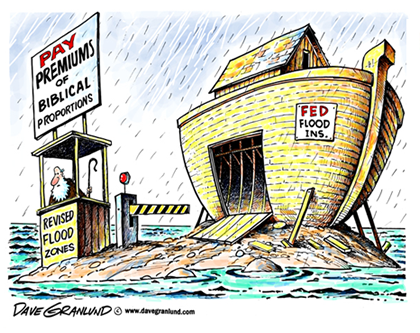
12/27/2014 - BUYING MONETARY INSURANCE Before the Flood!
Ronald-Peter Stoeferle is a noted Austrian economist and money manager who believes strongly that “we should expect that financial repression as well as wealth taxes in various facets which will increasingly gain in importance in coming years”. He believes “this to be a disastrous strategy, as the redistribution will merely buy time, while the structural problems remain unsolved.”
A NEW MONETARY REGIME
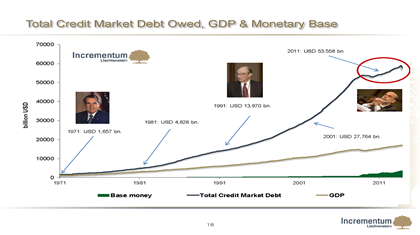
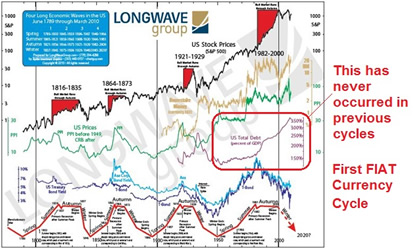
Since 1971 we have had a new monetary era or regime that has directed massive debt induced growth which has been doubling every 10 years. The system presently wants and needs to deleverage but the political pressures don’t allow for central bankers and politicians to let this happen. What we have instead is policy induced inflation pressures creating monetary tectonic pressures.
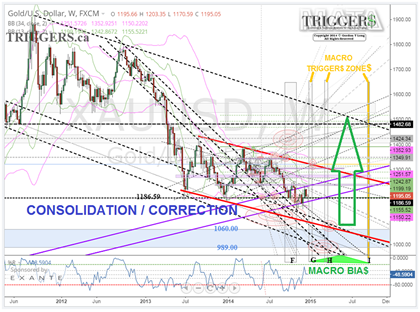
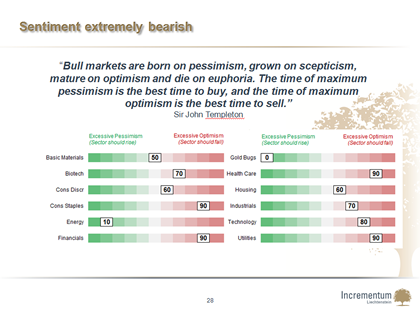
Incrementum believes we presently have a “Bull market in Greed and a Bear Market in Fear” which will resolve itself with Gold being one of the big winner and moving to $2300 US/Oz. The recent weakness in Gold is due to:
Disinflation and rising real interest rates,
Partly declining money supply (especially in the ECB),
Very weak commodity prices,
Record high short positions,
Rising opportunity cost of owning gold due to the rally in equities,
Tightening credit standards,
Increasingly negative analyst opinions,
Firmer US$ based on confidence in the US Economic outlook,
A high level of conviction in the ability of central bankers to “get it right”.
Most, if not all, of these false premises or signals will soon begin cyclically reversing.
“Financial repression is ultimately a government imposed transfer of wealth.”
AUSTRIAN INVESTING
Ronald-Peter Stoeferle and the team at Incrementum LI are developing a new approach which they refer to as Austrian Investing which combines the Macro views of the Austrian School of Economics with Asset Management. Their latest book “Austrian Investing between Inflation & Deflation (presently available in German only) shows how grasping the consequences of the interplay between inflation and deflation will be crucial for prudent investors. Investors should prepare for both scenarios – inflation and deflation.
Followers of the Austrian School have been extremely successful at anticipating major economic events like the Great Depression and the Housing Bubble.
Monetary Policy – The Starting Point
Macro Orientation – Most Important today
Top-Down
Understanding that central bankers & politicians cannot control the dynamics of inflation.
It is important to realize that radical monetary interventions will not lead to self-sustained recovery but to further turmoil in the financial markets.
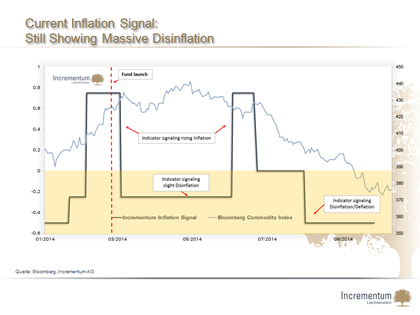
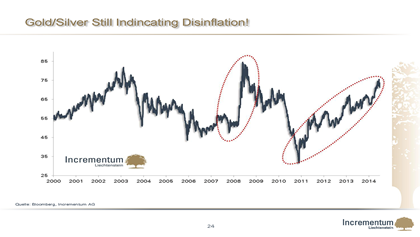
Understanding the Monetary Tectonic forces of Inflation and Deflation is critical to investment success. As such Incrementum LI uses their “Incrementum Inflation Signal Indicator”. Since August it has been signalling massive Disinflation / Deflation which has shifted their portfolio allocations.
Private Investors should watch the Gold-Silver Ratio closely.
Disclaimer: The views or opinions expressed in this blog post may or may not be representative of the views or opinions of the Financial Repression Authority.
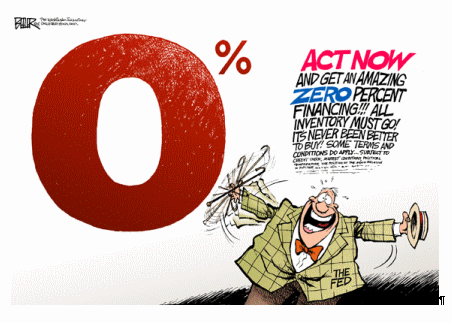
CNBC’s Rick Santelli & Charles Biderman discuss the global 0% rate policy, how it is causing global recession.
Disclaimer: The views or opinions expressed in this blog post may or may not be representative of the views or opinions of the Financial Repression Authority.
12/23/2014 - Morgan Stanley on Financial Repression
From last year but mostly still relevant, provides insight into what financial repression is & what the investment implications are .. looks at financial repression as:
• Explicit or indirect caps / ceilings on interest rates
– Government regulation in the U.S. – Ceilings on bank lending rates – Central Bank interest rate targets
• Creation and maintenance of a captive, domestic investor base
– Capital account restrictions and exchange controls to force a ‘home bias’ – High reserve requirements – Regulatory measures that require financial institutions to hold government debt in their portfolios – Transaction taxes on equities; prohibitions on gold transactions
• Direct ownership of, or extensive management over, banks and other financial institutions
– Restriction of entry into financial markets – Directing credit towards certain industries
Disclaimer: The views or opinions expressed in this blog post may or may not be representative of the views or opinions of the Financial Repression Authority.
12/22/2014 - Financial Repression By Central Banks and Private Banks Worldwide
In his latest essay, former Assistant Secretary of the U.S. Treasury Department Dr. Paul Craig Roberts identifies the dangerous trend of more & more manipulation of the financial markets by central banks & private banks worldwide, provides analysis & consideration of whether this trend can continue or not .. emphasizes the forces of financial repression – negative interest rates – happening in a supposed economic recovery”
Disclaimer: The views or opinions expressed in this blog post may or may not be representative of the views or opinions of the Financial Repression Authority.
12/20/2014 - Financial Repression Banks Remove the “Heart” of Dodd-Frank
6 years of highly visible Dodd-Frank legislation and thousands of lines of regulation, with no public debate, was just quietly removed and “neutered” by the stealth of an “Ear-Mark”.
To maintain government financing the banks have held Washington hostage.
Maintain our profit margins and have the public accept the risk of $3003 TRILLION or….. else!
The Bill (yet another ‘Ear-Mark’) allows financial institutions to trade certain financial derivatives from subsidiaries that are insured by the Federal Deposit Insurance Corp. — potentially putting taxpayers on the hook for losses caused by the risky contracts. Big Wall Street banks had typically traded derivatives from these FDIC-backed units, but the 2010 Dodd-Frank financial reform law required them to move many of the transactions to other subsidiaries that are not insured by taxpayers.
“It is because there is a lot of money at stake,” Johnson said. “They want to be able to take big risks where they get the upside and the taxpayer gets the potential downside,”
Disclaimer: The views or opinions expressed in this blog post may or may not be representative of the views or opinions of the Financial Repression Authority.
12/20/2014 - Financial Repression: Energy Company Debt Fallout from Federal Reserve Financial Repression Policies
Bloomberg reports on the unfolding fallout now happening in energy-company debt as a result of Federal Reserve financial repression policies of zero interest rates & stimulus-induced asset inflation .. “Since early 2010, energy producers have raised $550 billion of new bonds and loans as the Federal Reserve held borrowing costs near zero, according to Deutsche Bank AG. With oil prices plunging, investors are questioning the ability of some issuers to meet their debt obligations. Research firm CreditSights Inc. predicts the default rate for energy junk bonds will double to 8% next year .. ‘Anything that becomes a mania — it ends badly .. And this is a mania.'” .. The Fed’s decision to keep benchmark interest rates at record lows .. has encouraged investors to funnel cash into speculative-grade securities to generate returns, raising concern that risks were being overlooked.”
Disclaimer: The views or opinions expressed in this blog post may or may not be representative of the views or opinions of the Financial Repression Authority.
12/20/2014 - Financial Repression Creating System Bias and Noise
“The current capitalism suffocating regime of Keynesian central banking and extreme financial repression has created systematic bias and noise .. These distortions are the result of mis-allocations and malinvestments reflecting artificial sub-economic costs of debt and capital. The resulting bubbles and booms, in turn, cause highly aggregated measures of economic activity to be flattered by the unsustainable production, spending and investment trends underneath at the sector level .. Bubble finance does not create growth; it funds phony booms that end up as destructive round trips .. The meaning of the oil crash is that the central bank fueled bubble of this century is over and done. We are now entering an age of global cooling, drastic industrial deflation, serial bubble blow-ups and faltering corporate profits.”
Disclaimer: The views or opinions expressed in this blog post may or may not be representative of the views or opinions of the Financial Repression Authority.
12/13/2014 - Iceland Plans to Impose a 25-40% Exit Tax on all Assets Leaving the Country
Bloomberg & Morgunbladid report that Iceland plans to impose an exit tax as part of removing its capital controls – all bank assets would be subject to the levy .. more financial repression .. “Representatives from Iceland’s government, central bank and parliament discussed imposing a tax as high as 40% on investors exiting the island.”
Disclaimer: The views or opinions expressed in this blog post may or may not be representative of the views or opinions of the Financial Repression Authority.
12/12/2014 - Financial Repression Has Caused Drastic Mispricing of Financial Assets
“There are financial time bombs planted everywhere in the world economy because central bank financial repression has caused drastic mispricing of nearly every class of financial asset, which is to say, every layer of collateral which has ratcheted-up the entire edifice .. This drastic central bank driven financial repression has unleashed a mindless pursuit of ‘yield’ or short-term trading gains that give the concept of ‘irrational exuberance’ an entirely new definition .. What is happening now is that risk is coming out of hiding; the collateral chains are buckling; the financial time bombs are beginning to explode. There is nothing especially new about this development—its the third occurrence this century. But there is possibly something different this time around the block. This time the carnage could be much worse because the most recent tsunami of central bank credit was orders of magnitude larger and more virulent than during the run-up to the Lehman event or the dotcom implosion. Moreover, the central banks are now out of dry powder—– impaled on the zero-bound. That means any resort to a massive new round of money printing can not be disguised as an effort to ‘stimulate’ the macro-economy by temporarily driving interest rates to ‘extraordinarily’ low levels. They are already there. So duck and cover. This storm could be a monster.”
Disclaimer: The views or opinions expressed in this blog post may or may not be representative of the views or opinions of the Financial Repression Authority.
12/11/2014 - Moody’s and S&P Warn That European Banks Are At Risk Of Bailins in 2015
GoldCore article on recent developments relating to bailins & financial repression .. Banks in most western nations are vulnerable to bail-ins in 2015 & the recent G20 meeting in Brisbane was a further move towards the stealth bail-in regimes .. S&P Managing Director Stefan Best: “The European bail-in tool decreases the predictability of state support.”
Disclaimer: The views or opinions expressed in this blog post may or may not be representative of the views or opinions of the Financial Repression Authority.


 01/17/2015 - Principal Global Investors’ & CREATE Research Report on Investing in Financial Repression












 Ronald-Peter Stoeferle is a noted Austrian economist and money manager who believes strongly that “we should expect that financial repression as well as wealth taxes in various facets which will increasingly gain in importance in coming years”. He believes “this to be a disastrous strategy, as the redistribution will merely buy time, while the structural problems remain unsolved.”