Uncategorized

12/18/2015 - Bank Bailin Rules Undermine Bank Depositor Confidence

The head of supervision at the central bank of Italy says the bail-in rules which impose losses on bank investors, bondholders & bank account holders if the bank needs to be rescued can undermine the confidence of small savers or investors in the banking system .. “The bail-in can exacerbate – rather than alleviate – the risks of systemic instability caused by the crisis of individual banks .. It can undermine confidence, which is the essence of banking; transfer the costs of the crisis from government at large to a smaller category of people no less worthy of protection – small investors, pensioners – who directly or indirectly invested in bank liabilities.”

link here to the article

Disclaimer: The views or opinions expressed in this blog post may or may not be representative of the views or opinions of the Financial Repression Authority.


12/18/2015 - The Risk Of Not Being Able To Sell the Fund You Are Invested In

click to enlarge

It’s another example of the unintended consequences of financial repression – the risk of not being able to sell the fund you are invested in, or in not being able to get the money after selling your fund, either immediately or within a certain period of time .. Deutsche Bank has prepared the above infographic (click to enlarge) which summarizes the main choke points which predispose both funds to runs or outright shutdown.

LINK HERE to the article

Disclaimer: The views or opinions expressed in this blog post may or may not be representative of the views or opinions of the Financial Repression Authority.


12/15/2015 - Bank Runs In Italy

Cumberland Advisors’ Chief Investment Officer David Kotok highlights the plight of 4 banks in Italy rescued by the government, causing many to lose their life savings in the process .. “The bailout was carried out under the principles which governed Cyprus’ bailout. All of the stakeholders in the bank, including depositors, were at risk in the banks’ failure .. The Italian banking system is in serious trouble, and the failure of these four banks is simply the tip of the iceberg. Non-performing loans, loans that debtors are not paying off as agreed, but which have not yet been written off by the banks, have been rising. At this point 18% of all outstanding loans in Italy are non-performing. That is an extraordinarily high level, particularly when you consider that Italy is the eighth largest economy in the world and the fourth in Europe.” .. Kotok speculates that a contagion risk connection looms between the issues in Europe & the high-yield sector in the U.S. .. Kotok advises investors these words of wisdom to mitigate the risks: “If you cannot see it, don’t buy it. If you do not understand it, don’t buy it. It you cannot trade it with liquidity, avoid it. If you violate any of these rules, make sure you are getting additional compensation for the risk you are taking. In Italy, these are now proven to be three sound principles. In the U.S., the same rules apply.”

Article by David Kotok, Co-Founder and Chief Investment Officer of Cumberland Advisors

LINK HERE to the article
LINK HERE to the referenced article

Disclaimer: The views or opinions expressed in this blog post may or may not be representative of the views or opinions of the Financial Repression Authority.


12/12/2015 - REGULATORY RING FENCING: “Rules Provide Structural and Operational Reform to Address Run Risks in Money Market Funds”

Our FRA video guest, Graham Summers of Phoenix Capital Research reports that it will be much, much harder to get your money out during the next crisis:

Consider the recent regulations implemented by SEC to stop withdrawals from happening should another crisis occur.

The regulation is called Rules Provide Structural and Operational Reform to Address Run Risks in Money Market Funds. It sounds relatively innocuous until you get to the below quote:

Redemption Gates – Under the rules, if a money market fund’s level of weekly liquid assets falls below 30 percent, a money market fund’s board could in its discretion temporarily suspend redemptions (gate).  To impose a gate, the board of directors would find that imposing a gate is in the money market fund’s best interests.  A money market fund that imposes a gate would be required to lift that gate within 10 business days, although the board of directors could determine to lift the gate earlier.  Money market funds would not be able to impose a gate for more than 10 business days in any 90-day period…

Also see…

Government Money Market Funds – Government money market funds would not be subject to the new fees and gates provisions.  However, under the proposed rules, these funds could voluntarily opt into them, if previously disclosed to investors.

http://www.sec.gov/News/PressRelease/Detail/PressRelease/1370542347

In simple terms, if the system is ever under duress again, Money market funds can lock in capital (meaning you can’t get your money out) for up to 10 days. If the financial system was healthy and stable, there is no reason the regulators would be implementing this kind of reform.

As Zero Hedge noted earlier today, the use of “gates” is spreading. A hedge fund just suspended redemptions… meaning investors cannot get their money out. Expect more and more of this to hit in the coming months as anyone who is has bet the farm on the system continuing to expand gets taken to the cleaners.

The solution, as it was in 2008, will not be to allow the defaults/ debt restructuring to occur. Instead, it will be focused on forcing investors to stay fully invested at whatever cost.

This is just the start of a much larger strategy of declaring War on Cash.

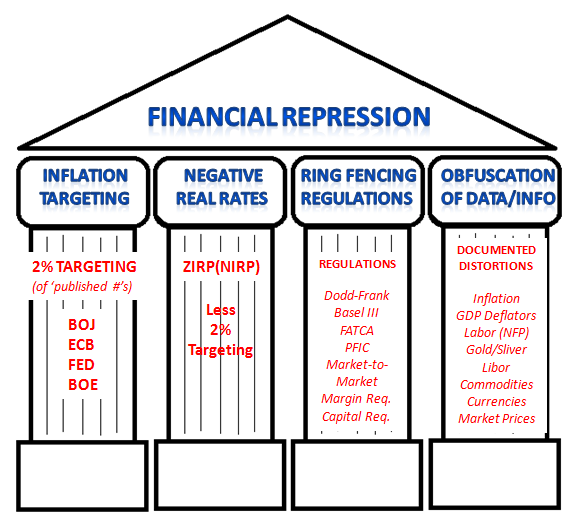
This is part of one of the pillars of Financial Repression that the FRA refers to as “Regulatory Ring Fencing”

Pyramid

Disclaimer: The views or opinions expressed in this blog post may or may not be representative of the views or opinions of the Financial Repression Authority.


12/08/2015 - FINLAND PROPOSES “HELICOPTER MONEY” (OMF)


Finland Government Officials Propose to Give Tax-Free Payout of $870 to Every Citizen Each Month.

As a way to improve living standards and boosts its economy, the nation of Finland is moving closer towards offering all of its adult citizens a basic permanent income of approximately 800 euros per month.

The monthly allotment would replace other existing social benefits, but is an idea long advocated for by progressive-minded social scientists and economists as a solution—counter-intuitive as it may first appear at first—that actually decreases government expenditures while boosting both productivity, quality of life, and unemployment.

“For me, a basic income means simplifying the social security system,” Finland’s Prime Minister Juha Sipilä said last week.

Though it would not be implemented until later in 2016, recent polling shows that nearly 70 percent of the Finnish people support the idea.

According to Bloomberg, the basic income proposal, put forth by the Finnish Social Insurance Institution, known as KELA, would see every adult citizen “receive 800 euros ($876) a month, tax free, that would replace existing benefits. Full implementation would be preceded by a pilot stage, during which the basic income payout would be 550 euros and some benefits would remain.”

Read more at http://globaleconomicanalysis.blogspot.com/2015/12/bernankes-helicopter-drop-hits-finland.html#aTG3KkokT0goe1Ia.99


Disclaimer: The views or opinions expressed in this blog post may or may not be representative of the views or opinions of the Financial Repression Authority.


12/06/2015 - Alasdair Macleod shows how: “THE FED’S IN A BIND!”

The Fed’s in a bind

ALASDAIR MACLEOD 3 DECEMBER 2015

One can understand the Fed’s frustration over the failure of its interest rate policy, and its desire to escape the zero bound.

However, since the FOMC has all but said it will increase rates at its December meeting, events have turned against this course of action. The other major central banks are in easing mode, and the slowdown in China has further undermined both world trade flows and commodity prices. The result has been a strong dollar, which has effectively eliminated any perceived need for higher dollar interest rates. Meanwhile, the US’s non-financial economy remains subdued.

Last August, a similar situation existed, when the FOMC signalled that a rise in the Fed Funds Rate might be announced at its September meeting. Ahead of it, China revalued the dollar by announcing a small devaluation of its own currency, taking the wind out of the Fed’s sails. While the talking heads saw this as a failure of Chinese financial policy, it was nothing of the sort. Given the US was dragging its feet over the yuan’s inclusion in the SDR, it was a salvo in the financial war between the two states, and the Fed found itself in the firing line.

Since then the pressure has been mounting from the IMF for the US to back down over the SDR issue. The result was announced only this week, with the dollar content hardly changing and the yuan being accommodated mostly at the expense of the euro from September next year. However, despite the SDR issue having been dealt with for now, the Fed appears to have very little room for manoeuver before higher interest rates will give rise to a new financial crisis.

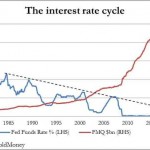
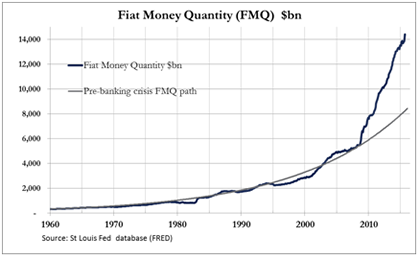
The chart below illustrates the problem. It is of the Fed Funds Rate since 1980 and the Fiat Money Quantity, which simply put is the sum of the commercial banks’ reserves at the Fed, plus cash and sight deposits held at the banks.

Interest Rate Cycle

From the mid-eighties, successive interest rate peaks (the pecked line) have declined to the point, which if the trend continues, would indicate a Fed Funds Rate peak today of roughly 3%. It is clear that the reason for this declining trend is the increase in bank-related debt, the principal counterpart to FMQ, and the interest burden it places on borrowers.

This trend of declining interest rate peaks was established before the Lehman crisis, when the Fed’s response was to rapidly expand its balance sheet. The result is FMQ growth accelerated from a compounding annual rate of 5.8% to 14%, taking FMQ to 70% above the previous long-term trend today. It would therefore require a far smaller increase in interest rates than indicated by the pecked line to tip the monetary system into a crisis, perhaps a Fed Funds Rate of as little as 1%.

The idea that we can be so precise about interest rate levels is obviously nonsense. If the Fed increases the Fed Funds Rate even slightly, non-financial borrowers often end up paying a significantly higher rate that includes a larger interest rate spread. The spread between interbank and corporate borrowing rates becomes an important indicator of financial stress, and junk bonds are already signalling deteriorating borrowing conditions. Just the threat of higher interest rates could turn out to be destabilising for the financial sector.

A problem of the financial sector’s own making

The key metric which has permitted debt to increase at such a pace is the declining rate of price inflation. This rate has not responded to monetary inflation as one would expect, having continually fallen from the high rates of the late ‘seventies, while the quantity of money and credit has increased significantly. The reason the rate of price inflation has declined is that by taking over the securities industry in the 1980s, the banks have been able to combine their licence to create credit out of thin air with the direct application of this credit into financial instruments. The result has not only been extremely profitable for the banks, but it has diverted excess credit from less profitable non-financial activities.

This partly explains why banks have increasingly neglected commercial and retail customers, concentrating capital allocation into investment banking. The effect has been to generally confine price inflation to assets, such as stocks, bonds and property. At the same time consumers have been packaged through securitised bulk lending for mortgages, student loans, credit cards and motor loans. Any pretence that banks exist to provide a service for customers has flown out of the window.

At the same time, this credit and securities duopoly has given the banks the ability to magically create paper substitutes for physical commodities through the futures markets, suppressing prices to levels below where they would otherwise be. In turn, this has reduced the pressure on price inflation for consumer goods. The decline in price inflation over the last thirty-five years is therefore the combined result of suppressed commodity prices, the reduced expansion of credit available to non-financial sectors, as well as favourable changes in statistical methods.

The declining trend of interest rates has been crucial for the profitable expansion of financial activities for their own sake. Since assets are valued with reference to interest rates, the falling trend in interest rates since the mid-eighties has delivered large profits to the banks and their financial customers.

The ground-level which inhibits further credit expansion is zero interest rates, a condition that has existed for seven years. Despite talk of negative rates, the impetus lower interest rates give to expansion of the financial side of the economy has already come to an end. Attempts by the Fed to raise interest rates, even slightly, should be considered in this light.

The next financial crisis could manifest itself in the coming months. The time-line of monetary expansion reflected in the chart above is at risk of being terminated by events. If so, it will mark the end of current central bank monetary policies and state control of markets, as free markets reassert realistic pricing. Government bond yields will normalise, stock markets will fall, and banks will almost certainly fail. Supressed commodity prices will rise as banks, short through paper contracts, will be forced to close their positions. Credit default swaps, where the banks are collectively exposed to losses when interest rates rise, will be a further source of grief.

When something as epochal as this happens, we can expect the macroeconomic establishment to be clueless with respect to the problem itself and its scale. Central banks will naturally revert to the Lehman remedy of further monetary expansion to cover the losses, whose enormous scale will not be apparent at the outset. This time, not only will the fiat money quantity accelerate into hyper-drive, it will be impossible to maintain the purchasing-power of the world’s reserve currency, therefore threatening that of all the others.

This month’s FOMC rate decision will not change this outlook, but it could bring forward the timing.

Disclaimer: The views or opinions expressed in this blog post may or may not be representative of the views or opinions of the Financial Repression Authority.


12/06/2015 - “THERE CANNOT BE A LIMIT TO STIMULUS!” says ECB president Mario Draghi

European Central Bank will step up efforts to support economy, says Mario Draghi

SOURCE: http://www.telegraph.co.uk/finance/economics/12034607/There-cannot-be-a-limit-to-stimulus-says-ECB-president-Mario-Draghi.html

Mario Draghi has said the European Central Bank would intensify efforts to support the eurozone economy and boost inflation toward its 2pc goal if necessary.

Speaking a day after the ECB’s moves to expand stimulus fell short of market expectations, the central bank president said that he was confident of returning to that level of inflation “without undue delay”.

“But there is no doubt that if we had to intensify the use of our instruments to ensure that we achieve our price stability mandate, we would,” he said in a speech to the Economic Club of New York.

“There cannot be any limit to how far we are willing to deploy our instruments, within our mandate, and to achieve our mandate,” he said.

On Thursday the ECB sent equity markets tumbling, and reversed the euro’s downward course, after it announced an interest rate cut that was less than investors had expected and held back from expanding the size of its bond-buying stimulus.

The bank cut its key deposit rate by a modest 0.10 percentage points to -0.3pc, and only extended the length of its bond purchase program by six months to March 2017.

Critics said that was not strong enough action to counter deflationary pressures on the euro area economy.

Some analysts believed a desire for stronger moves, like an expansion of bond purchases, was stymied by powerful, more conservative members of the ECB governing council, including Bundesbank chief Jens Weidmann.

But Mr Draghi insisted that there was “very broad agreement” within the council for the extent of the bank’s actions.

And, he added, it would do more if necessary: “There is no particular limit to how we can deploy any of our tools.”

He acknowledged some market doubts that central banks are proving unable to reverse the downward trend in inflation, saying that, even if there is a lag to the impact of policies in place, they are working.

“I would dispute entirely the notion that we are powerless to reach our objective,” he said.

“The evidence at our disposal shows, on the contrary, that the instruments we are currently deploying are having the effect intended.”

Without them, he added, “inflation would likely have been negative this year”.

Disclaimer: The views or opinions expressed in this blog post may or may not be representative of the views or opinions of the Financial Repression Authority.


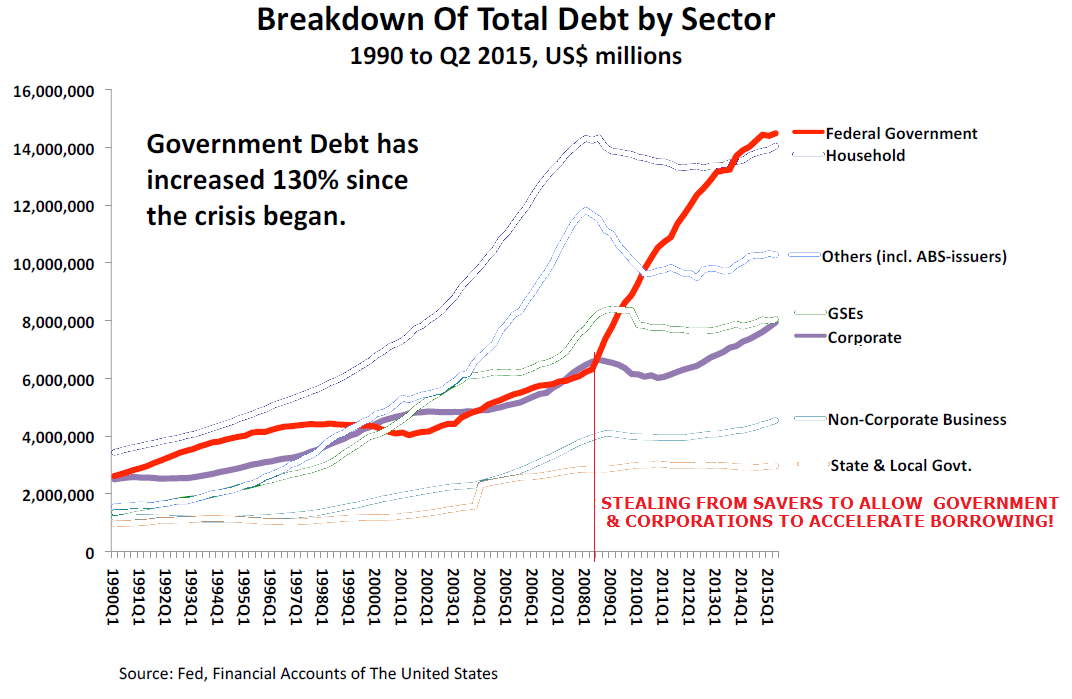
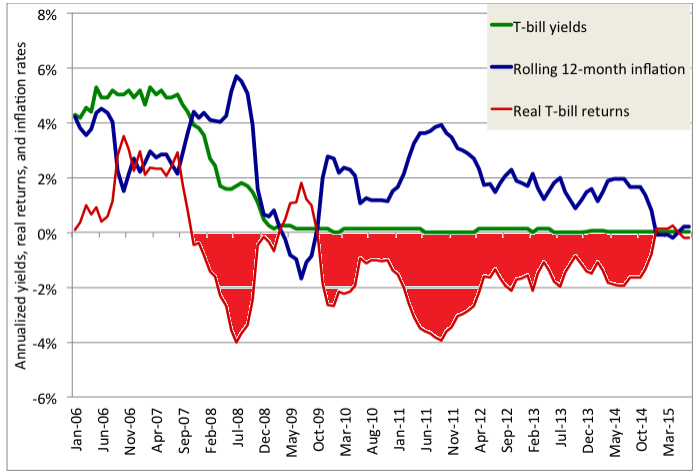
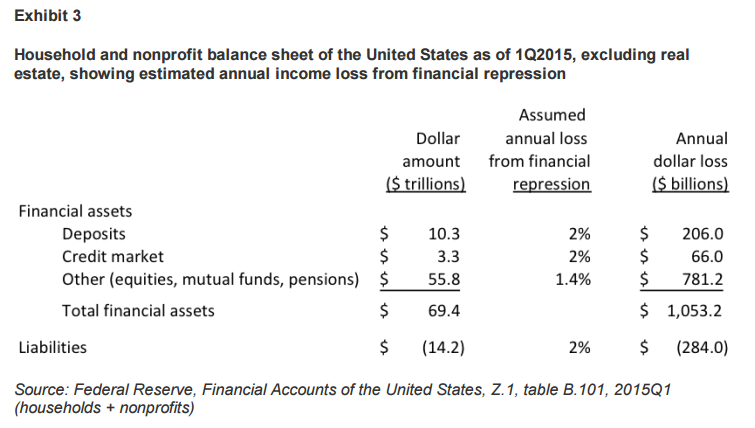
12/06/2015 - Stealing from Savers to Allow Government & Corporate Borrowing

Are We Stealing from SAVERS to Allow the Government & Corporations to Accelerate Borrowing?

12-06-15-Government_and_Corporate_Borrowing

$1 TRILLION/ Annually or 5% of GDP

12-04-15-FRA-Coleman-Siegel-00-3

12-04-15-FRA-Coleman-Siegel-3

READ: The Hidden Cost of Zero Interest Rate Policies September 28, 2015 by Laurence B. Siegel and Thomas S. Coleman

Disclaimer: The views or opinions expressed in this blog post may or may not be representative of the views or opinions of the Financial Repression Authority.


12/04/2015 - Bill Gross: Financial Repression – Central Banks Are Turning Savers Into Financial Eunuchs

WealthTerra

“Central banks are casinos. They print money as if they were manufacturing endless numbers of chips that they’ll never have to redeem. Actually a casino is an apt description for today’s global monetary policy .. Central banks haven’t really succeeded – this is a testament to what I and others have theorized for some time. Martingale QE’s and resultant artificially low interest rates carry distinctive white blood cells, not oxygenated red ones, as they wind their way through the economy’s corpus: they keep alive zombie corporations that are unproductive; they destroy business models such as insurance companies and pension funds because yields are too low to pay promised benefits; they turn savers into financial eunuchs, unable to reproduce and grow their retirement funds to maintain expected future lifestyles. More sophisticated economists such as Kenneth Rogoff and Carmen Reinhart label this ‘financial repression’. Euthanasia of the saver is the result if it continues too long .. Timing is the key because as gamblers know there isn’t an endless stream of Martingale chips – even for central bankers acting in unison. One day the negative feedback loop on the real economy will halt the ascent of stock and bond prices and investors will look around like Wile E. Coyote wondering how far is down. But when? When does Martingale meet its inevitable fate? I really don’t know; I’m just certain it will.”



LINK HERE to the Article

Disclaimer: The views or opinions expressed in this blog post may or may not be representative of the views or opinions of the Financial Repression Authority.


12/04/2015 - The Unintended Consequences Of Central Bank Policies

WealthTerra

Mises Institute posted essay refers to the recent letter to the Federal Reserve from the “savers of America” written by Ralph Nader .. the letter emphasizes how savers & retirees have been shafted by very low interest rates on bank accounts & fixed income investments .. it’s financial repression .. it’s the result of the unintended consequences of central bank & government policies & financial reform/regulations .. the essay makes a few great points to counter those seeing the “positive” short-term boom aspects of central bank money printing: “If Yellen is asserting that things are more affordable because it’s easier to borrow cheap money, then she’s just ignoring the trade-offs involved. Low interest rates and inflation mean that people must borrow more because it’s far more difficult to save under those conditions. Yes, debt is cheaper, but people must also take on more debt because it’s so difficult to save or make money off investments unless you’re not already rich. And, of course, this just applies to people who are at a stage of their life where it makes sense to take on more debt. If you’re old or on a fixed income, all you’re getting from the Fed is a huge ‘screw you.’ Moreover, when it comes to affordability of everyday, things, who is Yellen kidding? Home price growth and rent growth are at historic highs. Are we to believe that immense growth in rents and mortgage payments (the largest single expense for families) are a good thing for families? For people who already own homes, rising home prices are often a hurdle that can be overcome. But for people who don’t already own real estate, there’s little hope of buying one under these conditions. Surely, the Fed has played no small part in driving the homeownership rate in America down to a 30-year low. And again, if you’re retired: good luck. You’re gonna need it. Yellen no doubt believes that wages are higher because of Fed intervention. But in a world of sky-high rents, real wages are in fact lower.”

LINK HERE to thehttp://www.cliffkule.com/2015/11/the-federal-reserves-stimulus-hurts.html Article

Disclaimer: The views or opinions expressed in this blog post may or may not be representative of the views or opinions of the Financial Repression Authority.


11/27/2015 - Negative Interest Rates & The War On Cash: It’s About Making It Easier To Confiscate Your Savings?

WealthTerra

Ellen Brown* elaborates on the emergence of negative interest rates around the world & why it is happening .. she identifies 4 European central banks now promoting negative interest rate (NIRP) .. for now the Federal Reserve & the Bank of Japan are still at zero interest rate policies (ZIRP) .. it’s all financial repression .. The stated justification for these policies is to stimulate “demand” by forcing consumers to withdraw their money & go shopping with it. When an economy is struggling, it is standard practice for a central bank to cut interest rates, making saving less attractive – “This is supposed to boost spending and kick-start an economic recovery.That is the theory, but central banks have already pushed the prime rate to zero, and still their economies are languishing. To the uninitiated observer, that means the theory is wrong and needs to be scrapped. But not to our intrepid central bankers, who are now experimenting with pushing rates below zero.” .. Brown concludes that the big driver for the move to negative interest rates & a war on cash is the idea that should the banks get into trouble again with another banking crisis, perhaps stemming from a derivatives crisis, the banks could then easily take bank deposits, given the fact that most deposits/cash would in banks & not outside of the banking system .. “And that may be the real threat on the horizon: a major derivatives default that hits the largest banks, those that do the vast majority of derivatives trading .. The promise of Dodd-Frank, however, was that there would be no more government bailouts. Instead, insolvent systemically-risky banks were supposed to ‘bail in’ (confiscate) the money of their creditors, including their depositors (the largest class of creditor of any bank). That could explain the push to go cashless. By quietly eliminating the possibility of cash withdrawals, the central bank can make sure the deposits are there to be grabbed when disaster strikes.”

LINK HERE to the Article

Disclaimer: The views or opinions expressed in this blog post may or may not be representative of the views or opinions of the Financial Repression Authority.


11/20/2015 - Alasdair Macleod – THE FALSE PERCEPTION OF LIVING IN A WORLD OF INFINITE CREDIT

FRA co-founder Gordon T. Long deliberates with Alasdair Macleod, head of research at GoldMoney on the Austrian School of Economics in an Era of Financial Repression.

Alasdair. Macleod began his career as a stockbroker in 1970 on the London Stock Exchange. Through experience he rapidly learned about things as diverse as mining shares and general economics, within nine years he had risen to become senior partner of his firm.

Subsequently, he has held positions at director level in investment management, as a mutual fund manager, and also at a bank in Guernsey as an executive director. For most of his 40 years in the finance industry, he has been de-mystifying macro-economic events for his investing clients. From the accumulation of his experience he concluded that unsound monetary policies are the most destructive weapon governments’ use against people.

“I want to destroy this business of printing money as the solution to everything.”

Mr. Macleod strives to educate and inform the public in layman’s terms what governments do with money and how to protect themselves from the consequences.

WHAT IS AUSTRIAN ECONOMICS

“Prices are entirely subjective.”

It began with Carl Menger who was one of the 3 economics who came up with marginal theory of prices. Where Menger differed from other two was that he appreciated that prices were purely subjective. You cannot forecast tomorrow’s prices because prices are determined by the consumer who always has the option to buy.

“It overturns the cost theory of prices which is what Adam Smith believed in. It is completely irrelevant.”

The law of the markets, the reason you and I work is we go out to earn something. We need to transform our skills into consumption. In a free market economy we have people who use their skills to earn money for consumption; the intermediary in this is money. Money is nothing more than the temporary storage of someone’s labour that is transferrable into goods. If you understand this you will see how unsound money is bad for an economy. The idea by printing money which runs a budget deficit that a government can generate economic growth is nonsense.

“In regards to investing one thing that is desperately important to understand is that asset prices always refer back to their production.”

This applies across every asset that you buy. If you see that the prices of assets have moved away from their underlining productive value then you know that you are in a bubble.

A WORLD OF INFINITE CREDIT

“The world post 1970’s is a completely different world from before the 1970s.”

After 1981 rates had been lifted to a point which stopped the relationship between businesses and savers. This is what killed the price inflation up until the early 90s. Banks not only had the liberty to print credit but also to monopolize and control securities markets, if you combine these two thongs together; it is basically a money making machine, which is what we have today.

The end point in credit comes from the logical conclusion of that development. At every cyclical peak the level of interest rates which collapse the economy gets lower. The reason it gets lower is because this combination of credit control in securities markets does nothing more than just pumps up the level of debt. The overhang of debt means the rise in interest rates to stop the economy from getting out of control is getting lower. You cannot raise interest rates by more than one or two percent without serious economic dislocation.

NEGATIVE NOMINAL INTEREST RATES

“The effect of negative interest rates would be to throw every commodity into backwardation.”

There is no doubt that negative interest would drive up inflation, or rather, it would lower the purchasing power of said currency. Negative interest rates for the reserve currency in which all commodities are priced have a severe risk which we will generate runaway inflation, but in fact it is a collapse. In order to make negative interest rates work you need to ban cash entirely. I have no doubt at all that that is the underlying reason why there is so much emphasis on anti-money laundering.

THE FMQ CONCEPT

11-20-15-FRA-Alasdair_Macleod-00-2-420“The fiat money quantity is the amount of money that would have to be redeemed for gold that once was deposited.”

The fiat money quantity was put together to try to quantify the amount of money that Is being issued in return for the gold that we originally gave to our banks which the banks then handed to the federal reserve.
The reason for doing this is to try to get an idea of how much money is not only in public circulation, but also not in public circulation and potentially in public circulation. From looking at the Feds balance sheet and considering other factors like repos and reverse repos, we see that the growth curve has taken off; and in the very broadest sense we have monetary hyperinflation.

Abstract written by Karan Singh karan1.singh@ryerson.ca


Disclaimer: The views or opinions expressed in this blog post may or may not be representative of the views or opinions of the Financial Repression Authority.


11/08/2015 - Financial Repression: How Central Banks Can Implement Negative Interest Rates Without Confiscating Physical Cash

WealthTerra

Article explaining recent research paper to address the big problem with forced negative interest rates – depositors would see the numerical value of their bank deposits go lower & withdraw the cash to put it into their safety deposit box or to store it at home .. Miles Kimball, professor of economics at the University of Michigan, explains that flight to cash could be prevented in the latest economic review from the National Institute of Economic and Social
Research (NIESR) .. 
the basic idea is to attribute a negative interest rate for banks to accept physical cash if you deposit the cash into your bank account & to set this negative rate higher (more negative) than the negative interest rates you are getting at the bank account .. that way you are not only encouraged to spend your money before you have less of it, but also to bring in your physical cash as quickly as possible to the bank before it losses even more value faster .. “Paper money would be depreciating in value more quickly than electronic money. In effect, paper money would have higher inflation than electronic money.”

LINK HERE to the Article

Disclaimer: The views or opinions expressed in this blog post may or may not be representative of the views or opinions of the Financial Repression Authority.


11/04/2015 - 2 Solutions To Investing In Financial Repression By Vulpes’ Stephen Diggle

Vulpes Investment Management Founder Stephen Diggle goes through the math to explain the challenges for investing sufficient capital & generating enough yields for retirement .. how do you get yield in today’s environment of repressed interest rates & quantitative easing ., on concerns these investments are illiquid: “These sorts of solutions to the Yield Problem do have the major disadvantage of being illiquid and that is a real consideration. However, well run endowment and pension funds are supposed to have a clear idea of the ‘long term liability matching’ which they exist to do, so while a cash reserve of liquid assets would always be prudent, it’s hard to see how that safety amount would ever exceed 10-15% of assets. Liquidity is a nice thing to have, and usually better than illiquidity (although some make an argument that a long term commitment when enforced produces better returns); but when the price of liquidity is investment failure; as we would see the whole sovereign bond market, it is a crutch that must be foregone. In the real world no-one will have a pension fund comprising of one alternative asset, but the returns above are not fictional. We believe they are distinctly possible both for the pension disaster of traditional assets and the transformational impact of high yielding alternatives. We’d go further to say that it is almost inevitable that the coming crisis in retirement will lead pension funds of the near future into many more alternative assets, agriculture and real estate included.”

LINK HERE to the Article

Disclaimer: The views or opinions expressed in this blog post may or may not be representative of the views or opinions of the Financial Repression Authority.


11/01/2015 - Financial Repression – The Unintended Consequences

“Financial repression is not a conspiracy theory, it is rather a collective set of macroprudential policies focused on controlling and reducing excessive government debt through 4 pillars – negative interest rates, inflation, ring-fencing regulations and obfuscation – to effectively transfer purchasing power from private savings.” – The Financial Repression Authority

LINK HERE to our Article

04-01-15-Financial_Repression_Schematic


Disclaimer: The views or opinions expressed in this blog post may or may not be representative of the views or opinions of the Financial Repression Authority.


11/01/2015 - The Era of Financial Repression: Norway’s Sovereign Wealth Fund says Monetary Policy is a Risk to Watch

20130914_WBD000

“Monetary policy does affect pricing in today’s market to such an extent that monetary policy itself has been a risk you have to watch .. Investors are focused more on monetary policy changes than has been generally the case, than at any time, as far as I can remember .. As anything that moves prices is a risk that has to be monitored, here the effects of monetary policy affect prices dramatically .. It’s of course always been the case with long rates, and now more significantly with the currency. That’s just a fact of the current market.”

– Yngve Slyngstad, chief executive officer of Norway’s $890 billion sovereign-wealth fund

LINK HERE to the Article

“Financial repression is not a conspiracy theory, it is rather a collective set of macroprudential policies focused on controlling and reducing excessive government debt through 4 pillars – negative interest rates, inflation, ring-fencing regulations and obfuscation – to effectively transfer purchasing power from private savings.” – The Financial Repression Authority

Disclaimer: The views or opinions expressed in this blog post may or may not be representative of the views or opinions of the Financial Repression Authority.


11/01/2015 - Financial Repression Is Making It Difficult To Retire: How Do You Retire On Little Or No Savings?

Essay by our strategic partner Charles Hugh Smith who explains the challenges and issues for Americans (applies also to Canadians and Europeans) to retire, especially when interest rates are repressed to virtually 0% by central banks to the point where it is difficult to get any yield out of savings. Is there a way to retire on little or no savings and little or no income?

OLYMPUS DIGITAL CAMERA

OLYMPUS DIGITAL CAMERA


Sadajiwa Rukun CareResort AbsoluteLiving NobleCare

Disclaimer: The views or opinions expressed in this blog post may or may not be representative of the views or opinions of the Financial Repression Authority.


11/01/2015 - Scotiabank’s Guy Haselmann on Financial Repression

Guy Haselmann of Scotiabank checks the definition of a free-market economy, confirms that is not what we have today .. given the financial repression of “regulatory macroprudential policies conspiring with zero (or negative) interest rates & asset purchases to exterminate the markets’ ability to freely calibrate clearing market prices based on supply and demand factors. It is impossible for central banks to sustain controlling influence on market sentiment, investor behavior, correlations, and valuations, simply because effectiveness wanes over time.” 

LINK HERE to the Article

Some pointers for investors in an environment of long-term 0% interest rates & worldwide QE programs .. “Stock and bond diversification alone will not be enough to adequately protect a portfolio” .. Scotiabank’s Guy Haselmann suggests:
1) It is time to find ways to preserve capital. Return of capital strategies now trump return on capital pursuits. 
2) Where possible, transition from financial to real assets .. such as, real estate, farm land, collectables, art, other non-correlated & less-cyclical assets.
3) Cash has never had better optionality or a lower opportunity cost.
4) I remain a bond bull in long U.S. Treasuries for regulatory, technical, fundamental reasons. 
5) Find companies & countries with low levels of debt & stable cash flows.
6) Despite recent bad press, alternative investments should be considered.
7) Place larger premium on market liquidity & counter-party risk.

LINK HERE to the Article

Disclaimer: The views or opinions expressed in this blog post may or may not be representative of the views or opinions of the Financial Repression Authority.


10/30/2015 - Financial Repression By Central Banks

CitizenshipSolutions

Tim Price compares the approach being taken by the central bankers of the massively indebted western world to North Korea .. highlights how the rest of Asia has a bright future for economic growth, given its positive demographics & high savings rate .. “A combination of a Zero Interest Rate Policy, generalized financial repression and trillions of dollars, pounds, euros and yen all conjured out of thin air has failed to trigger inflation in the narrower CPI sense of the word. Central banks, in other words, have failed. Analyst and market historian Russell Napier of Cerno Capital suggests that ‘Central banks’ failure to reflate will be very damaging for the price of financial assets and will also ultimately trigger reflation from another source: the government.'” .. likes gold for protection against likely massive central bank monetary easing & government stimulus by the indebted western world in an attempt to generate inflation .. considers an outcome of ‘deflation followed by inflation’ to imply holding these investments: cash held at reputable and solvent banks, objectively creditworthy sovereign debt, inexpensive but high quality listed stocks, gold… concludes: “You would have thought that North Korea had done a reasonable job of invalidating the legitimacy of state socialism and central planning. Perhaps Janet Yellen, Mark Carney and Mario Draghi could go visit sometime. One way fares would suffice.”

LINK HERE to the Article

Disclaimer: The views or opinions expressed in this blog post may or may not be representative of the views or opinions of the Financial Repression Authority.


10/24/2015 - John Mauldin Letter: How Savers, Retirees & Investors Are Adversely Affected By The Federal Reserve’s Financial Repression

In his latest letter, John Mauldin laments the failure of the Federal Reserve in its monetary policies: “The Fed is implicitly acknowledging again that their policy action over the past 5 years of putting the US economy on a sustainable growth path has been a failure and now if their international concerns become more pronounced, they will also admit to the world that they have no tools to deal with it. I think today’s decision was a bad one. The dollar rally should be over and I’m bullish on precious metals (again) as I don’t understand at all what the bear case is in it anymore. Other commodities should benefit too from the weak dollar.… Therefore be cautious, the Fed did more damage to its credibility today. We have a Federal Reserve that doesn’t trust its models and is running U.S. monetary policy on its understanding of a flawed academic theory.” .. goes on a tirade for what has been happening to savers, retirees & investors on the Federal Reserve’sfinancial repression:
I’m sorry to the retirees that have saved their whole lives. I’m sorry to the generation of young people that don’t know what the benefits of saving [are]. I’m sorry to the free markets that best allocate capital. I’m sorry to pension funds that can’t grow assets to match their liabilities. I’m sorry to the successful companies that are competing against those that are only still alive because of cheap credit. I’m sorry to the U.S. banking system, [which] has been hoping for higher interest rates for years. I’m sorry to those industries that have seen a pile of capital (aka, energy sector) enter their industry and have been or will see the consequences of too much capacity. I’m sorry to investors who continue to be bullied into making decisions they wouldn’t have made otherwise. I’m sorry for the bubbles that continue to be blown. Again, I’m sorry to those who don’t want to hear this.

LINK HERE to the Article

CitizenshipSolutions

Disclaimer: The views or opinions expressed in this blog post may or may not be representative of the views or opinions of the Financial Repression Authority.