Camp-kotok

12/18/2015 - Morgan Stanley’s Ronnie Lapinsky Sax: “Interest rate normalization will provide headwind for investors using bonds for principal preservation”

QUESTION: Can you relate some of your career background in portfolio management and a general description of your investment approach?

ANSWER: I’ve been very fortunate. I’ve only had one job….and have been with the same firm since the beginning, when I turned 21, in 1976. It’s nearly 40 years of managing money for the wealthy. I strive to provide solid investment advice, high levels of service and the confidentiality clients have grown to expect. I am solely responsible for asset allocation and selection for my discretionary clients…. My niche stays within the bounds of retail, working directly with families helping them to achieve their goals. Every year, I am challenged by the change in our economic environment, the continued changes in technological advancements and how these and other factors relate to client allocations. Recently I stepped down as President of The Portfolio Manager’s Institute; Currently I serve as co-Chair of Morgan Stanley’s National Financial Advisory Council. I am proud to say that over 50 families have relied on my advice for over 25 years, some longer. By any measure, it’s been quite rewarding

QUESTION: Can you comment on your currently relating to the recent much talked about Federal Reserve policy statements and interest rate direction and how these could affect the financial markets

ANSWER:- Morgan Stanley’s Global Investment Committee supports that interest rate normalization will provide headwind for investors using bonds for principal preservation, as rates rise its likely longer duration bonds will fall.  We show the total return impact of a 1% rise in rates can impact a 30 year bond by a negative 17.9%; which is tremendous. To show the range, if you own a 2 year bond a 1% rise in rates has a negative 2% impact.

– Typically after interest rate hikes the companies with the strongest balance sheets that do not rely on floating debt fare the best

– Rate hikes will likely lead to a rise in interest income on deposit which should help those with larger portions of savings in the bank

– In this environment, Morgan Stanley’s GIC expects housing, mid/lower tier retail, airlines, hotels and leisure’s to benefit. Additionally, we see value in consumer finance and regional banks as consumer confidence is boosted

– It is important to note, we see the initial tightening as a signal of self-sustainability, not the end of economic expansion.

QUESTION: What are the challenges with portfolio management for clients in today’s environment resulting from and characterized by 0% or even emerging negative interest rates?

ANSWER:

– Income more difficult to provide clients, in a zero rate environment many will suggest high yield corporate bonds and leveraged loans to supplement traditional fixed income but many clients are not willing to sacrifice quality for a higher yield.

QUESTION: Do you see any unintended asset price distortions in the financial markets resulting from an extended period of virtually 0% interest rates and from quantitative easing (QE) by many central banks worldwide?

– We found that as the cycle has matured security selection based more heavily on credit quality created dispersion in spreads and opportunities for further security selection. In addition, we see credit spreads have widened significantly creating opportunity for credit selection.6

QUESTION: What types of generic investment classes and investment approaches make sense in today’s environment characterized by very low interest rates, low yields, volatile capital markets, emerging regulations and international capital controls in many jurisdictions including the United States?

ANSWER:

– Morgan Stanley’s GIC continues to recommend equities over fixed income. Within the US we prefer technology, financials, consumer/housing related products and industrials. If you are an investor that is looking for fixed income we would recommend below-benchmark duration and find the US high yield market attractive.

– In this environment, Morgan Stanley’s GIC expects housing, mid/lower tier retail, airlines, hotels and leisure’s to benefit. Additionally, we see value in consumer finance and regional banks as consumer confidence is boosted

QUESTION: Do you advise international and geographical diversification to your clients and if so how can this be factored in to the investment process?

ANSWER:

– While personally I do not have a large diversification to international it is definitely a theme you are seeing in today’s investment sphere.

– Europe is getting the support from the ECB with quantitative easing and the GIC expects European equities to continue outperforming in 2015.

Additional Commentary

– Lower energy prices help drive increase in consumer spending despite weak wage growth in 2014. Lower unemployment levels should lead to stronger wage growth going forward

– bullish on housing – We see US consumer confidence at an eight-year high based on the University of Michigan, Consumer Sentiment Index supporting the strength of the middle class and US economy going into 2016.


The individuals mentioned as the Portfolio Managers are Financial Advisors with Morgan Stanley participating in the Morgan Stanley Portfolio Management program. The Portfolio Management program is an investment advisory program in which the client’s Financial Advisor invests the client’s assets on a discretionary basis in a range of securities.  The Portfolio Management program is described in the applicable Morgan Stanley ADV Part 2, available at www.morganstanley.com/ADV or from your Financial Advisor.

Ronnie Sax is a Financial Advisor with Morgan Stanley Global Wealth Management in Bethesda, MD. The information contained in this article is not a solicitation to purchase or sell investments. Any information presented is general in nature and not intended to provide individually tailored investment advice. The strategies and/or investments referenced may not be suitable for all investors as the appropriateness of a particular investment or strategy will depend on an investor’s individual circumstances and objectives.

Disclaimer: The views or opinions expressed in this blog post may or may not be representative of the views or opinions of the Financial Repression Authority.


10/09/2015 - Leland Millar Talks Quality of China’s Economic Reporting

Special Guest: Leland Millar – President, China Beige Book International


FRA Co-Founder Gordon T. Long interviews Leland miller, the president of the china beige book international and discusses financial repression in the context of the Chinese economy. He describes himself as a Lifelong china watcher who decided to do something about the complete lack of data in china.

“One of the things that the china beige book plans to do is to give people a real picture of not just the growth dynamics, but also the labor market, the credit dynamics, the macro implications of Chinese growth, indications of future Chinese demand, implications of commodity markets around the world, we try to give the people a much better picture on what’s actually happening instead of just relying on official data and press release”.

FINANCIAL REPRESSION

Leland describes the Chinese reform as a reversal of financial repression and this repression in the context of the Chinese economy is the oppression of consumers and households by state organizations through its economic systems.

“It means reversing this long time economic model, where the state will profit through the economic system at the expense of the consumers and household, and one of the things that the new leadership is intent on doing in order to create consumption is to empower consumers, so they spend more and stop empowering state organizations which are fuelling the overcapacity and the massive debt bubble”.

What should investor know about china?

He explains the biggest misconception concerning the Chinese economy is believing the GDP tells you much about how china is doing.

“It is a broad, blunt indicator that doesn’t measure productive growth or credit dynamics”.

On some of the challenges of getting reliable data in china, Leland explains that he and his team had to ask Chinese firms and consumers on ground what is happening in the country, and  set up a number of polling units across sectors in order to get reliable and accurate information.

Economic trends in china

“For years we have been talking about the Chinese slowdown; it’s inevitable, despite the fact that the economy has been slowing”.

He goes on to explain that although the market sentiment has gone from optimism to “Armageddon” in recent months, the actual data is at odds with these sentiments. As a result of china’s economic slowdown, there is great vulnerability among emerging markets. Now, the reason for this is that for years these markets have relied on china’s demand without factoring the likelihood of a decline or certainty of a decline in china’s demand.

On China’s view of America, Leland has this to say

The Chinese look at America as a model that they are interested in taking pieces from; they like the dynamism of the economy and the global status.  On one hand, they see us as a model to learn a lot of things from but also as a serious threat that is looking to constrain their inevitable and ultimate rise”.

Abstract written by chukwuma uwaga uwaga3@outlook.com

Disclaimer: The views or opinions expressed in this blog post may or may not be representative of the views or opinions of the Financial Repression Authority.


10/02/2015 - Jeff Davis Talks Financial Repression & the Effects on the US Banking Sector

Special Guest: Jeff Davis – Managing Director, Financial Institutions Group, Mercer Capital


FRA Co-Founder Gordon T. Long interviews Jeff Davis of Mercer Capital, and discusses financial repression and its effects on the banking sector.

Davis is currently a Managing Director of Financial Institutions Group at Mercer Capital. Davis also provides financial advisory services primarily related to the valuation of privately-held equity and debt issued by financial services companies and advisory related to capital structures and M&A.

FINANCIAL REPRESSION’S EFFECT ON THE US BANKING SECTOR

“Financial repression is a price control that relates to all facets of the economy and has profound impact.”

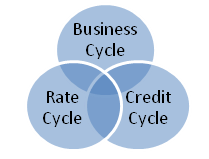
The 3 major cycles: Business Cycle, Credit Cycle and Rate Cycle.

The banks straddle all 3 to be a key contributor of capital in the US economy. Financial repression impacts at a very base level for all 3 cycles.”

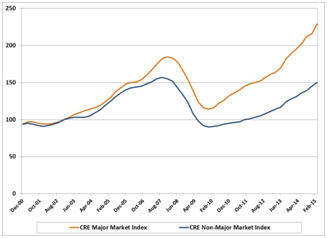
“Financial repression has artificially pumped up asset value.

“Commercial real estate values really pivoted in 2010. There is additional risk in the system now that asset values are pumped up”(See Chart to Left)

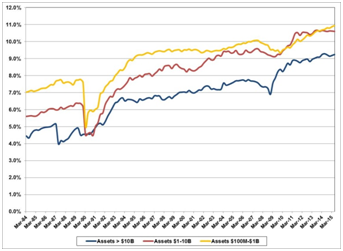
Leverage Ratio

“If you look at the leverage ratio we can see that over the last 20 years the industry has been raising capital. I don’t think that’s a bad thing. We are significantly much better capitalized than Europe which is a good thing, but as it relates to an investor there is a lower return on equity.”(See Chart to Left)

“Regarding financial repression, if you think about interest rates today, it is very painful for an institution to hold cash. There is significant risk taking occurring amongst commercial banks in taking additional credit risk and duration risk. Structurally banks aren’t as spread in terms of their assets relative to their borrowings that fund these assets.”

“Companies don’t go broke because they don’t make money. Companies go broke when they have no liquidity, so what financial repression has done is push liquidity into the system. So now heavily indebted companies are able to borrow money and we will soon see the consequences of that.”Financial_RepressionX_clip_image002

HOW BANKS FUNCTION

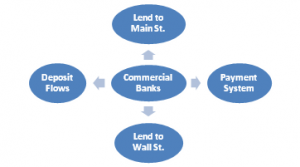
“The banks are special for being separated from commerce.”

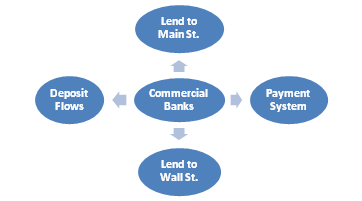
“The objective for a bank is to earn a spread on assets. Loans being the highest yielding asset, followed by bonds, and finally cash. The banks role is to take the deposits and prudently while still taking risk, lend the money into the economy to help finance the economy.”

SHADOW BANKING

“Over the last several decades the shadow banking system has developed into an alternative lender as well as another place for people to put their money.”Financial_RepressionX_clip_image008

The term “shadow bank” was coined by economist Paul McCulley in a 2007 speech at the annual financial symposium hosted by the Kansas City Federal Reserve Bank in Jackson Hole, Wyoming. In McCulley’s talk, shadow banking referred mainly to nonbank financial institutions that engaged in what economists call maturity transformation.

Commercial banks engage in maturity transformation when they use deposits, which are normally short term, to fund loans that are longer term. Shadow banks do something similar.

“Shadow banking system is separate from commercial banking system, but is a very large piece of the credit allocator. A lot of risk has been pushed out of commercial banks and is now in the shadow banking system, where it is not as opaque as a commercial bank.”

CONCERNS WITH SUSTAINED LOW INTEREST RATES

One day there will be a reckoning. It’s simply a buildup of risk; an attempt by central authorities to guide the economy.

Malinvestment: A mistaken investment in wrong lines of production, which inevitably lead to wasted capital and economic losses, subsequently requiring the reallocation of resources to more productive uses.

“A delay of lost recognition and mass malinvestment which is all a credit risk within the banking systems. However, my biggest concern is a dramatic slowdown in the economy, short rates at zero.”

Abstract written by Karan Singh karan1.singh@ryerson.ca

Commercial Real Estate Values

Financial_RepressionX_clip_image006

 Financial_RepressionX_clip_image004

Disclaimer: The views or opinions expressed in this blog post may or may not be representative of the views or opinions of the Financial Repression Authority.


09/25/2015 - Don Rissmiller – The Biggest Fed Meeting Since 2008 In Terms of Expectations

Special Guest: Don Rissmiller – Partner & Chief Economist, Strategas Research Partners


FRA Co-Founder Gordon T. Long talks Financial Repression and current economic developments with Don Rissmiller, a founding partner and chief economist of Strategas Research Partners. Mr. Rissmiller has overseen Strategas macroeconomic research since 2006, as well as thematic research, and high frequency econometric forecasting.

“When we think about financial repression, we think about interest rates being below normal levels or below inflation. You would do that if you’re in an environment with a lot of debt. The solution if you have too much debt is to try to make the burden of that debt to decrease.”

Rissmiller highlights the 3 avenues in which the government receives funds through taxes. Taxing income, taxing transactions, and taxing wealth; however financial repression relates by,

“Keeping interest rates below inflation is a fancy way of taxing liquid wealth, taxing cash.”

THE RESULT OF LOW INTERST RATES

“You’re trying to stimulate the economy by implementing lower interest rates.”

The financial repression process begins at the monetary policy level as a response to some shock In the economy. The goal is to get risk taking up in the economy, and that’s complicated with monetary policy because it is not the best policy when it comes to risk taking,

“It may be the best you can do, it may be an appropriate policy response in a time of stress, but it still has consequences that may not all be desirable.”

When you think about where we are going, what you can do is use whatever works. “You have to force other investors to take more risk. You might bid up asset prices, and of course assets are not equally distributed so that has consequences for income inequality.”

THE SEPTEMBER 17th FOMC MEETING

“It was the biggest fed meeting since 2008 in terms of expectations”

The Fed took the approach that they would like to wait a little more and see some more data. This is not uncommon, if we look back to 2013 to see an example of this, the Fed started talking about the quantitative easing taper in the middle of 2013, and by Sept 2013 the expectation was they were ready to go, but they held back for 3 more months because of the tightening of financial conditions.

“This is a reasonable way to look at what will happen in September of 2015, a tightening of financial conditions plus data that wasn’t equate to have confidence in your forecasts leading the Fed to delay.”

FORECASTING THE US ECONOMY

Considering the global slowdown in world trade and commodity prices, Rissmiller shares some foresight into the potential future of the American economy.

“We are seeing weakness in manufacturing that means another sector will have to pick up the slack. The sectors I will focus on are housing, consumer, and the government.”

“In housing we are seeing some improved signs on household formation. As unemployment is looking more normal we have had more household buying.”

“Consumer spending has been growing, we think this can continue because the decrease in energy prices tends to effect consumer spending with a lag and so we are going to continue to see positives to lower energy prices.”

” The government sector has been a drag, there is still one more budget fight coming in the next few weeks and that’s going to be a challenge, but if we get through that we are into the part of the election cycle where government drag turns into a small boost, we are already seeing some rehiring at the state and local level and that is significant as well.”

Abstract written by Karan Singh karan1.singh@ryerson.ca

Disclaimer: The views or opinions expressed in this blog post may or may not be representative of the views or opinions of the Financial Repression Authority.


09/18/2015 - Martin Barnes – Why Financial Repression is Here to Stay!

Special Guest: Martin Barnes – Chief Economist, BCA Research


FRA Co-Founder Gordon T. Long sits with BCA Research Chief Economist, Martin Barnes, a highly decorated and well renowned economist of 40+ years to talk Financial Repression and Barnes most recent work, Low Growth and High Debt: Financial Repression is Here to Stay.

FINANCIAL REPRESSION

Barnes defines Financial Repression as,

“An environment where interest rates are kept below levels which most people would consider being normal.”

In a recent publication, Low Growth and High Debt: Financial Repression is Here to Stay, Barnes focused on the problems of continued high debt levels and argues Financial Repression as a legitimate solution to the global debt crisis.

“If you can’t easily get your debt burdens down, then at a minimum you have to make the debt easier to live with, and the only way you can make your debt easier to live with is through Financial Repression. In other words, financial repression is the inevitable result of a world with low growth and stubbornly high debt.”

CONSEQUENCES OF LOW INTEREST RATES

“If money is free, very clever people at some point are going to do stupid things with it. There is no question that low interest rates will encourage some misbehaviour, and speculation. However it is hard to make the claim that today’s interest rates are low enough to be causing economic problems.”

Despite already low interest rates, economic growth around the world has been relatively low. Barnes states, “Economies should be booming with current interest rates but they’re not, we are living in a world that I would argue needs lower interest rates.”

“The by-product is financial distortion which has powerful implications for certain groups of people such as people trying to live off of fixed incomes. But you can’t push interest rates up to protect the interest of those people if the global economy is screaming for even lower rates. We cannot have a level of interest rates that will have everyone happy.”

THE PENSION FUND DILEMMA

A major mistake with the development of pension funds is that governments did not increase the pension age with the increase life expectancy.

“In a world of low returns, and people living much longer, the promises that were made a long time ago can no longer be kept. Everyone needs to understand that at some point those promises have to change, either by raising retirement age or increasing contribution rates. The logic behind these pensions is unsustainable and therefore it must change.”

SITUATION IN CANADA

In the midst of falling commodity prices, devalued currency and the housing market bubble, Barnes states the Canadian economic situation

“…is not disastrous; just like so many other economies, we are stuck in low growth. Exports are battling against moderate global growth and world trade. The big drop in the Canadian dollar has not lead to a big pick up in exports as we would have hoped. We are very tightly linked with the US economy and they are slowly growing so that is a positive.”

“Housing by every standard is incredibly overdone, especially in Toronto and Vancouver, it’s hard to get away from the fact that house prices are extraordinarily high here and it will likely erode.”

“China is moving away from its commodity oriented growth to a more service oriented model. The world is moving away from its commodity dependence which is not great for Canada, but we’ll adjust to that.”

Check out his interview with Gordon T Long which covers this and much more.

Abstract written by Karan Singh

Disclaimer: The views or opinions expressed in this blog post may or may not be representative of the views or opinions of the Financial Repression Authority.


09/11/2015 - David Berson – The Fed’s Plan for Interest Rates

Special Guest: David Berson – Senior Vice President & Chief Economist, Nationwide Mutual


David Berson is the senior vice president of Nationwide Mutual. Before now, he has worked as a College professor, at the Fed and for 20 years he was the chief economist at Sallie Mae. He has also worked at Nationwide Mutual insurance for the past three and a half years.

To David depending on where you are in the financial system financial repression will mean different things to you. According to him,

“Financial repression is holding interest rates below the level where they would naturally go.”

He explains that there are two sides to holding down the interest rate, a positive and a negative side. The positive with reducing the interest rate and applying quantitative easing include the addition of liquidity to the economy. According to him, most of the models used by macroeconomists indicate that monetary expansion helps the economy a bit at first but only a period of time. David says the expansion policy helped boost the economy out of recession and is responsible for the modest growth we see now. But the downside to it all is that keeping rates lower than it should naturally be results in savers being hurt due to the extremely low interest rates. At the same time borrowers are at an advantage. It also makes it difficult for investors to have a reasonable return. David agrees that low interest rates push investors to riskier assets but also insists that it is one of the points of having an expansionary monetary policy. He further reiterates that the upside to the artificial reduction in rates is the increased liquidity, which moves the economy a bit upwards.

“They need to concentrate on what’s happening in the domestic economy, they are the US central bank, they are not the central bank of emerging market countries even if those countries are greatly affected by what we do”

According to David, what’s happening in terms of the fall in commodity prices is not directly as a result of what the Fed does. He believes it is as a direct result of the rapid growth in china’s economy as they move to become an industrialized economy. He explains that the primary force driving the fall of commodity prices is the slowing down of the Chinese economy that is occurring now.

On what the Fed will do, David thinks the Fed will tighten this September although he also mentions that with the recent market volatility, the chances of that happening is less than 50%. He believes the Fed should tighten this September as he believes that such an action will help the economy.

On the disappointing recovery of the economy, David explains that there is an excess of government oversight on the economy, which has further contributed to the slowing down of the economy. If you look at what he calls the core GDP, which includes private sales and private purchases minus volatile inventory, trade and government, he is convinced that growth has picked up better than the overall GDP suggests and much closer to historical averages.

“One of the reasons why economic growth has been weaker in this expansion than others is a lack of government spending now I think that in the short-term negative in the long run I think a move in resources from the government sector to the private sector is positive but it takes a while for that to manifest itself in stronger overall GDP growth”.

Check out his interview with Gordon T Long which covers this and much more.

Abstract written by Chukwuma Uwaga – chuwaga@gmail.com

Disclaimer: The views or opinions expressed in this blog post may or may not be representative of the views or opinions of the Financial Repression Authority.


09/08/2015 - James Bianco – The Fed’s Plan for Interest Rates

Special Guest: James Bianco – President, Bianco Research LLC


Bianco research started in 1998 and is affiliated with Arbor research and training. It is an independent research company with James Bianco as its president.  Bianco research specializes in macro, fixed income and equity research.

James views financial repression in light of what Ben Bernake said in his November 12 op-ed in the Washington post:

”the purpose of QE2 is the fed buys bonds, force down interest rates, that would make them relatively unattractive for most bond investors, seeking alternatives they would move further out the risk curve and they would not buy .They would push up those assets prices, create a wealth effect expecting a cycle in which the wealth effect creates economic growth to justify those higher prices”.

The forced down interest rate will not bode well for individuals who need certain rates of return to guarantee things like pension and retirement. You end up taking more risk by buying riskier assets which pushes up its price causing you to feel wealthier. He explains that when a government body in this case the CBN steps in and sets price at levels where they would not ordinarily go by themselves, they are repressing the price of interest rate, inflating the price of risk assets. They argue it is a greater good because of the wealth effect that comes from that.

James doesn’t think that the wealth effect occurs as a result of that. According to him, Milton Friedman in 1915 developed the permanent income hypothesis which states that if an asset goes up in price for example a house, you treat it as another form of permanent income. One the other hand, if your stock portfolio goes up, you perceive as temporary due to what you read in the paper.

“That’s why we obsess over the fed because we think all this stuff is temporary and we want to find out how temporary it is, because when the fed raises rates… I guess to mix my metaphors a little bit with the old warren buffets’ old line that we find out that we are swimming naked when the tide goes out”.

That’s why a rate hike is such a big deal in the financial markets.
What will the Feds do?

There are two things to keep in mind concerning what the feds will do. There’s the economic data and the market pricing of it”.

He says that based on the economic data, the fed has set up some parameters for itself and from a data dependent point of view, they have everything they need, but James believes that what will hold back the feds will be market instability. Currently, there is a great deal of volatility and uncertainty in the Chinese and emerging markets. He believes the instability in these markets will cause the feds will to maintain interest rates because they are hoping that things would calm down enough by Dec. He mentions that part of the reason for the unstable markets is due to the Feds insistence on raising rates.

EU

On his view of the EU, James Bianco has this to say:

“The history of the Europe is for the last thousand years is every generation they try to kill each other and the last one was in World War 2”.

Then they decided to get closer in order to prevent more wars. This led them to create the euro. According to him, the problem with the euro, is that you have 17 different countries in different cycles using the same currencies. He says that Draghi’s plan is to get interest rates to below zero and continue trying to stimulate the economy. He goes further to explain that the current refugee crisis that the EU is facing will have a huge negative impact on their economy. He doesn’t think Draghi’s plan will work because people think it’s temporal and as long as they think that, the permanent income hypothesis will take effect.

Check out his interview with Gordon T Long which covers this and much more.

Abstract written by Chukwuma Uwaga – chuwaga@gmail.com

Disclaimer: The views or opinions expressed in this blog post may or may not be representative of the views or opinions of the Financial Repression Authority.


09/02/2015 - Adam Andrzejewski Talks Financial Repression & Actions for Government Transparency

Special Guest: Adam Andrzejewski – Chairman, American Transparency and Editor, OpenTheBooks.com


ADAM ANDRZEJEWSKI DISCUSSES HIS PUBLIC INITIATIVES TO BRING MORE TRANSPARENCY OF GOVERNMENT SPENDING AT ALL LEVELS TO THE ELECTORATE.

FRA Co-Founder Gordon T. Long interviewed Adam Andrzejewski, the Chairman of American Transparency and Editor, OpenTheBooks.com. on his personal goals which prompted his launch of these public projects.  Mr Andrzejewski’s American “Heratio Alger” story needs to be told.

In October 1997, Adam Andrzejewski founded an independent publishing business with his brother, Abram Andrzejewski. The publishing company, HomePages Directories, employs nearly 150 people and has an annual revenue of nearly $20 million. Adam Andrzejewski also started a grassroots initiative to enable local counties and school boards to post their check register online.

On March 1, 2009, Adam Andrzejewski announced his intent to run for the office of Governor of Illinois. Andrzejewski was one of four Republicans to file with the Illinois State Board of Elections to be placed on the ballot, submitting over 14,000 signatures. On 25 January 2010 Andrzejewski received an endorsement from Lech Wałęsa, former Polish President and Nobel Peace Prize Laureate. On 1 February 2010, Andrzejewski was endorsed by talk radio host Rush Limbaugh. On 2 February 2010 Andrzejewski was defeated by a significant margin in the Republican primary for Governor of Illinois.

His platform was based on government transparency. His campaign slogan was “Every Dime Online in Real Time.” Today as Chairman of American Transparency and Editor, OpenTheBooks.com. he is following through in a high profile and aggressive manner on his campaign platform and his personal goal to bring visibility of all levels of public government spending to the voting public.

Adam believes it is this visibility which will force accountability and responsibility from elected officials charged with the fiscal decisions of local, city, state and federal government offices.

“Open The Books” has become a national rallying cry for transparency in public spending. U.S. Senator Tom Coburn, sponsor of the 2006 “Google Your Government Act,” recognized Adam’s work,

“Open the Books is doing the work I envisioned when the Coburn-Obama bill became law. Their innovative app and other tools are putting sunlight through a magnifying glass.”

LEARN MORE & SUPPORT OPEN THE BOOKS

Disclaimer: The views or opinions expressed in this blog post may or may not be representative of the views or opinions of the Financial Repression Authority.


08/31/2015 - Ramiro Larroy – Lessons in Financial Repression from Argentina

Special Guest: Ramiro Larroy – Partner & Director, Integras Capital


RAMIRO LARROY DISCUSSES HIS VIEWS ON WHAT LESSONS THE WORLD CAN LEARN FROM RGENTINA ABOUT INVESTING IN AN ERA OF FINANCIAL REPRESSION

FRA Co-Founder Gordon T. Long interviewed Ramiro Larroy, Partner & Director, Integras Capital in Buenos Aires, Argentina.

FINANCIAL REPRESSION

“Financial Repression globally is basically governments keeping interest rates below the rate of inflation as a way of taxing savers”

Ramiro suggests that in Argentina it is much more direct it its enactment by governments. “We had many experiences throughout the years where depositors in banks were ‘bailed-in’ and forced to take on debt as opposed to their deposits”

“IT IS A TAX! It was applied a little differently in Argentina than how it is being achieved by governments in developed countries.”

THE ARGENTINIAN EXPERIENCE

“When Argentina regained democracy in 1983 we had a government that from an economic standpoint did not do that well. They ran fiscal deficits and prices of exports were poor. By the end of this government in 1989 the country was heavily in debt with inflation. At the same time they paid high interest rates on deposits so people kept deposits in the bank. With these deposits the banks were able to buy government debt. In 1990 enacted (like at midnight!) a program where everyone that had deposits received a bond.” Literally, overnight with no recourse.

“Maybe people were able to earn a rate higher than inflation before, but all of a sudden they lost everything!” The government did not have the money to pay the money owed on the bonds it had issued. This was a way to reset and issue a new long term bond.” Argentinians have experience in their bank deposits being taken from them.

CHANGED INVESTMENT SENTIMENT

“These banking actions resulted in a huge change in the mind set of investors! It is now very difficult for a family to have a substantial part of their assets to be held locally or exclusively in the banking sector. Though rates may be ‘ok’ in the banks, people are not comfortable with the risks they are taking! Pretty well everyone has developed OTHER WAYS OF STORING WEALTH, from Real Estate, to buying Gold to buying physical US Dollars.”

“The more wealthy individuals and families have their wealth outside of Argentina as a way of protecting those assets. It is not about higher returns, but rather not wanting to lose the wealth.”

STORE OF VALUE STRATEGIES

“Store of Value Strategies are so prevalent that on this day we are talking, in the morning paper of one of the largest newspapers in Argentina, the major story is “8 Strategies Not to Lose Your Wealth in the Upcoming Depreciation! Need I say more!”

.. there are many lessons to be learned in this broad 35 minute interview discussion. Maybe the most important is that Argentina is 15-20 years ahead in regard to Financial Repression investor strategies. Government actions are very predictable when debt becomes too large for officials to handle.

09-03-15-Argentina-Lessons-420

Disclaimer: The views or opinions expressed in this blog post may or may not be representative of the views or opinions of the Financial Repression Authority.


08/29/2015 - Danielle DiMartino Booth Talks Financial Repression, A Camp Kotok 2015 Guest

Special Guest: Danielle DiMartino Booth – Former Federal Reserve Advisor, Chief Market Strategist, The Lisco Report


Having done lots of fishing this summer at Camp Kotok in northern Maine, Danielle DiMartino Booth is here interviewed by FRA Co-Founder Gordon T Long. Danielle is a former Dallas Federal Reserve Bank Advisor and now the Chief Market Strategist of The Liscio Report. She takes an Austrian School of Economics viewpoint on economic and financial matters.

Danielle emphasizes how she understands financial repression “in her bones” because she worked in “The Financial Repression Factory”, referring to the Federal Reserve. She understands the level of malinvestment, mispricing and lack of price discovery as the unintended consequences of repressive and obfuscating monetary policies of central banks. She thinks the Federal Reserve “does not have a deep enough appreciation of malinvestment .. as if Ludwig von Mises never walked the planet.”

She is angered by the considerable level of savings which has been foregone thanks to the quantitative easing (QE) policies of the Federal Reserve. Gone are the days of retiring on a Certificate of Deposit paying a decent level of interest income, due to the virtually 0% interest rates.

Danielle says there must be a renewed emphasis on education and innovation in America for it create jobs and jobs that are higher-paying generally than is currently the case.

Check out her recent speech – subscribe to our Mailing and Alert System and we will email you the PDF or view the Scribd below:

July 2015 Speech by Danielle DiMartino Booth

Disclaimer: The views or opinions expressed in this blog post may or may not be representative of the views or opinions of the Financial Repression Authority.