10/01/2018 - FRA Roundtable Insight: Yra and Peter Podcast

FRA Roundtable Insight: Yra and Peter Podcast

By: Tenzin Lekphell

FRA: Hi welcome to FRA’s Roundtable Insight! … Today we have Yra Harris and Peter Boochwar. Yra’s a hedge fund manager, global trader in foreign currencies, bonds, commodities and equities for over 40 years. He was also a CME director from 1997 to 2003, and Peter is Chief investment Officer for the Bleakley Financial Group and advisory. He has a newsletter product called boockreport.com which has great macroeconomic insight and perspective with lots of updates on economic indicators. Welcome gentleman!

Peter: Hey Rich. Hey Yra.

Yra: Hi Rich. Hi Peter.

FRA: Just thought we’d begin. Today is Wednesday September 26th around noon eastern time and we have the Fed statements coming up shortly, even though this program will be published slightly after, but just wondering your thoughts on what could be said that this afternoon? Yra?

Yra: Well I think we’re all baked in at 25 basis points. I just put something out, a little note on the blog, I don’t know what Peter will say to it. I think the one of more interesting aspect is people are looking to remove the line that policy is not (inaudible 1:23-1:26) anymore. I’m not sure about that but I will be watching the way this vote goes because I want to see, there’s some discussion out there, I don’t know who it is out there of course they never put name’s to it, that there are some who are looking for 50 basis points. I know Peter and I have talked about this in meetings previous. We would of liked to see 50 basis points. I don’t think this one is doable because of the closeness to the November elections but, I want to see the Brainard and Williams will because of their recent hawkishness. I don’t know if Charlie Evans is a voting member but he’s been hawkish of lately. So I want to see some of these Hawks vote in favour of 50 basis points increase. That’d be the most interesting thing to me because that would put up much more hawkish tone to the Fed regardless and we’ll wait for the press conference. Outside of that, I’m not looking for anything else.

Fra: And Peter?

Peter: Evan’s actually is an alternate number so he won’t be voting but we will have some new voters. (Inaudible 2:33) will be voting for the first time and then some relatively new members. (inaudible 2:38), I’ll be voting, and (inaudible 2:41-2:42). It’s a newer complexion and I think that because of it, they’ll be raising 25 basis points and leaning towards a December hike as the market is pricing that in. The Market, or at least the Fad, I think follow up on what Yra said on Brainerd and Williams, they want to keep on hiking and you might as well just do it in December because next year you’re wide open in terms of meetings because every meeting has a press conference. Where is before, the next press conference meeting would have been March and if they did not hike in December, they would have to wait till March.

Now there’s a lot more flexibility next year and then went to hike. You might as well move closer to where they want to go, ultimately that’s 3% or more, and get there sooner rather than later because I think a lot of these Fed people they do speak to a lot of contacts and everyone is telling them wages, wages, wages are going to higher and you can’t find any any workers and these academics still focus on the Phillips curve. They still believe that inflation will likely be triggered by that and then you throw in the tariffs. Hiking today they’re only going to get 2 to 2 ¼ and which tells me that maybe they will keep in that wording that being accommodative because to think that 2 to 2 ¼ is not accommodate is quite comical and Yra can probably speak to this better than I can because he’s seen a long-term level of interest rates much higher and it’s laughable that 2 to 2 ¼ would not be considered accommodative at Fed funds level.

I don’t think Powell wants to be that exciting with the statement. I think the statement will be not much different than the prior one so we’re going to have to wait till the press conference in order to gauge some more details in which way he is leaning but again, whether he raises in December, or January, whatever, they want to get to 3 % plus fed funds rate all else equal and based on what they’re saying right now.

FRA: Any thoughts on that Yra?

Yra: I think that’s absolutely right. Powell and, I think the new voice of (inaudible 5:03), well we don’t have Nelly Ling, that’s her name right?

Peter: Yeah.

Yra: Who seemed to be at least beyond academics and aware of the financial ramifications that emanate from the Fed policy and long held Fed policy, which I find interesting. I think Vince Reinhart was on with (inaudible 5:36) today and I thought that was an interesting discussion because I think Vince Reinhart made a good point which is that these later appointments by Trump, who been pretty responsible Fed appointments, which I’m very surprised, because I wouldn’t put them as easy money people whatsoever. While he’s spoken about easy money, who ever is advising him, who’s ever council he’s taking on, maybe is directly from Powell, these have been responsible Fed appointees and I think these are good thing cause as Peter discussed. We need to get away from the academics. Not that academics don’t have a place, but they dominated the Fed. Greenspan certainly relied on (inaudible 6:19) although he had a gut feeling. Powell said in his (inaudible 6:23) hall of speech he applauded that Greenspan had, what I think Powell would say he has which is, some risk management tools so he’s not knee jerk. Although I would certainly argue that Greenspan, with the start of every meeting raising a quarter like he did at a certain period, really set the Fed at a bad course and the world because every other Central Bank has followed that same policy. For the life of me, I really don’t get it. Your willing to cut 1% which will on only raise ¼ point increments.

Peter: Measure and Pace right? That’s what Greenspan said every meeting in the mid 2000s. Measure and Pace.

Yra: Which I think it’s terrible because you’re not listening to the markets. (inaudible 7:14-7:16) I think a set course is a terrible public (Inaudible 7:18). You can have mandated goals but why should you have set course to reach it. I know that Peter agrees to that. They should have raised half a point long ago. This quarter point is nonsense then they could have stepped back and let the market digest. I’m gonna agree with Peter. It’s a long answer to a short question.

Peter: Here we are in the 10th year of this expansion and today’s hike is only going to bring real rates to zero. For them to call zero real rate not accommodative, if they take that wording out, is laughable. So I’d lean to them leaving it in but we’ll see.

FRA: Let’s go to a macro view on a financial markets. Peter you’ve recently mentioned or observed on the disconnect that you see between the US markets and the Emerging Markets. Can you elaborate on that? Like what and what is behind that?

Peter: Yeah it’s been pretty glaring. The out performance of the U.S versus everybody else.  In fact everybody else is down on the year and we know that S&P 500, in particular, has had a great year, even though 40% of S&P 500 revenues are sourced overseas.   

Certainly worries about slowing growth in Europe, certainly in China, and by default the rest of Asia and that’s being reflected in their equity markets and we know same problems with emerging markets. I think to believe that the US is immune to that is silly. But right now at least, US growth is well outperforming most other areas. Earnings growth in the first half of the year are very good, still should be fine in Q3, but I do think you’re going to start to see some issues with earnings related to tariffs, related to higher labour costs, that is the largest input for companies and I don’t see how much longer that discrepancy can last. Either overseas is going to catch up or on the upside, we’re going to catch up to them to some extent on the downside. The differential is pretty glaring.

FRA: Right now, has it been due to international capital flows going into the US from emerging market issues, concerns, challenges, and this global slow down looking to the U.S as a safe haven also considering the U.S dollar getting stronger?

Peter: That can be part of it but I think it’s U.S investors are dominated by machines. They don’t respond to speculation about the possibility of a slowdown driven by what’s going on overseas. They only do it when they actually see evidence of it. Whether that’s in earning season over the next couple weeks, if we begin to see some signs of it, or it’s actually in the economic data. So I think that’s why the US market has sort of shrugged off not only the growth story that’s changing overseas but the rates over here where they continue to rise and we have a over levered global economy. We have a very highly levered, over levered U.S corporate balance sheet outside of (inaudible 10:51) and rising rates is usually not a good set up with that. So I think that there’s this belief that somehow the Fed’s can engineer a soft landing. Historically that’s rarely the case. But until they begin to see evidence of weaker data here or (inaudible 11:11) in earnings, they’re not going to respond. So my point is don’t look at the US equity market as a discounting mechanism. I think it’s mostly reactive instead.

FRA: And your thoughts Yra on this?

Yra: I’m going to take a little bit different tactic here. I mean I agree with him but I see things that are going on. The other day, (inaudible 11:35) comments were a 180 degree from his press conference. (inaudible 11:45) sees vigorous pickup in underlying inflation. (inaudible 11:48-11:50) but the dollar didn’t sell off. Thinking that the European are gonna be, as (inaudible 11:54-11:55) says, vigorous. Well this is totally (inaudible 12:00) of what we heard him at the press conference. It’s really raising my (inaudible 12:07) there’s something going on here.

Are the Europeans now all of a sudden are getting a sense that Trump, that if they don’t do something to raise the level of the Euro, that they’re gonna feel the sting of Trump’s tweet or whatever. That really boggled my mind. I just don’t see it. Everything has been the other way from all the other conversation. Then of course (inaudible 12:37-12:39) walked it back even though Watney from Austria was still adamant (inaudible 12:46) by pulling back.

Yesterday, there was a tweet out by, I don’t know who she is, Dr.Julia (inaudible 12:57) that said, “Hawkish Yellen, Unemployment rate is half the full point below the natural rate (inaudible 13:04-13:05) stabilize it and they need to nudge it higher”. It’s almost a hawkish comment but yet 2 weeks ago on the 14th of September, we had Yellen speaking at bookings in that group meeting. In her speech, it’s been lower for longer, lower for longer, lower for longer!

Peter: (inaudible 13:33-13:34) that don’t work and keep on doing things that doesn’t work is what she’s saying.

Yra: Its sending mixed messages. That’s a great point and it’s all making it to the headlines. I think it’s really confusing for markets even though Yellen carries no weight whatsoever. None. But the way people throws these things out, I don’t see (inaudible 14:02-14:03) that Peter’s talking about. Where’s Europe going? Europe’s going nowhere. As I’ve maintained and I know we’ve discussed this for more than a few years already. (inaudible 14:13) locked himself in this terrible trap here and it gets (inaudible 14:16) more and more. I know Peter talked about it this morning with the Italians and what happens and now the French are really caught in this similar trap because they need Macron’s poll ratings are dropping dramatically and even as Peter pointed out, the (inaudible 14:32) strongest of the majors European stock markets. His poll numbers are dropping and he gonna need to placate some on the left with greater spending but their not going to be able to do it and Germany is really in dire (inaudible 14:49) politically. Merkel is having the legs cut under her all over the place and October brings the election in Bavaria in which the S.C.U (inaudible 15:00) is under dire threat and it’ll be interesting to see if they even hold to be the most popular party because that would really bring pressure on Merkel in many other ways.

Europe is a difficult (inaudible 15:14) and I don’t see them, yes they’re going to end QE at the end of December but even (inaudible 15:20) said, ending QE their not shrinking the balance sheet. He was explicit about that and that made the capital key such a dangerous situation for him because he’s got to abide by definition and buy 18% of the assets ECP buys which are German Bunds or German instruments. Well with German surpluses growing, I don’t know where their going to find that much to buy without pushing German rates, even on the long end, further down. So there’s here’s all these things confronting us.  

FRA: Could that issue, in terms of the amount of German debt being used as diminishing, prompt the emergence of a Eurobond for the ECP?

Yra: Well there are certainly those who won’t (inaudible 16:07) cause I think that’s what the end game is.

Peter: Germans (inaudible 16:12) try to push that into the future as long as they can.

Yra: As far as they can cause that would mean that the German would have to underwrite the whole debt load. I don’t see any unless you had a denaturalization meaning sell off a lot of  publicly held companies, meaning, government held companies in order to be able to buy back some of the bonds with real assets rather than ECP money. It will take a major political upheaval in Germany from those who are (inaudible 16:51) of that because right now the rising forces in Germany, the rising political voices are not in favour of that. In fact, I would say that one of the staunchest platform policies of the (inaudible 17:06) for Germany is less German involvement into the guarantee of the European financial system. The winds are blowing in the opposite direction and Peter exactly is right, they’ll delay that as long as possible. Macron….when he was a rising star couldn’t get her to sign on to a unified financial system, which is the risk that would be absorbed by the European stability mechanism, with the German’s guarantee in that cause the Germans saw through that and she wouldn’t even sign on that when Macron was maybe somebody (inaudible 1742). Right now, he’s a weakened force as she is and it’s the Italians, in my mind, who are holding the cards here.

FRA: So as we go towards the end of the year, could the German-French yield spreads on bonds likely increase as the ECP buys less assets going in to the end of the year? Your thoughts? Peter?

Peter: That’s a good question. I actually just think they’re both going higher, whether the spread widens or not, I’m not sure. As Yra said they both now have political issues. I can’t fully understand why the Macron’s poll numbers are dropping as fast as they are. Maybe it’s the French just don’t like change that he’s trying to bring, but I’m surprised by that. I think either way, you’re going to see a rise in yields in both countries and I think people don’t understand how much of an influence the ECP was and still is barely in terms of their buying in those markets in while they’re continue to reinvest proceed.

They were buying 7 times net issuance of European bonds. The Fed QE at its peak was 25% of net issuance of treasury (inaudible 19:03-19:04). That’s how dominant the ECP was. While we all know what they’re going to do, they told us what they’re going to do, I still think there is this level of nonchalant as somehow European bond yields can stay around these current levels even with the reinvestment. And that’s what I’m most worried about is a rate shock in Europe that could have a ripple effects.

We already seen the Bank of Japan pulling back and you’ve seen a jump in longer (inaudible 19:32) yields there and you’ve seen the 10 year yield creeping closer to 15 basis points as Bank of Japan is more tolerant of that. You’ve seen the US 10-year just a few basis points from breaking out to multi year highs. If you seen these rise in yields, its not for all good reasons, it’s not that the economy is great and the markets are just doing it, it’s that you have this Gorilla in this room thats walking out and buying less and a combination with other things including inflation and others. I think people are way to nonchalant with this move up in the interest rates.

FRA: And Yra, what do you see happening as we go towards the (inaudible 20:09-20:10)?

Yra: I think that’s right. (Inaudible 20:11-20:12) the reason I dig through the plumbing… if you look, German issuance is diminished because they’re running surpluses. France has grown over these last years. The real canary in the coal mine is that their running these budget deficits, meaning France and Italy, with these ultra low interest rates. Lets not minimize that..  

Peter: (inaudible 20:49-20:51) by 2%.

Yra: These deficits haven’t shrunk whatsoever and if interest rates start to rise, as Peter and I believe that they’re going to do, it’s gonna put even greater pressure on these deficits. I don’t know if they will get better growth. I applaud Macron. I think he’s trying to turn the tables on what has been a (inaudible 20:19) economic policy from Halland, and even Sarkozy. They did some stupid things. He’s trying to undo them but the deficit is still growing. Its like with Greece. You hear everybody talk about how Greece turned around. Well the Greece debt to GDP ratio, even with all this austerity, it’s still bigger then when it started down that path of austerity and thats with interest rates dropping dramatically. And that’s where the real risk here lies. And from the (inaudible 21:53) aspect of it, German credits are far better than the rest of the credits. Maybe the Dutch and Austrian certainly without the ECP would be able to stand on their own. But the others, (inaudible 22:06-22:08), and that includes France because France is not without its problems. And if Macron fails, the issues in france are really gonna get worse as Peter points out. Politically they don’t like this type of change. The unions in France still have a lot of power. Macron would like to diminish that power but they still have a lot of power. That’s the reason why I like to be long German and short French because right now the spread on 10 years is about 32 basis points which is about mid range over last 3 or 4 years. But based on the shrinking amount of German assets and the fact that German assets are needed for REPO financing, their high quality liquid assets, that will put demand in there regardless. Unless (inaudible 23:00) openly breaks with the capital key, which he has to be very careful because there are those in Germany that will return back to the German Constitutional court and say that this is illegal because your financing individual countries and in violation of the entire edifice of the Central Banks and what their supposed to do. (inaudible 23: 27) there are things waiting out there.

Peter: It will be a real disappointment if Macron is gone at some point. He was the right guy for that job at the right time for France. It’s amazing people don’t appreciate it.

FRA: Given these thoughts on Europe and what we mentioned earlier in the US, could we see another round of more easing by central banks globally? If we go to China and look at the currency there, if the Yuan weakens and we get global disinflation, could that cause more easing by Central Banks globally? Peter?

Peter: It’s a good question. I don’t think the Chinese want to go down the route of seeing a dramatically weaker currency. They are trying to shift their economy from a manufacturer infrastructure, (inaudible 24:23-24:26) investment type economy to more services and more consumption. You don’t want a weaker currency, if that’s the transition you’re trying to make. You don’t want to damage the purchasing power of consumers if your trying to improve consumer spending. I think they are more interested in having a stable currency not a dramatically weaker one. I’m sure the weakness we’ve seen will be tolerant of because it’s relatively modest and it can help cushion the impact of the tariffs but I wouldn’t look for major decline in the currency.

I think the currency that trades (inaudible 25:07-25:08) is the U.S dollar and people should be asking what’s going on with US dollar considering the out performance economically, the Central Bank that is far ahead of the curb relative to others, and why outside of emerging markets where the dollar has strengthened, why against the Euro or the Yen or some of the others has it not traded well? I’m putting aside the pounds because that’s obviously very Brexit related. That’s where I think people should be asking is What’s going on with the dollar and less so with the Yuan?

FRA: And Yra, your thoughts?

Yra: I think that’s dead right on target. I know Peter that’s the Michael Pettis argument which is, “hey, if your trying to build your domestic economy, and China’s certainly is, if I look at the copper market, the copper market is telling me that China’s going to embark on another round of massive infrastructure project whether it’s in the road initiative or just in China itself but that’s what the market is sensing here. You don’t want a weaker currency. Your trying to ramp up domestic spending. You’d like to have a stronger currency because then you can buy cheaper imports so I’m hundred percent agreement and I agree with Peter with the dollar.

The dollar is interesting here because the cost of carry is quite expensive. If we use overnight money in Europe, let’s say German money, it’s 250 basis points going higher. If we’re using 2 year differential, it’s well over 3 percent because German 2 years are about negative 50 and US is of course 2.8. I don’t ever remember, I wont say ever, it’s been certainly over 3 decades that we’ve seen a spread that wide and 2 years or less. So these are things that should be (inaudible 27:24-27:25) the strengthening dollars as a lot of people are positioning for. Peter, from 107,108, but that was based on the Trump Whitehouse as much as anything. Bob White Heiser, who is the power here, is not afraid to promote a weaker currency. I think the markets are starting to accept to (inaudible 27:52) that in but they really haven’t yet. That may be one of the tools they utilized.

FRA: What about Brazil? Are they intentionally driving their currency lower to help their agricultural exports and hurting U.S grain exports?

Peter: They don’t need the help. It’s a business to them.

Yra: They don’t need the help. Its bad politics. Their in a great position now because the Chinese (inaudible 28:31) knows the US for the moment because their agricultural exports from Brazil are so cheap. Even if though they had a (inaudible 28:42) crop because they’re so cheap, it will be interesting to see how much plant the Brazilian farmer grew this year. Even international prices are lower, priced in terms of Real, which the farmers ultimately get paid in as they take their dollars they receive in the international market and convert to domestic currency. Their not suffering whatsoever. The United States farmers are suffering under Tariffs as well as having to compete against the weakened Brazilian Real. They don’t need any help. I think they believe the currency is to weak relative to other policy aims that they have.

FRA: And the finally moving over to Japan. How will the Bank of Japan be able to extricate itself from five years of QQE, qualitative and quantitative easing, since they’ve accumulated so much Japanese debt and equities? Your thoughts Yra?

Yra: Well, I don’t know if they know how to extricate themselves. They’ve just been muddling along here and I mean muddling. They preceded down this path for way too long. Supposedly we heard last week that Abe was backing away from the inflation targets after his new found political strength is (inaudible 30:07-30:09) although he’s got his plate full but I don’t how they get out of here. They’re not going to do it with a weaker currency. We listen to Trump, the sense that he’s looking to throw tariffs on to the Japanese because they run to large of surpluses with the US, the Japanese have to be very careful here and the Europeans can’t be too happy because the Euro against the Yen has been rallying dramatically. The European auto industry is (inaudible 30:51) head wind of a weaker Yen and US tariffs and some really bad fall for Brexit, which not enough people talk about it but the European auto industry could really get hit. But I don’t know what the Japanese are going to do here. They follow this Bernanke down this rabbit hole for way to long and i don’t know what they do here.

FRA: Peter?

Peter: Yeah it’s a great point. I don’t know what they’re going to do. I think that their acknowledging the squeeze that they’re in by allowing a whole 10 basis points extra of a yield grab (inaudible 31:36-31:37) can get in Japan, which is quite amazing from 10 to 20 basis points. They are certainly slowing the rate of purchases. I think they’ve basically cut QE in half. I think they’ve suddenly realized that they are a dominant player in the ETF market and are a top 10 holder in about 40% of Japanese Nikkei companies. I think they got their fingers crossed on generating some higher inflation so they can further get out of what they’ve done but I don’t see how they can ever get out of what they’ve done. I think they’ll just continue to try to lessens their influence and see what happens but Kuroda….talk about overstaying one’s welcome.

Yra: And to add to that, I think one of their plans was, at some point, that they’ll be able to start buying foreign bonds if they needed to but now that they run in Trump, there is no way that the (inaudible 32:39) or even some of those pension funds have to be very careful. The government pension investment fund. They can’t just willy nilly because that will move to weaken the end and they have to be very careful here.

Peter: That’ll be dangerous.

FRA: On that note, we’ll end it there. How can our listeners learn more about your work? Peter?

Peter: They can search it in wealth management. They can go to bleakley.com and reach out to me. If they want to see my daily (inaudible 33:10-33:11), they can subscribe at boockreport.com.

FRA: And Yra?

Yra: My blog post, notes from underground, and you can go to Yraharris.com. It’ll come up notesfromunderground you can get access to it and join the conversation that takes place on regular basis about many of these same issues. It’s just a discussion on what’s going on in the world and hopefully you can find your way to profitable investment from them.

FRA: Great insight as always. Thank you very much gentlemen! We’ll do it again.
Disclaimer: The views or opinions expressed in this blog post may or may not be representative of the views or opinions of the Financial Repression Authority.


10/01/2018 - FRA Roundtable Insight: Yra and Peter Podcast

FRA Roundtable Insight: Yra and Peter Podcast

By: Tenzin Lekphell


FRA: Hi welcome to FRA’s Roundtable Insight! … Today we have Yra Harris and Peter Boochwar. Yra’s a hedge fund manager, global trader in foreign currencies, bonds, commodities and equities for over 40 years. He was also a CME director from 1997 to 2003, and Peter is Chief investment Officer for the Bleakley Financial Group and advisory. He has a newsletter product called boockreport.com which has great macroeconomic insight and perspective with lots of updates on economic indicators. Welcome gentleman!

Peter: Hey Rich. Hey Yra.

Yra: Hi Rich. Hi Peter.

FRA: Just thought we’d begin. Today is Wednesday September 26th around noon eastern time and we have the Fed statements coming up shortly, even though this program will be published slightly after, but just wondering your thoughts on what could be said that this afternoon? Yra?

Yra: Well I think we’re all baked in at 25 basis points. I just put something out, a little note on the blog, I don’t know what Peter will say to it. I think the one of more interesting aspect is people are looking to remove the line that policy is not (inaudible 1:23-1:26) anymore. I’m not sure about that but I will be watching the way this vote goes because I want to see, there’s some discussion out there, I don’t know who it is out there of course they never put name’s to it, that there are some who are looking for 50 basis points. I know Peter and I have talked about this in meetings previous. We would of liked to see 50 basis points. I don’t think this one is doable because of the closeness to the November elections but, I want to see the Brainard and Williams will because of their recent hawkishness. I don’t know if Charlie Evans is a voting member but he’s been hawkish of lately. So I want to see some of these Hawks vote in favour of 50 basis points increase. That’d be the most interesting thing to me because that would put up much more hawkish tone to the Fed regardless and we’ll wait for the press conference. Outside of that, I’m not looking for anything else.

Fra: And Peter?

Peter: Evan’s actually is an alternate number so he won’t be voting but we will have some new voters. (Inaudible 2:33) will be voting for the first time and then some relatively new members. (inaudible 2:38), I’ll be voting, and (inaudible 2:41-2:42). It’s a newer complexion and I think that because of it, they’ll be raising 25 basis points and leaning towards a December hike as the market is pricing that in. The Market, or at least the Fad, I think follow up on what Yra said on Brainerd and Williams, they want to keep on hiking and you might as well just do it in December because next year you’re wide open in terms of meetings because every meeting has a press conference. Where is before, the next press conference meeting would have been March and if they did not hike in December, they would have to wait till March.

Now there’s a lot more flexibility next year and then went to hike. You might as well move closer to where they want to go, ultimately that’s 3% or more, and get there sooner rather than later because I think a lot of these Fed people they do speak to a lot of contacts and everyone is telling them wages, wages, wages are going to higher and you can’t find any any workers and these academics still focus on the Phillips curve. They still believe that inflation will likely be triggered by that and then you throw in the tariffs. Hiking today they’re only going to get 2 to 2 ¼ and which tells me that maybe they will keep in that wording that being accommodative because to think that 2 to 2 ¼ is not accommodate is quite comical and Yra can probably speak to this better than I can because he’s seen a long-term level of interest rates much higher and it’s laughable that 2 to 2 ¼ would not be considered accommodative at Fed funds level.

I don’t think Powell wants to be that exciting with the statement. I think the statement will be not much different than the prior one so we’re going to have to wait till the press conference in order to gauge some more details in which way he is leaning but again, whether he raises in December, or January, whatever, they want to get to 3 % plus fed funds rate all else equal and based on what they’re saying right now.

FRA: Any thoughts on that Yra?

Yra: I think that’s absolutely right. Powell and, I think the new voice of (inaudible 5:03), well we don’t have Nelly Ling, that’s her name right?

Peter: Yeah.

Yra: Who seemed to be at least beyond academics and aware of the financial ramifications that emanate from the Fed policy and long held Fed policy, which I find interesting. I think Vince Reinhart was on with (inaudible 5:36) today and I thought that was an interesting discussion because I think Vince Reinhart made a good point which is that these later appointments by Trump, who been pretty responsible Fed appointments, which I’m very surprised, because I wouldn’t put them as easy money people whatsoever. While he’s spoken about easy money, who ever is advising him, who’s ever council he’s taking on, maybe is directly from Powell, these have been responsible Fed appointees and I think these are good thing cause as Peter discussed. We need to get away from the academics. Not that academics don’t have a place, but they dominated the Fed. Greenspan certainly relied on (inaudible 6:19) although he had a gut feeling. Powell said in his (inaudible 6:23) hall of speech he applauded that Greenspan had, what I think Powell would say he has which is, some risk management tools so he’s not knee jerk. Although I would certainly argue that Greenspan, with the start of every meeting raising a quarter like he did at a certain period, really set the Fed at a bad course and the world because every other Central Bank has followed that same policy. For the life of me, I really don’t get it. Your willing to cut 1% which will on only raise ¼ point increments.

Peter: Measure and Pace right? That’s what Greenspan said every meeting in the mid 2000s. Measure and Pace.

Yra: Which I think it’s terrible because you’re not listening to the markets. (inaudible 7:14-7:16) I think a set course is a terrible public (Inaudible 7:18). You can have mandated goals but why should you have set course to reach it. I know that Peter agrees to that. They should have raised half a point long ago. This quarter point is nonsense then they could have stepped back and let the market digest. I’m gonna agree with Peter. It’s a long answer to a short question.

Peter: Here we are in the 10th year of this expansion and today’s hike is only going to bring real rates to zero. For them to call zero real rate not accommodative, if they take that wording out, is laughable. So I’d lean to them leaving it in but we’ll see.

FRA: Let’s go to a macro view on a financial markets. Peter you’ve recently mentioned or observed on the disconnect that you see between the US markets and the Emerging Markets. Can you elaborate on that? Like what and what is behind that?

Peter: Yeah it’s been pretty glaring. The out performance of the U.S versus everybody else.  In fact everybody else is down on the year and we know that S&P 500, in particular, has had a great year, even though 40% of S&P 500 revenues are sourced overseas.   

Certainly worries about slowing growth in Europe, certainly in China, and by default the rest of Asia and that’s being reflected in their equity markets and we know same problems with emerging markets. I think to believe that the US is immune to that is silly. But right now at least, US growth is well outperforming most other areas. Earnings growth in the first half of the year are very good, still should be fine in Q3, but I do think you’re going to start to see some issues with earnings related to tariffs, related to higher labour costs, that is the largest input for companies and I don’t see how much longer that discrepancy can last. Either overseas is going to catch up or on the upside, we’re going to catch up to them to some extent on the downside. The differential is pretty glaring.

FRA: Right now, has it been due to international capital flows going into the US from emerging market issues, concerns, challenges, and this global slow down looking to the U.S as a safe haven also considering the U.S dollar getting stronger?

Peter: That can be part of it but I think it’s U.S investors are dominated by machines. They don’t respond to speculation about the possibility of a slowdown driven by what’s going on overseas. They only do it when they actually see evidence of it. Whether that’s in earning season over the next couple weeks, if we begin to see some signs of it, or it’s actually in the economic data. So I think that’s why the US market has sort of shrugged off not only the growth story that’s changing overseas but the rates over here where they continue to rise and we have a over levered global economy. We have a very highly levered, over levered U.S corporate balance sheet outside of (inaudible 10:51) and rising rates is usually not a good set up with that. So I think that there’s this belief that somehow the Fed’s can engineer a soft landing. Historically that’s rarely the case. But until they begin to see evidence of weaker data here or (inaudible 11:11) in earnings, they’re not going to respond. So my point is don’t look at the US equity market as a discounting mechanism. I think it’s mostly reactive instead.

FRA: And your thoughts Yra on this?

Yra: I’m going to take a little bit different tactic here. I mean I agree with him but I see things that are going on. The other day, (inaudible 11:35) comments were a 180 degree from his press conference. (inaudible 11:45) sees vigorous pickup in underlying inflation. (inaudible 11:48-11:50) but the dollar didn’t sell off. Thinking that the European are gonna be, as (inaudible 11:54-11:55) says, vigorous. Well this is totally (inaudible 12:00) of what we heard him at the press conference. It’s really raising my (inaudible 12:07) there’s something going on here.

Are the Europeans now all of a sudden are getting a sense that Trump, that if they don’t do something to raise the level of the Euro, that they’re gonna feel the sting of Trump’s tweet or whatever. That really boggled my mind. I just don’t see it. Everything has been the other way from all the other conversation. Then of course (inaudible 12:37-12:39) walked it back even though Watney from Austria was still adamant (inaudible 12:46) by pulling back.

Yesterday, there was a tweet out by, I don’t know who she is, Dr.Julia (inaudible 12:57) that said, “Hawkish Yellen, Unemployment rate is half the full point below the natural rate (inaudible 13:04-13:05) stabilize it and they need to nudge it higher”. It’s almost a hawkish comment but yet 2 weeks ago on the 14th of September, we had Yellen speaking at bookings in that group meeting. In her speech, it’s been lower for longer, lower for longer, lower for longer!

Peter: (inaudible 13:33-13:34) that don’t work and keep on doing things that doesn’t work is what she’s saying.

Yra: Its sending mixed messages. That’s a great point and it’s all making it to the headlines. I think it’s really confusing for markets even though Yellen carries no weight whatsoever. None. But the way people throws these things out, I don’t see (inaudible 14:02-14:03) that Peter’s talking about. Where’s Europe going? Europe’s going nowhere. As I’ve maintained and I know we’ve discussed this for more than a few years already. (inaudible 14:13) locked himself in this terrible trap here and it gets (inaudible 14:16) more and more. I know Peter talked about it this morning with the Italians and what happens and now the French are really caught in this similar trap because they need Macron’s poll ratings are dropping dramatically and even as Peter pointed out, the (inaudible 14:32) strongest of the majors European stock markets. His poll numbers are dropping and he gonna need to placate some on the left with greater spending but their not going to be able to do it and Germany is really in dire (inaudible 14:49) politically. Merkel is having the legs cut under her all over the place and October brings the election in Bavaria in which the S.C.U (inaudible 15:00) is under dire threat and it’ll be interesting to see if they even hold to be the most popular party because that would really bring pressure on Merkel in many other ways.

Europe is a difficult (inaudible 15:14) and I don’t see them, yes they’re going to end QE at the end of December but even (inaudible 15:20) said, ending QE their not shrinking the balance sheet. He was explicit about that and that made the capital key such a dangerous situation for him because he’s got to abide by definition and buy 18% of the assets ECP buys which are German Bunds or German instruments. Well with German surpluses growing, I don’t know where their going to find that much to buy without pushing German rates, even on the long end, further down. So there’s here’s all these things confronting us.  

FRA: Could that issue, in terms of the amount of German debt being used as diminishing, prompt the emergence of a Eurobond for the ECP?

Yra: Well there are certainly those who won’t (inaudible 16:07) cause I think that’s what the end game is.

Peter: Germans (inaudible 16:12) try to push that into the future as long as they can.

Yra: As far as they can cause that would mean that the German would have to underwrite the whole debt load. I don’t see any unless you had a denaturalization meaning sell off a lot of  publicly held companies, meaning, government held companies in order to be able to buy back some of the bonds with real assets rather than ECP money. It will take a major political upheaval in Germany from those who are (inaudible 16:51) of that because right now the rising forces in Germany, the rising political voices are not in favour of that. In fact, I would say that one of the staunchest platform policies of the (inaudible 17:06) for Germany is less German involvement into the guarantee of the European financial system. The winds are blowing in the opposite direction and Peter exactly is right, they’ll delay that as long as possible. Macron….when he was a rising star couldn’t get her to sign on to a unified financial system, which is the risk that would be absorbed by the European stability mechanism, with the German’s guarantee in that cause the Germans saw through that and she wouldn’t even sign on that when Macron was maybe somebody (inaudible 1742). Right now, he’s a weakened force as she is and it’s the Italians, in my mind, who are holding the cards here.

FRA: So as we go towards the end of the year, could the German-French yield spreads on bonds likely increase as the ECP buys less assets going in to the end of the year? Your thoughts? Peter?

Peter: That’s a good question. I actually just think they’re both going higher, whether the spread widens or not, I’m not sure. As Yra said they both now have political issues. I can’t fully understand why the Macron’s poll numbers are dropping as fast as they are. Maybe it’s the French just don’t like change that he’s trying to bring, but I’m surprised by that. I think either way, you’re going to see a rise in yields in both countries and I think people don’t understand how much of an influence the ECP was and still is barely in terms of their buying in those markets in while they’re continue to reinvest proceed.

They were buying 7 times net issuance of European bonds. The Fed QE at its peak was 25% of net issuance of treasury (inaudible 19:03-19:04). That’s how dominant the ECP was. While we all know what they’re going to do, they told us what they’re going to do, I still think there is this level of nonchalant as somehow European bond yields can stay around these current levels even with the reinvestment. And that’s what I’m most worried about is a rate shock in Europe that could have a ripple effects.

We already seen the Bank of Japan pulling back and you’ve seen a jump in longer (inaudible 19:32) yields there and you’ve seen the 10 year yield creeping closer to 15 basis points as Bank of Japan is more tolerant of that. You’ve seen the US 10-year just a few basis points from breaking out to multi year highs. If you seen these rise in yields, its not for all good reasons, it’s not that the economy is great and the markets are just doing it, it’s that you have this Gorilla in this room thats walking out and buying less and a combination with other things including inflation and others. I think people are way to nonchalant with this move up in the interest rates.

FRA: And Yra, what do you see happening as we go towards the (inaudible 20:09-20:10)?

Yra: I think that’s right. (Inaudible 20:11-20:12) the reason I dig through the plumbing… if you look, German issuance is diminished because they’re running surpluses. France has grown over these last years. The real canary in the coal mine is that their running these budget deficits, meaning France and Italy, with these ultra low interest rates. Lets not minimize that..  

Peter: (inaudible 20:49-20:51) by 2%.

Yra: These deficits haven’t shrunk whatsoever and if interest rates start to rise, as Peter and I believe that they’re going to do, it’s gonna put even greater pressure on these deficits. I don’t know if they will get better growth. I applaud Macron. I think he’s trying to turn the tables on what has been a (inaudible 20:19) economic policy from Halland, and even Sarkozy. They did some stupid things. He’s trying to undo them but the deficit is still growing. Its like with Greece. You hear everybody talk about how Greece turned around. Well the Greece debt to GDP ratio, even with all this austerity, it’s still bigger then when it started down that path of austerity and thats with interest rates dropping dramatically. And that’s where the real risk here lies. And from the (inaudible 21:53) aspect of it, German credits are far better than the rest of the credits. Maybe the Dutch and Austrian certainly without the ECP would be able to stand on their own. But the others, (inaudible 22:06-22:08), and that includes France because France is not without its problems. And if Macron fails, the issues in france are really gonna get worse as Peter points out. Politically they don’t like this type of change. The unions in France still have a lot of power. Macron would like to diminish that power but they still have a lot of power. That’s the reason why I like to be long German and short French because right now the spread on 10 years is about 32 basis points which is about mid range over last 3 or 4 years. But based on the shrinking amount of German assets and the fact that German assets are needed for REPO financing, their high quality liquid assets, that will put demand in there regardless. Unless (inaudible 23:00) openly breaks with the capital key, which he has to be very careful because there are those in Germany that will return back to the German Constitutional court and say that this is illegal because your financing individual countries and in violation of the entire edifice of the Central Banks and what their supposed to do. (inaudible 23: 27) there are things waiting out there.

Peter: It will be a real disappointment if Macron is gone at some point. He was the right guy for that job at the right time for France. It’s amazing people don’t appreciate it.

FRA: Given these thoughts on Europe and what we mentioned earlier in the US, could we see another round of more easing by central banks globally? If we go to China and look at the currency there, if the Yuan weakens and we get global disinflation, could that cause more easing by Central Banks globally? Peter?

Peter: It’s a good question. I don’t think the Chinese want to go down the route of seeing a dramatically weaker currency. They are trying to shift their economy from a manufacturer infrastructure, (inaudible 24:23-24:26) investment type economy to more services and more consumption. You don’t want a weaker currency, if that’s the transition you’re trying to make. You don’t want to damage the purchasing power of consumers if your trying to improve consumer spending. I think they are more interested in having a stable currency not a dramatically weaker one. I’m sure the weakness we’ve seen will be tolerant of because it’s relatively modest and it can help cushion the impact of the tariffs but I wouldn’t look for major decline in the currency.

I think the currency that trades (inaudible 25:07-25:08) is the U.S dollar and people should be asking what’s going on with US dollar considering the out performance economically, the Central Bank that is far ahead of the curb relative to others, and why outside of emerging markets where the dollar has strengthened, why against the Euro or the Yen or some of the others has it not traded well? I’m putting aside the pounds because that’s obviously very Brexit related. That’s where I think people should be asking is What’s going on with the dollar and less so with the Yuan?

FRA: And Yra, your thoughts?

Yra: I think that’s dead right on target. I know Peter that’s the Michael Pettis argument which is, “hey, if your trying to build your domestic economy, and China’s certainly is, if I look at the copper market, the copper market is telling me that China’s going to embark on another round of massive infrastructure project whether it’s in the road initiative or just in China itself but that’s what the market is sensing here. You don’t want a weaker currency. Your trying to ramp up domestic spending. You’d like to have a stronger currency because then you can buy cheaper imports so I’m hundred percent agreement and I agree with Peter with the dollar.

The dollar is interesting here because the cost of carry is quite expensive. If we use overnight money in Europe, let’s say German money, it’s 250 basis points going higher. If we’re using 2 year differential, it’s well over 3 percent because German 2 years are about negative 50 and US is of course 2.8. I don’t ever remember, I wont say ever, it’s been certainly over 3 decades that we’ve seen a spread that wide and 2 years or less. So these are things that should be (inaudible 27:24-27:25) the strengthening dollars as a lot of people are positioning for. Peter, from 107,108, but that was based on the Trump Whitehouse as much as anything. Bob White Heiser, who is the power here, is not afraid to promote a weaker currency. I think the markets are starting to accept to (inaudible 27:52) that in but they really haven’t yet. That may be one of the tools they utilized.

FRA: What about Brazil? Are they intentionally driving their currency lower to help their agricultural exports and hurting U.S grain exports?

Peter: They don’t need the help. It’s a business to them.

Yra: They don’t need the help. Its bad politics. Their in a great position now because the Chinese (inaudible 28:31) knows the US for the moment because their agricultural exports from Brazil are so cheap. Even if though they had a (inaudible 28:42) crop because they’re so cheap, it will be interesting to see how much plant the Brazilian farmer grew this year. Even international prices are lower, priced in terms of Real, which the farmers ultimately get paid in as they take their dollars they receive in the international market and convert to domestic currency. Their not suffering whatsoever. The United States farmers are suffering under Tariffs as well as having to compete against the weakened Brazilian Real. They don’t need any help. I think they believe the currency is to weak relative to other policy aims that they have.

FRA: And the finally moving over to Japan. How will the Bank of Japan be able to extricate itself from five years of QQE, qualitative and quantitative easing, since they’ve accumulated so much Japanese debt and equities? Your thoughts Yra?

Yra: Well, I don’t know if they know how to extricate themselves. They’ve just been muddling along here and I mean muddling. They preceded down this path for way too long. Supposedly we heard last week that Abe was backing away from the inflation targets after his new found political strength is (inaudible 30:07-30:09) although he’s got his plate full but I don’t how they get out of here. They’re not going to do it with a weaker currency. We listen to Trump, the sense that he’s looking to throw tariffs on to the Japanese because they run to large of surpluses with the US, the Japanese have to be very careful here and the Europeans can’t be too happy because the Euro against the Yen has been rallying dramatically. The European auto industry is (inaudible 30:51) head wind of a weaker Yen and US tariffs and some really bad fall for Brexit, which not enough people talk about it but the European auto industry could really get hit. But I don’t know what the Japanese are going to do here. They follow this Bernanke down this rabbit hole for way to long and i don’t know what they do here.

FRA: Peter?

Peter: Yeah it’s a great point. I don’t know what they’re going to do. I think that their acknowledging the squeeze that they’re in by allowing a whole 10 basis points extra of a yield grab (inaudible 31:36-31:37) can get in Japan, which is quite amazing from 10 to 20 basis points. They are certainly slowing the rate of purchases. I think they’ve basically cut QE in half. I think they’ve suddenly realized that they are a dominant player in the ETF market and are a top 10 holder in about 40% of Japanese Nikkei companies. I think they got their fingers crossed on generating some higher inflation so they can further get out of what they’ve done but I don’t see how they can ever get out of what they’ve done. I think they’ll just continue to try to lessens their influence and see what happens but Kuroda….talk about overstaying one’s welcome.

Yra: And to add to that, I think one of their plans was, at some point, that they’ll be able to start buying foreign bonds if they needed to but now that they run in Trump, there is no way that the (inaudible 32:39) or even some of those pension funds have to be very careful. The government pension investment fund. They can’t just willy nilly because that will move to weaken the end and they have to be very careful here.

Peter: That’ll be dangerous.

FRA: On that note, we’ll end it there. How can our listeners learn more about your work? Peter?

Peter: They can search it in wealth management. They can go to bleakley.com and reach out to me. If they want to see my daily (inaudible 33:10-33:11), they can subscribe at boockreport.com.

FRA: And Yra?

Yra: My blog post, notes from underground, and you can go to Yraharris.com. It’ll come up notesfromunderground you can get access to it and join the conversation that takes place on regular basis about many of these same issues. It’s just a discussion on what’s going on in the world and hopefully you can find your way to profitable investment from them.

FRA: Great insight as always. Thank you very much gentlemen! We’ll do it again.
 

Disclaimer: The views or opinions expressed in this blog post may or may not be representative of the views or opinions of the Financial Repression Authority.


09/25/2018 - The Round Table Insight: Charles Hugh Smith Podcast (Sept 21st)

Charles Hugh Smith Podcast

By: Tenzin Lekphell

FRA: Hi! Welcome to FRA’s round table insight! This is Richard Bonugli. Today we have Charles Hugh Smith, author, leading global finance blogger, and America’s philosopher. He’s the author of nine books on our economy and society, including A Radically Beneficial World: Automation Technology and Creating Jobs for All, Resistance Revolution Liberation: A Model for Positive Change, and The Nearly Free University & The Emerging Economy. His blog oftwominds.com has logged well over 55 million page views and is number 7 on CNBC’s top alternative finance site. Welcome Charles!


Charles: Thank You Richard! I hope I live up to that very nice introduction!


FRA: Oh you always do. Thank you for being on the show! And so I think today we wanted to do a bit of a change and look at the economy as a whole and some very interesting trends that are happening, namely a software automation and robotics process automation and artificial intelligence and how that is changing the economy, the job market, how organizations are being affected by these changes, what are they doing, and if people cannot be redeployed elsewhere within our organization, what’s the answer? Do we do a lunar Apollo crash program or, you know, just some of your thoughts on that? And just like to point out so you’ve written a book on Radically beneficial world on automation technology and creating jobs so that could be quite relevant here and also a number of articles as well.


Charles: Right! Right! Well this is a fascinating topic to me Richard and so I spent a lot of time trying to get up to speed on it and of course it’s evolving so quickly that those of us that aren’t really in the field, we’re always trying to play a little bit of catch up so I’m not claiming to be cutting edge here but I think I have thought a lot about it and tried to help my readers navigate it. So, I would start with what’s the context of automation, and robotics, and AI, the impact on the economy as a whole? And I called it, this whole sector trend change, the “emerging economy” because it hasn’t yet occupied every sector of the economy but we know it will right? So that’s why I call it the emerging economy. We see it everywhere but it hasn’t yet, it’s still quite a ways from fully manifesting in every sector of the economy. And one of the issues that you raised here is what happens if we can’t employee people in a sustainable fashion at a relatively high rate of pay? Then who’s going to be supporting the consumer economy? Right? In other words, the basic answer for a lot of people is we give everyone universal basic income but that’s like a $1,000 per person per month is for the general gist of that. That’s not the equivalent of a real middle-class job. That’s just survival pay so that’s not really gonna solve that issue. So that’s one issue and that’s I think the impotence behind your question. We really need people to be working. Not only because we need their productive and capacity but we also have to give people a way to generate enough income to have a good life as prices continue to rise and so on.


FRA: Yeah exactly and what’s happening here is generally technology companies will be able to transform an organization or provide some assistance in the areas of software automation robotics, process automation, and artificial intelligence. But what happens is after some work through organizational change management, they’re able to identify other areas of the organization where those affected by the job changes can be redeployed elsewhere in the organization but it doesn’t work for everybody. Some cannot be redeployed elsewhere within the organization and so they would be let go and then it becomes a societal problem or a government problem at that point. So that’s the big question what happens at that point?


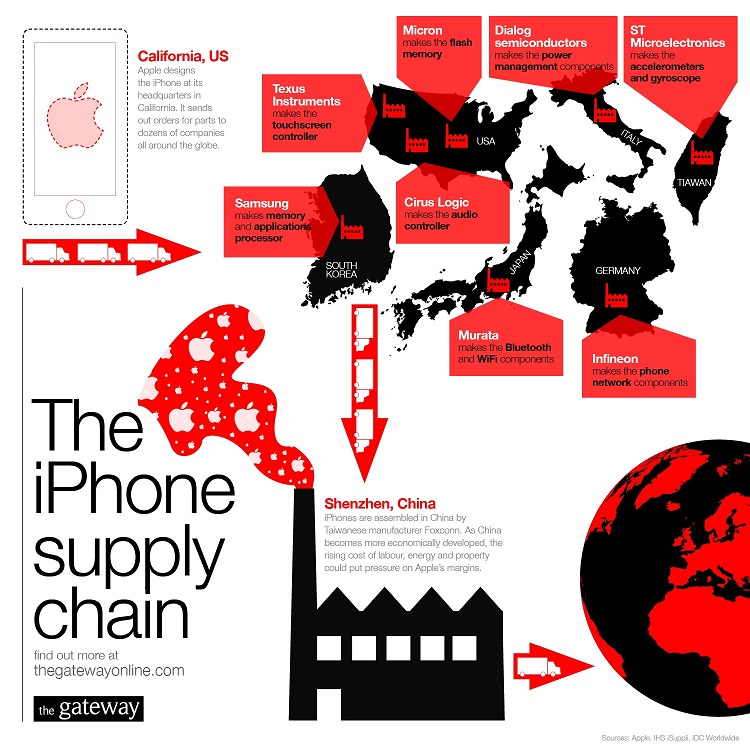
Charles: Right! Just to provide some context, I have assembled a few graphics here that will help us, I hope, contextualize your question. The first is the iPhone supply chain, which goes to show just how global the tech economy is.

Now of course, this is not the entire economy because I read somebody noted recently on the internet that you can’t get a haircut on the internet. Right? So my point here is with the iPhone supply chain is to show that automation is a global phenomenon right? Their automating in China despite the lower labour cost because the labour costs is rising there too. So it’s not just an advanced economy problem, it’s global.

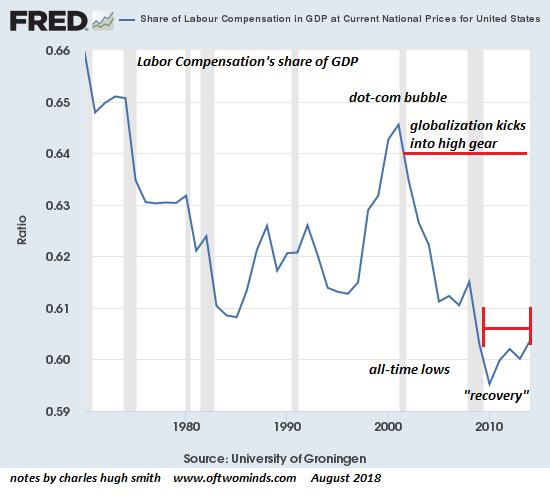
And my next chart here is the labour share of the GDP.

In other words, how much of the gross domestic product (inaudible 6:01-6:02) how much does that end up in the hands of labour as opposed to capital or other investment? We can see from this chart that labour share rose considerably in the dot com era because there was a huge expansion of employment to build out the basic infrastructure of the internet and so that created a lot of real employment. But when that got built out then the labour share of the GDP plummeted and it hasn’t recovered despite the so-called global recovery. So my point here is to show that we really need to keep labour share of the GDP high enough to support consumption or else the model of our economy no longer works.

My next chart is the acceleration of technological adoption.

Of course we all feel this intuitively but this points out that it took like 26 years for television to become ubiquitous and then it took social media only 5 years. So this puts a lot pressure on individuals and organizations because we can see this trend of automation is speeding up. It’s accelerating. It’s almost like whatever skill you learned in college, if it’s 4 years later, you’re already behind the curve. It requires, more or less, constant learning because of this accelerating adoption rate.

Although we’re talking about the economy as a whole, I have a graphic here of the United States which is an example of an advanced economy, you could call up a map of China or Japan or Europe and have a similar discussion.

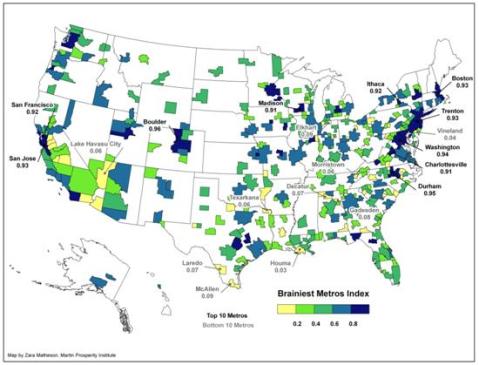
The so called creative class, sort of the generalized term for people with higher education degrees and experience in the emerging economy, these of course are clustered in certain areas. So we’re really talking about two separate economies. So when we try to answer your important question, what do we do with people who aren’t able to transition to an emerging technology kind of economy? It’s a regional thing too because obviously the places like the San Francisco Bay area and equivalent places have the human capital, If you will, to address these issues better then areas with a less educated, with less mobile kind of employment foundation.

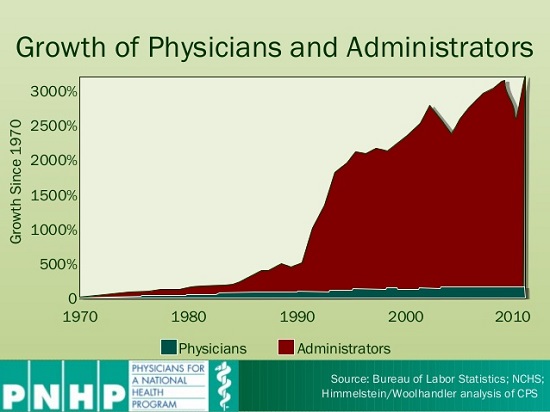
My next chart shows, this is in the health care sector in the United States which we all know is troubled for a lot of reasons, that the number of physicians have been added to the sector is minimal in the last 30 to 40 years where the growth of administrators is up about 3000%.

So I bring this chart to our attention as an example of a sector that is obviously ripe for disruption and there’s a lot of low-hanging fruit in terms of work that could be automated or streamlined in sectors like health care. In other words, this is not just high tech like we’re not talking about chip design or social media or mobile apps, we’re looking at these very large sectors that employ millions of people which are ripe for disruption by the forces that we’re talking about here.

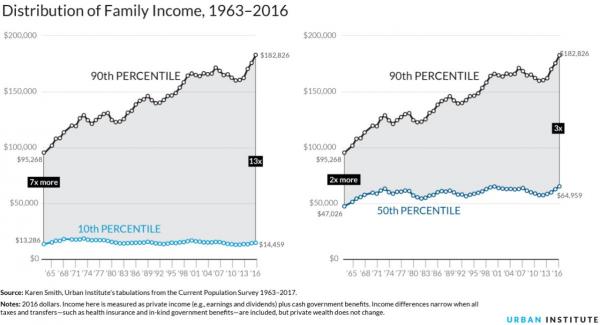
My last chart is distribution of family income which shows, that as we all know, the top 10% has basically lifted away from the bottom 90% in terms of income.

The reason why I bring this up is, there is a lot of reasons for that, but one of them is that this top 10% tends to be the most highly educated, the most dynamic sector of the population. They’re the ones that are acquiring the skills and managerial skills to navigate the emerging economy and this is reflected in their much higher income. And this is the danger of a what we’re talking about here is even if we can maintain some generalized employment, if most of the rewards are going into the top ten percent then that also called into question or our whole mass consumption model of our economy. Now having said all that, how are organisations being affected by this change and how is it affecting the job market and how do how do organizations take the initiative to redeploy or train resources affected by these? These are all excellent questions and of course it depends on the sector. Say, just to give a brief example, the construction industry. There’s a certain amount of technological innovation there in terms of components fabricated in a factory and then shipped and assembled on site to reduce labour but there’s a lot of, let’s say, remodelling work. It’s very hard to automate that kind of stuff because it’s unique to each particular dwelling or each project and we still need workers with multiple skill sets.

So I think as a general rule, what we want to train our people for, whether there within our organization or if their students or laid-off workers is we want to give people a menu of skill sets not just a specialty. I mean a specialty skills works great if you are designing really high-end chip sets or you’re a physician but like for the rest of the populist, specialization means that you can be replaced by automation a lot easier than if you can have multiple skills. That’s one issue here is that we want to broaden peoples skill set.  Another thought here is that some labours are hard to automate like creative work, design, editing, etc. But even those kinds of advanced skill sets are being are being automated too as automation eats its way up the food chain.

Another sector of work that’s fairly protected is managing people, you know managerial skills which is really hard to automate and also any kind of employment that’s based on high touch. What’s known as high touch, meaning that your interacting with humans is what creates the value of your employment and so of course it’s going to be like nursing and childcare and so.

I think what we’re really talking about here when talk about how to organization responds, we’re talking not about those professions that are very difficult to automate but we’re talking about the professions that have to work with automation. They may not be completely replaced but it demands the employee’s augment the processes and learn enough to increase productivity because that’s another thing we’re talking about here as automation and A.I spread throughout the economy, we’re finding productivity is still stagnating. So we’re not really getting the gains of that. I mean you must have some thoughts about that too right? Because technology is supposed to enhance productivity. That’s the wealth creation part.


FRA: Yeah, and you’ve also explored in recent writing as well how organizations are being affected by these changes. Not only as you just mentioned on the productivity results but also on profits. Can you elaborate on that? And in recent writings, you mention that the automation doesn’t just destroy jobs, it destroys profits too.


Charles: Right and that’s counterintuitive for a lot of people Richard because they assume that the robot, because it’s replacing human labor and it’s cheaper, that it’s kind of generate huge profits or the other company that replaced their employees with robots but it doesn’t work like that and the reason why is “commoditization”. When we commoditize something, whether it’s labour or capital or goods, it means that they’re interchangeable. They can be produced anywhere in the world and so this is what the globalization phenomenon has (inaudible 15:41)    why it’s reduced cost so much is labour is interchangeable, computer chips are interchangeable, computer design centres are interchangeable so a robot is like a good example of a commoditized tool where anybody can buy the same robot that I bought and they can put it on their line. So therefore where’s my scarcity value? Where’s my Competitive Edge? and so as soon as you get robots involved then profits fall because everything becomes a commodity and we can see this in technology that when something is commoditized, the value drops, the price drops, and the profit margins drop to near 0. Like for instance a tablet. Right now if you have the special software that Apple sells right it’s tightly bound to its Hardware, that’s their scarcity value you can only get the certain features that Apple has by spending $400 on an iPad right? But if you’re going to get a generic tablet, those are like 30 bucks a piece in China with free software loaded and they have to have an 80 or 90% of the capability of the more expensive one. That’s the same thing that’s gonna happen to robotics. Everybody can buy the same Robotics and a lot of the tools why automation are free or software they’re free or they’re very cheap. So that’s why profits are going to plummet as automation enters the supply chain.


FRA: Interesting! And in terms of how organizations are addressing this, I think it’s also interesting to note how you can almost divide the pool of resources into some certain scenarios. One is the resources that need to be trained for extra skill sets on how to manage the increased level of automation or robotic process automation or artificial intelligence that will come into play in the organization. And then there’s others that would need to be redeployed within the organization elsewhere overall increasing productivity in that way. And then there’s the pool that where there’s no opportunities identified. They are not able to do increased levels of activity of services and they’re not in the pool of being able to be redeployed elsewhere. Your thoughts on that?


Charles: Right! It’s an excellent point Richard and this was really why I wrote my book A Radically Beneficial World is what I was proposing was that there is a very large pool of workers who don’t have the value system, the ambition, this sort of background perhaps to take on the extreme challenge of learning a bunch of high technology skills sets. And of those people, many of them have other kinds of intelligence. In other words, we need to help people identify where their strengths are. So for instance, some people have great manual intelligence. They can work with very fine machinery, some of which is of course related to robotics.


FRA: Now what can we do about this? Should governments take a role in redeploying or training resources affected by these changes? So that this would be the pool of resources that are unable to be redeployed within the organization or that’s still continued to have an expanded role in their current positions and job functions. So what can government do in this regard? Does it make sense to have government play a role your thoughts?


Charles: That’s a great question Richard and I think we can discern two approaches here. One is direct government spending, like on infrastructure a lot of people think of that, but it’s also the government could streamline a lot of really clunky processes we have now and in it (inaudible 20:21-20:22) both have, you know, a lower-level high school education and also higher education. So there’s opportunities for the government to contribute to the solutions in two ways; simplifying and enhancing processes that’s already involved in and then direct spending.


FRA: What about Reliance on the Invisible Hand of Adam Smith? So you know would that play a role here in terms of inner resources able to self-identify or self-train into other areas of the economy?


Charles: Right, it’s a great question and it’s always an issue I think in a state market economy which describes most of the global economy now right that the government’s around the world are heavily engaged or involved in managing their private sector. And so a lot of people have a sort of Quasi-religious belief that the market can solve everything but there certainly seems to be examples in which government does need to play a role in terms of providing infrastructure for everybody so that everybody has equal opportunity within a society. It’s something that isn’t necessarily profitable for enterprise to supply those things. Sometimes it is, sometimes it isn’t right? The canals in the early of the 18th century in America were privately-funded. But to use the example you mentioned earlier the Apollo Mission to the moon, obviously there was no a market demand for that and so no one was going to put up money or capital because there was no profit to be earned and because there was no market. In my book A Radically Beneficial World, I talk about the community economy as a place where we, the government, could redeploy capital because there’s lot of work to be done in local communities (inaudible 22:47 to 22:48) do the work because it’s just not profitable enough for them. But governments are often heavy handed and there are a lot of programs like job training end up failing. They don’t produce desired results. That’s not a clear answer but I think there’s multiple levels of opportunity for government. Sometimes just providing some infrastructure, sometimes smoothing the path so that work private capital can get to work without a lot of red tape and regulation.


FRA: And what about the lunar Apollo crash program back in the 1960s? There’s estimates that perhaps somewhere between $4 and $8 in economic growth, economic activity was generated for every $1 invested into that program. So maybe could that be considered in terms of doing another crash type of program but in something else that makes sense today like you know nuclear fusion energy development coupled with the electrification of cars for example. Would that make sense it in create jobs not only in the white collar jobs but also blue collar jobs across the entire nation?


Charles: That’s a great question Richard. I think a lot of people are looking to that idea as a major solution. A big government spending program on something that was particularly useful, which would be energy, because we all know we need to transition away from fossil fuels. There’s a cautionary part of that idea and I looked to Japan as an example of the cautionary part. Japan has spent almost 30 years spending a tremendous amount of fiscal stimulus on infrastructure and what they done is mal-invested much of it in bridges to nowhere and high-ways very few people used and this is a result of their political system which gives a lot of power to the construction industry. Sadly, they in my view, they squandered trillions of Yen on infrastructure that really didn’t serve the entire citizenry as well as if they solarize their economy or done something that was more to the common good instead of just kind of make work projects. So we have to be careful here that we’re not just funding make work jobs, we want to leverage some technology that benefits the greater good. One example, and a lot of people talk about this, is upgrading the electrical grid because this is something that is required in order make use of electrical production from solar and wind. It’s increasing right? That grid has to be completely upgraded. So that’s an example of a program that sort of fits those parameters so that it would leverage government investment to the benefit of the private sector as well as to the citizenry. Of course everybody loves the example of the Arpanet, which was the original little government funded program that spawned the entire internet right? That was a really low cost investment and so I think we can talk about that too like it’s easy to talk about spending a trillion dollars, and everybody wants to spend a trillion, but maybe we should start by just trying to see what we could do with smaller sums to leverage new technologies and make them available to a wider range of people like 3D fabrication technology. That could be beneficial if the government invested in spreading that around and that should be a lot less expensive than big trillion-dollar programs.


FRA: Interesting. And finally how do you see all of this playing out in the long-term? Do you see like a combination of government taking a role, the invisible hand of Adam Smith or potential crash programs in the future?


Charles: Right! It’s a very dynamic situation and I would hesitate to make any predictions but I think the potential for disruption is so large that the government itself should be disrupted. In other words, we need to disrupt, to which we apply the technologies that we were discussing. We need to apply them to lower the cost and increase the effectiveness of government itself. And so when we talk about government spending, one of the first places we should invest in is streamlining government because it’s really, and it in so many ways, inefficient and ineffective and it desperately needs to be disrupted in streamlined. So that that might be a first place to start investing taxpayer money.


FRA: Wow, great insight as always Charles. How can our listeners learn more about your work?


Charles: Yeah, please visit me oftwominds.com, and you can read samples of my most recent books.


FRA: Great! Thank you very much for being on the program show for your insights on this very interesting topic.


Charles: Oh yeah, we barely touched the surface. Thank you so much for inviting me on the program!


Disclaimer: The views or opinions expressed in this blog post may or may not be representative of the views or opinions of the Financial Repression Authority.