05/01/2018 - The RoundTable Insight: Max Horster On Investing In Climate Change

Download the Podcast in MP3

FRA:       Hi. Welcome to FRA’s RoundTable Insight .. Today we have Max Horster. He’s the Managing Director and Head of ISS-Ethix Climate Solutions – a unit of Institutional Shareholder Services that enables investors to understand, measure and act upon the implications of climate change on investments. Max developed the industry’s leading methodology to gauge and assess climate impact on investment portfolios, resulting in the world’s largest database of company-level climate change data. He holds a Ph.D. in History from the University of Cambridge. Welcome, Max!

Max:      Hi, Richard. Pleasure to meet you. Thank you.

FRA:       Great. If you could start us with your background? How you got into this field? And your career?

Max:      Sure. You mentioned that my focus used to be in history. After that, I ventured onto asset management. I worked for almost 5 years with a large global asset manager capital group and I was scared. I realized that a topic that’s really close to my heart is climate change which mattered to investors. With that thought in mind, I started a small company in Zurich, Switzerland and operated under the name South Pole Group. We were among the first to look into the topic of investments and climate change. That was 8 years ago. We were a little bit early. So at the time we started, the only investors interested in this topic was (1:49 inaudible). Mr. (1:51 inaudible) invested at the charge investor’s foundation or so – who wanted to understand whether the money that they invested is in line with their mission. But over the years, that changed dramatically and I think about 3 years or so, the topic has really brought mainstream investments.  Mainstream investments come from entirely different angles which is from the risk perspective. So, not so much on how money helping (2:17 inaudible) but how the climate change affects the legislation and potentially affect returns. The market grew tremendously fast. As a leader of this market, we realize that, organically, we couldn’t keep up with the market growth. We were approached by quite a few organizations who were interested in acquiring us. So at some point, around the beginning of last year, beginning of 2017, we decided to enter a process. There was a handful of companies that were interested in acquiring us we’re gracious to be able to choose who we want to partner with and we decided to become a part of ISS (Institutional Shareholder Services Inc.) – which is probably known to this podcast as the largest provider of top government research and services proxy (3:23 inaudible). This is also one of the largest and certainly the fastest growing provider of ESG data (Enviroment Social Government data). Non-financial information. It’s the fastest growing in two ways – by organic growth and by acquisition (3:43 – 3:45 inaudible). Not the latest, I should say. Three weeks ago we added (3:48 – 3:52 inaudible) into our family as well. Since June 2017, we have been a part of ISS. We operate under the name of ISS-Ethix Climate Solutions. We basically do three things. We hep investors understand what climate change means for the investment and what the investments mean for the climate. We help measure (4:14 – 4:23 inaudible). Certainly, we help investors act upon that.

FRA:       So, this is a fascinating topic area. Wondering what your thoughts are on climate change? Do you see global warming? Global cooling? Combination of the both? What industry’s sectors of the economy will be affected by climate change going forth?

Max:      My view of climate change is impacted by the view of the scientific community on climate change. I’m not a climate fan myself. As you’re probably aware, the community of climate sciences is in agreement that … nobody is questioning that the climate is changing anymore I should say. There is still a bit of a debate of what the role of human being is in that – of mankind. Ninety-seven percent of climate fans say that man can play the role different degrees on this scientific event that is happening. Climate change is taking place. The community, policy makers and so on follow the scientific view that mankind is the reason for that – the reason for emitting greenhouse gases. The emittance of how we operate (6:05 inaudible) electricity. Therefore, in order to mimic the effects of climate change and reduce its effects and potentially combat climate change, we need to change as a world, as an economy, as a society. To the second part of the question, it is important to understand what the changes are that comes with climate change. To be clear, we differentiate between – we approach it from the risk perspective – we differentiate between transitional risk and predicted risk. Predictive risk is easily understood. When the climate changes, it can be warming and cooling, depending on what geography you’re at. The global climate is warming. However, there are some geographies where there is cooling because of its rippling effect. In general, when the climate is changing, certain physical effects happen – floods, drought but also heavy rainfall. Long-term changes also impact the economy. These physical effects are obviously impacting (7:58 – 8:02 inaudible). If you are producing fertilizers for southern Europe, due to climate change, agriculture won’t be possible any longer in the south of Europe. Your company might not be really affected by climate change but the market that you cater to is. It could affect the supply for your supply chain. We saw last year that the floods in Southeast Asia that the supply chain (8:30 -8:32 inaudible) were impacted by that. These are physical activity has affected every industry. Then, there are some transitional risks. Transitional risks are that come with the world closing in on climate change and trying to mitigate it. That is, of course, being done by regulators stepping in and saying we need to stop emitting CO2. This is triggered by society and changing the way they behave and the types of cars they drive and so on. This is what we call transitional risks and they’re heavily emit greenhouse gases and industries are impacted. That would be, for example, the oil and gas industry and the utility sector. At least the (9:27 inaudible) part of the utility sector, the energy sector in general. In these industry sectors, you have to differentiate between industries where they have to substitute technology that is kind of climate adjustable and where it isn’t. So, if you think about (9:48 – 9:50 inaudible) produce cars that are emitting less or no greenhouse gas emissions – electric vehicles substitute technologies for the combustion engine. You can also produce electricity through other (10:05 – 10:12 inaudible). Water, wind and solar. There are substitute technologies that means a company (10:20 – 10:21 inaudible) in a specific sector. The company can transition. There are also sectors that cannot transition – the oil company. An oil company is an oil company. If it doesn’t produce oil any longer, it falls into a different sector. This is how they approach looking at different sectors and what affects climate change legislation on one end and the climate change effect on the other end and how they affect those sectors.

FRA:       Does your firm, ISS, advice clients on climate change issues relating to ESG-CSR (Corporate Social Responsibility)?

Max:      Yes. This is the core of what my group and I are doing. We advise and we provide data and screenings that help investors frame the topic of climate change. Then measure where they stand. These are risks that I mentioned; physical and transitional risks. First we would look at what the frame of the topic means. We help organisations that are sometimes very large asset managers or asset owners to understand what the topic of climate change for them and for their specific DNA. To give an example; If you are a government pension plan of the country that is heavily dependent on oil exportation, you might take a very different view on the topic of climate change than a church (?) investor. Or you might take a very different view than an insurance company that not only (12:01 – 12:03 inaudible) but also on the liability side that therefore affects the climate change. So framing the topic is the first step that we help investors with. We come in with our consultants and we help determine what climate change means and creating policies around it. Then, in the second step, we help measure where the client/investor stands. That is typically done by providing the investor with data. We can provide raw data because the investor has the capacity to run themselves where the big risks are and where the opportunities are or where the impact lies. More often the case, especially when an investor stops looking at this topic, they send us their portfolios and we run the analysis on their behalf. There, we create either (13:04 – 13:06) depending on who the stakeholder is and what the aim is. We create reports that point out, almost like a heat seeker, where the risks and where the opportunities are. We also suggest steps that the investors can take to address those.

FRA:       In terms of all the actual tools and methodologies, what are those that the ISS use to assess the investment implications of investment asset classes in firms?

Max:      Typically, what investors start with is called the investor’s carbon footprint. The logic is that you own, let’s say an equity portfolio, you own 0.1% of general electric. The investor’s carbon footprint allocates 0.1% of GE (Greenhouse Gas Emissions) to your portfolio to you first. Then you can do that for other companies and you can calculate your emission exposure. You can understand what your expose is to what amount of CO2. How many tons of CO2 does the company that I own emit? (14:25 – 14:28 inaudible) that against benchmarks. We understand whether you are you below the benchmark or not. The benchmark could also be your own portfolio two years ago (14:36 – 14:39 inaudible). That’s the very first step that an investor takes and is typically a very good one to start with. It has some limitations but it quantifies the topic of climate change that investors can process very well which are numbers. Tons of C02. CO2 in many geographies has a price. You can associate the price with us and you can convert tons of CO2 into, for example, basis points. You can say that the direct costs of greenhouse gas emissions that your investors are responsible for is equivalent to is half a basis point. That is a language that is understood and trusted across an organization. From then on, we analyze, what I mentioned before, the transition risks. These can be risks that can be very sector specific. We would tell you what other companies you are invested in. Let’s say in the oil and gas energy sector have exposure to (15:41 inaudible) or to arctic drilling or other practical steps in the transitioning world might face the risk of being reduced by the regulator block by the regulators. We look at physical risks. So, one of the physical risk exposure achieved in long-term off the company portfolio – when we look at what we would call “scenario analysis”, you might be aware that the world committed in the Paris Agreement to limit global climate change to well below 2 degrees. Keep in mind that we’re geared toward 6 degrees of global warming. So, if we really stick to this 2 degrees’ target which every country in the world signed, and those countries ratified, that means a lot of countries have to change. If we look at what companies in your portfolio can be 2 degree aligned in the future. Will we still have such a business model in such a world that we committed to transition to.

FRA:       Through this work that you have been, how are investment asset classes affected by climate change overall? What have you seen?

Max:      I would differentiate between liquid and non-liquid asset classes. The most important differentiation in our business world is to see why. Because when it comes to physical risks, we’re physically affected by climate change. The increase of floods, droughts, storms and so on and these risks are ten to fifteen years out. They increase over time, but in the liquid asset class, you’ve caused (17:33 inaudible) out of them. I would say physical risks – or let’s say liquid asset classes are very much focused on the transition risk. With the equity portfolio, you are concerned about a government committing to a (17:50 inaudible) tomorrow because at that moment, you might own a company that is larger and the (17:57 inaudible) might tip the share price. You’re not so concerned about the curious perspective but about the physical effect of climate change in ten to fifteen years because at that time, you might not own that company any longer. When you think about non-liquid asset classes, namely real estate and private equity. It’s an entirely different ball game. We see today that in these non-liquid asset classes that physical risks are being taken into consideration in the moment of the investment. In other words, if you build a hotel on the shores of Florida and you realize that the hurricanes are increasing in magnitude in terms of strength and number, that matters to you much more as that what it will look like in ten to fifteen years – how climate change impacts these storms. This is much more for you and for insurance companies on selling you insurance for that hotel.

FRA:       Has the impact to the bottom line then – impact on profitability positive or negative? What classes or firms could be affected by this in terms of profitability? Positive or negative?

Max:      It’s an interesting point. There’s a lot of studies being done on that right now and the question whether the risk of climate change is prized into company valuation already today. You do find a lot of studies that support this view – that companies that have the risks and opportunities that climate change are better under control than others; if you create a basket of them and run them against others’ index, there are studies out there that states that these companies are outperforming their peers. That is also a reason for increasing the amount for low carbon investments strategies that are currently being created or have been created the past few years where asset managers put together portfolios with such promise and (20:26 – 20:29 inaudible) – so that an outperformance is possible.

FRA:       Very interesting. Do you know of any indexes like passive index or smart beta index that currently exists that focuses on firms with a view focusing on climate change?

Max:      Yeah. I would almost turn it around. There is hardly any major index out there that doesn’t have some sort of a climate adjusted index summary. I would say they are at very different levels when it comes to education. The most basic ones are typically indices that either excludes fossil fuel companies – what I would refer to as a divestment approach and would resemble a reference universe without the oil, coal and gas companies – or take out or reduce exposure to companies that have a larger carbon footprint. They basically emit more emissions than their peers for the same output. They are less carbon efficient. This is kind of the first generation of indices and there you find (21:50 – 22:00 inaudible). What I am excited about are (22:06 – 22:07 inaudible) indices that are most sophisticated and try to investment in companies. For example, only companies that have a 2 degree targets and are committed to it. So, companies that are ready to say we are committed to the transition to be in alignment with the climate goal. There a lot of companies out there across all sectors. You invest only in companies with a climate strategy and don’t invest in those that don’t.

FRA:       Interesting. How do institutional investors invest in climate change today and how can retail investors look to investing in climate change?

Max:      I would say that institutional investors, depending on what you’re looking at, the large asset owners in Europe have all started to look into the topic of climate change and the flagship asset owners in the U.S. have as well. The same goes for Australia and Japan. The way that they approach is that they first want to figure out where they stand. So they do kind of a status quo assessment of what is my first climate change today? And then they typically set themselves some sort of either a pathway so they have a climate strategy. Now, more often than not, their strategies might include targets. Their target could be: we commit to bring down the carbon intensity of our portfolio by 20% by 2020 or we want to bring up the companies that have a climate strategy in our portfolio. Another element that would be involved in the ISS would be the topic of (24:10 – 24:13 inaudible). In North America, the number of shareholders on the topic of climate change were at an all time high last year with 89 shareholders that addresses the topic of climate change. This year, now it is April 2018, we are already at the same amount. We expect that this number would be much higher this year and these are the shareholders that ask companies to close greenhouse gas emissions or to get themselves a 2-degree target. These shareholders are increasing its effect by institutional investors who often drive those in some sort of a collective engagement initiative. (25:00 -25:05) New York, California and so on as well. They are getting involved and then they look for products that help them to manage their greenhouse gas emissions or climate impact in general to manage that bound. That’s also a reason why we see increasing investment products popping up in that space. Retail investors, it is a bit of a different story but there are now online platforms available for retail investors where they can basically go online and type in the name of a fund that is available for retail investing and see how the climates affects us. One that we have been building on behalf of the European Union is called Climatrix. Climate Tricks minus waiting.org (I cant find the website). That is a platform where you can look every after 5000 largest retail funds that are registered for sale so it includes some U.S. funds as well and check them for the climate affects. Free of charge. You just go on there and you type in the name of the fund and it tells you whether the fund has one to five (26:36 – 26:40 inaudible) data points that is something easier to digest which is kind of a leaf system. So five leaves is obviously better than four. That is something that retail investors can do invest there and they can, of course, walk into their bank and talk to their advisors and ask for climate adjusted investment product. There is an increasing amount available.

FRA:       Wow! That is interesting. Finally, where can investors find more information on climate change investing and also learn more about your work?

Max:      We produce quite a bit of research as you can probably tell. You can find it at ISSgovernance.com. Where you then can look for climate solutions and mail us or reach us. Other resources that I find useful are thinktanks. There are two in particular that deals with investors about climate change. One is carbon trekker and the other one is called the two-degree investment initiative. Great resources, especially for methodology. Great way to read up on different approaches to investment in climate change.

FRA:       Great insight on the whole industry here and investing in climate change, Max! Thank you very much for coming onto the program show.

Max:      Thank you for having me!


By: Karl De La Cruz
Karl.delacruz@ryerson.ca


Disclaimer: The views or opinions expressed in this blog post may or may not be representative of the views or opinions of the Financial Repression Authority.


04/23/2018 - The Roundtable Insight – Charles Hugh Smith On The Developing Trade Wars

Download the Podcast

FRA:       Hi. Welcome to FRA’s RoundTable Insight .. Today we have Charles Hugh Smith. He is an author and leading global finance blogger and America’s philosopher – we call him. He’s the author of nine books on our Economy and Society including A Radically Beneficial World; Automation, Technology and Creating Jobs for All, Resistance, Revolution, Liberation: A Model for Positive Change and the Nearly Free University in the Emerging Economy. His blog oftwominds.com has logged over 55 million page views and number 7 on CNBC’s top alternative finance sites. Welcome, Charles!

Smith:   Thank you, Richard! Always a pleasure.

FRA:       I thought today that we’d talk about trade potential for developing trade wars. Where this could ultimately lead and what’s behind it. How have we gotten to this point? We see a lot of, not just in the U.S., but in international trade war issues. This week – Brazil accusing the European Union (EU) of instigating trade wars and threatens World Trade Organization complaint. So, it’s all over the globe now. You recently had a discussion with our co-founder, Gordon T. Long, and I’m just wondering if you can relate that in terms of how financial repression has caused the trade wars.

Smith:   Right! It’s a great topic, Richard, and I’m glad you brought up the issue with Brazil and the EU – showing that this is not just the issue between the U.S. and China which gets a lot of publicity but it is a global phenomenon. But the roots are global as well and at least one of the roots is financial repression which is the major central bank’s policies over the last nine years of recovery to drop interest rates to zero to buy risk assets, to push investors into risk assets and generate a lot of liquidity and credit. One of the results of that is corporations have had an easy time borrowing a lot of money and, of course, some of that have been spent on buying back their own shares and so on. There’s also been a great expansion of capacity, especially in emerging economies like China where the government is explicitly trying to create jobs. There’s been a huge amount of money poured in – generating more capacity. In other words, there are more factories, more production and more mines opening. So, the world is awash in most things. There is too much of everything because of this overcapacity. What that has led to in the private sector is the loss of pricing power. In other words, when there is an over-supply or over-capacity, then you can’t really charge enough to make a good profit. Then, the corporations with global exposure, have to start cutting costs. We’ve seen this lead into sort of an endless cycle where they first offshore production, then they offshore back office, then they slash and burn their payroll and then they move from salary to employees to contract labor. There are all these ways of cutting but eventually, you get through the fat to the meat. Then pretty soon you’re cutting the bone, right? Then you end up with zombie corporations which are still producing and are only surviving because they keep borrowing. In China, that’s the whole model of things. This thing so called SOEs (State Owned Enterprises) which they lose money. The state understands they lose money and they just keep borrowing money so they can keep their payroll. Outside of that sort of government subsidy, it creates a world in which nobody can have enough money to justify their evaluations. So, the national governments start turning to trade wars as a way of getting back pricing power and limiting the over capacity and over supply that’s crushing their domestic economies.

FRA:       Do you think that the trade wars could be implemented by tariffs or by global competitive currency devaluations?

Smith:   That’s a great question, Richard. Because part of what makes every discussion of trade so complicated is because different currencies are the sort of foundation of trade. If a currency is greatly devalued, then those products are cheaper for other buyers and other currencies. If a currency gains in relative value, then that nation’s export becomes expensive and their exports suffer. They talk about competitive devaluation, right? And that’s the policy in which everybody tries to weaken their currency but it’s a zero sum game. We can’t all weaken our currency, right? It’s like if one currency loses its value, it’s against a basket of other currencies. There is some question as to whether that’s really going to work. In other words, if you’re the only country that’s devaluing your currency and everybody else is stable, then you can get away with that and gain an advantage. But if everyone else is starting to play the game, then where would that lead? It’s not really a solution.

FRA:       Let’s dwell a little bit more in detail about the U.S. and the U.S. trade deficit. You’ve graciously provided a number of slides. If you can go through those and provide insight on each?

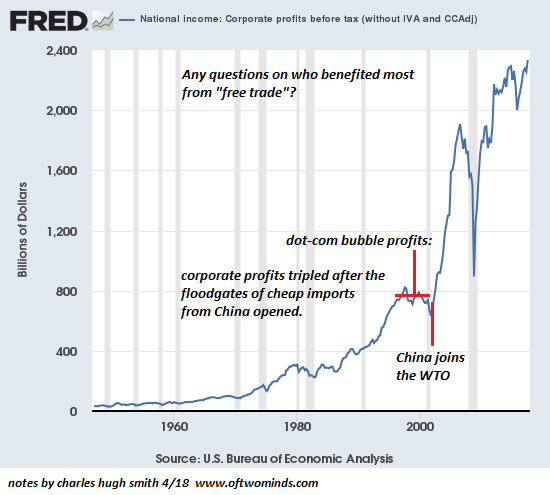
Smith:   Yeah! Another thing that I find fascinating in trade is that it ties in the global trade economy. We talked about financial repression in central bank policies and how that influences it and how currencies influence trade. In terms of tariffs, I think it is important to mention that many countries such as Japan protect their domestic industries without using tariffs. They just simply use bureaucratic mazes and motes. For example, if you’re going to export something to Japan, you have go through a bunch of different hoops with various ministries and the ministries, of course, are well trained to find some reason to put your application aside for six months and for another six months because have more research we need to do. There is more than one way to protect domestic industries and bureaucratic mazes are actually more effective than tariffs and I think we may get into the political side of this later in the program. But, you know, Trump has announced a bunch of tariffs and then he quickly announces a bunch of exemptions. A bureaucratic maze is actually way more effective way to control or protect your domestic industries. To go through my charts, the first chart is of U.S. based corporate profits.

It is kind of interesting that those profits around 2000 which had shot up a lot as a result of the dotcom boom of the late 90s. They were about $700 billion a year and then China enters the WTO (World Trade Organization) in 2001. Very quickly, the U.S corporate profits basically tripled. That tells you that I don’t think this is a coincidence. That’s a stretch. Clearly, who’s benefitted from the expansion of trade in emerging productive markets like China are the U.S corporations. People that have done research and say,” Oh well, the cost of goods at Wal-Mart are cheap because of the production overseas.” They kind of guesstimated that the American consumers might have saved $200 billion or something like that in the last set number of years. However, if you look at the corporate profits going from $700 billion to $2.4 trillion, the corporations have pocketed trillions. Consumers pocketed nickels. Another chart I have here is the U.S. oil production and has gone up quite a bit as everyone knows because of fracking and other technology since.

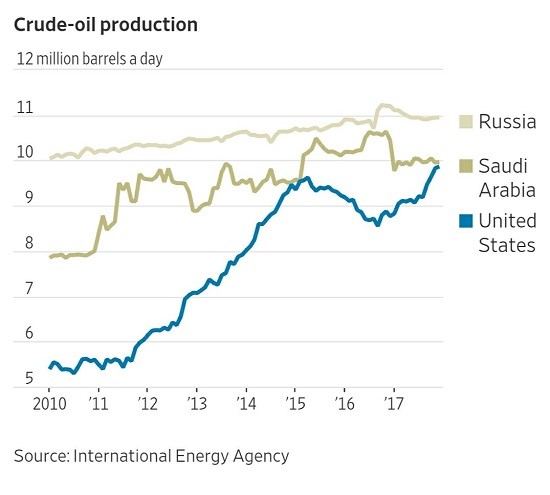
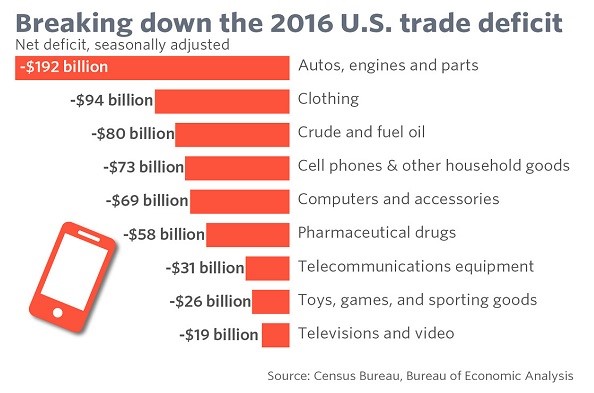
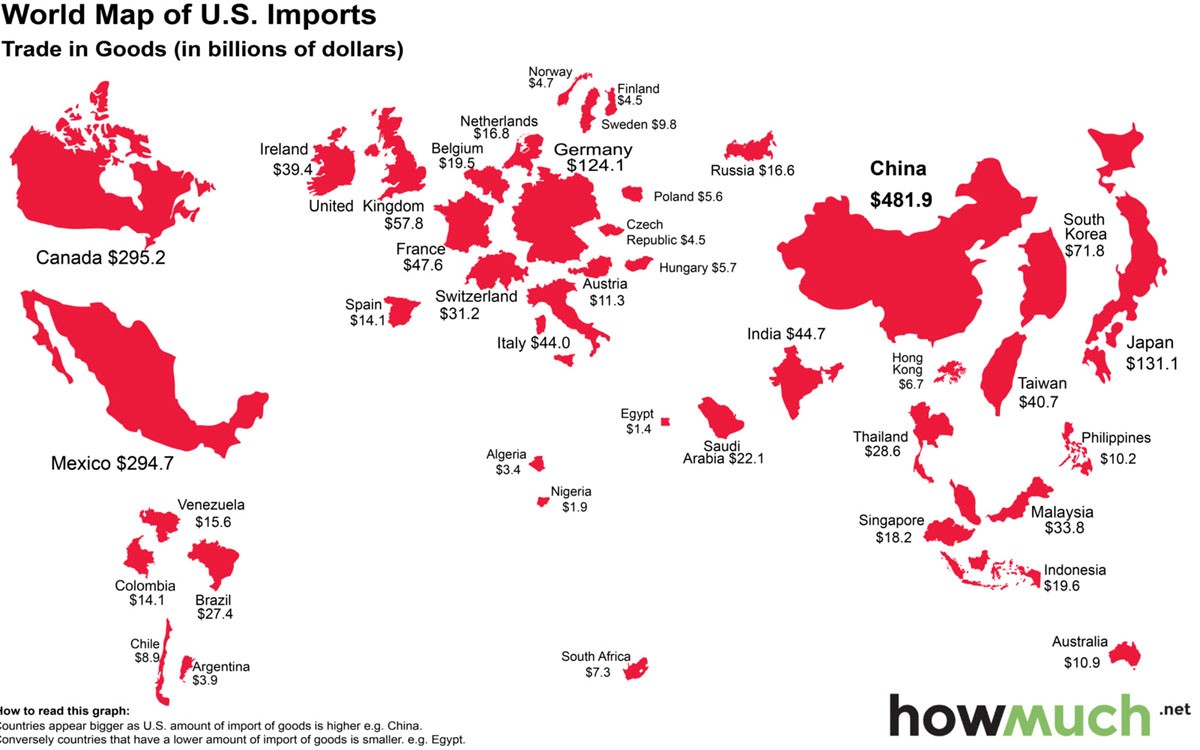
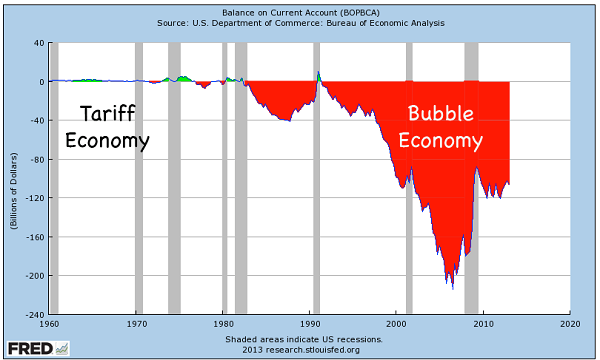
This has really relieved the pressure on total U.S. trade deficit and much of which was energy. When the U.S. was importing six to eight million barrels of oil a day, that’s hundreds of billions of dollars’ worth of energy, right? Now that U.S. production has increased, it continues to import energy products and its also exporting some of its oil as well. We know that Canada and Mexico – North American Free Trade Agreement – as a whole is an energy exporter. The U.S., bottom line, has been impacted positively by its oil increase. I have a couple of charts here about breaking down the U.S. trade deficit and it is interesting because we tend to think of it as a national thing, right? What is the trade deficit with China or Germany? This tells us that almost half the goods trade deficit is related to autos and vehicles. That’s an interesting kind of fact. Imports and exports are a really broad part of the economy. In other words, it is not just soy beans and steel or aluminum. It’s a lot of different products from different parts of the world. You can see that the U.S. runs trade deficits with most of the world. Another chart I have here is the trade deficit. It is not mine. It is from somebody else.

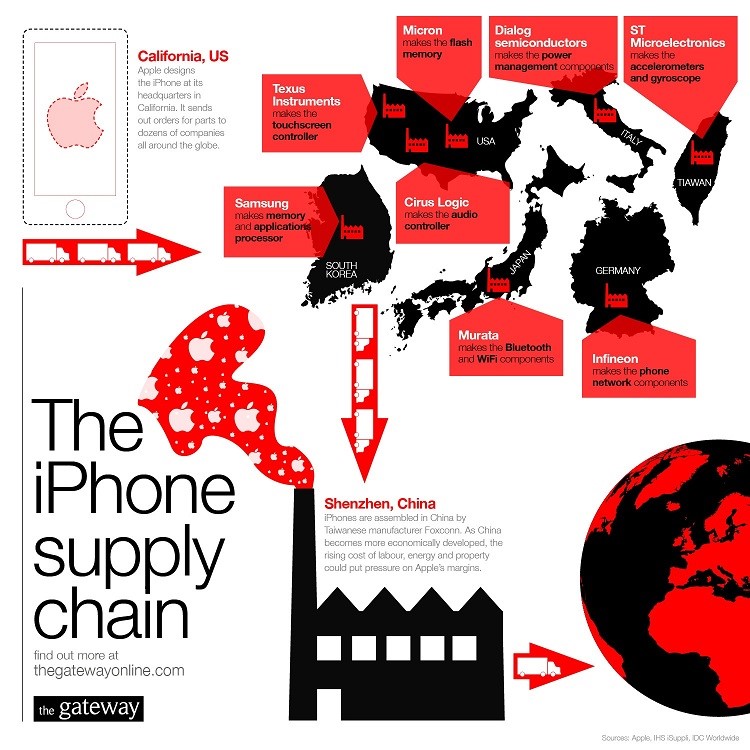
The trade deficit used to be extremely modest back in the early post 4 years. Once we got a bubble economy, where the central bank was pouring in tremendous amounts of liquidity into the banking sector and in the economy. Then we get a bubble economy. That’s when our trade deficits sky rocketed. Of course, that is a bit simplistic because oil was a big part of our imports and the strength of the dollar made it convenient to buy other people’s products. When your currency increases in relative value, then it becomes even cheaper for you to buy other nation’s output. There’s a lot going on to add to that huge increase in the national trade deficit there. So the last chart is the IPhone supply chain.

The trade is not calculated with any kind of accuracy. It is very difficult now because of the global supply chain to make sense of what trade really is. This is a good example because if an IPhone is shipped from China and lands at the dock in Longbeach, it is credited as a $500 import from China. But if we look at the components, they’re made in Japan, South Korea, Europe, America, and other nations that as much as $480 of that $500 ‘import’ from China is actually imported from elsewhere. As little as $10 or $20 may actually stay in the Chinese economy. If we calculated trade in that way, some people actually claim that the trade deficit with China basically disappears. So much of what China does is assembling components from elsewhere. That huge trade deficit with China is illusory to some degree.

FRA:       It is somewhat misleading in terms of how we measure trade and that’s leading to misunderstanding as well.

Smith:   Yes. That is right. Much like GDP. It includes a lot of stuff that doesn’t mean the economy is becoming more productive.

FRA:       What about what’s happening in terms of the U.S. Trump administration. Do you think their strategy is to use these trade tariffs and potential trade wars as a bargaining chip for trade treaty organization in order to get the U.S. a better deal?

Smith:   Yeah. I think we see some evidence to support that, Richard. That was one of Trump’s campaign kind of promises – to cut a better deal. It is interesting that when he first announced his trade war sort of policy, then companies like BMW suddenly announced they were expanding their assembly of vehicles in the U.S. It’s an interesting dynamic because if you get a political threat, then corporations don’t really have the luxury of waiting around to see how that policy is implemented.  They see the writing on the wall, they see the political narrative shift and trajectory. It makes sense for them to go ahead and increase their production and assembly in the U.S. In other words, be proactive. Don’t wait around for the trade war to heat up. Just go ahead and move your product line and some assembly to the U.S. ahead of it. Ahead of the curve so to speak. We’re starting to see some of that.

FRA:       Yeah. Speaking of the political angle, there was a recent discussion of placing 25% tariff on U.S. soy beans. Could this be a political ploy by China in order to aggravate the backing of Trump supporters in the U.S. Midwest where a lot of the soy beans are grown?

Smith:   Yeah! It’s a fascinating supposition. I’m glad you brought that up because any kind of announcement regarding trade will have a domestic impact on the companies producing those goods. It’s undoubtedly that the Chinese leadership are trying to undermine Trump’s political support with that. If you’ve ever driven through Iowa, for example, much of the state is soy bean fields, wheat fields and corn fields. The U.S. certainly a bread basket of grain and soy bean producer of global proportions. There was some analysis that came out and said that that sounds nice – the Chinese trying to say they’re going to raise the price of U.S. soy beans but the world does not have an over supply of soy beans. So they can buy some from Brazil which is another major producer but their demand is so large that they’re going to end up buying U.S. soy beans anyway.

FRA:       Yeah. There are 400 million pigs in China that need to be fed. So, without the soy beans, they’re going to run into a lot of problems. There’s only about 14 million tonnes of domestic production in China from my understanding.

Smith:   Yeah, exactly. This is where it is fascinating to drill down because people are saying,” What about rare Earth metals?” This is because China has a monopoly on some of those metals and you can get into some electronic components and chemicals that the Japanese have almost a lock on for relatively modest parts of key industries. It turns out there’s only couple of factories in the world that make these things. That’s why we have to be careful about the sledgehammer to drive attack. Politically, it is also interesting to ask if it is really true that the U.S. has just been a dumping ground for the last 30 years. In other words, everybody else can over produce and just dump over their production into the U.S. market. Maybe it has been unfair. Nobody wants to talk about that but I do wonder if that’s actually a valid perception. As I mentioned earlier about the BMW thing and a lot of the Chinese machinations, people don’t want to lose the U.S. market. It is too big and important. There is no substitute. In a way, Trump has little more leverage than the exporters as far as I can see.

FRA:       Do you think that the U.S. and China will follow through on these plans for tariffs? Do you think that they’ll be pushed back in the market in other countries and economic forces in general?

Smith:   It’s a great topic, Richard. Before we started recording, you sent me an interesting article from the economist Barry Eichengreen – whom I understand you’re going to interview in the near future – he was talking about the fact that China and countries like China with higher export to GDP ratios than the U.S. In other words, these are export dependent mercantilist economies. They don’t really want to encourage a trade war because they’re going to be a much a bigger loser than importing countries.

FRA:       They’re sort of more for free trade than the U.S., ironically.

Smith:   Right! Exactly! To me, it is interesting to look at the model that’s often held up as being remarkably successful since the end of WWII which is the mercantilist model that Japan followed which was to protect domestic industries at all costs and then use government money and power to boost your export sector. Do everything you can to make it easier for corporations to expand their production for selling overseas and that enriches your nation. South Korea followed that model, Asian Tigers and China pursued that model with great success. Now, looking back at what has happened to Japan, after that whole export burst ended in a financial bubble, they’ve been stagnant. Part of why they’ve been stagnant for twenty something years is that when you protect your domestic industry, you protect a bunch of inefficient and unproductive industries. Those companies don’t make enough money to become efficient. They become sort of like a zombie sector. There is some employment but they struggle. Since there is no competition from overseas, to say that that model is successful, it is only successful in the boost phase. But once you get to the point where you’ve protected a bunch of inefficient and unproductive domestic sectors and you run into competition in the global stage with your exports sector, then you get stagnation. Japan’s export sector is still large but look at the profitability problems they’re having. It turns out that big electronic industries like Toshiba and Panasonic, they’re riddled with financial scandals because they’ve been overstating their profits by trillions of yen for years. They’re really not profitable anymore. So much for the mercantilist model. It only works for a while. It is not a permanent successful model. There are blow backs and consequences. To put it another way, trees don’t grow to the sky.

FRA:       Rather than imposing these tariffs, could the U.S administration focus action on intellectual property rights dispute between the U.S. and China on IP (Intellectual Property)? Could that happen?

Smith:   It is important because a lot of what the U.S. exports is software, films, entertainment and all of those things are easily pirated. We all know stories that you could get the DVD of the movie in Hong Kong’s streets before it is even released in theatres. We have a lot of friends in China and they report to us. In general, for the Chinese people, software is like air. Everybody should be free to everybody. It is not considered theft as we would see or it as Microsoft and other companies would see it. Trying to control the theft of intellectual property is very difficult. It is worth doing. You have to make an effort if your export sector is heavily dependent on intellectual property like the U.S. is but I just don’t know how much you can really change that dynamic. It is very difficult to stop thievery except at the official level.

FRA:       Where do you see all of this going in terms of the next phase of trade war discussions? Could this cause inflation in consumer prices because now the U.S. actually have to make the dishwasher or microwave oven here rather than importing it because of the large tariffs. Do you see that potentially happening – much higher inflation?

Smith:   Right. I do wonder about that. People are starting to say,” Oh well, you know, you put tariffs on steel and aluminum and that’s going to ripple through the economy.” We have to start asking. What percentage of our products are basic materials like aluminum, steel and soy beans? If you take a box of cold cereal, it turns out that the grain is something like a nickel or a dime. If we look for inflation, it could be in finished goods, if there’s tariffs on finished goods, that could really hurt like auto parts. If people start slapping 25% tariffs on finished goods, that could have a really big impact. The alternative view is if those producers decide to move their production to the U.S. and go ahead and absorb the higher labor costs and taxes here, it might be awash. In other words, the actual sticker price might not go up that much or there would be benefits in terms of supporting U.S. employment that certain number of higher prices would be offset by bringing the supply chain home, stronger employment here, more taxes being paid and so on.

FRA:       Finally, what are your thoughts on how trade wars could potentially lead to physical wars? If we absorb more labor in the U.S. that would take away labor in China and the ruling party, there is concerned about that – causing social unrest. Could all of this morph into physical wars?

Smith:   There’s a famous quote by a French economist, Bastiat (Frédéric Bastiat), from the 19th century and I’m just paraphrasing. I don’t have it in front of me but it something like this: If goods don’t go across borders, then soldiers will come across borders. Kind of implying that dynamic you’re mentioning. I think trade is about 10-20% of most major economies – imports and exports together. We have to try and remember the scale. We’re not talking about most countries having 50-60% of their economy based on imports and exports. Trade is a critical sector of every economy but I think that the potential for disruption politically is in those countries that are super dependent on trade. Now, that would include Germany of which about 40% of their GDP is related to trade, as I recall. And China and these mercantilists based economies. They are much more likely to suffer political blowback and domestic turmoil and escalating sort of trade war environment. That domestic political turmoil and disorder is much more likely than a shooting war because trade wars are more relatively controllable compared to an actual combat war – where there is really a high risk where things get out of control. It is more likely that there will be domestic turmoil and that’s what politicians will have to focus on – how to deal with their domestic turmoil as a result of trade being disrupted.

FRA:       Wow. That’s great insight, Charles, on this potential for trade wars. How can our listeners learn more about their work?

Smith:   Please visit me in oftwominds.com. I got three chapters of my most recent books and big archives and come visit me at oftwominds.com.

FRA:       Excellent! Thank you very much, Charles.

Smith:   Ok! Thank you, Richard. My pleasure!

By Karl De La Cruz

karl.delacruz@ryerson.ca


Disclaimer: The views or opinions expressed in this blog post may or may not be representative of the views or opinions of the Financial Repression Authority.