01/20/2018 - The Roundtable Insight: FRA Co-Founder Gordon T Long On The New World Order In 2018

DOWNLOAD THE MP3 HERE

FULL TRANSCRIPT:

FRA: Today we have a very special guest, Gordon T. Long. He is the co-founder of the Financial Repression Authority. He and I started it up. He has been publicly offering his financial and economic riding since 2010 following an international career in technology, senior management and investment finance. He brings a unique perspective to macroeconomic analysis because of his broad background which is not typically found or available to the public. Gordon was Senior Group Executive with IBM and Motorola for over 20 years. He founded the LCM Groupe in Paris, France to specialize in the rapidly emerging internet venue capital and private equity industry. He is a graduate Engineer at the University of Waterloo (Canada) with graduate business studies at the prestigious business school, University of Western Ontario (Canada).

Welcome Gord!

GORDON T LONG: Thank you Richard! That’s the Ivey School down at UWO.

FRA: Yeah. A great background just in all areas to give you that deep insight from different perspectives as you’ve always had.

GORDON T LONG: Well thank you, but it makes me feel like I’m an awfully old man, but I am…But Richard it’s nice to be on this end of a speaker because of all of the videos we did for FRA together…Videos versus the podcast we are now currently doing so it’s nice to be talking from this end.

FRA: You have done an incredible amount of the videos that we started off with over many years.

I thought today we’d look at the 2018 perspective. Over the last several years you have done a yearly analysis of what the risk are in the economy and the financial markets and put it all together, tying all the dots together, in a sort of thesis that you see happening. And you’ve graciously provided a number of slides that we’ll make available on the website and also as a part of the transcript we will write for this podcast. I thought that we would begin there by using that as a basis for our discussion.

The first slide you illustrate a number of risks — Do you want to elaborate on those?
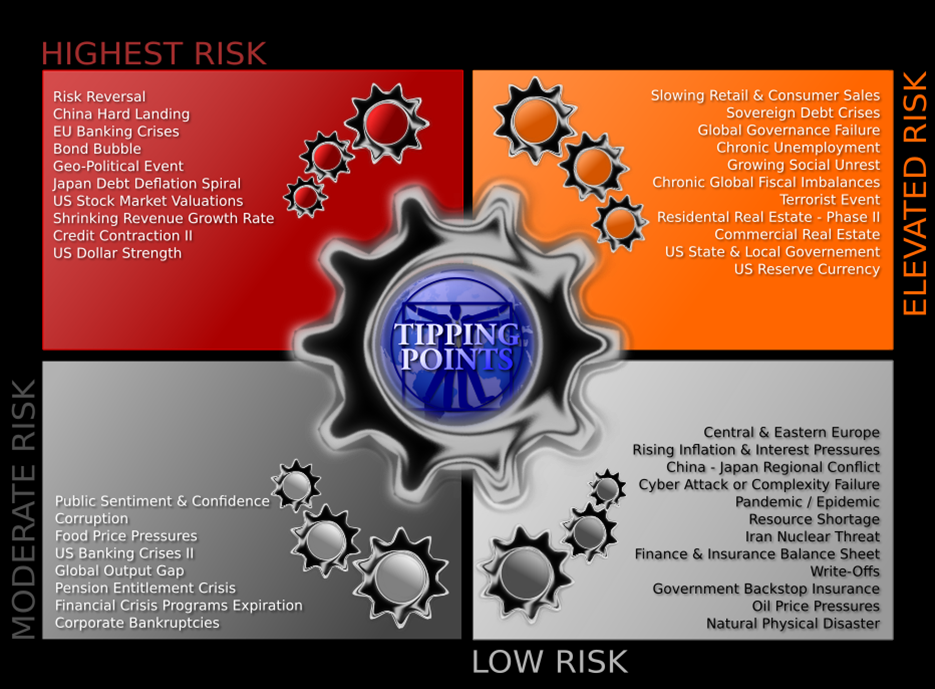


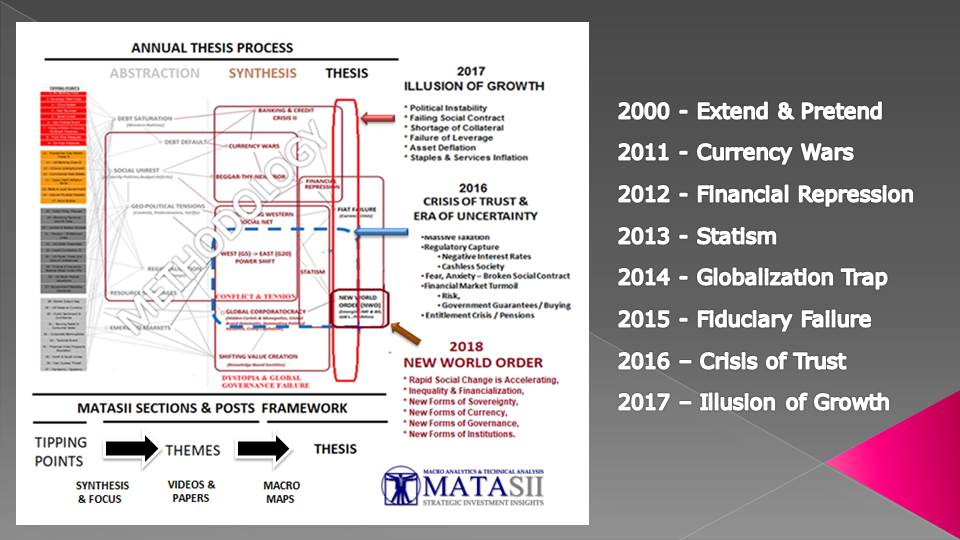
GORDON T LONG: Yeah, absolutely. As you’ve said I have been doing these every year. I started in 2010 where I actually started circulating it to my subscribers and into the public domain and it’s not where I chose a subject to write about. It starts with a process that I refer to as a “process of abstraction”. And the first part of that process is listing all of the tipping points that need to be tracked and watched without drawing any conclusions. In the first chart we are showing here are showing the risks which are grouped in from high to low risk in segments here. We had just over 34 last year which some of them are shown right here on this chart. This year going in we have 44 that we are following and tracking very closely. And when we take those risks and we start to follow them in a process of abstraction which I will show you how we come up with the thesis…But over on the right hand side of this chart you will notice a red box with 11, those are the new ones of the 44. This is the top 11. Quite a number of them have been there for a year, some of them for a couple years now…the bond bubble, China’s hard landing, Japan’s deflation, but what’s really showing up this year and has been moving into this hierarchy is the stock market valuations you see at number 2 as a tipping point. It hasn’t been up this high before, just maybe barely breaking the top 10 as it has grown. But also down at number 11, flows in liquidity and that is the magnitude of what the normalization by the Federal Reserve, effectively the taper program at the ECB and even the reductions in the rate of growth of money supply at the Bank of Japan. The “flows of liquidity”, which is still very high 135 billion a month, is falling and is mapped out to fall. These are some of the destabilizing factors that we see growing, not that the others here aren’t going away. And another one here is number 8, “credit contraction”. We are at the end of an extended expansionary period, one of the longest in history. We are going into our 9th year and we see signals that the business cycle and credit cycle has reversed and has started to fall off — With that is backdrop. The second chart here is really the process we flow. You see the coloured boxes on the left and then we start to abstract those and group them into themes and then from those themes we try and synthesize them and ask, “What are they trying to tell us?” as we move to the right. At the bottom you can see the kinds of things we track over at a site I have with my son called: Matasii.com. And we track all those and they’re in the public domain if you want to follow them or look at them. But it leads to these conclusions and that is the subject and you can see where it’s led us in previous years as they keep shifting around and the thesis papers that we wrote. What we find too is that we’re always at least 18 months to 2 years ahead of things before they really come into the fray and become major front and centre. When you really recognized financial repression back in 2012, it was pointing us earlier 2 years before that that it was going to be a major movement and that was as quantitative easing was starting to unfold in the United States. But this year it has forced us to talk about something called: “The New World Order” and I need to state right off the bat that it is not what the conspiracy buffs have been talking about for years. It just happens to be the same name. The new world order is basically a social change that is happening right now because of: the advent of networking and networking communications, the degree of inequality that is starting to surface across the developed worlds, the richer getting richer and the poorer getting poorer, and a number of other factors that we’ll get into, but it’s changing the forms governance, it is going to change the forms of institutions that haven’t changed since the Breton Woods at the end of the Second World War which were predominantly US-based institutions if you would: IMF, World Bank in Washington, the United Nations in New York. But these institutions haven’t really changed and the new world is going to force these changes. Governance, the whole idea of a sovereign state is changing. So in the paper we lay out what those changes are going to look like and how they’ll unfold.

Any questions on that, Richard?
FRA: Yes – Does this include also the network for blockchain technology and cryptocurrencies?

GORDON T LONG: Without question. It’s very central because one of the major changes we believe is going to be an exchange in trading around the world. And I’m not proposing that people should go out and buy Bitcoin, but I am saying that it and other factors like that are going to be with us in a massive way, and more importantly, the technology underlying it, the blockchain technology. So it’s going to and is already reinventing banking and you’ll that accelerating in a bigger way because it’s reflective of the sovereign state and borders are going away. Once you’re on the network…That’s the beauty of a product like Bitcoin and how many are there…a thousand different types now? But it says you can go anywhere in the world and do these transactions so how do you police it, tax it, regulate it? That’s the whole beauty of it – It’s self-regulating and self-policed, you don’t need governments and you don’t have the cost that goes with it. And that’s the model. I’m not trying to talk about Bitcoin; I am talking about blockchain and that model. One of the driving forces is that it will allow us to do away in some ways with a nation state. It doesn’t mean that we are getting rid of governance, but the governance of populations is going to change. We have a centralized approach to government, its top-down right? Well our forefathers never designed it that way. At least in the United States it was supposed to be the bottom-up, but it’s changed. And the technology and the network will allow that reverse and bring the control down to the bottom slowly because it’s not like the status quo is suddenly going to rollover, but these social changes are so big and so powerful and there will be some crisis in here that will force this change to happen.

FRA: On one of the slides you have: “The network is the instrument to control the governments or the governments will use it to control us.” Which way do you think it will go or do you think it will be a combination of both?

GORDON T LONG: It will be a war, that’s for sure. The governments will see it as taking away their power and their control and I don’t mean that negatively because they feel they need to have it to manage, but the reality is that they can be managed differently. You mention in the introductory that I had 20 years in corporate life so I was well acquainted with trying to run large scale organizations on a global basis. Back in the 80’s, the corporations were called international and they were just really beginning to grow. Growth internationally was far bigger than domestic and the problems that went with trying to do that and what came out of it with technology was that we had to decentralize. We were forced to decentralize and push it to the lowest level. It allowed us to downsize, right size, outsource, but to flatten organizations so that we could be more responsive and we could operate in more countries effectively. I’m kind of netting that out. Well our governments are actually in the same boat today. They need to be decentralized, but you can’t decentralize over a border though you can decentralize in the United States by pushing more control and power to the towns, but it’s going to be across borders. And we are seeing that really in effectively trade blocks today. That is where they are trying to work together in a coordinated fashion where they are trying to decentralize and have the power of a group, but they haven’t harnessed the technology to do it and that’s going to be a big part of the changes. So from a sovereignty standpoint at top-down, we are going to go to bottom-up. We’ve got inequality between nations within nations. What we’re going to have is equality across nations. These are going to be some of the changes we are going to start to see. Where we have country laws right now we are going to see international laws because globalization was never planned, it happened. Consequently, we never put institutions and laws in place to handle that. Yes, we have the international courts and the United Nations, but they’re not proactive. As Ronald Reagan said, “The government isn’t the solution. The government is the problem.” So they’re standing in the way of the degree and the speed of the change must have right now.
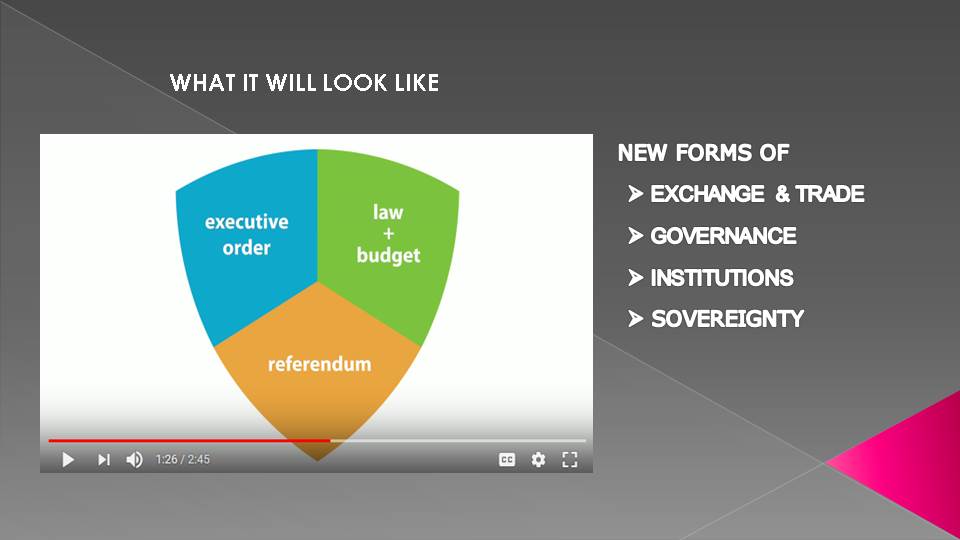
FRA: Yes, I can see the power of blockchain technology as providing decentralized platform to address some of those challenges of inequality by eliminating the middleman, for example, in transactions or services. But what about on cryptocurrency as one of those applications of blockchain — Do you think that governments will allow private-based cryptocurrencies to coexist with the monopoly power of fiat money that they have today?

GORDON T LONG: It depends on what government you’re referring to. I think our listeners are aware of the SWIFT system (Society for Worldwide Interbank Financial Telecommunication), we really have two sets of governments in the world, the developed countries and countries that I will simply refer to as the “bricks”. We have Russia, we have China and we have Brazil, we have India, we have countries that are outside of the formal developed countries with their currencies where they are debasing it, that is the developed countries. So when, for example, we pass sanctions against Russia, the way we impose them is ways through the SWIFT system and various forms. Well obviously there is a tremendous conflict and it leads into this whole concept of de-dollarization which is going to be one of the major changes in the next 24 months — It’s huge. The whole discussion that we should have on here is on de-dollarization, but the conflict that’s going on right now and part of the answer out of that is what’s going to happen to cryptocurrencies because it’s a way of getting around the controls that the central banks really have on the creation of money, the value of that money and the debasements of those currencies. Ever since Bernanke came in with his, “Enrich thy neighbour” and we have rotating debasement that is when we stop debasing, the ECB, and the BoJ. I have referred to them as the currency cartel, the four currencies, the big debtor nations, the USD, Euro, Pound and the Yen. That’s 95% of the currencies that are exchanged in the world and they’re the ones that are the primary debasement on the other side, which I was referring to, of the bricks. They are not debasing, but in many ways are trying to use gold-backing. So there is a fight that is going on and cryptocurrencies really bring that to the floor. Now Russia and China their problem with it is allowing money to flee out of China right now as capital flight. As it shakes itself out we’ve got these huge geopolitical issues that are facing us, but the cryptocurrencies are not going away. I’m not saying that Bitcoin won’t fail and something takes it place, I’m not saying for one moment that the government banks aren’t going to endorse it. But by endorsing it I’m referring it to controls and trying to use it as competitive advantages as opposed to it being a free open-sourced product like Microsoft Edge. If you go to Firefox, its open technology, there’s no charge and it’s open. It’s like Wikipedia. Once you open up that Pandora’s Box, you allow all the people in the world to participate in a really free democracy.

I’m not sure if I’m making any sense there, Richard, but this is how powerful the concept and the reality of the blockchain currency are because it takes it down to how you can vote. I actually lay out in the thesis paper examples and links to videos, which I encourage listeners to go and get the links, of people who have shown how you can take this technology and put it into democratic organizations from the ground up that can actually grow itself into a world organization…How voting would happen, how policies would be set, how individuals would participate in it at a town level, a state level, a regional level, right up through a global basis where you get a really participative democracy and it works in a much faster period. It sounds impossible, but there are just some brilliant people that are showing how to do it just as brilliant people that showed how blockchain and cryptocurrencies could work.

FRA: And do you see this evolution as being a part of a movement towards the fiat currency cycle failure as one of your slides indicates. Are we going to have a coming currency crisis?
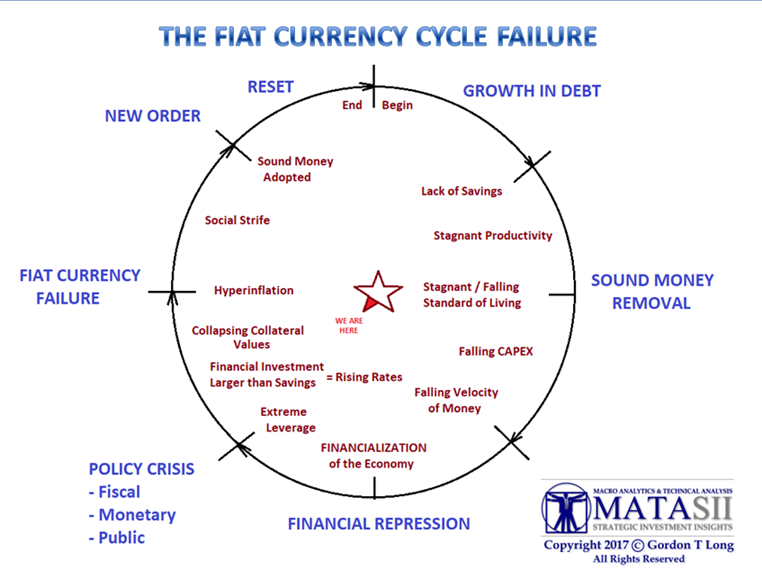
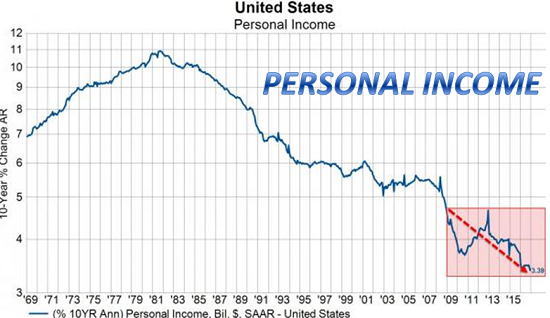
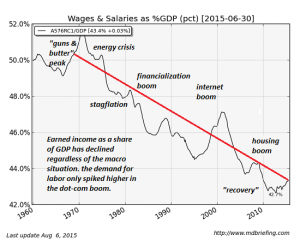
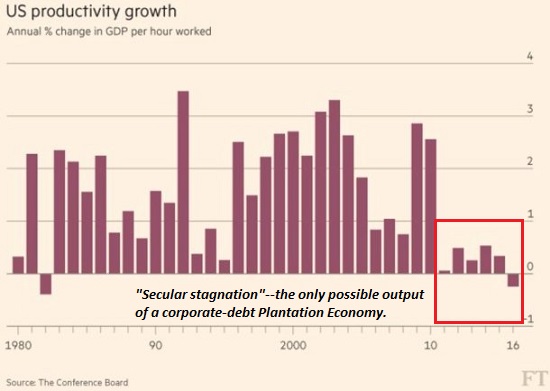
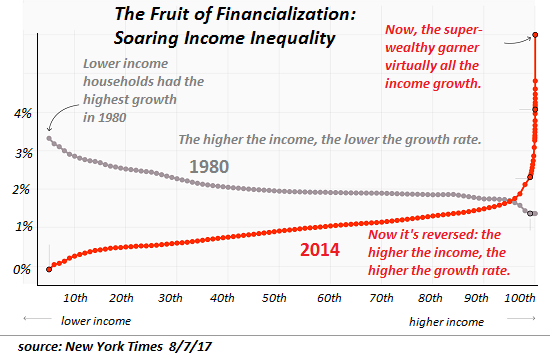
GORDON T LONG: I don’t know if we’re not already in it, Richard, and have been for a while, but yes, absolutely. This chart that we have here which is labelled, “Fiat Currency a Failure” really shows how we’re evolving. There is a little star in the middle in the red pointing to whereabouts we are in this cycle. I put out a chart, that’s included in the thesis paper, back at the time of the financial crisis called, “The Fiat Currency Failure” and the cycle that we would go through. This is a very simplified version of it. Once you get off sound money, you put yourself on a road map that nobody has ever retraced themselves from and has always ended in a fiat currency failure because at that point you’ve entered a fiat currency. But it starts at the top right here with growth and debt. Once you start growing your debt, in the case of the United States, when you consume more than you produce and you become a debtor nation and then all of a sudden you balance your trades out there is a lack of savings going on. You get stagnant productivity and what it does is it forces you into a fiat currency which we did officially in August of 1971. But now what starts to happen is you really get stagnant and falling standards of living because savings, which are typically in a capitalist system, invested into productive assets is what in fact improves your standard of living. That’s what allows a standard of living to increase and when that doesn’t happen, investments start to slow and you get falling capital expenditure and a falling velocity of money. You just had Lacy Hunt on and he’s very strong on what the issues of falling velocity of money are. But then it leads to what we’ve had for a long time, financialization of the economy which we now have. When you get the financialization of the economy all of these issues that you and I have talked about for years now associated with financial repression have become front and centre of the government trying to manage the economy at the best that it can do. But it leads to extreme leverage which we have now, unprecedented degrees of leverage, but it creates policy crises – Fiscal, monetary, public, that kind of disruption is where we are at right now. Before we get to the currency failure, the whole leverage itself has to start correcting and what happens then is really collapsing collateral values. There’s insufficient new savings and insufficient profits. And I’m talking about real profits which are coming from productive assets that are creating new profits which is new collateral, new value that underpins our society. We have $230 trillion of debt right now and you don’t lend money out without collateral. So what happens is all the money that has been lent out, the collateral has been repledged so many times, something called rehypothecation, across the global world within the Euro/Dollar system that the issue now is a shortage of collateral. Now if the collateral falls in value, let’s say that interest rates go up on bonds which means the bond price goes down, the collateral against those bonds is being reduced because what we do in our world right now is we’re making debt and asset. So we’re taking bonds and making it an asset and we’re pledging it as an asset. So when it goes down in price because interest rates are going up, you have to produce and pledge more collateral. Where’s that collateral going to come from if you don’t have new savings. That’s the era that we’re entering right now. Then, of course, we’ll have the governments forcing new kinds of systems or policy changes such as helicopter money to push more money into our society and that’s when we start to get into hyperinflation. We’re not there yet. We are still finishing a deflationary cycle because of the globalization, which is starting to peak. When I say peak, the rate of growth is what is beginning to peak. Once we get into fiat currency beginning to fail, we have the social strife and then we get these forced changes into these institutions and forms of government which I talked about earlier.

Didn’t mean to be long winded, Richard, because there’s a lot in that and we lay that out in the paper.

FRA: That’s great. There is a lot going on. On the next slide you mention where we are and that appears to be past the Minsky moment – Can you elaborate?
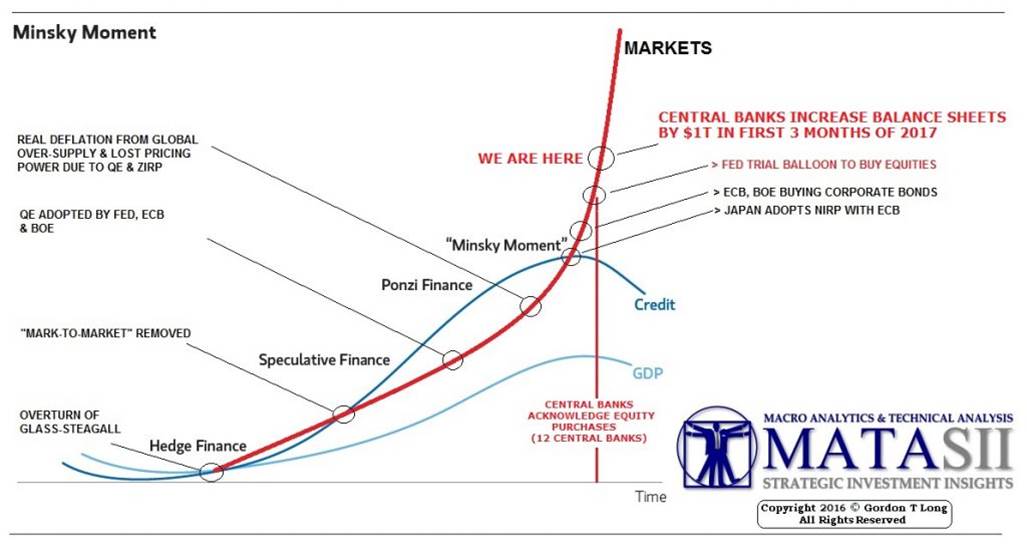
GORDON T LONG: Yeah Richard. You know governments aren’t going to roll over and quit on us. And I’m not about to say that markets are about to plummet because what governments are very good at doing is changing the rules. When they change the rules they allow things to accelerate. I can give you all sorts of examples of that. Remember the last financial crisis at the bottom of it we had a concept called “mark-to-market”. That was that all the books were so full of derivatives that they had to price them in a way that would price them to market. But to save the market, besides the 13 facilities that the bank came out with, the regulators changed it where they didn’t have to mark-to-market. They marked to fantasy. All of a sudden the bottom was in and the stock market took off and it was running ever since not because of that but it is an example of how they changed the rules. They could’ve never changed that rule is crises never hit, but we do that. So every time we get into a problem we change the regulations so that we change something else. Right now, even if the mark could start to fall, we have such a huge entitlement program, I think in the United States we are at least $10 trillion underfunded in total pensions at all levels – You can’t have that kind of collapse. So it says you got to keep the equities up. As you and I both know, the Bank of Japan is already buying equities. It owns 5% of the Nikkei, north of 70% of all ETFs. The Swiss National Bank buys $65 billion almost every quarter that we know about. A lot of the central banks, even the Norwegian central bank have been buying. So they are buying equities already. Apparently the Fed is not and the ECB is not and the Bank of England is not, but if we get into a crisis you can expect them to start buying equities in some fashion. I’m not saying that’s definitely going to happen, I’m just trying to give you an example that this is not over. They have not run out of tricks that they will bring forward to keep this thing going into this Minsky melt up. It goes back to that cycle we were talking about. You can keep doing it unless there is collateral somewhere and there is just not enough unpledged collateral out there right now unless they just print the money. Then what happens is you just print it without collateral, which is called helicopter money because that the basic derivative of helicopter money, then immediately you get hyperinflation. Whether that’s this year in 2018 or 2019, I don’t know, but I do know that over the next 3 years this big reversal that we talk about in the paper is going to unfold and is going to take away all the options from the governments that have fiat currencies.

FRA: Can you elaborate on how you see that happening and what the reversal may be?

GORDON T LONG: Yeah, absolutely. It is not my concept. This was actually a paper put out by the Bank of International Settlements in Switzerland. They were very clear that it is the most important paper they have put out in years. They were warning the central banks to say look, you’ve got to get off this paper money and you’ve got to start normalizing and you’ve got to do it now. And they’ve got the gun to do it. What they’re saying and what they argue is that the issue is that the demographics which are changing dramatically…You know the baby boomers aren’t buying as much, the Millennial’s don’t have as much money, at least in the United States, but around the world even in China where we’ve had a dramatic reduction in the growth in population, we don’t have the youth that’s coming on in relationship with the accumulation of wealth that the previous generations have had. So what we’ve seeing is that the rate of savings, and savings goes back to this building of collateral and underpinning debt and the rollover of the debt, is growing but at a certain rate which is a much slower rate. It is slower than the investment capital that is needed to sustain the debt levels and the growth levels we have right now. The delta, its difference, is growing at a significant rate. That is going to force yields to rise steadily because of supply and demand and not necessarily in a big spike, but consistently. As yields go out, it lowers the collateral value of the bonds and as we were saying earlier before we began the show, Richard, the global swaps marketplace is over $600 trillion and at least $400 trillion of that is in bonds. So a 1%/2% increase in rates is just a staggering reduction in the collateral value which has to be shored up. It’s like a giant margin call. For those who have had a margin call, you know it’s not a very good day. So that’s the problem and it’s like a glacier, it’s coming and we stop this. We can’t create the babies and the people to do it. And now we’ve got so much leverage in the system and they’ll try and stop it using pension plans, buying the market, printing the money and that’s what will eventually lead to a fiat currency failure.

I hope I explained that easily.

FRA: Yes and it’s quite interesting.

GORDON T LONG: It’s a 70 page paper. I tried to summarize it in less than 70 words.

FRA: And with the pension crisis, how do you see that unfolding? What will pension funds be doing given this view that you see unfolding.

GORDON T LONG: Well, I think the pension plans right now are in the middle of a lot of changes that they know they have to do. I think they see a large amount of this pretty clearly, at least the better ones. They have been moving out of the stock market. I think they see a bigger run up, but they’re moving into private equities and exchange traded products. They are not looking for liquidity; they are looking for long-term investments. I think they are also counting on the government to come in and start to guarantee investments. I think you’ll see the governments come in and guarantee investments with payouts on it even if it’s with fiat currencies. I think that they are speculating that the major central banks will enter into buying the equity markets. If that’s the case they will stay in and start going heavily into the equity markets. I don’t think that they have bought into that quite yet – I have. I believe that’s where the central banks are pointed. There was a paper out that showed we have $400 million in pensions around the world globally, all totaled. Right now in the United States we have an $84 trillion underfunded pension entitlement – Where is that money going to come from? They just can’t print it. They have to make sure that it’s created through the financial markets and a big part of that is either in the debt market (bonds) or in the equities.

I’m getting a little off-track here, but it is an important point that right now as we talk here today, they are talking about funding the government’s debt and you know we got a $20 trillion thereabouts U.S. federal debt. And the tax plan on what it’s going to do and how it’s going to increase it. But we are squabbling over nothing because the United States debt is not $20 trillion; it is $84 trillion because of the unfunded liabilities associated with Medicare, Medicaid and other social programs that we’ve made commitments to that are coming due. We have 10,000 baby boomers a day that are retiring and we’ll have a 1,000,000 a year turning 70 years old next year. The rate at which they are now claiming and a number of people who don’t have the money to pay into it, the youth, is significantly out of line. But as bad as that is, that’s still not our debt. This is why this cycle is going to unfold because this debt is actually $220 trillion and you ask how I got this number and that’s what is called the fiscal gap. We’ve had Kotlikoff on a couple times and he’s even laid it out before congress – They know it. What the fiscal gap is let’s say we lend money to Puerto Rico. The U.S. doesn’t lend money to Puerto Rico, the banks do. What we do is we guarantee it and we guarantee it in what is called in accounting lingo, a contingent liability. So the banks lend the money, Puerto Rico pays the banks and by the way they couldn’t pay 6% when bankrupt, but now the banks want 12% or 14% because they are not worried about it. They gouge them because they know if they default we’re going to anti. We pay, if in fact, somebody goes broke. Well we have got $220 trillion because we’ve been bankrolling everyone in the world with “government aid” for whatever country and we have these contingent liabilities. Let’s say the U.S. economy actually suffered a recession or a slowdown and let’s just say 2% defaulted. Now we’re talking close to $5 trillion on $25 trillion

Am I making sense here?

FRA: Yes, absolutely.

GORDON T LONG: And that’s why this is a given. The question is just the timing of it. That’s why we’ve going to see a new world order because out of this crisis, it’s not all bad news. Out of this crisis is the natural set of changes that need to happen and there’s a better world on the other side of it.

FRA: Given this view of a potential unfolding, as you’ve indicated, what are your thoughts on the financial markets short-term, medium-term, long-term and the investment markets in general? How do you see that unfolding for the various asset classes like commodities, equities, bonds and currencies?

GORDON T LONG: Well it really gets bound to what you price it in and that is the U.S. dollar. Gold could be going up or down depending on what is happening to the U.S. dollar, right? So it’s really what’s going to happen in the shorter term — What kind of strength we’re going to see or weakness in the U.S. dollar. A big part of what you see with the U.S. dollar is often it is a flight to safety. If we have geopolitical problems, people tend to flow to the least ugly at the party, if you would. So the money will flow to the U.S. dollar which strengthens the dollar which has a certain behaviour in the asset markets. So we’re facing significant numbers of tipping points (opening slide) right now. Which one of these might create a shock that impacts the U.S. dollar and the various crosses right now? Because the moment we have this is what happens is that Japan takes home their money into the Yen because it’s been a safe currency for them despite the debasement of it and then the carry trade starts to contract. So that’s what you need

to watch. You need to watch what’s going to happen to the dollar. I personally think we’re going to have some pretty significant freights, in the next 6 months, in the financial markets because we’re at such levels it’s only natural. We haven’t had a 5% correction in historical lengths of time. 15%, 20% is perfectly normal in a market, but the leverage couldn’t handle that right now. As we see some of these normal adjustments in the market it’s going to be how we react to them. And whether the policies, which I was eluding to earlier, forces the central banks to reverse course of normalization and taper, whether it forces them to put into things such as helicopter money – Time will tell. These crises are going to happen and it depends on how people are going to react in the market.

I am not sure this is the time you want to be speculating in the markets. That last 5% or 10% can often be the most expensive. There’s a lot of places to invest right now besides the stock and the bond market.

FRA: What would be your suggestions for investors, generically, in terms of asset classes? Where can they protect themselves and get yield?

GORDON T LONG: The best advice I can give is to get out of the currencies and get into hard assets because real wealth, the real collateral we talked about, is hard assets. Money is something where you have to grow it, mine or build it and those are the hard assets. So put your money into those real items. Gold and silver have always been the epitome of a hard asset, but to be frank they are right now a manipulated paper market. I think that is pretty evident, but that doesn’t mean that you don’t have some level of those kinds of hard assets. There are a lot of various commodities. Look what’s happening with cobalt, nickel and lithium right now. There is no better performing hard assets then them; They are right off the charts. Why? Because off electric bolts, our cars and it’s not because I think there are going to be a lot of electric cars in Canada and the United States, but because that’s where they are going in China and India. There is no question. There are 50 new models coming out next year. As a Canadian, just go up to Cobalt, Ontario. They are blowing off their lids. Now that game has already happened, but the point is that those are the kinds of areas that are continuously being needed to be looked into. The reason they move is because people say, hey there is some real value here. I know junior gold mining stocks have restarted to move to. But I am not saying to do that. I am saying to look for hard assets.

FRA: You mention also private equity as a potential investment?

GORDON T LONG: For those who can participate in private equity. More typically in the United States you have to be an accredited investor, so you’re limited, but I do know there are new laws changed in Canada that allow you to have a certain percentage in private equity. They aren’t as liquid; they are longer term. But sometimes in a crisis you are just glad to have your money in a safe place.

FRA: Perhaps to end our discussion today we can go to your last slide on, “What All Politicians Can Be Expected to Do” with a quote from President Donald Trump.
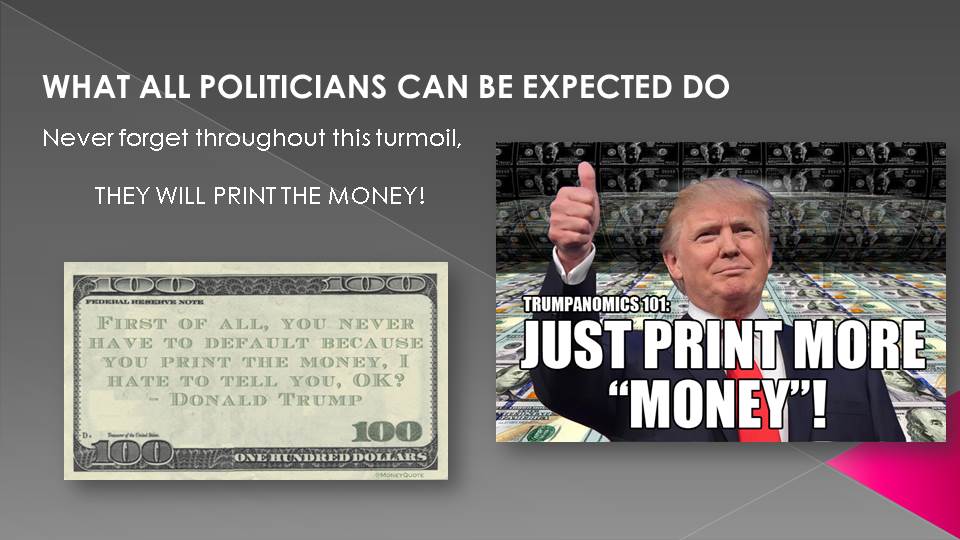
GORDON T LONG: I put him up just to say he’s just like all the rest. No matter what, they are going to print the money. It’s not because they are bad people, it’s the only solution that they can agree on because it’s not their money. And Trump was quite clear before he became president he said we can’t go broke because we can print the money. And he said he was the king of debt and I’m not picking on Trump in the least in my comments. He’s a right-wing conservative and he believes this is the solution. So you can bet that as these events unfold, and they will unfold, that that’s the tact they will take. Once you know that then investing becomes relatively easy because once you understand the policies that the government is likely to take, your investment becomes a little bit easier.

FRA: Great insight as always, Gord. This has been a fascinating discussion. We’ll put up those slides.

How can our listeners learn more about your work?

GORDON T LONG: Right now I am pretty well restricted to my work because I am retired, I’m an investor, I just manage my own money and I do this work to really narrow in on where my investing should be, but I publish and put all of this at www.matasii.com and there’s a subscription service for it depending on what kind of detail you want to go down to, but a lot of it is right out on a public page. That’s www.matasii.com. If you sign up for the newsletter, we’ll send you a various list of things if you’re interested.

FRA: Well great.  Thank you very much for being on the show. It would be great to do it in the near future again.

GORDON T LONG: Talk to you again, Richard.

< Transcript written by Daniel Valentin >
< Contact@dmvalentin.com >

Disclaimer: The views or opinions expressed in this blog post may or may not be representative of the views or opinions of the Financial Repression Authority.


12/15/2017 - The Roundtable Insight: Yra Harris Sees The Swiss Franc As The Oldest Cryptocurrency

FRA: Hi, welcome to FRA’s Roundtable Insight .. Today we have Yra Harris. He is an independent floor trader, successful hedge fund manager, a global macro consultant trading foreign currencies, bonds, commodities and equities for over 40 years. He was also the CME director from 1997-2003.

Welcome Yra.

YRA HARRIS: Thank you Richard. It’s good to be back with you – It’s been a while.

FRA: Great. I thought today we would start off our discussion with Janet Yellen’s presentation and her statements – Your thoughts?

YRA HARRIS: Well, the conference went just as I thought it would be. Of course, as usual, she handled herself well. She discussed some certain issues, but didn’t give much away. And more importantly she didn’t trap her successor, Jay Powell, to any type of situation. She has been gracious and thoughtful and so she continued in that vein. She didn’t really tell us much. Again, she was struggling to understand the lack of inflation and that will continue to plague her because they just don’t truly understand where the inflation is as the Fed measures it. That’s all we have to go in is the way they measure it. How any of the rest of us measure it at this point in time really is meaningless because we’re not driving the markets in that regard.

FRA: Did she set any expectations for future interest rate hikes?

YRA HARRIS: I’m not sure, maybe a couple, she was kind of reticent. I heard one of the media economists talking about it today saying that Greenspan understood with the technological innovation, going back to 1996, that he thought it was going to have an impact on supply-enhanced growth period so he was reticent to raise interest rates and that was a good thing. But every Austrian economist I know worth their weight and those who are not in the Neo-Keynesian new model will tell you that that was exactly what caused all the problems, was that Greenspan was reticent to raise all the rates even though the return on capital was rising significantly. And that’s when you need to start raising rates because then you head off any type of excess capacity developments which of course we saw by 1997-1998, we had a massive overcapacity situation which started the Asian Contagion. She is kind of settled with this too because she talked about that with the tax cut and the fiscal policy today which was good, not in any type of derogatory way, but she is worried about maybe the increase in debt, but she’s hoping that if this tax cut is stimulative it will be supply-side leaning and we will get greater productivity growth which she said would be the good type of growth that she wants.

So we will see.

FRA: What about the U.S. yield curve? Do you see continued flattening of the yield curve or potential inversion going into next year?

YRA HARRIS: Well again, they tried to pin her on that new version. People have to be specific. I am using the 2-10 yield curve. When the 2-10 inverts, there is danger ahead for a lot of asset classes. People will say, “Well, not so fast”, but I will be the first one to tell you because I’ve looked at this for 35 years as part of my trading paradigm that I developed for myself and I can’t time it. I have a study here that was done in 2003, it is right here I keep it in my drawer and it’s exactly on this. It was done by an intern of mine who is very highly qualified and it was written in July of 2004 titled, An Investigation into the Relationship between Changes in Yield Curve and the Performance of Stock Indices. So we’ve looked at this. It is so difficult to time. I can’t tell you when the results going to be, but I’m going to tell you just like in 2007 when then yield curve inverted, it was only by 6 basis points, we know what followed. In 2000, the yield curve inverted, we know what happened then. In 1979-1981, of course that was a forced inversion by Volcker as he was ringing inflation out of the system, but we know what happened then. This time, I can’t tell you. We’ve discussed this, you and I, for quite a while. We’ve been right in many ways about it and I’ve warned with what the central banks are doing that this is a wild card. I can’t tell you what the impact is going to be. It was interesting when Yellen discussed the yield curve today. She didn’t talk about the effects from other central banks and I think that’s a huge part of the flattening that is going on.

FRA: Yes. And about that…Do you see the ECB, Bank of England and Bank of Japan having their yield curves affected?

YRA HARRIS: Well for the Bank of Japan, Kuroda tried to give us a different spin on it thinking that maybe they were going to put an end to it, but as soon as the dollar/Yen softened off of that, I forget what the exact phrase was, it was from a speech in Switzerland in mid-November where he used certain language that spooked the market, but then he walked it back of course. You see that the dollar/Yen got weak today and then dollar really fell off after the Fed’s action. Tomorrow (Thursday, December 14th, 2017) we have an ECB meeting, an SNB meeting, Bank of England meeting and the Bank of Mexico – They are all in play here. I think Kuroda’s term that he used in November was reversal rate. It was a new term. We hadn’t heard it and myself included. I thought maybe they are thinking about ways that they can finally start to get out of this, but then he walked that back. They’re not going anywhere. And as I was talking with Rick Santelli the other day, I wasn’t on T.V. with him, but I had a tea and he had a cup of coffee and we were just talking about that and it’s different, unlike the U.S., when the U.S. started down the path of tapering when Bernanke stopped being afraid of his own shadow and stopped being plagued by the Taper tantrum and they actually announced how they were going to do it, it was a monthly reduction in the amount of what they were going to purchase and they were going to end it over in less than a year. They went from $85 billion to zero, where they weren’t purchasing any new stuff, in a fairly quick period, but the market new what they were going to do. The ECB is totally different. We know that they are cutting from $60 billion to 30 billion starting January 1st, but they’re not reducing it after that. So Draghi is going to be buying $30 billion instead of 60 billion, but he has already told us he is extending it out to September. So we know we are going to get $270 billion new buying with whatever else they are buying in Europe all of next year. And the Bank of Japan does have some latitude there because of the yield curve control. There is not change coming.  I think Draghi has a very grave problem on his hands. You saw it today where the Italian bonds actually got hit even with whatever they are buying because now we know there is going to be an Italian election on March 4th and this is going to be a very contentious election because right now the polls have the Lega Nord and Five Star Movement leading. So this market knows there is an election coming. But more importantly for Draghi is Merkel, And Richard you and I have talked about this before the election that she is not going to be as strong – And she’s not. She is very weakened right now and the German elites, the nomenclature or the thinkers, are so afraid of a new election, but meanwhile it is 3 months’ time from the election and no new governments have been formed yet. It’s a caretaker government. And Merkel offered, because she was pressured to do so, the SPD (Social Democratic Party of Germany), who swore that they weren’t going to go into coalition and now they’re negotiating for coalition, but she’s phenomenally weakened. This is a very important thing for Draghi because she has been his bodyguard. Whatever he wanted to do, Merkel was willing to deflect criticism. Now that she’s in such a weakened state with the Italian elections, he’s in no position to do anymore tightening or hawkish statements. I’m looking for tomorrow to be excessively dovish.

FRA: Any updates on the gold currency cross exchange rate you’ve written about recently that gold is being restrained from positive real yields?

YRA HARRIS: Right now, the 2 year yields dropped a little bit today, so we’ve about neutral right now using the 2 year on inflation. Real yields are probably about zero, but global real yields are exceedingly negative. That’s why I said gold will perform well against all currencies because global short-term real yields are very negative. In the U.S. they are neutral, but the interesting thing is the dollar is not getting a bit. This defies most things that anybody has looked at this and traded on it and analyzed it. The United States dollar should be screaming right now based on what we saw during the Reagan years because you’re getting a fiscal stimulus package via tax reform and rising interest rates. These are two variables that are very positive for currency and yet nothing. This is really starting to get interesting and forcing me to think because something is wrong here.

FRA: And today Yellen made some statements about Bitcoin, everybody is talking about Bitcoin. She mentions it is not legal tender – Your thoughts?

YRA HARRIS: Well it’s not legal tender, but it definitely should be legal tender. We have talked about Bitcoin before and again I’m far more interested and I’m on record for over a year saying that I’m more interested in the blockchain technology and the concept of it buying Bitcoin, to my own detriment, but I’m with guys like  Druckenmiller – I can only trade what I understand. I went through the dot-com bubble and I couldn’t understand them. I didn’t understand when people were talking about burn rates of money and my common response was that I’m a child of middleclass parents – We don’t burn money…You’re going to have to help me better than this. So I’m watching it and it’s intriguing. I wonder whether it’s going to affect gold. Some people think it affects gold because it moves potential gold buyers into another alternative, but as I wrote last week, hell has frozen over when I find myself in agreement with Alan Greenspan. Greenspan just didn’t understand and you cannot create value out of nothing. I know tech people tell me that it’s not nothing and that there is a process here that we can probably find in David Ricardo’s labour theory of value. You have to mine it so there is some value, but I agree with Greenspan about that where you just cannot create value out of nothing although I would’ve asked him the question…Then that would make the Swiss Franc the oldest cryptocurrency in the world because it’s so secretive, so if that’s the definition of crypto is being secretive and basically finding it under the radar. They’ve been doing this for a long time and we’ve watched them for 3 years create value out of nothing by printing Swiss Francs so I’m voting the Swiss Franc as the cryptocurrency of the year. If you actually look at the SNB stock price, it almost mirrors that of Bitcoin – It’s such a dramatic rise this year.

FRA: Do you think that a government-based digital currency or cryptocurrency, if we can call it that, will allow private-based cryptocurrencies like Bitcoin and others to coexist?

YRA HARRIS: I really can’t answer that. Janet Yellen was very good in her answer when somebody asked her if the Feds are looking into it and she said, “Other central banks are. When we said we are looking at it, are people doing research? Yes. But we are looking at digitized money, not cryptocurrencies and there’s a big difference.” And she was very good at explaining that difference. I think that we are going to get digitized currencies…Why? Because people like Larry Summers, Kenneth Rogoff and others have wanted to get electronic money because then they would have greater control over what you and I do. So when you go to financial repression rather than us pulling our money out of the system and hoarding it, they would force us to use an electronic currency which they can control. Then they would hope they can restore velocity to the money which is why Larry Summers said to get rid of the $100 bill because it’s much harder to hoard currencies with smaller denominations because if you’re hiding them under your mattress, it doesn’t take that much money to give you sleepless nights. You can only hold so much currency in smaller denominations.

FRA: And to allow for easier implementation of negative interest rates through monetary policy.

YRA HARRIS: Yeah. Marvin Goodfriend, who has written very extensionally on negative interest rates, that’s right because that’s the whole thing. I’m going to go to negative interest rates and I’m going to force you to keep your money in the system rather than anyone with a brain says, “Negative interest rates? I’m going to pull my money out of the bank.” Because if you have negative interest rates for 10 years and we’re at -2%, I’m going to lose 20% of the value of my currency. Then people pull it out of the bank and do other things with it such as investing in gold and other things. It gets very interesting.

FRA: Exactly. And finally, I’m just wondering about your thoughts on the geopolitical scene in terms of Saudi Arabia and Russia with what’s happening in Saudi Arabia and any new developments on meetings and more discussions between Saudi Arabia and Russia.

YRA HARRIS: I have looked at this for quite a while and I stated the last time around that there was major event that took place on October 4th and that’s when the Saudi King, not the crowned prince, Mohammad Bin Salman, the king himself went to Russia for the first time ever. I’m always interested in the events that are first-time-evers because there is always a reason for it. Dixon going to China was amazing event. So the king went to Russia. On those two days he was there, oil traded down to about 49 dollars and then over the next 8 weeks it went all the way up to about 60 dollars. Is this happenstance? No, I don’t think so. I think that major shifts are taking place in the world. You’re seeing it in the mid-east, and Russia is very involved with this because the Obama administration leaped them into a bigger role in Syria which has now given them the primary role. So there are all types of things that are taking place. There are shifting sands, no pun intended, and we have to pay attention.

FRA: Great insight Yra as always. How can our listeners learn more about your work?

YRA HARRIS: You can go to YraGHarris.com and Notes from Underground, which is where I blog, will pop up. They can follow me and register to receive it for the very expensive price of free. And again I don’t talk trades to people, I try to explain to you where I think the next opportunities are going to be from a trader’s perspective because I always have to wear two hats: as a trader and as an investor. And they are radically different.

FRA: Great. Thank you very much Yra for being on the program show again. Thank you.

YRA HARRIS:  Well Richard, at this time we’re in I hope I was able to “shed some light”.

Transcript written by: Daniel Valentin <daniel.valentin@ryerson.ca>

DOWNLOAD the Podcast Here

Disclaimer: The views or opinions expressed in this blog post may or may not be representative of the views or opinions of the Financial Repression Authority.


12/01/2017 - The Roundtable Insight: Former Fed Advisor Danielle DiMartino Booth On Bitcoin and Cryptocurrencies

FRA: Hi – Welcome to FRA’s Roundtable Insight .. Today we have Danielle DiMartino Booth. She is a global thought leader on monetary policy and economics. She is the author of Fed Up: An Insider’s Take on Why the Federal Reserve is Bad for America. Her book rose to number 22 on Amazon’s Best Seller List. She founded Money Strong LLC in 2015 which is an economic consultancy firm with a great insightful newsletter. She is also a full-time columnist at Bloomberg View, a business speaker and a commentator frequently featured on CNBC Bloomberg Radio, Fox News, Fox Business News and other major media outlets. Prior to Money Strong she served as Advisor to the Dallas Federal Reserve President Richard Fisher.

Welcome Danielle.

Danielle DiMartino Booth: So happy to be here.

FRA: Great..I’d thought we would begin with your book. Having worked with the Federal Reserve, the title appears to be very strong; An Insider’s Take on Why the Federal Reserve is Bad for America. Your thoughts on that?  Why is it bad for America?

Danielle DiMartino Booth: It’s not so much that I think the Federal Reserve has to go away. I just think that in its current form, or at least the form it’s been in since August 11th, 1987 when Alan Greenspan took office, has ended up being very bad for our country. We have ended up on a series of booms and busts and I, for one, am tired of being on this rollercoaster and think that it is high time we reinvent the Fed, take it down to the studs, and build it from the ground up and make it an institution that is good for America.

FRA: You recently commented on the Federal Reserve in terms of their biggest fear. Could you elaborate on that?

Danielle DiMartino Booth: There is a fallacy here. We have not just come through an era of deleveraging. If you look back at 2007, there was 150 trillion dollars of credit globally in the market. Today, we have over 220 trillion dollars of debt globally in the credit markets. So what we have actually seen is a very aggressive releveraging, overleveraging, of the global debt markets in order to eke out the economic growth that we have seen. I lay the blame for that at the world’s central bankers printing money to kingdom come, trying to create enough debt to spur economic growth, but the question I have is, at what price? I don’t think the central bankers want to answer that question. I think the 70 trillion dollars in debt build that we’ve seen since the outbreak of the great financial crisis is their greatest fear – It keeps them up at night.

FRA: Do you think central bankers have boxed themselves in a corner – Is there any way out? Can they actually implement quantitative tightening?

Danielle DiMartino Booth: I think that that remains to be seen. I laugh every time I hear that the quantitative tightening, the shrinking of the Fed’s balance sheet, is going to appear on autopilot. They are deluding themselves if they don’t think that this is a form of tightening when on Day 1, headed into this experiment of unravelling and shrinking of the balance sheet, the Fed owned 33% of all mortgage-backed securities in the country – They are deluding themselves. It remains to be seen if the Fed is going to remain agnostic to all data and continue shrinking the balance sheet while they continue to increase interest rates at the same time. It is double tightening if you think about it.

FRA: What about other central banks. What are your thoughts on what they are thinking and potentially doing?

Danielle DiMartino Booth: I’m very dear friends with a regular guest of yours, Peter Boockvar, and he lays out some very simple math. If you add together what the Federal Reserve says it’s going to be shrinking its balance sheet by around 400-some-odd billion dollars, run rate, this time, next year, and what Mario Draghi has committed to doing with the ECB in terms of tapering the ECB’s purchases, at this time as we are looking towards the holidays in 2018, we could theoretically have a trillion dollars less of global quantitative easing liquidity propping up these financial markets. It’s a big number and I think we have to take into context where that’s going to put these markets from the starting point of unprecedented historic overvaluation.

FRA: Is there any connection with the emergence and rise of valuations of cryptocurrencies, such as Bitcoin, to what the central banks have been doing?

Danielle DiMartino Booth: It is an unequivocal, staring straight in the mirror, reflection of investors and citizens worldwide, of their anxiety with what is being done to destroy fiat currencies because of this money printing going on. Bitcoin has risen up in the face of what I call a defacto, but very quiet, stealthy, currency war, in a world where we are beginning to understand, and this is with all due deference to gold bugs, that it’s not practical to go back on a gold standard – So we’re looking for an alternative. But I have deep fears about what central banks are going to do once the cryptocurrency technology is perfected.

FRA: And what are those fears?

Danielle DiMartino Booth: I am not sure if you are familiar with the concept of Fedcoin. And Fedcoin doesn’t bother me to the extent of what Kenneth Rogoff has in mind for the eradication of currency and actually tracking our every move.

FRA: Do you see more pervasive actions by the central banks in terms of blockchain-related services?

Danielle DiMartino Booth: It’s no secret. In fact, Bill Dudley gave a speech that’s on the wires that he is a complete advocate for a Federal Reserve type of currency that ends up being a substitute, if you will, for the dollar bill in your and my wallets. I don’t necessarily have a problem with technological progress as long as that cryptocurrency, as long as the Fedcoin, is just has as anonymous as the dollar bill is when we use it to transact physically. My greatest issue is when big brother steps into the frame, which is why I brought up Kenneth Rogoff, because I think that he would like to see cryptocurrencies not be anonymous such that central bankers were capable, this is the scariest thought I could possibly come up with, of tracking our every single buying transaction, our every purchase consideration and knowing what we are buying on a day-to-day basis. These are the things that truly should keep you up at night.

FRA: But would governments necessarily allow private-based cryptocurrencies to coexist with government-based cryptocurrencies?

Danielle DiMartino Booth: I would have to say no. What we have seen with the parabolic thousand point increase, and we are at a thousand points at 8:26pm EST on November 29th, Bitcoin crossed the $10,000 mark and it didn’t even take it 12 hours to go across the $11,000 dollar mark. What we are witnessing is clearly a bubble that is going to implode on its own weight. I think that we can all hopefully agree on that; we are all adults in the room. But I think that central bankers know good and well that once these cryptocurrency bubbles burst, laying in their wake will be a very refined technology that allows central bank cryptocurrencies to rise up where they have left off. To your question, do I think that they will be allowed to coexist? – I think not.

FRA: So you see a phasing out or an abolishing of Bitcoin and other types of private-based cryptocurrencies?

Danielle DiMartino Booth: I hate to inflammatory words like abolishing, but you could certainly see a sequence of events whereby if the Bitcoin bubble ends up bleeding into other overvalued asset classes that then bleed into an economic contraction leading to recession, and then causing the central banks of the world, starting with the Fed, to go back to the zero-bounded interest rates. Once we get to that point, and I hope we don’t, I hope that our new chairman, Jay Powell, is going to say, “You know what, zero-interest rates didn’t work. We are not going to go back there.” But if we get to the point where we are back to zero-interest rates or worse, negative interest rates, the next logical step for central bankers is the eradication of cash and controlling our buying which can only really be done electronically with this emerging cryptocurrency technology.

FRA: So in other words, the central banks would consider pushing for government-based cryptocurrencies in order to implement their monetary policies.

Danielle DiMartino Booth: When push comes to shove. I mean we are clearly going in the opposite direction. We are anticipating a rate hike right now and further rate hikes potentially into 2018. So we are not there, but again, you could certainly lay out a sequence of events that would lead to that inevitability – I hope that is not the case.

FRA:  In the interim how do you see the cryptocurrencies behaving? Will there be a rise in prices or a correction or a crash – Any ideas there?

Danielle DiMartino Booth: I mean if you are asking me if I can possibly assign any kind of logic or reasoning to what we are witnessing in a market that has seen a thousand percentage point appreciation since January 1st, 2017, you’re barking up the wrong tree. I could not explain this price action. In my weekly newsletter that I literally just published, I included a graph of the Tulip mania from 1630 and Bitcoin has almost surpassed the level of that hysteria and mania.

FRA: Yes – Our research team has done some sort of analogous valuations with gold. If you consider the cost to mine one ounce of gold to be approximately $500-$800 per ounce and the current price of gold today to be around $1,200 per ounce, Bitcoin is estimated to cost approximately $1,000-$1,200 to mine, or in other words to create one Bitcoin. So perhaps the fair market value of Bitcoin could be something like $2,000 per Bitcoin in analogy with the gold mining. That would mean there would be a considerable speculation element right now with Bitcoin.

Danielle DiMartino Booth: Well look, if you want to pretend that Bitcoin is not trading where it is and explore the economics of Bitcoin mining versus gold mining – It’s astronomical. I read an article that said that Bitcoin mining costs what the equivalent of 159 countries consumes annually in electricity. But that being said, there is something called quantum computing on the horizon. I do not pretend to understand it, but it involves quantum physics, and it will put to bed all of the bad economics associated with mining cryptocurrencies today and make it much more economical. And again, I’d lay you money that the world central bankers are very much onto what is occurring at the intels and some of the small boutique quantum technology firms that are out there, how they are looking to displace technology as we know it today.

FRA: Could some of the value of Bitcoin and other cryptocurrencies today be attributed to the mobility factor in terms of, for example, Venezuelans or the Chinese in China using cryptocurrencies to move money out of the country.

Danielle DiMartino Booth: I think that that has certainly been the appeal, if you will, of cryptocurrencies. The same could go for some of the nefarious players who have taken advantage of cryptocurrency for criminal means. If you don’t have an alternative, sometimes you turn to the only thing you can find. But again, the train has left the station on any logical subscription of any kind to Bitcoin and these other cryptocurrencies. At current price levels we are just talking about lunacy here, not a means by which to get your money out of the country. Don’t get me wrong, I agree with what you are saying and I think that that is some of the fundamental basis of Bitcoin and why it succeeded the extent that it has and how it has been adopted the way it has. But I have heard stories that former English literature professors are leaving their posts at universities in order to become Bitcoin players – This is a mania.

FRA: Yeah. That is crazy.

And finally, what are your thoughts on Jay Powell? How do you see Federal Reserve policy evolving over the coming years?

Danielle DiMartino Booth: Well, it’s hard to say. Your crystal ball is as good as mine is in the near term. I can’t say when this is going to end. I recently wrote a piece that said we could see the 3,000 on the S&P before this is all said and done because it long stopped feeling like 2007 and started feeling like 1998, I would say, about 6 months ago.

FRA: How can our listeners learn more about your work, Danielle?

Danielle DiMartino Booth: I publish every Wednesday. They can go on my website DiMartinoBooth.com, jump on a trial subscription that gives you a 30-day look back into my archives and see if you like what I write and subscribe to my newsletter. Certainly go on Amazon and buy Fed Up: An Insider’s Take on Why the Federal Reserve is Bad for America if you haven’t read it yet. I consider it to be a primer of financial literacy and the adoption has been tremendous and humbling. In the event that you’re bored, follow me on Twitter at @DiMartinoBooth – It is never, ever boring. A full-fledged debate involving Neel Kashkari, Peter Boockvar and I broke out last weekend – Like I said, never boring.

FRA: Okay great! Thank you very much for your great insight Danielle.

Danielle DiMartino Booth: Thank you very much. I appreciate your time.

Transcript written by: Daniel Valentin <daniel.valentin@ryerson.ca>

DOWNLOAD THE PODCAST

Disclaimer: The views or opinions expressed in this blog post may or may not be representative of the views or opinions of the Financial Repression Authority.


10/21/2017 - The Roundtable Insight – John Browne And Yra Harris On The Geo-Political Trends Affecting The Financial Markets And Economy

FRA: Hi ― Welcome to FRA’s Roundtable Insight ….. Today we have Yra Harris and John Browne. Yra is an independent trader, a successful hedge fund manager, a global macroeconomic consultant trading foreign currencies, bonds commodities and equities for over 40 years. He was the CME Group Director from 1997-2003. John is the Senior Market Strategist for Euro Pacific Capital, a distinguished former member of Britain’s parliament who served on the Treasury Select Committee as Chairman of the Conservative Small Business Committee, and also as a principal adviser to the British government on issues relating to geopolitical matters. He has worked at Morgan Stanley as an investment banker also working for other firms such as Barclays Bank and Citigroup. Welcome gentlemen.


JOHN BROWNE: Thank you very much Richard. Hello and to Yra too.


YRA HARRIS: Yeah John, hello to you and thanks Richard for having us and putting us together.


FRA: I thought we’d begin with a discussion on the Chinese oil contract. And just a general theme for today’s discussion are undercurrents geopolitically that are happening which could have implications in factors on the financial markets and the economy. Yra you have recently written on this new crude oil futures contract that is priced in Yuan and is convertible to gold. You wrote, “China’s ability to monetize gold is a direct assault on the US ability to manipulate the global financial system to it’s advantage ― A remnant of the Bretton Woods post-World War II global system.” Any thoughts on that?


YRA HARRIS: Well, as we’ve had the breakdown of the system this is all part of what’s taking place. People who don’t want to admit to themselves that there are major changes afoot. We see what China is doing and I’m not making a qualitative judgment one way or another, that’s just history. I just finished reading a book by Giovanni Arrighi, who people might find that he’s on the left, but in the 20th century there are changes going on, and there’s always changes going on in the international system. The United States is seeing itself diminished as the global hegemon. These things are taking place and the Chinese are very astute global watchers. We’ve talked about this before last time that when NAFTA started on January 1st, 1994, China devalued the Yuan from 5.8 to 8.7, where they held it for a long time after that, but that was a 50% devaluation. The Chinese are very astute watchers of the world situation and this is just more of that.


FRA: And John you have also written about the same subject about huge ramifications and a move with little notice outside of the financial world.


JOHN BROWNE: Yes, and interesting enough China is now the largest consumer of oil in the world and it’s two largest suppliers are Saudi Arabia and Russia. Just that fact alone is quite interesting when you think of the Saudi visit to Russia. But what recently happened, and it’s amazing it missed most of the financial media, China created a domestic oil contract that would be traded internationally in Yuan, and that Yuan would be convertible for gold. In other words, people that receive Yuan for their oil like Saudi Arabia or Russia or any other country that sells them oil, maybe even Britain, will be paid in Yuan, not dollars. This is the crucial thing because what Yra referred to after Bretton Woods was that the dollar became the reserve currency and most commodities in the world had to priced in dollars. If you were a German you would have to buy dollars in order to buy pork bellies in the Chicago exchange. What was most interesting is that in the early 1970’s when the oil crisis happened, Dr. Kissinger flew into Saudi Arabia and managed to persuade the Saudis to persuade the rest of OPEC to only sell oil for dollars. In other words, no longer would sterling be any good or any other currencies to buy oil ― Their oil was only to be sold in dollars. That underpinned the U.S. dollar and enabled the enormous expansion of dollar liquidity once Nixon had broken the gold window in August of 1971 and underpinned it. Now this is a very interesting thing here because now Saudi Arabia has stopped using dollars and other countries have stopped using dollars, particularly China. Say Saudi Arabia sells oil for Yuan to be paid rather than for dollars, and it can convert those Yuan into gold. That’s very attractive for all oil exporters to be exporting to China for it’s currency because unlike dollars, it’s convertible into gold. This strikes exactly to what Yra was saying, the hegemony of the United States and the power that it was in 1944 with Bretton Woods, it was by far the most powerful economy in the world and the richest country, and then by 1945 it was the most powerful military nation on Earth, and it has traded on that ever since. If you look at the depreciation of the dollar since 1914 when the federal reserve opened it’s doors, the dollar has depreciated by 90% or more. In other words, 2 cents of that dollar would buy you a present day dollar. And sterling has been even worse because there were 8 dollars to the sterling pound in those days, now it’s 1.2. So you can see that sterling has virtually been depreciated over 99%, and yet nobody has noticed it because all of the other currencies depreciated too, or most of them, because they have all been valued in dollars and not in gold. That particularity happened after 1971 and that’s when the real scam took place. Today we’re left with a world of seeming wealth, but really it’s just huge liquidity. There are dollars swimming everywhere hence these stock markets are rising ― People got to put them to work. You’ve got negative real interest rates, the interest rate in the U.S. is about 1.5% and the inflation rate is just over 2%. So there’s a negative interest rate in the United States as well. And we’ve reached ridiculous things where people are finding somewhere to put their money, even into junk bonds. In 2009, a European junk bond traded at 25% yield, today it yields less than a 10-year U.S. treasury bill ― It’s 2.2% as opposed to 2.3%. That can’t go on, I mean it just doesn’t make sense, and it’s a vast, vast bubble. I think Trump has done a wonderful job on trying to drain this swamp, but when he was in Puerto Rico he said he may wipe out Puerto Rican debt. If he wipes out Puerto Rican debt, and we have great sympathy for these poor people who have been cheated by their local government, if that happens then people will say, “What about Illinois? What about California? What about New York?” is the government going to wipe their debts? Eventually if you extend that argument further, what about America? Maybe a president comes in here and says we’ll wipe out the debt. So you start to get a real beginning of a fear as to whether I should start buying dollars and U.S. debt. That is the beginning of the pricking of this vast balloon, in my opinion.


FRA: Yra, any thoughts on that?


YRA HARRIS: I agree with everything that John has said. When you look at the European high yield index that yields less than 10-year U.S. treasuries, considered to be the safest debt in the world. If you don’t think you have a problem then you must be a central banker. This is an enormous problem and of course the world march is on, but so be it, that’s the way markets work. I think we can all agree that central banks have broken the signaling mechanism of what bond markets are supposed to do, so where they would be offering us warning signals, they can’t, because you cannot overcome the power of their printing press. They can print and print and we know that money in a world in which capital flows freely, all money is fungible, there is nothing to stop it. When you buy 60 billion a month in Europe, that money goes somewhere, it goes to buy other assets and so they’re buying all types of bonds. So we don’t have a market price and we know that the biggest fear for the central banks is for the market to take over the pricing mechanism because then it would reflect some sense of reality. As long as the central banks control we won’t have that sense of reality. That’s just the world that we live in and I think John is a 100% right, especially in what the Chinese want to do here. This is not a mistake and I want to see what their next move is. It’s interesting that Russia came out the other day and they are creating their own Ruble cryptocurrency. Ultimately, if there are these electronic medium of exchange, what we call currency, it will be controlled by the governments. They will not let this out of their control. One of the main things in the U.S. constitution is the government’s ability for currency and coinage, so they will lose control of it. But when we really look at it, and I think this is where John goes, because if we go back to 1960’s when Jacques Rueff was writing The Monetary Sin of the West and he was calling it, “the question”, because what we had was not a gold standard, we had a gold exchange standard. The United States was willing to exchange gold for currencies until the Vietnam War and the war on poverty began, and then there was just too much currency to exchange, so Nixon said that they were going to kill us here and we got to get off this standard. It’s the same thing if you look at Bitcoin. Bitcoin is nothing but a dollar exchange standard because it’s not like someone created Bitcoin out of nothing. If you are buying Bitcoins you are exchanging some underlined value. You might be exchanging gold, but most of the time you are exchanging dollars for those Bitcoins because they are always valued in dollars. The Chinese are really going to try hard to take us away from that. I think John wrote an important article about what China is doing and that we have to be very attentive to it.


JOHN BROWNE: What Yra said I think is so interesting because what we’ve got is an illusion of wealth and unreality. Governments and central banks have just created this incredible unreality and I mentioned those differences in yields, are just beyond belief. But the thing is when we go back to the gold standard we had before, there was real money because of the gold standard, before the first World War. What I find fascinating is that it had a rule of law within money, but it translated into national rule of law. There were very few wars when international currency came in based on gold and it was only when we broke from gold that we suddenly unleashed huge amounts of unrest and irregularity and the breaking of the law. The law is broken by the government all the time. Just look at the illegal immigration and the new secret funding of Obamacare ― illicit and unconstitutional, but it’s still accepted by all these rhino politicians who are corrupt. Populations are getting violent and very depressed and angry with each other ― It’s a great shame. I think it’s because we live in a world of unreality. Yra mentioned cryptocurrencies, of course this is a fantastic thing. A Bitcoin plus it’s blockchain methodology is an offer to clear the financial swamp. President Trump is trying to clear a political swamp in America, but a financial swamp is almost more severe. It offers the individual freedom from government, instant transactions at no cost and a tremendous degree of anonymity. I think it’s a fantastic revolution that’s taking place and that’s Bitcoin which of course is becoming the reserve cryptocurrency of the roughly 1200 cryptocurrencies. They all translate or measure against Bitcoin and Bitcoin is measured in dollars at the moment and the blockchain technology behind it is going to challenge governments and major corporations on how they do business. It is going to, in my view, almost redefine capitalism because it’s going to be a completely new way of doing it. The devoid of regulations where there is so much more freedom for the individual and I think we’re heading to a time of phenomenal change in the financial world because of blockchain. All the big financiers including: Jamie Dimon, who I like and is a tremendous guy, are all decrying Bitcoin because it is such a threat to the financial system that we’ve got now which is so expensive. They used to do everything for free, but they they are charging for everything, even wiring they are charging $15 to wire money. Is it just staggering when it’s all digital stuff I doubt it costs even 15 cents. So all of these things are going to change, in my view, if you just imagine 1850 compared to 1950, who could’ve imagined electricity and machine guns and all this sort of stuff ― It was fantastic. I think we are going to experience that in the next few years that one of the leading things is going to be the technology behind Bitcoin, the block chain, that it’s going to transform the world. It’s going to really face these big corporations, not just governments, on their whole business models. You think the internet was bad enough for brick-and-mortar companies, blockchain is phase 2 of the internet and it’s going to be an even bigger challenge for commerce and the whole of capitalism. So I think that we’re going to see a reversal and a technological draining of the financial swamp. It has huge implications for Wall Street, the city of London and every other financial centre because if I come along and I dial up Germany.com and I deposit $10,000 into an account that I’ve opened and they do due diligence, takes a few days to open the account where the check you out, know your customer, they do all that by regulation to avoid money laundering, I put the $10,000 in and convert it to Bitcoin and that money has come out of the banking system. No longer is it in deposit and leveraged up to make loans ― It’s gone. To the banking system it is dead money. At the beginning it was difficult to get into Bitcoin, but it’s getting very simple now, and if you don’t leave the money on the Bitcoin exchange and put it in your wallet then it is entirely secure. You have remember your password or it vanishes. The thing is it is going to change and the thing it’s going to do is create dead money in the banking system, in other words, taking deposits out of the banks and they’re going to be really strapped. I think Bitcoin is a majoy economic threat to bursting the balloon and then Bitcoin would rise phenomenally if money collapses. The only way you can get into cryptocurrency is through Bitcoin. None of the other currencies accept fiat money. You can put fiat money into Bitcoin and then Bitcoin into the other cryptocurrencies. This is going to siphon money out of the banking system, it’s going to siphon money that people think is real money. The combination of Bitcoin and gold, where the Bitcoin being much more mobile and easily moved around the world at no cost is a thing that I see of the future resulting from the swindle that people have been had by their governments and the banking system ― And that could prick the balloon.


FRA: Speaking of the move away from dollars, we talked about the Chinese, do you think the Russians may move away from accepting dollars for oil?


JOHN BROWNE: They already have done deals with China. That was a ridiculous thing about forcing the Russians which Obama did over the Crimea. Instead of seeing that the Crimea was to Russia as Cuba was to the United States under Kennedy, when Khrushchev put his missiles underneath the soft belly of America next to Florida Kennedy had to get them out even if it meant going to nuclear war. He simply couldn’t accept missiles sitting that close with such a short time fuse to get into the United States, he couldn’t accept it. He had to get it back and luckily Khrushchev realized that and climbed down as America removed their missiles from Turkey. Obama and Kerry hadn’t read their history because they didn’t see that Crimea and the Ukraine was a similar thing for Russia. And instead of accepting it and finding some weasel words typical of politicians to get over this problem, they forced Russia out and into the hands of the Chinese where we’ve spent ages trying to lead them away from the Chinese. Now Russia makes no bones about being awkward with us and one of the things they’ve done is tied up huge deals with China in their mutual currencies avoiding the U.S. dollar ― So they’re out. One of the things to break America is very interesting, we’ve piled up huge amounts of money in military systems, but maybe the Achilles heel of the western world is its money and not it’s forces because if China and Russia could break the dollar, it would smash America without firing a shot. The great generals are the ones who win without actually fighting. Just like in chess you threaten the king with a checkmate, you don’t’ even have to take him because he can’t move. That’s the game is to win with the minimum amount of fighting and the Chinese could be doing that by etching out our fiat currencies. When we’re talking trillions, I mean even a billion is enough to get your head around. I’ve seen a football crowd at Wembley stadium of 100,000 and that’s a huge number, a billion is way out of my comprehension. I went to a funeral in South Korea and there was said to be a million people at the funeral and even then you couldn’t see the size of the crowd, you can’t see a million. A trillion seconds ago was 31,500 years ago. The American government owes 20 trillion in direct debt and another trillion in unfunded liabilities and guarantees. These are staggering figures and people have no comprehension. It’s the big game of bluff that is run by the governments and the central bank ― Ordinary people have no idea. And if that bubble was to burst, the abject poverty that is to be reaped upon everyone as search, as to what Yra said right at the beginning, as the search for real value is way below these prices in almost everything. And we said what we’re trying to do next after oil, what about copper? Probably the most widely used natural resource in the world, other than water, for raw materials is probably copper. If they’ve done it for oil with this instrument then why not do the same thing for copper if the oil one is successful and then gradually spread it around. Who would be buying dollars to buy any commodities? You’d kill the dollar and with the dollar you’d kill the United States.


FRA: And Yra, what are your thoughts on the Russians moving away from accepting dollars for oil, the potential for that. You recently pointed out the Saudi King’s first ever visit to Russia.


YRA HARRIS: John talked about that, he eluded to it. These are major events. These are far more important than any of these Trump tweets. The Saudi King going to Russia for the first time ever ― That’s an enormous event, that a signaling event. When John talks about the Obama thing, they had no idea what was going on. Go read probably the best book on political science, Graham Allison’s The Essence of Decision, and you’d understand first of all everything that is going down in Washington because it’s the greatest study of bureaucratic politics and it’s acknowledged as that. This is all that is going on and Obama and Kerry dropped the ball because the Russians are never going to give up the Crimea. Why is Guantanamo Bay in Cuba? Why does the United States still have a naval base in Cuba? Because Cuba protects New Orleans and New Orleans is the grain-shipping capital of the world. Cuba protects the entire Gulf of Mexico which is huge for oil and food just like Crimea. Why did the Russians always want a base in Crimea? Because it allows it to either threaten or protect. Forget Turkey, if the Russians want to shut that down they can shut that down and that’s why you’re not going to move them out of Crimea. When people look at a map, so much of this becomes logic. The Russians learned a lot from Obama. They red-lined and they saw all the weaknesses and all of the apologies, so they just kept moving in and moving in. When the ambassador of Ukraine was trying to insight Putin with the whole revolution, Putin played that exactly right. Then John McCain, the idiot, sorry John I used to respect you, but when you want to give the Ukrainians advanced weaponry you are setting them up for massacre because Putin was waiting for that to happen. So things have quieted in the Ukraine because the Russians have the eastern part and they have their people in and it will work itself through, but the world is fascinating with all these things with the oil. The Russians are going to squeeze this too which is why they are working with the Saudis and the Saudis are in need of the Russians now that Russia is in control of Syria. What the Saudis fear most is the Shia crescent that extends out of Iran across Iraq into Lebanon. They know now that the Russians are the key players here, not the United States. As soon as the Russians took back that naval base in Syria it was a major game changer. John Kerry was ridiculous ― They had no plan and they got totally blindsided by the events that unfolded. We’ll see what John says about this, but the greatest wild card in the game for the Russians is Gerhard Schroeder. He has an enormous position now. Before it was just the pipelines, but now they’ve actually brought him in to Rosneft as a major director, are you kidding me? This guy was a chancellor. This would be like George W. Bush serving on the the board of Gazprom. There are things afoot here that are so big that nobody is paying attention to them and they will unfold. What’s going to be the market dynamic? I don’t know, but I know these things are in motion and we have to be very attune to them.


JOHN BROWNE: Yes, that Gerhard Schroeder thing is fascinating because obviously Russia and Germany have always had a huge trade and when the sanctions came on organized by Obama, the United States did less than a fifth of the amount of dollar volume trade with Russia than Germany did and so it hurt Germany far more. That threatened to break NATO because the Germans didn’t want to go ahead with these sanctions. That was a threat to NATO and a slit to NATO would’ve been very, very bad, but it risked it and eventually Merkel obeyed what Obama and Kerry had wanted, but it was a dangerous time and the Gerhard Schroeder thing illustrates this great weakness. I am appalled when I think the government here is focused on trying to fix a Russian assassination on the president and meddling around in these silly, unbelievable investigations of people while the big crooks go and these huge events are happening in the world and nothing seems to be done. But I think people are getting really fed up and they’re sick of being financially swindled by their governments and seeing their living standards fall. When I first came to Wall Street in 1969, most people had one family breadwinner, now both parents have to work to have a living wage and yet this huge illusion of wealth is there. Really the ordinary people are being squeezed to death. I think that they are getting fed up with that and also with their governments doing things that people now, thanks especially to the internet, are seeing things happening in the world which are totally against their interests and the government are doing it. It started with a big rebellion in Britain with Brexit, then with the election of President Trump, the people spoke and the financial elite were absolutely staggered that he won as they were staggered by the victory of Brexit. Now you see Catalonia wanting to leave in Spain, you saw the same sort of problem in Greece, in Italy, then in the German elections with the huge movement of right from 0 to 88 seats. They were saying that they were never going to get 1 seat, but they got 88 seats and now you see in Austria the similar sort of thing. The people are speaking and they are very, very fed up with their governments and I believe as I went back to that gold story when you dilute and you create turmoil with the money system it eventually spread to the political system where we had gold that is law and order within money and when that vanished, the law and order in the streets broke down. It has now reached a fever pitch and people have to live on the streets, I mean our leaders live in limousines and chauffeur-driven cars with police escorts and everything else, ordinary people have to live with their children going to school down streets that are dangerous. They are beginning to speak and I think all of these things are beginning to reach a crescendo which is extremely worrying.


FRA: Yra, you have written about the Sunday election in Austria as well, just wondering about your thoughts on that. You also mentioned financial repression will be the next theme for the European ripe.


YRA HARRIS: There’s no question and I know John will agree. The media and the established elites, whatever that means, it exists and I call it the DAVOS crowd who meet amongst themselves and claim their own self-importance, they want to make it into anti-immigration, but it’s so much more than that if you pay attention. I mean, today the German court basically sided with what the ECB has been doing up to a point, but this isn’t going to stay that way forever because they were all economists and yes, they got sidetracked because Merkel made that terrible decision about open immigration, but there are things that are going to re-rise because they are not going to back off of this. If the FDP is brought in and Linda gets the financial ministership, this is going to be a continuing issue because German citizens are paying, by design, the entire bailout of Europe. Right now because the world has enough growth, they are able to smooth it over, but that’s not going to last long either. Japan was able to go through a terrible period of non-growth or very low growth, but a lot of that is because the rest of the world is expanding. That alleviated a lot of the problems. Japan had more problems, of course, when the world went into a major repression in 2008/2009. Ben Hunt writes about it continuously: it’s a narrative. Do I accept the narrative of the mainstream? And it’s not that I’m a fanatic, I’m not, but I read everything that I can because I need to in order to prosper in what I do. I don’t accept that narrative because there are underlining things that are far more powerful going on and it’s outside of the narrative that they want to concoct as the way the world is ― It’s just not so. There is so much disruption going on and now we have the Chinese with the 5 year meeting and of course you have the Japanese elections. The Austrian elections were very important because, as John was talking about with the rise of the right there, this is the second time. The first time was back when the Euro was coming to existence and the Austrian people were not enamored with it. It’s harder to shun people now because you got the Catalans, you’ve got Brexit, you’ve got Poland whose not very happy with the way things are, you have other eastern members of the EU who are not very happy. There is a lot of underlined unhappiness and Merkel is right now in a very wounded position. The only thing that would salvage her would be if she created another coalition with the SPD. But the SPD, who just won an election that they weren’t suppose to do very well in, has no desire and they’ve said that. They do better as an out party than they do as a part of a coalition so Merkel is in a very precarious situation here. This will be interesting to watch.


FRA: John, your final thoughts?


JOHN BROWNE: Just listening to Yra I agree with everything he has said. What I see happening now is what I’ve said before. I think my summary feeling is that we have this illusion of wealth and we’ve built this massive bubble thanks to the Fed and the other central banks that have followed suit ― Absolutely gigantic, trillions of dollars of hot air. If that was to go, the higher the balloon goes, the more devastating the fall and we are really high up at the moment with the 23,000 stock market and everything. I think it’s shocking the way people have been treated and what’s really worrying is that people are beginning to act. And if the balloon is pricked because their actions on the street, and they get politicians who really will prick the balloon, it’s going to be a very nasty financial situation.


FRA: Great insight gentlemen. How can our listeners learn more about your work? Yra?


YRA HARRIS: Notes From Underground is available if you go to YraHarris.com. You can subscribe to it and it costs nothing. You can find me there and there’s a lot of dialogue that goes on.


FRA: And John?


JOHN BROWNE: I write for Euro Pacific Capital on the internet which is EuroPac.net. My articles are on there together along with Peter Schiff on the front page. That’s probably the best way other than lectures that I give every now and again and of course your wonderful podcast.


FRA: Great! Thank you very much gentlemen for being on the show.

Transcript written by: Daniel Valentin <daniel.valentin@ryerson.ca>

LINK HERE to download the MP3

Disclaimer: The views or opinions expressed in this blog post may or may not be representative of the views or opinions of the Financial Repression Authority.


10/01/2017 - The Roundtable Insight – Charles Hugh Smith On Why Wages Are Stagnant In The Developed World

FRA: Hi – Welcome to FRA’s Roundtable Insight. Today we have Charles Hugh Smith. He is America’s philosopher as we have called him in the past. He is the author of 9 books on our economy and society including: A Radically Beneficial World: Automation, Technology and Creating Jobs For All, Resistance, Revolution, Liberation: A Model for Positive Change and The Nearly Free University and the Emerging Economy. His blog, OfTwoMinds.com has logged over 55 million page views and is number 7 on CNBC’s top alternative finance sites. Welcome Charles!


C. H. SMITH: Thank you Richard. I always wonder if I can live up to that glowing introduction.


FRA: You always do. You have great insight as always. I thought maybe today we take a look at a topic you have written a lot about and that is on stagnant wages, particularly in the developed world such as the U.S. and Canada, and what the challenges are behind that…Why it’s happening and if there are any solutions to get out of that trend.

C. H. SMITH: Right – Well it’s an excellent topic. It confuses the conventional economic commentators because as of right now we all know in the developed world, at least in North America, the unemployment is quite low – It’s less than 5 percent which is considered full employment. Normally when we have full employment then employers have to start bidding higher wages and benefits to attract the most productive workers. A rising tide raises all ships and in other words wages tend to rise across the board. When you have full employment and a rising gross domestic product, but we have rising GDP and very low unemployment, according to the statistics, and our wages remain stagnant so something has changed. So I think that is the question that we are going to try to explore.


FRA: And as your writings have indicated that there are a lot of explanations that include automation, globalization, offshoring, the high cost of housing, the climb in corporate competition, the failure of the educational complex to keep pace, a global labour arbitrage as a big factor. What do you make of those explanations?

C. H. SMITH: Yeah – I think all elements and part of what we’re proposing here is that there is not just one explanation. If we could just nail it down to one cause then we might be able to change that which policy, but what you’re talking about is these very large structural forces such as globalization and the fact that the economy is changing faster than our higher education systems can change so they are falling behind what employers actually need employees to know. And so these are structural and very difficult to modify or change with just a few policy tweaks here and there. That’s not even mentioning the impact of financialization and financial repression which we all know has kicked into gear in the 21stcentury. That has also changed the distribution of the gains we’ve made from productivity. I have a chart here that the New York Times published in August indicating that virtually all of the income increases over the last few years are now going to the top half of 1%. That’s completely different than it was in the 80’s and 90’s where the distribution of increasing incomes was skewed to the lower end income and middle income sectors. That to me shows the impact of financialization because we know the top 0.5% are generally not people inventing something wonderful, they are not Steve Jobs, they are people that are simply getting nearly free money from central banks then using that cheap money to leverage it into ownership of income streams. They are not creating any income streams they are simply acquiring them with all the evil fruit of financial repression, cheap money, limited liquidity and high leverage.

FRA: For our listeners, Charles has made a collection of charts that provide good insight and we’ll have those charts in the write up of this podcast as well for everybody to look at. If you could go into what is the need for rising wages – the whole system is based on rising wages, could you go a little bit into that and why stagnant wages is a problem?

C. H. SMITH: Yeah – That is a critical point because our whole economy, the advanced post-industrial developed economies, they are all consumer economies – They depend on consumers buying goods and services on a permanent basis. So you have to have higher wages in order to support more consumer spending and more consumer borrowing because if we are going to borrow more than we need to make more net income so we can service that higher debt. So stagnant wages throw a monkey wrench into the whole permanent growth and expansion of consumption that our economies are based on. Now we can question that model and say what we really need is a growth model where we are actually getting more happiness and satisfaction with using less resources are earning less income, but that’s a discussion for another day. The economy we have is one that starts falling apart if wages stagnate or decline. I have a chart here of wages and salary as a percent of GDP and it’s quite interesting because it goes back to 1960. It’s basically a measure of how much of the economic activity or output of the economy is going to wages and salaries. What we find is is that it’s dropped quite a bit. In the 70’s, about 50% of all the GDP went to wages and salaries such as working and self-employed people, now it is hovering around 42% or 43%. That is a significant chunk because the GDP currently is about 18 trillion, so if you’re talking about 7% of that then you’re talking about a trillion dollars that used to be directed to wages and salaries and now is going to corporate profit or financier profits and basically financialization. So that’s a big change, but it’s secular, in order words it started in the 1970’s with the stagflation of the 70’s then it continued to climb in the financial boom in the 80’s and the only counter trend was in the Dot-com era, then the percentage of the GDP growth that went to wages and salaries actually increased, but when that boom ended it went back to a decline.

So we have to look for answers that don’t just start 5-10 years ago, we have to look back and say something has been happening for a decade or two. One possibility is productivity, that if we look at productivity growth – I have a chart here that goes back to 1980. Obviously it’s a volatile metric, it goes up and down depending on if the economy is entering a recession or not, but recently even though we’ve had strong growth in the GDP, the productivity has been very anemic and not just for a year or two but since 2010. That’s another change that’s undermining wages and salaries because all real growth comes from increases in productivity.

FRA: Now in some parts the local governments, which have growing budgets tied to increased collection of property taxes due to rises in housing prices, that could also become problematic in a similar way in the public sector if the housing prices stagnate or decline. How are property taxes going to be maintained or increase based on budgets that are factored in for growth?

C. H. SMITH: That’s right and an excellent point – And especially for municipalities and states where the majority of the local government income is largely based on property taxes rather than sales or income taxes. And of course if wages stagnate then people have less money to spend so sales taxes stagnate, they have less income so income taxes stagnate and then they can’t afford to move up to more expensive housing if they can’t afford the property tax. I think we can see the local governments around the U.S. are feeling a dwindling, a stagnation of their revenues. Another thing is I have a chart here of the annual change in the number of new firms or in other words how many new companies are emerging and succeeding enough to hire employees and pay taxes and all the good stuff that we expect of new business growth – That has been stagnant or declining since the 2009 global financial crisis as well, compared to the previous decades of very strong growth of new small businesses. That’s another element, it’s becoming more difficult to start a new business and to succeed. That also means that there is less opportunity for wage earners because the fast growing small businesses tend to be the engines of employment because they are growing fast and need talent and are willing to outbid existing corporations for the best talent and so they are a big part of higher wages. That is also causing stagnation in wages and salaries.

FRA: So, if we consider the big reason of financialization as the reason that wages have stagnated and that the economy is optimized for financialization, can we focus on that to explain what is financialization, how does it work, what does it mean to the average consumer and so what’s exactly happening behind financialization?

C. H. SMITH: That’s a great question. It’s a word that has various definitions. My personal definition is that it’s the commodification of everything in the economy into something that can be marketed globally. So for instance, home mortgages in North America, back in the ancient days or 20 year ago banks would originate a mortgage and hold it. It was a very slow, steady, low-risk business with a guaranteed return. Once that financial industry got financialized then the mortgages were packaged into financial instruments that can then be marketed globally as investments and then they could be sold as AAA-rated instruments to credulous investors and huge profits could be spun off of this. So that’s an example of how financialization works, is that it’s basically taking what was once a low risk industry and hyperfinancialzing it so it could be sold off and traded for immense profits. The high risk that is generated from that is then passed onto other people. The role of central banks in financialization is that the cheaper you make money, the more speculation that you enable. For example in the housing bubble of 2007-2008, that speculation was fueled on both ends of the spectrum. You had small-time players getting liar loans, which were of course enabled by central bank liquidity. And then you’ve got financiers that were selling F-rated financial instruments as AAA-rated. Nowadays, because of the credit-tightening and the regulations that were finally imposed on the banking sector, the small fry doesn’t really have the same access to liar loans and easy money, and so now it’s congregated up in the very top of the wealth power pyramid that if you’re a financier or a corporation, then you have almost unlimited access to cheap money. You can sell bonds at low rates or borrow money from a money centre bank at rates that no normal employee can possibly match. So the corporations can do thing that would not have been possible without financial repression because if they had to pay 7% or 8% to borrow the money, then it would no longer make sense to buyback so many millions of shares of their company in order to boost their wealth and capital gains. So it’s the cost of money and the availability of money to the apex of the wealth power pyramid and that’s why the chart from the New York Times shows that the vast majority of income gains over the 21thcentury are congregated over that very small part of the population that has access to unlimited liquidity at very low interest rates and then they can buy the income streams and outbid everybody else. I think that is one of the devastating impacts of financial repression, that the benefits are not evenly distributed. If you and I could go borrow a billion dollars at 1%, we could do some amazing things because all I would need to do is buy bonds that pay 3% and I would be skimming 2% for nothing. I would be earning 40 million dollars a year simply because I have access to cheap money. That is one of my favourite examples of how financialization works.


FRA: And you’ve got a great quote from one of your blog writings earlier this month saying, “Financialization funnels the economy’s rewards to those with access to opaque financial processes and information flows, cheap central bank credit and private banking leverage.” Those aspects cover what a lot of what financial repression is about such as cheap central bank credit – The whole money printing and quantitative easing aspects of central bank activities.

C. H. SMITH: Right – And the fact that for the 99.95% of us, we can borrow money to do something specific, modest and limited such as buying a house or getting a small business loan if we jump through a lot of hoops, but we can’t go borrow money with the size and leverage that the big players can – That’s why they’re scooping all the income gains. If we look at the chart here of declining wages for all layers of the educational accomplishment, in other words even the workers with advanced degrees, their wages are stagnating too while those with less education may actually be declining once you adjust for inflation. This is quite amazing that even the highest educated workers are no longer making gains. That shows how pervasive the damage is with financial repression.

FRA: That is an interesting chart. And if we can now ask what is the way out of this – Are there any solutions? Could a repeat of the dot-com bubble, where there was a break in the trend, be repeated through the revolutions we have going on like in blockchain, bio-tech, energy & environment, robotics. There are a whole bunch of revolutions that are happening in different industries. Could any one of those or perhaps collectively altogether duplicate a dot-com effect?

C. H. SMITH: That’s a great question and I think the more we learn about each of these scientific and technological revolutions, the more potential we see. Just as a beginning comment: there is a lot of media coverage of the replacement of human-beings such as the self-driving driving vehicles which are going to get rid of millions of drivers, that is definitely a real possibility, but we have to also make mention of something that is less sexy which is that a lot of technology tends to augment human labour. For instance, an industrial robot on a factory floor, it doesn’t just do it’s thing with no human interaction for months on end, years on end. More and more you need to change your product line very quickly and modify your production and so you actually need skilled humans to reprogram the robot. There is a lot of this kind of technology where the tool increases human productivity, but humans are definitely still the key part of the whole chain of production. So I think there is a definite possibility for higher wages which would basically mean the higher productivity that’s flowing from technological advances would go to those doing the work as opposed to those who own the income streams. But I have to say we are going to have to find some way to limit the predation of financialization in order to press those gains down the wealth power pyramid to those who are actually doing the work and creating the advances. That’s going to require certainly a political change that puts limits on financialization so there is more of the nation’s income left to be shared with the workers.


FRA: Could all of these trends have deflationary effect on the economy in terms of the need to sell assets for generating enough income to service debt and to pay ordinary everyday expenses? Do you see that potential in terms of deflationary effects on the economy in general?

C. H. SMITH: That’s a great question because it calls to my mind Japan, which as we know has been sort of in a deflationary cycle for roughly 25 years. When we look at Japan there are many aspects we can comment on and it’s stagnating too in terms of it’s wage structure and it’s growth. But one thing we might posit is that Japan’s export industry, it’s most productive sectors like automotive and various technology sectors, their productivity is increasing enough that Japan’s national economy has been able to stumble forward in a very low growth and stagnate way, but the very high productivity of the industrious sectors of Japan how allowed that to be modified. In other words, without those high productivity industries, then Japan would be in a real perhaps deathbell of deflationary dynamics. My point here is that if you have these very productive revolutionary technologies, they may be a small sector of the overall economy in terms of a percentage of economic activity, but in terms of the gross and productivity that they create, they have an outsized impact. So we might see something like that and we may be already be seeing something like that in the U.S. where the sectors that are growing fast and creating a lot of value are keeping the U.S. economy from entering a deflationary cycle. And because we know one cause of deflation is technology lowers costs and so things get faster, better, cheaper, or at least that’s the idea. That’s not a very complete answer to your question, which I think is a good one, but my point being is that technological revolutions can lower the cost of goods and services which is deflationary, but their productivity gains can increase the GDP which tends to counter that deflationary impact – In other words the whole economy can be growing even as prices decline.


FRA: That’s interesting and great insight – How can our listeners learn more about your work, Charles?

C. H. SMITH: Please visit me at OfTwoMinds.com


FRA: Great – We’ll have you on again. Looking forward to the next discussion.

C. H. SMITH: Thank you so much Richard – It’s been my pleasure.

Transcript by: Daniel Valentin <daniel.valentin@ryerson.ca>

LINK HERE to the podcast in MP3 Format

Disclaimer: The views or opinions expressed in this blog post may or may not be representative of the views or opinions of the Financial Repression Authority.


10/01/2017 - The Roundtable Insight – Casey Research’s Nick Giambruno On The War On Cash, The Future Of Cryptocurrencies, And Investing As The U.S. Pension Crisis Unfolds

FRA: Hi – Welcome to FRA’s Roundtable Insight. Today we have Nick Giambruno. Nick is Doug Casey’s globetrotting companion and is the Senior Editor of Casey Research’s International Man. He writes about economics, offshore banking, second passports, surviving a financial collapse, foreign trusts and companies, geopolitics, and value investing in crisis markets, among other topics. He is also the Senior Analyst of the Crisis Investing publication. He’s lived in Europe and worked in the Middle East, including Beirut and Dubai, where he covered regional banks and other companies for an investment house. Nick is a CFA charterholder and holds a bachelor’s degree in finance, summa cum laude. Nick is a frequent speaker at investment conferences around the world. Welcome, Nick!

NICK GIAMBRUNO: Great to be back with you Richard.

FRA: I thought today we would focus on a number of interesting topics that are in the news and public highlight including what’s happening with the pension crisis in the U.S. and the war on cash with the overall theme of central banks intervening in the economy and in the financial markets. Maybe we could begin with your thoughts on the war on cash. Where do you see that trending? Do you see governments getting involved with cryptocurrencies to move away from cash?

NICK GIAMBRUNO: Well, let’s start by looking at the war on cash. And not to mince words, the war on cash is evil – It’s all about restricting peoples’ choices and forcing them into digital systems that can track, monitor and control every penny you earn, save, borrow and spend. It’s really a totalitarian-type control system and there really is no redeeming values of it whatsoever in terms of benefits that are worth the trade-off of basically looking your absolute financial privacy. So first thing is first – It’s just an awful thing, but nonetheless it is a growing trend. It’s not naturally popular in academia and with governments because it’s all about transferring governments more power and control over people. That is uniformly a bad thing, but nonetheless, it is a growing trend not just in the United States, but around the world. Your listeners might remember back decades ago in the United States there used to be $500 bills, $1,000 bills, and even a $10,000 bill. Those have all been gotten rid of, I think, in the 1960’s and 1970’s with the usual excuse of, it’s only being used by drug dealers, terrorists, money launderers and that sort of thing. So, the largest bill we have since then is the $100 bill and the purchasing power of the $100 bill has gone down drastically since the 1960’s and 1970’s. Inflation is an important component on the war on cash because if the governments don’t issue larger denominations of bills to keep up with inflation, it has the de facto effect of forcing more people to use cards and digital payments than they otherwise would because it’s just not convenient to use cash since the largest valued bill has been inflated away. And I see the same sort of demonization that the governments, the media, and their academic cohorts have used in other areas such as the very large denominations of U.S. dollar bills back in the 1960’s and 1970’s. I see the same language used by the same type of people towards private cryptocurrencies and that is a scary thing because it shows that they are gunning for this. It is important to distinguish between a private cryptocurrency and a cryptocurrency which is controlled by the government. In my opinion, I think it’s a wonderful thing to have these private currencies because the ultimate power and control these systems is not with the state or any government – It is distributed and decentralized. That’s why we see governments talking about how it is only used by terrorists, drug dealers, and money launderers. That why we see people who are intimately involved in the current system, banking and central banking system, which is as you are fully aware a fraudulent system, like Jamie Diamond coming out and saying Bitcoin is a fraud, these are signs that they are gearing up towards an assault on this. And we can go into the reasons why, but I think it’s going to be extremely difficult for them to crackdown on these private blockchain and cryptocurrencies, I think the cat’s out of the bag on this. But nonetheless, all of these issues are intertwined.

FRA: Do you think that governments will allow the private-based cryptocurrencies to coexist? I know you said the cat’s out of the bag and they are uncontrolled, but maybe in the future if governments try to control or regulate then do you see the possibly or allowance by the governments for private-based cryptocurrencies?

NICK GIAMBRUNO: Honestly, I don’t think that they have a choice. They can try to control it and regulate it, but I don’t think that they are going to have much more success than say Venezuela does in trying to control currencies that they don’t like which would be the U.S. dollar and other currencies. So, I think the U.S. government is not going to have a whole heck of a lot more success than say Venezuela does or any government does in regulating currencies that they don’t like their people to use, which in itself is a terrible thing. Why should some bureaucrat tell you what kind of currency you would want to use voluntarily? It’s really a terrible thing. Also another thing to point to, a similar technology, is BitTorrent. Now BitTorrent is a decentralized file-sharing technology that allows people to share any kind of file they want whether it’s a Hollywood movie that just came out in theatres, an E-book or anything, you can share anything. Anyways, this technology has been around for over 15 years and despite the U.S. government’s best efforts to shut down BitTorrent, it’s’ still decentralized. It’s like a game of Whack-A-Mole and despite their best efforts it is still easily accessible to anybody on the internet. Bitcoin is similarly decentralized and maybe even more decentralized. So sure, they can say that Bitcoin is illegal and you cannot convert your dollars into Bitcoin. It will just shut down these exchanges, but it’s not like Bitcoin is going to die or that it’s going to be impossible for you to get Bitcoin – It might be a little harder. I think it’s basically impossible for the U.S. government, Chinese government or any government to totally eliminate these private cryptocurrencies other than shutting off the internet and keeping it shutoff, quite frankly.

FRA: Great points. On central banks – Do you see central banks as being favourable to a war on cash to make it easier for bank bail-ins for central banks to implement their policy, for example, negative interest rate policies and those types of things?

NICK GIAMBRUNO: Certainly – The central banks are all on board and on the same wavelength of the folks who are advocating for the abolition of cash. So, the central banks are fully on board for this and I think one of the main reasons for the war on cash is because central banks want to use negative interest rates, which is a bizarre thing in the first place when you actually think about it, it’s like getting paid to borrow money – It makes absolutely no sense. And it wouldn’t happen in a free market. Negative interest rates basically couldn’t exist in a free market. They only can exist in a manipulated and controlled market such as the system that we have with central banks and fiat money. But the thing is, they want to implement negative interest rates because of their wrongheaded belief that instead of losing money from the sting of negative interest rates, people will think: We better go out and spend it quickly before we lose money from it. And that it will somehow stimulate the economy. It is completely wrongheaded in the sense that it will encourage people to save more money because it will be harder for people to save money to spend on their basic necessities. That’s not going to spur people to spend more, it’s going to spur people to save more because they are going to have less money available to spend on rent, food and so forth. It’s not going to make them go out and buy the iPhone 8 or the next ridiculous fad as they would like them to. Anyways, the whole point of the war on cash is to force people into the banking system because cash represents an escape hatch for people who want to avoid negative interest rates. It’s no coincidence that in countries that have the worst cases of negative interest rates, you see people saving more in cash. Look at Japan. Japan has had record sales of safes that people would install in their house to store cash because Japan has negative interest rates and people don’t want to lose money from negative interest rates. So, it’s a completely wrongheaded and destructive policy, again, that has no redeeming values whatsoever that could not exist in a free market where there are voluntary interactions between buyers and sellers – It can only happen via coercion in a government controlled financial system.

FRA: Do you consider cryptocurrencies to be a store of value or investments? Will Bitcoin, for example, retain its current valuation or will it come down a little bit towards what the cost to produce a Bitcoin in terms of electricity and computers, I think it’s around $1,000 now. What are your thoughts on that?

NICK GIAMBRUNO: Yes – I think the real value of cryptocurrencies, in my opinion, have yet to be established that these are reliable stores of value for anything other than the very, very short term. Nonetheless, they are extremely valuable as transfer mechanisms to move a value from point A to point B instantly. You don’t have to keep it in the cryptocurrency, you can convert it into other things such as goods, services, fiat money, gold or whatever you want. In terms of moving it from point A to point B, I think they have a tremendous amount of value, but as a store of value I think it’s going to take some time to establish that. Personally I favour gold and silver as long-term stores of value. But with the cryptocurrencies which is really, really interesting is that you don’t need anybody’s permission to send money to anybody anywhere in the world and it doesn’t need to be backlogged by the bank and have the compliance department check it out to make sure it’s fine, it doesn’t need the approval of SWIFT, it doesn’t need the approval of the U.S. government. You can simply send cryptocurrencies to anyone in the world and there’s pretty much nothing anyone can do about it and that’s a really wonderful thing.

FRA: Great points. Going on that theme of movement internationally of capital – What are your thoughts on globalism? You’ve written a lot about that and the end of globalism on the economy. Will that lead to protectionism or more local freebased markets?

NICK GIAMBRUNO: Well, I think the jury is still out on that, but I think it’s important to also define our terms because these terms are thrown around a lot and I think it’s important that we have a common definition of these terms so we know what we’re talking about. Globalism, in my view, is simply the centralization of power on a global basis, that’s it. That’s all it means. You look at the people who advocate for these things in centralized global power structures, that is globalism. Now whether globalism has reached it’s venus and is now declining – I think there’s a good chance it is. The European Union is a perfect example of globalism because it’s centralization of power of all these nation states into one global, one giant, super-national institution. So, we are talking all about the centralization of power. And it’s interesting because cryptocurrencies tend to go in the opposite direction – They tend to be centralized power and I am 100% for decentralization. Decentralization is always a good thing and centralization is, generally, always a bad thing. What we’re looking at here is what is going to happen if and when globalism and the ideology behind globalism, which is universally ascribed to by the elites in the academic, the political, the financial, the media elites in the U.S. and the greater Western world. In my view, it is a bankrupt philosophy and I think it’s sort of akin to Communism in terms of, this is a bankrupt ideology that is going to be relegated to the dustbin of history sooner or later. So, what is going to replace that? I think that is an open question. Are we going to move towards a more decentralized, voluntary society? I would like that to happen. Or are we going to move towards nationalism and protectionism which is just replacing centralization of power on a global basis for more of this tribalism and nationalistic feeling which isn’t necessarily a good thing either. So, I think the jury is still out on that whether we are going to move towards a more nationalistic, protectionist type of a world or we’re going to move towards a more voluntary decentralized type of world – I think the jury is still out on that.

FRA: You’ve written a lot recently on the U.S. pension crisis. John Mauldin has pointed out that he thinks the bubble in government promises is arguably the biggest bubble in human history. He gives an estimate of 2 trillion, but says that that’s based on an average 7% compound return, of 2 trillion of unfunded liabilities for state and local governments on the pension crisis. But, assuming the market could go down 40%, then you have unfunded liability in the range of 7-8 trillion so it’s enormous. What are your thoughts on the U.S. pension crisis?

NICK GIAMBRUNO: This is a perfect example of the extreme corruption in the U.S. and the extreme corruption in government and financial markets. It’s a total mess and quite frankly the pension crisis is an unsolvable problem. There’s nothing that can be done to solve this problem – It’s simply too big. The issue at hand here is that the government, these local governments: municipalities and state governments, all over the place, they are making extravagant promises on retirement benefits that they simply can’t deliver on that gets them the support of their government employees, unions, police officer unions, teachers unions and these kinds of things. But they’re really promising these people, their own employees, benefits that they can’t deliver on. What’s interesting is that pensions are pretty nice benefits. I mean think about, you basically get or pretty close to get your last year’s salary adjusted for inflation until you die and that’s a pretty nice benefit. Pensions don’t really exist in the private market anymore. About only 4% of private U.S. companies offer pensions anymore just because it’s not possible for them to do, but for a government they can promise these extravagant things. Another thing is is the accounting method of pensions. Governments get to use different accounting standards than private pensions do. And the single most important number in the whole pension crisis is the assumed rate of return on the assets of the pension because that assumed rate of return is used to discount the future liabilities of the pension. If they use an artificially high assumed rate of return, their liabilities are magically shrunk. These pensions are assuming that they’re going to earn a better return in the stock market than Warren Buffet into perpetuity which is ridiculous. They’re not using anything towards realistic assumptions in their accounting – They are using Bernie Madoff accounting; it’s a fraud. If they were in the private sector they would be going to jail for fraud, but nonetheless they are in the government sector and, magically, what is fraud in the private sector becomes acceptable in the public sector, which is totally unreasonable. Be that as it may, what they’ve done is they’ve promised these extravagant retirement benefits to their employees and now we’re really close to the tipping point because these pensions plans are basically bankrupt and that’s at a time of a stock market bubble and a bond market bubble of historic proportions. That should pump up the value of these and it has pumped up the value of these pension plans, but nonetheless they are still paying out all this money in benefits that even with an enormous stock and bond market bubble these things are still insolvent. And even with using unrealistic return to discount the future liability – They’re still insolvent. So, the next time the market has any sort of minor recession or downtown a lot of these pension plans are going to go bust. What does that mean? That means the taxpayers and the states are going to be on the hook to pay for these extravagant benefits. People in the private sector don’t get to use benefits, so they are extravagant benefits. How are they going to pay for them when the whole thing has gone bust? Well, they’re going to increase taxes and what taxes are they going to increase first? – Property taxes. We’ve seen this in Illinois. Recently property taxes are going through the roof in Illinois. Illinois is hardly the only place that has a pension problem, many many jurisdictions do. If your town or your state or your municipality or your city has a pension problem, the likelihood of your property taxes doubling, tripling or even going higher is very likely. It’s not just in the U.S., any jurisdiction that gets into financial problems always turns to higher taxes and property taxes. Greece is a perfect example. I think Greece’s property taxes have gone up 4 or 5-fold in recent years as they’ve looked to squeeze people for any penny they can get out of it. So, really to me this is an illustrative example of just how rotten the political system is, how rotten the financial system is and it’s all wrapped up into one nice crisis. This thing is going to come to a head sooner than later, certainly within the next cyclical recession which we are way overdue for in the U.S.

FRA: And the same thing here in Ontario, up in Canada. The debt per capita is multiple times worse than in Greece so it’s only a matter of time. We already see the property taxes going up and use fees, for example, licenses across the board going up here and there.

NICK GIAMBRUNO: Yeah – It’s frustrating. And really I think we should take a step back to think about property taxes and property rights because how can you say that you own something and that you are the owner of a piece of property and that you have to pay a never-ending and ever-increasing annual fee on? – It’s ridiculous. Think if you had to pay property taxes on your sofa or your T.V. Could you really say you owned your sofa or your T.V. or are you merely renting it from whoever was charging you that fee? I think it’s the same thing and I think property taxes are a terrible thing and hopefully, I’m not holding my breath, but hopefully they’re done away with at some point in the future, but unlikely, they are probably going up.

FRA: And also, you’ve written on the pension crisis where you’ve suggested two asset classes that investors could consider: gold related and cannabis related investments. Can you elaborate on that rationale?

NICK GIAMBRUNO: Sure, okay. Let’s start with gold. I think the pension crisis is going to be terrific for gold because as I mentioned, this is an unsolvable problem in the traditional sense. These state and local government could double, triple, even quadruple taxes and it’s not even going to make a dent in this problem and that’s assuming that the tax revenue they receive after increasing taxes, the collection rate, would stay the same – It wouldn’t though because higher taxes are going to drive people away from these states. We’ve seen this already in Illinois and Chicago in particular. I think 3,000 millionaires have left Chicago because of higher taxes in recent months and there was a study done that this was like one of the single-most outflows of wealthy people in the entire world, not just in the U.S., not just in North America, in the entire world. So, I think you have to take a step back when you see all of these productive people, these wealthy people fleeing the city that there is an issue here. Certainly there is a point of diminishing return that comes with raising taxes that has already been reached in a lot of these places so they can’t raise taxes and they can’t cut benefits either because a lot of these benefits are enshrined in the state constitutions that they can’t cut these pension benefits. Isn’t that a nice thing? You’ve got the government who says they basically guarantee these benefits and it’s against the state constitution to renegotiate or lower these benefits so it’s already bankrupting these places causing local debt crisis. They are going to default on these obligations one way or another. But ultimately, what’s going to happen is that the federal government is not going to just sit back and let all of these states and cities not make good on their promises to their own employees. It’s just politically going to be impossible for the U.S. federal government to step back and do nothing. That’s the whole point of having the central bank. They are the “lender of last resort”, which really sanitizing what they really do. They print money and give it to people so they basically socialize the cost of these things through money printing and higher prices and inflation. So, that’s what is going to ultimately happen, is that the federal government and the federal reserve is going to step in and paper over this pension crisis by printing money. That’s the bottom line of what is going to happen eventually with this pension crisis and that’s going to be good for gold. So that’s the rationale behind gold because simply, there is no other way to solve the pension crisis besides the printing press. That’s what ultimately is going to happen. Number two, the states are so desperate for any penny they can get. They are going to start to look for alternative means of revenue and I think they are going to look at the states who have recently legalized cannabis and they’re going to find the opportunity too good to pass up. There’s 100’s of millions of dollars being flowed in with new tax revenue from the legalization of cannabis in various states such as Colorado. I think it’s estimated that next year when California goes live with legal recreational cannabis, that they could bring in about a billion dollars in cannabis-related tax revenues. Nonetheless, this is not going to solve the pension crisis. A couple billion here, a couple billion there – It’s not going to solve a multi-trillion dollar issue. And I know that you cited earlier that it was a 2 trillion dollar problem, but that’s using the unrealistically rosy rate of return assumption of a 7% which is what most public pensions use. If you use a realistic discount rate, we’re looking at 5 trillion plus problem. So, a couple of billion here, a couple of billion there from legalizing cannabis is not going to solve this problem, but nonetheless because these states are so desperate it’s not going to hurt. They are going to look to get every penny they can get and cannabis is going to be a beneficiary of their desperation. That’s the rationale for the second investment.

FRA: Very interesting. In addition to cannabis, what controls: monetary policies, fiscal policies, government regulations do you see coming in the near future that governments and central banks will employ to deal with the increasing burden of government debt and unsustainable spending and deficits?

NICK GIAMBRUNO: Well, I think we talked about those a little bit earlier. I think we’re definitely going to be seeing negative interest rates spread because negative interest rates, of course, benefits the borrower and who are the biggest borrowers in the world? – Our governments and they’re the largest borrowers, the U.S. government in particular. I think we already have negative interest rates in the United States, not negative nominal interest rates, but certainly negative real interest rates when you consider the nominal interest rate and the rate of inflation. Sure, they give you this phony CPI number of like 1-point-something percent, – It’s much larger than that. Everybody knows that. Just go to a grocery store and look at how much groceries cost, your medical insurance, your tuition, anything, the prices are going up more than 2%. It’s an insult to peoples’ intelligence that that’s the number that they use. Anyway, I think there already are negative real interest rates in the United States. The little measly couple of basis points you get for putting your money in a bank – that doesn’t keep up with inflation. So there already are negative real interest rates in the United States. I think they’re going to get more negative either with higher inflation or lower nominal rates. I think that’s baked into the cake because that’s going to support the U.S.’s ability to manage that debt. Lower interest rates makes it easier to manage that debt and that debt is going nowhere. I mean there is nowhere but north for where the U.S. debt is going. It’s politically impossible. I think it’s a pretty safe assumption is that we’re going to continue to see that. If we’re going to see more and more negative interest rates that means they’re going to need to ramp up the war on cash because negative interest rates really aren’t effective unless you trap peoples’ money in the banking system. Well you can’t really trap peoples’ money in the banking system if you give them the option of having a bunch of cash stashed under their mattress. So, I think we’re going to see negative interest rates ramped up and that necessarily means we’re going to see the war on cash ramped up. And we already are seeing this. I think the head of the Harvard business school or Economics department, Kenneth Rogoff, he’s a huge advocate for the war on cash. And he’s a trendsetter, obviously being a top academic at a top institution, he kind of sets the trends on this stuff and I wonder what motivates this guy because I don’t think he’s stupid, I think he knows what he is doing. He is like the kind of person who wakes up in the morning and looks for ways to try and restrict peoples’ abilities to use cash and I think he’s clearly a sociopath. Unfortunately, this kind of wrongheaded thinking is gaining current so I think we’ll see more of that.

FRA: As the last question here, do you see any political movements within the U.S. to extreme socialism as a backlash, perhaps led by the millennial generation, that could severely affect the economy or the financial markets?

NICK GIAMBRUNO: I think that’s very likely. For better or for worse, probably for worse, these people are the future generation in the U.S. and who is one of the people that they idolize? – Bernie Sanders. And there is a really interesting article that Bernie Sanders wrote about how Venezuela is the success story of socialism. Obviously this was written a few years ago before their hyperinflation and major problems they have right now, so I encourage your listeners to check that out. Bernie Sanders basically wrote a glowing review of Venezuela and said, “Hey, we gotta bring this to the U.S.”. Well, Bernie Sanders represents the economic views of these people so, yes, I think we are going to see a lot more of socialism, collectivism and all the stuff that entails in the future, unfortunately.

FRA: Great. How can our listeners learn more about your work, Nick?

NICK GIAMBRUNO: The easiest place to do that is on the International Man website. That is: InternationalMan.com. We talk about all of these issues and more importantly how you can protect yourself and your family from these terrible things that we’ve been talking about today. The situation is not hopeless. There are things you can do to not only protect yourself, but profit from the distortions that will inevitably be caused by all of these wrongheaded policies.

FRA: Great. Thank you very much for all the great points and insight, Nick – Thank you.

NICK GIAMBRUNO: Thank you Richard – Great to be with you.

Transcript by: Daniel Valentin <daniel.valentin@ryerson.ca>

LINK HERE to get the MP3 File

Disclaimer: The views or opinions expressed in this blog post may or may not be representative of the views or opinions of the Financial Repression Authority.


09/18/2017 - The Roundtable Insight – Nomi Prins On The How G7 Central Banks Are Coordinating Monetary Policies Together

FRA: Hi, welcome to FRA’s Roundtable Insight. Today we have Nomi Prins. She is a renowned journalist, author and speaker. She is currently working on a new book, “Collusion”, formally called, “Artisans of Money” that will explore the recent rise of the role of central banks and the global financial and economic hierarchy. Her last book, “All the President’s Bankers”, is a ground-breaking narrative about the relationships of presidents to key bankers over the past century and how they impacted domestic and foreign policy. Before becoming a journalist, Nomi worked on Wall Street as a managing director at Goldman Sachs, ran the international analytics group as a Senior Managing Director at Bear Stearns in London, worked as a strategist at Lehman Brothers and an analyst at Chase Manhattan Bank. Welcome Nomi.

NOMI PRINS: Hi – Thank you very much Richard.

FRA: I thought today that we would focus on a recent writing you have that stems from your emerging book, “Collusion”, it’s titled, “A Decade of G7 Central Bank Collusion – And Counting”. It’s a great piece and it’s available on your website and has been reprinted elsewhere as well. I was just wondering if you would like to give us a brief synopsis of that.

NOMI PRINS: That piece comes from some of the conclusions that relate to ongoing monetary policy globally, particularly with the G7 central banks. When I talk about collusion, in terms of the importance of setting monetary policy to the G7 for the G7, there have been, since the financial crisis of the United States, so many multiple meetings, background meetings, calls, statements between the central bank leaders and so forth which collectively have created a monetary policy that is zero percent interest rate and has also connected to it a substantial amount of asset buying or what we now know under the term, quantitative easing, by the major central banks in particular. It’s not that other central banks haven’t been co-opted or have retaliated by trying to set their own monetary policies in their own countries, but it just so happens that this has been a G7 process that has been led by central bank of the United States, the Federal Reserve, and particularly the G3 central banks: the Federal Reserve, the European Central Bank and the Bank of Japan, that has together kept interest rates on average zero and are set on course, since the last year and a half, have raised interest rates up to one percent. But while that happened, 19 countries in Europe including the ECB have rates at negative as well as does Japan, and the Japanese central bank on average comes out to zero percent. And it’s not an individual policy – it’s a collusive collaborative policy.

FRA: So, it’s almost like the collective set of G7 central banks are acting as a unified central bank. Can that be stated?

NOMI PRINS: Yeah. They are absolutely acting as unified and occasionally they have independent commentary to their regions whether that be throughout Europe, in the United Kingdom, or Japan. But the idea is that, even if you take these individual statements and meetings and media coverage separately, the reality is, this is a coordinated effort. For example, last year when the Fed had raised rates and it caused a lot of chaos in the markets in the beginning of 2016. Immediately, some of the other major central banks in Europe and Japan had cut their rate down and it was like a balancing act. But the way the coverage works in general is that it tends to be independent and so what I looked at for the book is all of the communications, collaborations and the timing of all the various monetary moves, which again, have collectively averaged to zero. But there is a process along the way, after the financial crisis, where the Fed first embarked upon zero percent interest rates – They were the first to embark upon quantitative easing by simply buying US government bonds, treasuries and very soon after that, US mortgage bonds from the private banks that needed the liquidity and capital. But this sort of grew and you have the European central banks buying corporate bonds; you have the Japanese central banks buying collections of equity here and there. So the process segued into different details, but it was very much coordinated and over the years, for example, there was a particular problem with debt in 2012 in Europe with a potential credit crisis, after all of these years of cheap money and the potential for defaults, that’s when again central banks got involved and acted in a unified fashion. So throughout the period in the last 10 years since the US financial crisis began, there have always been these iterations of collaboration and them acting as a unit even though their individual leaders tend to behave within their own countries, to their own government, as if they are acting independently.

FRA: It almost seems sort of like a game of passing the baton like an Olympic team running event. I remember back in 2014 there was a time when the Japanese central bank, the Bank of Japan, seemed to have taken over the baton, if you will, from the Federal Reserve and it almost seems that when one of the countries get into trouble they let that country run with more quantitative easing. Do you feel a lot of examples of that?

NOMI PRINS: Yeah, it’s actually interesting. If you look at just the chart of the easening and then hone that into the G3 from the last 10 years, you will see exactly what you’re saying. And then what began in 2013 is that the central bank governor and the Bank of Japan’s [Haruhiko] Kuroda when on this crazy, very fast accelerated pace of quantitative easing. And so what wound up happening was, if you look at a chart of purchasing of Japanese government bonds by the central bank, all of sudden the line went up in almost a straight-line fashion – A very steep line upward because two things happened: the president of Japan and the central bank of Japan were incoordination as well within the country. So there was coordination between letting the Bank of Japan go nuts on quantitative easing and then it worked within the fiscal policy promises of Shinzō Abe, who had just come in as well as the leader of Japan. He wanted to improve the economy. His concept was that he had 3 pillars of an economic policy, one of which was having cheap money and that worked with what the central bank leader wanted to do because he is quite international as well and saw his opportunity to increase quantitative easing. And that also had the effect of accelerating the Japanese stock market, had the effect of accelerating the flattening of the yield curve, purchasing of government bonds and so forth. As recently as a few weeks ago, the central bank leader of Japan, Kuroda, was talking about this idea of unlimited capacity to continue to buy bonds or to continue the quantitative easing process which also is what Mario Draghi, in slightly different words, was doing in Europe. So, it is a passing of the baton and you would think that after 10 years of what began, according to the Fed anyway, as emergency measures in the wake of the financial crisis and the idea of if we go back then was that there was no liquidity in the banking system, and that there was a fear that was stoked by the Treasury Secretary Henry Paulson, the Federal Reserve head at the time Ben Bernanke and the New York Federal Reserve president Tim Geithner who all basically got together and colluded to indicate that: unless there was an immense amount of liquidity offered to the banking system, everything would seize up and people wouldn’t be able to get their money of out ATMs. And so they created this bailout from the standpoint of congress, but the bigger bailout was what the Federal Reserve and central banks did which was at the time, start to bring bank rates down to zero at the end of 2008 and then start to buy bonds. Then when the Feds stopped, the European central banks started and it accelerated and then the Bank of Japan continued to accelerate. And then you have smaller central banks involved such as the Bank of England who have half a trillion or so assets on their books. They have kind of dibbled in and out, but recently they have talked about expanding their quantitative easing program, Mark Carney did, the head of the central bank there. And they kind of use it as this tool – They promote it as this tool, to either stimulate growth in economies or to create stability in opposition to some type of a problem or a process. When we had the problems with Hikoshimi, we had the other G6 central bank governors get together and promise that they would help with whatever liquidity was needed for Japan to navigate that crisis. So, what began as an emergency measure has become normalized.

FRA: In the collusion article, you mentioned that the central banks have amassed assets on their books worth nearly 14 trillion. Is that for the big 3 central banks or the G7?

NOMI PRINS: Yeah – that is exactly right. The G3 are at about, give or take, 13½, then you add in the UK, Canada and other banks and it’s probably a little bit more than that, but on average it’s between 14-14.3 trillion – It’s a fairly large number. If you consider that that number was basically zero 10 years ago.

FRA: And you mentioned the result of all this is the fuelling of bubbles and money that isn’t serving any productive real economy purpose because it happens to be in lockdown. Can you elaborate on those?

NOMI PRINS: So if I’m a central bank and over some period of years I decide to create electronic money, we refer to it as printing money, but the idea is: creating some fabrication for money that is then used in an exchange process for either government bonds or, in the case for the US for example, mortgage debt from the banks. What that does is puts this fabricated money into the system which didn’t come from tax receipts or organic growth in companies, it was merely manufactured. And it was an offering return for the Fed amassing debt on their books – Debt in the form of treasury bonds and mortgage bonds. So, what that means is that it effectively created 14½ trillion dollars of money that did nothing but an exchange for debt. And if you’re just exchanging debt and you can’t determine how that debt would’ve been spent anyway, then it’s really just sitting there on the books for no apparent purpose. Now it’s not the Fed’s job, technically, to do this, but if you had examples conceived of a process by which instead of exchanging fabricated money for debt, you invested it in some sort of a national bank or you develop roads or railways with it or energy systems or whatever it might be – That is productive. Whatever the process is there could have been productive ways to utilize fabricated money to actually enhance the real economy, but if you’re just buying debt, then you can’t trace that debt to the real economy. In fact, for mortgage bonds, all you’re really doing is giving banks liquidity or giving them capital to do other things with because you’re not telling them what they can or cannot do, you’re not stipulating what kind of loans they can and cannot make, it’s just capital that is given to them – Then, that money is not being used for any productive purpose. It is on lockdown at the Fed because they basically offered it out. They have in exchange received these bonds or this debt and they are not going anywhere – They are just sitting on the books not being used for any financing or any productive purposes, real growth, wages, hiring people, research and development or really anything. And that’s been copied in Europe as well on the European central bank in terms of trillions of dollars, on the books in the Bank of Japan and so forth. So none of that money is really being used, but the way it gets discussed is that it somehow is connected to economic stimulus, but if it was actually stimulating the economy then you wouldn’t have a 10-year policy where it has to keep continuing. So, what you have now after 10 years is the central bank leaders, for example Mario Draghi at the European central bank recently, who is saying, “Hey, you know what? This is the only thing that needs to done. Creating a monetary policy alone or low interest rates and buying bonds alone isn’t enough to stimulate the economy”. So, after 10 years they are saying we have to keep going because what we did wasn’t enough and somehow if we keep doing it and other measures get put into that, such as a type of fiscal policy, then altogether after we have done this for 10 years somehow it will relate to the economy. So, these people themselves are basically saying that this process: their collusions, methods, strategy and policies really haven’t done anything for 10 years.

FRA: You even point out how Stan Fischer who was the Vice Chair of the Federal Reserve, who recently just stepped down from that role, essentially admitted that the Fed caused low interest rates globally while failing to achieve the economic growth as promised.

NOMI PRINS: Right. Stanley Fischer was the academic mentor for the doctorate for both Ben Bernanke and Mario Draghi who ran at different times with some overlap, between the Federal Reserve and the European central bank so it’s interesting that Stanley Fischer, who was also the Vice Chair of the Fed for a number of years before resigning, was one of the supporters of this policy throughout his years of a mentors as well of his years of being at the Fed itself. So he was one of the very people who would’ve voted at various meetings and so forth to continue to keep rates low and the effect of the Feds keeping rates low was that they were kept low globally. Now what he didn’t say was that they were actually kept low globally because they are having communications with each other and that this was not a choice, it was kind of a mutual decision and it unfolded that way in terms of events and in terms of when rates were reduced versus when assets were bought by the various central banks. And at the end admitted that it really didn’t stimulate growth and not only did it not stimulate growth, but even the Federal Reserve itself had a report out a few years ago where it indicated that after a number of years of these policies in the US it actually increased inequality. The way it does that is that this money that is being created is really only going to top bankers and through governments – It’s really not trickling down into the real economy which means that cheap money is also being used to fuel these bubbles. If rates are at zero on a 2-year or close to zero on a 10-year depending on the country, you’re not going to be investing in government bonds – You are going to be looking for something else to get returns out of. And you have this money coming to you cheaply, but not if you’re a regular person. If you’re a regular person, you are not getting money at zero percent or close to zero percent like a bank does, like a bank can give it’s major clients or like major corporations can raise debt for themselves. A regular person is stuck with much higher rates whether it’s personal loans, credit cards, student loans or even mortgages – They don’t have the benefit of the cheap money. They suffer the consequences of not having more secure investments like government bonds or even CB’s or even good rates on a savings account like they would’ve had historically. So, they’re sucked into this vortex of the stock market whether they are actively involved or not whether through their pensions, their life insurance contracts or whatever it might be because there is nowhere else for those pools of money to invest and get a return that even keeps up with a very low inflation that we’ve had globally in the last 10 years and we’ve had very low growth. The bubbles are a result of these policies and even some of the superbanks/development banks such as the IMF indicated that this is a problem, that bubbles are a problem. Everybody is aware that these policies don’t promote growth, create bubbles in the riskier markets and yet they can do nothing else but continue them.

FRA: So with all of these failed policy experiments behind us after what has happened, this brings us to the big question that you ask: Why should we have faith that the Fed or any other central bank has any clue about what to do next?

NOMI PRINS: Right – Because all they’ve done for 10 years is effectively the same policy which they then admit has not gotten them any closer to what they had indicated the policy was initially supposed to do, which was to stimulate growth. In emerging countries it is more volatile, but slightly higher, but in terms of real growth it’s not there. In terms of being able to invest in more secure bonds for the population or for again, pensions and insurance, you can’t do that. And so what are they going to do if there’s an actual crisis. A crisis can come in any form. It could’ve come from, unfortunately, the hurricane that just happened in Florida. I’m not saying that will create a crisis, but you have a situation where a lot of development, real estate, leverage and cheap financing going into these larger development companies and through the main banks and so forth, is hit was a stoppage in occupancy rates. Or having to rebuild and having to wait for money to come in and that trickles in to potentially defaulting on certain payments or loans. It could be anything that starts to crack these asset bubbles whether that’s a natural disaster, a geopolitical thing, a new war or whether it’s simply that rates do get raised enough in one area, and I don’t believe the Feds are going to raise rates again this year for all of these reasons, but all of these things start to become cracks to let the air out of these bubbles at which point what do central banks do? They will double-down or triple-down on what they have done. That could work for a year or two years, but it’s still an artificial stimulant to the global economy. It’s still not healthy. It’s still an external source of capital that is unlimited and unregulated from the standpoint of a policy, and that’s very artificial and creates a lot of ongoing inequality and inability, ultimately, for people to have money invested in the future and be secure about it.

FRA: Given this lessening faith or growing sense of lack of faith in central banks – Could we get a Wile E. Coyote moment in the financial markets where there is all of a sudden a large drop in the equity markets?

NOMI PRINS: You could in the extent that something happens from an external perspective whether that’s a sector that continues to default or something happens to the real estate sector or the energy sector, right now energy is going to be a little better because of what just happened, retail which was just shifted in terms of the way in which people shop such as consumers losing confidence – A lot of external things can happen that deflate confidence in what is actually a stock bubble that could drive things down. Now this policy, these 10 years, has been really unprecedented in terms of this collusion between central banks. If it were not a global policy, it would be more likely to crack in one area which would reverberate throughout the world, but because it’s collaborative, artificial and collusive, there has been this way of keeping the house of cards up. Any major thing that happens can also take that down very quickly. The one thing we learned just studying crises historically is that there has never been a global reaction of this magnitude to a crisis. What tends to happens when something hits the markets is that they do tend to go down faster than they went up. That hasn’t happened yet, but if there’s a confluence of the wrong events, it definitely could.

FRA: If that were to happen, do you foresee the central banks again coming in in a consorted way to save the day? Especially, considering that there’s a concern on pension funds and insurance companies with large holdings of equities and the central banks are not looking forward to bailing them out if there was another financial crisis affecting them.

NOMI PRINS: I don’t think they care so much about pension funds and insurance companies. They care about the financial system as a whole and I do think that the first thing that would happen in the event, this happened in 2016 which showed a precursor to this, is in the event that something catalyzes a very fast day or two fall in the stock market, that central banks do come in and coordinate some sort of policy that boosts them up, but the fact is there is no ideas for them to do that this time simply because they are almost collectively at negative, aside from the Fed. The fed could go down by the point it’s gone up since December 2015 and it could go negative, but there is not much more room to go. It would boost the markets again though if things really fell and the Feds say that they’re going to reinstate quantitative easing in order to stabilize the economy or stabilize the financial system or promote growth or whatever it is they’ll say they’re doing it for. So, then you’ll just have volatility in the markets in that way. You could have a very steep drop followed by the sort of “save the day” efforts on the part of the major central banks and you’ll have an uptick. Then let’s say confidence goes down because there isn’t a lot of room to continue to do that in the same magnitude, then the markets go down again. You can kind of see how that might precipitate a jagged type of bear market with major ups in between when central banks do announce movements, which they would announce to try and save the market. All of this just means that their main function has become to continue to keep these asset bubbles inflated. A couple months ago when the private banks in the US had to give the results of their stress tests, basically stressing their books to the extent of what could happen in certain crises situations, and the Feds said that they all passed with flying colours while having mostly not passed the year before. So, somehow in a year they managed to magically change. They turned around and said that rather than saving extra capital or whatever, we are going to just buy our own stock. That just creates more inflation of these bubbles and that why the financial sector increased by so much more than some of the other sectors because all of a sudden they were given a green light by their own regulatory body, the Federal Reserve, to just use this, effectively 1% or less, money to buy their own stock and to pay themselves dividends that amount to two more than that – Effectively using the Fed’s policy to freely inflate their own stock by paying themselves dividends on their own stock that they bought. It’s kind of market manipulation if you think about it, but it’s legal because the regulatory body that is supposed to control this sort of thing green-lighted it.

FRA: So when does this all end? You mentioned ongoing emergency procedure spells an eventual recipe for disaster if you think about growing levels of central bank assets, you mentioned 14 trillion, and given the coming even much higher numbers on unfunded liabilities that may need to have central banks monetize further debt by governments, but is the end point limited by perhaps the interest rate? Or if you sort of look at it as a lever between debt and interest rates for servicing debt, is the end point involving interest rates?

NOMI PRINS: At some point, what’s going to happen is the interest rates will continue to remain low and again, I don’t think any of these banks are going to move rates up this year, but when a disaster happens, so not necessarily when rates get raised a smidge although that certainly does push that lever when the fact the Feds have moved rates by even just 1%, has created some more instability in terms of defaults and international corporate defaults and so forth because you have companies that have been mostly funded through US banks and other major private banks in dollars. They have multinational operations and have to repay them in dollars, but their currency isn’t worth as much, and the interest rates go up again for them so they lose twice, and they’re not growing as fast so don’t have as much profit to cover it. So that stuff is happening throughout the world organically. The lever is really when those numbers start to tip, but I don’t know when that is. I used to try and find the end point, such as when the European central bank actually stops using their quantitative easing program and then they get to the date where it’s going to stop and then they extend it. They have this ongoing elasticity in terms of their policy, but what will happen besides monetary policy in central banks is that the sheer development and growth of companies that are highly, highly leveraged relative to even how they were before the financial crisis, just simply aren’t making enough money to cover even the minutest of interest rate payments on their debts. That’s when stuff starts to collapse, not necessarily if they’re raised, although that would certainly hasten it and that’s why it’s kind of stopping right now, but when they’re actually simply not growing enough organically to make their own payments. And there’s a lot of that happening. For example the son-in-law of the president of the United States, Jared Kushner, he’s a real estate person; his major building 666 Fifth Avenue in New York City is completely overleveraged and it’s occupancy rates continue to become lower, which means he can’t pay for even the debt he has with the people who are supposed to be renting out space in his building – That’s an organic problem. On one hand it’s because you’ve taken out too much debt, on the other hand it’s because people won’t pay you for the provision, space, service or whatever because they don’t have the money or want to spend that. That’s when things start to collapse from an organic perspective, unless again we have a major war or a major sect or something like that happens more acutely and will more quickly create some sort of collapse.

FRA: But not really in terms of the time frame?

NOMI PRINS: Well if we go back into discussing negativities with North Korea, if the defaults have been increasing in the various sectors throughout the world continue to increase at a more rapid rate – You could see a crisis happening within the next year even though you’ll have the cavalry of central banks attempting to double-down or triple-down on what they’ve done simply because there will at that point be nothing on the gross side at all to enable companies, particularly small-medium sized companies that hire a lot of people, to pay off their debts. And if they don’t hire people they have to fire people. If they fire people and they aren’t paying people, people can’t buy stuff. If people can’t buy stuff, it all goes down very quickly and becomes a very quick spiral. You’re starting to see that. You’re starting to see defaults in various sectors and if that continues it could spiral down within the next year and that would happen naturally.

FRA: That’s great insight Nomi. How can our listeners learn more about your work and also when is your new book, “Collusion”, coming out?

NOMI PRINS: Collusion is slated to come out on May 1st of 2018 and in terms of anyone who wants to read more of my books or any of my writings I do have online or just in general, you can come to my website which is just my name, NomiPrins.com, and just check it out.

FRA: Great – Thank you very much Nomi.

NOMI PRINS: Thank you so much Richard.

Transcript by: Daniel Valentin <daniel.valentin@ryerson.ca>

LINK HERE to download the MP3

Disclaimer: The views or opinions expressed in this blog post may or may not be representative of the views or opinions of the Financial Repression Authority.


09/08/2017 - The Roundtable Insight – Yra Harris: Central Banks Fear Deflation More Than Inflation

FRA: Hi, welcome to FRA’s Roundtable Insight. Today we have Yra Harris. Yra is an independent floor trader, successful hedge fund manager, a global macro consultant trading foreign currencies, bonds, commodities and equities for over 40 years. Also he was the CME Director from 1997-2003. Welcome Yra.

YRA HARRIS: Richard, thanks for having me back again.

FRA: I thought we’d begin today with a discussion of your interview with Rick Santelli back in February of 2016. At that time you mentioned gold and bonds are better plays than the Chinese Yuan. Since then, I think you referenced gold at being 18% higher and also referenced a shift in asset classes taking place – that would be great to get your insight on that.

YRA HARRIS: This is always a cautious zone for me to do this. Sometimes you just have to go back and look at things you said to weed out all the noise that crowds the world of finance and the discussion that takes place. So yes, on February 1st 2016 I had done a hit which you can find HERE. And it was the Monday after a weekend – I mean it was a scheduled interview, and what took place over that weekend is what I call the four horsemen of the global macro world. People I hold very high regard for their analytical ability: David Tepper, Ian Horton, Kyle Bass and George Soros – These guys came out and made comments over that weekend, it got a lot of media play, that they expected a 30% depreciation in the Chinese Yuan because of all the debt issues in China and other things that were taking place. On that Monday morning with Santelli I discussed that that’s a difficult trade for a lot of people to make .. I said I would rather be long bonds, all kinds of bonds all over the world, sovereign debt not corporate, and gold. It raised Rick’s eyebrows and he said, “Why?” I said, well, because if the Chinese Yuan, and at that time it was trading at about 6.58, which was an okay level, it has certainly weakened over a period of time where it was down to 6.10, so I said if you’re looking for a 30% depreciation from these levels, the impact on the globe will be massive deflation because if the Chinese were depreciating that much that means they would be shoving exports out as fast as they could and it would really put downward pressure on prices all over the world and we already know we had too much slack in the global economy, and that would be the impact. And I would own the gold because it’s deflation that will force the hand of central banks to panic. We are now at zero to negative interest rates. People say they fear inflation; no they don’t, not at this point in time. We go back to Ben Bernanke talking about the lessons of 1937 and that’s the fear of deflation. Central banks fear what happened in Japan for the last 20 years. The fear of deflation weighs upon them, so then, from a hard money perspective, it’s more the issue of what you do in response to that deflation. And that’s why I said gold would be a better play, a safer play and an easier play for most investors and traders to make. So I went back the other day to review it and the Yuan had actually dropped. Right now, it is through the level it was on that weekend and right now it’s trading at 6.48.  So that’s moved where the Yuan is actually higher from that date, but gold is up now 18-19% from then and the bonds are basically steady, maybe they are now 10 basis points higher than they were. But that was the purpose of that trade because again it’s to put the light that central banks fear deflation far more than they fear inflation at this point in time. Now will that change? Well, the Fed hopes it changes, but it’s not changing. And we heard Mario Draghi this morning; he’s much more worried about hitting his inflation targets on the upside than anything else. So that was my point of that. I just wanted to go and revisit that for people who follow my blog and just to put perspective to things.

FRA: Great. And what about your current thoughts on the 2/10 U.S. yield curve? I think you had some concerns that it might be breaching the 73 basis points level.

YRA HARRIS: Yeah, we’re down here again. This 73 basis point level has been an important level for me. I’ve written about it for 4 years and we’ve bounced out of this area several times, but here we are back visiting it so we are getting some flattening in the curve. Now as I warned last night in my blog, this is a critical level for me and it sends a very important message to the banks because this curve ought not to be flattening. If the Fed embarks upon, as our beloved Peter Boockvar calls: Quantitative Tightening (QT), which is a wonderful phrase, but if they begin shrinking their balance sheet that should unleash more supply in the long-run in the market & the curve ought to steepen. But, if the curve chooses not to, I think the Fed will have received a message. We saw the Bank of Canada tighten after we saw the response of the currency which rallied quite a bit because it caught the market off guard because the consensus was that they weren’t expecting a tightening. So we saw that action and this plays right into Lael Brainard’s speech back in June. What Lael Brainard said recently is that she doesn’t want the Fed’s Funds Rate to go up, that the Fed Funds rate is high enough to embark upon quantitative tightening. And with more supply it’s going to be a trickle effect to begin with, just as Janet Yellen has famously said that the quantitative tightening will be like watching paint dry. Peter Boockvar doesn’t believe that, nor do I, once this starts going, but this curve is very interesting. Now, as I warned, and I’m not being a two-fisted economist here, but with the impact from the Bank of Japan and from the ECB still actively involved in quantitative easing programs and because we believe in the global macro world that money is fungible, it might push the long-run US curve lower and lower. And this is really going to cause a problem for the Fed. They’re going to have to sit up here and take note of it because they cannot afford in all their designs for whatever they want to do, for this curve to start flattening more dramatically.

FRA: And that’s what you think would likely happen if the 2/10 reaches 73 basis points then…

YRA HARRIS: Yes, especially if it closes on a weekly basis. In today’s world we can get all kinds of erratic movement, but it closed on a more long-term technical level like a weekly close, that would give me a warning sign. My history of studying this has been that when you get flattening curves, especially in the US dollar, which is of course the most significant part because they are the world’s reserve currency  – That your currency ought, and I emphasize ought, first of all to rally .. now that may seem counter-intuitive but that’s what does happen. I don’t know what the time lag is but the currency does rally. And it’s not good for metals because what does it reflect? It reflects a coming slow-down in the global economies. That’s what flattening yield curves project, that’s historical .. And that’s why historically they have been great predictors of economic and financial outcomes. But, in this world of massive QE, we don’t know that. Again, as we’ve stressed, and I’ve been on with you I think for 3 years on and off – the signalling mechanism has been so badly broken. And this may be one of those times, but it certainly sends a warning sign. And the warning sign this time will be interesting because if I’m right, this time the dollar will not rally and the gold will not break. It may have an initial effect, but there won’t be any significant damage done to these prices levels because the Fed will be in a very difficult situation as to how to respond to this because with interest rates at 1.25% it’s not like they have much latitude on that end. So this gets very interesting. We are at very interesting pivotal points and we’re going to wait to see how this unfolds. But, the market dynamics are telling us that we’re at very precarious points.

FRA: Yeah, and we also talked yesterday on the program show in terms of what’s happening in China on the Silk Road and the rally of base metals over the last 1 year period or so. So in the old world, base metals and precious metals could fall, but now because of all the distortions and new factors such as China’s development, we could still see that trend of rising base metals and precious metals?

YRA HARRIS: Well, yeah. I mean we are still trying to figure this out as we’ve watched copper rally. And I’ve been suspect about the copper rally, but now between the Hurricane Harvey and Irma there is going to be a lot of rebuilding and the copper prices were already moving higher, so we might see some of that fall off from that. With China’s Silk Road initiative it certainly has had some impact, but the way the Chinese securitize some of their debt is with commodities which I’m a big fan of. I think that there should be gold-backed bonds. How this hasn’t taken place is beyond me and I know my friend Bosko up in Canada has been working on this because he trades – he makes markets for people’s gold coins and he has been very interested in this. But this is significant. These are significant events that are taking place here and part of the reality may be that the Chinese are securitizing a lot of commodities and that puts a floor on the pricing and keeps them in demand. The problem is that when you use commodities as securitization, if you haven’t priced them, meaning: if you pledge me 100 ounces of gold and you’ve given too big of a haircut on it, then I’m not really protected if gold prices collapse. But if you figure out the right ratios it does work. Are we embarking upon this? I don’t know as of yet, but we are certainly seeing some interesting responses to all of this.

FRA: As you mentioned earlier about the central bank policies of Europe and Japan factoring into this thinking, do you still see their monetary policies as staying the same like the current program of 60 billion Euros per month by Europe? Do you see that changing?

YRA HARRIS: Well, I think about that. Peter and I have actually disagreed because he thought we were going to see an earlier statement from quantitative tightening, but he was dead right on target in saying that it will probably come in October after it shifted a little bit after Jackson Hole. And from what Draghi talked about today in his press conference, recalibrating the October meeting which fits Peter Boockvar’s timetable now. I don’t know; I think it depends on many things. Number one, I think that Mario Draghi is hoping, he’s fervently hoping, that Merkel does very well in this election because it will give him more latitude because Merkel has been running protection for Mario Draghi in his whole quantitative easing plan since day one. So the stronger she is, the more comfortable he is. So we will see the way this election comes out and we’ll play upon that. I still say that Mario Draghi nets me my premise and I’m sticking to it. He has a far different agenda than the Fed or the Bank of Japan does because he has a political agenda and his political agenda is how to craft a Eurozone bond because it will take a Eurozone bond to create a truly unified European financial system and therefore the bigger he builds that ECB balance sheet, the higher the chance that he is going to be able to synthetically create a Eurozone bond.

FRA: And to continue building that balance sheet if the ECB is running out of bonds to purchase, could it expand or broaden to include German equities?

YRA HARRIS: Well, that’s a very good question. Mario Draghi was actually asked that question today and he danced like he was afraid to answer, he really didn’t give an answer. Could he? – He said they haven’t discussed it – Baloney they haven’t discussed it. They are very aware because this is going to become a legal issue regardless. And if the AFD, the Alternative for Deutschland Party, actually does better in the election than some think, it will for certain become a major legal contention because they are already violating the whole basis of the Maastricht deal to begin with, but everybody has looked beyond that because Mario Draghi’s real mandate is preservation of the Euro. He said that in July of 2012. He keeps talking about inflation, but he has taken that upon himself to be the preserver of the entire EU project regardless of costs. So, we can’t answer that question, we really can’t, until we see certain things start to play out. Everybody is going to develop their own hypothesis and some are going to prove right and some are going to belong in the trash heap of ideas, or as Max Planck would say, science advances one funeral at a time; same with trading.

FRA: The last question is on the Euro. Where do you see that going? We’ve seen a lot of volatility, today for example after Mario Draghi’s speech and also the ECB releasing forecasts on foreign exchange.

YRA HARRIS: In fact, Rick Santelli had John Coulter on and Santelli asked him a great question at the end. Rick asked him about the Euro and he asked would he be buying Euros and Coulter of course dodged the question just as Mario Draghi dodged the question, he dances one with great ability. It’s interesting that he cited the 1.18 Euro level as the number that they use in their projections. So he was being nailed down to that, but he didn’t give it that much credibility. My view on this is that he likes Euro here because it helps Merkel because it quiets the Germans. He wouldn’t come out and say this, but if I was there I would have certainly asked the question: Does the strong Euro represent the successful policies of the ECB? Which of course is what Draghi would say if asked .. I’m not sure where it goes here, but I’ll tell you this, and I’m going to blog about it tonight: so far today in the cash Euro market the high has been 1.2059. This is a real critical area because if you go back to July 2012, and especially July 23rd when Draghi delivered his famous comments of whatever it takes – Meaning to preserve the Euro. The low that week, when he made that comment, was 1.2042. Then over the next year and a half the Euro proceeds to rally all the way back to 1.40. Now during that time is when the United States when in full quantitative easing mode. And then 2014 when the United States began tapering, the dollar starts to rally and the Euro drops over the next few years from 1.40 to 1.05. So these areas that we’re in are very important and we’ll see what happens.

FRA: Great insight, lots of volatility and moving parts today. How can our listeners learn more about your work Yra?

YRA HARRIS: You can follow me on my blog, “Notes From Underground” at YraGHarris.com. You can register for it; it’s free. You will get a real-time into what I am thinking about

FRA: Great excellent. Thank you very much Yra.

YRA HARRIS: Thanks Richard – I appreciate it.

Transcript by: Daniel Valentin <daniel.valentin@ryerson.ca>

LINK HERE to get the MP3 Podcast

Disclaimer: The views or opinions expressed in this blog post may or may not be representative of the views or opinions of the Financial Repression Authority.


08/28/2017 - The Roundtable Insight – Morten Arisson On A Unique Investing Method Based On The Austrian School Of Economics

FRA: Hi, welcome to FRA’s Roundtable Insight .. Today we have a very special guest. He’s Morten Arisson. He’s a Canadian economist, whose work in interest focuses on portfolio management, investing history, probability and mathematics. He has worked in strategy consulting, private equity and credit portfolio management. He’s written a book called Investing in the Age of Democracy. In that book he explains how democracy, beginning with the American and French revolutions, shaped the way we currently invest in the 21st century. He proposes an alternative approach to investing based on 4 key features that are unique to the Austrian School of economics: class probability, the role of entrepreneurship and institutions, and the notion of inter-temporal exchange. Followed by ultimate consequences, these define a unique investing method. So what he has done is structured the book in 10 lessons where history, math, law and economics mix to provide the reader with a rich perspective that stretches from ancient Rome’s first investment vehicles to high frequency trading in the 21st century. So we’re going to explore that today with Morten. Welcome Morten.

MORTEN ARISSON: Hi, thanks for having me Richard – a pleasure.

FRA: Great – so I just want to mention that you were kind enough to put some notes together that we will put into an overall transcript once this podcast is published so we’ll have a transcript plus a podcast that people can either read or listen to the podcast or both. Just wondering a little bit about your background on economics – how you came to look at the world through an Austrian School of economics perspective.

MORTEN ARISSON: Okay – I was educated in Economics. I have a bachelor’s degree in Economics, but it was only recently, a few years ago, that I became very interested in Austrian economics and I went to the conference at the Mises Institute, in Auburn in 2011 – And I did further research and I really liked the work of a gentleman from Spain, Huerta de Soto. He has written extensively about the issues of dynamics, coordination in markets, probability and so forth. And you know, being familiar with the Austrian school, I often heard that it is not clear whether one can say that there is a unique investing method that would define Austrian Economics, in an applied way. This book was a challenge for me. I was going through some pillars, some defining characteristics of the school of thought, and I think that if you follow them to the last consequence you can actually organize a very rigorous structure, a consistent investment method that will be unique. The book obviously asks why, if that is the case, market forces would have not led us there. I argue that we would have been there had it not been for interventions which are of political nature and have a lot to do with the political developments that we have seen since the French and American revolutions. So, broadly speaking, there were two trends: one was centralization – also sometimes understood as big governments – it has been increasingly growing since then, and at the same time Scientism, which is a term that was brought forward by Hayek, if I’m not mistaken, Friedrich Hayek. It mainly describes the abuse of the scientific method; in this case, to humanities. These two have created a lot of situations,  gave place to a lot of interventions by governments that in a way ended up taking us apart from this approach to investing.


FRA: And so what you’ve done is you’ve identified 4 elements from the Austrian School of economics that yield a unique investment method if you want to go into some detail on that.

MORTEN ARISSON: Right. Probably, I should expand a little bit more first on what each, centralization and Scientism, do to the way we look at investing today and how the pillars define that method. So, in terms of centralization, we have seen with increasing tax rates that we have experienced a loss in the saving’s capacity, particularly with the establishment a hundred years ago, approximately, even more, of income taxes. And that’s something that began in a few countries and now it’s widespread all over the world. Then, in parallel to that, we have suffered the loss of private money – also called gold – which was also a very slow process which began in 1913 with the creation of a Federal Reserve and then in 1933 with the expropriation of gold in the United States, we’ve had a system – the gold exchange standard that lasted until 1971. From then on, we have been basically on fiat currency. That also led to a misunderstanding of the concept of liquidity. I think this is important. I’m going to put a few minutes here.


FRA: Sure.

MORTEN ARISSON: The way people look at liquidity today is as if it was an intrinsic characteristic of an asset. So, people can say: “Well this bond is liquid or this stock is liquid.” If you look at the way we used to see it – even until 1936 John Maynard Keynes, who was obviously not an Austrian… – He referred to the concept of liquidity preference. So, we all do have a liquidity preference, which is the preference to be liquid and to own money, which is an asset that sort of protects us from uncertainty. At the same time, the concept that liquidity is characteristic to an asset unfortunately was suggested by Carl Menger, who was an Austrian. He called that, in his words, “Marktgängigkeit” which was sort of “marketability”. And from then on, it was corrupted, and today we understand liquidity as the capacity of an asset to be traded with credit. If we say that a market is liquid, what we are saying today is that there is enough credit in that market to trade an asset, even though as a counterpart we don’t have true savings supporting that. And that is very important, because then, that creates a distortion that shouldn’t be. I mean, if you want to be liquid, Austrians would say, just own money that is the instrument that you need to be liquid. Then, from then on, if you want to invest, invest in capital assets. But the corruption of the concept of liquidity led us to mix everything – money and capital, and create degrees of liquidity in them, and forces to think in terms of paying for risk premiums when in fact there’s an asset available to us at every time, which is money. That too, because money began to be created by the expansion of fiscal deficits which led us to the misunderstanding of sovereign risk as well, – and it is something I discuss in the book. But all of that together created a distortion in favour of public securities versus private securities, the creation of Ponzis, and with central banks, systemic risk. At the private level the rationalization of all that under modern portfolio management – the theory of modern portfolio management. And all of this is a product of that movement in centralization that we have experienced, our big government that we have experienced since 1780s. In terms of Scientism, which can be described as the abuse of the scientific method applied to humanities, you can see that particularly after the 1870s with Walras, you have seen infinitesimal analysis, general equilibrium and the use of probability and the mechanistic view of interest rates that Austrians considered as inter-temporal exchange rates rather than as productivity rates, applied to the valuation of securities which are actually property titles on entrepreneurial processes. So all of that together takes us to where we are today.

However, I think we can make a pause here and think in terms of the 4 pillars of the Austrian School of economics. One of them I think is the most important is entrepreneurship – the role of entrepreneurship. It is completely ignored in mainstream economics; there’s no place for that because, mainly, it cannot be formalized, and that is seen as a disadvantage rather than being considered on a factual basis. There is no reason to believe it is better or not to mathematize entrepreneurship. And somebody, a few years ago, published an article on a Spanish magazine – Procesos de Mercado, edited by Jesús Huerta de Soto, proposing a way to establish whether or not entrepreneurship could be formalized. He concluded that it cannot, – because it’s non-recursive, it cannot. And so why did I bring this up? Because if you establish that human action cannot be mathematized, entrepreneurship cannot be mathematized, then there is no point in saying that you can value equity, which is a property title on said entrepreneurship. And that has profound consequences, because if you cannot value that, if it’s up to the risk management of the entrepreneur, the immediate direct consequence of that is to say that if you’re going to invest in equity you should invest in private equity because it’s something that you can manage. It’s a risk that you can manage. It’s an uncertainty in which you have certain control. And that is not the case solely with public equity. And one of the things I bring up in the book is that at the time of Adam Smith, with the beginning of the concept of limited liability, there was an enormous debate on whether it was advantageous or not for investing. One of the distortions that took us out from the field of private equity that was predominant, I would say, since the fall of the Roman Empire to the times of the trading companies in Holland, was private equity. And it was in the beginning of the trading expansion of Holland that lawyers like [Hugo] Grotius bought up the issue of changing the status quo and establishing the concept of limited liability. There was a lot of reaction against that at the time, and it had to be imposed. And because it was imposed and was properly seen as a privilege, the monarch that did that charged a fee on that privilege. And I would say it stayed that way until the mid-19th, century when increasingly in the United States it was seen as necessary to fund more ventures. But, like I say – it’s something very, very recent and it has created a distortion in terms of favouring public equity versus private. And at the same time, if you add the other intervention, which is the banning of insider trading, which takes the signal out of the market, it creates the illusion that there is no such thing as insider information –,… It also unlevels the field of private equity versus public equities.


So this would be one of the first pillars – the idea of entrepreneurship, that if you think the Austrian way, literally you think that the best case for you as an investor is always to go for private equity. The other one is the concept of probability. I think it’s a key characteristic of the Austrian School of economics to distinguish between case and class probability. The concept of class probability was actually the mainstream concept of probability up until the 1920’s. And I’m going to try and be brief here, but it basically was the probability that – you can think of in terms of when you roll the dice [here are limited spaces and you know the outcomes. Richard Von Mises, who was the brother of Ludwig Von Mises, wrote a book called “Probability, Statistics and Truththat I think was published in 1928, and he made the case that that is the only time when one can speak of probability correctly – properly. And that means that, in order to do so, you have to identify a collective, a group of elements or, in this case companies, if you want. And they have to behave in a homogeneous way and converge to a number that you may be looking at, let’s say a return or a ratio. And most importantly, whenever you take different time frames to see that convergence take place, regardless of which time frame you take, you still see that trend taking place. And if you apply that to investing, you will realize that since entrepreneurship is unique – there are unique markets, there are unique companies with unique management, unique capital structures, it’s impossible to apply probabilities here, because, – I mean you can speak of a asset class called equity versus an asset class called debt and I guess you could say that the convergence of the net returns is positive otherwise there would be no entrepreneurs – otherwise they would be always bankrupt. But besides that, I can’t think of any other case. And the proof of that is that rating agencies show every month updated tables on, for instance, migration in risk ratings. I mean, if you could apply probabilities here regardless of which timeframe you see, probabilities of default for, let’s say companies with similar debt-to-equity or similar net debt-to-ebitda ratios, it should not change, – but the fact is that they do change… I’m not surprised. And it’s just, you know, with that scientist approach, with that search for perfect information, you run into the illusion that we can use it.

But it was a movement that began with Keynes in the 1920’s in a book called “The Theory of Probability” and it has really shaped the way we look at portfolio management today. If you use a Bloomberg terminal and you try to value any security that would be a derivative or any structured product, you would immediately see that probability is used without thinking, without a pause. It’s just something very direct. If you use the other concept, the Austrian concept of class probability you realize that unless you actually have control over that security that you want to own for your investment purposes, there is no point in trying to forecast the probability of something happening, because effectively you have no control. I mean you’re running into a tautology where you tell yourself: if such and such a thing happens, I would get this outcome. But I mean, that adds no insights – no further information. So, I don’t know if you have any questions or, if you want, I can go to the 2 other pillars of…


FRA: Yeah, sure. So we’ve covered so far entrepreneurship and sort of the correct theory of probability and we have two more institutions, money, capital and interest rate. Go ahead on those two.

MORTEN ARISSON: In terms of the institutions, I think that the Austrians have an advantage because they can understand the institutional context in which investing takes place. I mean, there are very important institutions like a deposit and a loan that the Austrians can distinguish. They understand that a deposit is not a loan, and that fractional reserve banking corrupts that concept today. They understand what is money and what it’s not, and the qualities that money has to have and that gold is money, so to speak, because it has all those qualities. If you look at, for instance, virtual currencies, I believe that virtual currencies lack two qualities that are quite necessary – I mean fundamental to money. One of them is fungibility. Since Bitcoin by definition is a ledger, a distributed ledger, it will never be fungible.

FRA: Sorry, just to clarify, the virtual currencies you’re meaning the cryptocurrencies right? Such as Bitcoin and –

MORTEN ARISSON: Right, right.

FRA: Okay. Just to be clear.

MORTEN ARISSON: Yeah. So those cryptocurrencies are distributed ledgers. There’s a reason why that happens, because they are not redeemable. So, the two characteristics that define money – I mean that are more but these are fundamental to money: these are fungibility and redeemability. And by definition virtual currencies or cryptocurrencies are not redeemable. You cannot redeem them into any… – you can change them, you can use them as an indirect medium of exchange, but you can never redeem them themselves. Fiat currencies you can do, you get the physical paper bill. Gold you can do, you get the metal. But that’s not the case [with cryptocurrencies] and because possession is not there to show ownership –, Ownership has to be established via the distributed ledger. And that institution [distributed ledgers], if you want, because it has been a spontaneous creation of the market, cannot benefit from fungibility, by definition, because at any point you know what belongs to whom.

FRA: Yeah.

MORTEN ARISSON: So, there can never an established capital market in that sense. And as far as I know, at least to date, the only inter-temporal exchange is peer-to-peer, right? Which some savings are – you know exchanged from one participant to the other, but not to a central institution that collects and then distributes. And I mean that is intrinsic to virtual currencies precisely because .. my understanding that those who created them, actually wanted to avoid that centralization, – But banking has a role, right? I mean, there’s a lot of information to be discovered about those saving and those demanding those savings, and it has value. And banking itself is an institution that has been documented at least since the time of ancient Greece. So, without fungibility you can never have capital markets in cryptocurrencies. And at the same time without the redeemability if there ever is any sort of expansion via credit multiplier, it will have to be unchecked by definition too, because there will be never any run on any Bitcoin banks, for example. And eventually Bitcoin or any cryptocurrency that advances to that stage would devalue. You know, defeating its own purpose, right? Because the credit multiplier would affect an expansion that was not thought of by the traders of the cryptocurrency. So, if you want, you know, in a way you can say that Austrian investing is institutional arbitrage, because you’re always understanding loopholes, interventions on market-driven creations, institutions and arbitrage and sell the bad ones to buy the good ones. You could say the same about structured investments, you could say the same within the space of currencies” you’re arbitraging certain features. Usually scarcity being one of them, we arbitrage scarcity when you see that a currency expands more than another, you’re arbitraging scarcity. If you need to take capital out of a jurisdiction that is pretty restricted, you are arbitraging redeemability. And that’s where Bitcoin gets its value [from], because it’s less redeemable and at the same time less sizable by the authorities.

There is also the issue of public institutions where you recognize, if you are into the Austrian School of economics, you recognize failures in public institutions. One of them is the Eurozone, where mainstream economists took last year’s crisis as a liquidity crisis, while lots of other economists understood that it was an institutional problem and that it was the fact that there’s not a unified bond market in the Eurozone. And the last but not least important of all the pillars is the understanding of what is money and what is capital that is lacking in mainstream Economics. And that interest rate is actually an institution too, whose function is to allow the inter-temporal exchange of resources between people. And the direct consequence of understanding that is that it allows you to differentiate when you invest and when you trade. When you invest is when you exchange your money for capital assets. And so with derivatives that are not used for hedging, for instance, or commodities or fiat currencies, you’re not investing, they don’t yield any produce and that’s the same case for gold. So an Austrian would say that you do not invest in gold, you exchange a fiat currency: one currency for another one. There is also another direct consequence of understanding what an interest rate is, which is that asset allocation is nothing else but inter-temporal preference. So, there’s a direct connection between your inter-temporal preference and the way you allocate your assets, whether you want growth or not. If you want growth you need, like I said, to invest in equity, in entrepreneurial projects. If not, if you want yield, obviously you will go for another part of the capital structure – for debt. And any subjective exchange – I mean any, inter-temporal exchange is completely subjective. There’s no point in trying to benchmark yourself against indices in terms of returns. You have to target your absolute returns, the ones you are comfortable with and the ones that are consistent with your liquidity preference and I’m going back to the concept of liquidity. So that when you put all these four pillars together: the correct understanding of the theory of probability, the correct understanding of the role of entrepreneurs, the correct understanding of the role of institutions, and the correct distinction between money and capital, and understanding of interest rates, then you come up with a particular method that would say to you: Well, you need to think of investing not in the terms you have seen until now, where you have one big diversified portfolio that tries to be optimized in terms of risk and returns, minimizing risk and maximizing return.

You shouldn’t be paying a premium for liquidity. You shouldn’t mix private and public securities. You shouldn’t even try to do any value investing because it’s a tautology. You will never be able to really know the value of any entrepreneurial project unless you have a control of it. And then, the first thing you should do is define your liquidity needs, so your liquidity preferences and separate that into a liquidity portfolio. Then, the second one is, once you establish your inter-temporal preference, you look for a certain component of growth and a certain component of yield and that growth will be represented by equity. But you have to prioritize private equity and in terms of that the same happens once you prioritize bilateral loans. But again the book goes to explain all the distortions that we have suffered that have made the use of bilateral loans, such as lending to someone directly via mortgage, – that took us away from that. We are left with public securities, public equity and public bonds, and we are constantly benchmarking the indices. There is another interesting thing; if you recognize the fact that final value increases with time and the direct consequence of that is that – most of the time with mainstream investing theory – the recommendation comes that when you’re young you should try to go for as much equity as you can for as much growth as you can with your investments, because only after when you’re established you need a stable cash flow. But when you think of that, you are putting yourself through an enormous amount of risk, uncertainty in securities over which you have no control and you lose an enormous amount of compounding value. So, I think that when you go through all this thinking in terms of how to approach investing, one conclusion is that the longer your term horizon, that means, the younger you are, the less you have to invest in equity and the more you have to invest in computable risk that can compound – that you can manage. There were a lot of institutions that we had created before this big increase in government. One of them was the annuity business by the insurance companies. It was a legitimate market-driven, spontaneous invention, but today we don’t have that and with distortion in interest rates it’s pretty expensive if you try to go that way. So, again, the younger you are the more you have to allow for that compounding to work for you. Only when you’re getting older and you see that you don’t get to your target in terms of savings, then you can start risking something, which is completely counterintuitive versus what common knowledge says. So, and after all, yes I devote one third of the book, the last third of the book, to discuss the proper macro themes in Austrian economics. But, as you can see, we just discussed very specific things and I haven’t gone properly into discussing any macro themes. And one of them, I think is most important, is systemic risk, in the chapter where I go to show that there is no such thing as systemic risk. It [systemic risk] is just the natural outcome of the interventions in the market by central banks. The fact that we don’t know when it’s going to happen doesn’t mean it is risk. It is there, and we know it causes, and we know how the process works, the coupling between central banks works, which I describe in a chapter, via cross currency swaps. And I recommend that after you have established your three portfolios, liquidity, equity and debt portfolios, one can think in terms of an aggregate hedge against that systemic risk at the portfolio level. That could sort of address the mainstream view that you have to pay a premium for liquidity. An alternative could be that you do not, again, you separate whatever liquidity you need under your liquidity portfolio. Then once you have established your investing portfolios you put a hedge against systemic risk for them, to protect them.


FRA: And how do you do that exactly in terms of applying a hedge?

MORTEN ARISSON: This is just my own opinion, in the case of Canada that the hedge was the exchange rate between the U.S. dollar and the Canadian dollar. As you see, increasing systemic risk in these particular times, in this particular moment, through the increase in risk from the real estate market, I think that will be translated into sovereign risk and it would push the monetary authorities to devalue the Canadian dollar. So, if you can be long an instrument that would capture that and  would have some convexity properties in that sense, then you’re doing exactly that [hedging systemic risk].

FRA: And just a couple questions. You mentioned on the equity portfolio that you should prioritize private equity. How do you go about doing that in terms of the prioritization process?

MORTEN ARISSON: I think the simplest way to do that, which is accessible to everybody, is to buy a property today. But that has been completely intervened today by the government. There is this push from the government to take you away from any safe haven assets. When you buy a property for investment purposes, obviously you are first avoiding fractional reserve or re-hypothecation of the assets, because there cannot be two similar assets on the same location, because you’re buying location. Then you are free to manage – you have a lot of latitude in terms of managing, and in terms of having control over that. But for real capital assets, I have a chapter devoted to them, but I think the conclusion in the book is that there is never a definitive answer to that. And that is very intrinsic to Austrian Economics: the notion that there is never equilibrium; that you’re always in danger, that you always have to look out for opportunities and for future problems. Like I said, there might be multiple real capital assets. You can have property, cattle, wine, forestry, and farmland. And all of them they serve a purpose at a specific time within a crisis. For instance, in terms of farmland, it’s not a hedge against crisis forever. It will be your equity investment, but to a certain extent if things go really bad, you will be stuck with an immovable asset, a very easily taxable asset. So again, even as I provide examples of ways in which you can invest into private equity, there is never a safe haven asset.

FRA: And in terms of public equity, is your suggestion to diversify due to the non-computable risk?

MORTEN ARISSON: Yes and no. If you say that then anybody could argue well you’re just saying the same as mainstream economics. And here’s the thing: in Mainstream Economics, the exercise of diversification is against the…they have what they call systemic risk component that they claim to be able to measure from observations on what they call risk-free assets, such as sovereign bonds. That diversification comes from the measurement of the sigma, the volatility of all their assets and their correlation and so on. Which again, they go into a circularity because they assume that past performance will be something that you can project into the future and you have to make a lot of assumptions that just revolve around themselves. What I am saying is, yes you have to diversify, but only because you know nothing. You absolutely know nothing and the shot can come from anywhere. If you tell yourself that you need 20 securities to be diversified, well you’re kidding yourself, that is not the case. If these are subject to a currency zone and they are denominated in a currency that because of institutional problems, because the central bank is too weak or prone to suffer from devaluation – there is no remedy to that. So, the diversification comes only as a consequence of the recognition of our ignorance, but only that. I cannot provide you with a specific number [of securities to diversify]. Obviously, the general idea is that all things equal, the more assets you have, the better. But that is not necessarily true and that [diversification] is a very subjective exercise.

FRA: The last question is on – you mentioned these three macro themes and how Austrian Economics has a unique approach to these three macro themes. Can you briefly touch on the inflation/hyperinflation macro theme?


MORTEN ARISSON: Yeah, sure. Obviously the general notion of inflation within mainstream economists is that you have something that is observable, that is a vector which they call an index of prices and that inflation is neutral, that never goes up or down in terms of monetary expansions or reductions. But as an Austrian you recognize two things. First, that it is not neutral, absolutely not. The reason that money expansion is not neutral is precisely what motivates monetary authorities to create, inflation. The second thing is that there is this notion that hyperinflation is simply an arbitrary high number in terms of inflation, and that is not the case. Hyperinflation is not quantitative – that is my point. Hyperinflation is a qualitative phenomenon and it is one in which the central bank finds itself defenseless, in a circularity where they are obligated, they are forced to issue an interest-paying liability. The interest that they pay on the liability is higher than any interest they receive on their assets so that [resulting] deficit, which is called quasi-fiscal deficit, can only be covered by monetizing and by printing money to pay that net interest. Then again, in order to take that money that the central bank just put into circulation, what they have to do is increase the rate, they have to sterilize that money that they have just printed, at a higher rate, which simply enhances that circularity. Today, right now as we speak, there is one country that is suffering from that – Argentina. With an instrument called Lebacs, the central bank began paying something like 38% a year ago and it’s around the high 20’s now. And, unless they have the fiscal deficit in control in Argentina, that will spiral out of control. So, even though you don’t see inflation in the 100’s like you used to in the 80’s maybe, the fact is right now that that central bank is out of control, and they’re in the early stages of a hyperinflationary process. What about us in the first world? Well, what matters here is the relation between the interest income received by the central bank in excess and what they have to pay. It doesn’t have to be too high. What if there was a sovereign problem in the Eurozone and all of a sudden the central bank had to replace sovereign bonds with their own liabilities? Right now what they do is they collateralize, but, what if they actually had to replace it with their own liability, but with an interest-paying liability? On the one hand they have, like any central bank, money supply which bears no interest and then they have to pay 25 bps. Those 25 bps will have to be monetized. So, right there, you have hyperinflation, and I think one has to pay close attention to that, and only if you understand that you will see how, in my opinion, we are at the early stages of a hyperinflationary period. But again, you have to understand that it is a loss of control by the central bank [what causes hyperinflation] and not the inflation rate on its own.


FRA: Wow Morten, great insight on Economics and investing. How can our listeners learn more about getting access to your book “Investing in the Age of Democracy?

MORTEN ARISSON: The book is already on available now on Amazon. It is under the title “Investing in the Age of Democracy”. And soon, I intend to put it on a digital format for Kindle.

FRA: Great, we look forward to that. Thank you very much Morten for being on our show.

MORTEN ARISSON: You’re very welcome.

Transcript by: Daniel Valentin <daniel.valentin@ryerson.ca>

LINK HERE to get the podcast in MP3

Disclaimer: The views or opinions expressed in this blog post may or may not be representative of the views or opinions of the Financial Repression Authority.