01/14/2018 - The Roundtable Insight: Yra Harris On His 2018 Outlook

LINK HERE to get the PODCAST in MP3

FRA: Hello welcome to FRA’s Roundtable Insight .. Today we have Yra Harris. He’s an independent trader, successful hedge fund manager, global macro consultant, trading foreign currencies bonds commodities and equities for over 40 years. He was also CNE Director from 1997 to 2003. Welcome Yra.

Yra Harris: Well Richard thanks for having me.

FRA: So we begin today with the discussion with what you’ve been writing about “Feeding the Ducks When They Quack”. Can you elaborate?

Yra Harris: You know it comes from the trading floor .. it was always said that when the retail customers came in or any customers who were buying at the top or selling at the bottom,most the time they would come chasing the market and the tongue in cheek attitude,the ducks are quacking feed them and give them what they want. It’s just a trader’s term. It has a derogatory side to basically that the public is always wrong, but you know being a foreign currency trader I learned that wasn’t necessarily the case because, yes, there always has to be winners and losers, but a lot of times you can be opposite the side of the central banker orsomebody doing a massive hedge. So there was room for the public to be more right than the banks believe it or not .. but in this regard as long as the Central Banks are buying and this is what I’ve failed to understand since what we saw in Japan. Of course, once the United States embarked upon quantitative easing, the first blush was actually that the long end of the curve yields went higher because the people who had hedges were afraid that there’s massive infusion of liquidity in the system. Then we’re going to have inflation, if not inflation we’re going to have a greater growth .. So people were actually selling the long end of the curve and were getting steepening, but then when they commenced upon more buying nobody was willing to take on the Central Bank, the Fed. And there were no sellers, sellers disappeared because as I talked about ad nauseam and Rick said over the last 10 years when he would interview me and that basically, you couldn’t make any money. And then the hedgers disappeared because why hedge? You knew that the bank was there compressing yields and essentially when they embarked upon QE2, there became no need to hedge. And as I’m going to write on the blog tonight, I’m going to pick up on Chris Whalen’s wonderful piece that he wrote the other day. I have it sitting on my desk and the Fed doesn’t hedge, the ECB doesn’t hedge because when you have a printing press what do you need to hedge for. If you have the ability to create money whenever you deem that you need it. So why should you hedge? Chris Whalen really beautifully talks about the dynamic hedges that disappeared from the market, which is again another part of the reasons that we are in such a low volatility environment. So that’s what my attitude has been. When the banks come calling you have a natural buyer .. I always thought that the Chinese if they were looking to liquidate some of their treasury portfolios for future inflation, it was time for them to do that and do the ducks are the Fed and all the central banks and their quacking is when they’re buying. So you should be feeding them and when they ran the 10-year, it was Central Banks as much as anything that ran the 10year over the summer down to 1.35/1.36 again. Anybody who needs to unload Treasuries should have been unloading them to the buyers that existed. That’s the purpose of that wisecracked comment “to feed the ducks”.

FRA: And so for 2018, do you see rising interest rates across the entire U.S. yield curve or just a steepening with the low end not moving much?

Yra Harris: I don’t like to make solid predictions like this that I did in the blog last time because some of the people I’ve met who are retired successful business people, who love to discuss markets. When I look across the board and all the readings I’ve done in putting into action really what Chris Whalen talks about .. there is going to become a breakpoint and that’s when there is no longer a Central Bank adding to the global liquidity structure through QE. So now that the ECB is down to 30 billion and the Fed is actually taking out 20 billion a month and the Japanese of course are curtailing their buying, they have been curtailing their buying anyway because there’s just not enough paper for them to buy. And they could have a greater impact or as great an impact by buying far less than they have traditionally been buying or been recently buying I should say. I’m looking for the curve to steepen. I think as I read Jay Powell and I’ve done a lot of research lately and going back to the recent release of the FOMC discussions from 2012. I think Jay Powell will go to maybe 1.75 to 2 percent on the Fed funds, but from all he has talked about in his discomfort with the size of the FOMC balance sheet that you might see them increase Boockvar’s quantitative tightening, which will put upward pressure on the long end of the curve. So I don’t think that they’re willing at this point in time until they really see wage inflation for whatever reason they’re going to hold real yields at neutral, zero. So if inflation is 1.8 and you’re 1.75 on the short end and so they’ll keep those in. If they keep the real yield at basically zero, then they’ll stop there. And then all the pressure will be for long end yields to rise. Now a lot of people say well that’s going to kill the economy. No it’s not. If the yield curve starting to steepen out, the stock market I think will take an original sell-off, but I think it will be the opportunity to buy back in equities because steepening yield curves are not historically negative  equity markets. In fact they’re actually positive because it reflects the fact that the Fed is kind of a neutral and somewhat accommodative, but not crazy so you know that’s my scenario. And I think as I said we’re going to go to 3-4. That’s my call for the 10 year at the end of the year. And if that puts the curve at 1.5, so be it. So that would be a fairly steep curve .. That’s what I’m looking for. And a lot of it is based on the fact that as the Fed says to do quantitative tightening, there will be more private sector or market participants who are buying. Who’ll have to step into the void to replace the Fed and they’ll have to hedge. Chris Whalen’s wonderful work is that dynamic hedging will slowly creep into this market and will make an impact on the long end yield.

FRA: Will that be an impact that does anything to the bond bull? What are your thoughts on Bill Gross’ assessment of the end of the bond bull? What will happen to the 10-year and 30-year bonds?

Yra Harris: I’ve been a big fan of Bill Gross. I was a big fan of Paul McCulley. You know they did some great work, but Bill Gross wrote a piece three or four years ago. It was interesting because anybody who’s a global macro trader and in bonds. Certainly, those who partake in bond markets. Bill Gross wrote a piece .. I have great respect for him. In a way, he hasn’t done well over the last few years and he’s kind of struggled .. He wrote a piece saying that maybe he was just lucky. But you know what we talk about it was the end of the bond bull. And then today he’s out saying well you know he expects rates to be 2.8 by the end of the year on the U.S. 10 year Treasury Bond. We’re at 2.57 today in the morning. With everything that’s going on in the world, that’s not much of a call. So that’s the way I’m looking at it. Is it the end of the great bond bull? I don’t know. I’ve got a lot of other things that I’ll look at to put this in because it’s all about context. Everything is about if you don’t have context and perspective you really don’t have much of anything anyway. So that’s what I’m watching. And I believe it. I have great respect for Bill Gross. I have great respect for Jeff Gundlach, as a big thinker. I think they’ll get Europe wrong because they’ve never bothered to read The Rotten Heart of Europe. These people have never read it .. So it’s nice that the Fed stepping back. I think Jerome Powell will vote to shrink the balance sheet. I think that’s where his comfort zone is. And I think Jerome Powell as I stated in the blog last night, where he actually talks to market participants unlike all the governors, who seem to be very insular and just a giant echo chamber. He is a governor, but he seems to want to actually talk to real market participants. In that regard I think he’s a little leery of the flattening that’s taking place, he doesn’t want it to continue. And if he really thinks it’s true, then it’s time to really increase the shrinking of the balance sheet. And I think that will get us a steeper curve.

FRA: And speaking of Europe where do you see the ECB policies going? Monetary policy?

Yra Harris: Well good question. There are things that scare me over in Europe. We talked about the upcoming election. In Italy, in the failure of the Germans to put together a government, these are things that need to scare people because things are not smooth there. And Draghi is in a terrible situation. And again, I will call anybody out on the carpet and anybody who you want to put on and discuss this because it needs to be debated. These people throw out things like the ECB has a has a single mandate, it’s inflation that’s baloney. Mario Draghi in July 2012 told you forget about the inflation mandate, the mandate is securing the existence of the Euro currency and the preservation of the EU. And if you don’t understand that you really need to go in and lock yourself a library and start reading and put the perspective together for yourself. That is what this is about. And so what happens now? Berlusconi is out. And meanwhile Berlusconi and the the Northern League and Fivestar who are not very enamoured with the ECB nor with Brussels are all pushing for various things about the Italian economy. Berlusconi was out yesterday talking about a flat tax and how good it will be. So they’re all playing off the Trump theme, but with Italy running 136 % debt to GDP ratio. And I know your listeners you know in the realm of the Financial Repression Authority understand this. It’s an enormous number that’s way beyond Rogoff danger of 90 % when countries get themselves in trouble and that ratio isn’t even shrinking. I think Italian 10 year yields were down to 1.7 percent. So the amount of money, the amount of the budget that goes to paying interest rates is probably historical in Italy recovering even at debt because of the manipulated actions of the ECB. Imagine if rates start to go higher there. So this is going to be very interesting to watch. Berlusconi has basically woken up to and I’ve never been a great fan of his, but what he has woken up to is this flat tax idea is he knows that Europe cannot afford to do anything to harm Italy. It is because of that massive balance sheet that Draghi has built up. And again, who bears responsibility? Who bears responsibility for that massive amount of sovereign and corporate debt on the book the ECB. Jerome Powell told told me, in a direct question that I asked him over a year ago, that don’t worry they have a printing press. Well it’s interesting because the Italians who have really been crushed by the Euro in this whole situation. They’ve been crushed because the Italians are famous for making financial mistakes. And they used to be able to bail themselves out of course by depreciating the currency the Lira, but they don’t control the currency anymore. So now they have to do the so-called internal devaluation, which is basically financially repressing workers because you have to keep wages low because you feel you can retain or attain some type of competitive advantage. If you can’t appreciate the currency something has to give. Of course it’s wages. I’d be lying if I told you I wasn’t. I am scared because Berlusconi is going to force it as I say he’s going to call the question. He’s going to call the question. Or he’s going to make somebody call the question and he’s going to look them in the eye and go, “What are you going to do to us?” We saw that you wouldn’t let Greece go. That you bent over a thousand ways and the Italian situation being the third largest economy in the EU, it’s too big and the IMF, they blew their wad with Greece. And they have to be very careful here about push-backs from other parts of the world because they were not happy that they infact got involved in the Greek situation because Greece is part of Europe. Europe is a major developed country. What are you bailing out Greece for? It should’ve been the EU’s situation. And Italy is just too big and Berlusconi with his flat tax is basically, to me, is calling the question: This is how I’m going to stimulate the economy and if you’re going to fight me out it well you’re going to bear the brunt of what do you do. Toss us out? We know you can’t do that because you didn’t ask Greeks out. So we get a free run here. So this gets very interesting as we go forward.

FRA: But will the German credit card be strong enough to make the EU successful?

Yra Harris: That is the $64 trillion question. The question is will the Germans stay the course. What will they get for it. You know this is politics. That’s right. That’s why we don’t study economics. We study political economy because this is the politics of nature .. Merkel she gave a new year’s speech was a joke I thought it was my kindergarten teacher admonishing me about something in the way she talked to the German people and she accepted responsibility. But this goes into what is being spun by the mainstream media. It’s not conspiratorial. That’s a fact. I read the FT front to cover, I have for 35 years already. And the spin is that the AfD and even the Free Democrats did better because people were angry at Merkel for the immigration. And they’re angry because they’re the most financially repressed people in the world because you have 2.5%or maybe 3% growth. You have inflation approaching 2% in Germany and you have the two year shot yielding negative 60 basis points. So they’ve been getting crushed in the effort to bail out Italy and all the others. So these are all things plaguing Europe and look if the German citizens acquiesce and say: OK we agree to a transfer union, we will run in a massive trade surplus of the current account surpluses and we’re willing to transfer money to Italy to help them. We will see you know it if they go that route. Fabulous I’ll go short so many bonds you won’t know what hit you and I’ll buy you know other things. But I’m very skeptical and my skepticism is being actualized by the fact that we’re now almost four months from the German elections and Merkel has yet to form a government.

FRA: Given the potential in Europe for being the epicentre of perhaps the next financial crisis as Peter Boockvar mentions, could we see international capital flows come from Europe and elsewhere to the U.S. markets especially as you mentioned there could be pressure on the long end of the yield curve with the movement into equities. So maybe the financial crises outside of the U.S. spurring capital flows to the U.S. .. plus the tax competitiveness that Trump has created from the new tax bill.

Yra Harris: That was the scenario that everybody painted for 2017 that we know never played out .. this could be the year .. when I look at the Euro currency chart and right now I have a neutral view to the Euro. In fact, I’ve been writing about I think the Euro it bore the angst about Trump and the dollar last year and Trump’s trade agenda. So money flowed into Europe and the Euro gained 13 to 14 % against the dollar, but also gain 10 % against the yen. I think that’s a problem for Europe .. I think the Chinese are unhappy with the weakness of the yen. I think the Koreans whose currency is the Won is really strong, are unhappy with the forced weaknesses because of the policies of Kuroda .. I think that the dollar is going to go lower but on a broad basis. Otherwise, I don’t think the Euro is going to do much this year. I’m not looking for a big rally in the Euro from here I think it’s kind of played out. I think it has Draghi concerned because he doesn’t need a strong Euro. He likes to point to the strong Euro as a statement about the effectiveness of ECB policy, but that’s to placate the Germans anyway, which is a big part of what he has to do. He is on very dangerous ground here and he knows it because he fights well. The last meeting, Jens Weidmann, who is the president the Bundesbank, who sits on the Executive Council of the ECB, they’re voicing their concern and others are joining to get the quantitative easing program has gone too far. So it’s a very difficult time. We’ll see what happens. Last year I thought the dollar was going to lower with Trump, especially with the industrialists, Mark Fields, who was the CEO of Ford at the time when he famously said in February of 2017 that immigration is the mother of all trade barriers. And from that day on the dollar reversed course from strengthening Will we go back down there? No, but I think that 123 area which I will tell you goes back to the range of the week of July 23rd, 2012 when the Draghi, of course, made his famous speech about no taboos and will do whatever it takes. I think that week it was around 120-70 in the Euro and ended up to close I think around 123-80 ..

FRA: For 2018, do you see some type of commodity bull market especially in precious metals and agricultural commodities?

Yra Harris: Yes it’s a great question. It’s a hot topic for a lot of people right now. Yes, I think people are looking to purchase hard assets because our commodities are using securitization like the Chinese are so famously good at securitizing copper whatever. They’re leveraging themselves up, they’re securitizing anything and everything .. I think they are right that commodities have been on the low end of the cycle. So it’s now time and we know that there’s going to be a lot of money with the velocity of money has disappeared. I’m looking for an increase in velocity as the Fed starts to unwind its balance sheet because there’s this money that was tied up at the Fed. The Fed grew its balance sheet because of reserve situations that pile up that these are going to be released. Ben Hunt had made that point for the last year and a half and I applaud him for that I think there’s some validity to it .. we heard the same story last year. I was looking for the Trump inflation, I’m watching very closely to see if now Trump proceeds down that path of being able to get a bipartisan deal on an infrastructure program of significance for the U.S. So there’s a lot of things in play here. The Chinese with their nose know we talked about before when they first announced it about three months ago that they were doing the Yuan-gold-oil interest in arbitrage that helped play it. It is interesting to start to see that we were getting some movement in the commodity sector across a broadly based basket.

FRA: And your sugguestion to the Swiss National Bank would be that they sell their equities and go to hard assets?

Yra Harris: I would say that .. They made their portfolio increased 55 billion with money that was printed in order for them to keep control of their currency. They printed a massive amount of Swiss Franc which they’ve converted to other currencies which they bought equities and they’ve done so well so the paper profit 55 billion last year equal to eight percent of their GDPall through the creation of money in order to keep the Swiss Franc weak, which they’ve managed to weaken against the Euro last year also by about 10 percent even though the Swiss itself held against the dollar was a little bit stronger .. But I would be looking to swap out, but I know they are caught because if they do that the Swiss will gain in value and have been trying to prevent it. I guarantee you that this will be some of these great dissertations on what the Swiss National Bank did .. I think we’ve covered the Swiss as well as anybody, in fact, I did see something that came out from the Ludwig von Mises Institute this morning really discussing in greater detail everything we’ve discussed the Swiss. If I was a Swiss I would for the sake of Swiss citizens start to be moving out of some of that.

FRA: And you gave them the Alchemist Award of the Year.

Yra Harris: Yeah, they definitely get the Alchemist Award of the Year, the ultimate cryptocurrency.

FRA: And finally your thoughts on Larry Lindsey as Fed Vice Chair?

Yra Harris: Oh you making me go down that path. I’m a big fan of Larry Lindsey. I have a lot of respect for Larry and I respect him for exactly why Trump probably won’t pick him is because Larry Lindsey answers. Larry Lindsey is an exceedingly bright analyst. I went back and read some of his old Fed speeches. In fact, I look at the piece in 1996 when he really was not in favour of, or he thought that the markets were ready to exuberant equity markets and they were doing a disservice to hold rates even though he voted with the majority. There was only one dissenter that was Gary Stern from the original Minneapolis bank. But he speaks his mind and he speaks his mind so forthrightly that he even took on the Bush White House when he was a member of that White House as the head of the Council of Economic Advisors and said that their numbers and what the Iraq war would cost in 2003 were way too low. And you know he got sent out into the hinterlands .. He bore all of this to the administration and was sent out to the wilderness, but he spoke his mind and he proved very prescient and he was right. So he tells you he speaks his mind. I think that Donald Trump would fear Larry Lindsey as a role because he’s talked about to be vice chairman which is usually a passive role. Donald Coleman was Vice Chairman to Greenspan and Donald is exceedingly bright, but he knew his place and the same with Stanley Fischer. Vice Chairs’ don’t like to buck, but  Lindsey in my estimation will be a bucker of that he will not sit quietly and he will voice his opinion, and it will be heard. And I think that he would overpower Jerome Powell. It’s just my opinion. I don’t know anything else, but it’s what I feel about it. As much as I would love to see it I am a heart to heart money person, I believe that responsible policy is what holds and what’s needed in a fiat currency world. And I think Larry Lindsey would bring that to the table, but I’m not sure that Trump White House is not looking for that type of person. So we’ll see. That will surprise me and I’ve been right on every Fed pick when people where saying it was going to be Gary Coleman, I vote no chance. In 2013, when it was supposed to be Larry Summers, I stood tall and said there’s no chance it’s going to be Larry Summers because I believe that Lizzie Warren was going to block Larry Summers .. we got Janet Yellen which is not bad, I think Yellen played as good a hand as she possibly could with what she was dealt. And I think she’s done a very good quality job. So we’ll see. I’ve been pretty good with this so because it’s not just economics, it’s politics. And let me end by to ask you a question because you’re pretty astute on monetary affairs. So yesterday the St. Louis Fed put out a very short paper title “FOMC Dissents. Why some Members Break from Consensus”. They talked about the way the Fed Board has voted. The St. Louis Fed did a study of the vote of the Fed Board. OK so they looked at the voting patterns. Since 2005 in what has been a major historical period for central banks. Major historical period around the world especially with the Fed. How many dissents have there been by the governors, not regional presidents FOMC governors to any vote. How many dissents over the last 12 years?

FRA: A low number or zero?

Yra Harris: Zero. Can we think about that? Can we think about the power of that in the most turbulent period of central banking? The amount of dissents by FOMC governors has been zero. That should leave us all speechless. I have nothing else to say.

FRA: That’s a great insight and words of wisdom from Yra Harris. Yra how can our viewers learn more about your work?

Yra Harris: They can head to the blog https://yragharris.com/ or all the podcast that I’ve been so honoured to be able to do and to be selected for the FRA, the Financial Repression Authority which have been great. What I blog Notes From Underground is free. All of a sudden the level conversation, the responses to the blog is amazingly high level. I am so honoured by that because the discussion is great .. People read it have serious questions .. It allows me to think and put my thoughts together and put it out there and get feedback from very intelligent people so it helps my training in that way. So it’s not you know so many things in this world today are about validation. People need to be revalidated, that’s the problem of social media. You go to be validated. I’m a Marxist. I need dialectical discourse. And so we are getting it. So people should absolutely go and by The Rotten Heart of Europe .. It’s not my book. It’s written by the brightest guy in Europe. Bernard Connolly. People need to read this book. Europe is going to take center stage in so many different ways. You need to know who the actors are so that you are not blindsided or held captive by a narrative spun by the insiders .. understand what’s going to take place or who’s involved.

FRA: We will have a link to that on the transcript on the website and also a link to your site. and a link to Chris Whalen’s Article that you referenced as well.

Yra Harris: Oh yeah. I sent him an email about how great it was. It’s a great article. Thank you.

FRA: Thank you very much Yra. Thank you.

Chris Whalen’s Article

Yra highly recommends reading The Rotten Heart of Europe – send an email to rottenheartofeurope@gmail.com to order

41-C4Mqc+8L._SY344_BO1,204,203,200_

Disclaimer: The views or opinions expressed in this blog post may or may not be representative of the views or opinions of the Financial Repression Authority.


12/15/2017 - The Roundtable Insight: Dr. Lacy Hunt On The Unintended Consequences Of Federal Reserve Policies

FRA: Hi, welcome to FRA’s Roundtable Insight ..

Today, we have Dr. Lacy Hunt. He’s an internationally recognized economist and the Executive V.P. and Chief Economist of Hoisington Investment Management Company, a firm that manages over $4.5 billion USD and specializing in the management of fixed income accounts for large institutional clients. He also served in the past as Senior Economist for the Federal Reserve Bank of Dallas, where he was a member of the Federal Reserve System Committee on Financial Analysis. Welcome. Dr. Hunt.

Dr. Lacy Hunt: Nice to be with you, Richard.

FRA: Great. I thought we’d have a discussion on a variety of topics relating to the economy and the financial markets. You recently mentioned that you thought this was the worst economic expansion recovery in U.S. history since 1790. Wow. Can you elaborate?

Dr. Lacy Hunt: If you calculate the average growth rate in the expansions since 1790, this is a long-running expansion, but it’s the slowest and in the last 10 years the household sector lagged very, very badly. The rate of growth in real disposable household income per capita is only 0.9 percent per year. And in the last 12 months, we’re up only 0.6 percent per year. So it’s a long-running expansion, but it’s been a poor expansion. There are certainly problems with some of the earlier data, but this appears to be the slowest expansion since the turn of the 18th Century and our households are the main problem for the growth rate lag.

FRA: And do you point a finger for this cause as primarily on the Federal Reserve or do you see structural changes happening to the economy?

Dr. Lacy Hunt: I think that the main element suppressing growth is the heavily leveraged U.S. economy. We have too much public and private debt, and this debt does not generate an income stream for the aggregate economy. As a result of the prolonged indebtedness, which is on the verge of going much higher because of problems in the governmental sector, the economy is now experiencing very poor demographics. We have a baby bust, a household formation bust, and the lowest birth rate since 1937. These demographics are exacerbating the problems because we have too much of the wrong type of debt and thus the velocity of money has been falling since 1997. Velocity this year is only 1.43 percent, which is the lowest since 1949. Furthermore, the debt creates a situation where monetary policy capabilities are asymmetric. In other words, a lot of action is needed to provoke even a muted impact on the economy, whereas the slightest monetary tightening goes a long way in depressing economic activity. So the root cause of this underperformance is extreme indebtedness.

FRA: And what about the Federal Reserve? How has it undermined the economy’s ability to grow?
Dr. Lacy Hunt: The Fed’s most serious mistake was made in the 1990s up until 2006 during which they allowed the private sector to become extremely over-indebted with the wrong type of debt. And, in essence, I think that quantitative easing, through the push for higher stock prices, created more problems than it has solved for the economy. QT caused the corporate executives to switch funds from real capital investments into financial investments through the paying of higher dividends, buying shares of their own companies, and buying back their shares from others. While this type of action does produce a higher stock market; it doesn’t generate a higher standard of living. And so, Federal Reserve policy has not improved the economy, although it certainly has well served components of the economy.

FRA: And due to that do you think that there’s been too much financial investment versus real economy investment in terms of diverting the economic financial resources away from the real economy?

Dr. Lacy Hunt: I think that’s the principal problem. Business debt last year reached a record high relative to GDP. As I said earlier, Fed policies have created a higher stock market but have not generated an improved standard of living. When the Reserve undertook quantitative easing, it was a signal to the corporate executives that the Fed preferred and would protect financial investments. But that meant financial assets were preferred over real side investments. And so QT is intermingling with the growth-depressing effects of too much debt. And the debt levels are getting ready to move substantially higher in our governmental sector. Government debt is already approaching 106 percent of GDP, a record high with the exception of a brief period during World War II. And by 2030, federal debt will be approximately 125 percent of GDP. For a long time, we’ve known about the issues that would inflate the entitlements — such as the prior-mentioned demographic problems — but there is an increasing likelihood that new federal programs with expenditure increases will further accelerate the growth in federal debt. I think there is clear evidence that increases in federal debt at these high levels relative to GDP over any measurable length of time, reduces economic activity. Thus, the multiplier is not a positive but negative figure, or otherwise exactly what economist David Ricardo hypothesized in his 1821 work. I have looked at the relationship between per capita changes in real GDP and government debt per capita and the relationship is negative, not positive. And so, we’re trying to solve an indebtedness problem by taking on more debt. You can get intermittent spurts of economic activity and inflation, but ultimately the debt is a millstone around the economy’s neck.

FRA: So would you say that we have migrated to a sort of financial economy?

Dr. Lacy Hunt: Let me give you a couple of examples. There’s so much liquidity in the financial markets, particularly the stock market, that a lot of the economic news is constructively interpreted even when it’s unconstructive. Virtually the world believes that the United States is experiencing large job gains and the idea that such productivity may be incorrect is hardly considered. But the rate of growth in payroll employment on a 12-month basis peaked at 2.4 percent in early 2015 and for the last 12 months, has sunk to 1.4 percent. What is even more critical — if you look at just the expansions and don’t include the recessions since 1968 – is that the average growth in employment in an expansion year was 1.9 percent. And in the last 12 months, we are half a percentage point under that figure. Yet, given these numbers, there is an erroneous perception that the employment gains are strong. And this view undermines the improvement in the standard of living. And because of the liquidity and the need of some investors to fully participate in the rising stock market, investors tend to overlook other important developments. If we go back to the 12 months ending November of 2015, real average hourly earnings were up about 2.5 percent. And in the latest 12 months, real average hourly earnings gained a miniscule 0.2 percent. The liquidity tends to push the focus away from the more realistic interpretation of the economy for certain types of assets.

However, the weak performance overall and the deceleration in some of the indicators that I just referred to is not unnoticed by the bond market. So, we have a dichotomy in which the stock market is strongly up but the long-term bond yields are down. Now, the short-term yields are up because they are under the control or heavy influence of the Federal Reserve. The Federal Reserve is in the process of raising the short-term rates and winding down their portfolio. They sold 20 billion dollars of government agency securities in October and November, pushing up the short-term rates. Erstwhile, the long-term rates — which look at some of the more important economic fundamentals — are actually declining.

Another element not in the public understanding, since the Federal Reserve no longer produces this sort of monetary analysis, is a very sharp slowdown in the money supply’s rate of growth, bank loans, and within important credit aggregates. Last year, the M2 money supply was up 7 percent. In the latest 12 months, it decelerated to less than 4.5 percent. The rate of growth in bank loans and commercial paper, which topped out on a 12- month basis about 9 percent, is now under 4 percent. So the Fed is raising the short-term rates, reducing the monetary base, and causing a tightening in the financial side of the economy. Some investors understand what is happening and yet it’s not in the general psyche because such monetary analysis is increasingly rare.

However, another more public indicator is the very dramatic flattening of the yield curve. And when the yield curve flattens in such a way, first of all, it’s a symptom that monetary restraint is beginning to bite. Now, the slowdown in money supply growth and the bank credit flattening of the yield curve will occur well before there is any noticeable impact on a broad array of economic indicators or long lags in monetary policy. But when the yield curve starts flattening, that intensifies the effect of the monetary tightening because it takes away or, at the very least, greatly reduces the profitability of the banks and all those that act like banks. Banks make a profit by borrowing short and lending long. When those spreads recede, bank profitability is hurt, particularly for the higher, riskier types of bank loans since not enough spread exists to cover the risk premium. So the banks begin to pull back, further intensifying the restraint pressing on economic growth. To the vast majority of investors, we have an economy that is apparently doing well, but in fact there are elements right beneath the surface that strongly suggest to me that the outlook for 2018 is considerably more guarded than conventional wisdom implies.

FRA: And do you see the potential for an inverted yield curve in the near future?


Dr. Lacy Hunt: I’m not sure that we will have to invert because the economy is so heavily indebted and the velocity of money is its lowest since 1949. Now, a number of people have pointed out that we typically invert before a recession and historically such inversions have been the case most of the time — but not always if you go back far enough in time — and you should since this is not a normal economy. For example, money supply growth since 1900 has averaged about 7 percent per annum, whereas, currently, the rate of growth in M2 is about 36 percent below the long-term average, indicating a very weak growth rate. And the velocity of money is lower than all of the years since 1942 — with the exception of 7 years — and the economy has never been this heavily indebted. And so the yield curve could possibly approach inversion, but it may or may not occur or stay there very long because at that stage of the game, the flattening of the yield curve will greatly intensify all the other effects — the reduction in the reserve, monetary, and credit aggregates, as well as the weakness in velocity. And when this reduction becomes apparent, the Federal Reserve will not be able to reverse gears quickly enough to ameliorate the impact produced upon future economic growth.

FRA: So do you still see a secular low in bond yields on the long into the yield curve remaining in the future sometime?

Dr. Lacy Hunt: The lows have not been seen. The path there will remain extremely volatile. We will have episodes in which the long yields rise. My attitude is that the long yields can go up over the short run for any number of causes. While many elements work out of the system in the long end, yields cannot stay up.   When yields go up — especially now that the yield curve is flattening — this intensifies monetary restraint, which puts downward pressure on commodities. This puts upward pressure on the value of the dollar and cuts back on the lending operations. Something I think has been somewhat overlooked in general euphoria over the strength of economic indicators, is the that commercial and industrial loans for all of the banks in the United States are now only up one-tenth of one percent in the last 12 months. There are forward-looking elements that have historically been very important for signaling that change is ahead. They don’t tell us the timing — timing is always difficult — but they are flashing signals that should be observed.

FRA: And as this plays out, do you see monetary policy and fiscal policy is changing, like will we get fiscal policy stimulus? Will there be a change in monetary policy and how will that look like?

Dr. Lacy Hunt: Here’s my attitude: the new federal initiatives, whether tax cuts or infrastructure or otherwise will not provide a boost to the economy if they are funded with increases in debt — that’s where we’re at. And by the way, it’s been that way for some time. If you go back to 2009, we had a one-trillion-dollar stimulus package that was said to be inflationary and was going to boost economic growth, but yet we still had this very poor expansion and little inflation except for intermittent bouts here and there, largely from highly-priced inelastic goods. All the while, the inflation rate has trended lower.

For example, when President Reagan cut taxes, government debt was 31 percent of GDP and now that’s 106 percent on its way to 120-125 percent. And so if you go back and if you read Ricardo’s great article in 1821, he was asked whether it made a difference as to whether the Napoleonic wars were financed by taxes or by borrowing. Ricardo said that, theoretically, either way private sector activity was going to be suppressed. Now we have a lot of evidence, including some that I produced, that the government multiplier is negative, not positive, over a three-year period.  Thus, the tax cuts may work for a very short while, but not on balance. And if the tax cuts were revenue-neutral and financed by reductions in government expenditures that would be a positive since the evidence shows tax multipliers are more favorable than expenditure multipliers. Such a theoretical proposal would provide greater efficiency for private sector spending and government spending. There’s also evidence that you would lower the cost of capital, but that’s not what we’re talking about is it? We’re talking about a debt-financed tax cut and we’re not talking about a revenue-neutral infrastructure plan, just as we were not talking about a revenue-neutral stimulus package in 2009. We’re talking about the debt-financed variety of tax cuts and at this stage of the game, this will make us more vulnerable, except for a few fleeting instances.

I will say this: when you have a debt-financed infrastructure program or tax cut, there will be pockets within the economy that will benefit, but the aggregate economic performance will not benefit and so fiscal policy, as I see it, is not really going to be helpful. The risk is that the debt buildup will add to the problems. There is extensive academic research indicating that when government debt rises above 90 percent of GDP for more than five years, this trend will reduce the economy’s growth rate by a third. Remember, we’re at 106 percent debt to GDP and there’s evidence these higher levels of debt have a non-linear effect. In other words, we use up growth at a faster pace. And there’s a lot of evidence from the available data that we’re even losing a half of our growth rate from the trend. For example, GDP has risen at 2.1 percent per capita since 1790. The latest 10 years produced a reduction to 1.0 percent. And so we should have lost only seven-tenths or come down at 1.3 over 1 but we didn’t and this is a consequence that we have to deal with. We’re not in a position to ignore the debt levels. Fiscal policy can be talked about, we can debate about it, and we can proclaim its benefits, but I don’t see them in the current environment just as I didn’t see them in 2009. I would change my tune if they were revenue-neutral, but that’s not the issue here.

To me, inflation is a money-price-wage spiral not a wage-price spiral as with the Phillips curve. The way inflations begin is by money supply growth acceleration not being offset by weakness in velocity, which shifts the aggregate demand curve inward. Remember, the aggregate demand curve is equal to money times the velocity by algebraic substitution as evidenced in all the leading textbooks on macroeconomics. So you have declines in the money supply and velocity, which will make the aggregate demand curve shift inward over time. This shift gives you a lower price level and a lower level of real GDP. It doesn’t happen every quarter or even every year, but it’s the basic trend. Thus, monetary policy is in the process not of decelerating money supply growth and by a significant amount. If the Fed adheres to their schedule of quantitative tightening, I calculate M2 will grow by the end of the first quarter – it’s currently running around four and a half percent – and the year over year growth rate will be down to less than 3 percent. And so monetary policy is taking steps to lower the reserve monetary and credit aggregates, and these actions will further flatten the curve because they can press the short rates upward. But I think the long-term investors will understand that the inflationary prospects on a fundamental basis are weakening not strengthening.

FRA: And do you see these trends as being exacerbated on the emerging government pension fund crisis? Could there be more debt used to solve that like for bailouts? Do you see that potentially happening?

Dr. Lacy Hunt: Well the main problem with government debt is that we’re going to have approximately one million folks a year reach age 70 in the next 14 to 15 years and we’ve known that this was coming, but we didn’t prepare for it. We’ve made a lot of promises under Social Security Medicare and the Affordable Care Act and government debt will have to be used to fund the entitlement benefits — I don’t see any other way around it. Another overlooked problem is that the actual federal fiscal situation is much worse than these surface numbers. For example, in the last three years, the budget deficit worsened each year. If you sum the budget deficits for 2015, 2016 and 2017, the sum is 1.2 trillion, but a lot of what was previously called “outlays” have been moved off budget — we call them investments (such as student loans) and there are other examples. The actual increase in federal debt in the last three years is 3.2 trillion. So the budget deficit is actually greatly understating what is happening to the level of federal debt which wasn’t always the case. Furthermore, the deficit was made worse by a 2015 bipartisan deal between Congress and the White House. And while neither party is blameless — they both agreed on the deal — yet it doesn’t change the fact that the federal situation is deteriorating and at a much worse rate than the deficit numbers themselves indicate.

FRA: And what about for state and local jurisdiction locales, in terms of their government pension funds? Could there be federal level bailouts at that level?

Dr. Lacy Hunt: Again, what are they going to bail them out with? You’re going to have to sell Federal Securities. And one of the multipliers on new sales of Federal debt is negative, not positive. Forget what was taught you in your macroeconomic class 30, 20, or even 15 years ago. When I was in graduate school, I was taught that the government multiplier was somewhere between four and five percent. Now, it looks like the multiplier is at best zero and even possibly slightly negative.

FRA: Great insight as always. How can our listeners learn more about your work, Dr. Hunt?

Dr. Lacy Hunt: We put out a quarterly letter as a public service. Write to us at hoisingtonmgt.com and we’ll put your name on the subscription list. We don’t spam you with marketing so please go ahead and subscribe.

FRA: Okay, great. Thank you very much for being on the Program, Dr. Hunt. Thank you.

Dr. Lacy Hunt: My pleasure Richard. Nice to be with you.

Submitted by Boheira Manochehrzadeh

DOWNLOAD the Podcast Here

Disclaimer: The views or opinions expressed in this blog post may or may not be representative of the views or opinions of the Financial Repression Authority.


12/02/2017 - The Roundtable Insight: Charles Hugh Smith Insights On Bitcoin and Cryptocurrencies

FRA: Hi welcome to FRA’s Roundtable Insight .. Today we have Charles Hugh Smith. He’s author, leading global finance blogger and America’s Philosopher. He’s the author of nine books on our economy and society including a Radically Beneficial World Automation Technology and Creating Jobs for All ..  Resistance Revolution Liberation, A Model For Positive Change .. and The Nearly Free University & The Emerging Economy. His blog oftwominds.com has logged over 55 million page views in his number seven and CNBC top alternative fine sites. Welcome, Charles.

Charles Hugh Smith: Thank you, Richard. I don’t know if I can live up to that .. but I’m very excited about our topic today.

FRA: Oh yeah. You always do. Always live up. And today we’re talking about Cryptocurrencies. You’ve written a lot about that on your blog, including today as we speak with the potential Bitcoin price as you suggest going to the $17,000 level.

Charles Hugh Smith: Yeah that was my sort of back of the envelope forecast a year or so ago and last summer. You know I want to start out Richard by saying that you know there’s a lot of people have an emotional connection to this topic of Cryptocurrency. A lot of people are extremely skeptical or feel like it’s really not worth anything and certainly not worth you know $10000 per bitcoin and other people are kind of evangelistic about it and super excited about the Blockchain, you know disrupting all of the intermediaries in our financial system. And so I think what we’re going to try to do in our program is to be skeptical of the whole Cryptocurrency movement and be open to the potential benefits that it offers, but not like we’re not going to accept anything just uncritically. We’re going to look at everything .. We’re not going to put our belief structure in either camp either anti-Bitcoin or pro-Bitcoin. we’re just going to look at it as coolly and rationally and as we can and try to understand the value if there is value here.

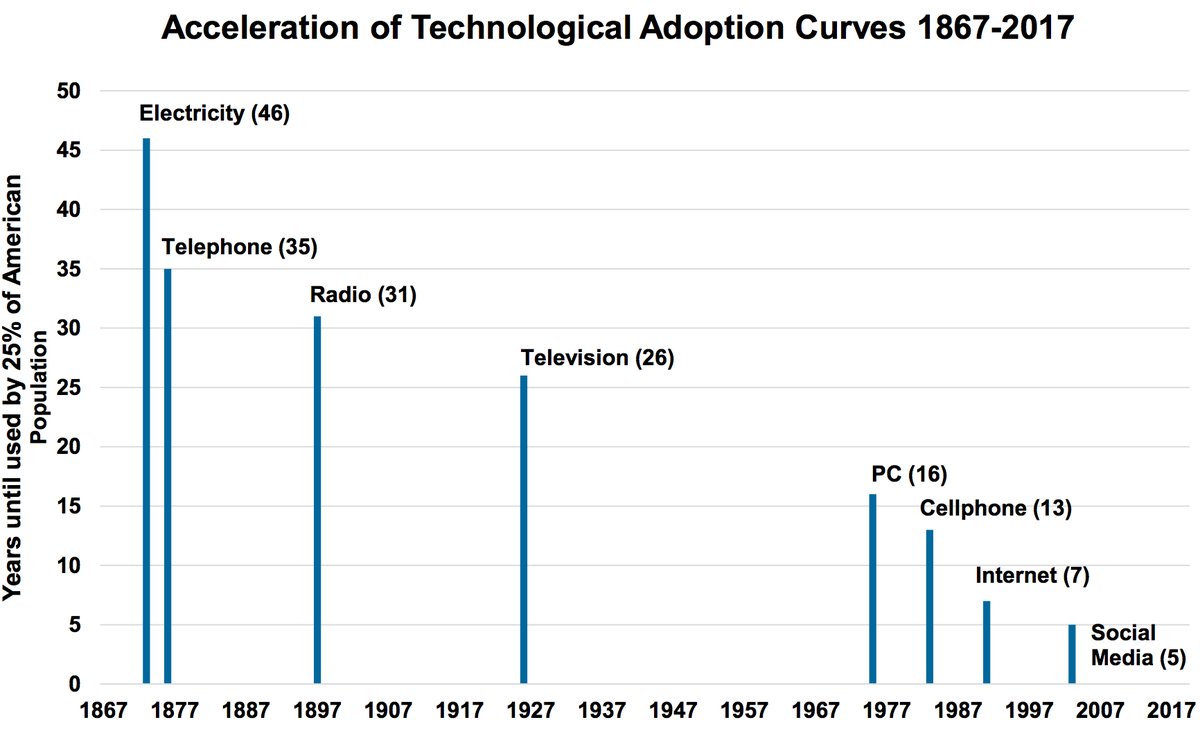
FRA: Excellent. And you’ve provided some charts that we will make available on the website .. maybe we can begin there with the technology adoption curve.

Charles Hugh Smith: Right. And you know it’s it’s almost unbelievable when you think about it, at least it is to me. That the whole Cryptocurrency space is only eight years old. I mean that Bitcoin protocol was released in 2009 and it really didn’t do anything for quite a while, it was kind of a hobby of certain people and Bitcoin trading under a dollar for quite a while and then under $10 for quite a while and then it kind of made a splash in 2013 with the Cyprus bailin ..  which was at least one of the triggers that caused Bitcoin to suddenly come out of nowhere and go to about a thousand dollars .. and then various hacks into Bitcoin exchanges caused a complete selloff that drove the price back down into the $200 you know so there was a massive sell off.

But my point is this space is developing very quickly in a lot of different directions that are hard for us amateurs to track. In other words, there’s a proliferation of Cryptocurrencies, but there’s also a lot of development going on ..  And then there’s a lot of development of trying to make the transaction rate of Bitcoin faster. You know for instance Bitcoin cash raised a block size from one megabyte to eight megabytes. And this .. was supposed to add a layer on top of Bitcoin that would process transactions much faster. Well that didn’t go because it was withdrawn because of technical difficulties. But you know it’s going to be very difficult to predict where the Cryptocurrency space will be in eight more years. That’s all I’m saying is that there’s a lot of development and innovation going on. And most of it we know will fail or drop away just as the Internet itself proved. But what we’re trying to do is ascertain the core value here. So that whether there will be some winners that will need to develop as as time goes on to meet the needs of people in our financial system .. That’s basically if it meets a need it will it will survive if it doesn’t really meet it. I mean if it doesn’t really have utility then it will fade in and become a novelty.

FRA: Yeah I agree very much with those observations. I mean you have the growth of the block chain based economy that is just massive potential. And then the use of Cryptocurrencies as a payment mechanism for Blockchain based applications and services. Right now there’s about twelve hundred Cryptocurrencies in the universe. And we can see lots of mergers and acquisitions just like what happened in the Internet.com era. Many of those Cryptocurrency is either going out of existence or many of them merging, some acquiring others, so that space could then dwindle down to a very small number of you know of Cryptocurrencies.

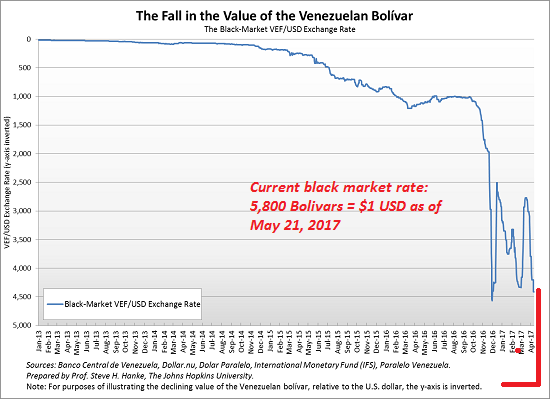
Charles Hugh Smith: Right and one of the other charts I proposed using for our program was a chart of the Venezuelan Bolivar, the national currency of Venezuela. And of course as we all know it used to trade about 10 to 1, in terms of the Bolivar to the U.S. dollar. And now last time I checked which was a few months ago it was trading around 6000 Bolivar to the dollar on the black market. So this currency is as experienced what we call, you know you can call it hyperinflation or a tremendous loss of purchasing power. That’s just basically destroyed the wealth of everybody holding Bolivar right. And so this is what we’re all concerned about with Fiat currencies. You know currencies that are created by Central Banks or national governments and that can be created without any restraints. And so this is what I think part of what’s driving the interest in Bitcoin and the Cryptocurrencies is what other financial mechanism is available to people who are trying to preserve their capital when their own national currencies are in free-fall.

FRA: Yeah exactly. Just recently there’s been a couple of quotes. One from Mike Novogratz on Bitcoin and one from Danielle DiMartino Booth on Bitcoin. And I would just like to read you that that. Mike says “this whole revolution came out of a breakdown of trust. It came out of the ’08 financial crisis when people said we no longer trust financial institutions, we don’t trust governments and in parts of the world today still. If you’re in Venezuela, it’s really hard to trust a Central Bank or in Zimbabwe. So the de-centralized revolution was Bitcoin is really the poster child of a response to the breakdown in trust.” And Danielle DiMartino Booth who is a former Federal Reserve Adviser to the Dallas Federal Reserve President, she mentions that “Bitcoin is a reflection of panic. It’s a reflection of people trying to get into a safe place knowing the major governments of the developed world have got their printing presses running 24 by 7. It’s a reflection of anxiety and fiat currencies and the fact it’s not practical to go back to a gold standard. What scares me most about Bitcoin, if the central bankers are studying it to figure out how the blockchain works. They are going to be controlling our spending with blockchain technology that is being perfected in the Cryptocurrency universe.” Comments?

Charles Hugh Smith: Wow. Yeah I think that those two, you chose quotes very wisely because those express very widely held views that you know we’ve all seen expressed by a number of commentators and observers over the last few years, which is Cryptocurrencies are one of the few avenues that an average person might have to escape the kind of financial repression that you know that you’ve covered in so many programs. In terms of capital controls, bail-ins, expropriations, and massive devaluation of the currencies. You know all these different tricks of financial repression, the elimination of cash. And that’s one of the driving factors, but then the fear on a lot of people’s part is that the central banks and central governments are not going to just stand still. They’re either going to issue their own blockchain currency and require their citizens to use only that Cryptocurrency or that they will try to ban or outlaw the existing Cryptocurrencies as an extension of the financial repression.

FRA: And everybody these days is talking about the price of Bitcoin where is that going .. you mentioned Venezuela on that chart – If we look at the history of the price of Bitcoin .. Going up to sort of the 1000 to 2000-dollar level. A lot of that seems to have coincided with Venezuelans in Venezuela and also Chinese in China looking to get money out of their countries – you know capital outflows and then from there, it seemed to have critical mass taking off to where it is today slightly over $10000 as we speak. Comments on that.

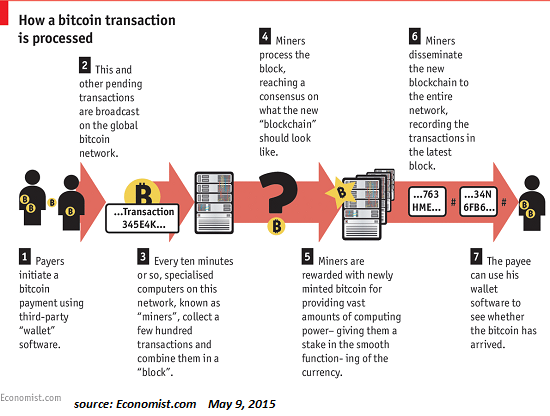
Charles Hugh Smith: Right. Well you know before we started recording you were speaking about the costs of mining Bitcoin and as being one factor in that we could use in its evaluation. And so let’s try to contextualize the discussion about the value of Bitcoin and you know a lot of people feel it should be zero because it’s not backed by anything. And of course then proponents say well there’s nothing backing all these national currencies either, there’s nothing backing the Dollar, the Yuan, the Yen or the Euro either. Which is technically true. And so let’s move on to valuation. One factor that’s in a lot of people refer to Bitcoin in particular as having a big impact on its evaluation is, it’s a scarce entity. In other words, there’s only 21 million Bitcoins that will ever be mined. And beyond that beyond that amount then there will be a fee structure to support the blockchain right. Because currently the whole blockchain is maintained, it’s basically paid for by the issuance of the admittance of new Bitcoins. And I think you had some numbers that you found on the estimates of how much that cost in terms of electricity and computing power to mine one Bitcoin.

FRA: Yeah you know with approximately $1000 US to perhaps $1200 US to mine one bitcoin. And that represents the cost of electricity and computing resources .. It’s similar in the gold world where it costs approximately $500 to $800 per ounce to mine one ounce of gold today. So on that basis, if we look at the value of gold being thirteen hundred dollars today relative to the cost of  mining .. Bitcoin could approximately be valued at something like $1500 to $2500 dollars US relative to its mining cost.

Charles Hugh Smith: Right .. And so in that analysis it’s overvalued you know by a factor of four then. Alternatively, we can say in a world where national currencies and central bank currencies are no longer trustworthy because they’ve been created in vast sums and continue to be created to the tune of like $300 billion a month or more. That may be what’s really happening is gold is lagging and this has of course been frustrating to a lot of people who feel that maybe gold should be $5000 an ounce if Bitcoin is $10000, then gold shouldn’t be $1300 it should be $5000 an ounce. And so it may be that gold is lagging and to where it should be. But you know let’s look at the utility value of some of these alternative currencies and I’m including precious metals are the historical safe haven because they have intrinsic value and in the case of silver they have utility value as well. I mean that we all know that silver is not only pretty and a nice thing to make art out of, it’s also a an industrial metal with you know that it’s widely consumed. So we understand the utility value in the store of value of precious metals and then Bitcoin is obviously it’s a different animal because it’s a digital thing and it has no physical presence and no physical utility, but it is quite handy in terms of transferring capital around the world. And I myself have used it to pay editors and translators in other countries and you know there’s no fooling around with bank fees and you don’t have to fill out any of the capital control forms required by the Federal government. And this is of course why a lot of people feel that Bitcoin you know it’s all about money laundering and drug money. But I am just a little regular person here doing my running my little business and I used it to pay other people doing you know legitimate services for me. I file my tax return you know what little gain I made on my Bitcoin transactions .. So you know I think there’s a legitimate utility to the Bitcoin and the Cryptocurrency phase in terms of regular people transacting business globally.

FRA: Yeah sort of the mobility utility factor. And as mentioned earlier that seemed to what happened to propel the price to go from $1 up to $1000-$2000 dollars per Bitcoin. Especially from Venezuelans and Chinese using it .. Now there is a development just in the last month or two that I’d like to mention. That has to do with the Internet protocol of Bitcoin. So most if not all of the Cryptocurrencies are operating over the Internet, over the IP Internet Protocol space and there are technologies coming out now that are able to detect Bitcoin transactions, Bitcoin traffic, even if the traffic is encrypted. This is quite new. As that develops, this will actually make it possible for banks to look at bringing into regulatory oversight the Cryptocurrencies, the traffic that’s coming to and from the banks .. and even governments as well for Bitcoin traffic into and out of countries. So this mobility advantage initially may not hold as much you know, given this technological development. The government of China has long been looking at this on how to do it .. this technology can be used by banks and by governments.

Charles Hugh Smith: Right. And that’s an excellent topic and observation. I wasn’t aware of this technology, but I think what it raises for me is the regulation of the Cryptocurrency space is inevitable in developed economies. You know in other words like this is a normal trend. And frankly I think it’s a good trend in the sense that if you want to legitimize a new form of money it has to be regulated to some degree so that people won’t get ripped off by fraud, like people selling Bitcoin they don’t actually own or you know this kind of thing. And I also think that you know if people are fortunate enough to make you know a million dollars trading Cryptocurrencies, then why shouldn’t they pay the same taxes somebody that was fortunate enough to make a million dollars trading stocks or bonds or future contracts. So I think the advent of regulation is a positive development. And the reason why I say that also is some countries are embracing the Cryptocurrency space and I mentioned Japan which has legalized Bitcoin I mean fully. Right. And of course this is the third largest economy in the world. And South Koreans have basically given a pass. So they’re not going to ban it which is taken as a form of approval .. the U.S. itself has deemed Bitcoin and Cryptocurrencies as commodities. So in other words they are viewed as, if you’re trading Bitcoin – it’s viewed as equivalent to trading pork bellies or something. Right, it’s a commodity. So I think once a country like Japan, with a huge capital market and a vast economy now that it’s legalized the Cryptocurrencies it’s very difficult for other economies to say oh no we’re going to ban this. And I think we have to draw a distinction between common sense regulation of the Cryptocurrency space, like legalizing it and regulating it and taxing it right, as opposed to banning it. And I’m not so sure that banning it is going to work anymore. Because like I’ve explained on my blog a couple of times, if for instance the United States decided to ban Cryptocurrencies Well I could take my Bitcoin and you know my one Bitcoin or whatever and I could put it on a thumb drive or a so-called hard wallet. And then I could take it with me to Japan or I could mail it in a package with some other stuff. And then I could have an associate or friend in Japan you know upload it and deal with it in a legal country. Where they are legal in a legal setting for Cryptocurrencies and then transfer it into yen or dollars in that country where it’s legal to do so and then transfer it back to the U.S. And so you know if I can figure out a really simple workaround. Pretty much anybody can. So I think where a lot of people fear this tracking of Bitcoin and other Cryptocurrencies and then regulating it, is a bad thing. It doesn’t have to be a bad thing. I think it could be a positive development actually.

FRA: Yeah and it will accompany the growth in Blockchain services as the economy develops around those based services you know. The concept of an encrypted Excel spreadsheet type of ledger that Blockchain is.

Charles Hugh Smith: That’s right. And I’m glad you described it so succinctly. Because a lot of people are confused by it and that’s really what it is. It’s basically a ledger that’s public so everybody gets to see what’s been entered. And so that’s the utility value. Well you know let’s also talk about, go back to the financial repression part because one thing I’ve started to write about and other people have also started to write about is the possibility that we finally get some inflation. We all know that unofficial inflation, real world inflation, is running a lot hotter than official inflation, but so far the central banks of the world have created you know trillions upon trillions upon trillions of new currency and they’ve injected that into the financial sector. And there’s been only asset inflation. Right. In other words, stock markets have doubled and tripled. And you know bonds have risen in value and real estates gone back up to bubble levels but there hasn’t been a lot of real world inflation and certainly no wage inflation. So if we started to get inflation that’s going to create a real problem for the central banks because they won’t be able to emit in the quantities of currency they’ve been emitting because that will fuel inflation and inflation of course destroys capital, it destroys the savings, it destroys the purchasing power of wages and people actually have less money to spend, less purchasing power. You know also that’s I think another driver for the whole Cryptocurrency space is that if Cryptocurrency is perceived as something that is a store of value based on scarcity, then it becomes an attractive hedge against inflation.

FRA: Exactly that’s a good observation. So where do we go from here. Like what will happen? How do you see the Cryptocurrency space evolving? You know I guess we have private based Cryptocurrency. And then they’ll also be government based Cryptocurrency.

Charles Hugh Smith: Right. Right. And my sense is the value of of Cryptocurrencies like Ethereum and Dash and Bitcoin, in other words, we can call these the leading Cryptocurrencies. The value is that they’re non-state, non-central bank, non-government right. And so I don’t see a Cryptocurrency issued by the Bank of China or the Federal Reserve as having any value because the the control of how much of that Cryptocurrency is emitted, is created, is of course still in the hands of the bank and so on. I think the fear of anybody that is at all skeptical of how government and central banks work, as the central bank and say oh well there’s only going to be 21 million of these coins issued and then the next morning they say Oh well actually we’re going to issue $300 billion and then it’s $300 billion. And then that currency has no value at all. And so I think that we have to kind of specify that the value of Bitcoin is that being decentralized, you can’t change the protocol. No one person or agency can say no we’ve decided to issue $210 billion of Bitcoin. Now it doesn’t work like that. And even if somebody claimed that we’re going to do this to the Bitcoin protocol the miners and everybody, the participants in the Bitcoin ecosystem, they would have to follow along and support that. And if they didn’t support it, then that fork would die and others would just vanish. And so if I declare, hey I’m going to start a new version of Bitcoin that there’s a billion coins and nobody comes along to mind that. In other words, maintain the Blockchain, then my version just dies it goes to zero because there’s nobody to support the Blockchain. So there is a rough and ready very free market kind of democracy, if you will, and a lot of people have criticized Bitcoin because it major miners obviously have a lot more influence than people who are mining as a hobby and so on. And so there are blocks of self-interested people who can dominate these Cryptocurrencies. And that’s a danger for sure. But it’s a lot different than having nine people meet in a room and decide to add a zero to the money. Yeah. And so I think that government and central bank versions of Cryptocurrency are going to go nowhere because they’re not again for the elements you described earlier in the program. There’s really no reason to trust them.

FRA: I mean they may be mandated by governments to use just like you know currencies today of the countries of the world. But I guess with the coexistence with private based Cryptocurrencies, the ones that make sense will be ones that are you know operating within the financial system. Even if they’re outside of the banking system, if you will, but still within the financial system. And the ones that are based on sound money, so that they have limited numbers that they can be printed or perhaps they’re based on a commodity like gold.

Charles Hugh Smith: Right. Right. And I think that you raise an excellent point that what people are seeking is sound money and sound money that has utility. In other words, it’s not just a store of value, but it’s a means of exchange and so there’s certainly a role for the precious metals. And that’s why a lot of people are saying if you’re going to go in terms of recommending a hedge that you should have both precious metals and some Cryptocurrency, you know exposure, even if it’s you know one percent or something. But I think you know I would say we’re sort of an equivalent of the Internet or the the world wide web around 1995. You know so we have it back when the first browser emerges. Right. And Mozilla and all that and all the assumptions that we would have drawn that have all turned out differently. Right now there is like Yahoo was the first for the most asked and and and then Yahoo faded and lost all of its advantages. And so we you know to say where will Bitcoin be in eight years. Gosh I would hate to even say. I mean it could it could be surpassed by a new Cryptocurrency or an entirely new Cryptocurrency protocol and then it becomes a legacy system. That’s definitely a possibility right. Something comes in that’s faster better cheaper and it’s going to it’s going to take all the market space away from the existing Cryptocurrencies you know. And that’s what we want. We want innovation, we want faster better cheaper. And that’s part of what we like about the Cryptocurrency space is it’s still open to that kind of thing compared to so much of the developed economies are controlled by monopolies, cartels, central banks, governments, which are only self-serving. You know they only choose policies and enforce policies that protect the few at the expense of the many. On the other hand Bitcoin could transition into being something that’s slow and secure. It’s never going to work in terms of buying a coffee at Starbucks with Bitcoin and that’s just a dead duck. It’s a transaction rate it’s just too small, but it might be useful in interbank transfers or large financial transfers. Maybe Bitcoin will find a home in that space. While other Cryptocurrencies will arise to take care of the the transactions on the level of consumer goods. You know we don’t know.

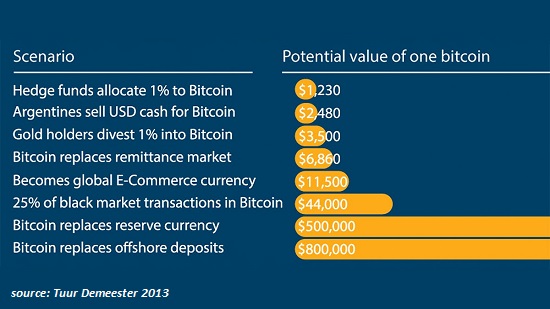
FRA: You had a chart that shows if Bitcoin replaces or becomes part of reserve currency. We could see prices in the $500000-dollar range:

Charles Hugh Smith: I know and it’s so funny because you know I’ve been following Bitcoin, but I never bought any and I was just kind of an interested observer until I needed it. As for its utility value, in other words, I needed to get some to buy some Bitcoin in order to pay the translators I had in Venezuela because that was the only form of currency that they could they could access right. That made sense. And if you think that the world economy is going to enter a time of instability where a lot of things start falling apart then of course we can say that Bitcoin or other Cryptocurrencies will well maintain their utility value for that reason. In other words, if people can access it and and pay their debts and buy stuff with it or buy other currencies with it, then its going to have utility value.

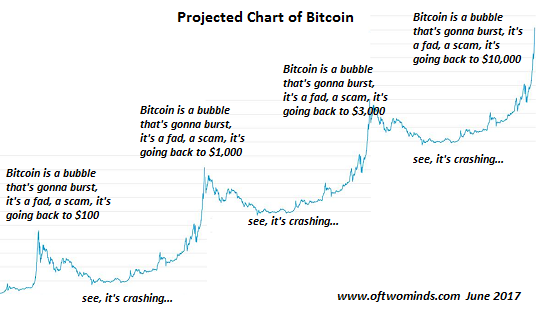
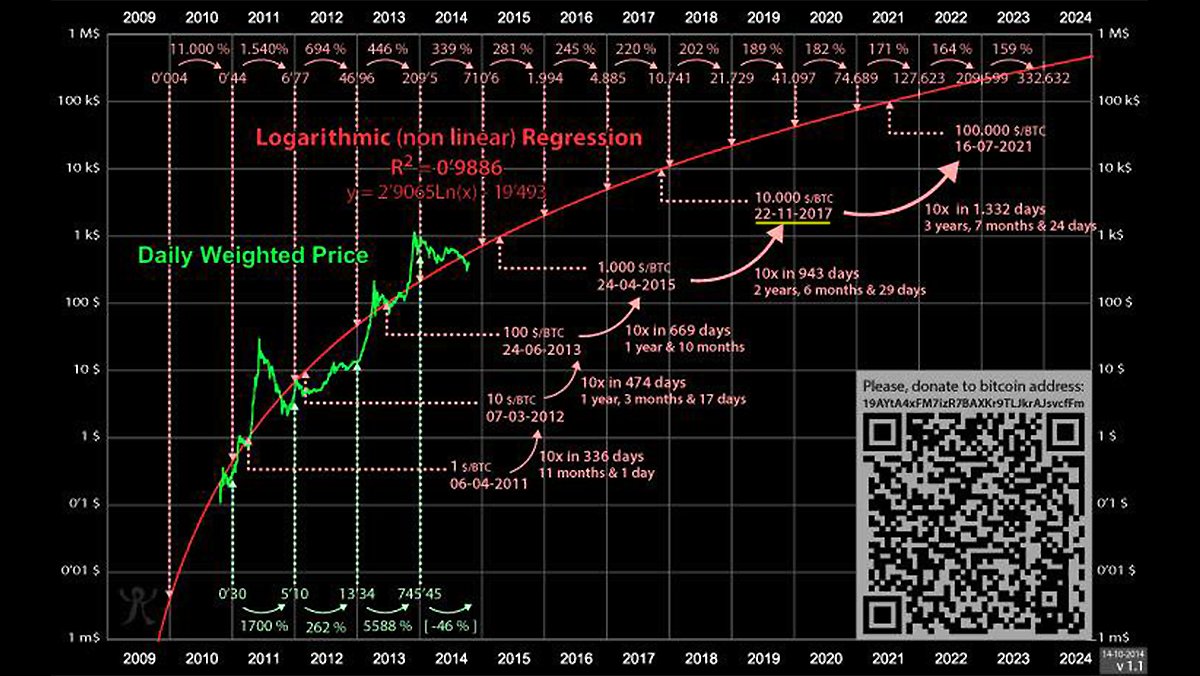
Charles Hugh Smith: I have another chart here the logarithmic progression of Bitcoin and its obviously kind of a rough guess, but this chart suggests that there is a logarithmic function to the number of days that it takes for Bitcoin to advance tenfold. In other words to go up by ten times and so it was kind of like how long did it take to go from a dollar to 100 an hour to a $10 then to $100 in $2000 and then to ten thousand. And so of course we can play these kind of games and you know those of us who like charts you know we love like tracking charts and projections and stuff, but it certainly we don’t know.

FRABut actually your logarithmic regression chart does seem to be fairly accurate. The November 22 date for $10000 is pretty much on track.

Charles Hugh Smith: Yeah it is. And this was I think the projection was made in late 2014. So by this chart, if we follow if that regression kind of goes continues as charted, then we would be at $100000 Bitcoin in 2021. So while we have to wait a whole four years. Yeah and of course I’m laughing because this is all speculation right, but we really don’t know what’s going to happen and what I like to say is this is the way markets should operate. They shouldn’t be manipulated by central authorities. So they always go higher and there’s never any retrace, there’s no volatility. You know volatility has been destroyed in a stock market, it’s been erased. And so there’s no real price discovery because there’s no volatility, there’s no price discovery. So Bitcoin is extremely volatile and to me, part of that is number one it has a very low float you know that of the 70 million Bitcoin. Several million, at least several million, are estimated to have been lost and in hard drive crashes and things like that. So the founders have about a million Bitcoin that they’ve never touched and never moved. For whatever reason and a lot of people are pursuing the idea of hold on for dear life, otherwise known as HDOL. And so the actual tradable float of Bitcoin is probably a relatively small percentage of that 17 million or 18 billion Bitcoin that are out there. So you got a very small float and like a small float in stocks, you get big volatility when there’s a small float and then if the more open the market is the more volatility you have. Right because you’re exposed to human emotions and there’s more surges of euphoria and panic and all the things that drive volatility, so I don’t see volatility going away.

FRA: Well that’s excellent insight for a balanced view. How can our listeners learn more about your work?

Charles Hugh Smith: Please visit me at oftwominds.com.

FRA: Great thank you very much Charles for being on the show. We’ll do it again.

Charles Hugh Smith: Yeah. Thank you so much Richard. My pleasure. Great topic.

Submitted by Boheira Manochehrzadeh <bmanoche@ryerson.ca>

DOWNLOAD/LISTEN TO THE PODCAST

Disclaimer: The views or opinions expressed in this blog post may or may not be representative of the views or opinions of the Financial Repression Authority.


11/03/2017 - The Roundtable Insight: Daniel Lacalle On How Central Banks Are Nationalizing The Economy

LINK HERE to the MP3


Disclaimer: The views or opinions expressed in this blog post may or may not be representative of the views or opinions of the Financial Repression Authority.


11/01/2017 - The Roundtable Insight: Alasdair Macleod And Bosko Kacarevic On Why Physical Gold Makes Sense

FRA: Hi welcome to FRA’s Roundtable Insight. This is Richard ..  Today we have Alasdair MacLeod and Bosko Kacarevic. Alasdair is the head of research for GoldMoney and an Austrian economist. He has a background as a stockbroker, banker, and fund manager. Basko is the president and CEO of Kindigo Capital, a Canadian based private equity firm in Windsor, Ontario, Canada. The whole financial licenses and commodity derivative stocks mutual funds and private equity. Welcome gentlemen.

Alasdair Macleod: Nice to be here.

Bosko Kacarevic: Thank you for having me.

FRA: I thought we’d do a focus today on physical gold. Why physical gold why does it make sense where to store it, how to store it. And then perhaps a comparison to what’s happening in the Cryptocurrency world, sort of Gore versus cryptocurrencies debate and further where we kick it off with if you want Alastair with why physical gold why does it make sense?

Alasdair Macleod: Well the the the basic sense behind physical gold is that it’s nobody else’s liability. It is Money, is money not an investment. And I think that’s an important point. But as money it tends to retain. In fact, over a period of time it tends to increase its purchasing power measured against commodities and if you like the items that are manufactured of commodities. And if you want proof of this basically from 1969 to the present day the dollar priced in gold has lost over 97 percent of its purchasing power. So that’s how strong on gold is. But if you’re going to hold gold in paper form someone can come away and change the rules. Your paper might go bust if let’s say you’re in an ETF, which invests in synthetic gold. If you try and invest in gold on the futures exchanges, sort of rolling contracts. That again is subject to really try and take delivery. You may not get your delivery. The one thing that really matters is that you have the physical gold. Now obviously you can store all your gold at home if you’ve got any significant level of assets. So you need to find if you like a really good LBMA registered faulting company who will store all your gold and that’s basically what we do is go money. We act as custodian; our customer’s gold is not on our balance sheet it’s it. It operates on the Canadian Belman laws. I think that’s the technical term. So if we have some sort of financial accident, there is absolutely no dispute about the ownership of gold which we have as custodians, it belongs to our customers. We have both a metal audit and also financial audit every quarter. So that again you know it’s all recorded, it’s yours and you’ve got a choice of vault around the world. So if you’re an American and you have a fear that the American government might be in a sort of command you to submit your gold in America. It’s not under the American government control, it be put it into a foreign jurisdiction. I mean we you know Switzerland or Singapore or somewhere like that. I wouldn’t say that you break the rules but it just makes it a bit more difficult for your government to get the gold. So there are all sorts of ways in which you can ensure that your money capital if you like is is is safe at all times and that basically is the function of gold stored in a proper vault.

FRA: And your thoughts Bosko.

Bosko Kacarevic: Yeah I have to agree with Alasdair. We approach the gold as a form of currency. We already regulated securities dealer in Canada as an exempt market dealer. So we provide as well storage facilities for investors in physical gold. Our one of our recent announcements was a we have a platform where RSP investors retirement accounts can put physical gold into their retirement accounts and have it stored in LBMA approved vault and they can trade the gold buy and sell it at any time. When the gold is in your RSP account because it’s in trust for the retirement then it can’t and the clients can’t take delivery of it. But the physical gold is there it’s accountable, it’s audited, and there we offer a basically a non fungible system. So when our clients purchased their gold it’s in a specific container, it’s allocated, and segregated to their account. So the exact same gold Maple’s gold bars that someone purchases is the exact same that they’re going to be selling. So we try to explain to people that you know a properly diversified portfolio should have some physical gold and silver in it depending on suitability. You know you might have 10 percent or 20 percent, but it all depends on the rest of the portfolio that the client is holding and at Kindigo we focus on our clients are mostly accredited investors. So there’s considerable due diligence that we do. And the KYC forms that have to be filled out, according to the compliance requirements in Canada.

FRA: And Alasdair what are the risks for for storing gold or ways in which you can have it from your perspective in terms of the industry. Like what are the advantages and disadvantages of different ways of storing gold?

Alasdair Macleod: Well obviously that I think we’ve just agreed the best way to store it, but you know unless you’re talking about small change at home if I can describe it that way is in LBMA registered vault. And again if you have it in a different jurisdiction from the one in which you live that you like is another safeguard. The other safeguard that’s a proper LBMA registered vault gives you is that gold that goes into the gold basically is proper bullion. We ensure that anything that comes in for our customers is bullion and not Tungsten painted gold colour, that unfortunate experience that happened in Canada earlier this week. So that’s terribly important say you’ve got to ensure that you know the gold comes from proper refiner. So it’s not conflict gold. This is another thing which is becoming an increasing issue in our politically correct world. So I would when it comes to dealing with set incentives, such as some of the refiners in Dubai. I sometimes wonder what the source of that gold is. So it is important I think to to deal with reputable people. Storing gold at home does give you potential problems because if you’re careless and you let someone know that you might have an gold at home then you know you’re probably open to being robbed. And if it’s a lot of gold then you know the story gets out then you could actually be robbed by some very very nasty people. So I think that is what I would keep at home is probably fairly limited. I would actually look past having a proper vaulted gold. Physically yes I think we’re OK. But you’ve got to understand that that you don’t have possession of the gold, you have possession of a piece of paper which gives you an entitlement to some gold and you may not even have a direct entitlement to some gold because when it comes to submitting your ETF shares, well stock in return for gold usually it can only be done through authorized banks who are on the list to be able to do it. So that again is is a bit of a problem.

FRA: And your thoughts Bosko.

Bosko Kacarevic: Yeah. You know our system is a closed loop system so we eliminate any possibility of any counterfeit gold products entering our platform because it’s all done through our office. I inspect every product that goes into the vault for my clients and we are providers to the Canadian man to other gold refiners. We have direct relationships. So there’s no that gets out into the public. The the article that Alasdair mentioned regarding the Canadian Mint at RBC you know it seems there was a case I think a few years ago that they found the gold bar or counterfeit bar at a jeweler and always seems that it’s a jeweler or a pawn shop that these things are discovered. You know I haven’t experienced any counterfeit products coming through our business. I don’t think any anyone who wants to pawn off any counterfeit products would go through our business or Alasdair’s business. I’m sure that these people that are attempting this are staying away from reputable dealers because they’ve been caught right away. The Canadian Mint has issued a statement to their defence. I mean I guess we’re an approved a billion and a dealer with the Canadian Mint. So they said that that the gold product was and wasn’t even produced by the Canadian Mint in the Royal Bank is saying that they didn’t even sell their product. So how this came into being I don’t know. But I think people need to understand too that you know the the ownership contract that you own the gold and you know people have to do their due diligence in their background checks on who they’re dealing with. Because at the end of the day when you want to sell you have to make sure that you know the gold is available for you that you’re selling. So when it’s in our vault you have title ownership of the gold and even the clients that are keeping their gold at home. You know we don’t pay out to people when they come into our office right away. We have the gold inspected and we always just to cover ourselves. We tell them they have to wait 24 hours before they receive their funds. So anyone trying to pawn off a fake gold bar isn’t going to leave our office and let us inspect it for 24 hours so we’ve never come across anything like that. And I think this is an isolated incident. But I think people need to be aware of it. If the ownership contract when you’re storing your gold in a vault the title ownership of your gold is what the important thing is.

Alasdair Macleod: Richard can I just add to Bosko saying there, one advantage that you guess of having gold in a proper LBMA vault is that it should be properly insured. And we also have to ensure all our customers gold. So I think that’s a very important point. Another important point to realize is that if you take delivery if you go ahead and you want to sell it, you have to effectively make sure that you know to convince the buyer that it is authentic and that will involve it being tested. So the marketability of gold which leaves the vault is not nearly as good as gold that is kept in the vaults. I just wanted to add those two points.

Bosko Kacarevic: I agree with that it’s very important, the insurance aspect too. We have clients that are storing, some people even for a large quantity of gold and silver at their homes and it’s just too risky and then what eventually happens is when they want to sell it you know in the case of silver. People are holding a few thousand ounces of silver. It gets pretty heavy and it cumbersome moving it you know. And when it’s in the vault for us it’s very easy to identify. Each container has a specific number. I have clients you know across the country and in Europe that they just pick up the phone they call us. We sell the specific holdings and wire them the funds so that people are unable to do that when you have your gold at home and you’re travelling or you’re you want to liquidate it quickly because one of the other issues that comes about is when people call and they want to sell it. If the market’s moving fast or are very volatile I won’t lock in a price for a client unless the gold is in our office. You can’t call me. But if the gold is in the vault I know it’s there. I know the identity of it so I can lock in a price for a client over the telephone and send them the money. But if they have it in their basement and they want to lock in the price you know it’s not possible they have to bring it in person. And once it’s in my possession then we can discuss locking in price.

FRA: Now in this day and age with the advent of cryptocurrencies does physical gold still make sense? So if we look at what’s happening with Bitcoin and other Cryptocurrencies. Is there a migration of investors holding physical gold towards holding cryptocurrencies either together or as an alternative, Alasdair?

Alasdair Macleod: What a fascinating question. I think Richard the answer to your question whether there’s a migration from buying gold into buying Cryptocurrency. I think there must be. Yes. We can’t deny that. The reason I would say that is because so many people who deal in anything really don’t actually understand the underlying economics of what they’re doing. What they understand I think a trend and quite simply if you see a trend moving or speculating you just jump on the trend. So you are going to have people who will see who take the view that gold is less exciting than Cryptocurrencies, has potentially less return over at whatever time frame that they’re putting in their mind. So they will sell gold and buy Cryptocurrencies, of that I have absolutely no doubt whatsoever. What is interesting in this however and I did actually write a piece on this in I think dated August the 10th. So for anyone who’s interested if you go on to Goldmoney sites and go into research and go into the insights then you will find. August 10th I wrote “Cryptocurrency- its status as money”. Now this is very important because I won’t get through the article. Basically my conclusion is that Cryptocurrency are not money. I mean it is not just a question of volatility, its the origins of it and all the rest of it. But cryptic currencies are the media for speculation par excellence. And you know with the limited supply and all the rest of it and the fact is that so far the people who got into it are basically geeks. If I can be that rude to call them that. The hedge funds are beginning to wake up to this. The authorities are beginning to wake up to it. I mean they even bought it yesterday the CMA decided that they’re going to introduce a bit you know a Bitcoin future. Various governments have sort of taken on the technologies, some are being frightened away by the volatility in the things in it. So I think the Chinese have sort of tried to close down Chinese based operators, but basically the public has yet to buy it. And if you look at any bubble which is essentially what the Cryptocurrencies are, it’s only when the public are really into it that you can say this is time to get out. It is getting dangerous. It is going to collapse. We are some way from that. But what I can’t see is what’s going to stop these Cryptocurrency is rising in the meantime because you know if it’s becoming you just my street futures exchanges and so on and so forth you are going to get asked a lot of hedge fund type money, speculative institutional money if you like yet to buy these things. So I see them going considerably higher than this. You know please don’t hold me to that. That if you like is the theory if you like the madness of crowds as Charles Makai wrote back in the 19th century. We are seeing it and this is pure. It’s like tulips without the bulbs. I mean it is amazing. I get very unpopular for saying this by the way because everybody in Cryptocurrency is convinced it’s money, convinced it’s some sort of new paradigm. And it was ever thus, every bubble is like that everybody involved believes that this is a new future and whatever. What fascinates me you know we’ve looked at it so far in terms of Crypto versus gold, which was the basis of your question. But I think at some stage it’s going to move on from there. What we’re going to be looking at is that potential for Cryptocurrencies to destabilize paper currencies. I’m trying to get this one. Trying to get my head on this one at the moment and I’m planning to write an article on this front shortly. So this to me is a fascinating topic. It really is.

FRA: Could the momentum into Cryptocurrencies keep a lid or a cap on the price of gold in U.S. dollar terms Alasdair?

Alasdair Macleod: As a follow-up, no I don’t think so. There is actually a far bigger story going on gold and it’s all to do with the declining use of the dollar in international trade and this is something that’s being forced on to the rest of the world outside of America by China and Russia working together as head of the Shanghai Cooperation Organization. I think that we’re likely to see. I mean my information is that we’re going to get in an oil contract settled in Yuan on the Shanghai futures exchange by the end of this month, November, and between Yuan on contracts countries like Iran, who either off a bit to deal in dollars or out of their choice, would not want to go anywhere near a dollar. Will have the facility to buy gold in Yuan. And that I think is something that is likely to lead to a significant rise in the price of gold. The other thing about the price of gold is that there are an awful lot of dollars outside America. We’ve got some people running around saying well you know the American economy is rubbish and the rest of it is just going to collapse and then the end of the purchasing power of the dollar will go up. But the latest figures we have which are over a year old now is that the total portfolios in dollar cash outside America is in excess of 17 trillion dollars. That was midway through the last year 2016. It was barely changed from the level Midway 2015. My guess is that with the dollar having eased over the course of this year we will already be recording a decline in the total value of foreign portfolios, the dollar elements in foreign portfolios. Those figures will be released in next April or May. So we won’t know until then. But just imagine if you go 17 trillion dollars outside America and you have got an economy you’ve got about 19 trillion dollars GDP something like that. This is too much money outside. I think for the situation to be sustained, so I would say the dollar is weak and that is what’s going to drive gold up. And I think it is something which is independent of the Cryptocurrency story, but what does fascinate me is the potential for the Cryptocurrency is to destabilize paper currencies if you like as well. And as I said I’ve got to get my head around that before I write it.

FRA: And your thoughts Bosko.

Bosko Kacarevic: Alasdair and I seem to be in the same camp. I’ve heard actually a number of my clients who have actually sold their precious metals to purchase Bitcoins because it seems like an alternative currency. But you know it’s not officially a currency, but it seems to be operating like one. And you know judging from what’s happening, the attraction to Bitcoin is similar to the attraction to gold. It’s it’s an alternative currency outside the banking system or in government and so on. But the problem with that is is when you’re when you’re comparing it to gold. Gold is still a physical commodity. You can take possession of it. I have a problem with Bitcoin because it exists on the Internet. It doesn’t exist in the real world. You can’t take physical possession like gold or even paper currencies. So there’s a huge cyber threat to the Bitcoin. I mean I find it strange that the person who invented Bitcoin, Satoshi Nakamoto, is still anonymous, nobody knows who he is or where he came from or whatever. That kind of raises a lot of flags for me. Then when you have issues with Bitcoin or let’s say that there’s a hacker that hacks into Bitcoin who are you going to call. There’s no nobody you can sue. When you invest in a company or you buy gold and silver or invest in the stock there are people behind that. When you invest in currencies, there’s a currency broker. The government issuing the currency, there’s essentially nobody behind bitcoin. It’s operating and it exists on the Internet and apparently from what I understand it’s a series of encrypted keys. But you know I think one of the fundamental changes that Bitcoin is introducing, is the blockchain technology that it’s produced on, which I think that there’s a lot of people in the financial institutions are adopting this new form of a distributed ledger and even that’s questionable as to the advantages of that. I think the credit card companies and the banking system the the technology that’s behind their ledger entries and their software accounting systems are doing fairly well. Introducing a distributed ledger, I’m not sure what the advantages of that are, but it seems that a lot of people are attracted to it. And you know mind you people are always attracted to new things like Alasdair alluded to earlier, but you have to remember that when the Internet was introduced and people were adopting there was a lot of, along with the advantages, it brought in a lot of problems. We have high-frequency trading now. So it’s not always a great thing to not have a central authority. In some cases, you want to have a central authority to be the mediator between two parties. So I’m still sceptical about Bitcoin. Obviously, it’s doing very well on a price level but on a value level. You know I still have a lot of reservations about investing in it, but currently, the CMA group thinks that the futures contract would be in demand and people will have the opportunity to hedge their risk in Bitcoin. So for me, it’s too early to get in. I’d like to see how it develops.

FRA: And I saw today an article by Jim Rickard’s on a new research report out by Goldman Sachs discussing this very issue of gold versus Cryptocurrency. Goldman Sachs appears to be leaning on the side of gold. Well as a preservation of purchasing power. They mentioned that Cryptocurrencies are vulnerable to a hacking, government regulation, and infrastructure failure during a crisis. Those are issues of concern and because of the volatility in Cryptocurrencies, they still see gold as preserving purchasing power better than Cryptocurrency, so that those are the results of the research report by Goldman Sachs and any thoughts on that and. Your final thoughts there.

Alasdair Macleod: Well I’d go along with what Goldman Sachs have concluded. I haven’t read their report, I must say, but as you’ve described it it’s hard to disagree with it. But I don’t know. I know that for people who are trading in it, this is all sort of a big issue. But from an economic point of view there is no doubt about it. Gold is money, always has been money whereas Cryptocurrencies are not then merely a medium for speculation. But you know we don’t actually care about that. Perhaps we always say is Bitcoin going up and we’ve got to get in there or in theory or whatever. We’ve got to go and buy it you know because you can’t stand aside and not buy these things. And this is why I think it’s terribly important to understand that actually it is just a whole load of hot air and nothing else, but this balloon I think, if I’m reading market correctly it is in the early stages rather than the final stages of its inflation. And as I said, I mean so far the people who got into it all the people in the know if you like the people who have been following this story from the outset, the early adopters, the institutions yet to get in. And I think that I mean this is this is the thing about the CMA contract it doesn’t settle in Bitcoin at all. All it does is it uses that bitcoin as a reference price. So that’s actually not going to be anything like gold futures contract where the gold is actually deliverable. This is a very very different thing. So I can’t see really that there is going to be the arbitrage between the futures contract and Bitcoin. I can see how that’s going to happen because there’s nothing deliverable. So that is not going to take demand out of the Bitcoin story so much I don’t think as inflating the number of gold contracts in outstanding on Comix definitely takes demand out of the gold market. So to my way of thinking, you know the the the institutions have yet to get into this. They will get into it because these new instruments look like you know go into contracts themselves so forth are beginning to take place. I think the other thing that’s going to happen is that the regulators are going to come in and insist that anyone maintaining accounts for people with Bitcoins or other Cryptocurrencies are going to have to do their due diligence. And I think the industry as a whole itself is likely to turn round and think we’ve got to clean up our act to make ourselves mainstream. I think all that is still ahead of us. And then you know when you think about the public investing in this, investing is the wrong word, speculating is probably better word, they think they’re investing. This is not just a bubble let’s say in the Shanghai stock market or you know if we go back to the tulips in Amsterdam that’s what 1640s or whatever it was all the Mississippi bubble which was France or the South Sea bubble which was which was England and most particularly, not just you know I mean just sort of England within coaching distance of London. That was the source of this. We’re talking about something that is catching the imagination globally and I mean already we’ve got so many imitators I think there are over a thousand Cryptocurrency I read somewhere. Where is proper paper currencies or something like a 170 only so already we’re you know there’s a lot of funny deals being done around in these icy roads and all the rest of it. This is an act which if it gets cleaned up and they will try and clean it up I’m sure that they will though try and clean it up. They the authorities will want to see cleaned up because they want to tax it apart from anything else. And the other thing is I think that the industry itself will want to see it cleaned up and that will open the gates for everybody to get involved. This is this is a theoretical bubble for any student of psychology in the future. They’re going to look back on this as an absolute wonderful example of a pure speculative bubble which is totally out of thin air.

FRA: And your final thoughts Bosko.

Bosko Kacarevic: You know when you compare the standard deviation of gold versus Bitcoin, I read a report recently that over the past 12 months’ gold has had a 12 percent deviation, where a big coin is over 60 percent. So you know I agree that it is a speculative instrument. It’s going to be quite volatile and the attraction of many people to Bitcoin to elude the financial markets. I think that’s going to be taken care of with the regulators are going to get involved obviously to see him now as is adopting it. So this idea of people being able to have a peer-to-peer and to trade outside of regulation or the government size. I think that’s just an illusion because of you ultimately you have to settle these Bitcoins for currency that’s going to be used in the real world. And you know you have to receive it in a bank. It has to be wired from whatever Bitcoin exchange or so there’s going to be financial institutions involved, regulating it. So I mean is it going to go up further. It’s very possible. I mean I think it is in the early stages and you know it’s it’s going to go through the process like anything else that’s brand new. It’s going to weed out the all the weak currencies and will Bitcoin be the winner in the end. I don’t know. Maybe a theory or the other thousand that are available. Who knows how it’s going to turn out, but there is definitely an attraction to it. And it seems to be distracting some gold investors are distracted and selling their gold and silver for Bitcoin and I disagree with it. But you know people like to follow trends and in some cases, they’re going to have to experience the negative part of following a trend and being wrong. So I don’t really know what’s going to happen but it’s interesting it’s a new technology and we’ll have to see.

FRA: OK great. Great insight gentlemen. How can our listeners learn more about your work, Alasdair?

Alasdair Macleod: Well the easiest way is to have open an account Goldmoney, no, but on Goldmoney site I write weekly is published on Thursdays I usually say if you look if you go onto the site, Goldmoney.com, research and then insight, you’ll find that. I also write a weekly market report and that again can be found under the research column.

FRA: And Bosko?

Bosko Kacarevic: People can reach me at our Website at Kindigo.com and you know on there this information about our company, my background, and they can email us through there. We don’t do a call in, but we do keep in touch with our clients and keep them up to date on what’s happening in the gold market.

FRA: Great thank you very much gentlemen for your insight. Thanks for being on the program show.

Submitted by Boheira Manochehrzadh <bmanoche@ryerson.ca>

Download the MP3

Disclaimer: The views or opinions expressed in this blog post may or may not be representative of the views or opinions of the Financial Repression Authority.


10/27/2017 - The Roundtable Insight: Charles Hugh Smith On Will The Private Sector Be Able To Grow Fast Enough To Meet The Demands Of The Public Sector?

FRA: Hi welcome to FRA’s Roundtable Insight ..  Today we have Charles Hugh Smith. He’s author leading global finance blogger and philosopher, America’s philosopher we call him. He’s the author of nine books on our economy and society including “A Radically Beneficial World Automation Technology and Creating Jobs for All”, “Resistance Revolution Liberation a Model for Positive Change”, and “The Nearly Free University in the Emerging Economy”. His blog of twominds.com has logged over 55 million page views. It is number seven on CNBC top alternative finance site. Welcome Charles.

Charles Hugh Smith (CHS): Thank you Richard. Always a pleasure to join your roundtable.

FRA: Great. And with that today with the focus on the sort of tension between the private sector and the public sector with many types of revolutions, technological revolutions happening in the in the private sector you know in terms of block chain and biotech, energy environment, lots of revolutions happening much like what happened with the with the Internet.com revolution. And the question is will that growth in the private sector be able to to meet the challenges of the public sector in terms of seemingly unsustainable growth and that growth in Entitlement programs. Dr. Albert Friedberg of the Friedberg Mercantile Group recently observed that in the U.S. it’s basically 10 percent of GDP and rising for entitlement programs. So you know that’s the big question. Your initial thoughts.

CHS: Well Richard I think that’s an excellent context for you know the points we’re going to make. And one of the first points I would start with is ultimately the public sector in this state what we call the state all all layers of government and government related entities. They all live off the private sector right. That the private sector has to generate surplus. It has to generate wages for employees and those are taxed by the public sector and that’s the source of the public sectors revenues. And so what we’re really kind of discussing is can the public sector generate enough profit and employment to support this fast ballooning public sector. And you mentioned the entitlements growing by 10 percent. And I have this chart of consumer goods and services.


The price changes what what we might call inflation. But it’s actually not. Not entirely inflation it’s it’s the cost of services being provided and how far above or below they’re rising then like people’s wages which household incomes as we all know if and stagnating for somewhere between 40 years and 10 years and depending on which sector of the economy you’re looking at. But we look at what is soaring in price and we look at like 200 percent increases and we find out it’s college tuition and we look at what’s climbing at a 100 percent or or more and it’s like health care and child care. And of course these are the sectors that are heavily controlled or are funded by by the public sector. And what we find is declining in price is cell phone service, software, TVs the kind of things that the private sector provides. So it’s pretty clear when you have competition and when you have exposure to innovation then you get it lower prices or at least you get more for your money. Or there’s there’s hope that innovation will impact the consumers, either the quality of the goods and they’re receiving or the price of the goods and services they’re receiving. So to sort of summarize everything that the public sector controls is skyrocketing in price and the quality is also now suspect right.

Like I’ve written a lot about higher education and I have another chart here showing that literally all of the the the higher education student loans that are being issued are actually funded by the federal government. So it’s it’s actually the federal government is funding these private sector lenders and guaranteeing them profits to fund these students getting diplomas which are declining and real world value. You know in terms of statistically what the earnings are of college graduates and so on that that’s been stagnating just along with the rest the wages. So I would propose that higher education is actually declining in its utility and value despite the cost soaring and many other people would make the same claim about health care at least in the U.S. Is that the cost keeps soaring but the actual you know measures of health of the American population are continue to decline. So this is a really striking difference. I think that’s really what we’re talking about is an enormous difference between the sectors controlled by the public sector and those controlled by the private sector.

FRA: Yeah you’ve written a lot about that in terms of several industries being sort of cartelized, you know with special interest group, lobbyists and just the interest by the government in them. Can you elaborate a bit on that?

CHS: Yeah I think that’s a great topic. If the public sector controls something like health care which in the US is dominated by the public sector programs: Medicare, Medicaid, and the Veterans Administration. Then the way to maximize your profit is to lobby the public sector, lobby the government agency, to lock in your cartel pricing. And so that’s what we see is that we see these pharmaceutical companies routinely raising prices 30 40 percent or even 400 percent just on a random basis that they make no claims that they’ve invented something new. They simply raise the price on an existing medication and the public sector also imposes a lot of regulations that some of which are of course important and necessary, but many of which are simply you know churn you know they just create more work, but they’re not really creating that not really impacting the patient in any in a positive way.

So I have a chart here of the growth of physicians and administrators in the health care system. And we see that the number of physicians has been flatlines for like 40 years where the growth of administrators from about the early 90s on has has ballooned up like 3000 percent. And so this is there’s no way that a private sector company could could bloat its management by 3000 percent and get away with it unless its revenues and profits were rising even faster.

And we see the same thing and I have a chart here of the faculty and management of the of the University of California system and it shows that while the faculty has risen slightly over the last 30 years from about 7000 to about 8500 the number of administrators has risen from about 3000 to like 7500. So we have these enormous ballooning of bureaucracies and all of which are really highly paid positions. And and yet where is the output. I mean where’s the gain in quality or any output. And of course there isn’t any. None that we can measure.

FRA: And associated with this involvement by government is an increase in government debt. And if you look at just debt in general in recent years in the developed world it’s taken more and more new debt to create $1 in GDP. I mean the figures are something like $4, of between $4 to $18. I’ve seen some estimates of new debt to create $1 in GDP. Your thoughts on that.

CHS: Right. Right. And I just read a report from a blog that showed that China has the same similar, very strong diminishing returns on its vast expansion of debt. That it’s expanding debt at rates that are multiples of its GDP growth. And so it’s also the case that even in the developing world the same diminishing returns that you describe is that is the dominant reality. And of course we have to ask why is there such a low efficiency or low productivity rate to this new debt. And and it’s because there’s no there’s no pressure of innovation and competition on how the governments are spending this money. And so there’s really no adaptive pressure in terms of natural selection for them to find more efficient ways to do whatever it is they’re doing. Right. The pressure simply to raise more revenues. And if they can’t do that then to borrow more money and this is where financial repression comes in because the only way the public sector can keep adding debt and it’s at this fantastic clip is to lower interest rates to zero or near zero. And create all these perverse incentives for speculation that we’re seeing now as a result of that manipulation if you will or intervention to keep interest rates low enough so the public sector can keep borrowing and borrowing and borrowing, you know to infinity.

FRA: Any ideas on what the endgame could be here if we consider the level of debt and the level of interest rates for the two lever’s, you know with rising debt at some point even small increases in interest rates could be disastrous. I mean where does this all end.

CHS: Right. Right. I just saw a statistic which I can’t verify of course but it sounds fairly close to me. Somebody said that the point six percent rise in the U.S. Treasury yields. That’s a kind of recent rise in one part of the Treasury bond yield spectrum generated 1.7 trillion dollars in losses right then and there you know just a relatively modest increase in only one part of the total global bond market created almost 2 trillion in losses. And so yeah if we extrapolate the possibility of of interest rates going up two or three percent then you’re talking about losses that could be in you know 10 trillion and up in the bond market and then of course as yields rise historically people sell stocks with low dividend yields and high risk. And then if they take the benefit of a higher yield in bonds and so stock markets tend to go down when interest rates go up as well. So we are the end game there is can they can they keep creating debt at a fast enough rate as the returns on that debt continue diminishing. And by some measures as you know that some people feel the return is already negative, like there is by the time you include debt service and other factors than actually we’re losing ground here. So eventually that will erode the the real economy. And I think that’s that’s really what we’re talking about here is can the public and the private sector outgrow the debt that’s being piled up by the public sector.

And I have a chart here. It’s kind of interesting that shows the adoption rates of technologies and it goes back into the 19th century and shows how long it took for electricity and telephony and radio and so on to be adopted by the general populace. And of course as we all know from our our own experience the adoption rates are speeding up for things like cell cell phones and the Internet itself and social media. And so we’re seeing like a faster rate of adoption and development and in the private sector and we’re seeing a glacial change in the public sector or actual resistance to any kind of innovation or change. And so I think the one of the endgames is that people the taxpayers might just simply be run out of patience with with having to pay higher taxes for lower quality public services. Right. And this could this could be a problem because as we all know public pensions are many of them are not really solvent and they’re based on unrealistic expectations of earning seven and a half percent, you know forever. And the number of people pulling the pensions drawing on the pension funds is rising fast as the boomers retire and so on and so there’s it’s not just entitlements but the entire pension system public and private is under pressure as the boomers retire and the wages of the millennials and the younger workers remain stagnant. So there’s there’s a whole other dynamic here that the public sector is going to be forced to borrow trillions more to make up these shortfalls in pension funds if it’s going to meet all those all those promises. On top of the public entitlements of you know social welfare, social security, health care, and so on. So yeah there’s there’s a number of pressures building and what’s the endgame? It’s anybody’s guess but if you destroy or or fatally wound the real economy then there’s no way that borrowing more is going to fix what’s broken.

FRA: So you think none of these revolutions in terms of like block chain in biotech and in others is strong enough for it deep enough to overcome with the general trend is in the public sector.

CHS: Well that’s an excellent question Richard because I mean my book that I wrote about higher education and that the nearly free university. The tools to dramatically reduce the cost of a college education are already enhanced. And of course this is not just remote learning but it’s also in my mind the key is not just remote learning and taking the best of what’s available and making it available to students digitally, but there’s a lot of possibilities for public private sector apprenticeships which are much lower cost than than supporting this gigantic campus with a huge bureaucracy and 42 deans of student affairs and his whole it tremendously expensive infrastructure. The way what actually is the most effective way to learn is to get out there in the real world and augment your book learning or your lecture learning or your lab work with actual experience in the field then of course this is how it works with the construction industry and many other trades. But it also works just as well in the scientific community. And I know for many of our young friends who graduated with degrees in biology or computer sciences they discover that they really don’t know what the employers really need them to know. And so that’s just one example of the kind of revolution that could occur in public funded sectors if the sector allows innovation. And so it’s like how do we break down the resistance of the status quo and the insiders who are benefiting. And I don’t know that we can but at some point when a system becomes completely unaffordable then people will flock to some new alternative and you know health care as another example people might just start going around the existing public sector and buying their own health care services at you know 10 percent of the cost of the official public sector fund. So if there’s definitely a battle royal you know over these sectors that are bloated and efficient super high cost and increasingly unaffordable. And so I’m hoping that it’s like a logjam. You know that is blocking the river of innovation and lower costs that something will break that logjam and exactly what that could be would would have to be some public sector agency or state agency that that broke away from the status quo and accepted a much lower cost model. And that’s what I hope for.

FRA: Could there also be maybe a geographic solution to this in terms of certain countries promoting innovation like Chile has has a program to encourage innovation with new immigrants you know could there be that type of solution. Maybe new countries that take on, you know more innovation that are regulatory friendly to business so that perhaps this is you know a brain drain and wealth drain from from the more stressed countries that we’re talking about.

CHS: That’s a great dynamic that you’re describing and it also works within within regions, like the EU or the United States or North America. And so I think that that’s probably the most likely vector or trajectory for real change is somebody somewhere allows or encourages the kind of innovations we’re talking about and they start reaping these tremendous rewards and and capital and talent and then are attracted to to those places. And as they drain away from the high cost places like Illinois and California and some of the developed nations as a whole then those those those places have their tax base has reduced their the profits generated by their private sector go down as talented capital flees. And so then there is a kind of Darwinian competition that the really high cost sclerotic bureaucratic unfriendly to business and innovation places become insolvent and then they’re forced to change or they or they just with her wither away. So that’s an excellent point. And I think the block chain is another example of that dynamic that whatever country fully legalizes block chain technologies and crypto currencies, like Japan appears to be doing. And it’s sort of baby steps. Even the U.S. appears to be integrating the crypto currencies into its investment sort of scheme. Those countries were prosper compared to countries that are trying to ban crypto currencies and block chain or limit them or co-opt them, you know like make a public sector version and force everybody to use it. Those kind of attempts to to stave off innovation will definitely fail and there’ll be a Darwinian selection process, whether it’s really not controllable because you know you can’t really force people to work hard and you can’t force them to put their money in places that that money is treated badly.

FRA: Could the reaction by governments be similar to what has recently happened in what is happening in Spain for example like with Catalonia. Could that be a blueprint for what is to come in terms of preventing brain drain wealth drain? You know the sort of the within the regions you see that potential.

CHS: Yeah definitely that what we’re talking about to some degree here of course is financial repression that the public sector manipulates interest rates and yields and and then and tries to subvert ban or limit innovative technologies like block chain. And then of course that what you’re describing that financial repression if that isn’t enough then they move to direct political repression. And you know one of my favorite quotes and I’m paraphrasing here was from Napoleon Bonaparte. And who is reputed to have said something along the lines of “what amazes me most is how little power can actually achieve”, In other words if you’re going to use force it’s remarkable how little force can actually accomplish. Because you’re you’re having to monitor and enforce something that’s unpopular that’s going to that’s a tremendously high cost of insurance. And so that’s a good way to go broke is trying to force people to do something they don’t really want to do. And that that doesn’t benefit them. And so I think if we had to summarize what we’re talking about it’s the public sector is default setting is to try to force everybody through financial and political repression or propaganda to do what benefits the public sector and it’s cartels and fiefdoms. But you really don’t. You can’t change anything unless you create a benefit for people that they want to adopt a new change or adopt innovation. They want it because it benefits them in some broad fashion. So and that’s really the battle we’re talking about between the public sector which tends to want to force everybody to do what benefits itself and its insiders and the public sector which realizes the only way you’re going to sell anything, whether it’s an idea or a concept or a product or service, is if it benefits the consumer and the citizen. So and of course you know anybody from the outside we would look at the public sector and go why don’t they accept a more public-private sector mentality. Why don’t they understand they have to generate additional benefits for people not by borrowing more money to pay for like a bloated inefficient corrupt system. But to foster and encourage innovation that that lowers the price of goods and services because it’s more productive. So that’s that’s really kind of the battle that’s being played out I think throughout the world.

FRA: Yeah. Well that’s great insight Charles as always. How can our listeners learn more about your work?

CHS: Please visit me. Oftwominds.com. There’s free free chapters of my book and thousands of various rants and essays.

FRA: OK great. Thank you very much. We’ll do it again next month.

CHS: OK. Thank you Richard.

Summary written by Boheira Manochehrzadeh <bmanoche@ryerson.ca>

DOWNLOAD THE PODCAST IN MP3


Disclaimer: The views or opinions expressed in this blog post may or may not be representative of the views or opinions of the Financial Repression Authority.


08/08/2017 - The Roundtable Insight: Dan Habib On The U.S. Real Estate Market And Interest Rates

FRA: Hi welcome to FRA’s Roundtable Insight .. Today we have Dan Habib. He’s been involved in the mortgage industry for over 15 years. He was an integral part of mortgage market guide where he created and managed the sales team and helped grow their subscriber base. Dan later worked for Morgan Stanley as a financial adviser where he was a member of the number one ranked Barens financial advisory team in New Jersey. He’s held his serious 763 65 31 and life and health insurance licenses. He’s also one of the founders of NBS highway and has been instrumental in its significant growth during the past four years as a senior market analyst. Welcome Dan.

Dan: Hey thanks for having me Richard.

FRA: Yeah, I just was wondering, could you give us some background on NBS highway and mortgage market guide. What they are? What type of services you offer?

Dan: Yeah of course, so mortgage market guide was kind of the original company that my father Barry and myself had started. We had sold that company and we are now running NBS highway air which we created about four years ago. But a similar principle. Really it’s a service for mortgage professionals where we try to help educate them each and every day, help them close more opportunities that they’re given and also gain and protect new and current referral relationships. We do that by really breaking down what’s happening in the market for them each day, breaking down the economic reports and as that pertains to the mortgage industry and interest rates. We also really help them with timing of blocking and floating their loans to avoid costly reprices or get better interest rates for their customers. We have a bunch of proprietary tools on the site and some really great real estate data that I think really helps our customers showcase and quantify the opportunity that exists in homeownership today. We really try to help (really kind of) give some insights and combat a lot of the negativity that you see in the media especially as it pertains to you know the health of the housing market, and you know some of these economic reports that come out. You know it’s our view that we think the media really just doesn’t really understand it. And you know you see all these reports and all these articles on CNBC all the time about how you know it’s more expensive to buy than rent in every state in the United States. And you know you have guys like Greg Carrdon, who was just on a video on CNBC and said that you have no business owning a home unless you have 20 million dollars in the bank and different things like that which you know ultimately our customers are viewing and seeing and you know in a marketplace where you have really tight inventory. Our customer’s customers are saying individual looking to buy a home and you know in a marketplace we have really tight inventory you know across most of the country and you know these customers aren’t getting a lot of bargains because of that. Now a lot of the time that come in at full asking price or maybe several thousand dollars above and they watch this negative media it’s no wonder why it’s easy for them to maybe flake out and maybe go out and rent. But ultimately it may not be the best decision for them. So we help them to really kind of get to the truth and meet behind the strength in the housing market and help explain that to our customers so they can explain it to theirs.

FRA: Can you help us provide insight into that? So you mentioned the mainstream media doesn’t have that sort of more accurate view of what’s happening. What is the current state in the U.S. housing markets?

Dan: So we think the housing market is strong you know a lot of times people have concerns. We’ve seen some good appreciation, are we in bubble like conditions? Well you know if you look at the facts we look back you know during the housing bubble years those 6 years. So we had an oversupply in the market, we had nearly doubled the amount of inventory levels that we have currently. So certainly not seeing an oversupply in the market from that dynamic. When you look at the demand side, the main demand remains extremely strong. You know one of the kind of metrics that we look at, we like to look at demographics and you know one of the most famous guys, if you look at demographics was Lee Iacocca you know and he was very famous. He worked for Ford and he saw that all these baby boomers were getting older and they needed to have a kind of stylish car and he turned up creating the Mustang, and ended up being the most popular car for Ford at the time and it was their most profitable. So it’s important to look at demographics. When we look at the demographics, Zillow says that the median age for first time home buyer is thirty three years old. So if we take a look at the birth tables and we go back 33 years ago, we can see where the birth rates were and that was in about 1984 or so. And then you can see what’s happened the next nine years. There was a huge surge in births each year greater than the previous year. So what that’s telling us is that over the next eight years you’re going to see a greater and greater and greater crop of individuals turning 33 in either coming into the housing market to either buy or rent. So we’re going to see strong demand I think for the next eight years and it doesn’t fall off the cliff after that, it plateaus at some of the highest levels since the baby boomers. So we think that we’re going to see some really strong demand, supply is tight. Obviously the first law of economics you learn as you know, tight supply and strong demand, it’s going to be supportive of home prices. But also we think that the kind of dynamics that we’re seeing in place are going to persist because builders have a lot of challenges out there right now. They’re highly regulated, they’re having a hard time finding labor and you know lenders just aren’t lending to them on spec like they used to. You know they used to be like build it and they will come, but you know they got burned in the past. So we think that the dynamics are going to stay in place. You’re going to have some tight supply, you’re going to have some really strong demand. And you know the media really I think focuses on the amount of sales. Now obviously if we look at the most recent reports that just came out we had existing home sales and new home sales. And you know both of those were decent reports of course we’re not seeing the amount of sales that we saw you know 10 years ago but we’re still seeing sales of new homes so that were we’re up like nine point one percent in the year over year basis and that’s with really tight supply. So you know if there was more inventory out there I think there’d be more sales. But I think that the dynamics are still in place are very strong and healthy housing market.

FRA: And is it localized like do you see differences between what’s happening in Miami New York versus perhaps less volatile markets. You know that I’ve appreciated in the Midwest.

Dan: Yeah. Well sure it certainly is localized. Overall if we were looking at you know as a whole in the U.S. appreciation you know depending on which report you’re looking at it’s been about six and a half to like 6.9 percent over the past year and forecast there for it to be above 5.2 to 5.5 percent depending on where you’re looking at of the nation for the year going forward. Of course you know that can vary in different markets. You know what’s funny is that it seems like the new markets that are doing the best are the ones that have legalized marijuana, you know in Portland and Seattle and Colorado, Denver those are actually leading in the way with depreciation over the last year. So they’ve been pretty hot.

FRA: Is there like a generational change or what about the millennials? We hear stories where they just want to rant or I mean do they want to buy houses at some point maybe because they’re strapped with debt initially but do they have the intention and the desire?

Dan: I believe they do. You know if you take a look// I think obviously the millennials are a different generation. But you know if we look at kind of like a normal life cycle right I mean if we look many years ago it was pretty normal for an individual to kind of get out of high school get married and start a family and have kids and buy a home. And that happened much earlier, you know people were getting married in the 20s, having kids and now it’s just kind of move back. You know obviously life expectancy got a little bit longer too, but millennials are taking longer to do things you know they’re not going to be like you know the guys in Stepbrothers, 40 years old living in their parents basement. I think they still do have they want to buy a home. But I think that you know they’re just taking a little bit longer to do something. So I think there’s some pent up demand there for sure.

FRA: What about the effect of interest rates on the housing market. How do you see that?

Dan: I think right now is a great time to buy a home. Interest rates I think are you know still really attractive you know interest rates on a 30 year fixed you know anywhere probably between about a quarter point a half percent right now. You now its funny, someone might say oh its high. You know I think all of you know the average interest rate will last like 45 years in the quarter. So we’re still at really attractive levels. And I think now’s the time to buy because you know if we take a look at the Fed. We know from the Fed’s latest meetings and their statements that they want to start where Peter Book likes to call “quantitative tightening” where they’re going to start unraveling their balance sheet and they’re going to do it in a measured pace where they’re going to let you know four billion or more in bonds and 6 billion in Treasuries kind of roll up their balance sheet each month and then kind of revisit each corner and I think increase it by those same amounts and once they do that you know I mean the fed’s the biggest buyer of mortgage bonds and treasuries so once you have the biggest buyers start to back out a little bit I think that rates are eventually going to have to start to move up towards the end of the year. If they start doing this in September and out in September. So you know I don’t think rates are going to go crazy because they go up half a percent or so once the Fed starts doing this. Yeah. So I think I think now is really a good time to buy a home.

FRA: As you see the rates going higher would that have a dampening or a negative effect on the housing markets?

Dan: I don’t think it’s going to affect purchase business too much to be honest with you. But obviously refinances of course you know, what’s interesting is if you look at the most recent mortgage application data that we got just actually this morning, it shows that refinances just rates are up about half a percent from the 50 basis points from this time last year and refinances are down 41 percent. So obviously it has a big impact on refinancing interface. They have a percent in of course that’s going to have an impact further on revise. But I think the purchase market’s very strong.

FRA: And in terms of Fed policy, the Federal Reserve on interest rates. How do you see that playing out? What point do they stop raising rates is the big question?

Dan: I think that the Fed wants to get one more hike in December. I think in September, I see them starting the announcer they’re pointed in on their balance sheet a bit and I think it has to. So long as you know we see things remain the way they are now. I think it was over in December and then I think they’ll probably pause a bit until maybe mid next year. Everything is going to depend on the data. Obviously I mean the jobs data I think has been sufficient for what they want to do. I think that inflation has been obviously a little bit stubbornly low. You know if you look at the most recent data from this morning or yesterday was with the personal consumption expenditures came out and that’s the FEDs favourite measure of inflation and that core rate showed only one and a half percent. Obviously below the 2 percent that they’re looking for we think that the Consumer Price Index is a better measure because it has a heavier weighting towards the cost to put a roof over your head as well as out-of-pocket medical expenses. So I think it shows you know true inflation a lot better. But you know for whatever reason it is the Fed likes to focus on the PCE for that has been stubbornly low. And I also think that the Fed expecting to see the labor market tightening, they’re expecting to see some wage pressure at inflation which we haven’t really seen yet either but maybe we’ll start to see that coming. You know on Friday we’re going to be getting the jobs report which is obviously going to be very important for the stock and bond markets, certainly could have a big impact depending on how that comes out. Know we did get the ADP report today which is about in line with expectations. I believe it was about like about a hundred and seventy eight thousand jobs were created last month. So a decent number. I think a strong enough number for the FED. But we’ll have to see how that BLS report comes out. And really I want to be paying close attention to that average hourly earnings numbers see if we’re seeing any wage pressure inflation there but like I said I think the FED is going to try to get one more hike in this year and then kind of see some of the data that comes out from there.

FRA: Do you think there’s a look at the Federal Reserve policy from the perspective of raising interest rates up to a point where it doesn’t go higher than a 10 year Treasury bond yield because that’s some point that could turn the yield curve into an inverted yield curve you know potential recession type of thing.

Dan; Yeah of course, you know the tend to spread is something that we actually have on our site for our subscribers as a good recession indicator. You know it’s been pretty accurate one. You know I think that FEDs going to be careful I think that you know they’ve obviously done this whole QE experiment for many years and I don’t think they’re going to want to raise rates too quickly to you know send the economy into a tailspin.

FRA: And what about the actual purchasing power of a home. Just what are your thoughts on that?  A lot of our commentators have mentioned a distinction between nominal terms and real terms so that if you take the price of a house today and divide by you know how many cups of coffee you can buy today versus how many cups of coffee can buy in the future. You know some measure of inflation. Do you see the actual purchasing power of a home as increasing nominally and in real terms or just perhaps nominally?

Dan: I think I see an increasing in real terms. I think that inflation, you know remains pretty low. I’m not too worried about it getting too out of hand. And any of the reports, you know we’re looking at a we have some great real estate data for every kind of a metro area in the country and you know what I’m seeing out there are some really strong appreciation forecasts. You know I think that it’s going to some really strong power.

FRA: And just your thoughts on the political situation in the USA. How is that affecting the housing market interest rates and the overall financial markets?

Dan: Well I think that initially the financial markets obviously got a really nice push from the new administration and you know we’ve seen the stock market has been on some tear. It’s been unbelievable. You know now and 22000 today. And you know even though the administration has been unsuccessful and you know ….and you see how we do on taxes. You know I guess some would argue that you know markets are moving higher.  Maybe not so much based on Trump anymore on the strength of the stock and the earnings that we’ve been seeing in some of the fundamentals. But you know I would love to see some of the stuff from Dodd-Frank. You know kind of get loosened up a little bit and I think that can have a good impact on the housing market. But you know again, its been a little disappointing to see really nothing pass through, you know so far.

FRA: Just overall, your view of the housing market for the next 5 to 10 years?

Dan: Like I said before, I think the housing market’s going to remain very strong. I think we’re going to see some really strong appreciation levels. I think that you know one of the things that has been encouraging is that if you look over the last several years we’ve seen some really good levels of appreciation and you know the media has been negative on the housing market the last five six years or you would have missed a great opportunity. But you know one of the things I think the media gets wrong is the affordability. You know we have great affordability data for every measure for every country and what I’ve seen is that for most markets affordability has remained pretty level. I think the media makes the mistake of thinking that if a home price goes up automatically affordability has to go down. But obviously there’s a couple of other things that go into that number obviously it’s the home price but it’s also interest rates, it’s also wages and jobs and you know if we were to use the media’s kind of explanation well that would mean that if home prices went down all of a sudden affordability has to go up. But what happens if interest rates skyrocket what happens if you lose your job? Does that home get more or less affordable? Obviously less affordable. So I think we’ve been seeing until homes are still relatively very affordable. I think the dynamics of tight inventory are going to persist. I think demand is going to remain strong. And I think it’s going to be a recipe for a really strong housing market for years to come. Not really seeing any kind of you know conditions that would worry me like any bubble like conditions and you know historically you know even if there were talks of recessions and stuff. If we were to look at the last 10 recessions from World War 2 you know nine out of the last ten of them, housing has actually done really well. And you know obviously the last one, housing prices actually started going down a little bit before the recession and really it was more like the housing bubble I think kind of led us into the recession and not vice versa. So you know I think that housings going to be very strong for the years to come.

FRA: That’s a great insight. Overall the discussion and I appreciate very much having you on the show Dan.

Dan: Thank you so much for having me.

LINK HERE to download the MP3

Disclaimer: The views or opinions expressed in this blog post may or may not be representative of the views or opinions of the Financial Repression Authority.


08/02/2017 - The Roundtable Insight: Charles Hugh Smith On Where The Jobs Are

FRA: Hi, welcome to FRA’s Roundtable Insight .. Today we have Charles Hugh Smith. He’s author leading global finance blogger and philosopher, America’s philosopher, we call him. And he’s the author of nine books on our economy and society, including neurotically beneficial world automation technology in creating jobs for all resistant’s revolution liberation, a model for positive change, and nearly free university in emerging economy. So we will talk about those books today and he also has a blog of twominds.com. That blog has logged over 55 million page views and is number 7 CNBC’s top alternative finance sites. Welcome, Charles.
Charles: Thank you, Richard. Well, let’s hope that impressed your resume, I am able to shed some light with you on education jobs and the impact of automation.
FRA: Yeah. No, sure, yeah great background and insight as always. And you’ve been very generous in providing some charts today, which will make available on the website for people to download and to view if they listen to this podcast and so yeah maybe we begin with the big picture. What you think education is? Why there is a problem? Also maybe how financial repression initially has created a lot of debt in student debt market and then take it from there.
Charles: Ok, well I take a stab at it and you can fill in whatever I miss for which I’m sure will be a lot of changes. You know Richard the thing I concluded and I’m not alone in this, is that higher education throughout most of the developed world and even in fact even in the developing world, like China. It’s a cartel, in another word it functions like a cartel and this is part of the financial repression. aspect there is no competition in the university and college system in the United States. and that every school just boost the tuition based on its peers, and the reason why they have this cartel like pricing power is because they control the credentials. The issuance of credential, diploma, which students have been brainwashed into feeling that they must have or else they are doomed to a life of unfulfilling work and poverty and so this is given in pricing power and that’s completely unconnected to either the value of the credential they are issuing or to their competitive value compared to other universities. And so you’ll have a really pretty nothing special you know state school charging tens and thousands of dollars and not that much less really than Ivy leagues which often give scholarships as well because of their huge fund that they accumulate from you know they’re highly paid graduates. and so this has created a financial repression that focuses solely on the students of higher education.

So we can see that student loans have risen from essentially almost nothing to 1.4 trillion and as this is weight more and more heavily on students and they start defaulting right and so the result of this is that cartel has now handed over the funding of its ridiculously over priced service to the federal government, which has now taken on all this student loan debt as an asset if you can believe that. And Gordon Long and I did a program where we drill down and discover that there is an enormous shadow banking system that which has benefited and profited immensely from processing all these you know trillion student loans.
FRA: yeah absolutely.

Charles: Yeah now as we seen these enormous costs increase, into like three or four hundred percent increases in tuition while the rest of the economy is more or less flat lined. We find it even the most educated worker has declining wages. And the chart I have submitted was from the 2006 era, you know the era of financial crises. and since then despite this so called recovery, wages of all workers have either stagnated, you know zeroed out or they declined as much as 5 percent.

So even college educated people are not reaping any benefits from this enormously expensive higher education and I have another chart that shows as a percentage of the workforce the number of people with a bachelor’s degree and higher has of course been rising for decades and as a substantial part of the workforce now and so now we’ve been told that getting a bachelor’s degree or higher is like a ticket to you know permanent prosperity and all this and the numbers don’t add up with that.

And we also have a chart here that shows student loan debt skyrocketing, but the median income earned by people that have a bachelor’s degree it has been declining. And so there is a mismatch here between the cost of education and the payoff. And people are looking around for answers like why is this? And of course, one reason is that the growth in higher education budgets is largely with results of more administration, more managerial staff being added while the actual teaching staff is not gone up by much.

I have a chart here that happens to be to the University of California system. Probably the largest public system in the US, just due to the size of California having 38 million people. And you can see that the number of management staff has skyrocketed while the number of teaching staff has edged slowly higher and they are about the same now. The system has almost as many administrators as it does professors and of course, as you and I were speaking before we started recording, the salaries in higher education are not in competition in the sense of the real world of entrepreneurism or managing in legitimate companies that turn a profit. A lot of these management positions are like they have assistant dead to an assistant associate dean of student affairs and the guy is making quarter million dollars.
It’s a completely out of touch with the private sector in terms of productivity and value of that position, which is really a net negative because the students are paying for all this additional management of their education and yet the quality of the education is clearly not keeping up with what the economy is demanding. Are you seeing the same thing?

FRA: Yeah the same thing in Canada where salaries could be 250 thousand and these are typically government type roles right positions and even though the University of Toronto, it’s also more than that because of the pensions, it could be 80 or 90 percent after they retire, so it’s just huge salaries and its rehashing and repeating the same course of teaching the same thing over and over again and there’s not much you know excitement to that. And you know you have to wonder what is the issue here, is its accreditation. Is that what is driving this you know partly and also the financial repression aspect of it. You know lower interest rates, the ability for the middle class to make loans right at high numbers so the wealthy could essentially pay cash; the poor have potential grants, so the middle class would have to come up with loans. Effects everybody has a virtually unlimited source of money to pay for the tuition and there is a play on the value of having an education, where everybody realizes that, but it’s gone beyond that where they are taking advantage of that value.
Charles: Right, right, and one pernicious aspect of financial repression is suppression of competition and so you know there is no competition really in higher education. The degree, there’s nothing in this whole system that actually measures in quantifies or compares the supposed education that student has gained or the value of the education and compare it to other competing schools. So studies like academic drift, which was a study that came a few years ago found that a huge percentage of university students in the US gained no appreciable knowledge after found years in a university. In other words, they didn’t really learn all that much, that could be identified. And so this has driven a movement away from businesses relying on credentials and grade point averages. For instance Google very famously used to focus on your grade point average and your course work and those kinds of stuff, and they realized it did not connect it didn’t correlate with the productivity and creativity of the worker so they have now moved away from that model and that the third of their hires don’t have bachelors degree or bachelors of science and no college degree at all, and so this is I think what’s what businesses and even government agencies are finding out that the credentials doesn’t say anything about the student which is why in my book in the university I suggested that the solution is a new model in which we are credit the student and not the institution in shirt the student has to prove that he or she has learned stuff and knowledge basis that are of value to the employers so that we would accredit each student and never mind the institution they would be out of it so if they failed to actually educate the student then they would get nothing.
FRA: so is it more of the alignment of the education towards what is being asked for or needed in the economy?
Charles: Yeah, that is right its aligning the education with what is needed in the economy and also aligning it or realigning it with to the cost of education so worthless education should cost almost nothing. if the institution can’t actually help the student or learn what is needed then the institution doesn’t deserve the tuition and that would revolutionize the higher education but Richard I’m just going to shift just a little bit here, and talk about what do we mean by the emerging economy and how are the skills and the knowledge basis that employers need how is that changing and of course we all know the big deal, automation that a lot of human labor can be automated and or replaced by software and robots and following software and many other jobs are now requiring humans to know how to program robotics and program software so that it’s kind of a cooperative effort if you will between me and the forces of automation and the human laborer right? yeah and so that is a higher level of skills thought to be able to reprogram a robot and that sort of thing right? it’s not simple assembly work anymore and so we’re seeing the job market breakdown into these broad categories, of course, the high skill ones like full programmers and people who design software and who can actual engineer actual robotics, of course, there would be jobs for these people who are highly educated engineering types as it’s the middle sector its everybody below that very highly educated engineering math science kind of a sector, that whole thing is, the larger chunk of the economy is vulnerable to automation the larger chunk of the economy is vulnerable to Automation. Of course we’ve seen this and in many fields at starting with like factory work but it’s moving up the food chain to accounting and even legal work and of course in financial tech too right, haven’t you. I’m sure we have all seen the photo in those trading desks at major investment banks that used to have these huge rooms crowded with traders now there’s twelve people in the whole room,
FRA: Most of it can be done through trade processing platforms like calypso and more these are like derivatives trading platforms that can do pretty much everything front office middle office back office altogether in one system.
Charles: Right, right and so another factor here is Michael Spins, he is the economist who won the noble prize in economics for his work on explaining how work is nowadays in the global economy, some of it tradable and some of them not tradable and so that’s a key factor because if tradable work like programming software, that can be done anywhere in the world right? It’s a digital file so that imminently tradeable. Where like giving someone a hair cut or doing the landscaping like on a yard, you can’t outsource them, you can have immigrant laborer and you can try to import labor if you are short on laborer to do that kind of work but yeah, a lot of people are seeing that there is a dichotomy here that we’re going to divide into low skill non-tradable work like landscaping like perhaps even things like food service that, of course, that’s a mixed example because a lot of food services are already being automated as well. And so we have these two pressures, whatever is tradable is under pressure from globalization, in other words, the employers are going to have to ask can this same work be done elsewhere in the world for a lower price so that puts pressure on wages and high cost to develop world economies. And in the low skill nontradable sector such as yard work and taking care of elderly people and that sort of labor then the pressure there is can we automate some of this and so we are hearing from Japan where they’re really pursuing the idea of having some sort of simple basic robots that would provide some basic services to elderly people that are maybe bedridden. So the robot could come in and make sure that they take their medication on time, that sort of thing. And so again because there are facing a labor shortage and here in north America the pressure is the cost of labors just keeps going up, not so much the wage but the cost of labor overhead to pinch us, disability insurance and the health care at least in the U.S., less so in Canada I think. So we sort of seeing that if we combine these sources we can see there seems to be plenty of jobs that are low skill but they’re also going to be low wage and the non-tradable sector, coz there’s going to be a lot more labor that’s able to do that work then there is the abundance on the labor side, not the job side. There’ll be plenty of jobs but there will be even more people who are qualified to do that, but on the higher skill level there’s going to be perhaps a few more jobs but those jobs are often tradable so there is more global competition and pressure on wages even on highly educated highly trained people, you know salary. so
FRS: What is the future pertaining in terms of where the trend is if you had to advise somebody who is going to college and what they should study or should they go to college or how should they prepare for the world of work.
Charles: Right, right, that’s an excellent question and I did write this book: “get a job and build a real career and defy of the wildering economy” and the reason why I characterize the economy as bewildering is it really is bewildering because there are all these big dynamics which we all touch upon whether the work you are trying to get is tradable whether it’s high enough skill can it be automated all of these things factor into jobs of the future. So there is a great Mackenzie report on automation and I think it sort of echoed what I’ve read else where in researching this topic which is what humans are good at and what machines are not good at is combining knowledge basis from various fields. Computers are really good at what is repeatable and can be broken down into definable task, and what they are not so good at is changing or adapting on the fly to changing circumstances, and so that’s the kind of skill set that everybody would benefit from having is try to develop multiple skill set and multiple knowledge bases so you could bring a couple of different sets of experience and knowledge to bear on problems because those are basically impossible to automate, at least in the existing technology, and that can be in a lot of different fields. It doesn’t have to be just in high end, we are not talking about high finance or programming software, it can be something like on the factory floor, with robotic arms and then the work changes because we got a different order, then the skill set that is going to be highly desirable is a worker who knows how to reprogram that robotic arm on the fly, in other words they can change the robot’s tasks and that with accuracy and speed that kind of skill is going to be valuable, so my point here is the whole range of skills from what we might call blue collars like welding and pipe fitting and construction, there’s going to be a lot of changes in those fields too, working with robotics and software and all the way up to health care and higher education itself. Not to mention industrial design, public relation and all the other fields that we think of as upper middle class.
FRA: Yeah, I see the same thing, I mean in terms of multi-disciplinary areas being brought together so like in the consulting world I see that happening with maybe a project involving compliance to a regulation but you know some aspects would have to do with it if you just look at IT itself a lot of that can be outsourced but once you have that, like an IT control, that needs to be put in place for a regulatory compliance this sort of that aspect to it the legal aspects that need to be considered and thought through and how they can be implemented together with the IT control sort of like a multi-disciplinary type of thinking.
Charles: Yeah, that is an excellent example Richard, and then on the global scale, then you can also add cultural knowledge because of the IT and the legal aspect of regulatory compliance then you also have the cultural issues to show up with making sure that the work force in a particular nation, is up to speed culturally, like why do we have to do this and how you educate each particular work force and so. Yeah, that’s a great example of what I am talking about, multi-disciplinary.
FRA: And just in general as you’ve mentioned earlier the ability to adapt quickly sort of the old idea of the adapt sort of the emphasis on the adaptability versus the big dinosaurs.
Charles: Yeah that is right and I think that Charles Darwin himself, famously said, it doesn’t go to the smartest, it goes to the most adaptable. And so one topic I also want to bring up, is that a lot of people in the automation field or in economics they often refer to the idea that well there is just going to be a lot of great opportunities for creative output, we are going to have a lot of people that are poets, making films and all these kind of stuff that. I just want to point out and I’m sorry if I just splash cold water on that but as we all know all the creative output is in super abundance in other words, everything is free now because there’s limitless number of songs and huge quantity of music and films and comics and cartoons and novels and stories and I mean any kind of creative output is in super abundance on the internet and so it’s very difficult to charge any money. You know to get more than 99 cents for an app or song or even an entire book is becoming a challenge. So it’s nice and I’m all for creative output in terms of self-expression and the fun of life, but in terms of making the middle class living my experience is that the number of people who make decent living at being a creator is pretty minimal and so I think the idea here is not to throw cold water on creativity but to say that learn the skills of creativity, which is often mixing and matching the multi-disciplinary skills we are talking about. Bringing a fresh perspective or looking with fresh eyes, but holding those creativity skills, but be able to bring bear on real world problems as opposed to thinking that I am going to be a poet or writer or you know an artist and I am going to make that my career. It is more likely is say for instance if you were super interested in that and had an act for say painting then you might want to get an internship with a curation staff, in other words, learn the ropes of how you would curate a collection and you’d be gaining skills into your interest in painting and your knowledge base, but you’ll be learning some skills that deal with real world and why people would pay you for the knowledge you have.
FRA: So I guess I mean one theme could be if you going into tradable skills that have to be some element of innovation and adaptability innovation, cutting edge if you will, but in the non-tradable that could also mean the job protection by regulations or jurisdiction based licensing, like you know lawyers can practice within certain jurisdiction, does that make sense.
Charles: Yeah that’s good point Richard and I think when we talked about the millennial generation few programs ago, I mean that’s what we both read was that the millennial generation as a generalization is interested in say government employment because it is more secure, but the downside of that is that the economy that we are talking about it has a certain Darwinian element to it, which is you’re going to lean the skills to be part of the disrupter or you’re going to be the disrupted. and so the problem is all these protected industries, which would include health care, higher education, and the government sector itself; these are the low hanging fruit for disruption because they are extremely high cost and tend to be inefficient and they tend to be cartels or self-serving protectorates. you know that makes sure that their wealth funded and never mind if their productivity is actually declining or they’re not really solving any problems anymore.

And so those are the fields that are more likely to be disrupted then the fields that already been constantly disrupted. For instance, the automotive industry. I mean come on the thing is in constant turmoil already, so there’s not much you could disrupt the auto industry with constant and rapidly changing, but if you look at healthcare it’s still stuck in procedures and bureaucratic mindset that no longer require, technology has gone far beyond what we now deliver health care in the US is so annotated and obsolete, it’s laughable and everybody knows this but we haven’t been able to break out of it and innovate, but that will happen because the costs are crushing, the government and private sector. So I would hardly recommend young people not to count on allegory or a health care job or government sector job as being some sort of guarantee going forward, it’s going to be disrupted too.
FRA: Yeah there’s going to be lots of tension, I mean you already see it in Uber and Airbnb, right all these development going on and doing disruption to that type of cartelized industry.
Charles: That’s right, so in higher education is pretty clear that I mean what the model that I proposed and I’m not, again this is not unique to me, I mean we just have to look and say the German model for the way that they funnel students out of high school into apprenticeships or university, and to me the apprenticeship model works well. We can replace the university of curriculum with that kind of approach even in software or philosophy or anything else. That model would be a lot more affective and a lot cheaper than the way we do now where we sit in classrooms.
FRA: Yeah, I think I saw some statistics where Germany does that at a very high rate like seventy percent of apprenticeship programs, compared to only ten percent in the US, something like that.
Charles: That’s right, and it was just an article in foreign affairs about how the US used to have a much more robust system of what we used to call like trade schools, and that’s been allowed to decline any road in favor of everybody getting a bachelor’s degree. This has actually crippled our economy in some way because we’re lacking the skills that the economy needs and yet we’ve turned down lots of people with degrees that don’t really have a lot of value. You know, art history and gender studies and this kind of stuff, and I myself have a degree in philosophy which you know could qualify as worthless. But it did require a certain amount of rigor in thinking things through, and that has served me well. I would argue that philosophy should not be put into the worthless degree category, but it should be connected if at all possible with some engineering skills, or some finance skills or some other more applicable, would be the ideal multi disciplinary approach we’re talking about. Don’t major only in philosophy, major in something else as well and together the two will probably serve you well.
FRA: Actually myself, I’ve got an engineering degree, but a minor degree in the philosophy of science.
Charles: Oh excellent.
FRA: Yeah that’s interesting. What is the path then going forward, I guess you can mention a number of industries but the path is sort of generic, that people should come with a sort of thinking outside the box, look at potentially disruptive industries, you know where things can be improved and then maybe take courses online, or is that what you’re suggesting in terms of trying to get opportunities from that way not necessarily through the traditional bachelor degree or MBA type of approach?
Charles: Right, the ideal pathway that I’m suggesting for people that either don’t have the money or don’t want to waste four years getting a degree that may or may not actually serve them is to seek out the equivalent of an apprenticeship, and this is not going to be a formalized model that you get to join. You’re going to have to make your own apprenticeship, and that would be to seek out a mentor in the industry in which you think you have an interest, whether it be fashion design or you know some sort of art related field or health care. Whatever it is, I would seek out a working professional who would help design your curriculum so that it would actually serve the needs of the working environment that he or she actually understands, and so that might include getting a BA or a BS, but I would get right out of the gate out of high school, and I would be seeking and apprenticeship with work for nine months or a year for somebody who could layout a curriculum and if I could learn all that stuff online then I might not even need a BA or a BS. So that’s what I would do. And if it turns out they say, “look you really got to get this BA or BS”, then you know what your pathway is at least you know that your work will be rewarded, that its essential for what you want to do in life. You’re not just burning four years and getting a hundred thousand dollars in debt and finding out it doesn’t even really serve the economy or your own career path.
FRA: Maybe also thinking outside the box, I know a lot of people that we talk to on the program show have an international perspective. There’s also the idea of looking where high growth areas of the world are, like you know Myanmar, Burma. If you go there now you can basically start a business, whatever has worked in parts of Southeast Asia will likely work there. So you can set up that business, it could be serviced offices or car rental, whatever works elsewhere in Southeast Asia can be replicated there at this time.
Charles: You know Richard that’s an excellent point or super important point that I failed to mention so far, which is really where the value comes in the global economy is filling a scarcity. Where there’s a problem that hasn’t been solved, if you can bring those skills to bear, then you’ve got a guaranteed and a very exciting career. And I think you’re making a really big point here about places like Myanmar, is that there is a huge amount of developing world economies, you know there is so many scarcities that need to be filled there and there’s often a regulatory burden or a lack of infrastructure. I mean there’s often major problems that need to be overcome to get to fill the scarcity, but being part of those can be very rewarding and will require some research. You don’t just blow into some new culture and new nation and it operates by different rules. But again, if we follow the idea of an apprenticeship, if you get hired by somebody who would send you to another nation. Or if you just go there and try to find work and just say “I’m going to give this six months”, then you’ll probably learn a tremendous amount on the job, far more that you can possibly learn by going to school there.
FRA: I can think of my own experience too with the disruption of the internet. I was one of the first users of the internet back in nineteen eighty-three, and I did the whole internationalization of the internet in the nineteen nineties, so all over the world. Setting up internet service providers in different countries. That type of thinking outside of the box, international in scope and just bringing on a new disruption type of technology or process.
Charles: Right, and I guess in a similar vein, we could also say that these sclerotic, stuck in the past kind of sectors like health care and higher education that we’ve mentioned. There’s also huge scarcities in those industries that just aren’t recognized yet. And also as you say geographically, that if you’re the first into a market and with a first solution, and it could be as something as full as bringing a wealth of web related public relations and social media skills to a small town. And if you’re first there, then you can write your own ticket because you’re solving problems and there’s no body else to solve those problems.
FRA: And I think overall with countries in the past pulling financial oppression method of say currency, devaluation, competitive currency devaluations, it’s now moving into a realm, given that all countries are doing it at the same time. Coming down to a differentiator of innovation and how adaptable can your economy be, and how competitive can your economy be, more and more I think I see that globally.
Charles: Right, I would say that cryptocurrency as another example of how financial oppression can cripple an economy is that there’s going to be a huge expansion of block chain technology. So if someone was technically minded I would recommend they really dig in and burrow in, learn how to understand and code block chain technologies because the nations that enable this and encourage block chains are going to succeed far more than those that are trying to supress of repress it.
FRA: Yeah exactly, and that’s a great way to end our program show for today, and that’s great insights as always. Charles, how can our listeners learn more about your work?
Charles: Please visit oftwominds.com and you can read free chapters of my books and look at my archives and see what else I’ve got on tab. Please visit and I welcome your readership.
FRA: Excellent thank you very much Charles.
Charles: Okay thank you Richard, my pleasure.

Transcript by Boheira Manochehrzadeh bmanoche@ryerson.ca


Disclaimer: The views or opinions expressed in this blog post may or may not be representative of the views or opinions of the Financial Repression Authority.