07/26/2017 - The Roundtable Insight – George Bragues On How The Financial Markets Are Influenced By Politics

FRA is joined by George Bragues in discussing his book Money, Markets, and Democracy: Politically Skewed Financial Markets and How to Fix Them, along with a thorough overview of the Austrian school of economics.

George Bragues is the Assistant Vice-Provost and Program Head of Business at the University of Guelph-Humber, Canada. His writings have spanned the disciplines of economics, politics, and philosophy. He has published op-ed pieces in Canada’s Financial Post.  He has also published a wide variety of scholarly articles and reviews in journals such as The Journal of Business Ethics, Qualitative Research in Financial Markets, The Quarterly Journal of Austrian Economics, The Independent Review, History of Philosophy Quarterly, Episteme, and Business Ethics Quarterly.


FRA: Just thought we’d begin with the book that you have: It’s called Money, Markets, and Democracy: Politically Skewed Financial Markets and How to Fix Them. Can you give us an elaboration on what the basic messages are, the themes of your book?

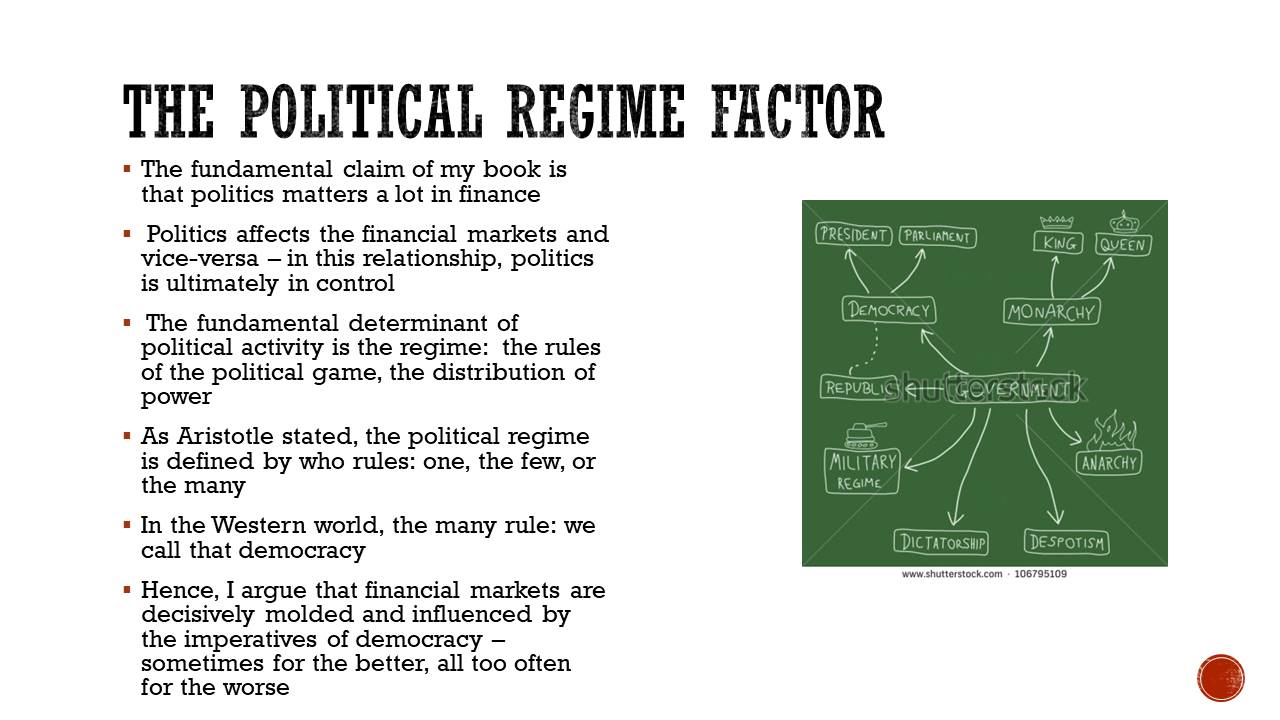
BRAGUES: Sure. The key thing I wanted to get across in my book is the importance of politics for understanding the financial markets. This is something that gets often missed in your typical courses that are taught at the MBA and also the undergraduate level. When a student takes a course in investment finance or financial economics, they don’t get exposed a lot to the political factors that drive prices, that drive trends, that drive decisions of monetary policy and interest rates, as was made abundantly clear with the 2008 financial crisis. Though one could have seen evidence of the role of politics in finance earlier than that, but it became much more obvious after 2008. This is definitely a gap in the way financial markets are taught to students, and the way they’re discussed by economists in general. The book is designed to address the flaw that the economics professor tends to be the only one that studies the financial markets. The dominate it, they practically hold the monopoly in it, and other disciplines, specifically politics, need to be part of the mix.
(click to expand)

As the title suggests, it’s not just politics per say, or politics in general that needs to be considered, but the regime. The regime is defined as the fundamental rules of the political game. This is actually a term that comes from the Ancient Greek philosopher Aristotle. He wrote a book – still very well known, still discussed among political philosophers – called The Politics and he distinguishes regimes into three types. He distinguishes it by who rules: if you want to know what a political system is like, you ask yourself who’s running the show, who’s making the decisions. Three basic different types of regimes that are possible: ruled by the one, which we would call autocracy or sometimes monarchy or dictatorship; there’s ruled by the few, which we would call aristocracy or sometimes oligarchy; and then there’s ruled by many. Democracy would be the example of that.

Financial markets around the world today, with only a few exceptions – China primarily among them – most of the major financial markets today are operating within democratic political contexts. The argument I make in the book is that democracy, because of the political incentives that it imposes on politicians because the values – the types of norms and morality a democracy has, these two factors, the value system and political incentives, what politicians need to do to get elected in a democracy – these fundamentally structure the nature of the financial markets. They don’t do it necessarily on a daily basis, you can’t day trade on this information or even swing trade on this information, but it definitely will illuminate anybody who’s involved in investing on the financial markets to help them better understand the force that drive prices over the long haul.

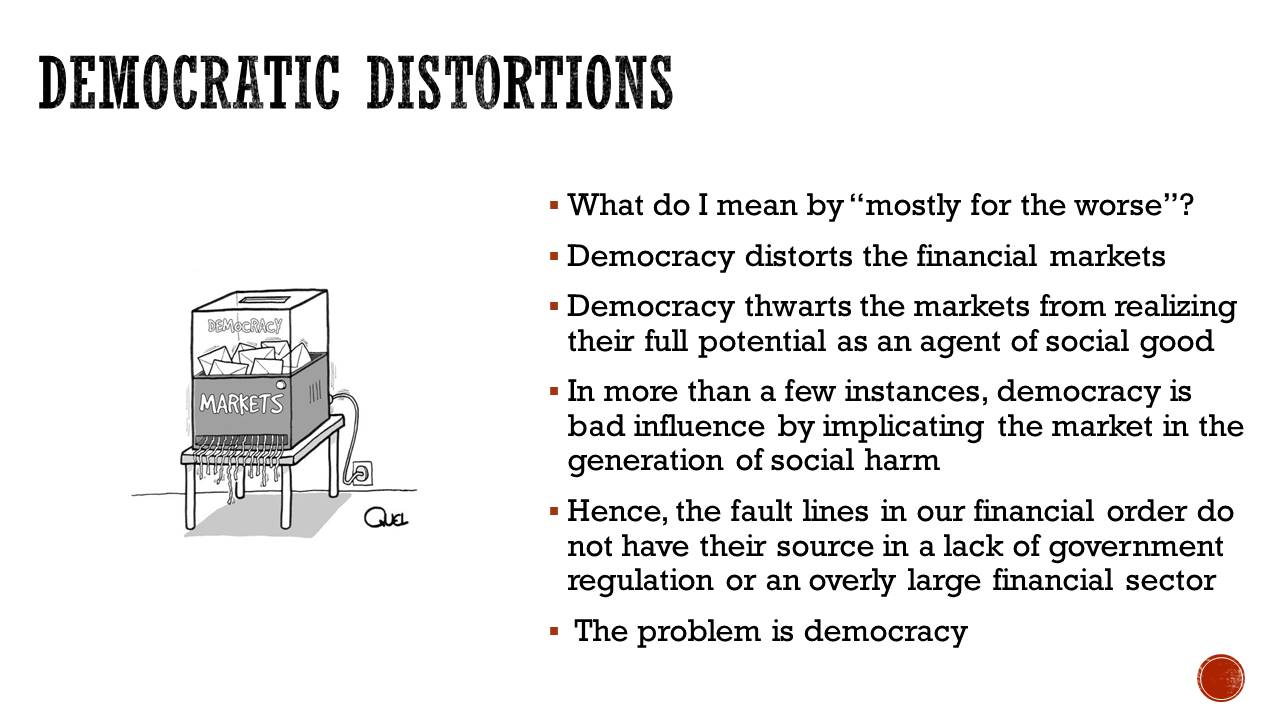
So my thesis is that democracy, while probably the best political system relative to the alternatives, despite it being the best of the available alternatives, it does create problems in the financial markets, it does distort the ability of the financial markets to do social good, and so a lot of the problems that we have are because of the fact that the markets are operating in a democracy.
(click to expand)

FRA: How does that happen? How does democracy distort the financial markets? Could you give some specific examples?

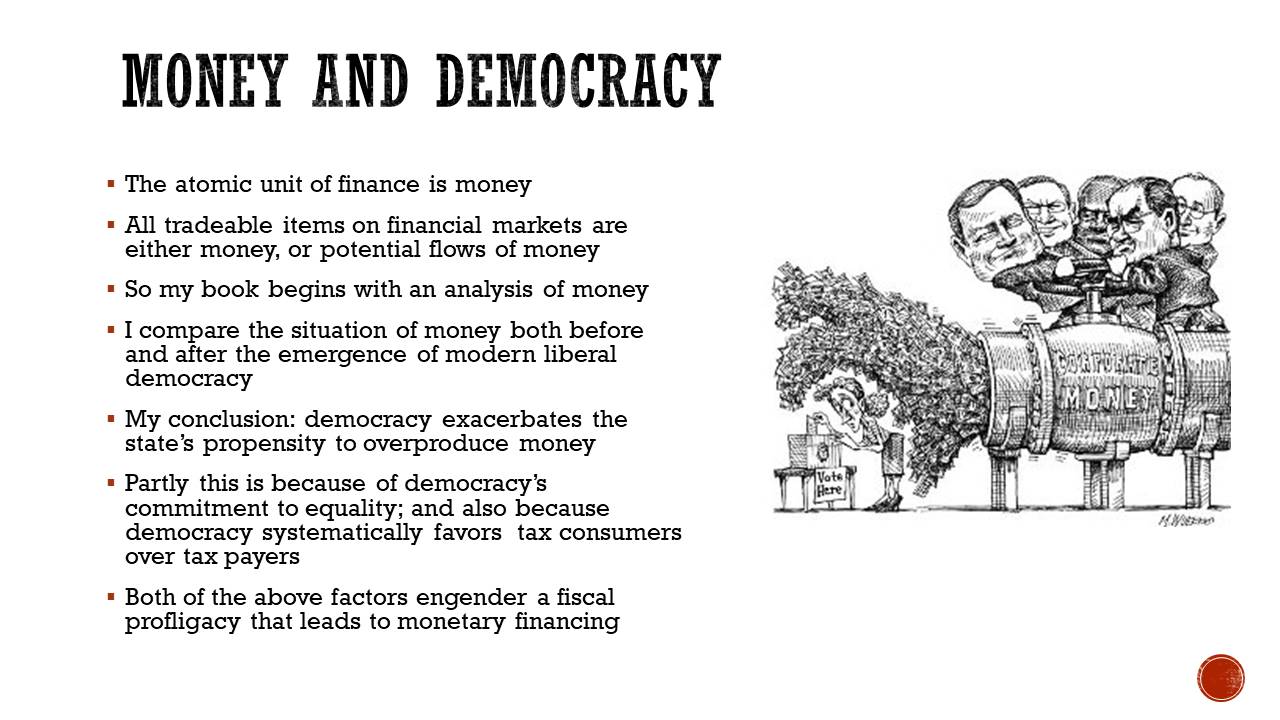
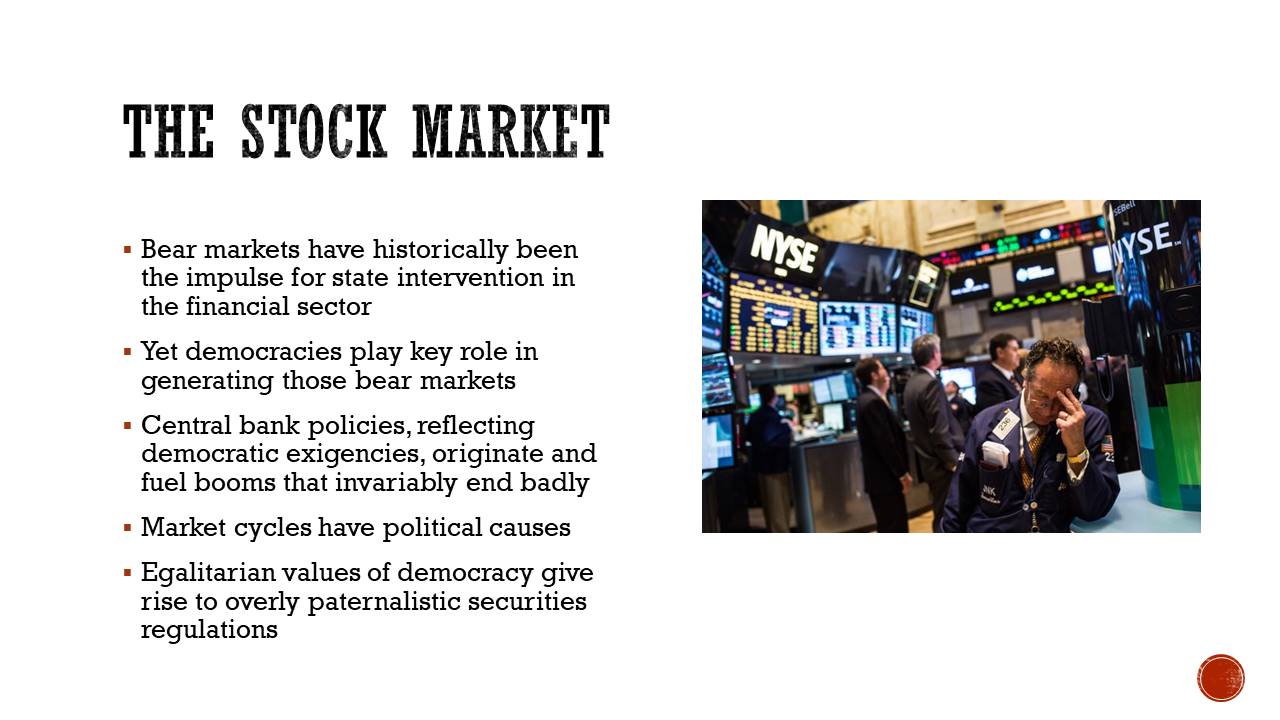
BRAGUES: The big example that I discuss in the book is the money supply. The main argument that I make is that democracies tend to oversupply money into the economy, and that has an impact on the financial system. I distinguish two factors that drive democracy’s overproduction of money, this excess liquidity. One factor is this class conflict between taxpayers and tax consumers. This notion of a class conflict between taxpayers and tax consumers is a notion within Austrian economics and it is meant to replace the Marxist view that the fundamental class divide in society is between bourgeoisie, the capitalists who own property, and the labour working classes who don’t own property. The Austrian view is that the main class division is between those who on net pay more taxes than they receive in services from the government – this group would be the taxpayers – and the tax consumers are those who on net receive more from the government than they pay. In terms of what a tax consumer can receive, this can range to anything from unemployment insurance payments, social assistance payments, favors provided by the government in terms of inhibiting competitors in your industry. The argument is that in a democracy, if a politician wants to get elected, the name of the game is to get 50%+1. Given that the distribution of the income in modern commercial societies tends to be such that there’s a few rich and wealth tend to be a small segment of the population, and the middle class and lower classes tend to be the majority, the best way to get elected is to offer mostly the middle class all sorts of public goods in terms of social programs and so forth, and then have those financed by the well-to-do who would function as the taxpaying class. That way you get your majority and get elected.

(click to expand)

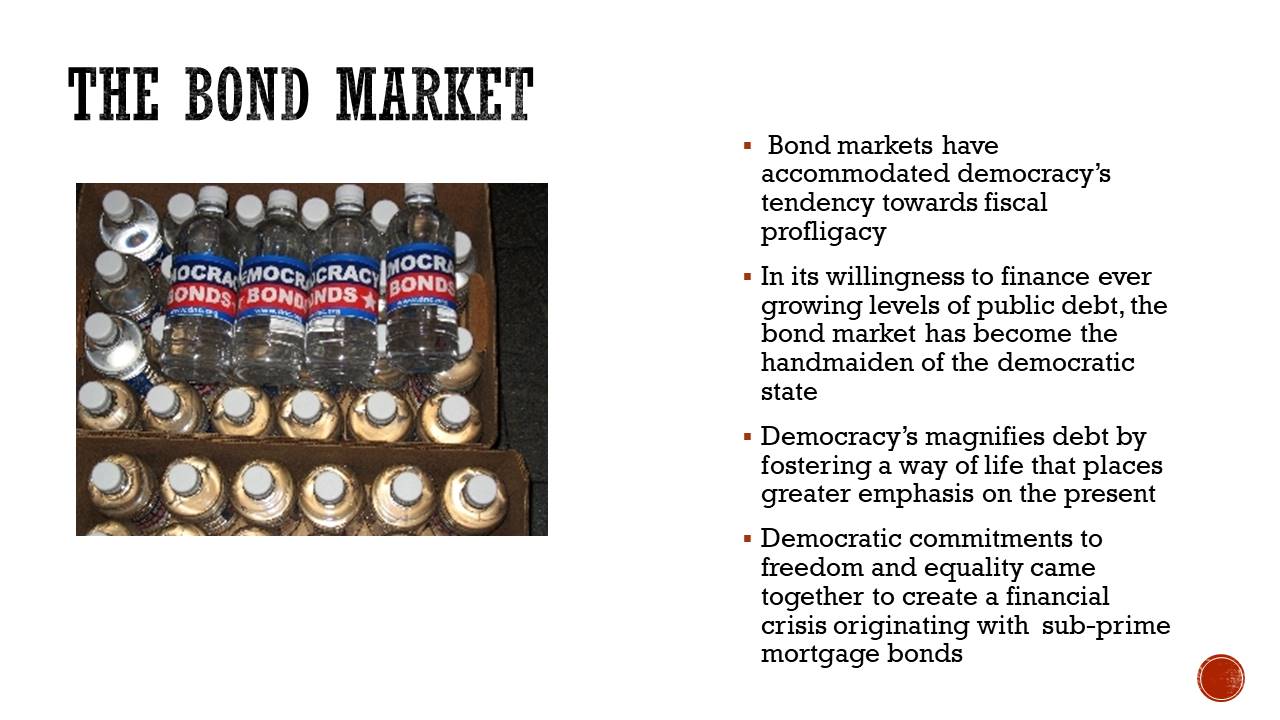
All politicians, whether the left or the right, both sides of the political spectrum do this. Perhaps the left does this with a bit more conviction guiding their efforts, but on both sides of the political spectrum this happens. So politicians engage in this bidding war every time election time comes, trying to offer the majority all these goodies with the idea that they don’t have to pay for it, someone else will. What ends up happening, I argue in the books, is that after a while of this bidding war where politicians offer more and more public goods, someone has to finance this. Eventually you run out of taxpayers or you run into taxpayer resistance. At that point politicians then resort to the bond market and the bond market has proven historically quite eager to lend funds to the government. Government bonds are very attractive investments for a lot of folks because of the safety. This is money that’s backed up by the power of the state, unlike corporate bonds which are not. Corporate bonds are only paid ultimately if the corporation is successful at attracting people to voluntarily buy their goods and services.

I argue in the book that we now have a kind of financial market-government complex, or a bond market-government complex. The bond market has emerged as a kind of handmaiden to the welfare state, this growth of government. At a certain point, even the bond market will say ‘we can’t lend more’ and at that point politicians will appeal to the money press and they will enlist the central bank to print money, essentially, though it’s more complex how liquidity is injected into the economy, but that’s basically what happens. So essentially democracy leads to fiscal profligacy, too much spent relative to the revenues politicians are willing to collect from people. They then have to go to the bond market; public debt rises. And then to increase their options of financing this deficit that is inherent to democracy, they require control over the monetary supply. My argument in the book is that the gold standard, which existed for a good part of the 20th century in one form in another, which ultimately ended in the early 1970s – August 1971 if you want to get exact – that was in a way written in the DNA of democracy; that democracy ultimately is intentioned with a monetary constraint like the gold standard. That’s one of the ways I make this argument that democracies do damage to the financial markets.

(click to expand)

FRA: It sounds like the endgame is either a no bid situation in the bond market, or as you mentioned they could go to the printing presses. The other endgame is the loss of purchasing power in the currency. Either way, I guess that’s likely to be the only way to stop the politicians’ continuous profligate spending.

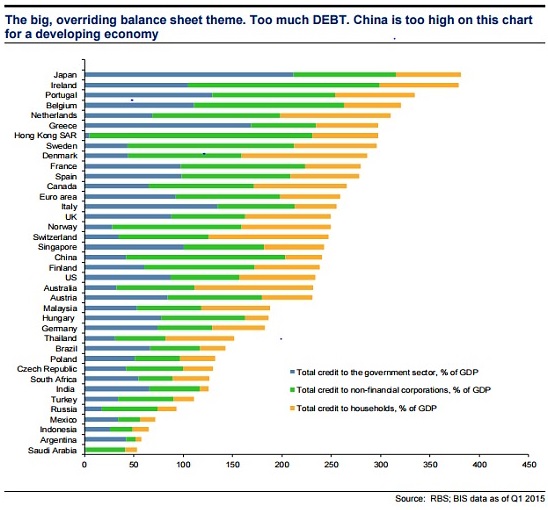
BRAGUES: Either the bond market has to say no, and historically as mentioned before they’re not very good at saying that. In the book I discuss the historical record of the bond market’s ability to keep governments to account. I remember in the past, I think he’s still around, Ed Yardeni coined the term ‘the bond vigilante’, which was a popular term in the 1990s. The bond vigilante is this creature that’s supposedly watching over governments, closely scrutinizing budgets and if they see any sign that they’re letting public debt out of control these bond vigilantes then start selling off the bonds of the country that’s engaging in this poor fiscal policy. The record, especially with developing economies, is that bond markets only react to excessive public debt very late in the game, when it’s become quite obvious and traders seem very eager to provide money to governments who are spending above their means while the debt is building up. And only when a certain threshold is hit – it’s really hard to find that threshold, Kenneth Rogoff wrote a book a few years ago when he went through the history of it and said, well if it’s a developing country it appears to be about 60% of GDP, that’s when the bond vigilantes come out; developed countries tend to have more tolerance. Even that threshold doesn’t seem to have held, because we now have countries – Japan principally among them – they’re well above 100% GDP and there’s no sign bond markets are growing less willing to finance their debts. The bond markets will have to have a shift in how they approach their investments into bonds.
(click to expand)

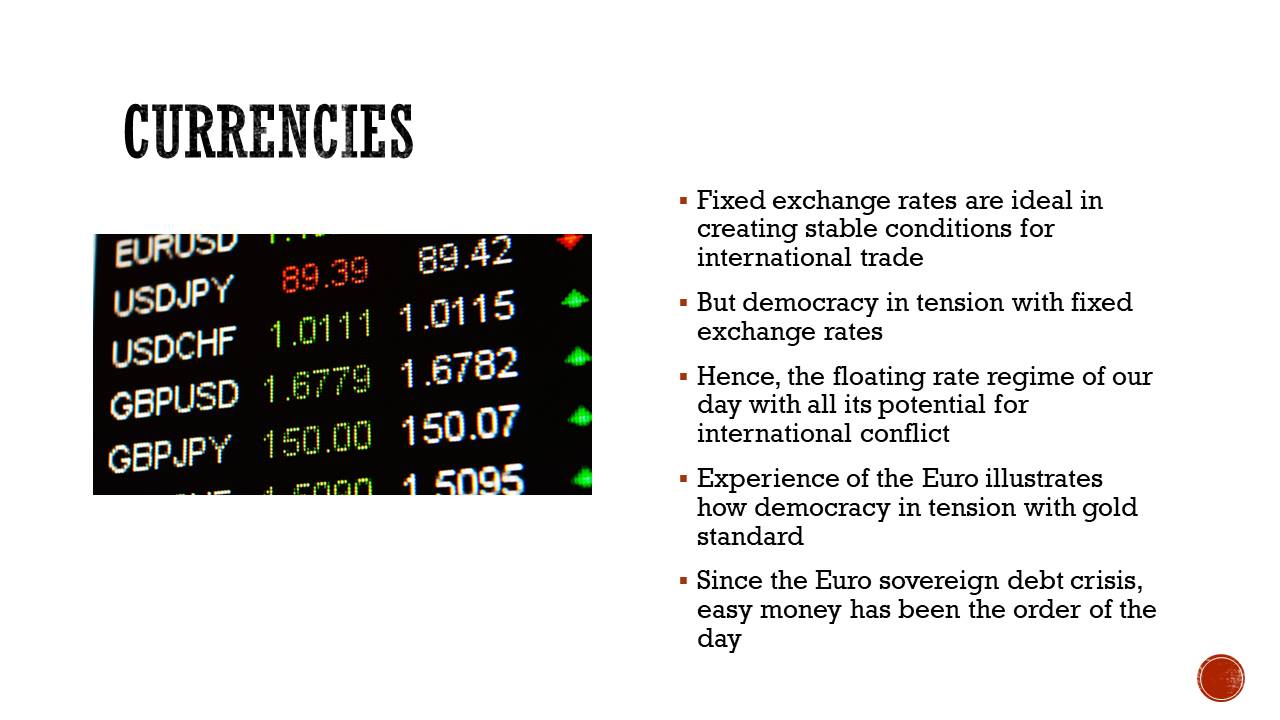
The other constraint would be the gold standard, but as I talked about in the book, I don’t totally foreclose the return of the gold standard. I agree that we should try to do as much as possible to bring that back, but democratic politicians don’t want to have the constraints posed by a gold standard because it makes their lives difficult. It means they have to say no to people, it means they can’t win elections by simply promising all sorts of goodies. It’s no surprise to me that the gold standard ultimately disappeared as democracy progressed.

FRA: You’ve included a number of slides, including one slide with a quote from James Grant, editor of Grant’s Interest Rate Observer where he highlights that you not only diagnosed the problem but also proscribed a solution to the problem. As you mentioned on the gold standard, what you’re saying is while not likely to happen, or not likely to come about, you do identify the solution. What is more the endgame: no bid in the bond market or gradual loss of purchasing power in the currency?

(click to expand)

BRAGUES: I would probably say the latter. Especially with the next 20-40 years or so, you have an aging demographic, a greater proportion of people who are older and they will seek safety, and I think that keeps up the bid in the bond market. I would say we have very slow decrease in purchasing power.

The thing is, in part of 1954 inflation was practically nonexistent. You’d have inflation only in certain periods, usually after a war, after substantive crisis, when the government is compelled to appeal to the monetary press to finance conflict. If you look at the data from early 19th century to 1945, I think in Britain for example there was really no change in purchasing power. The Pound was worth around the same in the early 19th century as it was going into the early 20th century. But that’s all changed since 1945. We now live with a situation which we think is normal, but which from a grander scheme of things is not, and people in democracy seems to be willing to live with an inflation rate of around 2% a year. I think governments are going to try to keep that going and if necessary, perhaps tolerate a somewhat higher rate – 3,4,5%. Some economists have talked about that, tolerating a different rate for inflation rate. I think all the incentives are for politicians to continue to take advantage of the bond markets’ generosity, if you want to use that term, and try to finance this via the inflation tax at the highest level of tax that is possible without incurring significant public protest.

FRA: I think we’ve seen figures of if you have inflation at 4% a year for 10 years, it can reduce the burden of debt by one half, something like that.

BRAGUES: Yeah. If you look at history, when we look at how the debt after WWII was dealt with, it was a form of financial repression that took place, where the inflation rate was held higher than the rates that most people be able to gain on deposit. I think they’ll try to appeal to that strategy again.
(click to expand)

FRA: Yeah, very likely. Just switching gears slightly, we’ve talked about the Austrian school of economics and you’ve also provide a set of slides on the investment potential of Austrian economics in investing. Just wondering if you can give some highlights of those slides and how you see the Austrian school of economics compared to the Keynesian school of economics.

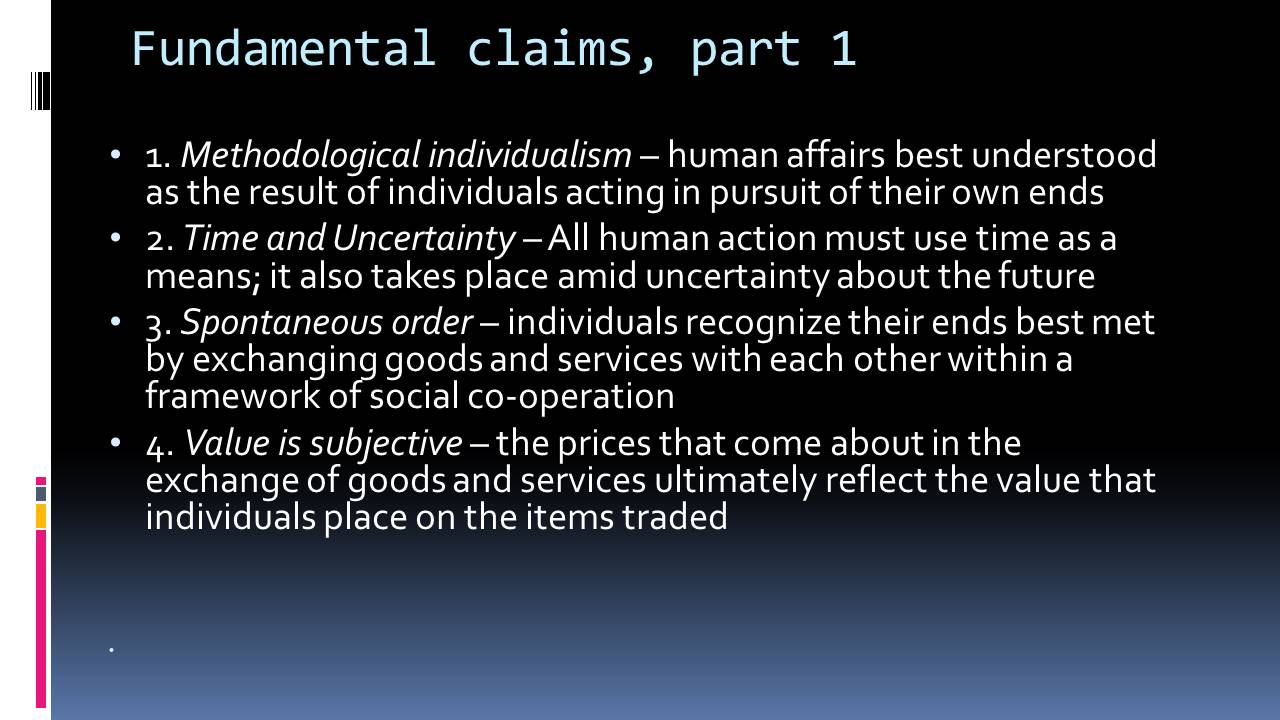
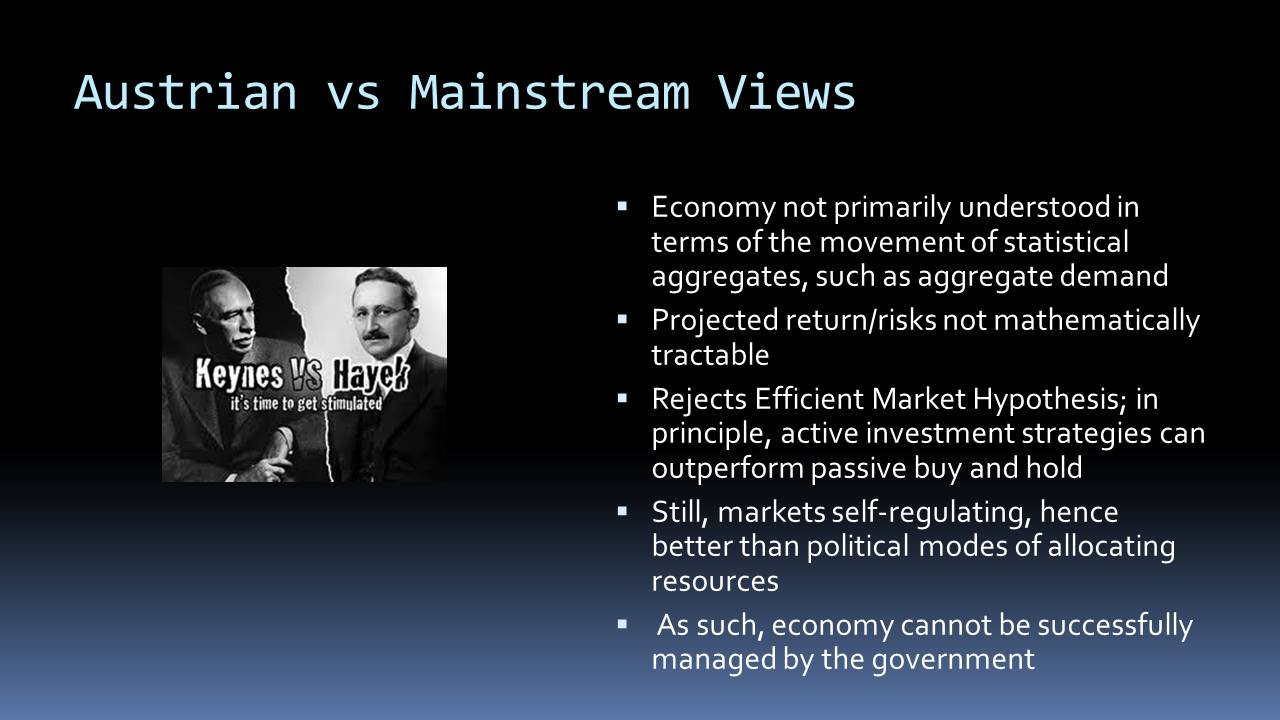
BRAUGES: In terms of Austrian investing, I think it’s a promising approach. In order to succeed in investing, you do need to have an approach that is different from other people because if you’re just doing what everyone else does you’re just going to get at best the average rate of return. You’ll get the same rate of return that you might, say, if passed an investing vehicle like an index fund minus the cost of running your investment, the commissions and so on. Because most people in the financial markets are essentially Keynesians – they may not be conscious fully of their beholden to Keynesian principles, but anyone who follows the markets on a regular basis, specifically on issues of how the Federal Reserve or ECB is expected to react to certain data points, it’s clear that when you see a lot of these analysts get quoted in the Wall Street Journal or the Globe and Mail and so on, that they effectively are operating with a Keynesian worldview. In terms of having a unique point of view that can offer above average returns, I think Austrian economics offers something certainly worth looking at.

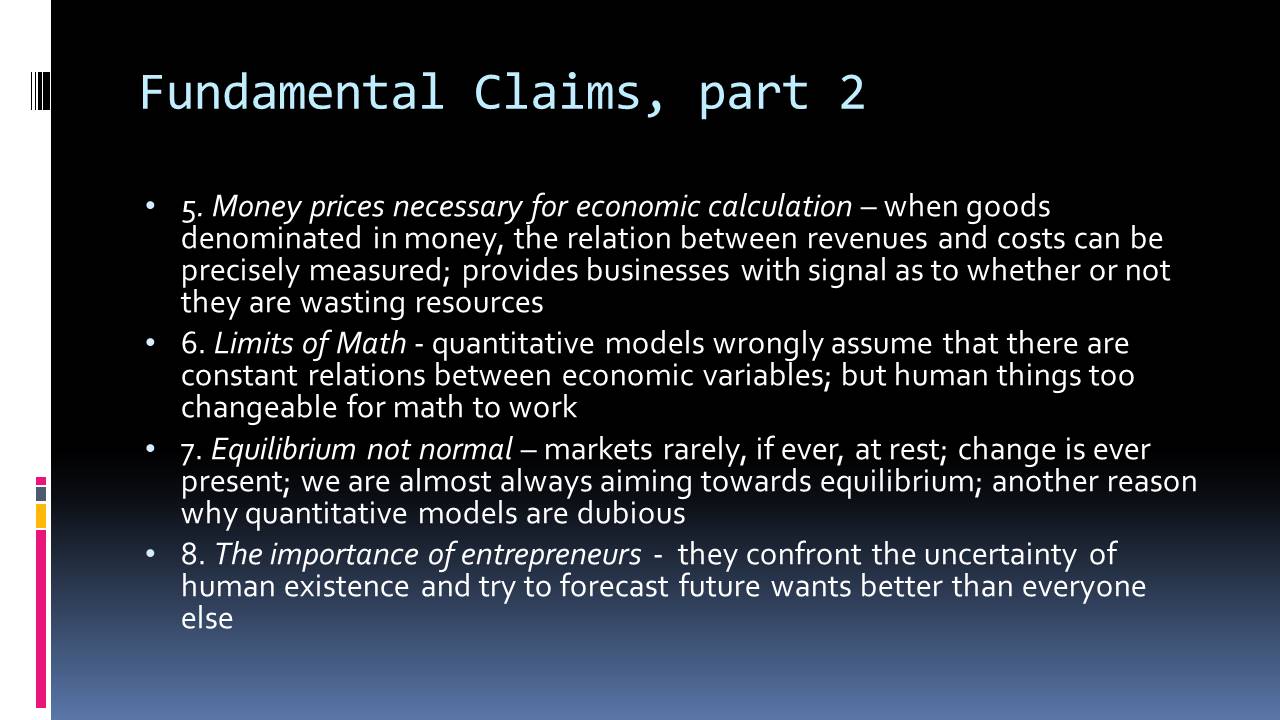
In terms of what it boils down to, I’m the first one to admit there’s not set Austrian approach. You can have five Austrians in a room and they’ll have five different approaches, although they’ll come from a common base, that common base being the commitment to certain Austrian economic principles. I say the two biggest ones that are relevant in terms of investing are A: the rejection of the efficient markets hypothesis, which is very common in the academic treatment of finance even though it’s losing some of its support to another field called behavioural finance, which argues that psychology needs to be considered in understanding how markets move. Efficient markets hypothesis still looms large, especially in academia, and it argues that in any point in time prices reflect all available information so that everything that is known or can be known is already in the price. So there’s no point doing any sort of analysis to try and beat the market if you believe in this theory because everyone else has already  looked at the financial statements, they’ve already considered the company’s strategy, already looked at the technicals and moving averages and trend lines and all that, it’s already in the price.
(click to expand)

The Austrian view rejects EMH and it’s because of its theory of entrepreneurship. Austrians are very big on the notion that what drives economic activity and specifically economic growth is the activity of entrepreneurs. What entrepreneurs do is they find arbitrage opportunities; they find profit potential that other people aren’t seeing. We can transplant the entrepreneurial function to the financial markets and say that there are similar arbitrage opportunities, similar opportunities that people aren’t seeing, that with good analysis and some work can be grasped. That’s point number one that differentiates the Austrian approach from more mainstream approaches that are taught in academia.

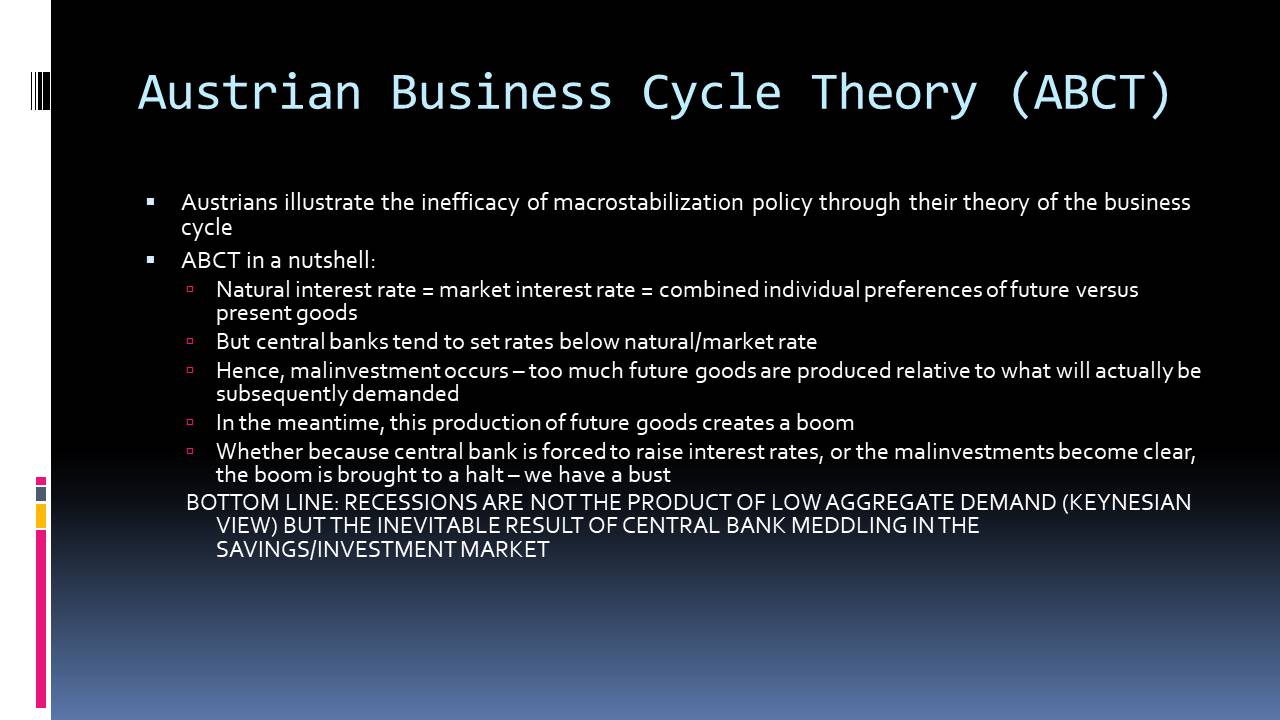
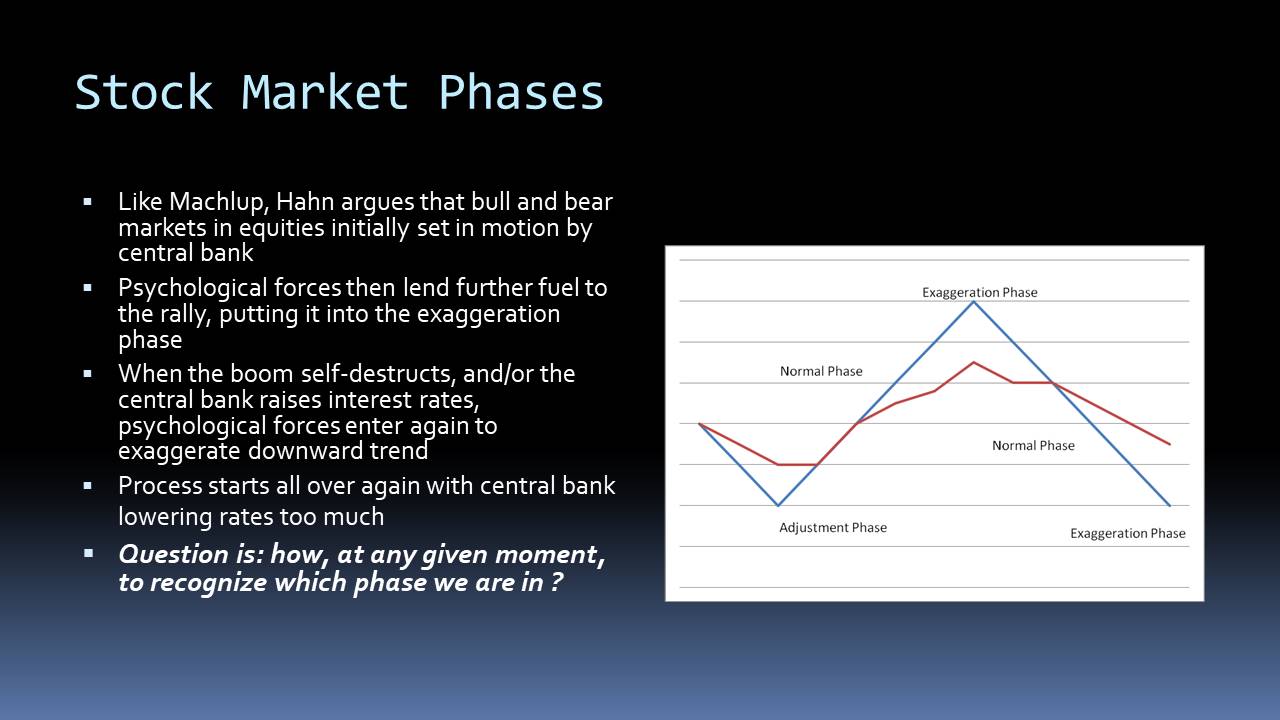
The second component that differentiates the Austrian approach from academic and certainly Keynesian approach, which tends to be dominant among financial market practitioners, is the notion of Austrian Business Cycle Theory (ABCT). This is the argument that central banks, through their policies in terms of money supply and interest rates, artificially induce booms and busts. Booms and busts are not on the Austrian view as simply sort of random events, facts of life of capitalism, or caused as some of the old Keynesians would argue by a lack of aggregate demand. They would argue that the reason we have bull markets and bear markets is large in part because of the actions of central banks. They would argue that central banks have a tendency to run overly loose monetary policies because all of the political incentives are there for that and reinforces that. What happens is that they tend to set the interest rate below what’s called the natural rate. The natural rate would be the rate that the market would set if the interest rate market were free, which it is not when you have a big central bank regularly intervening in the money markets. The argument is that when interest rates go below the natural rate, whenever they’re below what the market would dictate, it gives false signals to investors that future goods, goods with long term – real estate would be the classic example here, but also technology stocks, anything where the payoff is way in the future – those kinds of companies, companies that engage in those products, tend to get overbid. Too much investment tends to flow there and the Austrian view is that this will initially sustain a boom, especially in these areas of the economy, but then at some point one of two things or a combination of both happens: either people realize these investments are not going to work out, that the demand isn’t going to be there, that these future goods everyone’s producing for there isn’t going to be sufficient demand for them so you get a shakeout in that industry. Or two, the central bank decides to tighten monetary policy cause they can sense that things are getting a little too frothy, or a combination of the two. Then you have the bust and the market goes down. The idea is then the central banks will come in while the bust is taking place, aggressively lower interest rates to try to revive things, and the whole cycle starts over again. That’s probably the most important component to the Austrian approach of investment, this acknowledgement that central banks are the ones ultimately behind the longer term ups and downs of the market.
(click to expand)

FRA: In terms of other indicators or other aspects of the Austrian school that could help investing, you mentioned a few here like the Q ratio from Mark Spitznagel?

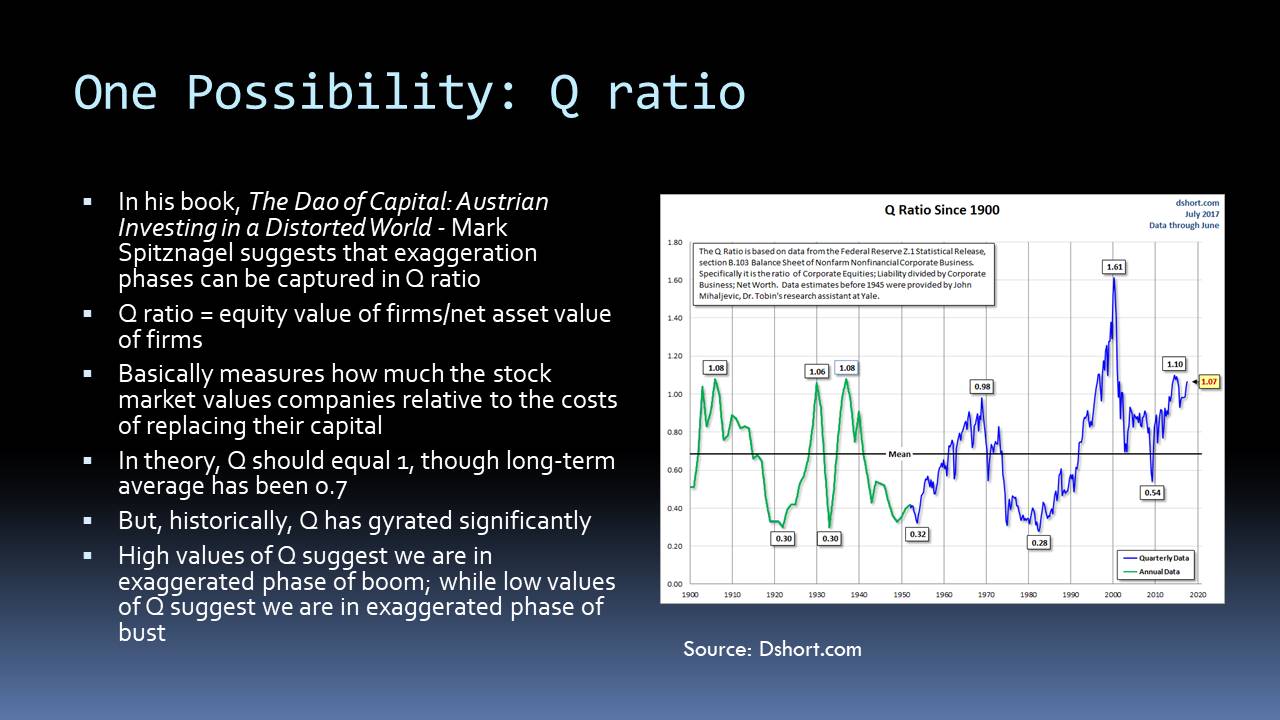
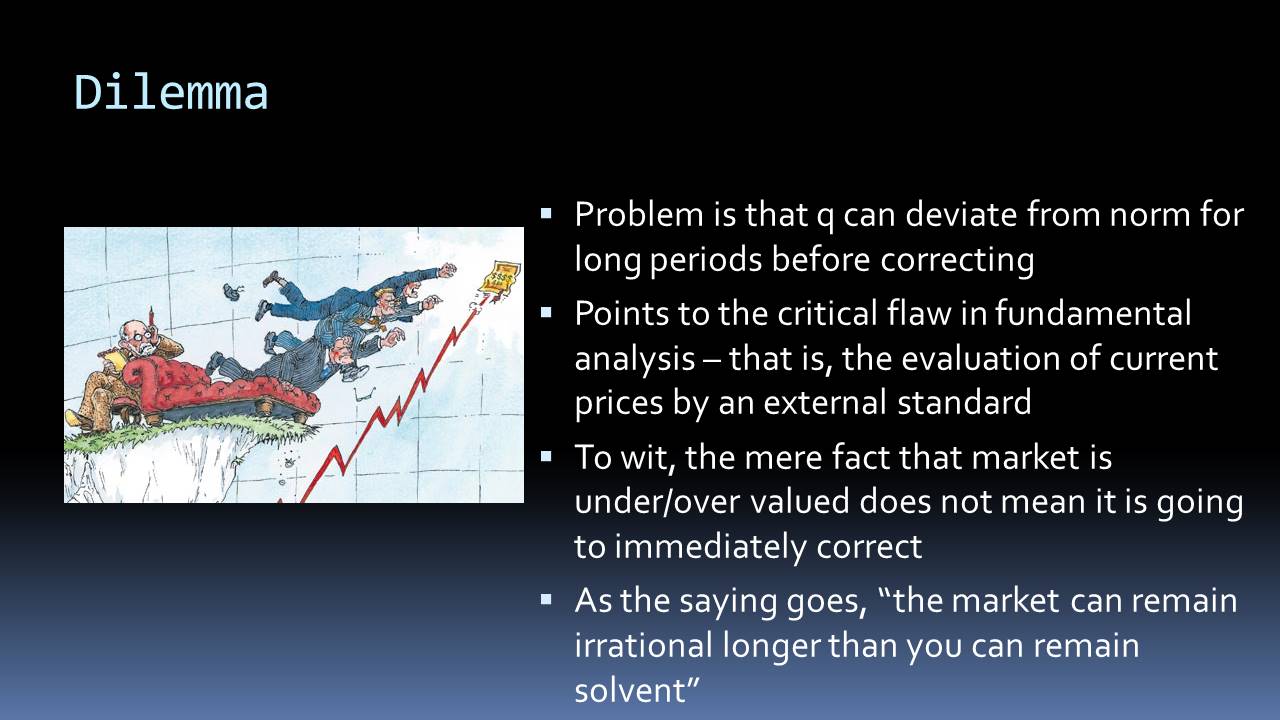
BRAGUES: Because the Austrian school recognizes there are going to be different phases of the stock market where things either get overvalued or undervalued, then the question arises, how do you recognize when we’re in a phase when things are overvalued and where things are undervalued? One approach has been put forward, by Spitznagel as you pointed out – his book is called The Tao of Investing – and he argues that we look at the Q ratio. The Q ratio goes back to James Tobin, a Keynesian economist. Tobin’s Q ratio is based on the numerator being the market value of companies, roughly stock market capitalization, divided by their real asset value, measured by the replacement cost of the assets of the firm. So basically you’re looking at the Q ratio measures how much it would cost to buy all the companies on, say, the S&P500, and you take that number and divide it by what would it cost me if I were to replace all the assets, going out into the real asset market and trying to replace all the assets that are on the balance sheets of S&P500 companies. In theory, it should be 1. That is to say, the market should be valuing the assets at the replacement value. That way you get avoid an arbitrage opportunity. In theory if the market value is higher than the replacement, you can sell stocks and buy the assets. Conversely, if the market value is below the asset value you can buy shares and sell the assets. Historically that ratio has been around 0.7, so Spitznagel suggests we use that as the anchor. If you’re about 0.7, that is suggestive of an overvalued market, and if you’re under 0.7 that would suggest an undervalued market.

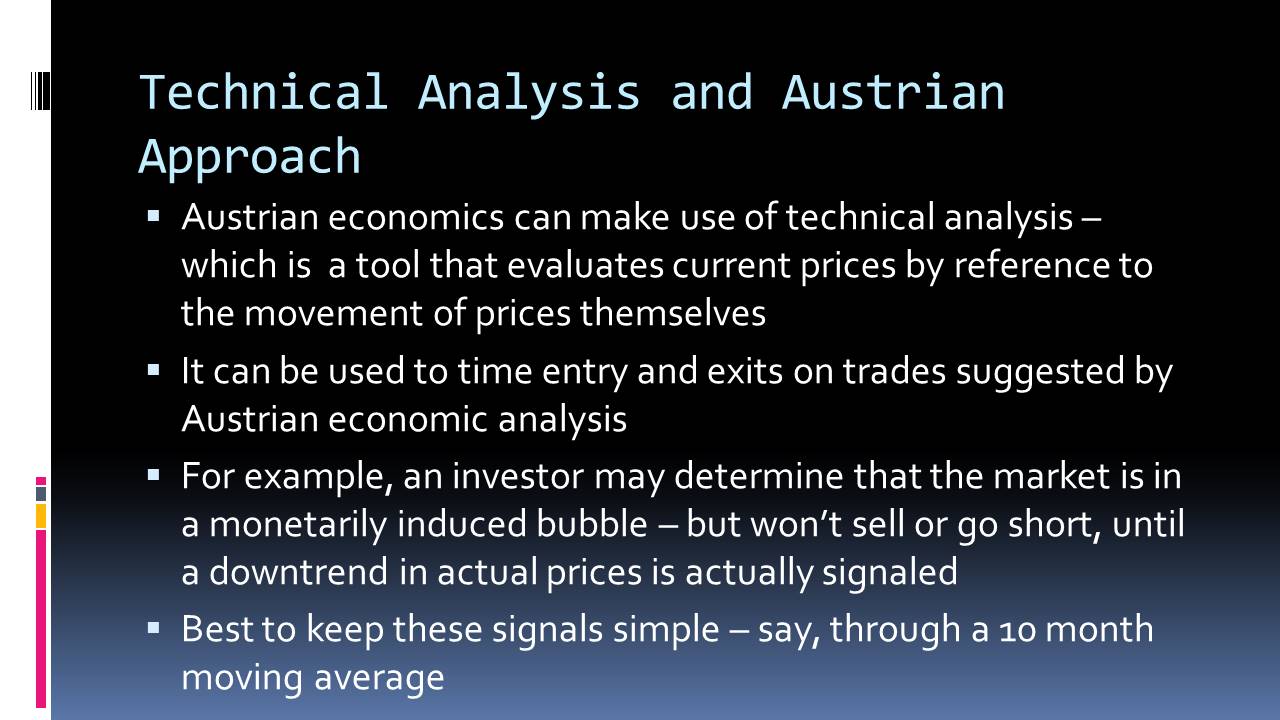
Currently I looked at that ratio today and it’s 1.07. It’s not the highest that it’s been historically; it’s been as high as 1.78 in the early 2000s at the height of the Dot Com boom. Currently at the 1.07 level it’s at similar highs at other turning points if we just take the early 2000s out of the picture. If we look at early ‘70s was another high, another high was just before 1929. If you look at the Q ratio that is suggestive that we may be at a key inflection point here. My only concern with the Q ratio, just like I would have any concern with any other fundamental type of metric, whether it’s P ratio or price-to-sales ratio or peg ratio, is that they can show for a long time that an asset is overvalued or undervalued, and if you were to take a position in accordance with that signal it could take a long time for it to actually go in the predicted direction. It’s a notorious problem with these kinds of signals, so I suggest that Austrians can apply technical analysis and the approach here would be you use some sort of long term moving average – this would be just one technique among several that you could use to gauge the long term trend – and you take advantage of the trend and you wait until the trend is broken. If you’re using, say, a 10 month moving average then you wait for the index – here the S&P500 – to close below that average at the end of the month and that would be your signal that, okay, it’s a frothy market but other people are recognizing it, it’s not me with my Austrian analysis and now that the market seems to be coming to realize what’s going on I will get out. And conversely when things are looking undervalued. So an Austrian analysis could tell you things are looking undervalued now, the bust has perhaps gotten a little too far, people have gotten a little too fearful, a little too anxious, but you wouldn’t immediately go in. You would wait until the market went about the 10 month moving average.
(click to expand)

I would argue this would avoid the problem of using something like the Q ratio or some sort of P/E ratio. You could also use the 10 year P/E ratio, which is like Shiller’s – Robert Shiller has that indicator – that you allow the market to tell you when the trend is over, when the frothiness is really done. I’ve done some back-testing on; it seems to work fairly well. There’s also a number of people out there that follow this method, but most people follow the method of just look at the moving average; they don’t come to it with an Austrian understanding of where the market is temperamentally, as it were – whether it’s undervalued or overvalued, just looking at pure trend.

FRA: Another aspect of the Austrian school would be the focus on stores of value. You mentioned you have a slide here about gold, if you want to talk to that a bit in terms of how that can play into a store of value.

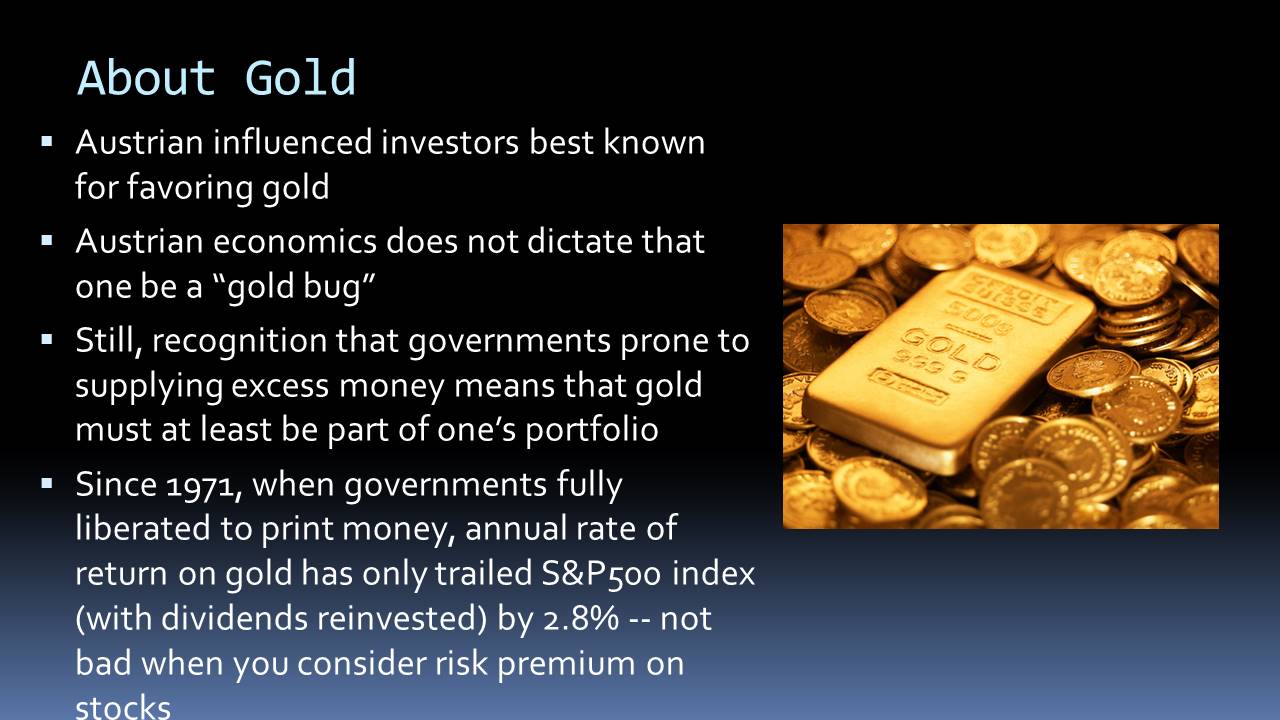
BRAGUES: Sure. One thing that Austrians can sometimes fall into the trap of is becoming excessively pessimistic. There are good reasons to be excessively pessimistic when one considers the fiscal state of our governments, and that what central banks have been doing to finance that fiscal profligacy. The reality is that markets seem to do different things that what some Austrians who are really negative would predict. Spitznagel makes this point in his book as well, that Austrians need to be careful of getting a little too pessimistic. That might translate into going into 100% gold; I would not be in favor of that going into 100% gold position. I do believe that it is a good store of value, to use your phrase, and at least some portion of one’s portfolio should be in gold for several reasons:

We really don’t know how this whole thing is going to play out in terms of these highly indebted states and central bank excess liquidity that’s been provided, so we’re not sure how that’s going to play out. It could play out very ugly; my Austrian friends are among those that are very negative and they may turn out to be correct. You want to have a position in your portfolio where you profit from that, or you protect yourself from that. Also two, if as I expect, we’re going to have this continuous slow reduction in purchasing power, whether it’s 2%, 3%, 4%, whatever it is, that does have a long term impact. That does compound and gold has proven able, when looked at form a longer term trajectory, to preserve your purchasing power against that.
(click to expand)

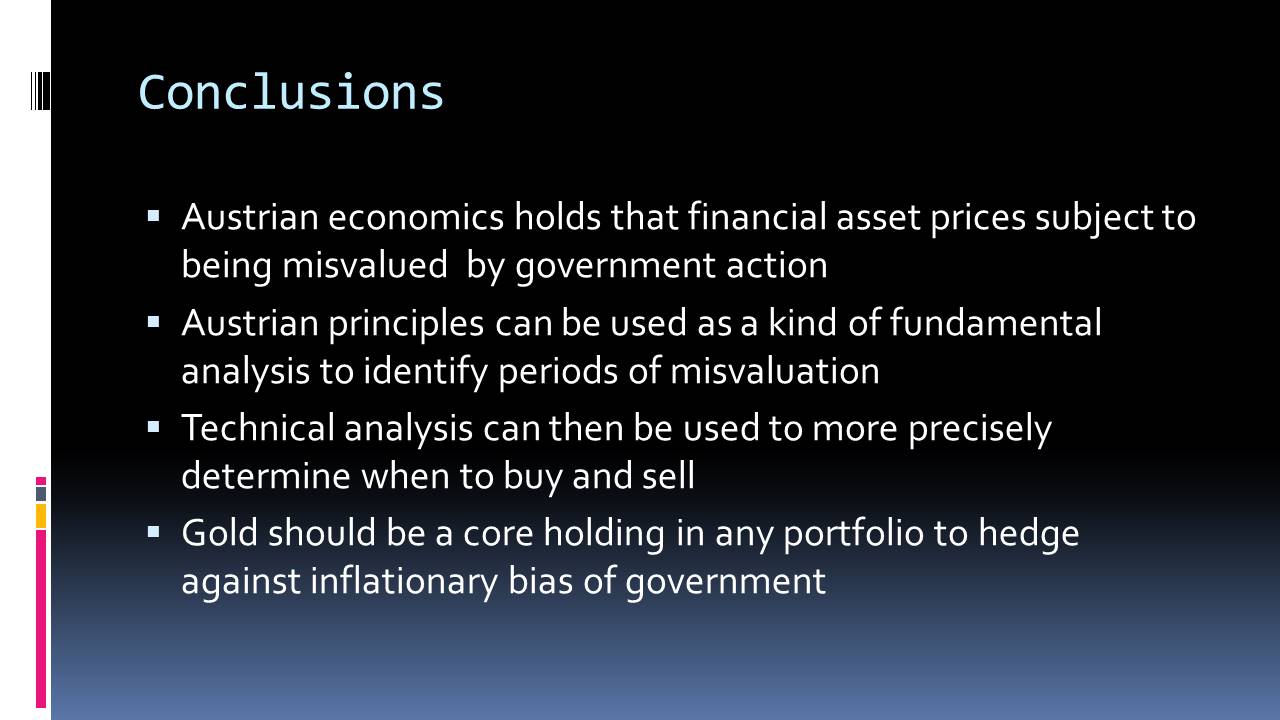
I just did this calculation today, but if you look at the returns of the S&P500 index, total returns assuming you invest all your dividends? From 1971 when the gold standard ended and you compare it to gold, I think there’s only about a—If you put your money in the S&P500 and invested your funds when the gold standard was abandoned in August 1971, you would have made about 10.38% a year, just over 10%. If you had just put it in gold, you would have been at 7.58%. So you’re only looking at about just under 3% differential. That’s not bad. Gold is… You’re not risking your money and businesses, when you invest in gold you really can’t expect that you’re going to earn a risk premium that a firm would typically be expected to earn for assuming risk in the marketplace and offering goods and services. There’d only be about 3% behind, and this is from the current day when gold is relatively low and well off its highs from 2011 and the S&P500 is at near all-time highs. Right now this calculation is very much favoring the S&P500 but over time gold doesn’t do too badly, even though things right now might not look too great in terms of its performance vis a vis the S&P500 index. But looked at it from a longer term? It does trail, but you’d expect that because the S&P500 is a different kind of investment; you’re investing in companies and there’s a risk there. You should be compensated for that.

From a crisis protection point of view, and also from a protection from this continuous reduction in purchasing power, I think that argues for some proportion of portfolio being in gold.

FRA: Excellent comments, excellent view. I guess to close out, if we take the Austrian school of economics and the basic messages and themes of your book on money markets and democracy, how do you see the situation today in terms of perhaps the millennial generation? Where they’re going, where they’re leading politics with respect to economics, finance? What are the millennial views and perspectives on the economy and financial markets currently? How are these views being formed by political, financial, and economic trends?

BRAGUES: The millennials… That’s a pretty slippery term to define; we’ll go with 18-29 year olds. This has been a talking point for the last year or so and it’s certainly became a major point of discussion with the success of the Bernie Sanders campaign – they didn’t win the nomination, he didn’t win that, but he certainly put forward quite a battle to Hilary Clinton. There was a survey done by Harvard University, it came out just over a year ago, which showed that millennials in the United States – so these are young people from 18 to 29 – for the first time since they’ve been doing surveys, that a majority of them no longer supported capitalism. The number was actually 51% no longer supported capitalism, 42% still supported capitalism – I’m not exactly sure with the remainder, I’m assuming they were undecided. Certainly with Bernie Sanders, who is a self-professed socialist or social democratic or ‘democratic socialist’ as he put it, certainly this played out politically. This is a concern though we shouldn’t make too much of it, but it is definitely a concern. I think the reason why we should not overplay it is that traditionally young people have veered more toward the left. If you look at voting patterns, for example Britain, the likelihood of someone who is young voting Conservative – I’m not saying the Conservative Party in Britain are perfect pro-capitalists or pro-markets, but they’re more likely to be pro-market than the Labour Party on the left on the political spectrum. Going back to the end of WWII, younger people were much more likely to vote for Labour or for some other party on the left than for the Conservative Party. As people get older, they tend to veer conservative. There’s this saying that if you’re not Liberal before leaning left when you’re under 30, you have no heart, but if you’re still Liberal after 30 you have no head. It nicely captures out how age affects political and ideological affiliations.

When we consider that, that means we should moderate some of our concern, but it’s still a concern. The question arises, why? I think there are a number of reasons: one is they’re just young, they’re more moved by their passions, morality is very much implicated with their passions or moral sensibilities and young people tend to be quite idealistic. When you look at capitalism, it – at least on the face of it, I wouldn’t say this is the definitive interpretation of it – it looks like it’s driven by selfishness or self-interest. If you’re idealistic that’s not a good motive to have, that’s not a good motive for society to be energized by. That, I think, is a factor that leads the young away from capitalism.

Another factor is just the educational system. Despite all the work that the Milton Friedmans and the Hayeks and the Miseses of the world – which is great work, great books, great arguments – all that effort still hasn’t made its way into the educational system where young minds are formed. I think too there’s certain factors of the way the human mind works against the proponents of capitalism and makes it more difficult for the pro-capitalist side to make its argument. The human mind is structured in such a way that we tend to favor the concrete over the distant, the specific over the vague. Whenever you make a case for capitalism you have to make arguments that are abstract, that tend to emphasize longer term benefits, things that are not immediately evident. That’s a problem that the opposite side, the side that the government is having a greater role in the economy, they don’t have that problem.

My favorite example is, let’s say you think there’s a problem with wages, that some people don’t make enough money. The free marketeer could tell you the story, well if you let wages be free eventually people will acquire skills, will have an incentive to do so, will invest in education or work harder to get promoted, and eventually they’ll get up the income scale. That’s sort of a more longer term view and it can be mentally grasped, but it’s a lot more clear and vivid if you could just tell people, or we could pass a law and we can set a minimum wage at x level where we think people are going to be less poor. And there’s the end of the story. There’s an easier story that the other side has to tell, and I think that plays into this situation with the millennials.

Transcript by: Annie Zhou <a2zhou@ryerson.ca>

LINK HERE to download the podcast

Disclaimer: The views or opinions expressed in this blog post may or may not be representative of the views or opinions of the Financial Repression Authority.


07/14/2017 - The Roundtable Insight: Yra Harris On How The ECB Is Increasing Its Balance Sheet To Create A Eurozone Bond – Will The ECB Buy German Equities?

FRA is joined by Yra Harris in a discussion on the effects and implications of Lael Brainard’s speech on both the US and Europe.

Yra Harris is a world-recognized Floor Trader and Floor Broker with over 40 years of experience in areas of commodities and futures trading, with broad expertise in currency markets. He has served as a member of the Board of the Chicago Mercantile Exchange (CME). He is a regular guest on Bloomberg and CNBC.

The FOMC’s Lael Brainard gave a speech that has potentially significant implications for the financial markets and monetary policy. Brainard and Yellen seem to be confidants, where the two of them share a lot of thoughts and provide strategic thinking for the Federal Reserve. The piece was dynamic because it laid out why the Fed may consider the necessity  of starting to shrink the balance sheet while halting further interest rate increases.

The implication is that they don’t want the Dollar going up, that they’re concerned about the recent flattening of the yield curves, and that they’re not in a hurry to raise interest rates because they’re worried that they’re not seeing the inflation impact that they would’ve liked to have seen. This really lays out, in a way we usually don’t get, what the inner sanctum of the Fed is thinking about.

Prior to this we were seeing the stock markets falling because of the view that Trump vulnerable, and then it stopped. This has a far greater impact because the market will love the fact that the Fed will stop raising the Fed Funds interest rate, and will actually move to shrinking the balance sheet. Even Brainard makes a statement that it’s more the short term interest rates that have a greater impact on currency movements. Cutting short term interest will hurt your currency, and raising short term rates will impact your currency favorably. For example, the Canadian Dollar is trading at 18-month highs and all that took was a 25 basis points increase to 75 basis points.

EFFECT ON EUROPE AND GERMANY

German equities may be bullish even though you’re getting various sell signals across various equities. In terms of relative value, Germany as a stock market has a better relative value. They’re not ridiculously overvalued on a historical basis, and it’s really the only place for German investors to park their money. Everyone on the planet wants to see Germany with massive tax cuts to generate more consumption and therefore reduce the current account and trade balances of Germany.

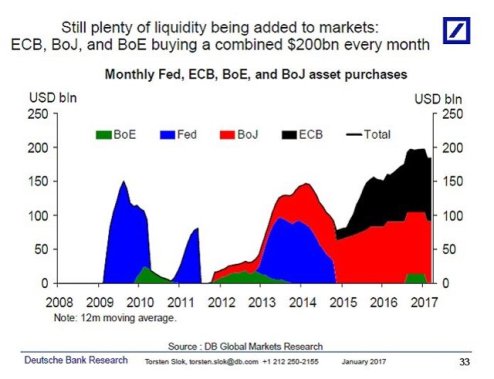
When you’ve got the ECB still buying, and the BoJ still captured by their own lunacy under Kuroda, still buying significant amounts of sovereign bonds on a monthly basis, it’s a good time to start shrinking your balance sheet – that’s where the Fed is now. If the Fed embarks on this, the market’s not going to be as gentle letting them out as they believe, and that’s with the other central banks buying. There’s going to be all sorts of repercussions on the long end of the market, but the Fed isn’t that concerned about it right now. They would love to see a steepening of the yield curve that would help the banks whether or not they raise rates on the short end.

What seems to be taking place is that Draghi is in a rush to build a balance sheet because they’re eventually going to create a Eurozone bond. If you’re going to buy $1B of assets, you have to do it according to everyone’s capital contribution to the ECB. You can’t violate that, but he’s been violating that because there’s politics involved. Italy’s in total violation of the Maastricht Agreement, with 134% debt to GDP ratio. Italy will never be able to outgrow what its financing needs are for its deficit. With all the issues of non-performing loans in the Italian banking system, of course Draghi is going to violate this. Under that rubric of ‘whatever it takes’, he’ll do whatever he needs to do. This could translate into the ECB buying German equities.

RECENT G20 MEETING

It really didn’t have much. They wanted to isolate Trump, and it’s not hard to do that, and they did it. When you’re portraying President Xi of China as a free trader, you’ve got a lot of problems. Europe is a free trader when it wants to be a free trader; France is notorious for tariffs and blocking trade. There’s absolutely nothing there.

The Japan-EU agreement won’t see the light of day in its present form. The biggest blocker will be the German auto-makers. There’s a lot of agricultural stuff that makes it into Japan, but the auto end of it is very interesting. So it’ll be a long, drawn-out process.

Abstract by: Annie Zhou <a2zhou@ryerson.ca>

LINK HERE to download or listen to the MP3 Podcast

Disclaimer: The views or opinions expressed in this blog post may or may not be representative of the views or opinions of the Financial Repression Authority.


07/01/2017 - The Roundtable Insight: Yra Harris, Ronald-Peter Stoeferle, Jayant Bhandari On What Interest Rates And Gold Prices Are Saying

FRA is joined by Yra Harris, Ronald-Peter Stoeferle, and Jayant Bhandari in a discussion on the possible shift toward populism and on the future of cryptocurrencies.

Yra Harris is a world-recognized Trader with over 40 years of experience in areas of commodities and futures trading, with broad expertise in currency markets. He has a proven track record of successful trading through combination of technical work and fundamental analysis of global trends; historically based analysis on global money flows. He has served as a member of the Board of the Chicago Mercantile Exchange (CME). Yra Harris is a Floor Broker and Floor Trader. He is a regular guest on Bloomberg and CNBC.

Ronald is a Managing Partner and Investment Manager of Incrementum AG. Together with Mark Valek, he manages a global macro fund which is based on the principles of the Austrian School of Economics. Previously he worked seven years for Vienna-based Erste Group Bank where he began writing extensive reports on gold and oil. His benchmark reports called ‘In Gold We Trust’ draw international coverage and interest. Next to his work at Incrementum he is a lecturing member of the Institute of Value based Economics and lecturer at the Academy of the Vienna Stock Exchange.

Jayant Bhandari is constantly traveling the world looking for investment opportunities, particularly in the natural resource sector. He advises institutional investors about his finds. Earlier, he worked for six years with US Global Investors (San Antonio, Texas), a boutique natural resource investment firm, and for one year with Casey Research. Before emigrating from India, he started and ran Indian subsidiary operations of two European companies. He still travels multiple times a year to India. He has an MBA from Manchester Business School (UK) and B. Engineering from SGSITS (India). He has written on political, economic and cultural issues for the Liberty magazine, the Mises Institute (USA), Mises Institute (Canada), Casey Research, International Man, Mining Journal, Zero Hedge, Lew Rockwell, the Dollar Vigilante, Fraser Institute, Le Québécois Libre, Mauldin Economics, Northern Miner, Mining Markets etc. He is a contributing editor of the Liberty magazine.

POPULISM

A big theme in Bernanke’s recent speech was the rise of populism. Bernanke uses phrasing similar to Karl Marx in 1844. His speech paints the Fed into a corner. Why is Yellen so concerned about wage inflation as the Fed’s reason for raising rates when wages have been so stagnant? You’re going to kick the American worker and workers all over the world; even Draghi picked up on that theme as well as Japan and even Mark Carney. Wages have certainly not picked up, and it’s only asset values that have increased.

Populism is a consequence of the economy. It’ just a symptom and one very disturbing number that shows 70% of all households in developed countries have stagnating or declining household income. It’s no wonder that populism is going up because people are actually not doing very well, so of course they vote for change and not the status quo. That’s the same in the US, and with Brexit, and all over Europe. Populism going up is just a consequence of the economic mess we’re in, and historically it’s always been like that.

When it comes to the Fed, they’re quite desperate because they’ve lost an enormous amount of credibility over the last couple of years. Now they kind of want to appear very hawkish. We all know the Fed is tightening into weakness. We’re also seeing massive recession threats come in: tax receipts are very weak, industrial production is weak, credit growth is collapsing. We’re seeing so many economic numbers get weaker and weaker, sooner or later the Fed will have to make a U-turn, and that’s the point where gold will pick up momentum and rise 5-10% within a matter of a few weeks or even days.

We are in an advance stage of democracy around the world. Democracy automatically leads to populism and over-regulation. The reason is if the masses don’t understand the devastation over-regulation and populism lead us to. Over-regulation means there are too many regulations imposed on the businesses and populism means they are taxed to death if they are doing business. The result is decay in economic growth.

INTEREST RATES/YIELD CURVE SIGNALLING

The yield curves are difficult signals because of the destruction of the signalling mechanism of debt markets. Real yields are the normative measures. Now we just don’t know yet what’s going on in the markets: the 2-10 and 5-30 yield curves are both flattening in sync. That hasn’t been true until about 3-4 months ago, and now they’ve both flattened. The Fed could be raising rates but that has more of an effect on the short term rates than anything beyond two years. It would traditionally mean the Fed would be wrong for tightening here. Everyone’s making a big deal about what Draghi said, but there wasn’t any hawkishness in his speech and the ECB is still going to be buying $60B a month until December.

The yield curve in China is flattening significantly as well. A recession is something normal; it’s just a normal cleaning process within a cycle and afterwards the economy will be on a more solid base. However, we all know what central bankers and politicians will do, as soon as the word ‘recession’ comes up, there will be actions by central banks. They’re not out of ammunition yet, but it has to become more extreme. In Europe, the market recognizes that the Federal Reserve will have to stop the rate hike cycle sooner or later. On the other hand, the ECB will have to become slightly more hawkish. There’s enormous pressure on the ECB, especially from the Germans, as real estate prices go nuts. If Trump really wants to succeed with his reindustrialization of the US economy, he needs a weak Dollar. At the moment it seems the bull market in the USD is over for now, which would be a pretty good environment for gold and commodities.

Usually flattening yield curves are bullish for a currency, but we’re not seeing it. The Germans realize a strong economy needs a strong currency, and you only have to look at the most prosperous countries to see they’re all hot currencies. Most of the time, weak currency countries are usually on the bottom of all those statistics. A strong currency is like a fitness program for the economy.

UPDATE ON INDIA 

Indians have almost completely refused to use electronic money because the transaction costs are huge, and the money keeps disappearing. Businesses continue to fail, and then next week they are rolling out a new indirect taxation system which will be completely different from what India has had so far, which will require even small businesses to submit a minimum of 40 tax returns a year. There are all sorts of regulations the government is imposing on businesses.

The wealthy part of the population is interested in cryptocurrencies. About 10% of the trade in BitCoin is because of Indians, but this is still going to be a marginal part of India because Indians are technically backward. The only way they can run that mainstream economy is by using physical cash.

A lot of people are getting into cryptocurrencies because they’ve gone up in the recent past, and that is always a bad way to trade. For people in emerging markets who have no way to move their money outside their own jurisdictions, cryptocurrencies are a great way to move their money and preserve their wealth. Unfortunately, there is no inherent value in cryptocurrencies

The market cap of BitCoin at the moment is roughly $50B USD while the total market cap of all gold is $7T. There should be competing currencies, and cryptocurrencies make people start questioning and discussing money, which is an important discussion. The technology behind cryptocurrencies will be changing whole industries in the next couple of years. There’s a real revolution going on in the crypto-space.

POTENTIAL GOVERNMENT RESTRICTIONS

When push comes to shove, governments do not like competition. When there are alternatives, the Fed doesn’t have monopoly power. If they think BitCoin is ‘funding’ terrorists, the government has the ability to force it to stop.

Blockchain technology is going to change the future of many things. The problem is that blockchain-based cryptocurrencies are not backed by anything physical and it can be easy for governments to cause troubles in the cryptocurrency space. If crytocurrencies become too big, there will be government interventions. At some point governments will realize this is competition for their monopoly on money.

It’s likely that governments will get into the cryptocurrency space and turning fiat currencies into a cryptocurrency of some sort and at the same time allowing private-based cryptocurrencies to exist as long as they’re able to do it based on regulatory compliance with the financial system. While they may be outside of the banking system they’ll still be within the financial system. That’s a big distinction there. It’s in the interest of governments to go to cryptocurrencies, in particular central banks to implement negative interest rates because of the problems of having physical cash in implementing central bank policy.

Wall Street makes a lot of money on the rehypothecation of so many assets that have collateral base to it. If people could hold their stocks through blockchain technology in their name and not at the DTCC anymore, and Wall Street wouldn’t have access, that would destroy a big profit center – especially of Wall Street.

Abstract by: Annie Zhou <a2zhou@ryerson.ca>

LINK HERE to get the MP3 Podcast

Disclaimer: The views or opinions expressed in this blog post may or may not be representative of the views or opinions of the Financial Repression Authority.


06/22/2017 - The Roundtable Insight: Uli Kortsch On The Monetary Trust Initiative – Why/How It Could Address The Underlying Problems With The Financial System

FRA is joined by Uli Kortsch in a discussion of the Monetary Trust Initiative and the underlying problems with the monetary system that lead to its creation.

Uli Kortsch is the Founder of both the Monetary Trust Initiative (MTI) and Global Partners Investments (GPI).  Currently most of his time is spent on MTI whose mission is to bring transparency and authentic principles to our monetary system. As President of Global Partners Investments and other ventures, he has worked in over 50 countries, written a bill for Congress, and conferred with approximately 15 national presidents, ministers of finance, and ministers of commerce.  He has served on numerous corporate boards with both for-profit and not-for-profit organizations.

Monetary Trust Initiative: Fixing Our Money


HOW MONEY IS CREATED

Almost everyone thinks it’s the Fed that creates money, but it’s not. It’s the commercial, normal banks around the corner from which you borrow money. Almost everyone thinks that money came from a prior saver; it didn’t.

Let’s say you want to buy a Ford for $30,000. You walk in and the banker lends you the money. When you sign the contract that’s an asset to the bank, and let’s assume we now do an intermediation process. The bank takes that $30,000 from a prior saver and moves it into your account. This doesn’t happen, but it’s what most people think. Where did that $30,000 come from? It came from a man who saved the money. But who is that man? It happened to be a man that’s working for Ford and Ford paid the money to the employee, who saved the $30,000 which you now have. What do you do? You give your dealer the $30,000 so you can get the car, and the dealer gives that money to Ford, which gives it to the worker, which gives it to the bank, which gives it to you and—It’s one big circle. The money hasn’t come from anywhere. People don’t think about this. We’re not intermediating money from the previous saver, because the previous saver didn’t exist. Where did they get the money from? The same place you did: the bank.

Then most people think the money came from the Fed, who printed approximately $3T of money over a period of a year and a half, and we run a fractional reserve banking system. Well, no. Those are reserves, and reserves never hit the street. None of us have ever gotten a penny of that. So where does the money come from? Let’s go back to the Ford.

You sign your contract for $30,000 and the bank, out of nothing, creates that $30,000 deposit.  That is true in the aggregate and the overall system how it works. In the bank’s bookkeeping, it looks different, but that’s in effect what happens. Let’s reverse the whole process and say the bank charges you 10% interest. You have a really good year and haven’t made any payment. At the end of the year, you pay your whole loan off: you owe the $30,000 loan plus $3,000 in interest. That’s a total of $33,000. What happens with that money? The $3,000 is income to the bank from the money it created out of nothing, the $30,000 that you have now payed off ends up as nothing. The bank, in its bookkeeping, in its aggregate, destroys the $30,000.

We’ve got several things here that are now obvious: 100% of our money is created by debt. It’s what we call bank money verses cash. Almost everything is based on bank money; there’s very little cash out there. There are a few implications to this. We must have an ever increasing level of debt in order to have price stability. In order to have price stability, if GDP grows by 2%, then the monetary aggregates have to grow by 2%. We have to have an ever increasing level of debt, but a lot of economists say one person’s debt is another person’s asset. No, debt creates saving, not the other way around. You have to turn the whole thing on its head: if there was no debt, there’d be no savings.

We know the $30,000 was created by the bank, but where did the $3,000 come from? We’re always short. There is never enough because we always create debt but not interest. The first users of money are always the greatest beneficiaries. In this case, it’s the banks or the people wealthy enough to borrow these funds at ridiculously low interest rates.

INEQUALITIES

Back to reserves, it’s a dual cycle system where two cycles run simultaneously and do not interact. When the Fed creates $3T, we run a fractional reserve banking system at about at 10% reserve ratio. In theory, if it were the Fed creating money through their reserve system, $3T would be the equivalent of $30T on the street. Well, that didn’t happen. What happens is that the FOMC create this “money” on their balance sheets and go out and buy paper – Treasuries and agencies – and goes to the bank because they have to buy from a primary dealer. The bank hands over the Treasury for $1000. Where does that money go? It goes nowhere because it’s an accounting entry that goes from an asset to the Fed to an asset to the bank, but it stays as a reserve.

The effect of inequalities is unbelievable. Agencies are houses and Treasuries are bonds. What we’ve done is forced the market into higher risk and the people who own those assets have gone through the roof. The top 1/10th of 1% is almost the exclusive beneficiary of these trillions of Dollars that have been created. The banking system favors assets. It does not favor labor. It preserves assets and preserves their value. The way to solve this is to change our whole system for greater equality.

These are the biggest issues, and what do we do about it? The question really comes down to money creation. We can get into arguments with the Austrian economists about gold standards or methods of limiting the amount of money production, but that’s secondary.

There are two separate issues: how money is created and how we control that.

You cannot have the second issue without solving the first issue. The first issue, how money is created, we have to take out of the hands of private banks. It is an extraordinary privilege they have: they’re allowed to create money, and they’re allowed to merge their funds with their customer’s funds. No one else is allowed to do that and this is why we have bank runs.

How do we then create money? Some minor examples historically were through sovereign money, the power of the state to create money. The control level is actually much better, because currently we’re printing money and bankers are trying to maximize loans. The only reason they do not issue loans is when they don’t trust the customer or economy. So you have these huge ups and downs in the business cycle as a result of this kind of system. If you get away from banks creating money, you stabilize the system. How do you distribute it? You can do it directly through the government. In theory, the government represents everyone, so if you want to equally hand the money to everyone you give it to the government. Then banks become true intermediaries and depositors. It creates stability in the system because when you have a decreasing economic situation, the government can create the amount of distribution and pull it back later on.

This happened during the American Revolution, when they created Greenbacks to pay for the Civil War and to rebuild the country’s infrastructure after. We could do the same today for infrastructure and not create inflation. It has to be done carefully, and if it does you can stop it or sterilize the funds. We would not be left indebted.

CHALLENGES AND BOTTLENECKS – THE NEXT STEP

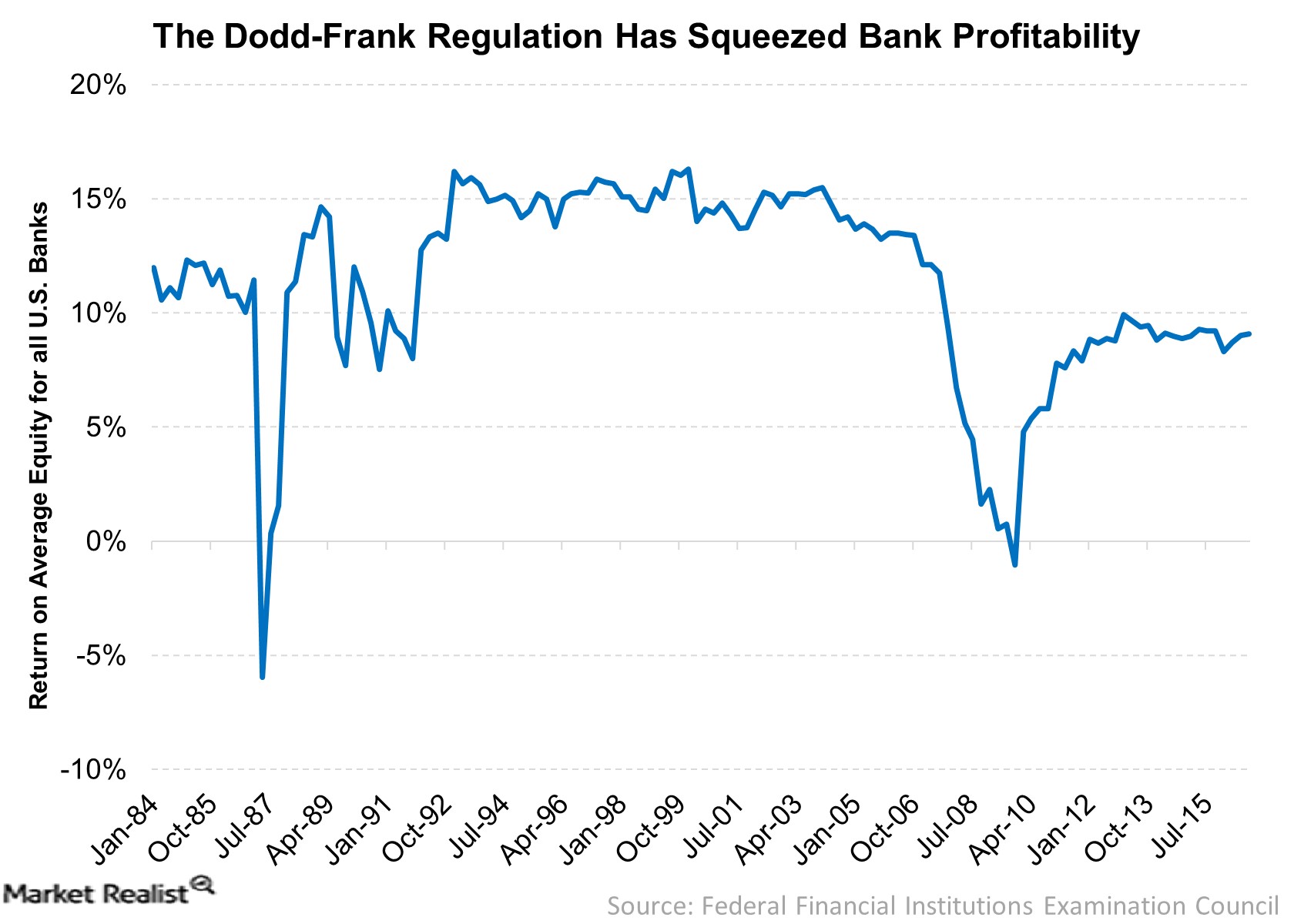
The bottlenecks are the smaller banks. Since Dodd-Frank was enacted, about 2000 community banks had gone bust or been forced to merge, because the regulatory expenses are so burdensome that they can’t handle it. Dodd-Frank is not needed under a system of sovereign money, so you don’t need a regulatory oversight like we have now because the system is internally stable. Lawyers and the employees involved in the regulatory system are opposed to this, along with the large banks that disproportionately gain. It’s regulatory capture.

What’s interesting politically is that people who are fairly strongly on the left or right are in favor of this. It’s the people in the middle who aren’t a whole lot that don’t care much socially, who need to be persuaded. There’s a rising level of interest as people start to understand that in effect, we’ve been lied to for the last hundred years about how the system really works. People are starting to get angry.

MONETARY TRUST INITIATIVE

The Monetary Trust Initiative’s goal has been to create a model. Four years ago the plan was Puerto Rico, now it’s New Zealand and some other small places whereby there is monetary autonomy and we can change the system such that it’s a demonstrable model that can be studied. All the attention is going toward that.

It is not currently operational there.

Abstract by: Annie Zhou <a2zhou@ryerson.ca>

LINK HERE to download the MP3 Podcast

Disclaimer: The views or opinions expressed in this blog post may or may not be representative of the views or opinions of the Financial Repression Authority.


06/15/2017 - The Roundtable Insight: Jeff Snider – We Have A Shadow Money Driven Economic Depression

FRA is joined by Jeff Snider to discuss the shadow banking system and monetary policy.

As Head of Global Investment Research for Alhambra Investment Partners, Jeff spearheads the investment research efforts while providing close contact to Alhambra’s client base. In the nearly year and a half run-up to the panic in 2008, Jeff analyzed and reported on the deteriorating state of the economy and markets. In early 2009, while conventional wisdom focused on near-perpetual gloom, his next series of reports provided insight into the formative ending process of the economic contraction and a comprehensive review of factors that were leading to the market’s resurrection.

In 2012, after the merger between ACM and Alhambra Investment Partners, Jeff came on board Alhambra as Head of Global Investment Research. Currently, Jeff is published nationally at RealClearMarkets, ZeroHedge, Minyanville and Yahoo!Finance. Jeff holds a FINRA Series 65 Investment Advisor License.


FRA: So we have a real special treat. You’ve provided some slides that will be made available on the website and also in the body of our write-up. They provide some great insight into monetary policy evolution over the last couple of decades and what we’re going to be talking today is monetary policy in 2017: h the Federal Reserve is raising interest rates, why they’re doing that, and how the whole evolution over a long period of time, the last couple of decades, especially since the 1990s, has led to bubbles and overall economic chaos. So with that, if you want to start an overview of what you’d like to talk about and start getting into the slides?

SNIDER: We have a bit of a contradiction here because the Federal Reserve in 2017 wants to raise interest rates. I think they’ve made that very clear that’s what they’ve wanted to do all along for the last couple of years. Yet most people have an intuitive sense that the economy hasn’t ever recovered from the Great Recession. So we have this disconnect between what they’re doing and the way the world actually seems to be, and there doesn’t seem to be a good explanation for why all this has occurred the way it has. The reason for it is because the monetary system and the banking system have been drastically changed over the last few decades, especially during the 1990s, the all-important years that led monetary policy along a different path than the economy and the markets. So to understand what the Federal Reserve is doing today, you really have to review how monetary policy evolved as the banking and monetary system evolved.

FRA: And to begin with, on the first few slides you’ve got a quote from 1969?

SNIDER: Edwin Dale was a reporter for the New York Times. In early February 1969 he wrote an article that was called ‘Laughing At The Fed’. It was a fairly typical article for Edwin Dale, and Edwin Dale wasn’t a typical beat reporter for the New York Times, he was very well known, very astute observer of economics and monetary policy. The article had such an effect that two days after it was published, it was actually discussed in the FOMC meeting that followed just after. In fact, the best part of the story is that Frank Morris, who was the president of the Boston branch of the Federal Reserve, actually took it upon himself upon reading Edwin Dale’s article, and asked various banks in his bank district whether or not they were actually laughing at the Fed. Which, I think, is a pretty good starting point to tell you about the timeless nature of policy makers, how they can typically be thin-skinned and often probably too self-assured. And, furthermore, how none of the banks actually answered back that they were laughing at him when in fact you could be sure that as soon as they hung up the phone with Mr. Morris that they actually were laughing.

That was kind of the period in 1969; just on the cusp of what would become the Great Inflation. And it became the Great Inflation because Edward Dale was essentially right. The Federal Reserve had no idea what it was doing, even though it sounded like it was in command of every little minute detail. It’s almost a perfect mirrored start between then and now because nowadays things are very similar: the Federal Reserve makes a bunch of claims, does a bunch of things, and nothing ever seems to work. But that’s not the way it was. In 1969 when people were supposedly laughing at the Fed, to 1999, things had changed very drastically.

In 1999, Alan Greenspan was considered the maestro. He was essentially the most admired central banker in history. So we have to understand how it got that way, how the Fed in 1969 go from being a joke to, by 1999, being the apex of technocrats?

FRA: As you mentioned, no one was laughing by the late 1990s when Alan Greenspan was the maestro.

SNIDER: If you go back to that time period, if you’re old enough to remember the Dot Com era, Alan Greenspan was, on Wall Street at least, a god; even with the mainstream media he was something of a celebrity. I remember that his briefcase even had its own page on CNN.com when the internet was relatively young, because it was believed that you could tell whether or not the Fed was going to raise rates by what hand he was holding the briefcase. It got to be that kind of almost cultish behaviour because of his reputation and the reputation that people believed was based on actual condition.

FRA: So what really happened in the 1990s? Can you elaborate?

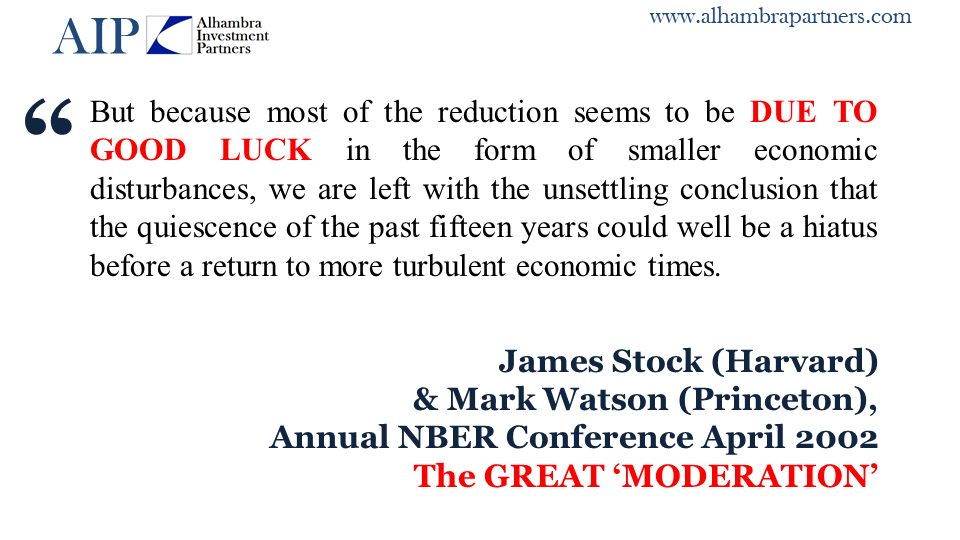
SNIDER: There was a lot of disagreement over what happened. If you were a stock investor, Alan Greenspan was the chief; even in the academic circles of mainstream orthodox economics, there was quite a bit of doubt. In 2002 for example, James Stock of Harvard and Mark Watson of Princeton delivered a presentation at the annual NBER conference that coined the phrase ‘the Great Moderation’. And what they were doing was try to figure out where this oasis of low volatility economy actually came from. They assigned several reasons for it, and one of the most intriguing and most relevant answers they came up with was what they called just pure good luck. What they meant by that was during the 15 years leading up to that point, during that decade and a half of what seemed to be a Great Moderation, there weren’t any of the usual kind of global monetary abnormalities that had plagued economic systems throughout history. From their position inside orthodoxy economics, especially in the academic side, that seemed to be just good fortune. When, in fact, there were other explanations for it that explained a lot more than just passable luck.

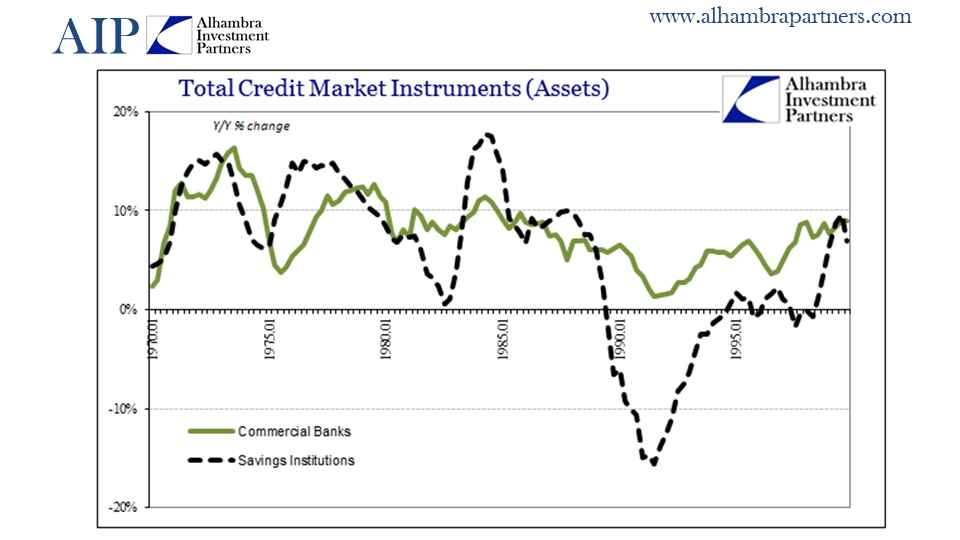
FRA: So take us through some of these initial slides here. You’ve got total credit market assets and how does the story develop over the last two decades?

SNIDER:  Policymakers themselves, again going back to the 1969 Edward Dale article, were very interested in taking credit for the Great Moderation. They wanted everyone to believe, as many people did, that they were in control of the economy. That by increasing or decreasing the Federal Funds Rate a quarter point at a time, they could engineer the so called ‘Great Moderation’. Ben Bernanke actually gave a speech in 2004 where he actually made that claim: that monetary policy, under interest rate targeting, actually deserved the credit for the Great Moderation. It was a view that many people came to adopt, including many in the official academic circles, as well as people inside the Fed, where it was almost a given that monetary policy was perhaps the most powerful thing on Earth and that by controlling the Federal Funds Rate, the Federal Reserve could make everything go. But if you actually go back into the 1990s and review what happened, what you’d find is that, again, a radical transformation.

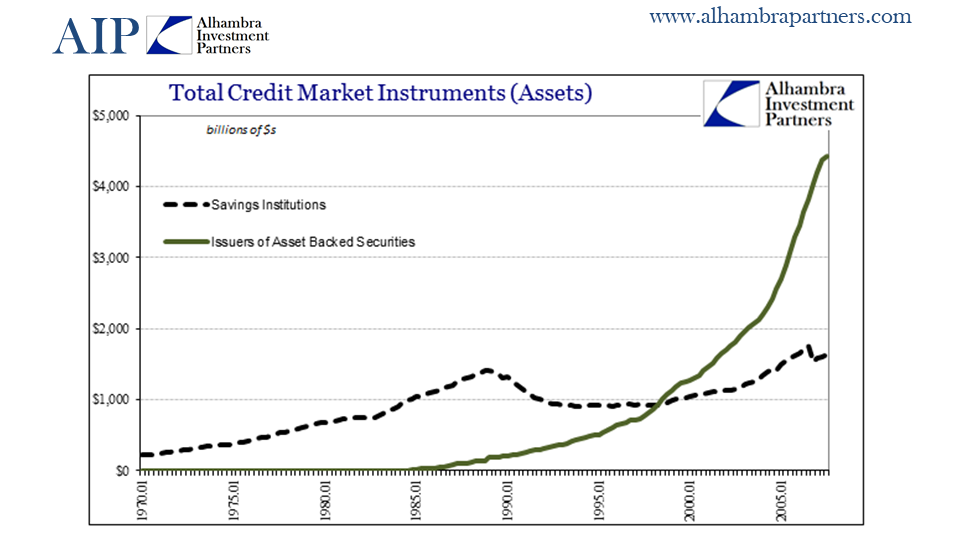
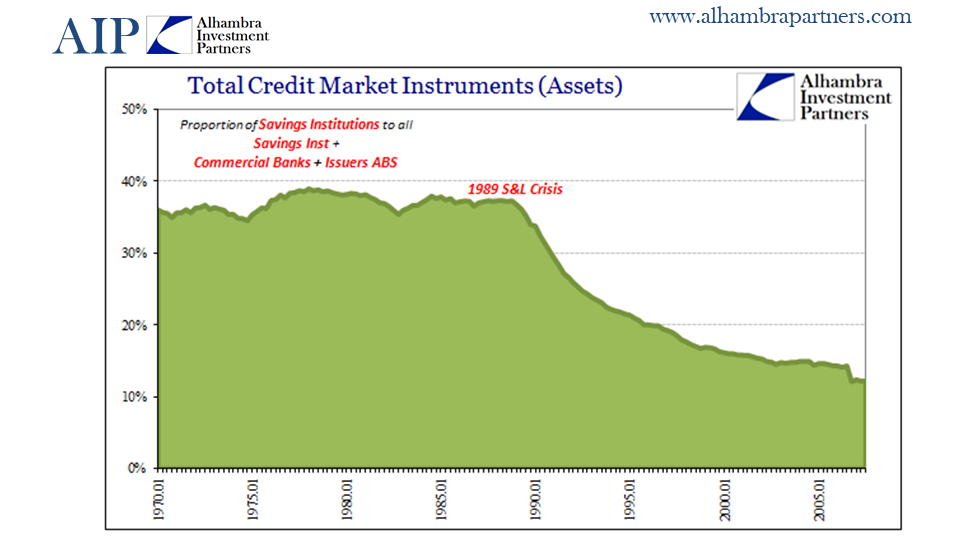
The S&L crisis that developed in the late 1980s pertained to what we all think of when we think of a bank: the bank as in taking in reserves of either cash or hard money, then the money multiplier taking that into levels of loans and deposits. The actual, traditional banking system. That wasn’t the only part of the banking system at the time, of course, but after 1990, after the S&L crisis, the traditional bank model essentially ended. By the mid-1990s, these new forms of banking and monetary advance had increased and grown so rapidly that they had surpassed the traditional model in every way, shape, and form.

I presented here just one of those possible avenues, which is the issuers of Asset-Bank Securities, the type of off-balance sheet arrangements that no one really became aware of until 2007 when it was too late. These were wholesale, modern vehicles for not just banking but securities, all sorts of money dealing activities… basically the whole range of what used to be done under the traditional banking banner were being done more and more under this brand new system that did not operate in the same way as a traditional bank. By 2007, the traditional banking system was a fraction of what it had been, even in 1990. So there was an enormous evolution of banking and even money because the way these things were funded over the 1990s.

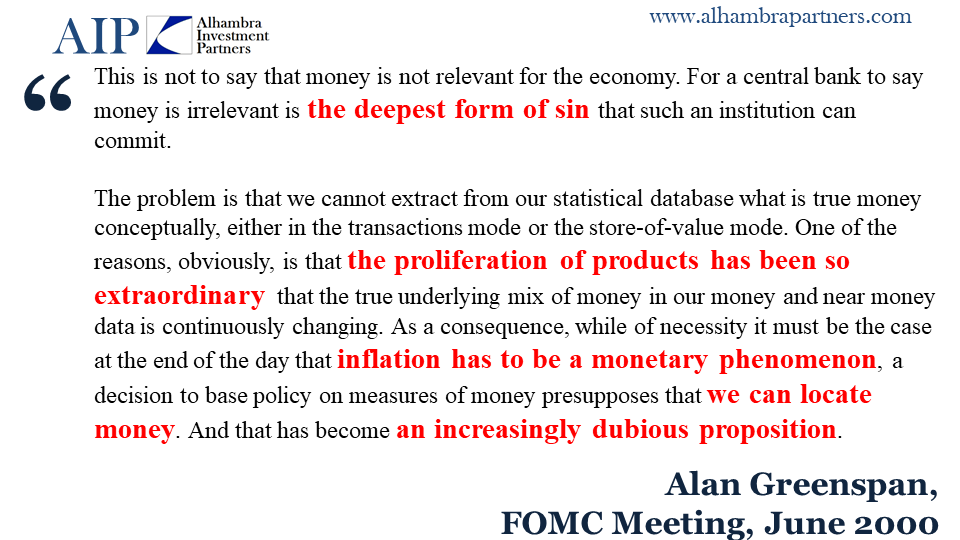
In fact, it was Alan Greenspan himself who noticed these kinds of things and mentioned them throughout the 1990s. I’m sure most people remember in December 1996, Greenspan’s irrational exuberance. But they remember it for all the wrong reasons. They think about the Dot Com Bubble and what they think of as a warning. But what he was really saying, if you read the speech before he got to irrational exuberance, what he was really saying is that the monetary correlation – the correlation between money growth and various money aggregates in the economy – had gone way off course during the 1980s. He was confident that by targeting just the Federal Funds Rate, that wouldn’t matter. In other words, he knew that monetary evolution was taking place. However, he felt that because the Federal Funds Rate was such a hugely powerful control mechanism, it wouldn’t matter that the Federal Reserve couldn’t even define money.

Any normal person in that situation, especially tasked with being head of the central bank, probably would be unnerved by it. But his reputation was such at the time and the conditions of how people perceived the economy, especially in 1990. It was a disconnect between what everybody thought he was able to do with the Federal Reserve and what he was actually able to do. And so proven through monetary policy there may be changes in the Federal Funds Rate, especially in the decade of 2000. You see this very big difference between what is supposed to happen and what does happen.

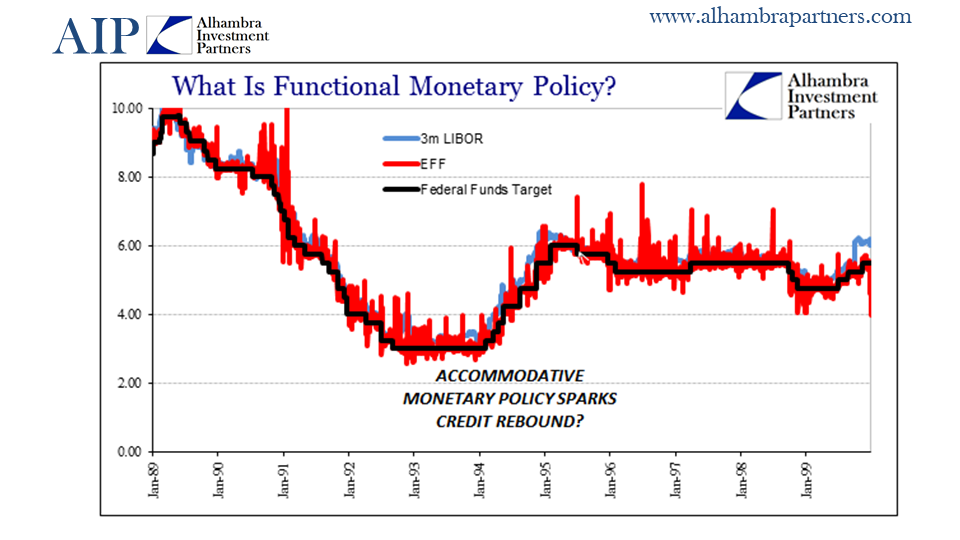
FRA: And that brings us to the concept of the functional monetary policy. We have a chart that sort of begins around 1989 and then goes into the 1990s that depicts accommodative monetary policy sparks credit rebound.

SNIDER: That’s what people conceive out of what the maestro was doing in the 1990s. He was moving the Federal Funds Rate around, either stimulating or tightening:  the famous 1994 bond massacre when he tightened rates and engineered supposedly the soft landing for the middle 1990s. And there were other minor adjustments in the latter part of the decade. There was a 75 basis point rate cut around 1997-1998 related to the Asian flu, but overall what happened throughout the 1990s was that people got the idea that there was a correlation between what the Federal Reserve did with nothing more than the Federal Funds Rate, and this relatively calm period of economy where it expanded for a decade without any recession. Then 2001, the recession that did come was a very mild one, despite the fact that the Dot Com bust was an enormous event. So it really did seem like, on the surface, the monetary policy was a powerful instrument wielded by the best and brightest that we had to offer. Of course that really started to go awry with the housing bubble.

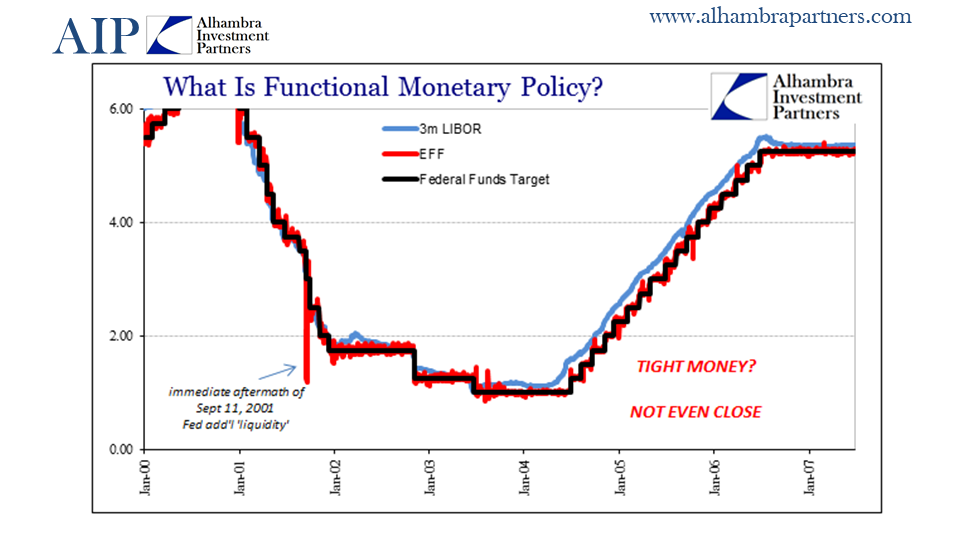
Really, the housing bubble goes back to 1995, and what we can see of the housing bubble conventionally is the housing mania portion, which is 2003 forward. During that period, we really start to see how monetary policy wasn’t what people thought it was. In fact, Greenspan’s Fed started to raise the Federal Funds Rate in lieu of 2004. He kept at it for 17 straight rate cuts, so that by June of 2006 the Federal Funds Rate had gone from 1.5% to 5.25%. Which sounds, on the surface, like a tremendous amount of monetary policy tightening, yet when you look around at that time and look through all the various statistic monetary economics, there was almost no detectable effect from that policy cut. In fact, conditions overall, especially monetarily outside of the traditional monetary statistics, it was actually the opposite. Greenspan intended to tighten but it was as if the banking system had simply gone insane in the opposite direction. It was expanding at an exponential, parabolic rate in almost every wholesale-shadowed capacity.

FRA: Moving past that into 2007-2008, as you show on the next slide, the interest rate going down and you question if this is accommodative money, not even close.

SNIDER: It’s funny. It’s almost an exact mirror image of the rate hike. During the hiking regime of 2004-2006, the Greenspan Fed raised the Federal Funds Rate from 1% to 5.25%, and then starting in September 2007 the Bernanke Fed just reversed it – it went from 5.25% back to 1%. During that period where this is supposed to be a hugely accommodative interest rate cut or a series of interest rate cuts, you cannot classify that period as accommodative in any way, shape or form. In fact, it ended up in the first global financial panic since the 1930s.

So what are we witnessing here with the Federal Funds Rate? It isn’t stimulus when they cut the Federal Funds Rate, just as it wasn’t tightening when they raised it. So what is actual, functional monetary policy? What we find is that it ties directly to the evolution of banking and money primarily through the 1990s, how banking had changed from the traditional banking model to this wholesale model which at the time in 2008 people had started to refer to as ‘shadow banking’. The reason we call it ‘shadow banks’ is because the central bank, the Federal Reserve and its cousins throughout the globe, simply dropped the ball. They stopped caring about actual functional money because they thought the Federal Funds was all they needed to control.

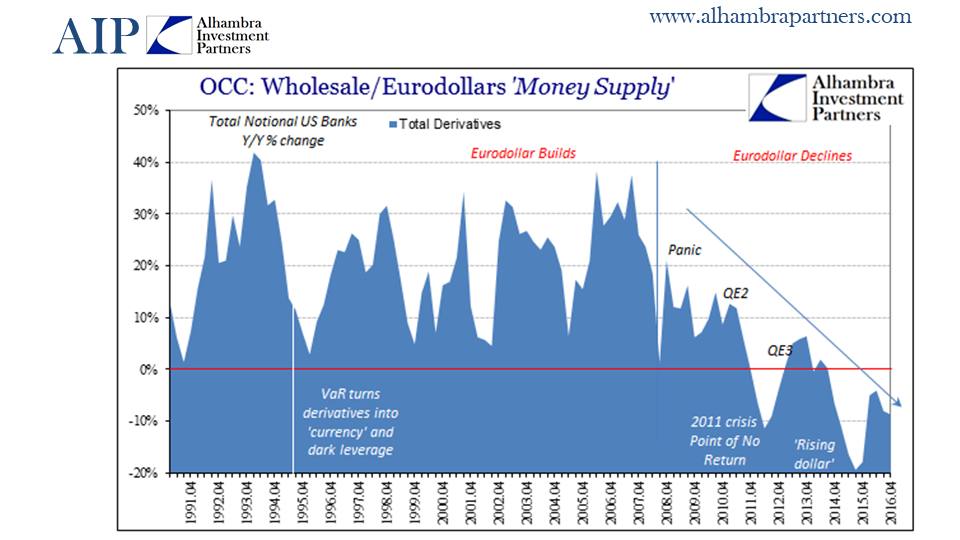
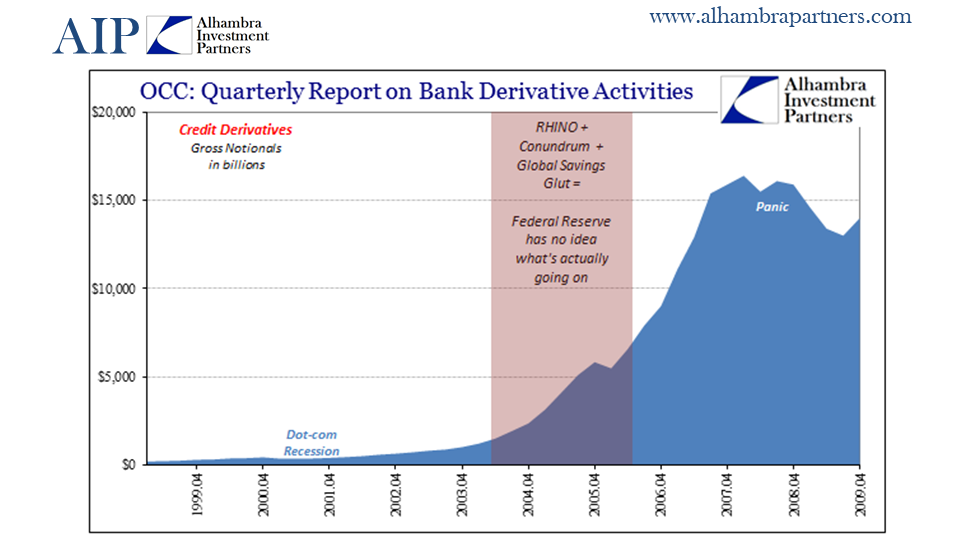
FRA: And the next two slides, if you can provide some elaboration from the office of the controller currency, getting into derivatives and how value at risk turns derivatives into ‘currency’ and dark leverage?

SNIDER: These are the other balance sheet factors that have, at various points in time, acted very much like money themselves. They’re very currency-like at times, especially the thing about interest rate swaps and credit default swaps. Credit default swaps, people probably remember from AIG, and the relation to subprime mortgages, but in fact the use of our credit default swaps was primarily related to balance sheet capital efficiency. In fact, most of the credit default swaps were primarily for primarily European banks to expand their balance sheet without having to raise additional cash. So what these derivative balance sheet factors tell us is, in general terms, bank behaviors. Whether they’re expanding, not necessarily how they’re expanding but how quickly they want to expand, and from that we can infer the global monetary system as it actually was, was expanding. Credit default swaps in particular, you look at during the period where Alan Greenspan was raising rates in the mid-2000s, the credit default swap market or at least the total gross notional written standing paid absolutely no attention to the Federal Reserve whatsoever. In fact, they increased geometrically throughout that period and into the period after it until the panic period started in 2007. So the banks that were off in this other shadow world were expanding rapidly all throughout the 1980s and 1990s and early 2000s. So we have to consider, was that this so-called good luck impetus that allowed the so-called Great Moderation to develop? Was it instead how banking was evolving and growing during that period rather than Alan Greenspan and his 25 basis point rate cuts and rate hikes in the Federal Funds Rate, which was in many ways an irrelevant marker.

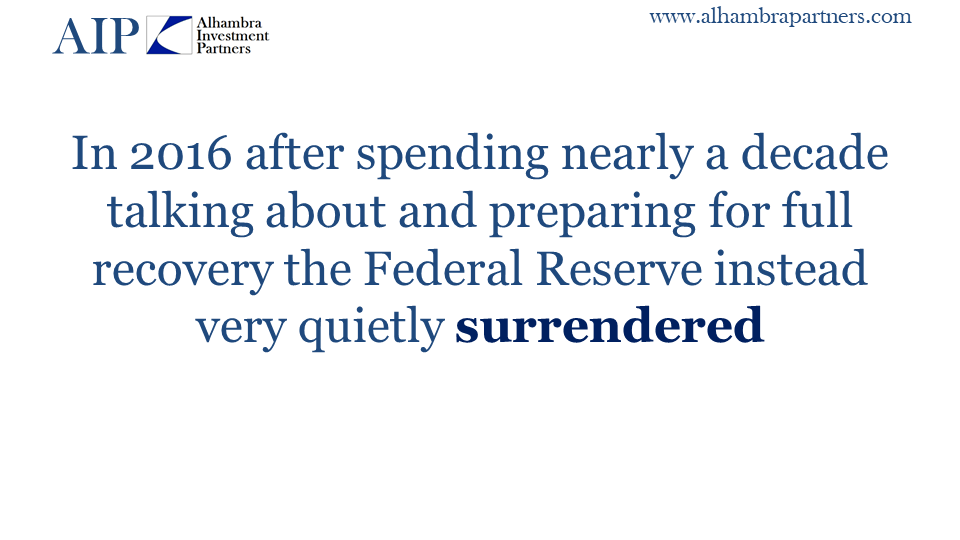
FRA: What happened in 2016 from the financial crisis that caused the Federal Reserve to quietly surrender, as you quote?

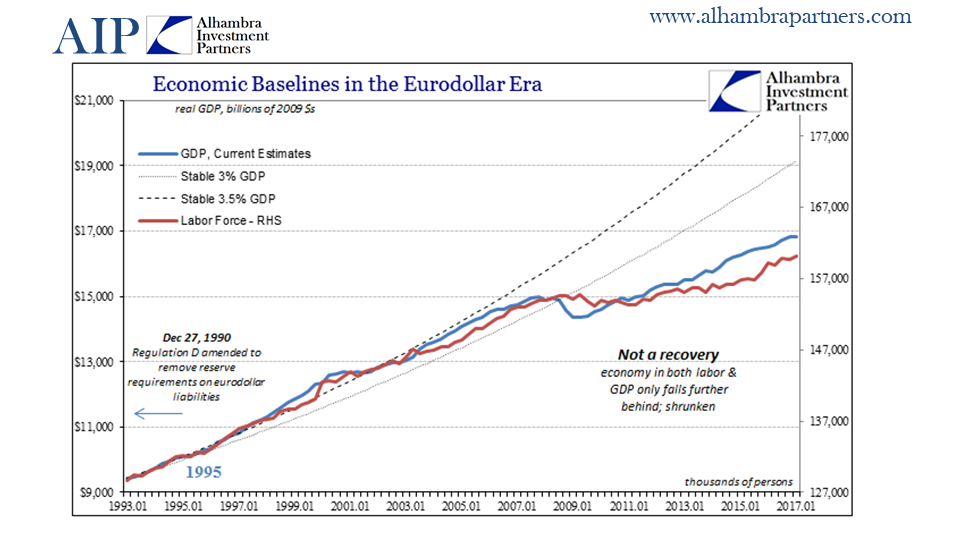
SNIDER: Well, the fact that the economy never recovered, to put it bluntly and blatantly, despite all expectation. To be fair, Federal Reserve officials like Ben Bernanke from the very start said that the recovery would be long sell. And he did so because they expected the banking irregularities and the bank panic and all of that would act as a drag on recovery rather than be a rapid event like there had been in typical recessions. They fully expected that it would be drawn out a little bit longer than maybe people were comfortable with. That, in the end, it would be a full recovery. Yet time and again we find that it wasn’t ever a recovery. Every time the economy was supposed to kick into high gear, something even close to recovery, it just never did. By 2016, the Fed was forced to admit defeat. They had tried four different QEs that had no success. It didn’t create the inflation they thought it would, and therefore there was no inflation and no wage gain and no recovery, so they had to admit what most other people had finally figured out many years before, that there was never going to be a recovery.

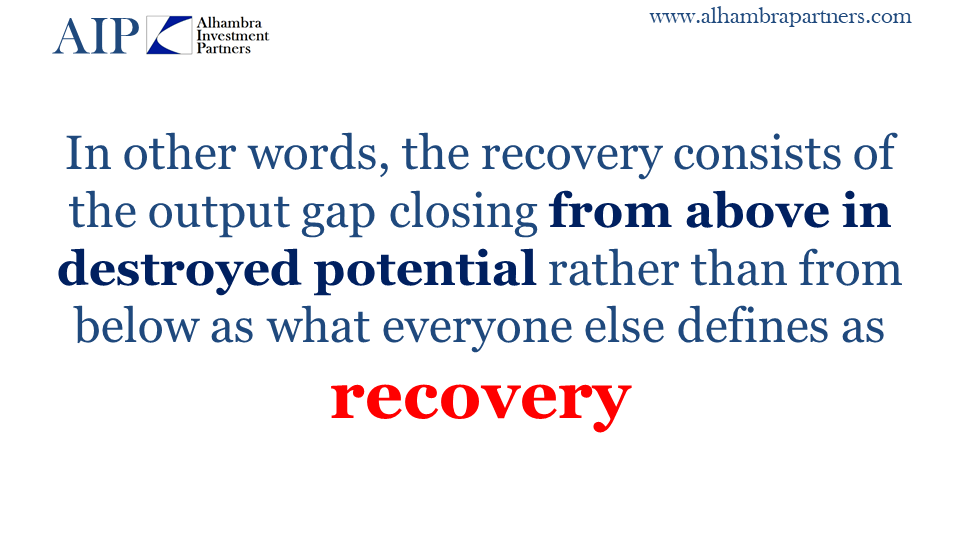
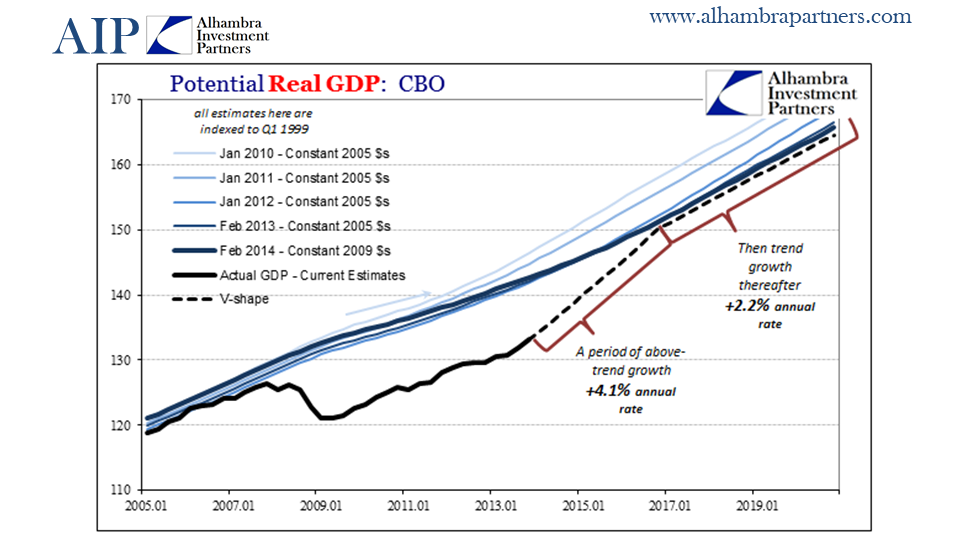
FRA: The next few slides illustrate how the Fed was in fact destroying potential rather than initiating recovery.

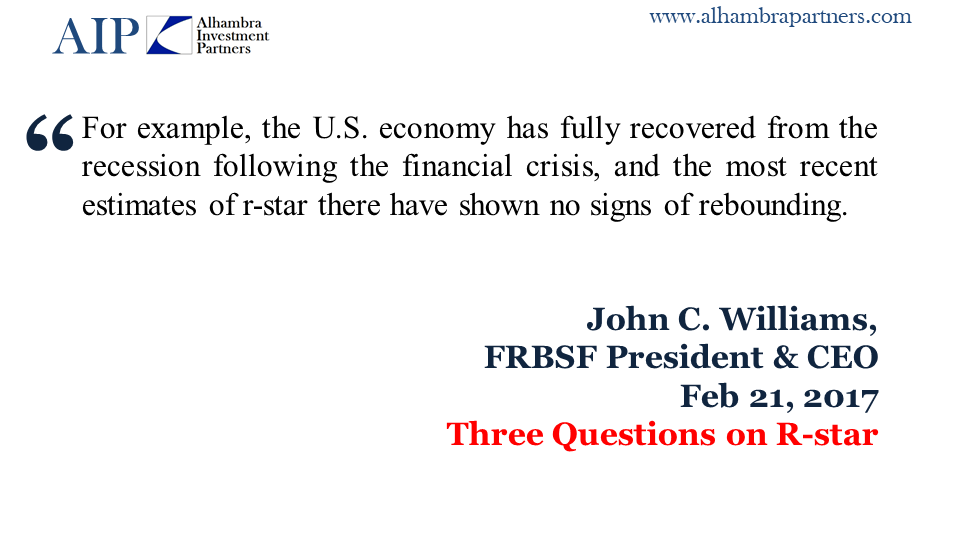
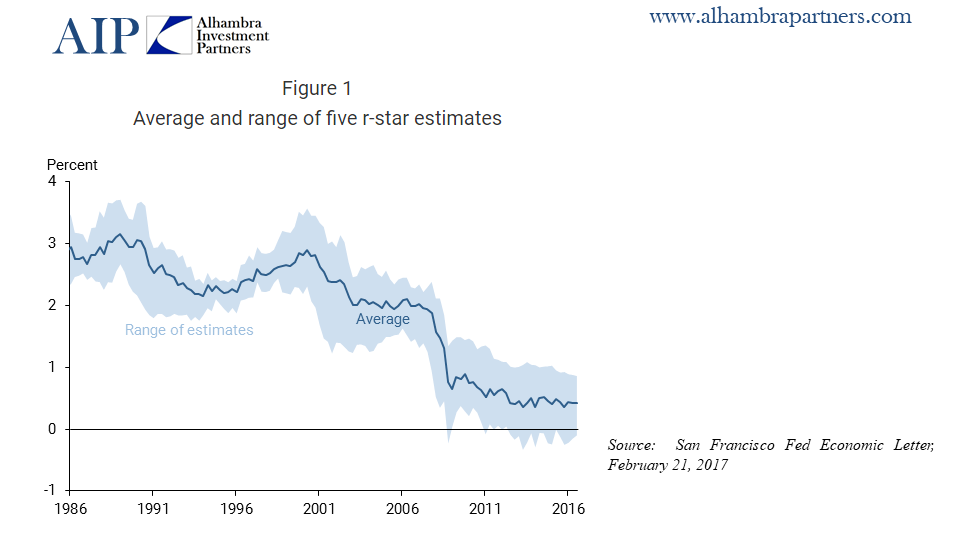
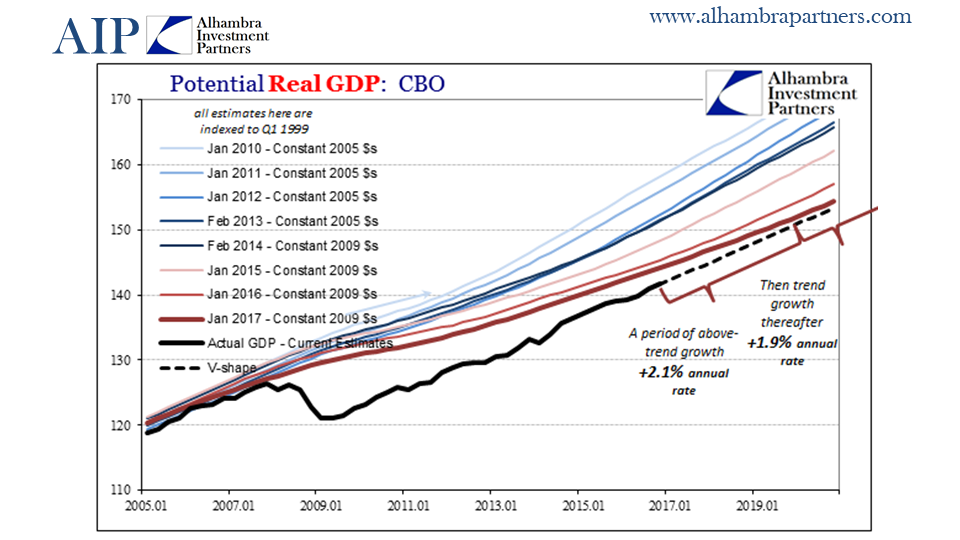
SNIDER: I don’t know if I would say the Fed was destroying potential so much as they were calculating the destroyed potential as a consequence of what they still think of as unknown. One of the primary ways that they arrive at that conclusion is what’s called R* or the natural rate of interest. The natural rate of interest is something that a Swedish economist had developed in the late 19th century, but lay dormant until the late 1990s when academics at Princeton and other place resurrected it. The natural rate of interest is supposed to be useful to monetary policy because it supposedly tells us where employment and inflation balances. In other words, what is the rate on money that won’t either spin the economy off into overheating or depress it too much into a depression. It’s not something that’s directly observed, so it has to be calculated through various mediums; there’s no actual agreement on what R* is. But what economists and policy makers have come to realize is that their calculation of R* since the panic in 2008 has basically arrived at that conclusion: that there basically is no recovery. And furthermore, there isn’t one coming. When you get to that point in terms of monetary policy, what that means is that there’s nothing left for you to do.

The FOMC discusses things like the output gap because that is supposed to tell them where they are in relation to this R* rate where risks of inflation and deflation are perfectly balanced, where unemployment can be the lowest without risking inflation overheating. What you find is that as the so called recovery developed, time and again they expected to get this burst of recovery-like growth to occur. When it didn’t happen, they’re forced to mark down their estimate of potential GDP and potential output to match the fact that it never happened. Over time, year after year, the level of potential just sank and sank and sank so that by 2016 there was very little distance left between potential and where GDP actually was. To the Federal Reserve policy makers, what that said was there was no output gap, or very little left. And if there was very little output gap left, there’s absolutely nothing for monetary policy left to do. At a situation where output and the level of potential are the same or nearly the same, stimulus is a waste of time.

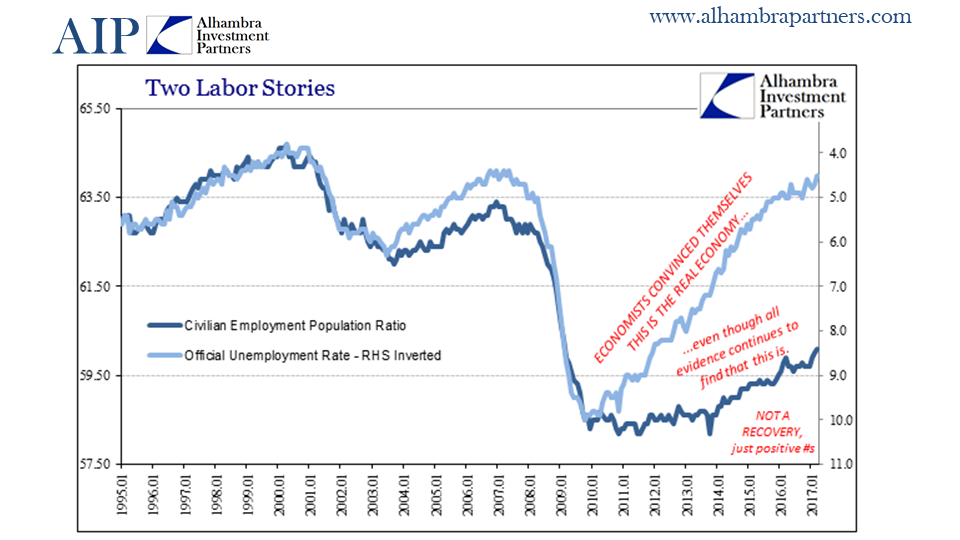
FRA: If we look at labor, one of your charts there, what happened to cause a divergence from 2010 up to today in terms of two labour stories?

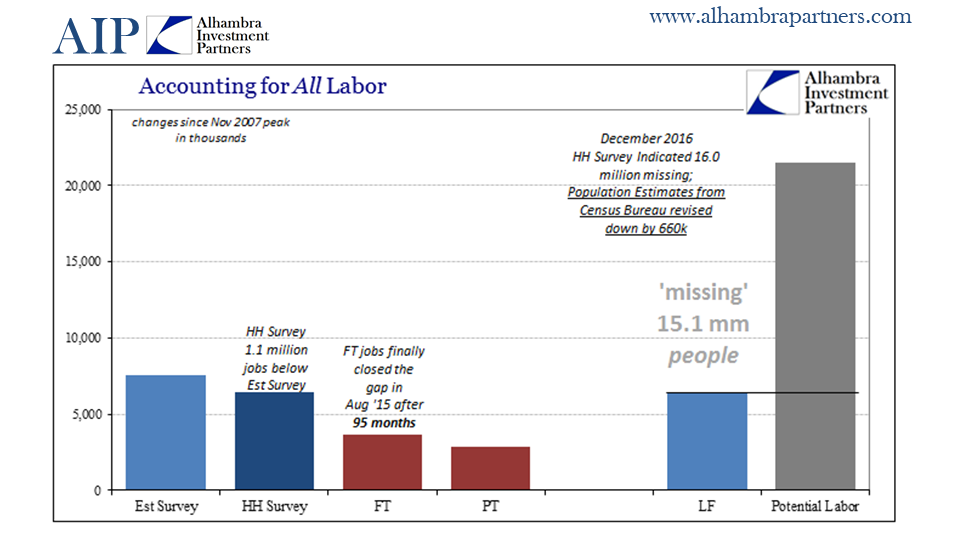
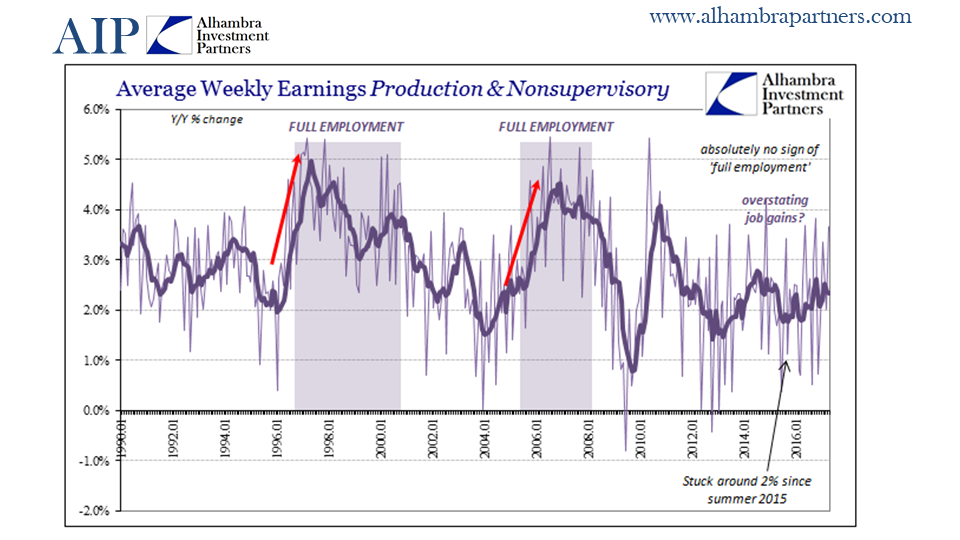
SNIDER: That gets back to, essentially, the mystery of where did the recovery go? For monetary policy makers, this is a global phenomenon, not just a US one. Specifically with the US, the participation problem is that for whatever reasons, a huge chunk of the potential labour force has never re-entered the labor market. They have either never entered during the recovery period, or those that were out of work in 2008 never went back. The size of that pool of missing labor is immense, perhaps 15 million or more.


From the view of monetary policy in the unemployment rate, which figures into the output gap calculation as well, these people don’t matter. It’s as if the unemployment rate is an actual metric that’s appropriate for describing our economic situation to this day. But if that was the case, as the unemployment rate fell especially through 2014 and the start of 2015, we should’ve expected to see inflation start to rise. Instead, it obviously went the other way: inflation actually fell due to the oil prices and the slowdown of the economy due to the rising Dollar. So you have this very big disconnect between the size of the labor force which didn’t grow, and the fact that BLS was estimating almost robust job growth. Over time, what happened was that the Federal Reserve got to the point where they were figuring the unemployment rate described full employment, and because of that and the output gap they felt they had no choice but to start raising rates, no matter what the economic conditions were at the time. That’s why in December 2015 they raised the Federal Funds Rate for the first time even though the conditions at the time were near recession.

In fact, on the day they had announced that first increase in the middle of December, the Federal Reserve also announced that industrial production had shrank, which is usually a recession indicator. So you have striking contrast between what the Fed was doing and what the economy was doing. And it doesn’t really make sense except if you understand both monetary evolution and how monetary policy actually brought it about, essentially. The economy was so poor for so long the Fed basically gave up on any form of stimulus because they essentially said, this is it, this is as good as it’ll ever get.

FRA: As you mentioned, despite reflation sentiment rampant all over the world, there is still no momentum anywhere, just more of the same “recovery”.

SNIDER: That’s an unusual occurrence. At least in this historical cycle, when you have any sort of downturn, whether a recession or a near recession, there’s usually an upturn that’s equal or better. Usually there’s symmetry associated with those types of moves. I think there was the expectation, especially late last year and the start of this year, that that would be the case. Things were really bad, and seemingly possibly becoming a full recession early last year, but then escaping all that it should’ve  been the case where the economy here and elsewhere started really meaningfully improving; not just some positive numbers switching off with negative numbers, but actual momentum very much like we saw in any other point in history. And that hasn’t happened. Q1 2007 GDP is probably the best example of that recently, where another quarter of hugely  disappointing output growth that is actually perfectly consistent instead with the fact that the economy is as it is. Since 2007 it’s run at a reduced rate with very little monetary momentum that will allow for expansions to take hold for what we would know as a recovery.

It’s a global thing, where you find the same problems in China, in Europe, in Japan, Brazil, pretty much anywhere. That points us in the direction where the global economy can be synchronized. The list of suspects that could accomplish such a thing is exceedingly small. In fact, there’s only one thing on it, and that’s the global dollar system. It’s the only thing that could first of all create such a massive dislocation in 2008 and then make it a permanent factor. The fact that the money now functioned steadily and chronically since 2007 tells us a lot about these economic conditions and why, after every time the economy turned lower it doesn’t ever turn back higher again.

FRA: In your slides you also raised the concept of shadow money and how that figures into systemic disruptions. Can you elaborate on that to explain?

SNIDER: There’s quite a bit of debate about what’s driving banks to retreat. It’s essentially the major problem. Before 2007 banks grew exponentially; they grew as fast as they could in any way or shape they could, whether it was mergers and acquisitions, whether it was derivatives and money-dealing, whatever it was. After 2007 banks have done the opposite. Overall they may not have shrunk, but they aren’t growing either. The lack of growth is actually a contraction. Some people believe that’s because of regulations where things like Dodd-Frank and Basel III rules have imposed rules strictly on bank leverage in a post crisis period, but I’m pretty sure that’s not the case. In fact, what changed in 2007 was behavior.

The very fact that before 2007, it was thought that there was very little risk to these various kinds of shadow components. No matter what a bank was doing or what it could come up with, there was no risk to it. And even if there was any kind of trouble associated with the credit default swap book or repo book, the Federal Reserve based on the myth of Alan Greenspan as the maestro would be able to get everyone out of it. So the 2008 panic was very instructive in a way, because it showed banks the Fed had no idea what it was doing, and even if it did know what it was doing it was incapable of solving these problems. If you’re a bank post crisis, that’s a huge factor to how you set your balance sheet construction because you can no longer depend on the Fed. That point was driven home especially hard in 2011, when despite two QEs, the Fed had expanded the level of bank reserve in the system by $1.6T to the middle of 2011, yet there was another liquidity even in that year. In fact, it was so bad that in August 2011 the FOMC actually debated an option of bailing out the repo. For banks in that position and time period, it was a huge wakeup call that shadow banking activities were enormously risky. In fact they were so risky that it wasn’t worth the effort. It wasn’t worth the balance sheet to take them, especially given the economic circumstance where they depressed rate of output here and everywhere around the world. There was no reward for taking on that risk, so the risk paradigm shifted and so did balance sheet capacity shift. And because balance sheet capacity shifted, there was no economic momentum.

FRA: So do we have a shadow money driven economic depression?

SNIDER: I believe so. I think it’s pretty clear when you step outside of the traditional definitions of money, and you marry the evolution of the 1990s to the conditions of today. You can see how things evolved. Going back to the idea of the Great Moderation and what they called good luck, if it wasn’t ever good luck, it was due to these external factors which really weren’t external, but they were only external to the orthodox view. If it was due to these external monetary factors, then it makes sense. The Great Moderation was a temporary artificial period of calm that was created by monetary growth that was at times explosive growth. Where did asset bubbles come from? They came from the shadows, and the fact that the shadow system has been nothing but dysfunctional ever since, and so has the economy? That would be one hell of a coincidence, don’t you think?

FRA: Yeah. And what about the shadow banking system in China? Do you see problems there?

SNIDER: The Chinese system is a little bit different. Their banking system is a little more of the traditional model. That’s not to say a great deal of their growth, especially since 2009, hasn’t been in the shadows, because they’ve clearly tried to replicated the shadow system here but apparently they haven’t learned any of the lessons from the crises. It had grown enormously and they’re having all sorts of trouble in the Chinese version of the system, the very same way we had trouble ten years ago. We have funding mechanisms that are breaking down, creating all sorts of risks that people don’t really understand. Unfortunately that includes policy makers themselves. It’s all too easy to simply ignore this stuff when it seems to be working and things are growing well and it looks like the economy is growing with it, why ask any questions? If it ain’t broke, why fix it? Unfortunately, the problem is that once it does break, there is no fixing it. That’s where we are and that’s where China’s headed, but probably in a more managed cycle than we did in 2007-2008. Ultimately it’s the same thing. Once the contradictions of the monetary system and shadow system become apparent, there is no going back.

FRA: Given all this historical context, where do we go from there? Do you see a slowing global economy? You’ve got a few slides in there showing exports out of China slowing down, imports from China to the US slowing down, could it turn into a stagflation with rising inflation and slowing economic growth? Where do you see things headed in the next year or two?


SNIDER: Unless something substantially changes, and I don’t think the economy will substantially change, we’re kind of stuck in this disinflationary depression condition, which here in the US they call the low-growth state. The lack of compounding over time has an enormous cost and an enormous contraction. Unless the monetary system is substantially reformed, I don’t think this will change. In fact we know it won’t because in many ways the Japanese pioneered this very path 25 years ago. We are following along the Japanese path far too closely for my comfort. It’s instructive to look at Japan for what our future could look like. The problem with that is that the global economy isn’t the Japanese economy; more specifically, the global social and political system I don’t think will stand the two decades of absolutely no growth or very little growth.

We’ve already seen some of the social and political cohesion coming apart; the votes last year whether it be for Trump, Brexit, the Italian vote, there’s already been a great deal of political unrest that’s becoming a populist type of—I don’t want to say revolution or revolt, but it’s the backlash against an economic system that just doesn’t work. You have to wonder how long can we go in this current state where it doesn’t get better. No matter what happens, no matter what any of the supposed experts tell us to do, nothing will work because the monetary system isn’t working. There has to be a breaking point where either the political system realizes the dangers inherent in that condition and actually responds favorably by taking hold of the Eurodollar system and actually reforming it rather than trying to throw another QE into the mix. That’s a possible positive outcome. I don’t want to contemplate the possible negative outcomes because some of them are truly the worst kind of historical comparisons.

Transcript by: Annie Zhou <a2zhou@ryerson.ca>

LINK HERE to get the MP3 Podcast

Disclaimer: The views or opinions expressed in this blog post may or may not be representative of the views or opinions of the Financial Repression Authority.


06/08/2017 - The Roundtable Insight: Bill Laggner On Debt Bubbles & The Emerging FinTech Revolution

FRA is joined by Bill Laggner to discuss non-housing debt, auto loans, and FinTech.

Non-housing debt is being driven mainly by student debt and the auto loan, which are part of the echo bubbles created post ’09, and the figures are alarming. We know that some of the student loan industry is underwritten by the government and the large banks, but there’s an auto loan bubble where the figures range up to $1.5T. A lot of this industry is not securitized. There’s a chunk of the industry that’s essentially private automobile loans, and they’re bundled and sold among high net worth investors. The number is larger than what the graph reflects to the right.

The government is intervening with student debt to recast the debt, alter the terms of the debt, extend the terms etc. We know we’ve never had a true recovery; we’ve had asset bubbles but the real economy is still struggling. What’s happened is that now there’s been lobbying efforts where they essentially want to allow these people to file bankruptcy, and of course the taxpayers would eat it. It’s just another example of the Austrians’ looking at the idea of monetary fiscal distortions where the governments subsidize credit, and when you subsidize credit you end up getting a lot of these takers that take the debt and worry about repaying them later.

When Obama left office, they had one set of default figures, and subsequent to his departure another set were introduced and the figures were significantly higher. What is the real default rate? It’s likely that half of the loans are highly delinquent over 60 days or defaulted.

Looking at bubbles, in 1988 Kevin Duffy wrote a piece with the Wall Street Journal about how Japan isn’t going to take over the world for a number of reasons, one of which being that their economy is a bubble. They had owned a lot of US real estate etc., and what was interesting about their bubble and real estate is that real estate prices became wildly inflated and they were issuing 100 year mortgages. If the person borrowing money died, his wife could inherit the mortgage and when she died the children would inherit. That’s how you underwrite a bubble: you create these lunatic fringe-type policies underwritten by policy makers. We’ve seen this go on for longer than most people would’ve thought; altering the mortgages, altering the terms, the taxpayers were subsidizing the programs, they’d recast the mortgage with lower interest rates and try to paper over this. But the real economy is hollowed out. By essentially destroying the foundation of a true vibrant economy with low or no regulation, little or no taxes, and incentive for capital to be formed and reinvested, you wouldn’t see this.

The economy is fragile. We’re seeing sectors of the economy roll over, and asset prices following suit, but the broad market is levitating – these large platform-like companies have been levitating the market – and central banks are raising interest rates. Credit is starting to tighten in parts of the economy; usually when you have credit tightening and there are bubbles that it’s set upon, that’s usually a recipe for disaster. But we don’t know. We could see a scenario where the economy rapidly slows in the second half of the year, and the Fed could start cutting interest rates. Who’s to say the central banks don’t collectively go to negative 100 or 200 basis points to try and put a floor under housing? When you let your mind get creative in a fiat system, there’s no limit to what they could do. It’s a confidence game and as more and more people start fleeing the system and buying gold or Bitcoin or a farm, you could end up having a major currency crisis in a developed world.

The governments have come in and created various fiscal interventions to try and provide credit to different groups, and when banks and governments provide credit people either take it or don’t. In this case they took it, especially in the west, and we got to see nine year car loans, some of which were sold off to Wall Street and securitized while others were held by respective automobile dealers. Or a secondary market was formed. When you have a pool of savings, the central banks have pushed people into the deep end of the pool and people started doing things with safe money that they would not typically do. When enough people do it, and you’ve got a bit of momentum from this massive credit echo boom, part of this whole boom in subprime and non-subprime lending has been underwritten by historically safe money.

What’s happening is that someone will originate a loan that is non-securitized, and the default rates start going up. It’s a bizarre world of credit finding its way into a part of the market that would typically charge a high rate of interest and it wouldn’t attract as much capital as it has. Again, another distortion from central bank folly.

The lease bubble is primarily underwritten by the automobile companies themselves. The ability for these companies to, post ’09, go to the bond market to become credit providers of these “leases”, and then the terms in the lease market became loose. So it flows through on the purchase side or the lease side, and you get more of these cars leased.

Almost 4M vehicles are coming off lease in ’17 and ’18. There’s been enough leases coming off in ’16 where prices have rolled over, and at the end of this year and start of next year you’ll get a significant repricing of cars.

With regards to lending in the non-securitized, non-banking market, peer-to-peer lending has been massive over the last these years. Then you have these wealth advisers that offer credit lines against your stock and bond portfolio. Robo-advisors and these security lenders that are non-brokered dealers, non-bank lenders, have been lending money against securities. When you look at the peer-to-peer lending world, and then at some of the anecdotal pieces on other non-bank, non-securitization lenders against asset securities, you can see a number easily close to 300-400B based on all the new credit created in the last five years. Add that to the margin debt figures and then you’re talking about margin debt approaching $1T.

On the banking side, the bail-in model is going to be implemented throughout the developed world. The Fed is going to allow more failures this round and likely won’t step in for a non-bank lender. For housing, the government will do everything imaginable to prop up housing, but that’s not going to stop it from going down. They will come up with all types of creative ways to keep people in their homes. They’re not going to sit idle and watch housing go down 60-70%, but they’re not going to interfere with car loans and student loans and credit cards.

Housing prices in Canada will go down a lot. The government will lower rates and figure out ways to provide credit to people, but that’s not going to stop housing prices from going down to something closer to the norm in terms of wages. Over the last 6-7 years, we’ve essentially underwritten a casino-like economy. It’s amazing how many people are in this casino, gambling.

FinTech is one of the most fascinating things we’ve seen in the last 25 years. There’s a lot of crypto-currency being created that are suspect, but some of it is real. It’s a borderless way of transacting value through the rail system known as the public bloc chain. What’s happening is that you have really smart entrepreneurs that are throwing technology and decentralization to create alternative ways of holding and sending value. It’s an industry run by centralized parties that take somewhere between $3-4T out of the global economy through foreign exchange fees, credit card fees, ATM fees, etc. By creating these alternative forms of exchanging value that are decentralized and innovative and creative, you create an ecosystem where more and more people are exchanging products and services without traditional friction points from all these authorities. You have these fiat currencies and people are losing confidence in them, and a parallel ecosystem competing with a fiat system that’s flawed and centralized.

It’s very volatile, but there are very interesting entrepreneurs throwing a lot of human and financial capital at it. What’s happening with smart contracts and peer-to-peer value exchange is interesting. A lot of these companies are private; there’s a company in Russia that’s toying with the idea of accepting Bitcoin and making it available to buy and sell. You’re probably a year or two away from these companies going public. There’s a lot that needs to get sorted out in terms of security, scalability issues, and trying to take something technical and very complex and filtering it down to something that’s convenient and user-friendly for people. People are moving to these platforms and the regulators are lightly regulating them, so you’ll see evolution happen.

The takeaway is that we now have true competition to fiat currency.

Abstract by: Annie Zhou <a2zhou@ryerson.ca>

LINK HERE to get the MP3 Podcast

Disclaimer: The views or opinions expressed in this blog post may or may not be representative of the views or opinions of the Financial Repression Authority.


05/26/2017 - The Roundtable Insight – Yra Harris On Currencies – Central Banks Can Promote Crypto/Electronic Currencies To Help Implement Negative Interest Rates

FRA is joined by Yra Harris to discuss the current state of currencies – crypto currencies, USD, Yen, and Euro.

Yra Harris is a recognized Trader with over 40 years of experience in all areas of commodity trading, with broad expertise in cash currency markets. He has a proven track record of successful trading through a combination of technical work and fundamental analysis of global trends; historically based analysis on global hot money flows. He is recognized by peers as an authority on foreign currency. In addition to this he has specific achievements as a member of the Board of the Chicago Mercantile Exchange (CME). Yra Harris is a Registered Commodity Trading Advisor, Registered Floor Broker and a Registered Pool Operator. He is a regular guest analysis on Currency & Global Interest Markets on Bloomberg and CNBC.

Yra highly recommends reading The Rotten Heart of Europe – send an email to rottenheartofeurope@gmail.com to order

41-C4Mqc+8L._SY344_BO1,204,203,200_


RECENT RUN-UP OF CRYPTO CURRENCIES

It seems to have caught on for people who are trading gold and treat it like a haven. It’s difficult to understand how the crypto currency market works and why we can be secure that it will hold value when it seems to just move around in huge gyrations. We saw the movement of when it had a fall of almost 50% a few months ago when it appeared that the guys from Facebook were behind the push for creating a Bitcoin ETF; when it looked like it wouldn’t get approved, the currency dropped significantly in value. In some way, central banks would love to go to a crypto currency or an electronic currency, because then they can control what people do with their money when they need to go to negative interest rates. There’s a lot to understand and learn here and too many uncertainties here. If you’re looking to secure your money, you should stick with precious metals.

The concept of crypto currencies in the form of Bitcoin and Ethereum don’t appear to be based on anything in terms of either a commodity like gold or precious metals or the faith and credit in a government, so it’s a bit of a wonder how it’s getting its value.

Governments don’t like competition. If the Chinese wanted to shut this down they could shut it down whenever they wanted; they still have tendencies toward repression. If there was a movement by governments to get into crypto currencies, then it would make more preferable sense to have some type of crypto currency that would be backed by a commodity, preferably gold, verses nothing like Bitcoin or Ethereum. Otherwise you would need to use a government-based crypto currency – which would be another form of fiat currency. In other words,  it would be preferable to use a crypto currency based on a commodity instead, as long as that commodity-based crypto currency is still regulated by the financial system.

In a fiat currency dominated world, central banks have not acted in the best interests of holders of the currency – that has forced people to reconsider things. Shariah-compliant crypto gold is a potentially interesting movement.

RECENT CURRENCY SHIFTS

Yra offers his perspective on the US Dollar (USD) currency, offering his counterarguments relative to recent observations by Russell Napier who takes a bullish view on the USD:

Russell points out  that Japan is running out of savings so there’s an insufficient private savings level to fund its government. The counterargument to insufficient savings rate is the fact that Japan traditionally has a tremendously high savings rate and phenomenal investment all around the world. They run current account surpluses not just because of trade balances, but from investment income. If their savings are drawn down, the Yen won’t collapse even though the underlying fundamentals are terrible in other ways. When the Japanese get nervous about the world, they bring money home, and they have huge amounts to bring home.

Russell also points out how China for a weaker Chinese currency (and relatively stronger USD) for export competitiveness. Yra points out that if the Chinese are going to move to a more domestic-based economy, it will not be in their interest to depreciate their currency. Will the currency go down because China has troubles? Maybe, but it’s already depreciated over the last 18 months in anticipation of a lot of those troubles. It depends on how much the Chinese move toward enhancing themselves in a domestic-based economy instead of on exports – from that view, the Yuan will likely appreciate.

Yra points out the Yuan-Peso currency exchange rate is a much more interesting relationship because Mexico stands to be a real competitor to China for the US economy, whatever way NAFTA is treated. The Yuan needs to not appreciate against the Peso.

INTERNATIONAL USD DENOMINATED DEBT

Russell thinks the USD will strengthen also because of the high levels of USD denominated debt held internationally outside of the US, saying that at some point in the event of a recession, there could be higher demand for USD to pay back USD denominated debt.

Yra asks will the global recession cause a run in the Dollar? If the US equity market is a flows argument, and global flows are headed there, the Dollar hasn’t performed that well over the last 4-5 months. That one’s not going to play out and if the world gets into that type of financial difficulty because of the debt, some of the old true relationships are going to break down dramatically. That’s really when you want to start buying gold – if that’s the case, the Dollar isn’t going to be bullish, and you just load up on precious metals instead of any currency.

We know the US President can lower the value of the Dollar, but it’s not an easy task when everyone wants a weaker currency. What can the  US President do? He has to explain to his friends and trading partners why he wants a lower Dollar and get them to sign off on it as what’s best for the global financial system. That’s what we’re discussing here. He could do it by having bad policies.

ON THE EURO CURRENCY

After the French elections are over, we can probably look for the Euro to rally. The Euro is too weak for where the Germans are at. The question for the EU is “whose Euro is it”. France, Italy, and Spain don’t need a stronger Euro, but will it go up? Maybe. As Germany now presses onto this election, the discussion seems to change a little bit. With all the problems the US has, it’s scary what the discussion is. But the equity market continues rallying so no one cares. The fact that the Dollar cannot gain any type of strength with everything else that’s going on in the world and other geopolitical problems, that is a warning sign that things are not good here and the Euro can go higher.

Draghi isn’t going to announce any tapering of the QE plan, and he needs to keep building the ECB balance sheet because that’s what’s going to pave the path for a Eurozone bond. That’s the real game and it’s capturing the Germans. That’s where they’re going and it won’t be easy. They’ll bail out Greece because they don’t want this to be an issue in the German elections because it’ll undermine Merkel a bit. The stronger she gets, the better it’ll be for her after the election.

Abstract by: Annie Zhou <a2zhou@ryerson.ca>

LINK HERE to download the MP3 Podcast

Disclaimer: The views or opinions expressed in this blog post may or may not be representative of the views or opinions of the Financial Repression Authority.


05/19/2017 - The Roundtable Insight: Peter Boockvar and Alasdair Macleod On The Risks Of Central Bank Policies To The Financial Markets

FRA is joined by Alasdair Macleod and Peter Boockvar in a discussion of geopolitics, central bank monetary trends, and their impact on the global economy and markets.

Alasdair Macleod writes for Goldmoney. He has been a celebrated stockbroker and Member of the London Stock Exchange for over four decades. His experience encompasses equity and bond markets, fund management, corporate finance and investment strategy.

Prior to joining The Lindsey Group, Peter spent a brief time at Omega Advisors, a New York based hedge fund, as a macro analyst and portfolio manager. Before this, he was an employee and partner at Miller Tabak + Co for 18 years where he was recently the equity strategist and a portfolio manager with Miller Tabak Advisors. He joined Donaldson, Lufkin and Jenrette in 1992 in their corporate bond research department as a junior analyst. He is also president of OCLI, LLC and OCLI2, LLC, farmland real estate investment funds. He is a CNBC contributor and appears regularly on their network. Peter graduated Magna Cum Laude with a B.B.A. in Finance from George Washington University. Check out Peter’s new newsletter service at www.boockreport.com.

THE TRUMP FACTOR

Up until recently, the market was laser focused on tax reform, health reform, and policies. But Trump’s behavior in his tweets crossed a line that the market couldn’t ignore it any longer. The market knows that he needs all the credibility and stature in order to get the tax reform that the market has been anticipating. The market has been solely focused on tax reform and not paying attention to central banks pulling back and the issues with the US economy and mediocre growth. It’s all been chips on the table of ‘Trump’s going to make things great with tax reform and I don’t care about anything else’, and this is a gigantic wake-up call that the belief that everything is going to go smoothly was incredibly naïve.

This is much more than a one-day event. Now you have a dark cloud over the Trump agenda. You take that away at the same time the Fed is raising interest rates, the US economy is mediocre at best, and the yield curve keeps flattening? There’s no room for error in terms of valuations, and it’s that kind of cocktail that gives us a sell-off like we’re having today.

Trump’s problem is that there’s a turf war raging in the White House. On one side you’ve got established security and on the other you’ve got Trump and his men. The central point about this is that you’ve got the McCain type faction hell bent on continuing to wage a cold war against Russia and China, and you’ve got Trump coming in as a peacenik. He’s turned into someone who’s started quite a few actions around the world. What’s interesting is that President Shi came over, and the result now is that there’s a dialogue between him and Trump. Trump wants to do the same with Putin, but he’s being prevented because there’s so many leaks accusing him of leaking things to Russia, or appointing someone who’s said the wrong things to Russia, etc. The unfortunate thing about it is that it’s moved away from that into the public domain, and now it’s become an issue and they’re talking about impeachment. The fallout from the turf war is starting to destabilize things, and it’s likely that Trump has lines of communication with Shi and Putin, which in the final analysis is going to be very good for all of us. Continuing with the cold war is fundamentally a mistake.

THE EFFECTS ON INTEREST RATE POLICIES

Rate hike odds have gone down, but at the end of the day the Fed is still going to focus on the numbers that they see, and in their eyes they’ve reached their ‘mandates’ in terms of employment and inflation and they’re going to raise interest rates. It’s going to be interesting to see how they manage the political landscape verses what they should be doing on the economy because even if Trump gets impeached, Mike Pence will just carry out what Trump did. The Fed should not be focssed on politics and focus more on what policies will come this year and next. Even so, the Fed seems intent on raising a few more times and shrinking their balance sheet.

The possibility of impeachment does throw into the air when tax reform and health care reform is going to be done. The policy people working on tax and health care reform are going to do that regardless of what shows up in the newspaper and on TV. As Trump is losing credibility, everyone has to ask the question of what moral suasion is he going to have on this process to get something passed. If he doesn’t get this passed and it bleeds into next year, that’s going to have economic implications because corporate CEOs and CFOs are going to freeze some decision making on capital spending or anything else. That’s what the market is questioning; they couldn’t care less about whether Trump is president, they’re just worried about what happens to his agenda.

The basic job of the Fed is to try and manage monetary policy in the context of what the economy is actually doing. Having driven interest rates down to zero, there comes a point where the Fed should try and normalize. Unemployment and employment statistics have come back to target, and that means interest rates should be normalized. The problem the Fed has is that there’s so much debt in the US economy that to raise interest rates very much would destabilize the situation. This is why they’re being very cautious about the rate at which they increase interest rates. If they raise the Fed fund’s rate to 2.5%, they could bring on the next credit crisis. The Fed is very much aware of the debt situation and they don’t want to raise rates like they did in 2006/2007. Assuming that people in the Fed have a sort of inkling, that’s as far as they’re willing to go.

NORTH AMERICA’S EFFECT ON EUROPE

They’ve been beating to a different drummer. While we have political challenges with Trump, their political situation has actually gotten cleaned up with the elections in Austria, the Netherlands, and France. Then we have Italy next year, but the political worries that were becoming widespread have calmed down. We’re seeing better economic activity, and at the same time there’s a growing pressure on Mario Draghi to further taper. Europe is enjoying some calm, but it’s going to be the European central bank and Draghi that completely disrupts that sometime this year and certainly into next year.

There is growing antagonism in Europe about the whole of the EU project. The real problem the ECB has is that it has completely mispriced the bond markets. The prices are way overinflated, but under Basel II and Basel III, these debts are risk free as far as the regulators are concerned. They’re not risk free. The problem now is that as things begin to normalize in the EU, what’s going to happen is that substantial losses are going to appear in the bond market. This could be better absorbed in the US banking system, but not the European banking system. The banks are horribly weak: their balance sheets are rubbish, dressed up to look good for regulators. If you dig down, most of those banks are barely solvent and they cannot afford to take the losses on the bond market which accompany an economic recovery. That is going to be the big, big problem.

Moving on, we’ve got the Brexit negations and the general election. There’s little doubt that Theresa May will have a strong mandate to negotiate as she sees fit with the EU. The EU does want to get a settlement done because they’ve got other problems. The potential Brexit offers the UK is absolutely enormous. If interest rates start rising in the US, there is going to be a tendency for the Euro to be weak. Sterling could also recover against the Dollar are people begin to understand that Britain’s position in negotiating Brexit is actually pretty good, and an agreement is going to be achieved.

The only other currency that needs to be considered in this context is the Yen. Japan is beginning to move, joining the Asian Infrastructure Investment Bank for example, which indicates that business in Japan is starting to drive the government in a different direction from the pockets of the US. There’s lots of change going on, but the big danger is raising interest rates in the EU, which is going to be difficult to do without casualties in the banking sector.

The Fed is going to create policies here irrespective of what goes on overseas. They’re not going to run out of things to buy, but you run into restraints where you start to break the market. The Bank of Japan has certainly broken the JGB market, and the more ETFs they’re going to buy the more they break the stock market. You do reach a natural wall, and that’s not even talking about the limits they reached in terms of the inflation they’re creating and the goals that they’ve met. The level of central bank activity for the sole reason of 2% inflation is a scorched earth monetary policy, and now they have to live with the consequence that they can’t reverse themselves. It’s going to be a nightmare to get out; look at the Fed: here we are in the ninth year of the expansion and the balance sheet hasn’t shrunk one Dollar after raising three times.

OVERALL EFFECTS ON GOLD AND LONG END OF BOND MARKET

The Dollar Index has given back the entire Trump trade; it’s gone back to where it was on Election Day. Now you have the yield curve below where it was on Election Day. Half of that is the Fed raising interest rates and people worried about the economic implications, but at the same time we’re seeing a drop in long yields because they were worried about US growth and the Trump reform not happening. The only real outlier here is the stock market, that’s really on a different planet in terms of its perception of the macro economy and what Trump can do.

The reason that the stock market is so overvalued is that no one is valuing anything in the stock market anymore. The vast majority of investors today are just buying ETFs. It sort of insulates them from reality, but at some stage the market will turn and you’re going to get an awful lot of liquidation. You can’t say the stock market is overvalued; it’s just not valued.

China has tried to take a lot of speculation out of the wealth management products because they’ve been frontrunning the Chinese government’s purchases of commodities. Everyone in China knows the government is stockpiling commodities for its plan to industrialize the whole of Asia. She’s easing down her US Treasuries in order to buy commodities. Basically China’s shaken this out and that process is coming to an end. This is an important signal in gold and silver today. This year so far, silver has risen less than gold, likely because of China unwinding these wealth management products. If you put together the thought that this liquidation in the commodity holdings in the wealth management products, plus the weakness in the Dollar, the potential for gold to rise is pretty good. Base metals and precious metals will move up from there, possibly extended to mid-year. The background for gold and other precious metals is looking pretty good.

The Dollar’s been nothing like a safe haven, so people have found a different save haven. The whole thing with geopolitics is that usually it has a very short impact on markets. It still comes down to what affects markets over a longer period time than currencies, commodities, and fixed income: monetary policy and economic growth. That’s what people should focus on the most.

The Dollar will continue to weaken in the short term, because the rallies we’ve seen in both the Euro and Sterling aren’t over yet. Measuring the Dollar against a basket of commodities, you get a different situation: the Dollar is fundamentally weak against the major commodities and raw materials. Energy is interesting because it refuses to weaken, the purchasing power of the Dollar measured in oil will tend to go down.

FINAL THOUGHTS

This is the first year that all five central banks are either raising rates, ending QE, shrinking their balance sheet, or tightening liquidity. The only reason this market is trading is because of central bank policy. The second concern is what Trump is going to be able to pass, assuming he remains in office, because obsession with tax reform and regulatory relief has blinded people to other growing risks. These are the two things people should focus on the most, instead of geopolitics. People have to understand that we have credit cycles, not business cycles. If central banks didn’t exist, we wouldn’t have these cycles at all! We’re getting quite close to the crisis phase in the cycle, and this time around this crisis could even be bigger than the great financial crisis 8-9 years ago.

Abstract by: Annie Zhou <a2zhou@ryerson.ca>

Disclaimer: The views or opinions expressed in this blog post may or may not be representative of the views or opinions of the Financial Repression Authority.


05/12/2017 - The Roundtable Insight – Alasdair Macleod On How The International Coordination Of Monetary Policies Has Increased The Potential Scale Of The Next Credit Crisis

FRA is joined by Alasdair Macleod in a discussion of international monetary policies, particularly China and the Eurozone.

Alasdair Macleod writes for Goldmoney. He has been a celebrated stockbroker and Member of the London Stock Exchange for over four decades. His experience encompasses equity and bond markets, fund management, corporate finance and investment strategy.


INTERNATIONAL COORDINATION OF MONETARY POLICIES

The business cycle that the banks are trying to manage isn’t actually a business cycle, but a cycle of credit created by the banks themselves. Assuming you have an economy working with sound money, under those circumstances there can’t be what we call a business cycle because everything is random. You get creative destruction of businesses which are ill-founded. When they go to the wall, they do so on a random basis. There’s no cyclical behavior. Then the central bank comes in and feels that the economy isn’t performing strongly enough so it encourages the banks to create credit. Suddenly you have extra money going into the economy. Instead of people having to make a choice, they can have both. The creative destruction you see in an economy gets postponed, and accumulates the whole time under the hood. Eventually what happens is that the excess credit in the economy has to come to a halt.

The cycle of credit is what creates what we believe to be a business cycle. Central banks coordinate their stimulation of the economy to stop the economy from overheating. The effect of this is that they all do the same thing at the same time.

EFFECT ON CURRENCIES AND GOLD

It depends on the stimulation an individual central bank gives to its economy. On top of that, you’ve got what people actually do with the currency and the cycle is basically the change in purchasing power of the currencies the whole time. Underneath this you get an accumulation of debt that never gets washed out on this credit cycle. When you raise interest rates to the point where the economy suddenly shudders to a halt, you start lowering interest rates to try and expand the quantity of money in the economy to prevent people from going bankrupt. Generally central banks succeed in that, but the effect of this is to defer the destruction of debt which is completely unproductive. This rolls into the next cycle, and every time it just gets bigger and bigger. Then you look at statistics and you see the amount of debt built up has increased immeasurably, so the next financial crisis will be worse than the last one.

The protection the ordinary person has against fiat currency losing its purchasing power is to hold some money in gold. You want to be able to use this money when paper currencies either lose most or all of its value. In that sense, gold gives the most protection. If you want to insulate yourself from the collapse of the paper currency, then gold is the only thing you can use. Maybe silver, but silver has been demonetized. The only sound money in the market at the moment is physical gold.

You ask yourself, to what level would the Fed fund’s rate have to rise to trigger the next credit crisis, and that level is in the region of 2.5%. The credit cycle is really comprised of stimulation, inflation, and having to destimulate. You destimulate to the point where you collapse things, because there’s no fine line between slowing things down and creating the next crisis. You can’t just slow things down because it’s not enough of a response to kill price inflation; if you raise interest rates a bit, the market thinks the central banks are too afraid and then continue to advance purchases and dispose of money in favor of goods. The only way the central banks can stop this is to raise interest rates to the level where we change our behaviour.

The central banks raise interest rates to the point where the collapse occurs, then they crash interest rates and chuck money into the economy to ensure nobody goes bust. The idea that the central banks think they can manage what they think is a business cycle is just completely bizarre. Governments are effectively stuck in a debt trap as well. What we’ve got to look through is next time, is how much money does the Fed have to write an open cheque for this time, and what will be the effect on the Dollar. The Dollar, after all, is the currency to which other currencies tie themselves, and if the Dollar falls we all fall. This time around it will be considerably worse than last time.

TIMING OF NEXT CRISIS

The whole situation has become quite unstable. In Europe, there’s a movement of money away from the banking system and into principally Germany, Luxenberg, and the Netherlands. These banking systems are, as far as large depositors are concerned, safe relative to the banks in the Mediterranean countries.  The flight of capital from these weaker countries has hit record levels. The ECB is sitting on the situation and saying it’s not a problem, but the ECB has the eventual liability for the settlement system which is reflecting these imbalances. The total imbalance is in the region of 1.3T Euros. The important part is that the statistics coming out of the Eurozone indicate that there’s economic recovery going on. If there’s economic recovery going on, why do we have the continuing flight of capital?

Lots of people would say that China is a problem. What it’s now trying to do is deflate a bubble in the domestic market while inflating another bubble as it’s indulging in infrastructure spending. The annual spend on infrastructure is now in the order of $750B equivalent. That’s why you’ve got the demand for commodities coming out of China. But China finds that the wealth funds have been frontrunning her by buying commodities. This credit is getting more difficult for central banks to manage, and whole situation is becoming very unstable.

EFFECT OF USD INTERPOLITICALLY

If you pick up on China’s view as to what America is dong, you get a very different view from what’s reported in mainstream media in the West. The Chinese have worked out that America gains a huge amount from exporting the Dollar for value. They take it one step further and say that when Americans to raise funds, they encourage those Dollars back by destabilizing the region those Dollars have gone to. We’re now in a situation where Trump has been elected, but one of the problems he has is that he can’t raise any money because the debt limit has been reached and it’s not being extended. So how would you extend the debt? The Chinese would say that you destabilize a region where the Dollars are, and those Dollars are going to come flooding back. How do you get Congress on your side? You play the patriotic card and threaten to wage war with North America. No American can actually go against the idea of patriotism, so he got the extension up to October. This also explains why Trump moved from peace-making to warmonger in the space of less than 100 days.

Iran is also likely to be targeted later on this year, when Trump wants to increase the budget deficit after October, because the Middle East is one of the areas where there are lots of Dollars owned.

The Shanghai Cooperation Organization is set up by China and Russia, which started as an intention and security agreement and morphed into an economic unit. The idea is that the whole of Asia would become a free trade area. Between them, they are creating an industrial revolution throughout the most populous continent in the world. We’re talking about 40% of the world’s population suddenly having an industrial revolution that will link the whole continent. This is also impinging on Europe. It takes roughly two weeks to get a container from Beijing to Madrid right now, and it will be cut down. Compared to shipping by sea, which takes three weeks, you can see how the investment in these rail communications is massive. All the capital investment that is going to create this industrial revolution in Asia has to be financed, which is why the Asian infrastructure investment bank was set up by China and Russia jointly. All that infrastructure development has to be financed, and London is the center from which it is going to be financed. As far as the Chinese and Russians are concerned, they don’t want America to be involved at all. New York is completely frozen out of this for the reason that everything they do is reflected in bank balances back in the American banking system; they don’t want American interference or Dollars. London, working with Hong Kong, is how this is going to be financed. The big, big game is no longer Europe, it’s the whole of Asia.

EFFECT ON EXCHANGES IN SHANGHAI

China has been trying to promote the Yuan as an international trade settlement currency. It’s got a long way to go; the Dollar dominates this market. But one way they can promote the Yuan is by ensuring there are efficient financial markets that would allow people to do with the Yuan what they do with the Dollar. One of the things they have done at the outset is to set up a Yuan-gold contract in the futures market in Shanghai, settled in physical gold. We now have another thing that has been postponed: an oil contract in Yuan, that could result in oil priced in gold. America’s response to this is to be seen, but it’s clear that the future major economy in the world is going to be the whole of Asia.

In order to promote the Yuan at the expense of the Dollar, there has got to be some form of a gold conversion for trade purposes. Only when that happens can the Dollar be knocked off its pedestal as the major trade settlement currency.

There will be a point where China offers a gold option on trade settlements. If you want to do it at a gold price it has to be a far higher level, so the Chinese would move toward a higher level. But they don’t want to destabilize the world economically, so they’re reluctant to do it. As things evolve, they’re getting closer toward having to take that decision. To an extent it depends on what America does. China owns an awful lot of US Treasuries, which will have to be written off at some stage. Either America stops them selling, in which case China simply waits for them to mature and doesn’t reinvest their proceeds, or China forces the pace. We’re getting closer to the point where some decision has to be taken.

Abstract by: Annie Zhou <a2zhou@ryerson.ca>

LINK HERE to download the MP3 Podcast

Disclaimer: The views or opinions expressed in this blog post may or may not be representative of the views or opinions of the Financial Repression Authority.


05/06/2017 - The Roundtable Insight: Yra Harris On The Bond, Currency, Equity and Commodity Markets

FRA is joined by Yra Harris to discuss the current state of bond, currency, equity, and commodity markets.

Yra Harris is a recognized Trader with over 40 years of experience in all areas of commodity trading, with broad expertise in cash currency markets. He has a proven track record of successful trading through a combination of technical work and fundamental analysis of global trends; historically based analysis on global hot money flows. He is recognized by peers as an authority on foreign currency. In addition to this he has specific measurable achievements as a member of the Board of the Chicago Mercantile Exchange (CME). Yra Harris is a Registered Commodity Trading Advisor, Registered Floor Broker and a Registered Pool Operator. He is a regular guest analysis on Currency & Global Interest Markets on Bloomberg and CNBC.

Yra highly recommends reading The Rotten Heart of Europe – send an email to rottenheartofeurope@gmail.com to order

41-C4Mqc+8L._SY344_BO1,204,203,200_


BOND AND CURRENCY MARKETS

We’re just coming off a Fed meeting in which they called the first quarter transitory, which means they’re not worried about it, yet they made no change to the current policy of maintaining the Fed balance sheet. The $4T will remain at $4T, and whatever expires will be renewed by the purchasing of whatever duration expires by the new instrument. With the Fed raising rates, even though GDP turned out to be low, there are other elements that are slowing down. Right now, if the Fed was looking to start unwinding its balance sheet, which would mean a dynamic act of actually starting to sell some of their assets, the first move would be for the curve to start to steepen. A lot of potential buyers would step back, and market would say ‘show me what you’re going to be doing’. You’re going to have others trying to front run the Fed, because the Fed model says there should be no problem. But what the Fed doesn’t model is the effect on the marketplace, and they’re hoping the marketplace allows them to do this. What the Fed is worried about is whether the market will be cooperative with what they want to do. It’s why they don’t want to acknowledge any pre-program. It’s the same problem the ECB has. A lot of people front run the ECB, and the market tries to rush ahead of it.

If the Fed tries to unwind by an aggressive type of action, which is selling the debt to unwind in a quicker way, the long end of the curve will go up higher than the short end in the immediate period, because the market will race ahead of them. We don’t know how the curve ought to be steepening in that environment. With the Fed doing nothing but raising rates, the curve has actually flattened quite a bit.

It’s interesting how the US 2-10 curve, the ‘investor’s curve’, just mirrors the German 2-10 despite negative rates in Germany. These two just continuously mirror each other. Ultimately, if the Fed is too aggressive in unwinding the balance sheet, that’ll tip us into a very flattening curve, which will fly in the face of what we think should happen. There’s going to be all sorts of things here because the market is going to set the tone. If the Fed were to actually embark upon an unwinding, the market will then set the tone unlike QE. Right now the curves are telling us that the Fed is a little too aggressive, and that’s why it’s flattening.

Everything is ‘transitory’. The Fed is not going to do this in a vacuum. If Marine Le Pen wins the election and throws the entire financial system into turmoil, the Fed has to change their perspective too. So we have a lot of things in play here. Yellen will be very reticent to raise rates too quickly; they want to see more from Trump and Congress before they get more aggressive.

OTHER FACTORS THAT COULD INFLUENCE USD AND BOND MARKETS

In the first quarter, central bank buying totaled a trillion Dollars in assets. The amount of liquidity is huge. The Dollar and all currency markets are all relative value plays. Even if everyone is moderately up, some are doing better and offering a higher return, but the US equity market is close to what we may discern as full value based on historical metrics. In a fairly stable world, the US is not where we should be chasing assets right now. The Mexican Peso and stock market is probably the most undervalued asset class in the world.  People are pushing India as a great place to invest, but India has a lot of enormous infrastructural and political problems that they’re trying to work on.

The best place for investment right now is Germany. If the Germans agreed to do whatever it takes to hold the EU project together, you’ll experience some inflation in Germany but the currency will be weak. On the other hand, if things got so bad that the whole EU project fell apart, you’re buying Germany with a low currency. If it were to pull out for some reason, German assets would convert to Deutschmarks. Germany could be bullish on assets, and you get the use of a weak currency. We get a cheaper currency with a much stronger economy. This is not an easy world to invest in. The political risks are phenomenally great; Italy is still a massive problem for Europe, Greece has not gone away, and there’s no trade in Japan’s JJB.

When you look at how central banks have single handedly destroyed the bond market, you don’t have to look very far. The Fed may be too self-confident, but their models have no respect for market reaction and they still think they can extract themselves with very little pain. If they deem to shrink their balance sheet, they’re going to find out the pent up power of the market and its ability to cause them a lot of pain.

THE GLOBAL MINSKY MOMENT

At the end of the day, interest rates aren’t high enough to attract people into leaving the comfort zone. They won’t let interest rates go high enough to ease some of this burden, so people take comfort in the equity market. Minsky must be spinning in his grave that we’ve gotten to this point and it’s so controlled by the central bank. The central banks have created a global Minsky moment because everyone is complacent. It’s everything approaching the Minsky moment because where are you going to go? There is a cost to everything; just because you don’t see it today doesn’t mean it won’t pop up tomorrow. This is all the outcome of central banks not knowing when enough is enough. QE1 in the US was absolutely needed to prevent a mass liquidation of US assets, but after that it stopped making sense. QE2 and QE3 were totally unnecessary and has created this mess that we are now in.

SILVER-COPPER RATIO TO EQUITY MARKET

Gold has depreciated against silver significantly over the last few weeks, while the equity markets have been holding up pretty strong. Usually silver tends to outperform because it also has industrial usage. Copper has a tendency to outperform the other metals when the equity markets are doing well, because people correlate it to the economy. Copper has been dramatically outperforming silver over the same period, which is highly unusual when the equity markets are holding.

The Chinese have gigantic warehouses full of commodities, which wreaks havoc on that market. You do hear some bad things about what’s happening in the Chinese economy. If that’s the case, commodity prices may come under pressure as some of the lenders call the collateral and start pushing it on the market to raise some cash to secure loans.

INVESTMENT POTENTIAL OF COMMODITY ASSET CLASS

The agricultural sector is a good sector to be in. We have massive crops around the world and prices are relatively strong historically. We’ve had a bit of a rally in the agricultural products in the last few weeks, but it’s something to pay attention to. You should take a look and see if there’s an opportunity for you. The one thing that we’re sure of is that China and India need grain, end of story. As their income levels move up, agricultural products and higher protein products are in demand.

The great thing about the commodity market, unlike the commodity markets which are manipulated, is that farmers and miners react to price. The markets do work.

Abstract by: Annie Zhou <a2zhou@ryerson.ca>

LINK HERE to download the podcast in MP3
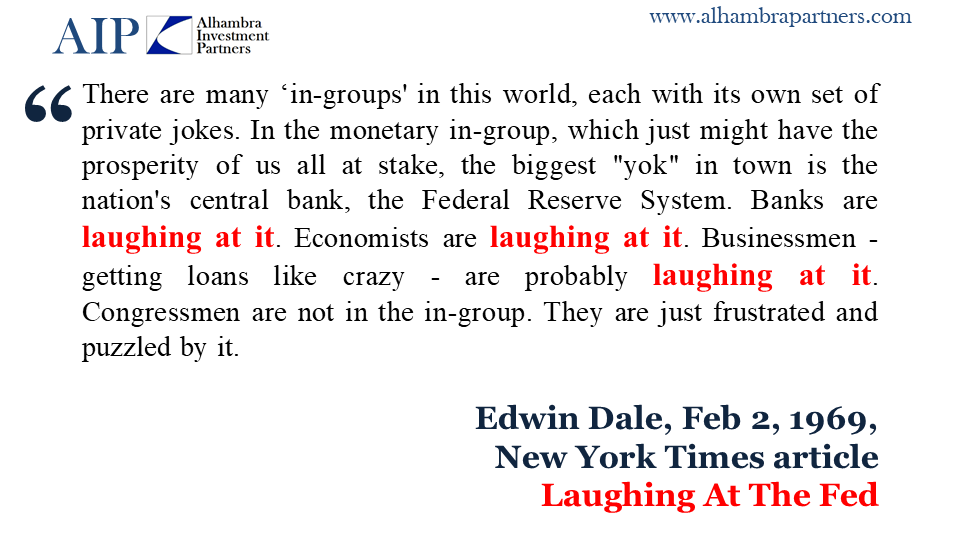
Disclaimer: The views or opinions expressed in this blog post may or may not be representative of the views or opinions of the Financial Repression Authority.


04/07/2017 - The Roundtable Insight (Full Version) – Yra Harris, Peter Boockvar and Uli Kortsch On Central Bank Distortions

FRA is joined by Yra Harris, Peter Boockvar, and Uli Kortsch in discussing central bank distortions, global currency trends, along with protectionism and infrastructure spending in the US.

Yra Harris is a recognized Trader with over 40 years of experience in all areas of commodity trading, with broad expertise in cash currency markets. He has a proven track record of successful trading through a combination of technical work and fundamental analysis of global trends; historically based analysis on global hot money flows. He is recognized by peers as an authority on foreign currency. In addition to this he has specific measurable achievements as a member of the Board of the Chicago Mercantile Exchange (CME). Yra Harris is a Registered Commodity Trading Advisor, Registered Floor Broker and a Registered Pool Operator. He is a regular guest analysis on Currency & Global Interest Markets on Bloomberg and CNBC.

Yra highly recommends reading The Rotten Heart of Europe – send an email to rottenheartofeurope@gmail.com to order

41-C4Mqc+8L._SY344_BO1,204,203,200_

Prior to joining The Lindsey Group, Peter spent a brief time at Omega Advisors, a New York based hedge fund, as a macro analyst and portfolio manager. Before this, he was an employee and partner at Miller Tabak + Co for 18 years where he was recently the equity strategist and a portfolio manager with Miller Tabak Advisors. He joined Donaldson, Lufkin and Jenrette in 1992 in their corporate bond research department as a junior analyst. He is also president of OCLI, LLC and OCLI2, LLC, farmland real estate investment funds. He is a CNBC contributor and appears regularly on their network. Peter graduated Magna Cum Laude with a B.B.A. in Finance from George Washington University. Check out Peter’s new newsletter service at www.boockreport.com.

Uli Kortsch is the Founder of both the Monetary Trust Initiative (MTI) and Global Partners Investments (GPI).  Currently most of his time is spent on MTI whose mission is to bring transparency and authentic principles to our monetary system. As President of Global Partners Investments and other ventures, he has worked in over 50 countries, written a bill for Congress, and conferred with approximately 15 national presidents, ministers of finance, and ministers of commerce.  He has served on numerous corporate boards with both for-profit and not-for-profit organizations.

EFFECTS ON THE EQUITY MARKET

The Swiss National Bank (SNB) has been printing money to buy equities for years now. They have interest rates that are deeply negative, all because they’re afraid of the negative economic impact of a stronger Swiss Franc against the Euro. But the SNB is about to get lucky because the ECB has decided it’s time to take a step back from their policies. Maybe it’ll be a time out with respect to the Swiss and what they’ve done fighting tooth and nail to prevent a rally in the Swiss Franc. They have become one of the largest shareholders of a lot of companies, what with all the money they’ve printed trying to find a home somewhere. They’ve essentially become their own S&P500 fund and are behaving like a hedge fund overall .. like a sovereign wealth fund, but unlike Norway or Singapore, the only thing the Swiss mine is a printing press.

If you look at what the world is doing – basically trying to weaken their own currencies – we’re taking the wealth of the country and moving it to exporters. Everyone loses since the currency that we hold has a certain value with respect to the rest of the world when it comes to imports. The exporters aren’t just corporations, they’re also workers. What is the gain verses the loss on a national average?

The concept of weakening one’s currency is tremendously mistaken. We only have to look at Japan and see their experiment of weakening their currency since 2013. The ideal currency is a stable one.

If you drive your currency lower, your consumers are going to be losers, especially if you’re buying a lot of imports, because the prices of your imports are going to go up. This is a discussion that’s also plaguing Germany. It’s an established policy that they promote exports and keep a low currency, which burdens the purchase of imported goods around the world.

If China were to move to a consumer based economy, they would do better with a stronger currency. That’s why the Yuan is such an important denominator in what China wants to do. If they’re making the shift to a much more domestically oriented economy to soak up all that excess capacity, they should promote a stronger currency as that would be better for their consumers.

THE EFFECT ON THE US DOLLAR

Trade flows are only a small percentage of the daily moves in currencies. The foreign currency market is $5T in debt, so what’s $500B of a trade deficit in the US? Nothing. What’s going to drive the dollar is real interest rates, not nominal interest rates. The Fed started raising rates in Dec 2015, and the 5yr real rate is +50 basis points. Here we are, three hikes later, and it’s -19 basis points. Anyone who looks at nominal rates is not really looking under the hood, and it’s the steep decline in real rates that’s what’s kept a lid on the Dollar, which is at a level that’s no different than where it was a couple of years ago. Look at everything that’s been thrown at other currencies. These currencies have stop going down. It says a lot about the flaws of the Dollar and the impact that negative real interest rates have, notwithstanding the rise in the Fed funds rate. Real rates in the US are negative, and that will bear on the currency.

If you’ve been a saver-investor for the last five years, it’s very difficult to find a way to protect yourself in this environment. If you put your money into two year US Treasuries, with negative nominal real rates, you’re losing money. And that’s where their safety zone is. There is about $11-12T sitting in zero interest rate bearing savings accounts. At a 1% yield, that’s $100B extra of interest income. Multiply that by 8 years of zero interest rates, and you’re talking savers that have been deprived of almost $1T through this monetary policy the Fed said would promote growth.

It’s always a policy where someone gets paid and someone suffers. In the world we live in, savers have been punished and borrowers have been rewarded. With QE it’s the ultra-rich that gained tremendously from the rise in asset prices.  The political left which complains about capitalism is the source of the problem. They’re driving asset prices through the roof.

EFFECT ON THE BALANCE SHEET

We’re up to the point where the Fed funds rate was historically 200-300 basis points above the rate of inflation. If inflation was at 2% right now, historically the Fed funds rate would be 4-5%. The problem is that with the enormous amount of leverage built up in the financial system, getting to that Fed funds rate would literally blow up the system. So the question now is, where should the Fed funds rate be in light of that? Let’s just get it to a 0 real interest rate, so we have a 2% Fed funds rate. Right now they’re at 0.875%. One of the rules of the central banks is that you don’t wait until after you get to your supposed mandate targets to then start normalizing interest rates, you should be at normalized interest rates when you get to your target. So it’s clear the Fed is well behind the curve. It’s only in the halls of academia that “neutral interest rates” exist, and it’s their way of rationalizing this very slow growth in interest rates. They waited for the perfect world to end QE and raise interest rates, but none of that exists so now they’re playing catch up.

They want to slowly raise interest rates and keep everyone calm, but that means they are getting behind the curve. Then they want to shrink their balance sheets to not be disruptive, and normalize interest rates at the same time they created another credit bubble. If the Fed announced that they were going to actively shrink their balance sheet, and think the market won’t punish them, they don’t know how the market works.

Let’s say we start unwinding the balance sheet. That curve ought to straighten out quite a bit on paper, with one large buyer exiting the market on top of foreigners who are net sellers of US Treasuries. If people start worrying about what this will do to the stock market, do we then get an actual flattening of the curve instead because everyone is freaked out about growth? If this curve does not steepen, it’ll be a signal that there are many other things afoot here.

THE AUTO SECTOR

The auto sector was a main driver of growth post-recession, and it’s interest rate credit sensitive, second only to housing. Look what’s happening in the auto sector. This is another sequel called boom and bust, and it’s written and directed by easy money. We now have the Fed who may continue to shrink their balance sheet – at the same time a major driver of growth is now rolling over. The auto sector itself can’t necessarily put us into recession, but the ripple effects could be extraordinary. 45% of all jobs touch the auto sector in some way, and this is a big canary in the coal mine.

We’re not only at high auto sales but also record repossession of autos. It’s a classic case of intertemporal misallocation. Through the use of credit, they keep borrowing all this demand from the future and the future is now.

INFRASTRUCTURE AND UNEMPLOYMENT

Especially now, when labour is especially tight, who are you going to find to build that bridge? All those construction workers are building other things, so it’s just a transfer of resources. The infrastructure will ultimately create more productivity.

Our reliance on U3 numbers is really inappropriate in today’s economy. The appropriate number is U6, which includes people who would like to get a job who have not actively looked for a job over the last four weeks and the people with part time jobs. Thirty years ago we lived in a U3 economy where people had steady, stable jobs and you were employed by someone full time. We don’t live in that world anymore.

Since 2007, U6 has not dropped. It’s been around 10%. Things are better than they were a few years ago, but there’s still a huge percentage who are not participating for one reason or another. Right now it’s about 9.2%. The average since the 90s is over 10%, so even though the U6 is very high, it’s not out of the ordinary.

US NOTES FOR INFRASTRUCTURE

Uli’s proposal .. create US Notes for infrastructure spending .. They are not part of the debt limitation legislation and create no real debt. They are no interest bearing, non-repayable, and are created by Treasury and transferred into the Treasury account at the Fed, which creates no inflation whatsoever as long as it stays at the Fed. Once they’re in circulation they’re no different from any other US Dollar, it’s just the way they’re created is radically different. Our Fed notes are created through debt where US notes are driven by value.

Most of the spending is on the state level. The point is to use federal US Notes to fund states and municipalities on a debt free interest free basis. The $300B Obama infrastructure bill is all debt based money. All of that money increases the $20T total output in Treasuries, whether they’re owed internally or not.

There’s nothing sustainable in terms of growth when there’s money spent on infrastructure. It’s short term in nature. Once the job is done, the workers still have to find something else to do. Hopefully the focus on infrastructure spending doesn’t distract us from creating more sustainable long term growth and that gets through to tax and regulatory policy.

Trump has talked about mimicking the German method of really training people so they’re going into apprentice programs. When you look at the outcome from education, for the most part it’s hyperinflation. In the general American population, if you go into an apprenticeship program you tend to be seen as a loser, which is terrible. That’s what Germany does well. They train tradespeople, and there’s a lot of pride to it. Here, we push college at everybody and all it does is multiply the debt levels exorbitantly.

TRENDS IN PROTECTIONISM

They talk about protectionism because Trump and some of his administration don’t understand trade. They see deficits as a negative, but consumers in the US who can buy things cheaper overseas have their standard of living improved. There are some things that we should make and some things that other countries should make, and what we have to do is make ourselves as competitive as possible and let the chips fall where they may. Trump is taking this mentality of deficit = bad, surplus = good and then goes into a meeting with the Chinese with that mentality.
We should be embracing the second largest economy in the world because they are our partner in a sense of creating healthy, sustainable, quicker growth. But to battle with them over a trade deficit number is just a misunderstanding of the benefits of trade. The “curse” of being a global reserve currency is that you have to export Dollars. It’s impossible to do anything else, especially as other countries build up their USD reserves. If some other currency becomes strong from a global currency perspective, which makes it easier for the US to not run a deficit. The emerging markets have built up their dollar reserves to an astronomical level over the last few years because they’ve been afraid from a stability perspective.

When you’re the reserve currency of the world, you have a different role to play and you’re not just like everyone else. That’s the basis of Pax Americana. Instead of gold, the global currency became the Dollar. The world is in this situation, and if you rip that bandage off and say, no, we’re not supplying Dollars to the world, we will embark on a global depression of huge magnitude. Trump wants to roll back Pax Americana and the cost of being imperial America, but that better be done in a timely way. The Americans filled the void when the Brits abdicated their empire and the role of the British pound, but who’s going to fill that void now?

The Chinese will bring all sorts of gifts to placate Trump, but that pushes the stock market higher in the hopes of there being some rational discussion.

Abstract by: Annie Zhou <a2zhou@ryerson.ca>

LINK HERE to download the podcast
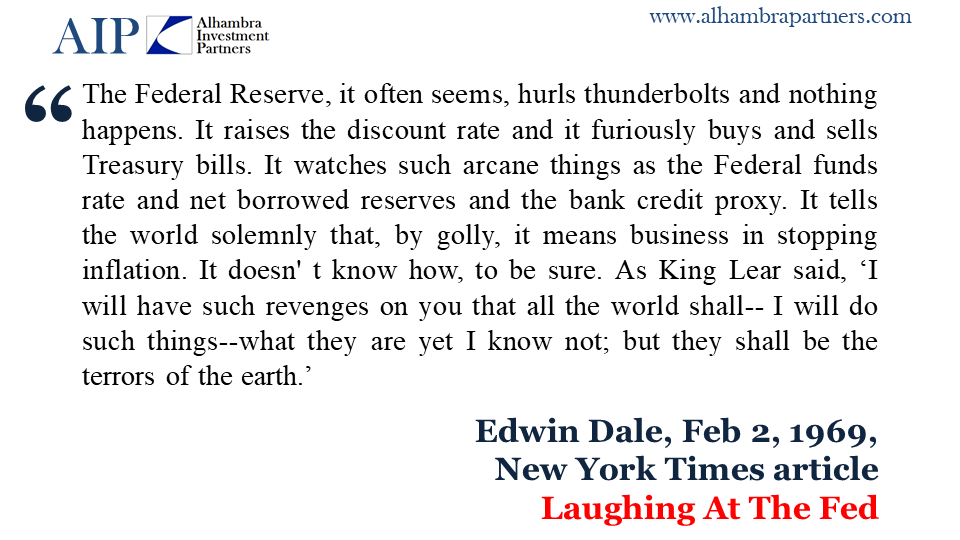
Disclaimer: The views or opinions expressed in this blog post may or may not be representative of the views or opinions of the Financial Repression Authority.


03/31/2017 - The Roundtable Insight – Yra Harris & Uli Kortsch On How Switzerland Is Performing Financial Alchemy

FRA is joined by Yra Harris and Uli Kortsch in discussing the impact of Switzerland on the Eurozone, along with the upcoming elections and the global debt.

Yra Harris is a recognized Trader with over 40 years of experience, with broad expertise in the cash currency markets. He has a proven track record of successful trading through a combination of technical work and fundamental analysis of global trends; historically based analysis on global hot money flows. He is recognized by peers as an authority on foreign currency. In addition, he has specific measurable achievements with the Chicago Mercantile Exchange (CME). Yra Harris is a Registered Commodity Trading Advisor, Registered Floor Broker and a Registered Pool Operator. He is a regular guest analysis on Currency & Global Interest Markets on Bloomberg and CNBC.

Uli Kortsch is the Founder of both the Monetary Trust Initiative (MTI) and Global Partners Investments (GPI).  Currently most of his time is spent on MTI whose mission is to bring transparency and authentic principles to our monetary system. As President of Global Partners Investments and other ventures, he has worked in over 50 countries, written a bill for Congress, and conferred with approximately 15 national presidents, ministers of finance, and ministers of commerce.  He has served on numerous corporate boards with both for-profit and not-for-profit organizations.

SWISS END OF THE EUROZONE

The Swiss print a lot of Swiss Francs as a means of intervening in the markets. They exchange those for primarily Euros, some Dollars, Yen, etc. They’re busy accumulating a massive equity portfolio along with their foreign exchange reserves. They hold $2B of Apple stock because their policy of intervention is to try and keep the Swiss Franc from appreciating too much. Back in January 15 2015, they let the peg to the euro go and we saw a giant move up in the Swiss Franc. The world sits back and lets the Swiss central bank actively be a currency interventionist, but the Swiss are smart enough to understand that they don’t want to just hold everybody else’s currency; they are buying real assets through their process of intervention.

The Swiss Franc represents the frugality of the global investment system as investors are willing to buy Swiss assets with negative yields out over 10 years. There’s a tie-in with potentially increasing its gold reserves. If you’re buying all those equities, you might as well start adding to your gold reserves.

GOVERNMENT GOLD HOLDINGS

The Swiss referendum on gold last year was to increase their gold holdings. They were selling gold and the referendum was to stop selling and repatriate the gold. The amount of paper gold out there out there is about a hundred times the amount of real gold, so what is really out there? No one really knows.

Switzerland is an island, surrounded by the Eurozone. Switzerland is an island of monetary stability. They’re trying to weaken their currency through the increase in reserves and purchase of various assets.

Italy is in very bad shape. If they were to use GAAP accounting for their banks, the country would instantly go bankrupt. France isn’t that much further behind, and we know where Greece is. About 40% of the Swiss National Bank (SNB) is owned by private individuals, so it’s a different system. The Fed is owned by its member banks and it’s impossible to go bankrupt; they can have negative equity and no one cares. But if the Swiss central bank were to go bankrupt that’s a different story. We are coming up against a global recession, our debt levels are again greater than they were in 2007 before the last recession, and this time we do not have the fallback position of the emerging markets like we did then. Plus the political problems, the shaking that is occurring is very substantial. When the debt levels again reach the point where we have another recession, what is going to be the fallback this time, other than more debt?

If we do go into that global recession, the overhang of debt is greater than it was in 2007-2008.

One of the arguments we get against the ‘evil of debt’ is that it’s owed to somebody. It’s not owed to anybody, it’s created by the banks because almost all of our money today is electronic. The money is created by the banks through debt. If we go back in history, nations inflated their way out of debt. The scenario doesn’t change. The central banks have turned the world upside-down and we’re not even close to understanding what right-side up is.

SUSTAINABILITY OF EUROPE AND SWITZERLAND

“The market can remain irrational longer than you can remain solvent.” – Keynes

This is at least the second longest running time between recessions since WW2. The question is whether or not the next recession will be deep enough that some of these abnormal situations fall apart, or will it take another recession past that. We have both political and market pressures, and if you talk China and Russia we have military pressures. The Russians are going to have the biggest Eastern European military exercise this September; a power play verses all the small nations immediately around there.

We have three aspects: a very unbalanced market, a very fragile political situation especially in Europe, and now very recently a military aspect.

One of the things Trump had right is the role of NATO in the world. It’s served its purpose for a long time. Just because we get into this mindset, we don’t have to see it to its illogical end and Trump is right in wanting to roll back Pax Americana. It’s served its time and you don’t have to serve out your Imperial desires until you go broke like Britain. People are up in arms about NATO but it’s the same people who were up in arms about the One China policy. The world is changing dramatically and Trump isn’t wrong to address these things.

Based on the political uncertainty, markets are not pricing correctly. The real risk factor is in these markets.

POSSIBLE EUROZONE EVENTS WITH MAJOR IMPLICATIONS

The probability of the ECB doing a full guarantee is virtually zero unless there was a split in the Eurozone between the north and the south. The probability of a Eurozone country leaving he euro monetary union is ~70%.

Even though Britain is invoking Article 50, it’s a two year process now. So much could happen in the next two years in Europe. Italy is in severe trouble. The only ones who can guarantee a European bond are the Germans, so the Brits are going to get a two year window and a lot of things can go topsy-turvy. If there’s one threat of it, they’ll come begging the Brits to come back because they’ll need them, and the British will be able to make the greatest deal ever where they’ll be able to get back their sovereignty for financial assurance.

The political system in France is weighted against Marine Le Pen and the odds of her winning are low, but then the issue becomes the German elections. Germans are not used to borrowing to finance asset purchases, but when you’re running negative real interest rates, the real yields are negative yields and you’ve got to protect yourself. Otherwise it’s the ultimate form of financial repression to bail out the rest of Europe, and that’s what this election in Germany may hinge on.

If it breaks up north/south and the north takes the Euro, the SNB will make a fortune. If the southern nations wind up with the Euro, everyone else goes about recreating a synthetic Deutschmark – that would be the most interesting outcome of all.

THE NEXT 6-12 MONTHS

Uli: There’s about a 30-40% probably that there’s going to be a serious crash by the end of the year. The problem is that we’re all on a tipping point. The system’s kind of like a plateau. 20 years ago the plateau was very wide. It’s become narrower and narrower and now it’s like a mountaintop. What would get us to fall off the edge of the cliff? The plateau is narrow, so initiating action becomes more and more likely to move us off one of these points, because it doesn’t take much.

Yra: There’s a huge amount of debt that plagues the global system, which is why the Border Adjustment Tax discussion is crazy. If you had a 20% appreciation of the Dollar, that would be the spark to ignite a terrible situation.

A huge amount of debt is Dollar financed. It makes the sub-prime situation ridiculous. Where will the world get their Dollars from, if the U.S. does not run a deficit?

The Trump people are talking tax reform, not tax cuts. It’s revenue neutral, which means there’s going to be winners and losers. If there’s really good winners it’ll be the middle class. That’s why Trump won. The cost of Britain leaving is just a soundbite. How are they going to force the Brits to pay? They’re already leaving. There’ll be no settlement of that debt ever.

Abstract by: Annie Zhou <a2zhou@ryerson.ca>

LINK HERE to the podcast

Disclaimer: The views or opinions expressed in this blog post may or may not be representative of the views or opinions of the Financial Repression Authority.


03/25/2017 - The Roundtable Insight: Alasdair Macleod And Jayant Bhandari On The Factors Driving The Purchasing Power Of Currencies Lower

FRA is joined by Jayant Bhandari and Alasdair Macleod in discussing current trends in gold, along with Asian currency markets and their expectations for them.

Jayant Bhandari is constantly traveling the world looking for investment opportunities, particularly in the natural resource sector. He advises institutional investors about his finds. Earlier, he worked for six years with US Global Investors (San Antonio, Texas), a boutique natural resource investment firm, and for one year with Casey Research. Before emigrating from India, he started and ran Indian subsidiary operations of two European companies. He still travels multiple times a year to India. He is an MBA from Manchester Business School (UK) and B. Engineering from SGSITS (India). He has written on political, economic and cultural issues for the Liberty magazine, the Mises Institute (USA), Mises Institute (Canada), Casey Research, International Man, Mining Journal, Zero Hedge, Lew Rockwell, the Dollar Vigilante, Fraser Institute, Le Québécois Libre, Mauldin Economics, Northern Miner, Mining Markets etc. He is a contributing editor of the Liberty magazine. He runs a yearly seminar in Vancouver titled Capitalism & Morality.

Alasdair Macleod writes for Goldmoney. He has been a celebrated stockbroker and Member of the London Stock Exchange for over four decades. His experience encompasses equity and bond markets, fund management, corporate finance and investment strategy.


UPDATE ON INDIA

India is very rapidly becoming a police state. Last month the government announced that any cash transaction over 300,000 Rupees (approx. $4500USD) would no longer be legal. Any transaction over that amount, according to them, has to be through the banking system. But they have actually come out with 40 amendments in the last few days, and the latest one says that cash transaction limit is now 200,000 Rupees. If you make a transaction over that amount, you will be penalized with the same amount you tried to transact with. This is an absolutely crazy situation in a country where 96% of transactions are made in cash.

Last week Uttar Pradesh, the biggest province in India and which basically decides who runs the federal government as well, elected BJP (Bharatiya Janata Party) into power, and Modi appointed Yogi Adityanath as head of the state. Yogi Adityanath is a Hindu extremist, who has openly and publically asked for the killing of hundreds of Muslims for every Hindu killed. In the last few days that he has been the minister, they have already been establishing a very backward sort of law and order in the province, and a few Muslim shops have been brought down in the last few days. This can very easily escalate. In 1991, there was the destruction of a mosque in Uttar Pradesh, which Hindu extremists wanted to convert into a temple, and now that a Hindu extremist is in power he has no choice but to convert that mosque into a temple. This is a very delicate situation for India.

INDIAN DEMAND FOR GOLD

The gold demand is very subdued even today, and the reason is that people don’t have access to cash to buy gold. More than 50% of ATMs still do not have cash and banks are clogged with people. At the same time, the economy is stagnating, and in a negatively yielding environment people have a tendency to buy gold. People just don’t have access to their own cash.

In a police system, people will trust their institutions even less than they have in the past. And now tax authorities have the right to enter your house without reason. They still need a warrant, but the whole institution climate is such that savers and businessmen are extraordinarily afraid of the state. This will increase people’s interest in gold or in moving their money out of the country.

GOLD RETURNING TO CENTRAL BANK RESERVES

The reason this is happening is because China is getting rid of Dollars in order to stockpile the commodity it needs for its development over Asia. China will spend huge amounts of resources in developing not just the Silk Roads but also the associated infrastructure, and the industrial revolution that China will be bringing in effect. We’re talking about a massive, 20-year project. China will effectively be selling Dollars down against the price. The problem the other central banks who will be dealing with China has is that they will have to try and match, to some degree, the pace at which the Chinese central bank disposes of its Dollars and adds to gold. One way or another, central bank demand is being driven into gold.

They also have the problem that if you’re looking at fiat currencies, where do you go instead of the Dollar? The Euro? The political situation in Europe suggests that currency might not exist in its current form within a 2-3 year timeframe. The Yen? Probably yes, but the problem with Yen is negative yields, and you don’t necessarily want to have Japanese government bonds that effectively yield nothing or very very little. There is not a lot of choice for the Asian central banks. For example, if Thailand just adjusted their portfolio, it probably means they’d have to pick up 60 tonnes of gold just to adjust their reserve portfolio by 10%. You can’t just walk into the market and buy that much easily. You can see that there is an underlying tendency for central banks to sell Dollars to buy gold.

MOVING AWAY FROM FREE TRADE

Last weekend the G20 finance ministers agreed to drop the reference for free trade. The Americans are changing the terms of global trade. They’re moving away from trade agreements, they’re moving away from WTO mandated minimums, and consequentially they’re saying that they’re going to run trade and they don’t care what anyone else says.

This is rather like the Smooth-Hawley problem we had under Hoover, which drove the whole world into a depression. The American move will lead to a contraction in global trade. The Chinese are mostly protected from this since they’re already moving away from selling cheap goods into developing the Asian continent. As the volume of trade contract in the coming years and global trade diminishes, Dollars will be returning home. And they will be returning home at the same time that Asian central banks are trying to reduce their exposure to the Dollar. We are at the peak value of the Dollar in terms of its purchasing power. The price of gold measured in dollars is going to go up quite sharply.

This goes as far as Saudi Arabia, whose market is Asia. Suddenly we have a situation where the Eurasian continent landmass is now the most economic driver in the world and America is receding into the distance. The consequences of this are not fully understood and will take time for us to work this one out. The importance of Asia is becoming paramount. Already China’s trade with Asia exceeds her exports to America. They need to redeploy the labour from the production of cheap goods into the further development of her own economy and move 200M people into new cities, expanding the middle class. This is the most populous country in the world, bar India, which is going upmarket. We really don’t understand this, if we still think America still runs the world. No longer. This is changing. Mr. Trump is going to find that the world is not quite as he thinks it is.

It’s only really been the last 200 years where the combined GDP of China and India have not been greater than the rest of the world, so a reversion of the mean is happening. The natural North American partner for China is Canada, not only because of raw materials and commodities, but because Trudeau Sr. was the first Canadian to go over to China and form the diplomatic bonds that persist until today.

SIMILAR TRENDS IN ASIA

The USD can continue to be very strong in the near terms. Emerging markets are facing huge financial and economic problems. They have taken on too much private and public debt which means that compared to the USD, their fiat currency has even less value in the future. As a result, the locals still prefer to own USD if they can get a hold of it. The USD can still hold its value, particularly if these emerging markets fail or if European currencies collapse.

The thing is that China is stockpiling all these resources. The effect China is having on the global supply of raw materials and energy is remarkable. The idea that if you get a recession in America, demand for raw materials go down because companies reduce their margins and prices start falling. But not this time. Raw material prices will continue to rise. These are precisely the conditions you have for stagflation, where you see your own economy going nowhere but prices are rising. People are latching onto the idea that the purchasing power of their domestic currency is not holding, and they prefer to hold fewer Dollars than normal to have lower exposure to that declining currency. When you start thinking that way, the purchasing power of the currency goes down irrespective of the quantity in circulation.

This hasn’t happened before. The idea that America runs the world is no longer true. They’re playing second fiddle to what China is doing to the whole of Asia.

SOUTHEAST ASIA DOLLAR DEVALUATION

This will not trigger a wave of global competitive currency devaluations, because the problem is that these countries have inherent problems in their economic structure. Devaluing their currencies against the US economy won’t help them, but the temptation will be there because this is how they’ve historically operated. If they do that, gold will be more attractive due to the loss of purchasing power in currencies worldwide. It’s becoming a subject of interest for people who not only want to buy commodities, they want to invest outside their own countries, and they want to own and hold gold outside their own country.

The world has changed. Governments still seem to think they can push their own people around, but it doesn’t work like that anymore. The amount of control that countries like India think they have over their people.

The loss of purchasing power in these currencies has been absolutely incredible. When the dollar goes down, other currencies will tend to lose their purchasing power on balance more rapidly. The Euro has potential for disintegration; the political developments in Europe are pointing to that being an escalating risk in 2017.

FINAL THOUGHTS

There’s a huge amount of accumulation of intellectual capital happening in China. You go to bookshops and you get books translated from English to Chinese. You see coffee shops, restaurants, offices trying to copy the western way of working. The Asian continent is where the excitement is. 90% of all engineers and scientists are Asians living in Asia.

Abstract by: Annie Zhou <a2zhou@ryerson.ca>

LINK HERE to download the MP3

Disclaimer: The views or opinions expressed in this blog post may or may not be representative of the views or opinions of the Financial Repression Authority.


03/17/2017 - The Roundtable Insight: Daniel Amerman On How Varying Forms Of Financial Repression Will Need To Be Applied To Address Surging U.S. Social Security And Medicare Benefits

FRA is joined by  Daniel Amerman in a thorough discussion on the future of the US national debt and the impact of the upcoming surge in social security and medicare benefits.

Daniel R. Amerman is a Chartered Financial Analyst, author, and speaker, with BSBA and MBA degrees in Finance, and over 30 years of professional financial experience. As an investment banking vice president in the 1980s he did groundbreaking work in the security originations and asset/liability management areas, including CMO/REMIC originations as part of portfolio restructurings for financial institutions, as well as the creation of synthetic securities for institutional clients. As an independent quantitative analyst in the 1990s and 2000s, he structured mortgage-backed bond financings and provided analytical services for real estate acquisitions by multifamily and commercial real estate owners, investment banks, and tax-exempt issuers.

Mr. Amerman is the creator of a number of DVDs and books on finance, including two books published by McGraw-Hill (and subsidiary): Mortgage Securities, and Collateralized Mortgage Obligations: Unlock The Secrets Of Mortgage Derivatives. He has been a speaker and workshop leader for sponsors including The Institute for International Research, New York University, and many banking groups.


US NATIONAL DEBT AND THE FUTURE OF INTEREST RATES

The easiest way to talk about financial repression is to look back at the classic financial repression period of roughly 1945-1970, when all the developed economies in the west were engaged in financial repression. In this case, financial repression means forcing negative real interest rates, which is how they escaped from very high government debt levels relative to the economy the last time we were in this situation. Many things today are different from that time, and the difference is that when financial repression was occurring the first time, what was happening was that the baby boomers gave us a tremendous number of workers producing real goods and services, which gave the the economy a boost and helped get government debts under control.

AmermanA2AmermanA3

The difference this time is that the boomers are retiring, and the expenses of paying for them are about to get far more expensive. You can see that we have a tremendous increase in projected benefit payouts. You take the entire US government expenditures right now, and just paying out anticipated social security and medicare that so many boomers are going to be collecting, we’re expecting to be adding another trillion dollars per year by 2024. We have this tremendous increase in cost at the same time that we’re starting with a $20T national debt.

There are a number of different ways that social security and medicare costs can be effectively reduced by nicking it in small little ways that reduce overall payments for everybody substantially over the years to come. In the US, social security payments are not tied to the CPI, but a different index that tracks wages that increases at a slower rate than overall consumer prices.

HIGH DEBT, SOCIAL SECURITY & MEDICARE COSTS

The key point is that we can’t really look at financial repression in the post-WW2 example because it’s fundamentally very different. They used financial repression to hold the debt level in inflation-adjusted terms for a 25 year period. We went from the national debt exceeding the total size of the economy to being under 30% of the size of the economy, but they weren’t facing this tremendous challenge we are with benefits costs. Because of that, the impact on investors and anyone who is expecting social security or medicare benefits means things have to work differently this time around.

We know for a fact that in the coming years we’re going to have this force that’s getting more powerful every year that we’re just not used to dealing with. We have twinned unprecedented situations: a $20T debt and much higher social security and medicare costs on the way quickly, and those two are happening at the same time.

AmermanA5AmermanA6

When you look at these, the key column is net interest which is exploding upwards. It doesn’t happen instantly because the weighted average life of the debt outstanding is 5.8 years, so it takes a number of years for it to actually reflect in the interest payments going out. What would happen is that we’d still have this surge in the deficit that’s going up almost dollar for dollar with the net interest payments. If you look at the overall impact on the economy and total governmental debt, what economists usually do is compare the size of the government debt to the economy, and you can see that the debt crosses the size of the economy by the mid 2030s and accelerates from there.

BENCHMARK OF “INSANITY”

AmermanA7 AmermanA8

We define insanity as if benefits and interest payments consumes all government taxes and every other dollar of government spending has to be borrowed. By the 2020s, we’re more than halfway there, and in that dangerous yellow zone that could shift at any time.

From AC3, with benefits being paid in full, the net interest column has been negated. But now the problem is in the net benefits column, where the deficit is shooting up out of control again. You can see how the red line is pulling the yellow line up step by step, and by the time it reaches 2039 the annual deficit exceeds all normal governmental spending.

AmermanA9AmermanA11

We have two entirely independent compelling major financially problems out there. There’s the $20T debt being held in check by some the lowest interest rates in history, and we also have the tremendous increase in social security and medicare payments that’s going to hit soon. The problem is that in reality, we have both of these hitting us at the same time.

AD3 shows what would happen if we return to historically accurate interest rates. It takes some time for it to be reflected, but we still go from $400B in net interest payments to almost $2T at the same time that we have net benefits almost doubling. When those two hit together, it’s like we have two exponential series hitting each other simultaneously and reinforcing it. If you look at AD15, you see that we’re in the insanity range in under ten years. The future national debt, the future social security and medicare, and the future interest rates are all intertwined.

AmermanA12 AmermanA16

GOVERNMENT REACTION

The point is not to say these scenarios will happen, the point is that this will happen if we had normality in the same way most people are building their assumptions when it comes to long term retirement planning. People are expecting to get their benefits in full because that’s what the government has assured them. They’re looking for long term historical returns in terms of investment allocations, and the point is that if everyone’s expectations were met simultaneously, then the country’s very quickly in the insanity range.

Even with 2% economic growth rate, you can stay in the green the entire time. You can do that with interest rates, you can do that with benefits, you can do that prioritizing interest rates over benefits, you can do it prioritizing benefit changes over interest rates, you can do it with tax changes, and you can do it with inflation. All of these are valid ways of staying within the range.

If you look at paying everything with taxes, the degree taxes would have to rise is shocking. This would be very difficult politically to do. Part of the appeal of financial repression to the government is that there is virtually no political cost to this. People pay personal cost in their lives, but this is generally not understood by the voters. Some of the methodologies of staying in the green are far more politically palatable than others, so we’re more likely to see those used and those are the ones where individuals need to have their defenses in place for. Every single one of these possibilities for staying in the zone has  very broad effects on all investment categories.

Much depends on the specific methods being used and the exact approach the government takes. Bonds in general are not a good idea during financial repression, though there are some time periods where they could be a good investment for a period of time. Real estate, gold, silver, and things like that are good investments.

There is very much a direct personal cost for savers, and working in a different way but related, a direct personal cost for beneficiaries.

CLOSING REMARKS

Social security is not fully inflation indexed. Most people have their medicare premiums deducted from their social security payments, and there is a provision called hold harmless which allows the government to strip away all inflation indexing to the extent that medicare premiums are increasing. Often times when people look at things at this, they take a high drama approach.

All it takes is a tweak of a half percent here and next thing you know these seemingly huge problems have gone away. But when you follow through to the impact on individual savers and individual beneficiaries, they are in fact being paid in full. If you’re going to make a $100T problem go away, $100T in pain has to be shifted somewhere. It happens, but not in a way where people can say, this is happening to me right now because this change was made here.

Abstract by: Annie Zhou <a2zhou@ryerson.ca>

LINK HERE to get the podcast in MP3
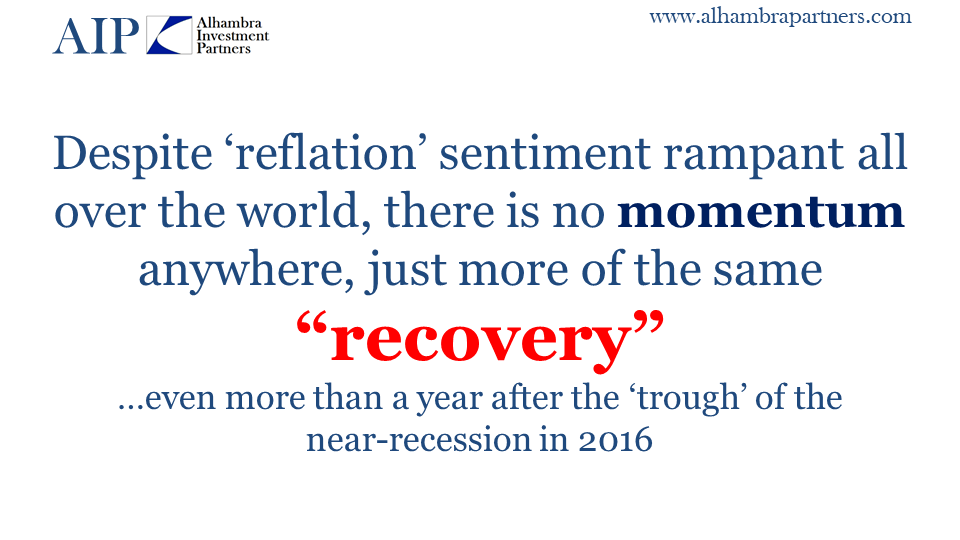
Disclaimer: The views or opinions expressed in this blog post may or may not be representative of the views or opinions of the Financial Repression Authority.


03/13/2017 - The Roundtable Insight: Charles Hugh Smith On Inequalities And Distortions Caused By Central Bank Policies

FRA is joined by Charles Hugh Smith in discussing income inequality as a result of central bank policies

Charles Hugh Smith is a contributing editor to PeakProsperity.com and the proprietor of the popular blog OfTwoMinds.com. He is the author of numerous books, including Why Everything Is Falling Apart: An Unconventional Guide To Investing In Troubled Times.


ENGINES OF INEQUALITY

A lot of people are connecting the dots between rising income inequality and central bank policy. Wages as a percentage of GDP is a very broad-based method of saying how much the economic activity in a nation is ending up in the hands of wage earners as opposed to owners of capital or rent-seekers. We want to differentiate between rent-seeking –  monopolies and cartels getting the government to protect their income streams and eliminate competition – as opposed to the innovative, creative destruction side of capitalism where growth and income inequality might be rising because the most talented and the most successful at allocating capital are benefiting. We can see that both of those forces are at work. A lot of people have noted that the top 5% of wage earners are scooping up most of the gains in wages while the bottom 90-95% are seeing stagnating wages.

GDP-wages8-15a

If you look at GDP as a percentage of wages, it’s been declining since 1970. Something else is going on. Why are wages declining for decades? Clearly it’s connected to policies. 1970 coincides with the decoupling of the USD from gold, so from that point it all comes down to central banking policies and interventions by the Fed in the US.

We can also look at debt. The primary function of central bank policies over the last few decades seems to be facilitating the expansion of debt at a rate that’s far faster than the expansion of GDP. The global bond market is basically the creation of debt instruments, and from 1990 there was about $10T in global bond market debt, and now it’s pushing $100T. We have to ask if the major economies of the world increase tenfold, and the answer is no. Looking at US sovereign debt, around that period it went from $3T to $20T. We can kind of follow that narrative and see what happens when debt is awarded and the acquisition of debt is easy for those closest to the money. There is a tremendous conservation of central bank policies, which is to lower interest rates and make it easier for banks and corporations to borrow money. This is one of the key drivers in wealth and income inequality.

global-bond-market

When the rent-seeking, exploitative part of the economy that used to be a relative modest percent of the economy, grows to 10-20% of the economy, it leaves less actual capital for innovators. We want to encourage innovators, but in the US we have a system where if you’re already extremely wealthy, then the Fed policies have enabled you to enlarge your rent-seeking at the expense of everyone else. Increasing levels of debt are yielding less economic growth over time, requiring more and more debt to get the same level of increase in economic activity.


DEBT AND DISTRIBUTION OF WEALTH

The debt has soared, and so has global financial assets, but not as much. There’s been a healthy expansion, but it’s completely asymmetric to the amount of debt that’s increased. In China, within a decade their total debt load has gone from $3T to $30T. A lot of other nations have followed that same pattern of skyrocketing debts and assets that have gone up but not by the same proportion.

Distribution of wealth in the US since the 1917s has favored bottom 90% the most in the 70s and 80s, and then about 1990 it’s gone against wage earners. We can perhaps extrapolate these vast changes in wealth and income inequality and ask what the social changes are. A lot of people have pointed out that the election of Trump, Brexit, and the rise of the “right” parties in Europe are connected to the social disorders that are arising from this wealth inequality.

wealth-distribution1-17

There’s potential for misattribution by the general public on why the financial crisis happened and why income wealth inequality is getting worse. Both Canada and Mexico has a larger, broader-based middle class than the US, and the Gini coefficient reflects that. Mainstream media doesn’t explain that the wealth effect only benefits those with assets or access to cheap credit that can be used to buy assets. This is where the central bank has created a vast social injustice, and that’s why the social cohesion is being lost. People recognize that these central bank policies are exacerbating social injustices. The fallacy of the central bank idea that if they create all this wealth in the wealthy class, some of it will trickle down and benefit the bottom 95%. But that trickle effect is very modest and not something the central banks can control. That’s a structural flaw in central bank policies.

global-debt2016

The way you deal with financial crises is by forcing people to take losses all the way along the line. You don’t create moral hazard and bail people out and make it easy for people to avoid losses, because then you pile up a lot of bad debt that is hidden. Policy makers at central banks don’t address inequality, perhaps because they know they’ve failed in that area and it’s a problem they don’t have any influence on.

LOOKING FORWARD

Millennials are quite financially conservative and are aware that the generational burden is falling on them. They might not cleave to any of the political lines that we’re used to. It’s interesting because they favor more socialist agenda, in the sense that it reduces the inequality and injustice that is rising, but they may very well be conservative financially instead. There may be a hybrid political solution going forward.CB-buying2-17

We could get rid of central banks or limit them to providing liquidity in liquidity crises. If we went back to a market of private capital, that would instantaneously remove a lot of the benefits rent-seekers get from central bank policies and everyone would have a transparent market for capital. That would open up the capital market to innovators in a way the central banks have repressed.

There is a huge potential benefit to innovators and small enterprises in decentralized crypotcurrencies. These currencies have great value as they’re outside the control of central banks. If we can decentralize money and capital, that would open the door to a lot of solutions.

These distortions are building up systemic risk that’s beneath the surface. Right now central bank policies are all about masking risk, but the systemic risk is rising at the same time that benefits of adding more debt to the system are diminishing. There’s going to be a banquet of consequence in the next few years, and we can see it being prepared right now.

Abstract by: Annie Zhou <a2zhou@ryerson.ca>

LINK HERE to download the MP3

Disclaimer: The views or opinions expressed in this blog post may or may not be representative of the views or opinions of the Financial Repression Authority.


03/12/2017 - Potential Effects Of Changes To The Dodd Frank Act

WHAT IS THE DODD-FRANK ACT?

The Dodd-Frank Wall Street Reform and Consumer Protection Act, first passed in 2010, was set up to regulate and restrict banks’ influence in the financial markets. It was put forth with the goal of reducing the “too big to fail” status of banks, end bailouts, and to protect the consumer from abusive financial system practices while promoting transparency and accountability. The Act added new regulatory bodies in an attempt to maintain stability in the financial markets, and restricted their ability to engage in proprietary trading.

Primarily, the Act created the following:

The Financial Stability Oversight Council (FSOC) that regulates and responds to risks to the financial stability of the US, and promotes market discipline. This includes demanding banks they consider too large to increase their reserve requirements.

The Volcker Rule, which reduced the amount of speculative investments banks could engage in, thereby banning conflict of interest trading that banks could use to increase their own profits. This includes hedge funds and private equity funds.

The Consumer Financial Protection Bureau, which promotes transparency and accountability of banking practices, and allows financial irregularities to be reported.

As of February 2017, Trump has called for the reduction of the scope and regulations of the Dodd-Frank Act.

The-Dodd-Frank-Regulation-Has-Squeezed-Bank-Profitability-2017-02-22

EFFECT OF POTENTIAL CHANGES

Some of the changes suggested directly target the Volcker Rule, which could give banks more freedom in engaging in speculative investing to increase their profits

Dave Sheaff Gilreath of Sheaff Brock Investment Advisors LLC notes that a decrease in regulations would have positive effects on stocks in the financial sector. Already stocks of big banks have jumped since the announcement.

As for small town banks, loosening the restrictions would make it easier for them to provide loans to local small businesses – their primary customers. Bank capital levels and credit quality would also be checked less often, and the overall compliance burden would be reduced. For smaller banks, this change could mean the difference between going into the red or not.

As Peter Boockvar notes, “Dodd Frank discourages traditional market makers to provide liquidity.” Large amounts of equity funding would help banks cope with a financial crisis.

Along the same lines is the likely delay of the fiduciary rule, intended to force investment advisors to recommend lower-fee investments to their clients, and to act in their best interest financially. However, this could also discourage banks from working with low net worth clients as it will definitely reduce income.

In addition to all this, Trump is going to replace Janet Yellen with someone sympathetic to his administration apparently one of his Wall Street compatriots, making it highly likely that future financial decisions will be weighted in favor of Wall Street and bankers.

Unfortunately, the eventual outcome is highly uncertain as it is still unclear what sections of Dodd-Frank will be repealed, rolled back, or modified. Regardless, Trump has made it clear that he intends to empower Wall Street despite what he says about helping Main Street.

By: Annie Zhou <a2zhou@ryerson.ca>

Disclaimer: The views or opinions expressed in this blog post may or may not be representative of the views or opinions of the Financial Repression Authority.


02/24/2017 - The Roundtable Insight – Have Central Banks Reached The “Coffin Corner”?

FRA is joined by Uli Kortsch and Jayant Bhandari in discussing global interest rate trends and growth, along with the likelihood of another recession.

Uli Kortsch is the Founder of both the Monetary Trust Initiative (MTI) and Global Partners Investments (GPI).  Currently most of his time is spent on MTI whose mission is to bring transparency and authentic principles to our monetary system.  He was asked to organize a conference on this topic at the Federal Reserve Bank in Philadelphia, the proceeds of which are now published as a book.  He is a regular speaker at various conferences in different countries. As President of Global Partners Investments and other ventures Mr. Kortsch has worked in over 50 countries, written a bill for Congress, and conferred with approximately 15 national presidents, ministers of finance, and ministers of commerce.  He has served on numerous corporate boards with both for-profit and not-for-profit organizations.

Jayant Bhandari is constantly traveling the world looking for investment opportunities, particularly in the natural resource sector. He advises institutional investors about his finds. Earlier, he worked for six years with US Global Investors (San Antonio, Texas), a boutique natural resource investment firm, and for one year with Casey Research. Before emigrating from India, he started and ran Indian subsidiary operations of two European companies. He still travels multiple times a year to India. He is an MBA from Manchester Business School (UK) and B. Engineering from SGSITS (India). He has written on political, economic and cultural issues for the Liberty magazine, the Mises Institute (USA), Mises Institute (Canada), Casey Research, International Man, Mining Journal, Zero Hedge, Lew Rockwell, the Dollar Vigilante, Fraser Institute, Le Québécois Libre, Mauldin Economics, Northern Miner, Mining Markets etc. He is a contributing editor of the Liberty magazine. He runs a yearly seminar in Vancouver titled Capitalism & Morality.


RELOADING THE AMMUNITION

We’re going to have another recession. Who knows when it will come, but it will come. We’re close to having the longest buildup growth since the last recession, so we’ll have another one fairly soon. The problem is that under our current system, we use interest rates to stimulate the economy. It appears negative so we increase interest rates and make money more expensive, so people stop borrowing. The interest rates globally are so extraordinarily low that in order to stimulate growth during the upcoming recession, there’s not enough movement without going back into negative interest rates. If we do have another recession fairly soon, we’re going to go into negative interest rates.

Most of the savers are older and trying to live off a certain portfolio or expecting a certain kind of income. When you have negative interest rates, the more money you have the more expensive money becomes. You lose money off your money, so the net result is that consumers save more. Instead of negative interest rates stimulating the economy, they actually slowed down even further.

We have an intersection of the interest rate of the economy and the world is able to handle, and where central banks are desperately trying to increase the rate.

If we increase the interest rates, the governments cannot afford their own debt. If we were to pay normal interest rates on US federal debt right now, we would have a deficit of above $1T. We currently have $10T in global debt denominated in USD. As the interest rates go up, those companies can’t afford those either. If you have a crash internationally, we are so linked today that no one will be spared. It’s this coffin corner where you’re damned if you do and damned if you don’t. You’ve got to raise the interest rates, but if you do you’ll crash the economy.

If you look at the last century, western economies mostly grew at a faster rate than the rest of the world. What actually was happening was that the non-western economies had negative real interest rates, and a lot of western economists don’t recognize that. The same disease might’ve entered the western economy society over the last decade or so. We might have over regulated businesses so much that the capital no longer has capacity to generate economic growth. Even negative interest rates might not be enough to help these companies add economic growth to their society. The emerging markets are clearly facing this problem right now, except for East Asia.

2016-11-30_12-30-10


INFLATION: US AND INDIA

We continue to be in such a strongly deflationary environment, but it would be more of the Japanese style of deflationary stagnation versus the stagflation we saw in the 70s and 80s. If you look at the demographics that are changing everywhere, plus IT developments that reduce prices, plus global trade, plus the debt overhang, it’s strongly deflationary.  Every single major crash in over a hundred years has been deflationary, so why are we so concerned about inflation?

Inflation will continue and the government of India is preparing itself to spend a lot of money. Governments are trying to get emerging markets to go cashless so they can destroy their informal economy and move the money to the formal economy. In a lot of these countries, because they’re trying to force people to move their money, they’re reducing the interest rate in the formal economy but actually destroying the growth in the informal economy and that is where economic growth lies in countries like these. The result is that there will be inflation in these emerging markets.

Even in the US, the majority of the growth is in new companies and for the first time in decades the two lines have crossed negatively where if you graph the birth and death of new companies, we’ve gone negative. We are now destroying more companies than we’re creating, and this has never happened before since these statistics were kept.

We’re locked into this Keynesian world view that this is how we do things, but we’re going to face a major crash if we stay with this paradigm, and there’s no way out of it. If we keep on doing what we’re doing, we’ve only got a few years. If we are willing to switch from the Keynesian paradigm to the Fisherian paradigm, we could solve this.

Keynesian economics have become a part of us that it’s almost impossible for institutions and governments to understand that there’s an alternative. In their view, the printing press is a solution to all their problems. All these emerging markets have become very big believers in these things, and this has already led to a huge amount of malinvestment in the west and even more in emerging markets. If you go to Africa and Latin America, private debt levels are much higher as a proportion of their GDP. Those people have taken out massive private loans for consumption, not for investment purposes.

THE CHINA FACTOR

Under Trump and where trade is at, there is a possibility of another Smoot-Hawley. If there’s a sudden decrease in the value of the Yuan relative to the USD, there will be a decrease in trade. The amount of money that’s available to support the Yuan is a lot less than what they’re officially publishing. We would have to be very careful and very wise to not immediately do something stupid like blocking trade. If the Yuan had a significant crash, that would affect the whole Asian bloc.

If the Yuan falls for any reason, it will be extremely harmful to every emerging market. The Yuan is very competitive compared to other smaller manufacturing places, so if it falls for any reason, it will be disastrous for these smaller economies. But it’s so closely linked to the international market as the factory of the world; it operates differently from other currencies. The PBOC’s support mechanism effectively creates a currency board.

When the US acts as a global reserve currency, there has to be a constant leakage of Dollars out, which gives us a negative Current Account standing. If we were to reverse that, there would be an enormous Dollar squeeze globally that will backfire like there’s no tomorrow. The

INTEREST RATES IN THE COMING MONTHS 

You’d have to have some real balls to do this, and there’d have to be timing involved, but it’s likely they’re not going to be able to reload the gun in time for the next recession. When you think the height of the Fed rate has been reached, you can buy US Treasuries. You can make a lot of money, but it’s a risky play.

International institutions have recognize that a lot of corporations in the developing world don’t produce as much as they thought they should, and the result has been that these corporations are basically extensions of governments in these countries. There has been pressure on governments to reduce interest rates on these corporations so they can survive. They’re forcing investments to shift from the informal economy to the formal economy, which is leading to a drop in interest rate which is good for the government. But the way they want to structure the monetary might be destroying the informal economy and the livelihoods of a major part of their population.

Abstract by: Annie Zhou <a2zhou@ryerson.ca>

LINK HERE to download the Podcast

Disclaimer: The views or opinions expressed in this blog post may or may not be representative of the views or opinions of the Financial Repression Authority.


02/19/2017 - The Roundtable Insight: Doug Casey On The Economic State Of The World

FRA is joined by best-selling author and world-renowned speculator Doug Casey in discussing current economic state of the world, from India’s demonetization to Trump.


Doug literally wrote the book on profiting from periods of economic turmoil: his book Crisis Investing spent multiple weeks as #1 on the New York Times bestseller list and became the best-selling financial book of 1980 with 438,640 copies sold. Then Doug broke the record with his next book, Strategic Investing, by receiving the largest advance ever paid for a financial book at the time. Interestingly enough, Doug’s book The International Man was the most sold book in the history of Rhodesia. And his most recent releases Totally Incorrect (2012) and Right on the Money (2013) continue the tradition of challenging statism and advocating liberty and free markets.

He has been a featured guest on hundreds of radio and TV shows, including David Letterman, Merv Griffin, Charlie Rose, Phil Donahue, Regis Philbin, Maury Povich, NBC News, and CNN; has been the topic of numerous features in periodicals such as Time, Forbes, People, and the Washington Post; and is a regular keynote speaker at FreedomFest, the world’s largest gathering of free minds.

Doug has lived in 10 countries and visited over 175. Today you’re most likely to find him at La Estancia de Cafayate (Casey’s Gulch), an oasis tucked away in the high red mountains outside Salta, Argentina.


CURRENT WRITINGS

Speculator is the first of a series of six novels following our hero, Charles Knight, going to Africa to look at a gold mining project he got lucky on. It’s an adventure novel about a bush war in Africa and how he made a couple hundred million dollars, and it’s actually an excellent novel. The second in the series explains the drug business the same way we explain the mining business.

THOUGHTS ON THE CURRENT STATE OF THE WORLD

We entered the hurricane in 2007. The governments of the world papered it over by printing scores of trillions of new currency. It’s surprising that we haven’t gone out of the eye of the hurricane and into the trailing edge, but we’re entering the trailing edge as we speak. It’s going to be much different and much longer lasting, and much worse than the unpleasantness of 2008-2009.This is going to be the biggest deal since the Industrial Revolution 200 years ago, and not in a good way.

The Euro has always been an Esperanto currency. If the US Dollar is an “I owe you nothing” on the part of the bankrupt US government, the Euro is a “who owes you nothing”. It’s a disaster waiting to happen. The European Union itself is likely to break up, and that’s a good thing because most people are unaware of the fact that Brussels has gone from a sleepy little town to one that holds 50000 employees of the EU who serve no useful purpose. If the Europeans want a free trade zone, all they have to do is drop duties. You don’t need a gigantic bureaucracy in Brussels to do that.

We’re going into a time of real chaos. One of the big things we’re going to see is migration from Africa, especially Africa south of the Sahara. There’s a 1-1.5M migrants that came to Europe this year, but in the future there’s going to be scores of millions. Most people are unaware that 42% of the world’s population will be African by the year 2100. It’s going to be an invasion of Europe by Africans; that’s going to continue and compound. At the same time, the Chinese are taking over the continent. It’s going to be a race war. A lot of Europeans are going to be coming to South America. That’s the big picture.

2016-11-30_12-30-10
DEMONETIZATION AND DEBT

It’s incredibly stupid on the part of Modi; half the people in India are earning 1-2 dollars a day. Unfortunately, this is something that’s happening to one degree or another around the world. Governments are trying to get rid of cash, and this is catastrophic from an economic point of view and a personal freedom point of view. Without cash, everything you do goes through a bank and is monitored. There is absolutely no privacy at that point, especially in India which is technologically backward.  It’s a complete disaster.

It’s definitely going to happen in the US and Canada as well. All these government officials talk to each other and seem to share a common philosophy.

When you look at US government spending, we’re going to be running trillion dollar deficits as far as the eye can see. As the world goes into the next stage of the greater depression, it’s going to go well above a trillion dollars. The US government is going to be manifestly bankrupt. They can only get the money by selling the debt to the Fed, and when debt is sold to the Fed they pay for it by printing money. We’re going to be seeing much higher levels of inflation, and the Dollar is eventually going to turn into a hot potato.

TRUMP’S PROTECTIONIST POLICIES

It’s going to be worse than stagflation. If these countries stop putting up tariffs, people can’t sell to you at the same time; they don’t have the ability to buy from you. What’s going on in the US with the Trump administration is an excellent chance and the same thing will be going on in Holland and France and all through Europe.

Every four years, there’s about 2% more of the kind of people who voted for Hilary. Trump is a one term president at best, and the next president is going to be in the middle of an economic catastrophe. Americans are likely to vote for somebody that’s going to promise the government’s a cornucopia.

INVESTING IN A TRUMP WORLD

One of the good things about Trump is that he’s moving to gut the EPA. It means that mining is going to have a resurgence in the US. That’s the best place to be because the stock market is grossly overpriced by any reasonable parameter. That’s an accident waiting to happen at this point, and the bond market’s even worse. We’re at the bubble end of a 35 year bull market in bonds. Bonds are the biggest bubble in world history, at this point.

Commodities are very cheap right now. In the inflationary environment we’re going to have in the future prices are going to go way up. Food commodities are the place to be.

You should go where your money and yourself are treated best, and that’s no longer in the US.

Abstract by: Annie Zhou <a2zhou@ryerson.ca>

LINK HERE to get the podcast

Disclaimer: The views or opinions expressed in this blog post may or may not be representative of the views or opinions of the Financial Repression Authority.


02/18/2017 - The Roundtable Insight: Jayant Bhandari On India’ Demonitization And Investing Using The Principles Of The Austrian School Of Economics

FRA is joined by Jayant Bhandari in discussing emerging trends resulting from India’s demonetization, along with suggestions for investment in a Trump world.

Jayant Bhandari is constantly traveling the world looking for investment opportunities, particularly in the natural resource sector. He advises institutional investors about his finds. Earlier, he worked for six years with US Global Investors (San Antonio, Texas), a boutique natural resource investment firm, and for one year with Casey Research. Before emigrating from India, he started and ran Indian subsidiary operations of two European companies. He still travels multiple times a year to India. He is an MBA from Manchester Business School (UK) and B. Engineering from SGSITS (India). He has written on political, economic and cultural issues for the Liberty magazine, the Mises Institute (USA), Mises Institute (Canada), Casey Research, International Man, Mining Journal, Zero Hedge, Lew Rockwell, the Dollar Vigilante, Fraser Institute, Le Québécois Libre, Mauldin Economics, Northern Miner, Mining Markets etc. He is a contributing editor of the Liberty magazine. He runs a yearly seminar in Vancouver titled Capitalism & Morality.


UPDATE ON INDIA

India is becoming crazier by the day. In the last two weeks, the Indian government has come out with two new regulations which now make it illegal for people to do transactions of more than 300000 Rupees ($4500USD) in cash Remember this is a country where more than 95% of consumer transactions are cash-based. This country is becoming increasingly a police state. Everywhere people are losing jobs, food prices have fallen quite a bit, and farmers are going to face horrendous problems. In a country where more than 50% of the population lives on daily wages, if you have an economic crisis they will go hungry.

About 75-80% of Indians live in rural areas, but even in towns often there is no electricity. Only about 25% of India is connected by internet, and the connection is fairly unreliable. In rural areas there might be a bank among 50 villages. These people might need to walk 30-50km to take cash out of the bank if the government forces them to deposit. If you earn $1-2 every day, would you have time to walk for three hours each way to deposit your cash? This is an impossible situation.

EMERGING TRENDS

This has completely disrupted the economic structure of the country. Food prices have fallen quite substantially in the last few months, not because of excess supply, but because there has been a significant reduction in demand. This tells you only one thing: poor people cannot afford to buy food. Farmers can’t make money because prices have fallen so much, which means they’re dumping their produce. This means in the next cycle, these farmers will not be producing food. Food prices will be higher three months from now than they were before demonetization happened.

In the smaller villages, people have taken up bartering, but bartering only works well with tribal peoples. In a modern economy, bartering doesn’t work because you can’t do all of the transactions.

This is going to fail mostly because Modi wanted to impress a western audience that he was very pro-market, and he’s failed so badly that this will hopefully delay western governments approaching cashless societies.

2016-11-30_12-30-10

AUSTRIAN SCHOOL OF ECONOMICS

Keynesian economics is superstition and irrationality. Keynesian economists believe that by running the printing press you can generate wealth. The only way to understand the world is through the understanding of Austrian economics, which is nothing but the common sense of rational economists.

The reality is that cash has no inherent value. It’s based on regulatory edict. Investors should stay outside the currency system. Money should be kept in jurisdictions where you have more trust in – internationalize to protect yourself. The more you spend outside the cash and banking system, the better it is for you.

There are property companies in Hong Kong and Singapore that are trading for 50% of their net present value. These companies offer you anything from 5-10% dividend yield. When you focus on countries that provide you very good downsize support, and you invest in companies with almost assured revenue and profitability, you put yourself in a situation where you continue to make a profit. There’s so much similarity between value investing and Austrian economics. One is how to invest your money; the other is an understanding of economics, and there is a huge amount of overlap. You want instruments that provide a higher yield than what the bond markets offer.

Precious metals are a great way to store your value. You could invest in properties, or property companies. Diversify yourself internationally and invest in countries that have a very good history of protecting your properties.

INVESTING IN A TRUMP WORLD

One does not necessarily have to agree with Trump’s policies, but he’s trying to do what he promised to do. There’s no other example in modern politics where a politician tried to do what he promised to do during elections. He’s trying to improve America’s position in the world, so if he succeeds America’s economy will improve quite a bit.

Trade can be a gray area, and it might be a negotiating ploy that Trump is using. Maybe he wanted to get Mexico to approve building a wall by making the subject much bigger than it actually was so Mexico would ignore the key thing – building the wall. Freedom of movement is important, but a lot of immigration is creating a lot of problems for the western world.

Nothing he’s doing is destroying the economy of the United States. It’s entirely possible that you can reduce the prices and improve the profitability of American companies and increase employment in the US, provided that Trump continues to do what he said he would do. As long as he’s taking the country in the right direction, countries and the stock market and investments will respond to that.

Abstract by: Annie Zhou <a2zhou@ryerson.ca>

LINK HERE to download the MP3 Podcast
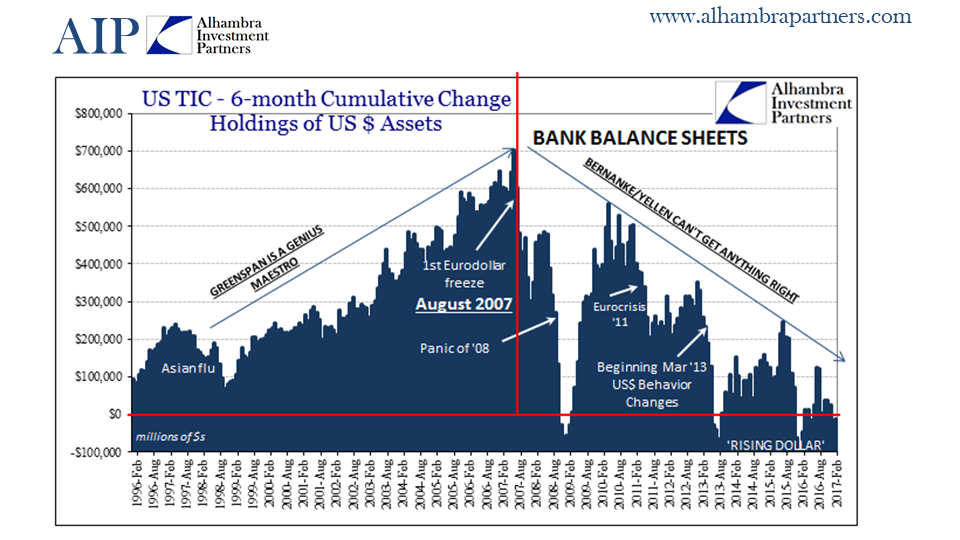
Disclaimer: The views or opinions expressed in this blog post may or may not be representative of the views or opinions of the Financial Repression Authority.

02/10/2017 - The Roundtable Insight: Yra Harris & Peter Boockvar On Implications Of The Border Tax, Dodd Frank Act Changes, And Steepening Yield Curves

FRA is joined by Peter Boockvar and Yra Harris in discussing their predictions for Europe and the actions of the ECB, along with the Fed’s behavior and potential consequences.

Yra Harris is a recognized Trader with over 32 years of experience in all areas of commodity trading, with broad expertise in cash currency markets. He has a proven track record of successful trading through combination of technical work and fundamental analysis of global trends; historically based analysis on global hot money flows. He is recognized by peers as an authority on foreign currency. In addition to this he has Specific measurable achievements as a member of the Board of the Chicago Mercantile Exchange (CME). Yra Harris is a Registered Commodity Trading Advisor, Registered Floor Broker and a Registered Pool Operator. He is a regular guest analysis on Currency & Global Interest Markets on Bloomberg and CNBC. He has been interviewed for various articles in Der Spiegel, Japanese television and print media, and is a frequent commentator on Canadian Financial Network, ROB TV.

Yra highly recommends reading The Rotten Heart of Europe – send an email to rottenheartofeurope@gmail.com to order

41-C4Mqc+8L._SY344_BO1,204,203,200_

Prior to joining The Lindsey Group, Peter spent a brief time at Omega Advisors, a New York based hedge fund, as a macro analyst and portfolio manager. Before this, he was an employee and partner at Miller Tabak + Co for 18 years where he was recently the equity strategist and a portfolio manager with Miller Tabak Advisors. He joined Donaldson, Lufkin and Jenrette in 1992 in their corporate bond research department as a junior analyst. He is also president of OCLI, LLC and OCLI2, LLC, farmland real estate investment funds. He is a CNBC contributor and appears regularly on their network. Peter graduated Magna Cum Laude with a B.B.A. in Finance from George Washington University. Check out Peter’s new newsletter service at www.boockreport.com.

EUROPEAN PREDICTIONS

What has been going on in Europe even with the ECB’s aggressive QE program is that the 2/10 has a far different character from other yield curves like the 5/30. The 2/10 is an investor curve and the 5/30 is much more speculative. Those curves have been steepening out fairly dramatically. Sophisticated investors and speculators are selling into the ECB buying the long end. Usually steepening curves are not good for currency in the short term, because they reflect that the economy is hotter than the central banks have prepared for.

The Greek curve has inverted again, significantly so. That’s sending a signal that the Greeks are having problems on the 2-year end. People are very nervous about Greek’s ability to make it through the next phase of the lending crisis.

There’s a rise in inflation expectation. We know that the markets are testing out the ECB, and that come April their monthly purchases will be reduced 20%. They’re extending the term of QE but on a flow basis they’re cutting it by 20%. Adding it all up, it helps to explain that steepness. You can pick apart that it’s good if it’s responding to growth, and it’s not good if it’s responding to inflation or the ECB backing off. Europe’s been buying less foreign bonds, which implies that they’re buying less of their own bonds. This is happening in the face of the ECB purchases. The Germans are furious that they’re seeing inflation to the extent that they are and the ECB is still going full steam ahead. That pressure is only going to grow.

The overnight deposits at the ECB are at an all-time high, and the repo rate isn’t moving in Europe. People in Europe are very nervous; they’re willing to give the ECB their reserves. This is a great signal that investors are getting nervous. The European equity markets are stalling out and US markets are carrying on like this doesn’t affect them, but any of these problems are systemic in nature at this point. The amount of sovereign debt purchased by all domestic banks in within the old established nations is so bad that if this seizes up, the repercussions will be felt globally.

2016-11-30_12-30-10

EFFECTS OF INTERNATIONAL CAPITAL FLOWS

It’s possible that in times of nervousness that people repatriate money back home. Why else would you have record deposits when you’re being taxed 40 basis points? US money may leave Europe if there’s a problem and come to the US, but European money is not necessarily going to leave Europe if they have their own liquidity and balance sheet issues. Safe haven trades don’t play out the way people think they will, because they’re not one dimensional.

If the US puts on the border tax, the hit to the global financial system would bring on a wave of deflationary liquidation of assets that could really wreak havoc. The main thesis behind the border adjustment tax is that we’re going to tax goods that are imported, not exported, and importers don’t worry because the Dollar will rally 20% which offsets the 20% tax and everything will be fine. But overhauling the US tax code on the corporate side and placing all your chips on foreign currencies and the Dollar is incredibly stupid. Maybe the Dollar rallies, maybe it takes three years to adjust, and in the meantime the economy goes into recession because the price of goods rises to an extraordinary extent on an economy that’s dependent on consumer spending. And you throw in the $10T of Dollar related debt held by companies overseas that will get killed by the strengthening Dollar.

If the Dollar weakens from this border adjustment tax, then the US goes into recession.

CHANGES TO THE BANKING ACT

Banks will still have to hold a lot of capital, and hopefully we’ll have incentives for banks to lend. In terms of effect on the US economy, we still need a willing lender and a willing borrower, and hopefully this will facilitate that.

If you’re a commercial bank, you should have to adhere to the rules. The problem is that if you’re a bank and you want to leverage yourself off, you have to reveal daily what your risk profile is, and you can’t get FDIC insurance if you hit a certain risk level. Banks like everyone else should pay commissary value for the risks they’re taking.

The best part of Glass-Steagall was that it separated commercial banks from investment banks. It’s the small banks that had been most burdened by Dodd-Frank, but it’s the small banks that will hopefully get the most relief from the changes.

FED WOEFULLY BEHIND THE CURVE

The stock market is at an all-time high and the Fed Funds rate is at 0.65%. Historically the Fed Funds rate is 2 points above inflation. Even to get real interest rates back to zero, the Fed Fund’s rate should be at 1.5-2%. In the eighth year of an economic expansion, the Fed thinks negative interest rates is the right policy. That’s extraordinarily dangerous, and the Fed seems to be realizing that they’re caught and if Trump is successful in creating faster growth, it’s going to be hugely inflationary while they sit at 6.5%. They may raise in March, since they’ve shown that they like to raise on the day of a press conference meeting.

A lot of this year is going to be determined by central banks and interest rates, and less so Trumponomics. Germany is doing fairly well, with 1.7% inflation and a 2 year yield that’s negative 80 basis points. Germans should be borrowing money hand over fist to buy hard assets, since that’s where things are going to play out. Yes, the US is going to have tax and regulatory relief, but it’s a played out game. It’s a good value to buy things, in Germany, that have to be vastly undervalued.

Abstract by: Annie Zhou <a2zhou@ryerson.ca>

LINK HERE to get the MP3

Cedargold Image

Disclaimer: The views or opinions expressed in this blog post may or may not be representative of the views or opinions of the Financial Repression Authority.