
Uncategorized
 09/19/2015 - Dr. Marc Faber: Governments Pay Less On Interest Now Even Though Their Debt Levels Are 3x Higher
09/19/2015 - Financial Repression Results From Repressed Interest Rates Set By Unelected Bureaucrats

Mises Institute posted commentary on the Federal Reserve’s decision to hold interest rates .. emphasizes how crazy the situation is today with the decision on the financial system’s most important metric – the Fed Funds rate, upon which so many prices of financial & economic assets depend – being made by a bunch of unelected, unaccountable, anti-market bureaucrats whose identities are completely unknown to virtually all Americans” .. the “elites” of the Federal Reserve“determine the cost of borrowing money across whole economies, we might call that price fixing .. But we live in an irrational world, where the judgments of real economic actors with skin in the game are thwarted by omniscient bureaucrats who openly seek to distort the price of money.” .. quotes Ludwig von Mises on how monetary interventions cannot create prosperity: “Attempts to carry out economic reforms from the monetary side can never amount to anything but an artificial stimulation of economic activity by an expansion of the circulation, and this, as must constantly be emphasized, must necessarily lead to crises and depression. Recurring economic crises are nothing but the consequence of attempts, despite all the teachings of experience and all the warnings of the economists, to stimulate economic activity by means of additional credit.”

09/05/2015 - Is Financial Repression Here to Stay?

The First Chairman of the UK’s Financial Services Authority Howard Davies writes an essay on financial repression .. “Maybe it is unreasonable for investors to expect positive rates on safe assets in the future. Perhaps we should expect to pay central banks and governments to keep our money safe, with positive returns offered only in return for some element of risk.” .. Davies worries about the consequences of financial repression on the economy .. he sees distortions from the prudential regulation adopted in reaction to the financial crisis – “The question for regulators is whether, in responding to the financial crisis, they have created perverse incentives that are working against a recovery in long-term private-sector investment.”
09/05/2015 - The Unintended Consequences of Zero Interest Rate Policy (ZIRP)

David Stockman* rails on the ZIRP policy by central bankers, in particular the Federal Reserve .. points out the St. Louis Fed has just confessed that ZIRP is not helping the main street economy .. “Self-evidently there is no main street emergency, but it is undeniable that ZIRP is the mother’s milk of Wall Street speculation. After all, the money market is where dealers and hedge fund gamblers finance themselves and put on their carry trades. By contrast, no businessman with productive inventories of raw materials, work-in-process or finished goods would be foolish enough to fund his working capital in the overnight markets .. Speculators in tradable financial assets, however, are thrilled to do that all day and night. They know that the shills who run the central bank’s printing press would never allow the money market to be parched for liquidity or allow a temporary surge in the overnight rate to clear the markets of rank speculation.” . this all causing rampant speculative gambling in the financial markets, not to mention distortions in the economy .. & of course financial market bubbles .. “That’s what ZIRP does—-it inflates financial bubbles .. At the end of the day, ZIRP is really not even a monetary policy. In fact, it constitutes a giant, capricious transfer of income and wealth by an agency of the state to borrowers and gamblers at the expense of savers and producers.” .. it’s the unintended consequences of financial repression.
09/02/2015 - Central Bank Repression of Interest Rates is Causing Distortions and Bubbles

Mises posted essay by free market economist Dr. Thorsten Polleit .. explains how low central bank interest rates have been fueling asset price inflation .. emphasizes how the idea of central banks producing fake money out of thin air “induces a recurrence of boom and bust, bringing great misery for many people and businesses and eventually ruining the monetary and economic system” .. it’s all about the unintended consequences of financial repression .. “Central banks — in cooperation with commercial banks — create additional money through credit expansion, thereby artificially lowering the market interest rates to below the level that would prevail if there was no credit and money expansion ‘out of thin air.’ .. Such a boom will end in a bust if and when credit and money expansion dries up and interest rates go up .. To keep the credit induced boom going, more credit and more money, provided at ever lower interest rates, are required. Somehow central bankers around the world seem to know this economic insight, as their policies have been desperately trying to encourage additional bank lending and money creation.” .. Polleit advises a “normalization” of higher interest rates as soon as possible, warns it will be very painful for the economy in the short-run but beneficial in the long-run.
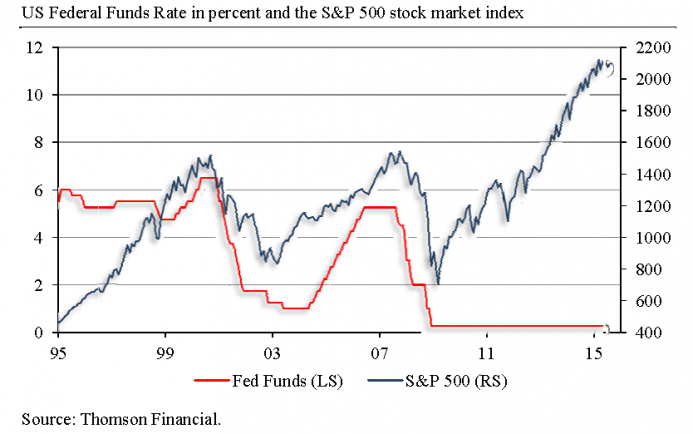
08/22/2015 - The Unintended Consequences of Financial Repression: “The Impossibility of Meeting Return Targets”

Greenwich Associates conducted a study on German institutions .. some quotes from the study:
“The low interest rate environment makes it impossible to meet return targets. We have not yet found a solution.” — German Public Pension Fund.
“Low interest rates are a problem. As a reaction, we have globalized our investments and invested in higher risk asset classes.” — German Foundation
“Primary challenge is the low interest rates. The only chance to avoid this is to do things you didn’t do before.” — German Insurer.
For many institutions in Germany, “doing things they didn’t do before” means investing significant amounts of assets in something other than domestic & government bonds.
08/22/2015 - The Unseen Consequences of Zero Interest Rate Policy
Incrementum’s Ronald-Peter Stöferle explains how central banks with a zero interest rate policy (ZIRP) in place are creating unintenddd consequences & associated adverse risks to investors & retirees .. it’s financial repression .. “With artificial stimulus like ZIRP, we only end up with a situation in which governments, financial institutions, entrepreneurs, and consumers who should actually be declared insolvent all remain on artificial life support.” .. with the unintended consequences being:
1. Conservative investors by nature come under increasing pressure with respect to their investments & take on excessive risks in light of the prospect that interest rates will remain low in the long term. This leads to capital misallocation & the emergence of bubbles.
2. The sweet poison of low interest rates leads to massive asset price inflation (stocks, bonds, works of art, real estate).
3. Structurally too low interest rates in industrialized nations due to carry trades lead to the emergence of asset price bubbles & contagion effects in emerging markets.
4. Changes in human behavior patterns occur, due to continually declining purchasing power.
5. As a result of the structurally too low level of interest rates, a ‘culture of instant gratification’ is created, which is among other things characterized by the fact that consumption is financed with credit instead of savings.
6. The medium of exchange and unit of account function of money increases in importance, while its role as a store of value declines.
7. Incentives for fiscal discipline decline.
8. Zombie banks are created: Low interest rates prevent the healthy process of creative destruction. 9. Banks are enabled to roll over potentially non-performing loans practically indefinitely & can thus lower their write-off requirements.
9. Newly created money is neither uniformly nor simultaneously distributed amongst the population
08/01/2015 - Financial Repression Will Intensify as Central Bank/Government Policy Options Become Limited
Economist Satyajit Das sees increasing methods of financial repression being employed by governments as policy options become limited .. Introduced in 1973 by economists Edward Shaw & Ronald McKinnon, the term refers to measures implemented by governments to channel savings & funds to finance the public sector, lower its borrowing costs & liquidate debt .. Das sees new taxes, means testing, user pay surcharges all coming .. “Entitlement liabilities, such as retirement benefits, will be managed by increasing the allowable minimum retirement age, reducing benefit levels, linking to actual contribution by individuals over their working life, and eliminating inflation indexation. Many of these policies will be packaged as socially and ethically progressive initiatives, belying the financial imperatives.” .. points out in a 2013 study, the McKinsey Global Institute found that between 2007 & 2012, interest rate & quantitative easing (QE) policies resulted in a net transfer to governments in the United States, Britain & the eurozone of $1.6 trillion (£1.03 trillion), through reduced debt-service costs & increased central bank profits – “The losses were borne by households, pension funds, insurers and foreign investors. Households in these countries together lost $630bn in net interest income, with the major losses being borne by older households with significant interest-bearing assets. Non-financial corporations in these countries also benefited by $710bn through lower debt service costs.” .. Das also sees deliberate devaluation as another financial repression mechanism .. regulations are another mechanism: “Governments can legislate minimum mandatory holdings of government securities for banks, pension funds and insurance companies. New liquidity regulations already require increased holdings of government bonds by banks and insurers.” .. wealth confiscation is yet another mechanism – seizing savings or pension fund assets like in 2013 when Spain drew €5bn (£3.5bn) from the state’s Social Security Reserve Fund, designed to guarantee pension payments in times of hardship .. nationalizations are yet another mechanism .. “Debt monetization and the resultant loss of purchasing power effectively represent a tax on holders of money and sovereign debt. They redistribute real resources from savers to borrowers and the issuer of the currency, resulting in diminution of wealth over time. This highlights the reliance on financial repression, explicitly seeking to reduce the value of savings. Ultimately, the policies being used to manage the crisis punish frugality and thrift, instead rewarding borrowing, profligacy, excess and waste.”
08/01/2015 - The Disappearing Retirement Fund

International Man’s Jeff Thomas points to the unprecedented financial & economic challenges & crises in the indebted developed world .. Thomas is very pessimistic about the retirement situation for Americans, Canadians, Europeans .. he thinks their investments in their pension funds will diminish dramatically in value or disappear .. for example, on U.S. social security, “Ergo, each year, those working will need to be taxed more heavily if the system is to continue. Unfortunately, at some point, we reach the tipping point and the concept itself is no longer viable. After that point, benefits will be reduced and, possibly, eliminated altogether.” .. in regard to private pension funds like 401Ks, Thomas sees the risks of a stock market crash as bringing down the value of these funds, even if the funds are so-called “diversified” .. but there’s more – there are now new risks from governments desperately in search of funds to keep their operations & public pensions going .. “When governments find themselves on the verge of insolvency, they invariably react the same way: go back to the cash cow for a final milking. Each of the jurisdictions that is in trouble at present, has, in its playbook, the same collection of milking techniques. One of those will have a major impact on pensions: the requirement that pension plans must contain a percentage of government Treasuries .. Legislation will be created to ensure that a percentage be in Treasuries, which are ‘guaranteed’ .. Sounds good. And people will be grateful. Unfortunately, the body that is providing the guarantee is the same body that has created the economic crisis. And if the government is insolvent, the ‘guarantee’ will become just one more empty promise. Recently, the U.S. Supreme Court ruled that employers have a duty to protect workers invested in their 401(k) plans from mutual funds that perform poorly or are too expensive. By passing this ruling, the US government has the power to seize private pension funds “to protect pensioners”. It also has the authority to dictate how funds may be invested. The way is now paved for the requirement that 401(k)s be invested heavily in US Treasuries.”
07/04/2015 - The Head of India’s Central Bank: Financial Repression Policy of Devaluation Is Being Used to Hide a Worldwide Depression

The Indian central bank chief who saw the financial crisis coming thinks the world is now facing Great Depression-era problems .. Raghuram Rajan*: “Are we now moving into the territory of trying to produce growth out of nowhere? We are in fact shifting growth from each other, rather than creating growth. Of course, there is past history of this during the Great Depression when we got into competitive devaluation .. We have to become more aware of the spill-over effects of our actions and the rules of the game that we have — of what is allowed and what is not allowed — needs to be revisited.” .. it’s financial repression ..

06/27/2015 - Entire Discussion Now Available for FREE – Real Vision TV – THE RESET Watch Raoul Pal & Grant Williams Talk Financial Repression

Global Macro Investor’s Raoul Pal and Vulpes Investment Management’s Grant Williams discuss essentially what we have classified as the 4 pillars of financial repression: repressed interest rates, forced inflation, obfuscation and ring-fencing regulations. The terms they use are a bit different, but the basic concepts are the same.
They discuss the systemic risks to the financial system including the loss of faith in money itself. They explain how massive money printing has distorted financial markets and prices worldwide, especially through the suppression of bond yields by central bank policies.
They also discuss their suggested solutions to investing in this environment – physical gold held outside of the financial system, cryptocurrencies, assets held outside of the concentration of risk in the financial system, investments in the monsoon regions of the world.
This is a fascinating must-watch discussion which will help you understand what is currently happening in the financial markets, the banking system, the investment world and the global economy.
If you want to subscribe within the podcast – Apply Our Discount Code – we are partnered with Real Vision TV and we offer the maximum discount you can get anywhere .. Our Discount Code is as follows: FRA-RV
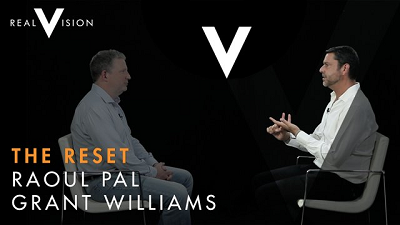
FREE REALVISIONTV PROGRAM SHOW DISCUSSION BETWEEN RAOUL PAL AND GRANT WILLIAMS ON FINANCIAL REPRESSION – NOW AVAILABLE AT NO COST – SIMPLY CLICK THE PODCAST LINK BELOW.
CLICK HERE Subscribe to REAL VISION TV at the lowest possible price: Real Vision was launched to combat the dumbed-down approach to finance in traditional media. It is the world’s first on-demand video channel for finance and our driving ambition is to deliver the highest quality economic, financial, and geopolitical content available. This obsession affords us access to the world’s finest financial minds. Want to see it? See THE RESET by linking here.
If you want to subscribe – Apply Our Discount Code – we are partnered with Real Vision TV and we offer the maximum discount you can get anywhere .. Our Discount Code is as follows: FRA-RV
25% Discount off of $400/Year Subscription = $300/Year
06/14/2015 - Financial Repression: The War on Cash will Accelerate in the next 6 Months

Greg Hunter interviews Gordon T Long .. “We have run out of runway, but never underestimate the ingenuity of a trapped politician and central bankers to come out with new policies and new ways to extend this. We are going to see some pretty violent volatility and corrections. We are going to be in there guaranteeing collateral because our issue is . . . there is a shortage of collateral. The Fed sucked all of the bonds out of the market. There is a shortage of them. So, we have a major liquidity problem. That’s the runway we are running out of, and flows are starting to slow dramatically. Now, that says it’s getting unstable, but that doesn’t mean the world is coming to an end. It does mean we are going to do something else, and one of those things is negative nominal rates and cashless society. That’s the reason why we are going to have a cashless society. You are going to see this (cashless society idea) accelerate in the next six months.” .. 30 minutes
06/13/2015 - Austrian School Economist Carl Menger: “Money Emerges from a Free Market Economy, Not From Government Decree” Dr. Joseph Salerno on The War on Cash

“The free market provides the prospect of an escape from the fiscal police state that seeks to stamp out the use of cash [financial repression] through either depreciation of central-bank-issued currency combined with unchanged currency denominations or direct legal limitation on the size of cash transactions. As Carl Menger, the founder of the Austrian School of economics, explained over 140 years ago, money emerges not by government decree but through a market process driven by the actions of individuals who are continually seeking a means to accomplish their goals through exchange most efficiently. Every so often history offers up another example that illustrates Menger’s point. The use of sheep, bottled water, and cigarettes as media of exchange in Iraqi rural villages after the U.S. invasion and collapse of the dinar is one recent example. Another example was Argentina after the collapse of the peso, when grain contracts priced in dollars were regularly exchanged for big-ticket items like automobiles, trucks, and farm equipment. In fact, Argentine farmers began hoarding grain in silos to substitute for holding cash balances in the form of depreciating pesos.”
– Dr. Joseph Salerno, The Mises Institute
06/13/2015 - The Lessons on Capital Controls from Argentina

Sovereign Man explains how Argentina’s government is bankrupt & has been implementing countless sets of controls including exchange price controls, media controls, exchange controls & capital controls [financial repression] .. “When governments find themselves in financial trouble because of the stupid decisions that they’ve made, their first response is to award themselves even more power to make even stupider decisions. And among the stupidest decisions that any government can make is imposing capital controls .. something that Argentina has in abundance.” .. these capital controls include prohibitions to leave the country with more than U.S.$10,000 in cash & significant paperwork & bureaucracy to wire funds out of the country .. also there is a 30% difference in the official exchange rate with the market exchange rate so that your wired funds leaving the country are effectively 30% less than you think .. “What happens with capital controls: you see a rapid decline in your standard of living as the government traps your savings in a bankrupt system .. It’s like lying on the ground with a blindfold on while the government builds a coffin all around you .. Little by little they fasten together all the sides, and then the top, nail by nail. Capital controls are like a coffin for your savings.”
06/13/2015 - The European Union is Rushing Legislation on Bank Bailins

Michael Snyder highlights what is happening in the European Union – they are rushing legislation (financial repression) for all European Union countries & threatening that if a country does not enact “bailin” legislation within the next 2 months, it will face legal action .. what is a bailin? – it’s when creditors like bank depositors or shareholders lose something to help bail out a bank, instead of the government bailing out the bank .. why 2 months? – because you have Greece ready to default & it could send contagion effects all across Europe .. “Greece will only be just the beginning. In the end, I expect major banks to fail all over Europe as we head into the greatest financial crisis that Europe has ever seen. Bank account holders all over the continent could end up having to take ‘haircuts’, and that would just make the coming deflationary cycle in Europe a lot worse. And I actually expect events in Europe to start accelerating greatly by the end of this calendar year. Apparently the top dogs in the European Union are also concerned about the immediate future, because they are rushing to get ‘bail-in’ legislation passed in every nation in the EU by the end of the summer.”
06/13/2015 - Financial Repression on Americans: Gold-Backed Currencies Available Globally Except for U.S. Residents

John Rubino highlights the recent emergence of BitGold & its purchase ofGoldMoney .. points out this is not the first service or facility of using gold as a payment system – Peter Schiff’s Euro Pacific Bank already allows non-U.S. customers to buy gold and/or silver, store it for free at Australia’s Perth Mint & then use a debit card to spend it .. Rubino: “Not so long ago the U.S. was where innovations emerged before spreading to the rest of the world. But in the realm of sound money and individual financial freedom at least, this is now Siberia. Foreign banks won’t accept American customers because they’re terrified of IRS agents showing up on their doorsteps with subpoenas. And now gold-backed payment systems that are apparently legal everywhere else are closed to Americans. So we’ll have to watch the merger of sound money and modern technology from the sidelines. Outside the U.S., however, gold-backed currency has the feel of an idea whose time has come. And to repeat an assertion made in yesterday’s piece on BitGold, widespread acceptance of these payment systems might generate a positive feedback loop that sends gold much, much higher. So their success will benefit all owners of precious metals, not just the early account-holders.” .. it’s financial repression on Americans especially.
06/09/2015 - Financial Repression Tutorial: It’s about Macro Prudential Policies to Control and Reduce Government Debt

Financial Sense’s Cris Sheridan interviews Gordon T Long* on financial repression .. Gord explains how financial repression is not about conspiracy theories, nor is there some official government policy for financial repression .. it’s happening from macro prudential government policies focused on reducing & controlling government debt .. click on the above chart to enlarge – in the middle you will see the 4 pillars of financial repression – negative interest rates, inflation, ring-fencing regulations & obfuscation .. “Financial repression uses a combination of inflation and government control of interest rates in an environment of capital controls to confiscate the purchasing power of much of the nation’s private savings.” .. discussion on how to protect your investments in such an environment .. 43 minutes podcast .. courtesy thanks to Financial Sense for making this available

“Financial repression is not a conspiracy theory, it is rather a collective set of macroprudential policies focused on controlling and reducing excessive government debt through 4 pillars – negative interest rates, inflation, ring-fencing regulations and obfuscation – to effectively transfer purchasing power from private savings.” – The Financial Repression Authority
06/09/2015 - Mark Thornton on The True Meaning of Financial Repression

Financial Survival Network interviews Mises Institute’s Mark Thornton .. Thornton writes: “With politicians and central bankers seemingly gone mad with their obsession for money printing and ultra low interest rates, it is nice to know that academic economists have a term (i.e., financial repression) for the policies that have created our current economic conditions.” .. the term financial repression dates back to 1973 when 2 Stanford University economists – Edward Shaw & Ronald McKinnon .. identifies 2 major macroprudential policies of financial repression in use – ZIRP or zero interest rate policy of central banks to keep interest rates & lending rates at or near 0 – this makes the interest rate on government debt low .. & the second is QE or quantitative easing is the central bank policy of buying up government debt from banks – this increased demand increases the price of government bonds & reduces the interest rates on those bonds .. Take a look at the frescoes Mark refers to in his article and see if you recognize a parallel to modern America: The Allegory of Good and Bad Government .. 20 minutes
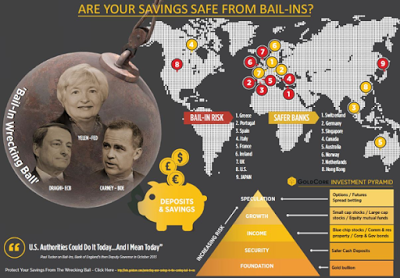
06/06/2015 - Financial Repression Risk: Bank Bailins Are Coming!

Financial Repression Risk:
Bank Bailins Are Coming!
GoldCore update on bank bail-in financial repression developments .
– 11 countries face legal action if bail-in rules
are not enacted within 2 months
– Bail-in legislation aims at removing state responsibility
when banks collapse
– Rules place burden on creditors
– among whom depositors are counted
– Austria abolished bank deposit guarantee in April
– “Bail-in regimes” coming globally
The European Commission has ordered 11 EU countries to enact the Bank Recovery and Resolution Directive (BRRD) within two months or be hauled before the EU Court of Justice – The countries are Bulgaria, the Czech Republic, Lithuania, Malta, Poland, Romania, Sweden, Luxembourg, the Netherlands, France & Italy .. the idea of bank bail-ins is to so that governments do not have to bailout banks again on the next financial crisis.
06/05/2015 - Financial Repression Risk: Bank-based Safety Deposit Boxes

International Man’s Jeff Thomas writes about the increasing level of legislation that controls what individuals are allowed to do with their own wealth – financial repression .. “Many people who see the writing on the wall are doing whatever they can to exit the banking system as much as possible, in spite of the fact that the banking system is essential to most types of economic transactions.” .. Thomas sees a move towards electronic money, away from physical cash .. “After this is completed, confiscations will occur. Again, these will be implemented by the banks. But in order to maximize the amount that will be taken, it will be necessary to force people out of other forms of wealth storage and into bank deposits.” .. Thomas highlights the potential effects on bank-based safety deposit boxes – governments & the banking sector will likely try to herd the wealth from safety deposit boxes into bank deposits to make it easier to do bailins .. “Banks are now a time bomb for depositors. Wealth storage in safe deposit boxes looks to become a thing of the past.” .. Thomas advises non-bank wealth-storage facilities for storing precious metals.