Interviews

03/04/2016 - Dan Amerman: MARGIN RULE CHANGES FORCE NEW PRIVATE FUNDING OF PUBLIC DEBT

FRA Co-Founder Gordon T.Long and Dan Amerman have an in-depth conversation covering various topics such as financial repression, quantitative easing, devious actions of the Fed and much more. Daniel R. Amerman is a Chartered Financial Analyst, author, and speaker, with BSBA and MBA degrees in Finance, and over 30 years of professional financial experience. As an investment banking vice president in the 1980s he did groundbreaking work in the security originations and asset/liability management areas, including CMO/REMIC originations as part of portfolio restructurings for financial institutions, as well as the creation of synthetic securities for institutional clients. As an independent quantitative analyst in the 1990s and 2000s, he structured mortgage-backed bond financings and provided analytical services for real estate acquisitions by multifamily and commercial real estate owners, investment banks, and tax-exempt issuers.

Mr. Amerman is the creator of a number of DVDs and books on finance, including two books published by McGraw-Hill (and subsidiary): Mortgage Securities, and Collateralized Mortgage Obligations: Unlock The Secrets Of Mortgage Derivatives. He has been a speaker and workshop leader for sponsors including The Institute for International Research, New York University, and many banking groups.

Mr. Amerman has spent a number of years in researching alternatives. Drawing upon his background outside the individual investor industry, he has developed an interrelated group of non-traditional solutions – including asset/liability management strategies – for such concerns as financial crisis, inflation, inflation taxes, low economic growth rates, and pervasive low yield markets.

REVISiTING THE EXPANSION OF FIAT CURRENCY

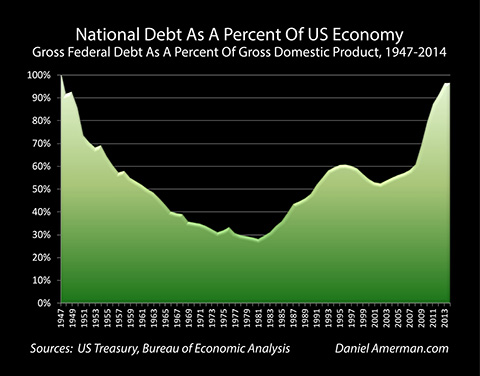
The bigger issue is that we had a change in the national debt super cycle. As of 1947 due to the expense of WWII, the outstanding US debt was approximately equal to the size of the total economy. This is as toxic for a country back in 1947 as it is today.

Historically the growth rate of heavily indebted countries is much slower. It is a slow economic growth and a high interest rate risk environment. This was not just the US alone, this was most definitely global. What world leaders did as a result was get together, and yes Bretton Woods was part of this and they agreed to put rigid financial controls on the population. Effectively the size of national debt was held down for approximately 25 years while the economies experiences periods of substantial growth. Eventually these national debts as a percent of the economy had dropped down to below 30%.

This decline promoted a rapid growth environment, free market interest rate, removal of capital controls, and lifted the limitations on private ownership which we have had since 1973; individuals in the US could not hold gold for investment purposes.

RING FENCING

“You’re not going to keep up with inflation and there is not much you can do about it. That’s the point of ring fencing.”

I split it into two ways. The first is capital controls and second, forcing intermediaries to participate in financial repression. Another component as well is repressing the ownership of precious metals so people do not have an alternative protection from inflation. What’s surprising is that the term financial repression has a conspiracy theory connotation associated with it, when in fact financial repression is an integral part of macroeconomics. It has been a core part of managing financial systems over a long period of time. What’s surprising is that the term financial repression has a conspiracy theory connotation associated with it, when in fact financial repression is an integral part of macroeconomics. It has been a core part of managing financial systems over a long period of time.

In the US in a relatively short period of time, particularly in 2010 all these elements were released for the first time since the 1970s. Interest rates were forced down below inflation by massive government intervention, quantitative easing and forms of capital controls all came out together and as a result dominated the markets ever since. The fascinating part is that there has been a series of developments over the last few months which may be the biggest round of financial repression that we have seen since 2010.

“Ring fencing which I consider as the third pillar is the forced participation of financial intermediaries in the name of public safety. Two key developments were what came out in 2015 was that the Fed has a part of the financial stability board. This board is the G20, the IMF, World Bank combined and all simultaneously agreed to change their money fund policy as well as their margin rules.”

Ring fencing which I consider as the third pillar is the forced participation of financial intermediaries in the name of public safety. Two key developments that came out in 2015 was that the Fed has a part of the financial stability board. This board is the G20, the IMF, World Bank combined and all simultaneously agreed to change their money fund policy as well as their margin rules. They changed regulation on money funds which are apparently done in the name of public safety such that it was an expensive burden for any funds to use anything other than federal debt for their money funds. Effectively creating an enormous financial advantage.

“This is a classic scenario. Take a financial intermediary and in the name of public safety make them hold US government debt.”

This is a classic scenario. Take a financial intermediary and in the name of public safety make them hold US government debt. In doing this you have expanded the market for government debt by whatever the net change is. Essentially locking in an additional trillion dollars of funding for the debt.

“A key thing to make note of is that these are all financial intermediaries, so when people ask who is funding the debt, the answer is all of us are.”

We are essentially financing the government through an intermediary. By changing regulations they are both increasing the relationship and locking into it. At this short term end of the yield curve we are doing this for virtually no yield whatsoever. We are providing the money to the federal government through an intermediary whose participation is forced.

FORCED MACROPRUDENTIAL POLICIES 

“They are forcing ever lower interest rates on more of the population. This is providing larger low-cost funds to the government in an ever more constrained manner where it becomes harder for people to escape.”

On Nov 12, 2015 the financial stability board agreed to implement margin rule changes. They were talking about it being a blast from the past, it was what central banks used to do in the 1970s. This is now brought back out, but in this case it is also an expansion of the mandate of the Fed. Where we are with these changes is that the Fed will be without active congress and expanding their control over the US markets to all investment firms to participate in some sort of secured lending.

Financial firms often need cheap money on a short term basis. They can sell a treasury security to someone else at a given price and agree to buy it back at a higher price; in effect it becomes a short term loan. The difference in price is the interest rate that they are paying, this can be done without an actual sale and instead with the pledge of the securities as collateral.

“Central banks are concerned that these low quality collateral loans are now considered to be at risk for triggering a new financial crisis. That’s why they’re changing the regulations where they have the ability to change margin rules at will.”

The best known forms of margin deal with stock ownership where your borrowings become limited. If this was raised to 60% or 70% to bring down stock values, people will have to scramble to sell these securities or they will have to come up with the additional cash through some other means, otherwise there will be a forced liquidation.

What has been created is a major incentive to use US treasuries securities as collateral for repurchase agreements. Once everyone does this then you get a situation where the Fed is no longer in control of leverage in the market.

PREPARING FOR THE FUTURE

Funding for US national debt has just increased by $2.5 trillion. This is very similar to something that is far controversial and that is quantitative easing. Total US treasuries securities held by the Fed are between 2.4 to 2.5 trillion. They are holding this approximate level because they say they are not doing quantitative easing and rather doing purchases every time they take principal to keep at that level. This was major news and made headlines throughout the world, yet something just as big happened and nobody noticed; this is a forced funding of the federal debt that is just as large as what happened with QE.

“The Fed is in the process of deploying two massive stabilizers. Why are they doing this in 2016 when they hadn’t done so in 2010?”

The logical interpretation would be they are very concerned of what’s to unfold in the future. They are pre-emptively moving major stabilizers in place.


To follow Daniel Amerman and his work, please visit http://danielamerman.com/aHome.htm

Abstract written by, Karan Singh

Karan1.singh@ryerson.ca

Disclaimer: The views or opinions expressed in this blog post may or may not be representative of the views or opinions of the Financial Repression Authority.


02/26/2016 - Reggie Middleton: OBSOLETING BANKS, BROKERS, CLEARINGHOUSES & EXCHANGES

FRA Co-Founder Gordon T. Long has an in-depth discussion on the future of Bitcoins and Block Chain technology with serial entrepreneur, Reggie Middleton. Middleton’s experience has given him the ability to recognize value, or the lack thereof, well before much of the professional populace. His ability to identify opportunity and his “out-the-box” mind-set are due to years of entrepreneurial pursuits in insurance, financial valuation/modeling, technology, media, and real estate. He is the founder of Veritaseum and the finance and technology blog, Boom Bust Blog. Until 2011, he wrote about financial evaluation and the global financial crisis at the Huffington Post.

After graduation with a degree in business management from Howard University, he worked for Prudential Insurance and trained in the sale of financial products. Since then, he worked in the fields of financial securities and risk management. He was also a significant investor in residential real estate.

Middleton is known for making predictions about the crash of markets and large financial institutions long before they occur. Aaron Elstein of Crain’s New York Business said “Mr. Middleton has been startlingly accurate in the past. He forecast the collapse of the housing market in 2007, and in early 2008 warned of the demise of Bear Stearns weeks before it happened. Earlier this year, he said that Ireland’s finances were in terrible shape long before Standard & Poor’s got around to downgrading that nation’s credit rating.”

In 2007, he founded Boom Bust Blog, a commercial financial advisory reported to have over 3000 subscribers. In February 2013, he won CNBC’s first-ever stock draft competition, beating out six other professional traders. He then went on to win the second CNBC stock draft in 2014 by an even larger margin, beating out all other professional participants.In 2014, he founded his current venture, Veritaseum, the progenitor of UltraCoin technology. According to Mr. Middleton, UltraCoin exploits modern cryptography in the fields of finance, economics and value transfer to disintermediate legacy financial institutions such as Wall Street banks.

THE EUROPEAN BANKING SYSTEM

“The problems from 2006-2009 are the same problems we have now.”

I call it the great global macro experiment. Authorities attempted to do things they have never done before. Things such as negative interest rates and particularly QE which was a practise adopted from the Japanese. It is important to note that Japan began QE within their economy 30 years ago and still to this day the desired results from it have not been achieved; Japan is still fighting inflation.

“Central bankers believe that if they prolong the problem long enough they can export their economic problems to other countries, not realizing that it is a global economy.”

The way it works is, we have a bubble; and a bubble is defined as an instance when prices shoot above the fundamental value of the good or service. Once this bubble pops and instead of allowing a natural reset of prices and value, instead people try to further push prices up.

Blockchain Technology

“It is essentially bitcoin revamped with a different name.”

Bitcoins underlying foundation is essentially a new way of dealing with databases. It is a database that is distributed amongst many individuals. In essence it is a database run by 3 million machines which each shares a full copy of the database and each having full functionality of the database.

With this much territory, you get a system which cannot be taken down by a single or even multiple authorities. In addition it solves something called the “double spending problem” which is the risk that a digital currency can be spent twice.

Double-spending is a problem unique to digital currencies because digital information can be reproduced relatively easily. Physical currencies do not have this issue because they cannot be easily replicated, and the parties involved in a transaction can immediately verify the bona fides of the physical currency. With digital currency, there is a risk that the holder could make a copy of the digital token and send it to a merchant or another party while retaining the original.

This was a concern initially with Bitcoin, since it is a decentralized currency with no central agency to verify that it is spent only once. However, Bitcoin has a mechanism based on transaction logs to verify the authenticity of each transaction and prevent double-counting. Bitcoin requires that all transactions, without exception, be included in a shared public transaction log known as a “block chain.” This mechanism ensures that the party spending the bitcoins really owns them, and also prevents double-counting and other fraud. The block chain of verified transactions is built up over time as more and more transactions are added to it.

“The bitcoin and block chain technology now parallels what the internet was in 1993. Most people didn’t get it and if they did get it they strictly thought of the internet as email; fast forward and look where we are now with the internet. Bitcoins and digital currencies are a way of transferring value.”

INDEPENDENT GLOBAL BANKING

Certain strong regimes such as the US, Germany and Britain have attempted to impose their limitations. An example would be the US with peer-to-peer file sharing halting the activities of The PirateBay. This was possible because it was a centralized server which was easy to target. But now we are in an environment that has similar things with millions of hubs and files are transferred in a huge web. This is near impossible to take down therefore the law was broken and governments and authorities resorted to illegal means to halt these new developments, it is unclear still as to how successful they were.

“It is about adapting to paradigm shifts. History shows that entities that fight or prevent these shifts will not be successful and eventually be forgotten. Microsoft is a good example of a top tier company which sustained two paradigm shifts and this was because of all their patents and so much of the world using their services.”

The banks are taking bitcoin technology and trying to incorporate it into their business models. It will make many processes faster but at the same time, you do not need banks to make transactions anymore. Therefore no matter how much more efficient banks become, if they become obsolete than the increased efficiency is of no good.

“The banks are following the same route with banking as AOL did with the internet. Ultimately the end result will be no different as well.”

If you charge a correct risk payment for capital, a bank could never get big enough to take down the world because it wouldn’t be able to afford to take that risk. If I can get money at 75 basis points then I would take all the risk in the world and if I mess up I only have to pay 75 basis points; there is no reason not to take risk. But if I paid 18-25% for that money I would become far less risk averse.

“Bring back true fundamental market analysis, natural market economics and the system solves itself.”

FUTURE OF BITCOIN AND BLOCKCHAIN

At the end of the quarter we are launching an HTML client which allows you to hold assets in your device on a webpage. It is like having a bank account on a webpage that sits on your device and it cannot be stolen unless it is stolen from you directly.

Additionally we will be launching applications of block chain technology to capital markets. We plan to have applications for credit, peer-to-peer swaps and for real estate transactions in beta of md-year but definitely by year end.

There are legal issues but we can get passed these issues by putting actual cash within the block chains. It will increase the efficiency to facilitate cash flows from various kinds of investments. It is a way of eliminating banks from the equation.


Abstract written by, Karan Singh

Karan1.singh@ryerson.ca

Disclaimer: The views or opinions expressed in this blog post may or may not be representative of the views or opinions of the Financial Repression Authority.


02/22/2016 - Graham Summers: 2008 was just a warm up for what is ahead!

Graham Summers is the Chief Market Strategist with Phoenix Capital Research in Washington, DC. Phoenix capital research is an investment research firm, that has clients in 56 countries around the world, specializing in investment research on a subscription basis.

Japan‘s NIRP announcement & the US$

Japan is at the forefront of the Keynesian central planning that has been in the markets for the past few decades. The federal reserve first went to ZIRP and launched quantitative easing in 2008. The European central bank went to ZIRP and they launched QE in 2015. The bank of Japan first went to ZIRP in 1999, in which they then launched quantitative easing in 2000. They’re much more experienced in seeing what these sorts of policies can accomplish.

A week or two before NIRP was announced, Kuroda, the head of the Bank of Japan announced that Japan’s potential GDP growth was 0.5% or lower, which is an astounding admission, implicitly admitting that no matter how much money is printed or what monetary policy will be used, Japan’s GDP will not and cannot break above 0.5%.

Graham states, “From a psychological perspective, this is like a central banker saying, ‘we don’t have the tools required to generate economic growth’ – Similar to a doctor saying, ‘no matter how much medicine you take you won’t possibly get better’.”

That was the beginning of the end. “It wasn’t too surprising for me that shortly thereafter when the Bank of Japan went to NIRP, the market reaction was terrible. When you reach the end game for central banking omnipotence, there are no longer positive results from central bank policy.”

“Anytime you cut interest rates, or launch quantitative easing, there will always be negative as well as unintended consequences. The one positive consequence since 2008 is that when these policies are launched, stocks go up” “None of these policies really generate economic growth, they’re all about the bond bubble”

CaYHMomUUAAbnw8

Graham mentions that when Kuroda launched NIRP, the positive consequences of that policy which is the Japanese stocks rising, only lasted one day. The negative aspects exist, and Japan has since had to cancel a bond auction due to a lack of interest, which in Japanese history, has never happened. Meaning that Japan was not able to sell it’s debt on the markets because investors did not want to buy bonds at a negative yield. “When the crisis hit in 2008, all central banks coordinated their responses, however, this was in a fiat world, where everything was relative. All the policies consisted of currency debasement,  with the idea of inflating away debt payments.” The problem with this is that when any one country launches any policy, it has an adverse effect on the currency against which their currency trades.  The most obvious example being the euro vis-à-vis US federal reserve and the dollar. The euro represents 56% of the value against which the dollar trades, if the ECB does anything to push the euro down, the dollar would naturally go up. The bank of Japan and the European Central Bank employing NIRP, should be very dollar positive. However, for years hedge funds have been betting very large leveraged sums that are shortening the yen and going long on the Nikkei, when the Bank of Japan implemented NIRP and the negative consequences occurred, that trade began to surge, as did the yen, and the Nikkei collapsed. What this has done is forced very many institutions and hedge funds to liquidate their positions.

“We are seeing the yen soaring and the dollar is falling as a result. That is not based on any fundamentals, that is just liquidity sloshing around the system. From a global perspective, what the bank of Japan did should be very dollar positive and I believe it will be proven to be the case”

sc-3

“We are in such a central planning oriented world that what has been driving markets in the short term is perspective on what central banks are going to do.”

An Imploding Bond Bubble

The bond bubble is the bedrock of the financial system, it is over $100 Trillion in size, and is going to take years to deflate. The first wave of deflation was the high yield bond market, which has begun to implode. It will also feature emerging market corporate debt defaulting. Slowly, one by one each foot will fall until we will reach the sovereign bond default but it will take months, if not years.

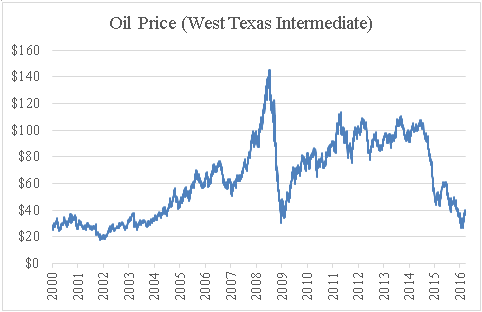
“Oil experiencing a 60% price collapse in about a 6 month period in 2014, was really the bond bubble, the junk bonds in the energy sector blowing up. The bubble we’re dealing with right now is the crisis to which 2008 was the warm-up, and it will take much longer to unfold than people think.”

Gold

Gold was in a bit of a bubble in 2011, it was so far overextended above it’s overall bull market trend line, it was bound to collapse. When that collapse is combined with central bank manipulation and the effort to suppress gold, you’re going to see an asset class struggle for years to find it’s legs again.

Since China devalued the Yuan in August – September, gold has begun to outperform stocks. Since Japan went to NIRP this process has accelerated dramatically. It appears for the last 6-7 years, investors were loading into stock as a hedge against central bank policy, and gold would also benefit from this. This trend reversed in 2011, investors continued to use stocks as a hedge against central bank policy, but they abandoned gold. That seems to have reversed, investors are now moving into gold as a hedge against central bank error and stocks are suffering. The reason gold is having such a dramatic move is that the gold market is so much smaller than stock, that when you start seeing large scale chunks of capital moving into gold, the movements become very significant.

Custodial Risk

Graham explains that custodial risk is the question of what an individual actually owns. He uses the example of buying stock and how individuals no longer receive a paper certificate, and the assets are held digitally, usually in a broker’s account.  If the financial institution who is sitting on these assets for you, goes out of business, what are people to do with their money? Graham illustrates that gold and physical cash is so appealing due to the lack of custodial risk.

“Central banks hate physical cash because the custodial risk does not exist”


Disclaimer: The views or opinions expressed in this blog post may or may not be representative of the views or opinions of the Financial Repression Authority.


02/19/2016 - Leo Kolivakis: Financialization is causing Inequality, which is limiting aggregate demand growth!

Gordon T. Long, Co-Founder for the Financial Repression Authority,  interviews Leo Kolivakis, Publisher and Editor of the Web Site “PensionPulse.blogspot.com“. Mr. Kolivakis is an independent senior economist and pension and investment analyst with years of experience working on the buy and sell-side.  He has researched and invested in traditional and alternative asset classes at two of the largest public pension funds in Canada, the Caisse de dépôt et placement du Québec (Caisse) and the Public Sector Pension Investment Board (PSP Investments). Also Mr. Kolivakis consulted the Treasury Board Secretariat of Canada on the governance of the Federal Public Service Pension Plan (2007) and been invited to speak at the Standing Committee on Finance (2009) and the Senate Standing Committee on Banking, Commerce and Trade (2010) to discuss Canada’s pension system.

You can follow his blog posts on Bloomberg terminal and follow Mr. Kolivakis on twitter @PensionPulse where he posts links about pension and investment articles.

In this 45 minute video interview Leo Kolivakis discusses the importance of a good pension system with strong governance being critical in insuring the average persons retirement security.  Pension liabilities are going up while bond yields are going lower which is going to create a huge amount of stress on pensions!

Contributory Pensions and 401Ks have proven to be a failure compared to Defined Benefits programs. History will eventually show that the transition from Defined Benefits to Contributory Benefits was in fact is detrimental to the global economy.

Structural Issues

Leo Kolivakis believes we have entered a period of long deflation due to six major structural issues:

  • The global jobs crisis
  • Aging demographics
  • The global pension crisis
  • Rising inequality
  • Technological Advances
  • High and unsustainable debt all over the world

Each of these structural factors is significantly contributing to global deflation.  Together they are a domino effect, exacerbating deflationary headwinds in the world.  They are causing rates to remain ultra low and will continue to for years to come .

Rising Inequality

What is not understood and fully appreciated by economists is how the dramatic rise in inequality brought on by low interest rates is limiting aggregate demand growth.

Investing in an Era of Low Aggregate Demand

Bond yields are going lower to negative and you must prepare for a lower returns, for a very long time

Question:  If rates remain ultra low, won’t that be good for residential and commercial real estate?

“Not necessarily. If deflation becomes entrenched, low rates will exacerbate debt and increase unemployment at the worst possible time. It can easily spiral into a debt deflation crisis and you’ll see rising vacancy rates and/ or declining rental rates. In this environment, real estate is the asset class that makes me most nervous.

But it’s not just real estate that will suffer if deflation becomes more entrenched.

“All asset classes will exhibit a prolonged period of low or negative returns except for…good old nominal bonds!”

02-12-16-FRA-Leo_Kolivakis-00-CGraphics

Ultra Low Rates For Years?


Abstract written by Joshua Brown-Tapper

Joshua.BrownTapper@ryerson.ca


Disclaimer: The views or opinions expressed in this blog post may or may not be representative of the views or opinions of the Financial Repression Authority.


02/19/2016 - Dr. Marc Faber: “They Will Bankrupt the World!”

Dr. Marc Faber joins FRA Co-founder Gordon T. Long in an exciting discussion of monetary malpractice, negative interest rates, the influence of current geopolitical risk and much more. Dr Marc Faber was born in Zurich, Switzerland. He went to school in Geneva and Zurich and finished high school with the Matura. He studied Economics at the University of Zurich and, at the age of 24, obtained a PhD in Economics.

Between 1970 and 1978, Dr Faber worked for White Weld & Company Limited in New York, Zurich and Hong Kong. Since 1973, he has lived in Hong Kong. From 1978 to February 1990, he was the Managing Director of Drexel Burnham Lambert (HK) Ltd. In June 1990, he set up his own business, MARC FABER LIMITED which acts as an investment advisor and fund manager.

Dr Faber publishes a widely read monthly investment newsletter “The Gloom Boom & Doom Report” report which highlights unusual investment opportunities, and is the author of several books including “ TOMORROW’S GOLD – Asia’s Age of Discovery” which was first published in 2002 and highlights future investment opportunities around the world. “ TOMORROW’S GOLD ” was for several weeks on Amazon’s best seller list and is being translated into Japanese, Chinese, Korean, Thai and German. Dr. Faber is also a regular contributor to several leading financial publications around the world. A regular speaker at various investment seminars, Dr Faber is well known for his “contrarian” investment approach. He is also associated with a variety of funds and is a member of the Board of Directors of numerous companies.

JAPANESE NEGATIVE INTEREST RATES AND THEIR GLOBAL IMPLICATIONS

“It’s an experiment by few mad professors that occupy senior positions in central banks.”

Over the last 5000 years of recorded human history, interest rates have never been as low as they are now. The time value of money is the natural state. It is the markets way of pricing today’s money and the future’s money.  The higher the uncertainty of future money is, the higher the rate of interest will be. What central banks are doing at the present is incomprehensible to me, unless it means an expropriation of money.

The central banks in their madness believe this will result in economic growth. But in reality it will force people to become insecure. For example if you received 6% on your money, and then rates become zero and in this case become negative which in other words you’re being penalized for your deposit. Does that rate make you save more or spend more? One thing I will never understand is despite us having democracies, somewhere, somehow, the system has given so much power to a bunch of well understood, unelected academics and most of them have never worked for the private sector for a day. The Fed, Bank of Japan, ECB are all likeminded people; they all believe money printing boosts economic activity and tight money is negative.

“They will bankrupt the world.”

We do not know how badly it will end, but an interesting thing to note is if you look at the 2008 financial crisis, which sector got the most bailout money? It was the banks and the fund managers. Then you look at the performance of their stocks, it is a disaster. Bailout money and money printing doesn’t help at all. In fact it has made matters worse for the average American. I side with Americans who support Bernie Sanders because he is expressing the views of ordinary people that the Wall Street guys and the banking lunatics have essentially cheated the people.

“In every instance where they have negative interest rates, the exact opposite of the objective occurs.”

This view of central banks to distort the free market and capitalist system is a view of the paternalist; some people that think they know better.  They think they can steer the economy like how you would drive a car.

FED RAISING RATES

“As a working man it is hard to believe the world has handed so much power to a bunch of ignorant and arrogant people.”

Firstly Janet Yellen was the president of the San Francisco Federal Reserve which is in charge of California, Arizona, Nevada and another state. In her district we had the biggest real estate bubbles ever. Now she is the Fed chairman and slashed interest rates. We have had eight years of zero interest rates, and now she increases it by a quarter of a percent which is meaningless. She should have increased rates when there was a strong recovery in 2010 and 2011 but she waited. She waited right until the world is entering a very deep recession. She will go down and have a front portrait in a museum as a central bank failure.

IMPLICATIONS OF MONETARY MALPRACTICE 

“There are reasons to believe that central banks will go bust.”

Systemically I think they have allowed the debt level to expand, particularly they have allowed government credit to expand as a percentage of the economy. You have to understand that when you try to supress individual risks in a system, eventually you end up with systemic risk. We will eventually have a huge crisis and investor will not know how to deal with it.

People like Bernie Sanders are not blaming the Fed, they are blaming Wall Street. In other words they are blaming rich people for the hardship or ordinary people. The Fed essentially threw money at Wall Street and naturally they kept it for themselves. Yes, there is a trickle-down effect which makes them give their waiter a slightly larger tip; it is insignificant.

ISSUES OF CURRENT GEOPOLITICAL RISK

“Everything the US touched in the Middle East and Central Asia, from Afghanistan to Iraq, Syria, Egypt and Lebanon, it all turned into a complete disaster.”

The Neocons had this brilliant idea to start making trouble in Ukraine, not understanding it is Russian territory and historically until the early 20th century Ukraine was part of Russia. Also not understanding that Crimea is of huge strategic importance to Russia, just like what California is to the US. Russia will never give up Crimea, I can promise you that. This is because it is a warm water port and they need it to have the access to the Mediterranean, without it they are at the mercy of America.

The Europeans are equally as incompetent. Angela Merkel just follows the US without understanding she is hurting the business interest of Germany. Russia and Germany were historically, culturally and politically very close. The interventions are very poorly thought out.

In the case of China, it is the second largest economy in the world with a population of 1.3 billion people. It is a highly advanced economy, especially in defense technology. A pivot to Asia by the US is seen by the Chinese as an aggression. It is a threat to the sovereignty and security of China  which has created another set of geopolitical tensions.

FEAR OF A COLLAPSING PETRODOLLAR

Under Mr. Greenspan the central bank enjoyed a lot of prestige. He had done better than his predecessors; his only major mistake was deliberately creating the NASDAQ bubble.

“However, Bernanke and Yellen are complete chaos. I don’t actually believe that they make the decisions; they are told by someone what they should do.”

It is difficult to tell what people think but if you look into the Japanese negative interest rates, the intention was to weaken the Yen. Not that the weak currency helps anyone, but by slashing interest rates and having them below zero 10yr Japanese bond will cause you to lose money unless the Yen appreciates. The idea was to have negative interest rates cause the Yen weaken but it actually strengthened.

INVESTMENT OPPORTUNITIES IN ASIA 

The area of Indochina is a boomtown. Not Thailand but Cambodia exports are rising at about 20%/annum. Vietnam has huge inflow of foreign direct investment, partly because the Taiwanese, Koreans and Japanese can invest in Vietnam and produce goods there.

There are a lot of investments coming from China and South East Asia. The US is afraid of China gaining too much influence in that part of the world so they waste money there by trying to displace the Chinese.  The Chinese will go to Cambodian government and say they are going to make a road or a bridge and in 6 months it will be built. Whereas the US will send a team of useless characters to go check out the scenery then come back in 3 months to check out more scenery and 5 years later nothing will have been done. All the while in this time the Chinese will have built roads, bridges, tunnels and all kinds of infrastructure.

ADVICE FOR INVESTORS

“My advice is to have a diversified portfolio. You have to have some equities, some bonds, real estate and precious metals.”

In my view it will not end well. This era of artificially low and market distorting interest rate structure will end terribly. There is a popular notion now of ‘sell everything’ but this is a flawed idea. You sell everything and you have all this money now, what will you do? Deposit it in banks? What happens when the bank goes bankrupt? In practise it is very dangerous to have all your money with one bank.

Abstract written by, Karan Singh

Karan1.singh@ryerson.ca


Disclaimer: The views or opinions expressed in this blog post may or may not be representative of the views or opinions of the Financial Repression Authority.


02/10/2016 - Felix Zulauf talks Financial Repression & Warns of What is Ahead

FRA Co-founder Gordon T. Long recently interviews Felix Zulauf, Founder and President at Zulauf Asset Management AG. 

FELIX ZULAUF has worked in the financial markets and asset management for almost 40 years. He started his investment career as a trader for a large Swiss Bank and received training in research and portfolio management thereafter with several leading investment banks in New York, Zurich and in Paris. Felix joined Union Bank of Switzerland (UBS), Zurich, in 1977 and held several positions over the years including managing global mutual funds, heading the institutional portfolio management unit and at the same time acting as the global strategist for the UBS Group. After two years with a medium-sized Financial Organization as a member of the executive board, he founded his wholly owned Zulauf Asset Management AG in 1990, allowing him to independently practice his own individual investment philosophy.

Mr. Zulauf focused on macro and strategic issues within the firm. In spring 2009 Zulauf Asset Management was split in two parts and Felix Zulauf fully owns the split-off Zulauf Asset Management AG focusing on some advisory activities to selected family offices and institutions including a US based global macro fund. Felix Zulauf always believed that the world economy and the financial markets move in cycles. That has helped him avoiding all the major casualties in the financial markets since the 1973/74 bear market in equities. He has been a member of Barron’s Roundtable for over 20 years.

QUESTION: How would you define Financial Repression?

FELIX ZULAUF: “Financial Repression is an attempt by the government and central banks to reduce free market forces and the freedom of individuals to do what they would do if they had the free choice.  It is compounded by market manipulations such as money printing, regulations, and distorting the interest rate; which are the best capital allocator there is and much better than any committee or central bank. Government authorities force capital to be allocated wherever they want capital to be allocated and not where the market would allocate it. It is the beginning of an era that will lead to decisive decline of prosperity and individual freedom.”

QUESTION: What type of economist would you consider yourself?

FELIX ZULAUF: “I am closer to the Austrian School. It is important to know that economies and financial markets do not progress in a linear way. They are cyclical; there are expansions and contractions and recessions have the job to remove the excessive build up in expansions. Bear markets have the same job, to reduce excess in boom markets. This is a very natural action and reaction process.”

QUESTION: You wrote the following – could you elaborate on it:

FELIX ZULAUF: “At some point in time we have to get rid of the debt that we have. Obviously central banks are trying to do that by financial repression. The consensus among the investment community is that financial repression will work. I’m not so sure. Financial repression means that they put interest rates below the inflation rate, and by doing that the debt-to-GDP level of the different segments in an economy, the households, governments, etc., drops down over time. I’m not sure that policy will be successful, but for some more years they will try that. If it doesn’t work, then we will go into other things such as currency reforms, confiscation .. It’s very hard to imagine the world will solve its problems in a conventional way. More likely we will see more government controls on capital flows as things get out of control over time.”

Central banks have used mechanisms to reduce the level of debt ration within the economy. They have tried these mechanisms for many years and it hasn’t worked. You have seen some deleveraging in parts of the world economy, but in total the world economy has leveraged more.  Debt to GDP is the highest level it has been in modern history and therefore this route the central banks have taken has failed.

QUESTION: Where are we in the possible outcomes you warned us of?

FELIX ZULAUF: If it unfolds in a free market mechanism fashion then it would lead to massive bankruptcies but I doubt the authorities will allow this to play out be cause it can lead to a systemic collapse. I think eventually there will be another burden on taxpayers and there will be attempts to confiscate some of the wealth out there through whatever means they can think of to bring down and finance the debt. The bottom line is in the future we will be less wealthy.

QUESTION: How will the leverage failure unfold?

FELIX ZULAUF: I don’t know if there is a way to escape. Even if you made all the right decisions and came out a winner and were able to preserve your capital, they would most likely tax you on whatever gains you make. Ideologically, we are in a very highly socialist environment.  You have to have a certain diversification as an investor and you have to make sure you’re in the right jurisdiction.

QUESTION: How can the fed raise rates into a economy where broad fires are burning especially in credit markets?

FELIX ZULAUF: Quantitative easing does not work. You cannot fix the problems rampant in today’s economies by printing mass amount of money. You have to solve problems from a political and economic angle but not by printing money. I don’t expect any further rate hike by the Fed, they are attempting normalize but it won’t work because the economy is soft. They have tried and I think it is becoming more and more apparent to them that money printing does not work. Rather than money printing I think they have adopted a bond yield target. Central banks are tired of QE, they realize they have to leave some pressure on the economy, politicians, and entrepreneurs move forward and make the necessary decisions. I don’t think this is a good message to the financial markets, because it means the financial markets have to suffer more pain until the central banks come in and attempt to fix the system again.

QUESTION: What does the BOJ’s recent announcement of NIRP signal?

FELIX ZULAUF: With the world economy growing at such low rates, we have a risk of running into systemic growth again. I suspect the Chinese will eventually let the currency go and then you have another deflation hit the world economy, this is when you run into another systemic crisis.

Letting the currency go and letting the currency find its own equilibrium will lead to a central bank crisis. This affects pricing power and when pricing power is affected it trickles down to profit margins, and therefore corporate earnings are going to decline.


Abstract written by, Karan Singh

Karan1.snigh@ryerson.ca

Disclaimer: The views or opinions expressed in this blog post may or may not be representative of the views or opinions of the Financial Repression Authority.


02/06/2016 - John Charalambakis: IT’S ABOUT RISK MITIGATION & CAPITAL PRESERVATION!

John Charalambakis is the Managing Director of Black Summit Financial Group, a boutique style asset and wealth management firm, which focuses on risk mitigation, capital preservation and growth through strategies that are rule based. Dr. Charalambakis has been teaching economics and finance in the US for the last twenty years. Currently he teaches economics at the Patterson School of Diplomacy & International Commerce at the University of Kentucky.

FINANCIAL REPRESSION

“The outcome of financial repression is when the role of the markets is diminished because of the actions of central authorities, such as central banks.”

Slide6

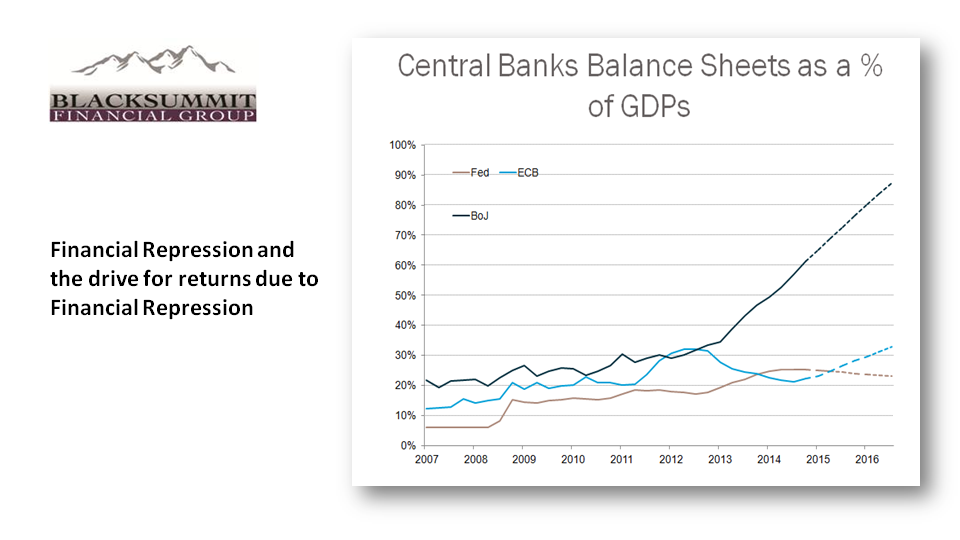
Fed: Central banks of the United States, ECB: European central bank, and BoJ Bank of Japan

Assets under management have skyrocketed from about 7% in 2007 for the U.S Fed, to over 20% as of the end of 2015, increasing 3 times. Over this time, the GDP did not equally increase 3 times. This increase eventually leads to a greater role of central authorities. Looking at Japan in 2007, they had about 20% of their GDP in their balance sheet, currently they have over 90%, meaning the role of the markets is diminishing and the role of central authorities is increasing, creating financial repression.

Gord asks John what assets people should invest in, in this era of financial repression that would create a store of value, which may not bring in a yield, but would preserve their money.

GOLD – INTRINSIC VALUE ASSETS

“I think the goal of any pension fund, institutional or private investor should be capital preservation. Assets should have intrinsic value.”

“Assets that have intrinsic value such as gold or silver, historically have retained their value especially in times of crisis.”

John mentions how the price of gold in 2009 rose from about $500-$500 to $1900 because investors were seeking a safe haven of intrinsic value assets. “There is not enough gold for everyone. Only 1/3 of 1%, a miniscule number, is invested in precious metals.” Hypothetically if every manager by the end 2016 would invest just 3% of their wealth into precious metals, the price of gold would rise to an estimated $2700. Growing demand and financial stress can, and likely eventually will, create a financial crisis.

KEY PRINCIPLES OF THE AUSTRIAN SCHOOL OF THOUGHT

  • Uncertainty is endogenous in the markets, and therefore investments should be based on rules. “Regardless of where the market temporarily may be moving, the investor, whether individual or institutional, should be guided by rules.”
  • Investors, whether fortunately or unfortunately, are emotional beings, therefore there are psychological deficiencies caused through emotions, effecting investments. Due to these emotional deficiencies, investors must be disciplined, and once again be guided by rules
  • The conventional methodology of 60/40, stock and bond rule is not adequate. It ignores the risk parity considerations. Investors should shift their portfolio based on the macro environment of risk, in order to take advantage of the more promising and safe investment at the time being. John mentions that in 2009-2011 bonds gave a much better return, because money had left stock and shifted to bonds. It also ignores the potential black swan phenomenon. A black swan phenomenon is likely to happen again and in greater frequency than we’ve seen before, we need to be prepared and eventually hedge our portfolios in such a way, that we are able to sacrifice some return for the sake of stability and preservation.
  • Portfolios need to structure in such a way to survive in a macro and business cycle, as well as the credit cycle.
  • Markets cannot escape realities of wealth creation. Nations do not become wealthy by printing money. Rather, wealth is created through free markets, when the entrepreneur is allowed to take risks, because risk liberates. “When there is excess regulation suffocating the entrepreneur, wealth cannot be created.” Investing in entrepreneurs and innovators, with proper risk analysis, can result in great returns.

“Unfortunately risks and stresses are being built up and portfolios are suffering the consequences. People think because they have wealth on a financial statement, that wealth can be preserve. When the markets collide, that wealth is destroyed because it is paper wealth, not real wealth.”

INFRASTRUCTURE INVESTMENT

“Infrastructure investment needs to be financed, usually countries finance infrastructure through deficit spending, and that cannot happen due to big holes in their budgets.” John questions whether or not the internal rate of return justifies infrastructure. He doesn’t believe the environment is mature enough currently, due to the possibility of a looming crisis in the next couple years. This would push back infrastructure spending.

PREPARING FOR A POSSIBLE CRISIS

  • Analyzing risk, and understand where the risk is coming from.
  • Anchor the portfolios. (Most usually used in hard assets)
  • If applicable; hedge the portfolio either by selling covered calls, and collect premium by doing so, as well as mitigating risks. Individuals may also consider buying puts.

“Since we are in an era of financial repression you cannot expect the income from treasuries or CDs, explore all sources of income”


Kamilla Guliveva

kamillaguliyeva@hotmail.ca

Disclaimer: The views or opinions expressed in this blog post may or may not be representative of the views or opinions of the Financial Repression Authority.


02/03/2016 - Amin Rajan: HOW PENSION PLANS ARE RESPONDING TO FINANCIAL REPRESSION

Chief Executive of CREATE-Research, Amin Rajan discusses investing in the age of financial repression as well as key points for risk mitigation with FRA Co-founder Gordon T. Long. CREATE-Research is a a network of prominent researchers undertaking high level advisory assignments for governments, global banks, fund managers, multinational companies and international bodies such as the EU, OECD and ILO. In 1998 Amin was awarded the Aspen Institute’s Prize in leadership. It is a subject on which he has done extensive research involving some of today’s outstanding business leaders. In two resulting publications, he has developed a close link between leadership and the emerging business models.

As well as appearing on radio and television regularly, he has contributed feature articles to The Financial Times, The Guardian, The Sunday Times, and The London Evening Standard and IPE. He has published reports and articles on leadership, business cultures, strategic change, globalisation, new technologies, and new business models. He has presented the results of his work at over 100 major events in the USA, UK and Asia-Pacific in the last five years. His expertise covers, amongst others, leadership and new business models in financial services. As an economist, he has held significant positions, including, Secretary; Economic Group, Cabinet Office, providing weekly briefs to the Prime Minister. And as a Forecaster; UK Treasury’s Econometric Model, producing forecasts of key macro indicators.

“Financial repression results from a combination of low interest rates and rising inflation. Authorities are keeping interest rates low so they can manage their huge debt and furthermore they’re attempting to spike up inflation as a means to eliminate this debt. This combination of low interest rates and rising inflation results in an arbitrary redistribution of wealth from investors to borrowers.”

PENSION PLANS AND SMARTER ASSET ALLOCATION

Risk in equity markets are currently at their all time high. We have a lot of conviction-less trade which means people are taking high amounts of risk because they have no other choice. Under this new approach to asset allocation, a number of things are happening:

  1. They are taking much more risk in order to get higher return.
  2. Trying to look for uncorrelated assets
  3. Having a very broad diversification which covers different geographies, different asset classes etc…
  4. Practising dynamic investing

In today’s markets lucrative opportunities do appear but they vanish as soon as they appear which results in a tendency to capture value as soon as value appears. Pensioners have been pushed up the risk curve and as a result their main view is they ought to be as opportunistic as possible and get out at the first sign of concern. What they are essentially doing is rebalancing their portfolios much more now than they have ever done before.

Dynamic investing has become the norm in that you have to be very vigilant from where your returns are coming from, how quickly they’re materializing and how nimble can you be in ensuring you are capitalizing on those returns. As a result of difficulties in seeking non-correlated assets, institutional investors are moving towards risk factor diversification. They are identifying various risks and are identifying various assets which allows them to compensate for that risk.

“Authorities are looking at all the factors which contribute to portfolio risk and undoubtedly the biggest risk at the moment is policy errors on the part of the Federal Reserve.”

There are many risks lurking in the background, risks such as QE. The challenge is to construct a portfolio which factors in such risks. In the past there was tendency to go for stop-loss mechanisms or to go for options contracts, in order to protect the downsides. What we are finding now is there has been so much volatility in the market that many of these stop-loss mechanisms get activated from the wrong information.

IDIOSYNCRATIC RISK

01-28-16-FRA-Amin_Rajan-00-3-10

“Idiosyncratic risk Deals with the fact correlation between asset classes is very difficult to avoid which essentially makes diversification seemingly ineffective.”

We find that all asset classes are highly inflated in values simply because of central bank action. We find that the real returns come from finding individual opportunities at the most micro level. Idiosyncratic risk is about looking at very specific investment opportunities, assessing their risk parameters and making a decion to act upon it or not. These broad brush approach ways in investing just do not work; you have to be much more specific. It is about understanding the risk parameters about specific investment opportunities and understanding what are the inherent risk and opportunities and figuring out how to minimize the risks while maximizing the returns.

“Growth is what everybody is looking for and it is truly what keeps people awake at night.”

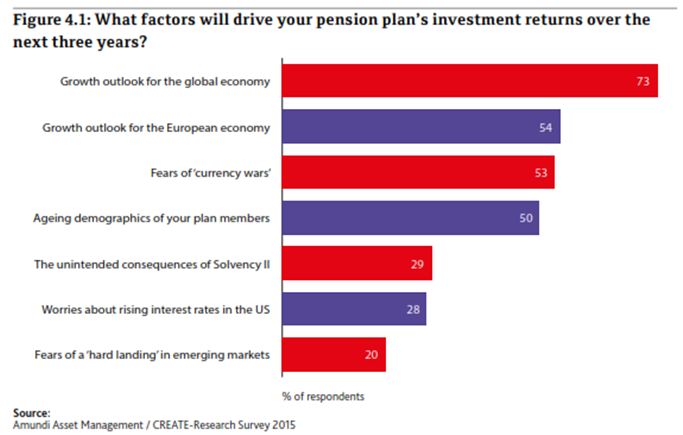
In regards to figure 4.1, what we try to do before asking investors about their asset allocation approaches, we try to find out what they think will be driving the markets over the next 3 or so years. The most common response we got was growth in global outlook and growth in the European economy. There are worries about currency wars, since the beginning of last year we have had 25 nations around the world that have devalued their currencies. Things like aging demographics are having major effects on pension plans because due to the baby boomer generation a mass influx of people will be coming into retirement, and this will dramatically change the asset allocation of pension plans or of individuals who are managing their own funds.

QE programs inflated asset values for both equities and bonds and that saved the day. Now we are in a situation where these asset values are not sustainable in light of economic performance from the last two years or so. We hope that growth will resume, we hope that the situation in China and Japan improves and so on. But if these conditions do not happen we will be in a situation where the current valuation will be very hard to sustain and we could be looking at another major correction.

“Growth has slowed down everywhere. In Europe and Japan we are talking about another round of QE. The biggest worry in all this is that this drug of QE worked in the beginning but for it to work again we have to come out with bigger and bigger doses.”


THE GOALS OF PENSION PLANS

01-28-16-FRA-Amin_Rajan-00-3-11

“They key is to try and be a smart investor, don’t continue old trends because that is a recipe for disaster.”

Four key ideas that pension plans have is:

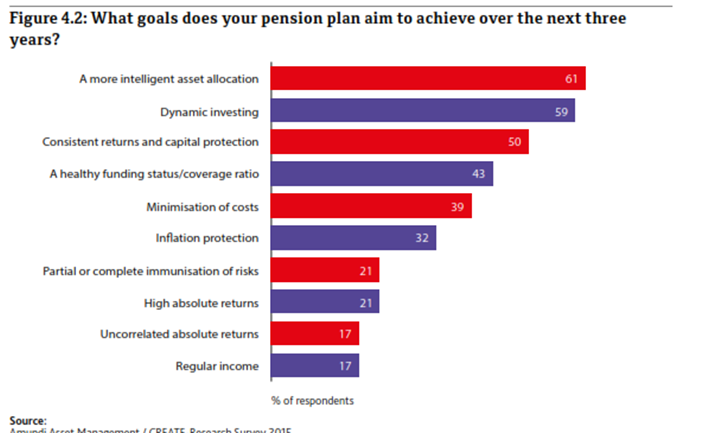
  1. Don’t follow the herd: Have an intelligent asset allocation. Engage in asset allocation which firmly addresses your long term liabilities.
  2. In so far as long as good returns will come from idiosyncratic forces try to engage in dynamic investing. Identify opportunities, identify value traps, know the difference between the two and take advantage whenever opportunities arise.
  3. Go for consistent returns and capital protection: If pension plans experience big losses now, it will take a very long time to reconcile those losses. Because of the fact we are in a low return environment you cannot afford to take big hits.
  4. Healthy funding levels: At the moment the funding levels are not good in any part of the world except for Canada. In the US every funding level in the private sector is about 78 and numbers do not vary much in the UK, Japan and other markets.

MACRO RISKS TO IDIOSYNCRATIC RISKS

01-28-16-FRA-Amin_Rajan-00-3-12

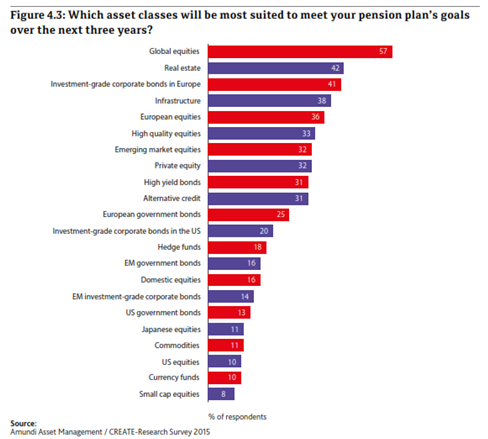
What we did was analyze amongst these asset classes which ones are people most likely to fear. And sure enough at the top came out global equities and real estate. Secondly, within these asset classes are people going to use them the same way they have in the past? For example, to think that as long as you’re invested in global equities you will be okay or are you going to be much more selective? We concluded that being selective is definitely the way to go, to be very selective in the way we invest in global equities, real estate etc.

It used to be a belief that fixed asset allocation in numbers would follow as well as that 90% of returns come from doing the right asset allocation. Now this is outdated and nobody holds on to those beliefs anymore. If we believe in this we will only think that some 50% of returns come from correct asset allocation and the other 50% comes from making the right choices of specific securities.

THE AIMS OF ASSET MANAGERS

“There is a rampant feeling that we are entering a long period of low returns. QE isn’t going to work second time around in the way that it worked the first time. It has lost its potency.”

What asset managers need to do is having their business models change in four fundamental ways:

  1. Asset managers need to get much closer to their clients. Understand their clients risk profiles, identify if clients are being provided service that they need and so on. Client focus is paramount.
  2. Investment Capabilities: What makes an investment professional at a time when markets are so distorted? It is a tough question to answer but I believe an investment professional should know the difference between value traps and value opportunities. The fact that markets are falling in emerging markets does not necessarily mean that it is a great buying opportunity. A smart investor knows that emerging markets have very strong price momentum. Prices in these markets have tendency to be falling for much longer.
  3. Understanding correlations under different phases of market cycles: Yes, correlations are rising but what we also find is that there are different regimes emerging. Under certain regimes correlations are higher and under others they are lower. Learn to understand what those different regimes are and then devise your portfolio accordingly.
  4. Alignment of interest: Asset managers need to have a strong financial alignment of interest. It can be from having things such as performance related fees or making sure they are not a part of a structure which basically says, heads I win and tails you lose. Innovation processes that asset managers have need to be rethought. Products need to be tested and tried before being released.

A link to Amin Rajans’ full report, Investing in the Age of Financial Repression can be downloaded at

DOWNLOAD

http://www.create-research-uk.com/?p=dlreport&t=report&r=37

Abstract written by, Karan Singh

Karan1.snigh@ryerson.ca

Disclaimer: The views or opinions expressed in this blog post may or may not be representative of the views or opinions of the Financial Repression Authority.


01/29/2016 - Lacy Hunt – “INFLATION & 10Y UST YIELD HEADED LOWER!”

Dr. Lacy Hunt joins FRA Co-Founder Gordon T. Long in an in-depth discussion on the current debt dilemma and the decisions of the Federal Reserve. Dr. Lacy H. Hunt, an internationally known economist, is Executive Vice President of Hoisington Investment Management Company, a firm that manages over $5 billion for pension funds, endowments, insurance companies and others. He is the author of two books, and numerous articles in leading magazines, periodicals and scholarly journals.  Included among the publishers of his articles are. Barron’s, The Wall Street Journal, The New York Times, The Christian Science Monitor, the Journal of Finance, the Financial Analysts Journal and the Journal of Portfolio Management.

Previously, he was Chief U.S. Economist for the HSBC Group, one of the world’s largest banks, Executive Vice President and Chief Economist at Fidelity Bank and Vice President for Monetary Economics at Chase Econometrics Associates, Inc.  A native of Texas, Dr. Hunt has served as Senior Economist for the Federal Reserve Bank of Dallas. Dr. Hunt received his Ph.D. in Economics from the Fox School of Business and Management of Temple University. Furthermore Dr. Hunt served on the Board of Trustees of Temple University from 1987 to 2010 and is now an honorary life trustee. He received the Abramson Award from the National Association for Business Economics for “outstanding contributions in the field of business economics.” He is a life member of the American Finance Association.  He was a member of the Economic Advisory Board of the American Bankers Association and Chairman of the Economic Advisory Board of the Pennsylvania Bankers Association.  He served on the Monetary and Fiscal Policy Affairs Committee of the National Chamber of Commerce.

TACTICS OF THE FED

“Debt only works if it generates an income to repay principle and interest.”

Research indicates that when public and private debt rises above 250% of GDP it has very serious effects on economic growth. There is no bit of evidence that indicates an indebtedness problem can be solved by taking on further debt.

One of the objectives of QE was to boost the stock market, on theory that an improved stock market will increase wealth and ultimately consumer spending. The other mechanism was that somehow by buying Government securities the Fed was in a position to cause the stock market to rise. But when the Fed buys government securities the process ends there. They can buy government securities and cause the banks to surrender one type of government asset for another government asset. There was no mechanism to explain why QE should boost the stock market, yet we saw that it did. The Fed gave a signal to decision makers that they were going to protect financial assets, in other words they incentivized decision makers to view financial assets as more valuable than real assets. So effectively these decision makers transferred funds that would have gone into the real economy into the financial economy, as a result the rate of growth was considerably smaller than expected.

“In essence the way in which it worked was by signaling that real assets were inferior to financial assets. The Fed, by going into an untested program of QE effectively ended up making things worse off.”

THE FLATTENING YIELD CURVE

“Monetary policies currently are asymmetric. If the Fed tried to do another round of QE and/or negative interest rates, the evidence is overwhelming that will not make things better. However if the Fed wishes to constrain economic activity, to tighten monetary conditions as they did in December; those mechanisms are still in place.”

They are more effective because the domestic and global economy is more heavily indebted than normal. The fact we are carrying abnormally high debt levels is the reason why small increases in interest rate channels through the economy more quickly.

If the Fed wishes to tighten which they did in December then sticking to the old traditional and tested methods is best. They contracted the monetary base which ultimately puts downward pressure on money and credit growth. As the Fed was telegraphing that they were going to raise the federal funds rate it had the effect of raising the intermediate yield but not the long term yields which caused the yield curve to flatten. It is a signal from the market place that the market believes the outlook is lower growth and lower inflation. When the Fed tightens it has a quick impact and when the Fed eases it has a negative impact.

The critical factor for the long bond is the inflationary environment. Last year was a disappointing year for the economy, moreover the economy ended on a very low note. There are outward manifestations of the weakening in economy activity.  One impartial measure is what happened to commodity prices, which are of course influenced by supply and demand factors. But when there are broad declines in all the major indices it is an indication of a lack of demand. The Fed tightened monetary conditions into a weakening domestic global economy, in other words they hit it when it was already receding, which tends to further weaken the almost non-existent inflationary forces and for an investor increases the value.

FAILURE OF QUANTITATIVE EASING


“If you do not have pricing power, it is an indication of rough times which is exactly what we have.”

The fact that the Fed made an ill-conceived move in December should not be surprising to economists. A detailed study was done of the Fed’s 4 yearly forecasts which they have been making since 2007. They have missed every single year.

The Fed begins the year with the high forecast and ts declines each forecast after that and by December it isn’t much of a forecast because you already have 11 months of data. An empirical indication that QE has failed is the fact that their models have relied on them to be indications and the models were wrong which means the policies have also been a failure.

CRIPPLING NEGATIVES

“Another risk which may very well lead to a worse result is the Fed going to negative interest rates. First we must consider if the Fed can engineer negative interest rates and it is very likely they do have that capability. There will be severe consequences which we will not even be able to anticipate.”

There is a trend that in weak economic times the fed will continue untested experiments. Even though QE 1, 2 and 3 have failed, in dire times they will implement QE 4. But if the Fed resorted to negative interest rates it will have an adverse impact on bank earnings, particularly small banks and greatly harm savers who have already been hurt. Negative interest rates will simply penalize people to a far greater degree. It will have devastating consequences to the money market mutual funds; difficult to see how they would operate at all.

Pushing interest rates in a negative territory will greatly increase the unfunded liabilities of the corporate pension plans. Pension plans will either be dropped or for those already covered it will explode the liabilities causing them to cut expenditures in the real economy to fund the pension liabilities.

“If the Fed went into negative interest rates they would ultimately be required to call in the currency and force people to use their bank deposits.”

We are no closer to solving our indebtedness problem in 2016 as we were in 2009.

Q4 2015 REPORT  – PDF DOWNLOAD


Abstract written by, Karan Singh

Karan1.singh@ryerson.ca

Disclaimer: The views or opinions expressed in this blog post may or may not be representative of the views or opinions of the Financial Repression Authority.


01/27/2016 - Yra Harris: Japan Seeks Chinese Capital Controls

yen-yuan-banknotes-picture

“The most important news item of yesterday was buried on page 6 of theFinancial Times: BOJ KURODA SEEKS CHINESE CAPITAL CONTROLS. This is significant for a Governor of a major central bank to openly suggest the imposition of ‘stringent capital controls to help stem massive outflows of hot money from China and stabilize hot money’ .. Governor Kuroda seems concerned that if the Chinese YUAN continues to weaken it will cause problems for the Eastern Asian economies and put pressure on other central banks to pursue policies of currency weakness. Japan would have to embark on more QE to deal with Asian depreciation and it appears that Kuroda-san is reticent about buying more JGBs. It seems Kuroda wants the Abe administration to continue its structural reforms, which have fallen far short of its stated goal. It seems many central bankers have tired of more QE as it appears that the vast monetary purchases have had limited success.”

LINK HERE to the article

Disclaimer: The views or opinions expressed in this blog post may or may not be representative of the views or opinions of the Financial Repression Authority.


01/20/2016 - Eric Sprott: “Think About How to Mitigate Your Losses!”

FRA Co-Founder Gordon T. Long deliberates with Eric Sprott about the outlook for the global economy in 2016. Eric Sprott is a Canadian hedge fund manager and founder of Sprott Asset Management. He became a billionaire on paper with the initial public offering of Sprott Inc, the parent of his Sprott Asset Management firm. In August 2011, Sprott was acknowledged by Bloomberg as a ‘hidden billionaire.’ The publication estimated Sprott’s worth at $1.3 billion, largely based on his publicly disclosed holdings in Sprott Inc. and Sprott Physical Gold Trust. Sprott started his career as an analyst at Merrill Lynch covering everything but commodities. He eventually became known as a natural-resources and energy investor.

In 1981, Eric Sprott founded Sprott Securities Ltd. (now Cormark Securities Inc.), an institutional brokerage firm focused on small-to-mid capitalization companies, servicing Canadian corporate and institutional investors. In the year 2000, Eric Sprott made the decision to focus solely on the investment management business. Accordingly, the “investment management division” of Sprott Securities Inc which became one of Canada’s largest independently owned institutional brokerage firms. In 2000, Eric divested his entire ownership of SSI to its employees and chose to focus his sole attention on the investment management business and he formed Sprott Asset Management. In 2006, Eric was awarded the Ernst & Young Entrepreneur of the Year Award for Ontario.

In late 2009, Sprott published a well circulated white paper titled, “Is it all just a Ponzi scheme?” The document dug into who was actually purchasing recent Federal Reserve U.S. Treasury auctions and concluded that the biggest new buyer versus the previous year was the U.S. government.

Eric’s approach to philanthropy is straightforward.  He wants to help society change for the better. He is also constantly studying how to best serve his community through the foundation’s philanthropic donations. He believes that “the world needs true leadership to deal with unrecognized problems.”

2016: WHAT LIES AHEAD

“There is nothing constructive to say about the financial ponzi we have gone through since QE and negative interest rates were initiated.”

By knocking interest rates down to zero and in some cases they’re negative, savers are getting crucified. They get no return on their money. They have to buy the slimiest of assets, US bonds receiving 2%.

QE, printing of money will not do anything for the economy. We saw this with japan for the last 30 years. QE was only in place to inflate assets prices and we are all going to pay the consequences for that. It’s shocking that the market has held up as long as it has, and even more shocking is that during this whole process policies are so irresponsible that precious metals are not getting enough attention. I feel like a lone wolf believing that people should be in precious metals to protect themselves against this recession.

THE FOCUS FOR INVESTORS

“The most important thing is that roughly 97% of stocks are in bear markets throughout the world.”

Originally only a few stocks in the US were holding things up, and now they’re all getting crushed. In 3 months it would be no surprise to see every stock in the world being in a bear market. Furthermore it’s unbelievable to think you have a stable economy when oil prices are under 30. There are so many areas of falling prices; hitting or nearing all-time record lows.

“I do not have much hope for the economy right now; the stock markets are reflective of that.”

The whole issue of medical care in the US is being swept under the carpet; there are significant expenses for too many people. We need to be very careful about equity and bond investments. If you begin with the premise that the US is broke, you have $85 trillion of unfunded liabilities and a GDP of 18 trillion that says enough right there; it’s a joke.

This is why I preach to own precious metals because they will survive a financial meltdown. Risk mitigation is critical, but you have to understand all the elements of risk. It is phenomenal the risk that you will be taking in turn for the yield you’re expecting.

PRECIOUS METALS

precious_metal_bg

Not to put a number on it, but I believe for the last 15 years the demand for gold has been well above supply and central banks have superficially provided the extra supply. The physical gold market may overwhelm the paper market, if or when it does you can imagine a recession or depression or even a currency crisis which is happening throughout the world.

BLACK GOLD

Oil-Price-Fall

For oil, when you ask questions about markets that are dominated by paper and the influence of central planners it is difficult to give an answer that makes much sense. Ultimately oil should be going back up; very few entities can produce at $30/barrel. Sooner or later we will see shutdowns, and once that happens it will be highly unlikely for a restart until prices are at a profitable amount.

CANADIAN DOLLAR

falling dollar

“Government revenues are going to plunge coupled with stocks falling; 2016 is not looking very bright.”

It is a very tough situation because of oil prices are so devastating for everyone but particularly devastating for US and Canada. People are going to take all sorts of losses and reclaiming former capital. It is a dark hole where weaknesses are being amplified unless there is an outside influence to turn things around.

CLOSING STATEMENTS                 

“Seeing all the previous crisis happening from the Dot.com to the 2008 crisis you can see what is likely to happen here; it has just been postponed. But I suspect it will be worse, it will be global and it will not be as easy to fix as it was in 2008 because now it will have to be coordinated.”

It is a question of whether people believe or don’t believe in the market. Everyone realizes after what has happened is that there is a vulnerability in the market that people didn’t expect. Hopefully we will see signs of precious metals going up that will indicate the importance of focusing on the real issue in the financial system is today.

“All indicators are telling you that there is no recovery happening here anytime soon. It may just keep going down and potentially get violent. In the midst of all this the key thing is to focus on mitigating your losses.”

LINK HERE to info on SprottMoney

Abstract written by, Karan Singh

Karan1.singh@ryerson.ca

Disclaimer: The views or opinions expressed in this blog post may or may not be representative of the views or opinions of the Financial Repression Authority.


01/13/2016 - PROSPER – HOW TO PREPARE FOR THE FUTURE

Special Guest: Adam Taggart – Co founder, Peak Prosperity

FRA Co-Founder Gordon T. Long interviews Adam Taggart, regarding his new book: “Prosper! How to Prepare for the Future and Create a World Worth Inheriting” co-authored with Chris Martenson PhD. Adam is an author, and the Co founder of Peak Prosperity, a website created to help individuals make appropriate and informed financial decisions.

Prosper front cover - FINAL

“We fell from a certain height in 2008, we’re at much higher heights in many other areas right now, and none of the fundamental causes of the 2008 crisis have been resolved or satisfactorily addressed”

Adam says that if in 2008 we only fell from about halfway up the ladder, we can expect a much greater upcoming fall which will be faster and hurt more. He is a strong believer in taking prudent preventative action, before a major correction. “Everyone wants to buy insurance after their house burns down, but it’s too late then.” This book is intended to aid people in taking informed steps to minimize or possibly avoid upcoming financial pain.

KEY MESSAGE OF THIS BOOK

Developing Resilience

“Resilience is the ability to be as least changed as possible by a change in your environment”

‘”Developing investments today that are going to protect you against the greatest and most likely risks”

Drawing from the permaculture school of thought, there are 8 forms of capital to address when developing true wealth: Financial capital, living capital, material capital, social capital, emotional capital, knowledge capital, cultural capital, and time capital.

Adam mentions it is important to realize capital is able to be exchanged from one form to another. Financial capital is often the first thought of form of capital, but Adam says it is important to consider the other seven forms of capital. Adam recommends people look upon these 8 forms of capital and examine where they have a deficit and where they have abundance, and encourages them to prioritize their time in reducing the deficits and not just focus on one or two.  This framework of 8 forms of capital will work for anyone, regardless of their socio economic condition


01-13-16-Eight_Forms_of_Capital

Adam mentions that everything in this book is common sense. Gord references a Will Rogers quote, saying, the most uncommon thing is common sense.


Disclaimer: The views or opinions expressed in this blog post may or may not be representative of the views or opinions of the Financial Repression Authority.


12/18/2015 - Bill Laggner: Corporate & Sovereign Bond Defaults To Send Shock Waves Into The Currency Markets

Bill Laggner is the Principal and Co-Founder of Bearing Asset management in Dallas, TX. Mr. Laggner and his partner manage the Bearing fund using an Austrian School of Economics lens in terms of identifying boom-bust cycles, value in the market place, bubbles, and distortions created by both fiscal and monetary authorities.

“We started back in 2002, creating the Bearing credit index when we say that authorities would not let the recession play out”

On describing the Austrian School of Economics, Bill says that Austrian economists would categorize their theory as human action and individual decision making and their responsibilities of those decisions being what really creates normal economic activity. He points out how unfortunate it is that today we have fiscal and monetary intervention which distort human actions.

“We create these boom-bust cycles that are magnified by the very interventions that we’re witnessing today”

SAVINGS & PROPER ALLOCATION OF THOSE SAVINGS

Bill thinks that one of the key aspects of the Austrian economic theory that investors should pay attention to is that one has to have savings and a proper allocation of those savings. He also says that people have to quantify both risks and return as well.

“In that environment as well, you would want interest rates to be set by the market place and not a group of bureaucrats who are essentially socializing credit”

On whether we have an inflation or deflation right now: There is a lot of discussion about inflation in the Austrian theory in terms of the phenomena comes about in terms of pricing, in  light of that we have deflation in commodity prices which was a function of the excess supply created by false signals coming out of China. According to Bill we are facing a deflationary state as of right now.

Bill thinks China and Glencore are the canaries in the coalmine when it comes to credit cycles in the commodity market.

CREDIT CYCLE HAS TURNED

Gord states that the credit cycle is now changing, taking its signals from the business cycle. Bill agrees with Gord, saying:

“We’re at the end of the credit cycle, the whole mal-investment in shale oil…tens of billions of dollars in lost wealth”

For the future, Bill anticipates a massive series of defaults, resulting from huge deflationary pressures and a tightening by the market place, which is basically an unintended result of constant intervention. We are looking at corporate bond defaults, sovereign defaults which will send shockwaves into the currency system.

“We’re probably looking at some kind of new currency system, which looks likely to be gold”

At Bearing Asset Management: They run an aggressive, long-short portfolio.

Bill points out even in the turmoil we’re in he remains optimistic. He thinks that technology will be the savior as the wheels are coming out from the bus, looking at how the internet connects people all over the whole who do business daily.

“We’re coming to a realization that we can look to each other and share expertise, knowledge, goods and shy away from things like speculating in commodities, speculating in real  estate, speculating in the stock market and get back to pricing money correctly.”

“The beauty of America is that the entrepreneurial DNA in this country is unlike any other part of the world.”

Gord mentions that if we could take away centralized control and planning from the planners and controllers in a logical fashion, adjustment will happen. He says that “a crisis is nothing but more than change trying to happen.”

If people want to get more information and insight from Mr. Bill Laggner, they can go to bearingasset.com/blog. They write a lot about relevant topics relating to wealth and the financial markets.

Disclaimer: The views or opinions expressed in this blog post may or may not be representative of the views or opinions of the Financial Repression Authority.


12/18/2015 - Morgan Stanley’s Ronnie Lapinsky Sax: “Interest rate normalization will provide headwind for investors using bonds for principal preservation”

QUESTION: Can you relate some of your career background in portfolio management and a general description of your investment approach?

ANSWER: I’ve been very fortunate. I’ve only had one job….and have been with the same firm since the beginning, when I turned 21, in 1976. It’s nearly 40 years of managing money for the wealthy. I strive to provide solid investment advice, high levels of service and the confidentiality clients have grown to expect. I am solely responsible for asset allocation and selection for my discretionary clients…. My niche stays within the bounds of retail, working directly with families helping them to achieve their goals. Every year, I am challenged by the change in our economic environment, the continued changes in technological advancements and how these and other factors relate to client allocations. Recently I stepped down as President of The Portfolio Manager’s Institute; Currently I serve as co-Chair of Morgan Stanley’s National Financial Advisory Council. I am proud to say that over 50 families have relied on my advice for over 25 years, some longer. By any measure, it’s been quite rewarding

QUESTION: Can you comment on your currently relating to the recent much talked about Federal Reserve policy statements and interest rate direction and how these could affect the financial markets

ANSWER:- Morgan Stanley’s Global Investment Committee supports that interest rate normalization will provide headwind for investors using bonds for principal preservation, as rates rise its likely longer duration bonds will fall.  We show the total return impact of a 1% rise in rates can impact a 30 year bond by a negative 17.9%; which is tremendous. To show the range, if you own a 2 year bond a 1% rise in rates has a negative 2% impact.

– Typically after interest rate hikes the companies with the strongest balance sheets that do not rely on floating debt fare the best

– Rate hikes will likely lead to a rise in interest income on deposit which should help those with larger portions of savings in the bank

– In this environment, Morgan Stanley’s GIC expects housing, mid/lower tier retail, airlines, hotels and leisure’s to benefit. Additionally, we see value in consumer finance and regional banks as consumer confidence is boosted

– It is important to note, we see the initial tightening as a signal of self-sustainability, not the end of economic expansion.

QUESTION: What are the challenges with portfolio management for clients in today’s environment resulting from and characterized by 0% or even emerging negative interest rates?

ANSWER:

– Income more difficult to provide clients, in a zero rate environment many will suggest high yield corporate bonds and leveraged loans to supplement traditional fixed income but many clients are not willing to sacrifice quality for a higher yield.

QUESTION: Do you see any unintended asset price distortions in the financial markets resulting from an extended period of virtually 0% interest rates and from quantitative easing (QE) by many central banks worldwide?

– We found that as the cycle has matured security selection based more heavily on credit quality created dispersion in spreads and opportunities for further security selection. In addition, we see credit spreads have widened significantly creating opportunity for credit selection.6

QUESTION: What types of generic investment classes and investment approaches make sense in today’s environment characterized by very low interest rates, low yields, volatile capital markets, emerging regulations and international capital controls in many jurisdictions including the United States?

ANSWER:

– Morgan Stanley’s GIC continues to recommend equities over fixed income. Within the US we prefer technology, financials, consumer/housing related products and industrials. If you are an investor that is looking for fixed income we would recommend below-benchmark duration and find the US high yield market attractive.

– In this environment, Morgan Stanley’s GIC expects housing, mid/lower tier retail, airlines, hotels and leisure’s to benefit. Additionally, we see value in consumer finance and regional banks as consumer confidence is boosted

QUESTION: Do you advise international and geographical diversification to your clients and if so how can this be factored in to the investment process?

ANSWER:

– While personally I do not have a large diversification to international it is definitely a theme you are seeing in today’s investment sphere.

– Europe is getting the support from the ECB with quantitative easing and the GIC expects European equities to continue outperforming in 2015.

Additional Commentary

– Lower energy prices help drive increase in consumer spending despite weak wage growth in 2014. Lower unemployment levels should lead to stronger wage growth going forward

– bullish on housing – We see US consumer confidence at an eight-year high based on the University of Michigan, Consumer Sentiment Index supporting the strength of the middle class and US economy going into 2016.


The individuals mentioned as the Portfolio Managers are Financial Advisors with Morgan Stanley participating in the Morgan Stanley Portfolio Management program. The Portfolio Management program is an investment advisory program in which the client’s Financial Advisor invests the client’s assets on a discretionary basis in a range of securities.  The Portfolio Management program is described in the applicable Morgan Stanley ADV Part 2, available at www.morganstanley.com/ADV or from your Financial Advisor.

Ronnie Sax is a Financial Advisor with Morgan Stanley Global Wealth Management in Bethesda, MD. The information contained in this article is not a solicitation to purchase or sell investments. Any information presented is general in nature and not intended to provide individually tailored investment advice. The strategies and/or investments referenced may not be suitable for all investors as the appropriateness of a particular investment or strategy will depend on an investor’s individual circumstances and objectives.

Disclaimer: The views or opinions expressed in this blog post may or may not be representative of the views or opinions of the Financial Repression Authority.


12/16/2015 - Yra Harris: Read “The Rotten Heart of Europe”!

Yra Harris: Read “The Rotten Heart of Europe”!

FRA co-founder Gordon T. Long deliberates with Hedge Fund Manager, Yra Harris about the effects of financial repression and the imminent credit event. Harris is a macro Global Trend Trader and publisher of the Blog Notes From the Underground.

Yra Harris is a recognized Trader with over 32 years of experience in all areas of commodity trading, with broad expertise in cash currency markets. He has a proven track record of successful trading through combination of technical work and fundamental analysis of global trends; historically based analysis on global hot money flows. He is recognized by peers as an authority on foreign currency. In addition to this he has Specific measurable achievements as a member of the Board of the Chicago Mercantile Exchange (CME). Yra Harris is a Registered Commodity Trading Advisor, Registered Floor Broker and a Registered Pool Operator.

Yra Harris is a recognized global trader who is a regular guest analysis on Currency & Global Interest Markets on Bloomberg and CNBC. He has been interviewed for various articles in Der Spiegel, Japanese television and print media, and is a frequent commentator on Canadian Financial Network, ROB TV.

FINANCIAL REPRESSION

“The way governments repay the interest on their debt.”

When governments borrow money, they do not want to pay back the money at any real market rate, instead they artificially hold rates down to pay off creditors. It is about the size of the government debt and being able to debase it; pay it off in less value.

“Financial repression has led to serious inequalities.”

It begins with Tim Geithner, bailing out Wall Street and banks as opposed to bailing out main street. Financial repression has focused its effects on the savers, the people who have been saving for retirement are being seriously damaged and forced to go into the stock market.


A recent paper, The Hidden Cost of Zero Interest Rate Policies by, Thomas Coleman and Laurence Siegel report “Zero interest rates cost $5 trillion per year, or rather 5% of GDP from savers that is being transferred to other entities.[1]

“When there is too much debt, all financial authorities have a chief goal, and that is to create inflation.”

Many people have called Geithner out on his ill-advised actions. Everybody fell in line with the ‘you have to protect Wall Street’ way of thinking, and to a certain degree that is true. The first QE was mandatory because you had to prevent the mass liquidation of assets. The lessons from the 1930s boldly taught us that the US cannot take such an immense liquidation of assets. People need to begin equating what is the real return on their money, which is the true financial repression because all zero interest rates do is culminate into inflation; the best friend of debtors.

FUTURE RAMMIFICATIONS WITH THE FED

“The French are tired of being ‘Germanized’”

The proof will be what will happen in the yield curve. If the curve were to flatten further the equity markets will retaliate. What the yield curve does, what the dollar does and finally what gold does when the Fed raises rates will be the three indicators we must keep an eye on.

Is it going to be the German euro or the French euro? Germans are hard money advocates because they are savers, and right now what is happening in Europe is the ultimate financial repression. German savers are being severely hurt in order to bail out the rest of Europe. The euro was at 82 cents in 2001 and 2002 because the Germans needed a weak euro in order to get all the labor reforms that were being put in place. They played this card upon the ECB and they got what they wanted.

THE IMPENDING EVENT

“There is something right now eating at the debt markets. It may be in the mining or energy sector, but this market right now is scared of some credit event that it lurking out there.”

There is a credit event somewhere going on, it is evident by how the markets are acting. What is dangerous is that it is taking place now, during the holidays and anything that happens will therefore be magnified. The stock markets are off, if you look at the coordination of them, they are all out of place.

The Fed is aware of this so they must ask what it is that they are not seeing. I will not be surprised if come this Wednesday, they will not raise rates. If the Fed does not raise rates on Wednesday, the stock markets will have a high sell off because people will think what it is that the Fed knows.

Richard Cue has done great work, he has recently written about recent debt developments throughout the world. The debt structure which is supposed to be handled hasn’t been dealt with at all, and the greatest error you can make; borrowing to buy back your stock.

As soon as corporation free cash flows starts to erode, that debt becomes a major issue. We have had a run on this fictitious financial engineering of buybacks that will boomerang and it may be violent. There are symptoms of debt overhang, and global slowdown will reveal to us the weak players that took on too much debt.

images


[1] Thomas Coleman and Laurence Siegel. The Hidden Cost of Zero Interest Rate Policies, Sept 28 2015.


Subscribe to our Youtube Channel to watch our Program Show – click on the red Youtube button to subscribe:

Disclaimer: The views or opinions expressed in this blog post may or may not be representative of the views or opinions of the Financial Repression Authority.


12/11/2015 - AUSTRIAN SCHOOL FOR INVESTORS with Ronald-Peter Stöferle

FRA Co-Founder Gordon T. Long discusses the Austrian School of Economics with German Finance bestselling author, Ronald-Peter Stöferle. Ronald is a Chartered Market Technician (CMT) and a Certified Financial Technician (CFTe). During his studies in business administration and finance at the Vienna University of Economics and the University of Illinois at Urbana-Champaign, he worked for Raiffeisen Zentralbank (RZB) in the field of Fixed Income/Credit Investments. After graduation, he participated in various courses in Austrian Economics.

12-07-15-FRA-Ronnie_Stoeferle-00-3


In 2006, he joined Vienna-based Erste Group Bank, covering International Equities, especially Asia. In 2006, he also began writing reports on gold. His six benchmark reports called ‘In GOLD we TRUST’ drew international coverage on CNBC, Bloomberg, the Wall Street Journal and the Financial Times.

He was awarded 2nd most accurate gold analyst by Bloomberg in 2011. In 2009, he began writing reports on crude oil. Ronald managed 2 gold-mining baskets as well as 1 silver-mining basket for Erste Group, which outperformed their benchmarks from their inception. In 2014 he published a book on Austrian Investing, Austrian School for Investors – Austrian Investing Between Inflation & Deflation.

AUSTRIAN INVESTING BETWEEN INFLATION & DEFLATION

“For an investor it is critical to understand we are not in a cyclical crisis; we are in a systemic crisis.”

Well I have to admit I am not an economist which is why I am open to the Austrian school of economics Complex econometric models that try to forecast future models simply do not work, the 2008 financial crisis is an example of that. The Austrian school of economics simply described is “common sense economics.”

As a practitioner we are writing about the theory of the Austrian school of economics. It is a book dedicated to the practitioners of the Austrian school. What I want to point out is that the Austrian school has a completely different view when it comes to inflation and monetary systems.

For Keynesian economists inflation is simply a rise in prices. There is no point in discussing the details of inflation, however for Austrian economists it is an increase in the money supply.

The Austrian school shows the new monetary system which began august 1971, when President Richard Nixon suspended the convertibility of the dollar into gold. Since this was done we have seen major misallocation of capital.

“This interplay between inflation and deflation is crucial to understand, this refers to the term, monetarytectonics.”

“If you have an Austrian mindset, you have a great advantage.”

You are able to understand other currencies, thinking outside the fiat money system and as an investor focus on the real results not the nominal results you make.

THE CHANGING CREDIT CYCLE

 “In 2016, we very well may face a recession.”

For an Austrian a recession is something that’s normal, it is like a fitness program that prepares the economy for the next stage up. Trying to avoid such a recession will be difficult as QE, fiscal stimulus, monetary stimulus and low interest rates only make the situation more severe.

“The credit cycle leads the business cycle and therefore the fed will have a hard time fighting this falling trend in economic activity.”

To fight against it, negative rates in the US might be implemented. Many academic studies in the US say that evidence from Europe shows that negative interest rates work. The Fed may very well consider implementing negative interest rates. We will see increasing fiscal stimulus. There are many voices saying we should introduce helicopter money, but rather is it now called The People’s QE.

INVESTING ADVICE FROM THE BOOK

  1. To have a nonfragile portfolio, and investing in your own skill set offers a great yield.
  1. A good investor separates from a bad one in times of crisis.
  1. Become an entrepreneur, the Austrian school greatly encourages entrepreneurship.
  1. The Austrian school is very modest in saying we cannot predict the future but be prepared for all scenarios.
  1. It is highly recommended to read Austrian School for Investors – Austrian Investing Between Inflation & Deflation. Many people have interpreted it as a philosophical book that attempts to cultivate and establish this Austrian mindset. It is a pragmatic school of thought which offers great benefits if implemented, and this book is the perfect guide to it.

Abstract written by Karan Singh karan1.singh@ryerson.ca


Disclaimer: The views or opinions expressed in this blog post may or may not be representative of the views or opinions of the Financial Repression Authority.


12/10/2015 - PROF. THOMAS COLEMAN & LARRY SIEGEL: The Hidden Cost of Zero Interest Rate Policies – $1 TRILLION or 5% per Year Taken From US Savers

FRA’s Co-Founder Gordon T. Long interview Thomas Coleman and Larry Siegel on their paper, The Hidden Cost of Zero Real Interest Rates. Thomas Coleman is the executive director of the center of economic policy at the University of Chicago Harris School of Public Policy and has spent most of his career in the financial industry mainly in research, trading and model development for derivatives and trading other fixed income derivatives. Larry Siegel is the research director at the research foundation of the CFA institute and also the senior advisor at Ounavarra Capital. He is also an author and public speaker.

12-04-15-FRA-Coleman-Siegel-00-3

$1 TRILLION or 5% per Year Taken From US Savers

On financial repression Larry describes it as the use of market prices, in particular interest rate to transfer resources from party A to party B in this case from savers to government. According to him the government can then borrow at rates that are extraordinarily low and not a reflection of the true value of the money to the lenders.

On the paper, Thomas explains that there are 3 highlights. The First is detailed from a historical perspective. He says that from looking at history we can see that nominal rates are low by historical standards. According to him what really matters are real interest rates. He mentions that when taking into account nominal interest rate and inflation we currently have real interest rates as minus one percent. This means that the real value of saving in a zero rate deposit would be a loss in value at about one percent a year.

“Financial repression is a disastrous ongoing strategy”.

Thomas mentions that one of the costs of a negative real interest policy is that negative real rates potentially distort decision making. He explains that the real interest rate is the price that determines how much we consume or how much we want to consume, the price of consumption today versus consumption in the future and how such a policy disrupts such decisions. Thomas stresses that it is the real interest rates that matter and that one of the reasons nominal rates has gone down below zero especially in Europe is because inflation has trended lower.

“Businesses decide whether to undertake a project based on whether the return they expect to make on the project is greater than the cost of capital. If you force the apparent cost of capital low enough through a low interest rate policy a lot of projects will look good and profitable that aren’t if you applied a normal cost of capital to that product so this motivates businesses and consumers to do a lot of things they shouldn’t be doing”.  –Larry

On trying to understand the wealth transfer from savers to borrowers, Thomas likens it to an implicit tax. He says that it is more than just a transfer from households to government but also from one set of households to another, from older to younger there by reinforcing the idea that negative real interest rates are potentially a distortion to  the price of consumptions today and consumptions tomorrow and also what we save today versus spend today. The troubling thing with all this according to him is the potential distortions that arise as a result of a negative real interest policy.

Abstract written by Chukwuma Uwaga – chuwaga@gmail.com

PAPER:   The Hidden Cost of Zero Interest Rate Policies

Disclaimer: The views or opinions expressed in this blog post may or may not be representative of the views or opinions of the Financial Repression Authority.


12/03/2015 - Brett Rentmeester Outlines: APPROACHES TO SOLVING YIELD CHASING & HIGH VALUATION RISKS

FRA Co-Founder Gordon T. Long interviews Brett Rentmeester on Austrian economics and the importance of having an entrepreneurial mindset in investment.  Brent Rentmeester is the president of Windrock Wealth Management and has been in the wealth asset management for over 18years. Mr Rentmeester believes the uniqueness of Windrock is its focus on the macroeconomic picture, Austrian economics and what it all means for investment implications as well as an entrepreneurial mindset on how to find investment opportunities.

The Austrian school to him is the “acknowledgement of the influence that central banks have on the business cycle and interest rate and therefore the opportunities left for investment”.

He mentions that the traditional stock, bond portfolio is under a lot of challenge going forward because there is no real and safe income anywhere today. As a result people are becoming speculators and risk takers even when they don’t want to.

Brett believes having an entrepreneur mindset when investing, is the key to addressing the dilemma of income and the future of investment. Secure private lending is lending money to borrowers that is backed by real tangible assets or an income stream. According to him, what makes this a unique category is that it addresses the pockets of lending that is being neglected by the big banks as a result of  the financial banking distress that took place in 2008.

On examples of secure private lending, Brett highlights 3 different categories with his examples. He explains that in auctioned rental properties, the government organizations Fannie Mae and Freddie Mac by law are restricted from buying mortgages on such properties until after 2 years, this results in a niche market for private lenders. “In energy markets more states are moving towards a deregulated market. What this means is that a consumer can buy energy from a variety of energy companies. Now this system is facilitated by third party brokers who go door to door offering this energy from various energy companies. Now because the brokers want the commissions up front and the energy companies can’t provide it, we see people coming in to pay the brokers a discounted fee upfront and then agree to collect the 3year contract provided by the energy companies.

Trade financing

“Global trade happens between different parties but often times it’s financed by big banks, trade receivables. So one party needs to buy goods and a supplier supplies them but someone’s got to finance that transaction and it’s often the third party bank”.

Due to new regulations, banks are required to reserve more capital in such situations, as a result an opportunity is created for private money to finance the transaction between the customer and supplier.

“Rather than taking on more risk you don’t have to today, you just have to be more creative”

– Gordon. T. Long.

Brett echoes this sentiment saying:

“So much of the industry and investors think in a very narrow box of stocks, bonds and maybe hedge funds but there’s a lot of things outside of that, that if you open your mind to the opportunities, are quite interesting to research”.

Abstract written by Chukwuma Uwaga – chuwaga@gmail.com

Disclaimer: The views or opinions expressed in this blog post may or may not be representative of the views or opinions of the Financial Repression Authority.


11/20/2015 - PURU SAXENA SAYS: “FINANCIAL MARKETS ARE SO DISTORTED AND SO TWISTED THAT RELIABLE INDICATORS ARE NO LONGER WORKING. EVERYTHING IS BACKWARDS!”

Special Guest: Puru Saxena – Founder and CEO Puru Saxena Wealth Management

As part of the ongoing series of Austrian School of Economics, FRA Co-Founder Gordon T. Long sits with Puru Saxena, of Puru Saxena Wealth Management. Mr. Saxena is the portfolio manager of his firm and he oversees discretionary investment mandates. He is also responsible for heading the firm’s research process and formulating investment strategy.

Mr. Saxena has extensive investment experience and he is a registered investment advisor/money manager with the Securities & Futures Commission of Hong Kong. Highly respected in the investment management business, he is a regular guest on various media such as CNN, BBC, CNBC, Bloomberg, Reuters and a host of other channels. Furthermore, he is regularly featured in several publications such as Barron’s, Hong Kong Economic Times, South China Morning Post, Benchmark magazine, Hong Kong Business and China Daily.

Mr. Saxena is also the editor of a monthly economic report – Money Matters. A highly acclaimed publication is read by professional and retail investors in numerous countries. He first began publishing his monthly economic report in June 2000 and it has now attracted a wide following. Prior to establishing Puru Saxena Wealth Management in 2005, he was a Founding Director and President of financial services firm – Bridgewater (now Tyche Group), where he oversaw the firm’s investment strategy.

LIMITING CENTRAL BANKS BALANCE SHEET GROWTH

“Financial markets are so distorted and so twisted that reliable indicators are no longer working. Everything is backwards”.

People are so conditioned now of believing the stimulus jargon that every time a central bank utters the word stimulus, everybody starts buying stocks again. If you look at japan, they have tried this for nearly 25 years now, and we have had recession after recession. There are zero percent short term interest rates, and not much economic growth in Japan. I don’t think this monetary experiment is going to end very well.

CENTRAL BANKS FUTURE ACTIONS

“I would be very weary by promises from the government and central banks at this point because they have a vested interest.”

I think they will try and inflate this in a typical Keynesian manner. We have negative interest rates already throughout Europe, so it won’t surprise me if you have it in the US.

“The problem isn’t a liquidity problem, it is a debt problem.”

The world has never been so indebted; the debt to GDP ratio is now over 280% globally. When you have this much accumulated debt, history has shown that economic growth slows down. Economic growth, by definition, comes from the private sector taking on more debt. When people borrow, they bring forth tomorrows consumption, today, and they consume without ever buying any assets.

“Whatever they’re doing, it’s not working.”

Central planners do not realize that if somebody is already in debt, they are not going to borrow anymore with interest rates at zero. We are currently in a deflationary environment. Central planners are trying to fight this by implementing quantitative easing, and all sorts of bizarre experiments. But at the end of the day the monetary velocity is at a decade low.

At some point, maybe even next year, we are going to get a recession. We are going to get a global recession which will occur at a time where interest rates at the short end of the curve are already at zero.

“Asset prices are going to deflate quite sharply and when this happens, there will be chaos.”

CURRENT MARKET MISCONCEPTIONS

“Major mistake people have is that QE works, or stimulus works.”

First one is that QE causes hyperinflation and therefore everybody drove up the prices of commodities to multi year highs. Investors still believe QE causes economic growth, I do not believe this. People think stimulus will cause economic recoveries and economic growth. When people realize stimulus actually leads to anti-growth you will see a big sell off in equities.

The one thing I’ve learned from being in this field from 16 years is that markets go up and markets go down. There is no one way street.

TO DIVERSIFY INTERNATIONALLY

“I think investors should keep a large chunk of their money in cash right now and long term treasuries are also a good idea.”

But if you’re look at a long term horizon, (i.e. 5 years+) I think investors should start looking at the beaten down commodity areas. Commodities have been decimated over the last 4 tears. If it was me I would not buy any equities right now. We personally don’t own any stocks on the long side for our clients at the present. The downside risks for many stocks is greater than their upside potential.

Abstract written by Karan Singh karan1.singh@ryerson.ca

Disclaimer: The views or opinions expressed in this blog post may or may not be representative of the views or opinions of the Financial Repression Authority.


11/20/2015 - Robert Wenzel – The Fed Flunks! My Austrian Economic Speech at the NY Federal Reserve

Special Guest: Robert Wenzel – Editor & Publisher of Economic Policy Journal.com & Target Liberty


Investing based on The Austrian school of Economics

FRA Interview of Robert Wenzel by FRA Co-founder Gordon T Long.

Across well-known literature, the Austrian school of economics has earned and put its indelible mark on the complicated world of economic analysis and theory. The school of thought varies significantly from the mainstream schools of economics like the classical, neoclassical and Keynesian schools of thought. In essence the Austrian school of thought believes in using logical thoughts to explain and solve economic problems rather than getting technical and going into mathematics to explain the same problems.

“The key to understanding is that what you have with mainstream economists is that they look at things from a very mathematical, very empirical approach… unlike in physical sciences you cannot do that for the science of economics because you’re dealing so many variables like changes and desires”

Unlike the mainstream none-Austrian economists, Wenzel believes that there’s a lot to be understood from the economy based on logical build up from solid premises. He goes on to mention that another key aspect to be understood is that Austrian economists believe that when the Fed injects money into certain sectors of the economy, it’s those sectors that turn to boom. According to Wenzel, when the Feds eventually start tightening this money supply it leads to a crash.

On the current economy:

“We’re in a period of accelerated money supply”

Wenzel thinks there could be an increase in price inflation and the possibility of another dip in the price of oil.

Explaining how we have inflation in some areas and deflation in others when we’ve been pumping money into the system, he explains it by outlining how it depends on how quickly people want to spend the money.

“if there’s a great desire to hold money, you’re not going to see the inflation right away”

When people don’t spend money what happens is you have money building up in cash balances which Wenzel terms “the desire to hold cash balances”. With this you see people reluctant to spend money and hence a low velocity of money.

On the confusing environment of economics and how understanding the Austrian school can help to clear things up …. Understanding the business cycle and inflation comes about in terms of the Austrian school of thought. It definitely helps to clear a lot of things up but even more can be taken from this approach. The methodology additionally helps out in terms of having people analyzing the world through logic rather than attacking it solely with empirical data.

On considering Quantitative easing and going into negative nominal rates …. QE is a method where the fed prints a lot of money and buys long durtion debt. The negative nominal rates idea is based on the Keynesian idea that it’s spending that helps the economy to grow, so the idea is to use negative rates to pressure people to spend their money. Wenzel calls this “a tax on holding money”.

Asked if he sees Hyperinflation in the future:

It could happen at some point. The Fed’s target of 2% could easily go up to three 3% with accelerated printing of money. At this point they might raise rates but if the inflation is at 5% and they raise rates from 12bp to 2% that still won’t be able to fight the inflation. However it may be too soon to say hyperinflation.

The business cycle should be understood as a boom and bust cycle.

“Whatever is going up now does not necessarily mean it will go up long term. The bust will occur but they will pump it up with new fed printing, which is eventually where the inflation comes in”

Abstract by Agang Moeng. Can be reached at agang.moeng@ryerson.ca
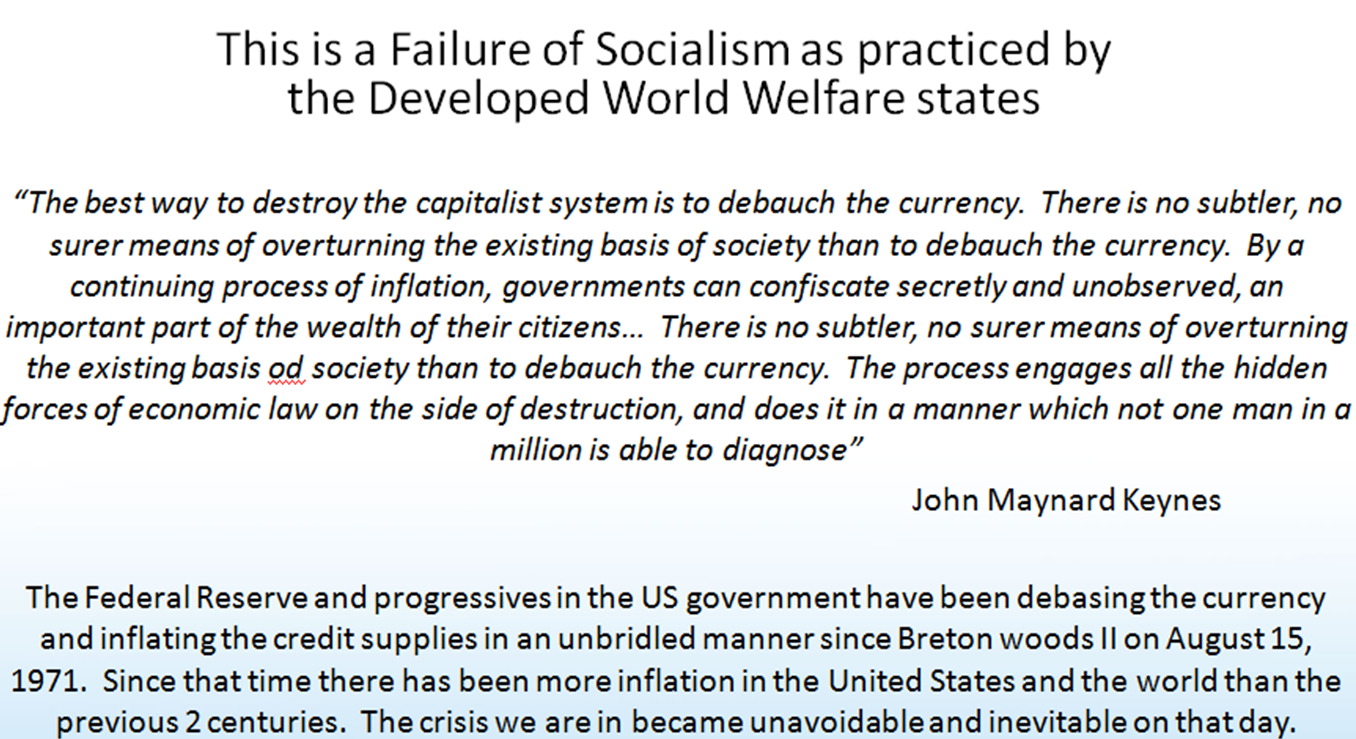
11-13-15-FRA-Robert_Wenzel-01

The infographic above shows some differences in Keynesian and Austrian views. Courtesy of The Austrian Insider.

Disclaimer: The views or opinions expressed in this blog post may or may not be representative of the views or opinions of the Financial Repression Authority.