Austrian-school-of-econ

04/14/2017 - The Roundtable Insight: 5 Top Money Managers Discuss Austrian School Investing – Now Published

LINK HERE to download the MP3 PODCAST

LINK HERE to download the Summary and Transcript in PDF

SUMMARY – also see FULL TRANSCRIPT BELOW

Today we have five panelists from around the world, Russ Lamberti from Cape Town, South Africa, Mark Valek from Liechtenstein, Chris Casey from Chicago, Bill Laggner from Dallas, and Mark Whitmore from Seattle.

Chris is the Managing Director of WindRock Wealth Management. He combines a degree in Economics from the University of Illinois with a specialty in the Austrian school of Economics. He advises clients on their investment portfolios in today’s world of significant economics and financial intervention. He’s Also written a number of publications on a number of publications on websites including the Ludwig von Mises Institute, Zero Hedge, Family Business, Casey Research, and Laissez Faire Books. He is a board member of the Economics Development Council with the University of Illinois, a Policy Advisor for The Heartland Institute’s Center on Finance, Insurance, and Real Estate.

Bill is a Co-founder of Bearing Asset Management, he’s a partner with Kevin Duffy that manage the Bearing fund using an Austrian School of Economics lenses in terms of identifying boom-bust cycles, value in the marketplace, bubbles, and distortions created by both fiscal and monetary authorities. He’s a graduate at University of Florida, began his investment industry career in the late 1980s initially as a stockbroker, and then moved to the buy side at fidelity investments. He’s been featured also in Barrons, Reuters, and CFA magazine.

Russ Lamberti is the founder and chief strategist of ETM Macro Advisors. Which provides Macroeconomic intelligence and strategy services to asset managers, family offices, and high net worth individuals. He is the Co-Author of “When Money Destroys Nations”, a book about Zimbabwe’s hyper-inflation, and he’s a contributing author at the mises.org institute.

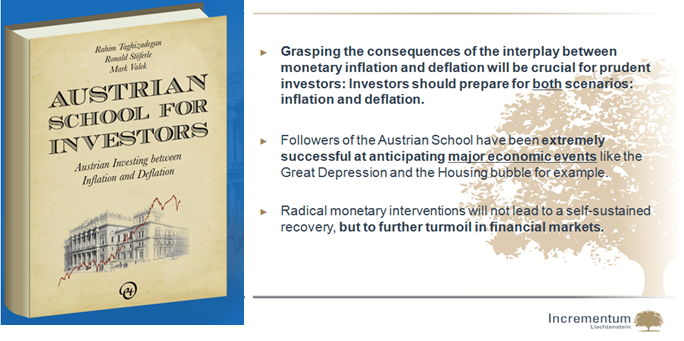
Mark Valek is a partner investment manager of incrementum, he’s a Chartered Alternative Investment Analyst (CAIA) and has studied business administration and finance at the Vienna University of Economics. From 1999 he worked at Raiffeisen Zentralbank (RZB) as an intern in the Equity Trading division and at the private banking unit of Merrill Lynch in Vienna and Frankfurt. In 2002, he joined Raiffeisen Capital Management and in 2014 he published a book on Austrian Investing. He’s one of the authors of “Austrian School for investors”.

Mark Whitmore is the Principal, Chief Executive Officer of Whitmore Capital. Mark has been managing personal portfolio assets, periodically publishing newsletters and blogs, and providing pro bono financial planning/investment consulting since leaving law in 2002. His specialties are currencies and international economic analysis. He obtained a B.A. in Political Studies from Gordon College, graduated Summa Cum Laude at the University of Washington he earned a Masters of International Studies (MAIS) at the Jackson School and a J.D. from the School of Law.

Austrian School of Economics Explained:
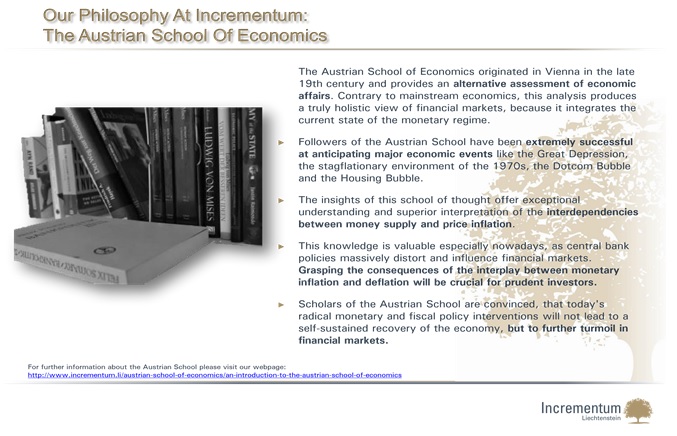
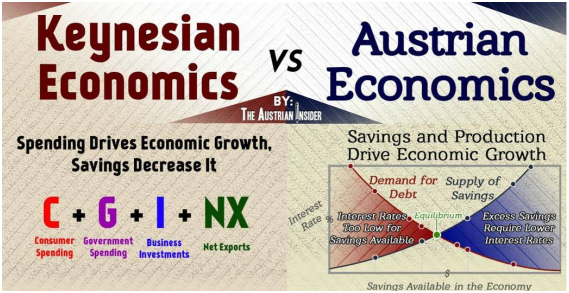
Mark Valek defines some basic points and differences of the Austrian School as: Economics about the behavior of individuals and human action, The Subjective value theory, under consumption of savings is necessary for sound investing and growth, capital structure being key to a sustainable economy, and price mechanic mechanism coordinates the centralized knowledge. Perhaps the most important distinction of Austrian Economics is its view towards the monetary system. Some of these points are inflation being defined as expansion of the money supply and finally expanding money and credit supply causes a boom and bust cycle in the business cycle theory.
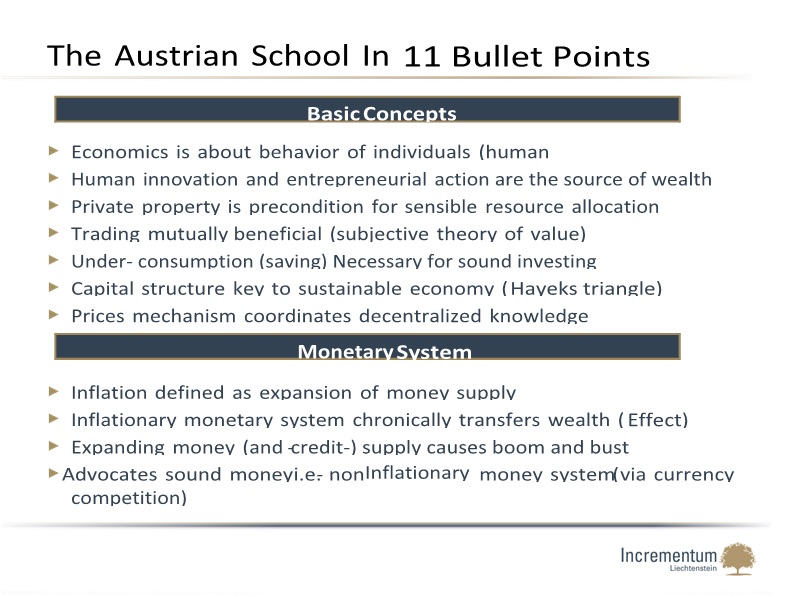
He points out that these are the typical differentiating points, but this is by no means a complete list, and you can discuss the differences between the Austrian School and traditional Keynesian theory.

Russell Lamberti thinks that one of the key differentiators from a practical analytical and investment perspective was that the Austrian school draws a very straight and consistent line between microeconomics and macroeconomics. He notes that at the microeconomics level, Keynesianism is very similar, but when they aggregate it up to the macro, a whole different theoretical framework is used and there’s essentially no consistency between neo-classical and Keynesian micro and macroeconomics so there’s a fundamental break down there. He ends the thought by saying in today’s Macro world it’s only really the Austrians who are talking about the unsustainability of certain demand trends because of misallocated capital and misallocated productive resources and that’s why he thinks the Austrian Business Cycle is such a key distinguishing feature of the Austrian school.

Chris Casey discusses why Austrian Economics can provide new insight, saying that Austrian Economics is the only one that really puts man at the center of the discussion. It boils economics down to man in the context of nature as it relates to scarcity for his needs and wants. And in so doing they then use a number of first principles that build on from the deductive reasoning standpoint to create a consistent and sound economic school and economic philosophy. And that’s what really makes the difference from the other economic schools out there. It’s not just the conclusions, it’s how we arrive at those conclusions.

Mark Whitmore adds that specifically, the role of central banking is something that is really distinct from an Austrian perspective vs Keynesianism.  Specifically the asset price inflation that you’ve seen has largely been ignored by Keynesians in the last two bubbles.  Now we’re into a third bubble I would argue as well. And essentially the Fed and the Keynesians will continue to point to there being really no headline inflation pressure and hence there’s really no reason to begin to normalize or adjust or move up interest rates meaningfully. And I think that from an Austrian standpoint, this exacerbates this boom-bust cycle which we’ve seen which has been really compressed in terms of time lately versus what has historically been the case. Since the mid to late 90s the amplitude of bubbles to the upside has just been far greater. He highlights Henry Hazlitt’s two points as far as critiques of Keynesianism. The first one being that fundamental flaw in terms of interest, with Keynesians tending to service the visible minority at the cost of the invisible majority and again it gets to this whole issue of government being the problem solver, the one that can allocate assets essentially, in its view, the most effectively from a Keynesian perspective in a counter-cyclical effective way, where the Austrians are much more skeptical of the accuracy of that. And second,the propensity under Keynesian Economics to over-consume in the present generation at a cost of creating massive debt or future debt for future generations to essentially somehow deal with, we’re sort of seeing that today in all developed parts of the world.

How it’s used in past, present and future Economies including how and why the 2007-2008 financial crisis happened:

Bill Laggner says what was interesting was that the internet created this initial innovation wave decentralization wave, and of course due to excess credit creation, money creation, you had a bubble and then a subsequent bust. And then instead of letting the system purge and heal, the central banks led by the U.S. came and lowered interest rates and you segued from a technology bubble to a private sector credit bubble. And of course it went longer then everyone on this call thought it would, and it eventually hit a wall and again tried to cleanse and it’s interesting central banks let certain groups fail and then when things started to get out of hand, they stepped in and bailed out a number of politically connected contingents and then laid the foundation for this third bubble, and this third bubble’s gone on longer I ever imagined or my business partner imagined that it could. He also points out that the distortions are epic, and that this won’t end well.

Mark Whitmore chimes in discussing Kurt Rickenbacker’s idea of “Ponzi finance” which is a powerful analytical insight that essentially the boom-bust cycle is endogenous to the particular type of finance credit system you have in place.Credit can thus becomes increasingly untethered to any kind of historic connectors such as sound collateral. One increasingly witnessed these signs of the economy going off the rails in the upward direction in a trajectory that was simply unsustainable. So indeed that bubble went longer than most of us expected, and this one is truly epic.
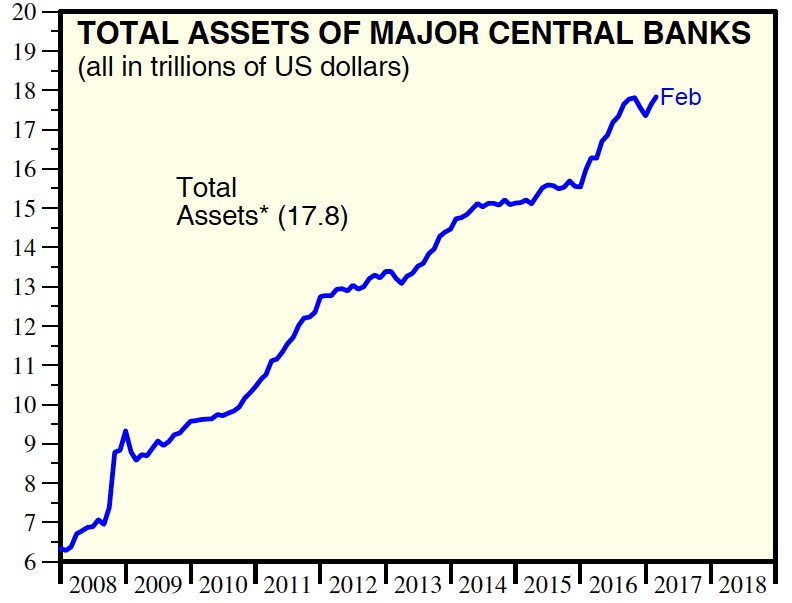
 

* Includes the US, ECB, BOJ and PBoC.

Sources: Yardeni Research, Inc. (www.yardeni.com); Haver Analytics

He notes that the curve and amplitude of the line showing the increase in central bank assets seen above is almost exactly the same as the line showing the increase in the S&P 500. He calls this the engine that’s driving what’s been taking place in terms of asset price inflation and ends by calling it highly unstable, and saying again that this will not end well.

Russell Lamberti emphasizes the importance in looking at this as three very big bubbles in a row, but also to think about the compounding effects of repeated malinvestment that has been essentially dis-allowed from correcting and from reallocating promptly. He also discusses this unwritten law against recessions, saying this is not just a problem in America, this is a problem everywhere in the world. Politicians don’t like recessions. As they push back through repeated cycles we have chronic malinvestment, chronic poorly allocated capital. And this creates a hostile working lifetime of living in an essentially very strange unreal financial and capital structure. He ends by saying: we’re in a third very excessive state of distortion and the best case scenario that we can hope for is a sharp, painful clear out of chronic malinvestment. That is the fastest path to genuine economic progress again, I hope we get there soon.

Chris Casey adds that when discussing how Austrian Economics explains the 08 crisis gives us some guidance to future bubbles in economic recessions, it’s worth recounting what can not explain the 08 crisis, and that is mainstream economics. And it’s worth remembering that in 2002 at Milton Friedman’s 90th birthday party that Ben Bernanke stood up and literally apologized for the great depression, and he basically said something to the effect of “we won’t do it again” and so that tells you central bankers pretty much around the world do not understand the causes of recessions at its most fundamental level. “They can’t explain why it occurs, they can’t explain why it’s a cycle, they can’t explain what Austrians call ‘the cluster of error’, why all these businesses have made horrendous investment decisions. They can’t explain why every recession is proceeded by monetary inflation, they can’t explain why certain industries are far more cyclical than say consumables. So it’s just something that cannot be explained, the Austrians do, and for the listeners who may not be all that knowledgeable on the Austrian School, in short, whenever you inflate the money supply, you are decreasing interest rates which distorts the whole structure of production, it forces economic actors to make investments they would not have otherwise done, that they would have otherwise deemed unprofitable, and it creates this malinvestment in the system, as my colleagues here today mentioned, we’ve already seen this play out twice in the last 20 years. And the response, if that’s the causation of a recession, the response should be hands off.”

The Austrian School Investing, Investments/Asset Classes/Investment Strategies

Bill Laggner discusses how knowing the Austrian business cycle theory is helpful in fact, during the second bubble, the credit bubble, he wrote an article with a colleague called “collateral damage”. And what he found fascinating about writing the article was the Bearing Credit bubble index created back in 2004 when it was pretty obvious that we were segueing into this new bubble. He says: I kept looking at the types of asset backed securities are being created mainly, and mortgage arena, and then the derivatives wrapped around it, and then attended a few conferences. But I started focusing on the collateral because it’s a confidence game, right, I mean people have confidence when these troubles start, they grow and what was interesting was in 2005 the home-builders had started declining severely and writing down land values ext. but subsequent to that you had maybe 12-18 months of watching paint dry. I mean the other related industries kind of kept chugging along. And it wasn’t until early 07 where the secondary market for certain types of mortgage backed securities just locked up. And that was the beginning of the end. So to me, when I look at excess credit creation through the socialization of credit by the central bank and or other government agencies like Fanny and Freddie in the U.S. I was looking at collateral that was kind of a helpful sign that we were near some kind of inflection point. I think  what makes this cycle so much more difficult, and look full disclosure I mean we’ve had a net equity short bias for the last several years, and it’s been pretty painful. I think this cycle, because they’re all playing the same game, they’re all in together. Is there any limit to what the central bank balance sheets can go to? I mean, how many bonds can the central bank give Japan or the ECB or the Fed purchase, and I think it’s pretty clear that since all the chips are in the middle of the table, they’re going to continue to buy bonds, and try and hold certain parts of the yield curve suppressed to keep the game going.

Chris Casey discusses how it’s unclear if Austrian Economic principles are necessarily applicable to investing, but Austrian Economic conclusions certainly are. He goes on to say “They certainly are as they relate to the macroeconomic phenomena of recessions and inflation. Because these are the two forces that create the greatest risk factors regarding ones investment portfolios. The recessions are going to pop any bubbles that are out there pushing the equity markets, and inflation will destroy the bond markets. And when you’re looking at equities or bonds, these obviously make up for most people the vast majority of their investment portfolio or at least the core of the investment portfolio. So if you’re able to use Austrian economics to navigate these two risk factors, I think it presents a tremendous advantage for investing. As far as whether or not there’s been empirical evidence demonstrating this, not to my knowledge, I think it would be difficult to construct such a study for a couple reasons. One being the time period that we’re looking at. Austrian economics hasn’t been utilized in this form for very long. And secondly would be the sheer number of people using Austrian Economics in this fashion. It’s a very limited set. The people here on the call know that they represent a good portion of that universe, may be the universe, of people managing money with Austrian Economic concepts in mind.”

Mark Whitmore also tends to be somewhat skeptical as far as can you look at Austrian Economics as instrumental tools for specific kinds of investment analysis or recommendation. What he think is incredibly valuable is how you explain the efficient market theory; this idea that whatever the price of the given asset is at any time, it’s the “right price”. Because all the information is being priced in so trying to outguess the market is kind of a fool’s errand. And I think that one of the most basic, the most essential insight of Austrian Economics is this idea of subjectivism, and that prices are wholly derived by human beings, and one of the other schools of economic thinking that I think dovetails nicely with the Austrian school is Economic behaviorism, this idea that individuals are driven by greed and fear, and as a result, and this feeds very much into the boom bust cycle of the Austrian framework, that you get these ridiculous, unexplainable run-ups in asset prices that leads to catastrophic losses.

Russell Lamberti thinks it’s about creating a coherent perspective of macro-reality, saying how there’s so many investment firms, you go on their websites and they talk about how they like to find miss-priced assets because they believe that the market doesn’t always effectively price assets. But they’ve never really got a coherent reason why. He goes on to say “I think the nature of clusters of error of boom and bust cycles, of the business cycle creates a very coherent reason why you get big distortions and big mispricing. And what I try to do for my clients is I say to them that ultimately using Austrian principals is essentially about creating a coherent perspective of reality, and also using that coherent perspective of reality to compare it to the market narratives that emerge. Donald Trump gets elected, and there’s a narrative there that emerges, a reflationary narrative. A narrative might be that he’s going to deregulate and the market finds an excuse to run even higher. And you’ve got to kind of test all these market narratives against really sound perspectives of reality. In addition to that I’d say a few things: one is that an Austrian perspective gives you an understanding that you’re not in a free, unfettered market, you’re in a market where the state plays an incredibly dominant role and is essentially trying to plunder private resources. And so a huge element of investment strategy from an Austrian perspective has to be at the sense of you are defending your wealth against the plunderers”.

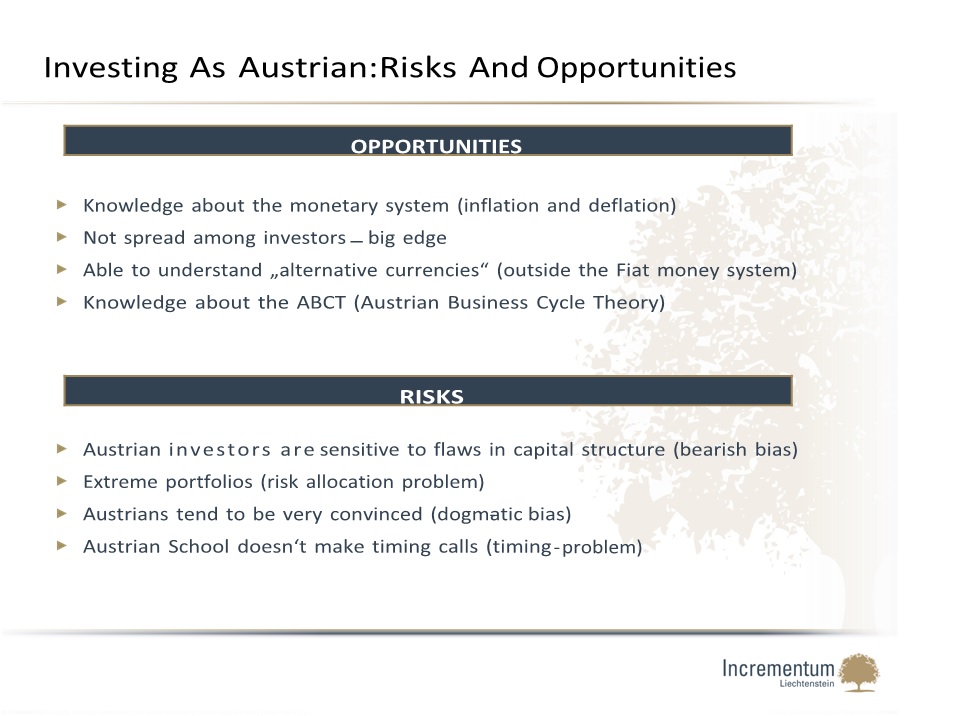
Mark Valek thinks knowing Austrian Economics provides you with a potentially huge edge. He points out that even though you can read about it online at mises.org or on other websites, many people don’t care enough or are not aware of it. He thinks another large edge is that Austrian Economists in general are able to understand alternative currencies much better. They are able to think about it outside of the money system just as we all think so much about the current system, that helps us for instance when bitcoin currency came up. So knowledge of Austrian Economics can provide a good investing edge sometimes in an indirect way as long as it’s utilized properly. He also discusses the potential weaknesses of using the Austrian system, saying that strictly speaking from an Austrian School, you don’t get any help regarding the timing of when we would expect to happen, however, you can still use other theories to help with that aspect.  The last potential risk he discusses is that Austrians have a dogmatic bias and tend to be very cautious in an investment space.
Ethical Issues:

Russell Lamberti points out that “We all have to make a decision about leverage. In a system where debt is created by fractional reserve banks, we understand that the core of business cycle problems arises from creating debt liabilities without prior saving – this is a systemic problem. And of course when you participate in that system, there’s two ways you can look at that. You’re ether participating in the bank and leverage system as a defence mechanism against that system, but you can also argue that you’re aiding in advancing that system, so I think every investor has to answer some pretty tough questions about leverage and about the kind of leverage.” Bill Laggner agrees and adds “I think people are leaving tax-free bonds or government bonds and doing other things with their capital, getting involved with private local businesses. I don’t want to get too far off track but I think that is something clearly playing out”.

How Austrian Economics help you when looking at investments from a risk-return standpoint:

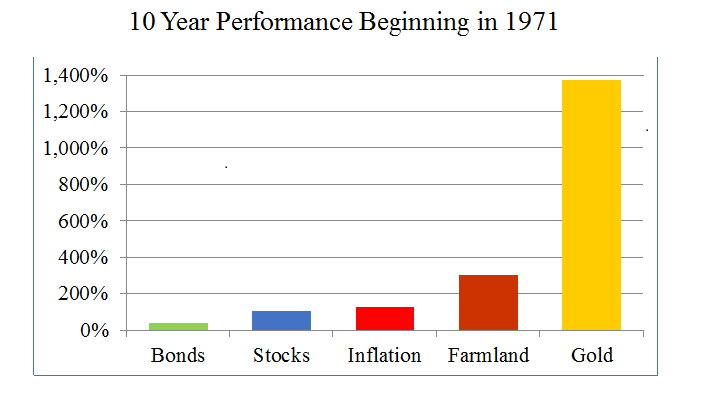
Chris Casey recalls what Mark Whitmore pointed out and added “hopefully I’m not misinterpreting him, but I believe Mark made a point that Austrian Economics doesn’t help us analyze any particular investment vehicle or perhaps even investment asset class, and by that I mean just because one company has more or less debt then another company doesn’t make it more or less Austrian. Or just because a company operates in such and such industry doesn’t make it more or less Austrian. Austrian Economics helps us because of the explanations as to inflation and recession. It helps us protect portfolios it helps us minimize risk. It also helps us profit from macroeconomic developments when they occur. Primarily meaning any kind of pops in bubbles or bond markets, whether stock or bond markets. So there you want to look for investments that will do well in that context, or that will weather the storm so to speak and do well regardless as to what happens. So you want to consider industries that potentially have high growth that will not be negatively impacted or at least will not shrink or be reduced in size through the effects of inflation of recession. Maybe you want to look at investments that historically have done well when you have inflation, meaning you want to consider gold, you want to consider farmland, things like that. So, I think Austrian Economics again helps us from an investment portfolio standpoint, minimize risk, and really seize onto some great opportunities as these things transpire. But as far as analysing any particular asset or asset class, I don’t think they lend that much value.”

Mark Whitmore adds “this notion of efficient market theory which attempts to just buy and hold the market no matter what, being completely price indifferent is clearly suboptimal. And that’s really key, as that Austrians, I think, have a sense of value in the marketplace naturally. And it doesn’t come from any unique insight of the Austrian School, other than the fact of the combination of the subjectivism coupled with the inherent boom-bust cycle makes those of us who use Austrian Economics very sensitive to issues of price and value. I think a cynic is often defined as someone who knows the price of everything and the value of nothing and I feel like Austrians are exactly the opposite.  Whereas other investors are chasing price action if you’re somebody who’s sort of a trend follower or you’re simply buying and holding, there’s a greater tendency among Austrian investors to appreciate value.”

Websites and other information on the panelists:

Russell Lamberti: www.etmmacro.com where you can sign up for a free newsletter called “The Macro Outsider”: http://etmmacro.com/the-macro-outsider/

Bill Laggner: http://www.bearingasset.com/ and a blog at http://www.bearingasset.com/blog

Chris Casey: https://windrockwealth.com/ includes podcasts, articles, blogs and more

Mark Whitmore: http://whitmorecapitalmanagement.com includes a quarterly newsletter

Mark Valek: http://www.incrementum.li/ and he has a book called “Austrian School for Investors” available on amazon.


Abstract:

Austrian Economics takes into account the behavior of man, and has different views than traditional economic theories on monetary policy, and differs from Keynesian economics greatly on the macro level. It can also be used to identify when there is too much debt and when bubbles are in danger of bursting. Austrian Economics can be very useful for observing the overall behavior of the economy and can often help an investor make more informed decisions.

FULL TRANSCRIPT

FRA: Hi, Welcome to FRA’s Roundtable Insight. Today we have a special treat for our listeners, it’s a discussion on the principals of the Austrian School of Economics and how those principals can be used in investing. Today we have five panellists from around the world, Russ Lamberti from Cape Town, South Africa, Mark Valek from Lichtenstein, Chris Casey from Chicago, Bill Laggner form Dallas, and Mark Whitmore from Seattle.

Welcome Gentlemen

So I thought we’d have a discussion initially about what exactly is the Austrian School of Economics and how does this school of economics differ from other schools such as the Keynesian School of economics. Mark Valek, would you like to begin?

Mark Valek: I’d love to, thanks for having me, very excited to discuss basically an economic school which is from Vienna, my hometown, unfortunately Vienna, in the University doesn’t really teach Austrian Economics anymore. However, I think the topic of the Austrian School is a big one, one can talk for hours on end on how it differs, we actually tried to make the Austrian School to list the 11 of 10 bullet points, we came up with an 11th one so we could describe the Austrian school in 11 bullet points. And this is by no means a complete observational but just some basic concepts we put together, we refer to them:

  • Economics is about behavior of individuals, it’s basically about human action
  • They can point human innovation and entrepreneurial action of a source of wealth creation
  • Private property is preconditioned for sensible resource allocation
  • Trading is mutually beneficial (The Subjective value theory. Theory of Value)
  • Another point would be under consumption of savings is necessary for sound investing and growth
  • Also, very important point I think which differentiates the Austrian school is its view towards capital structure. So capital structure is key to a sustainable economy. Thinking about Hayek‘s triangle for the guys who know what I’m talking about here.
  • And price mechanic mechanism coordinates the centralized knowledge.

So these were some basic, basic concepts and they are not only found in the Austrian School, perhaps what does differ more is the view towards the monetary system. And I just want to add 3 or 4 points regarding the Austrian view on the monetary system:

  • Inflation, for instance, is defined as expansion of money supply, something very central to Austrian Economists
  • Inflationary monetary systems chronically transfer wealth, I’m talking about the Cantillon effect, something I think the other schools really don’t talk about at length and it’s something very interesting for society also these days.
  • And finally expanding money and credit supply causes a boom and bust cycle in the business cycle theory

So these are perhaps the more typically differentiating points, especially from the Austrians, but this list is by no means complete, just a few thoughts perhaps to put on a discussion.

FRA: And Russ you’re perspective on the Austrian School of Economics

Russell Lamberti: Yeah, well everything Mark said was valid, I would, you know at a high level I think that one of the key differentiators from a practical analytical and investment perspective was that, the Austrian school draws a very straight and consistent line between microeconomics and macroeconomics. In fact strictly speaking the Austrians wouldn’t differentiate between the two, whereas what you see in Keynesian and monetarist schools is that they have relatively sound microeconomic principals, although they do still differ with the Austrians in one or two key areas, but when they aggregate it up to the macro, a whole different theoretical framework is used and there’s essentially no consistency between neo-classical and Keynesian micro and macroeconomics so there’s a fundamental breakdown there, Austrians are far more consistent there, I think part of the sense of that is also that the Austrians school derives its lineage from the classical schools of the 1700 and 1800s. And I think we must never forget that because a very key distinction in macroeconomics, a very key departure point between the different schools of thought is what’s known as Say’s law of markets. And you know Say’s law essentially is probably a poorly named concept because Jean-Baptiste Say was not necessarily the best articulator of Say’s law. But nonetheless, Say’s law essentially says that you know, properly allocated production, production that is sustainable is ultimately what finances the ability to demand. You know, and I think that in today’s Macro world it’s only really the Austrians who are talking about the unsustainability of certain demand trends because of misallocated capital and misallocated productive resources and that’s I think why the Austrian Business Cycle is such a key distinguishing feature of the Austrian school.

FRA: And Chris, your thoughts?

Chris Casey: Well the Austrian school certainly has a number of conclusions in Macroeconomic explanations that my colleagues have discussed, but if you boil it down and ask the true question as far as what makes Austrian Economics different I’m reminded of Ayn Randwhen she was describing, or criticizing I should say, other philosophiess and philosophers. And I remember her comment I forget which writing it was, it was something to the effect of: these philosophies have excluded man from their theories, and in so doing it’s no different than, let’s say, an astrophysicist that has no concept of gravity or a doctor that has no concept of germ theory. And the same could be said with other economic philosophies. Austrian Economics is the only one that really puts man at the center of the discussion. It boils economics down to man in the context of nature as it relates to scarcity for his needs and wants. And in so doing they then use a number of first principles that build on from the deductive reasoning standpoint, create a consistent and sound economic school and economic philosophy. And that’s what really, I think, makes the difference from the other economic schools out there. It’s not just the conclusions, it’s how we arrive at those conclusions.

FRA: And Bill, your perspective on the Austrian School?

Bill: Well, look I think everyone here has covered quite a bit of the main points, I would add that the world we’re living in today where we’re very far from any Austrian practices, you cannot have a healthy economy without savings, and by artificially setting the interest rate through central banking, you set in motion numerous distortions. And I think everyone at this table would agree that we’re living at a time where the distortions have never been greater. We have nothing resembling a natural rate anywhere around the world as far as I know. And so what’s happening is your setting in motion layers and layers of malinvestment and then every time there’s a crisis in the Keynesian way of looking at things, they come to the rescue and try and either bail something out through monetary or fiscal policy and/or socialize it directly or indirectly. And I would say we’re living in a time today where so much of the credit expansion that we’ve witnessed especially coming out of the great financial crisis in 2008-2009 is a function of either zero or negative interest rates and/or socializing some aspect of credit that’s entered the economy, and when you have that, clearly there’s no feedback loop. There’s no clear natural feedback loop you have a very distorted picture of things, and I think what makes today’s investing environment very challenging.

FRA: and Mark Whitmore, your thoughts on the Austrian school?

Mark Whitmore: Well, batting clean-up here is a little tough, because as Bill mentioned, I think that people have really nicely covered a lot of the main, sort of theoretical tenants of Austrian Economics, I guess I would add that specifically the role of central banking is something that I think is really distinct from an Austrian perspective vs Keynesianism, specifically the asset price inflation that you’ve seen has largely been ignored specifically in the last two bubbles, and now we’re into a third bubble I would argue as well. And essentially the Fed and the Keynesians will continue to point to well there’s really no headline inflation pressure and hence there’s really no reason to begin to normalize or adjust or move up interest rates. And I think that from an Austrian standpoint exacerbates this boom-bust cycle which we’ve seen really compressed in terms of time verses what has historically been the case since maybe the mid to late 90s and the amplitude of bubbles to the upside has just been far greater. And I guess I would just add Henry Hazlitt’s kind of 2 points as far as critiques of Keynesianism. The first  fundamental flaws being that it highlights in terms of interest, the visible minority at the cost of the invisible majority.And again it gets to this whole issue of government being the problem solver, the one that can allocate assets essentially, you know, in its view the most effectively from a Keynesian perspective in a counter-cyclical effective way, where the Austrians are much more skeptical of the efficacy of that. And second of all, the propensity under Keynesian Economics to over-consume in the present generation at a cost of creating massive debt or future debt for future generations to essentially somehow deal with, we’re sort of seeing that today in all developed parts of the world.

FRA: Great, let’s move to a discussion on how the Austrian School of economics is helpful in understanding how and why the 2007-2008 financial crisis happened. And then sort of in parallel to that, what is the Austrian School saying today about the global economy, are there any trends or outcomes that could be identified using the Austrian school. Just general question opened to the floor. Anybody?

Bill Laggner: This is Bill, I would say that all of the Austrians I’m sure on this call saw the crisis building coming out of the reflation right after the tech bubble that burst. It was interesting, the internet created this initial innovation wave decentralization wave, and of course due to excess credit creation, money creation, you had a bubble and then a subsequent bust. And then instead of letting the system purge and heal, the central banks led by the U.S. came and lowered interest rates and you segued from a technology bubble to a private sector credit bubble. And of course I think it went longer then everyone on this call thought it would, and it eventually hit a wall and again tried to cleanse and it’s interesting central banks let certain groups fail and then when things started to get out of hand, they stepped in and bailed out a number of politically connected contingents and then laid the foundation for this third bubble, and this third bubble’s gone on longer I ever imagined or my business partner imagined that it could. I think distortions are epic, I think we’re living in a fascinating time. It’s not going to end well, but I think along the way, there has been a continuation of decentralization, innovation, that’s the positive that I think we’re seeing today is as well, that’s just the natural order of the entrepreneurs and the ecosystem, they’re up.

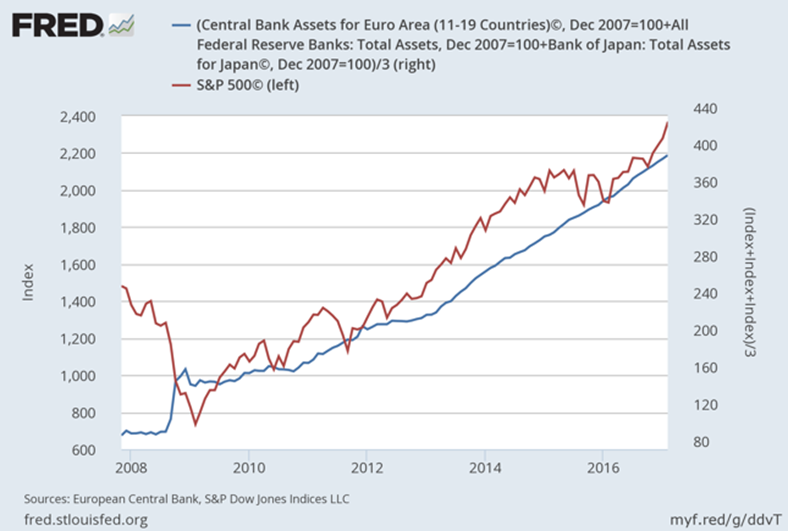
Mark Whitmore: This is Mark chiming in here, I would say that in terms of leading up to the Global Financial Crisis I feel tremendously bad for Kurt Rickenbacker.  He was I think a really fine economist, informed by sort of the Austrian School perspective and he had done a great job identifying the perils of the tech bubble that I think Bill mentioned, a lot of us who are Austrians saw coming, and died right before the bursting of the second bubble.  And what he had talked about is this notion of “Ponzi finance” that I think is good analytical insight that Hayak also talks about which is essentially the boom-bust cycle is endogenous to the particular type of finance credit system you have in place, and this credit can become increasingly untether any kind of historic connectors to things such as sound collateral and whatnot you saw increasingly these signs of the economy going off the rails in the upward direction in a trajectory that was simply unsustainable. So indeed that bubble went longer than most of us expected, and this one is truly epic, there’s one slide that I drew up which essentially overlays the growth of S&P 500 with the growth of central bank assets in Japan, the Eurozone, and the United States.

* Includes the US, ECB, BOJ and PBoC.

Sources: Yardeni Research, Inc. (www.yardeni.com); Haver Analytics

The assets of these central banks have been expanded a little bit more jagged but the curve, the direction and amplitude of the line is almost exactly the same and so you see this again, unsustainable credit fueled engine that’s driving what’s been taking place in terms of asset price inflation.It’s just highly unstable, and again this will not end well.

Russell Lamberti: Hey it’s Russ, I just wanted to chime in on what Bill had mentioned, I think it’s really critical to look at this as three very big bubbles in a row, but also to think about the compounding effects of repeated malinvestment that has been essentially dis-allowed from correcting and from reallocating promptly. There’s basically been since, I don’t know how long, maybe it was the Greenspan era that essentially ushered us in. But there’s essentially an unwritten law against recessions. And this is not just a problem in America, this is a problem everywhere in the world. Politicians don’t like recessions. As they push back through repeated cycles we have chronic malinvestment, chronic poorly allocated capital. And this creates a hostile working lifetime of living in an essentially very strange unreal financial and capital structure. But of course, as Bill rightly says, you have the countervailing forces of progress constantly working, the market is constantly trying to figure out how to make the best of its present reality and its present situations. This is why I think you have inherent paradoxes when you look at these big cycles, because there is so much to be bearish about, and yet there’s also a lot to be bullish about, and I guess that’s the essence and the nature of risk and opportunity. You know Mark Thornton once mentioned that Murry Rothbard used to say he was permanently bearish about the short term and permanently bullish about the long term. And I think that it’s an aphorism, but it kind of speaks to this notion that state intervention can really mess up markets and financial markets in the short term. But over time the power of the free market and of private enterprise is extremely pervasive and eventually seems to win out at the end of the day. Of course in the interim what that means is that because you have such disinflationary forces because of private enterprise and technology, it kind of emboldens the policymakers to run these bubbles longer and larger than they should be, so no question that the last two bubbles have been a symptom of these kind of policies, and I agree, we’re in a third very excessive state of distortion and the best case scenario that we can hope for is a sharp, painful clear out of chronic malinvestment. That is the fastest path to genuine economic progress again. I hope we get there soon.

Chris: This is Chris, I’ll just add that in discussing how Austrian Economics explains the 08 crisis gives us some guidance to future bubbles in economic recessions, it’s worth recounting what does not explain the 08 crisis, and that is mainstream economics. Whether it’s so-called Chicago or Keynesian schools. And it’s probably worth remembering that in 2002 at Milton Friedman’s 90th birthday party that Ben Bernanke stood up and literally apologized for the Great Depression, and he basically said “We’re never going to have a significant recession again.” I believe he said something to the effect of “we won’t do it again” and so that tells you central bankers pretty much around the world do not understand the causes of recessions at its most fundamental level. They can’t explain why it occurs, they can’t explain why it’s a cycle, they can’t explain what Austrians call “the cluster of error”, why all these businesses have made horrendous investment decisions. They can’t explain why every recession is proceeded by monetary inflation, they can’t explain why certain industries are far more cyclical then say consumables. So it’s just something that cannot be explained, the Austrians do, and for the listeners who may not be all that knowledgeable on the Austrian School, in short, whenever you inflate the money supply, you are decreasing interest rates which distorts the whole structure of production, it forces economic actors to make investments they would not have otherwise done, that they would have otherwise deemed unprofitable, and it creates this malinvestment in the system, as my colleagues here today mentioned, we’ve already seen this play out twice in the last 20 years. And the response, if that’s the causation of a recession, the response should be hands off. The response by the government and central banks should be to not re-inflate the money supply, do not create bailouts, not have deficits which only will spur consumer spending at the expense of savings. So if that’s the antidote for recessions, the governments since the 08 crisis has done the exact opposite and it’s simply set up the economy for far, far greater downturn then what we even experienced (in 2008), with the possibility of significant inflation. So the 08 crisis gives great lessons and basically proves out the Austrian theory, the business cycle. And it really demonstrates errors and issues with other explanations from other economic schools of thought.

FRA: and Mark Valek, any thoughts on applying the Austrian school to the financial crisis and where we’re potentially heading today and the Global economy?

Mark Valek: Definitely some thoughts, very short though because again, a lot has been said already. Where are we going in the Global Economy? Providing you have the Austrian perspective as we all obviously have, you actually know that there are significantly high (inaudible) to the capital structure, and this is not a sustainable state. But there lies the problem for investing obviously, the timing question, but sooner or later this state of capital structure will not last, it’s absolutely not sustainable. Just on a side note, as an asset manager, I encounter sustainability so many times a year, it’s kind of a hyperinflated world, everybody wants to invest sustainably and what bugs me that is nobody things about if our, for instance, monetary system is sustainable, and I would argue against it. So this is to me, really a very superficial discussion here. However, I think if this cleansing process starts the next time, we will probably will not see the big fear we saw the last time, which was basically the fear of deflation of debt deflation if you want to call it, like debt. I think the authorities have proven that they just will not let this happen so market participants probably are not going to have fear that will be too little money going around or being printed, but perhaps we’ll start to fear that this is going to be an overdose the next time, and I think as soon as this psychology changes, you have (Inaudible) things like price inflation look much more realistic in such an environment if you ask me.

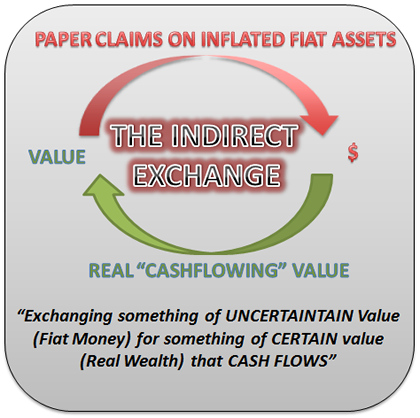
FRA: Great insight, and so given this view of applying the Austrian school to the economics environment, if we can consider that as far as the investment environment, does it make sense to look at the principals of the Austrian school in investing, I mean, we see some of the principals, of being stores of value, indirect exchange method, meaning exchanging fiat currency for investments that are real assets that provide cash flows, investments with little or no debt, high free discounted cash flows as well. Little or no leverage, also scarcity in innovative industries, and then perhaps cryptocurrencies that are outside of the banking system but are still regulated within the financial system. So does it make sense to apply those principals in investing, and what are those principals? Also, are there any empirical studies or analysis that taking this approach can provide an edge or an enhanced investment management performance? This question is for the floor.

Bill Laggner: This is Bill, I could say I think knowing the Austrian business cycle theory is helpful in fact, during the second bubble, the credit bubble, I wrote an article with a colleague called “collateral damage”. And what was fascinating about writing the article was we had created the Bearing Credit bubble index back in 2004 when it was pretty obvious that we were segueing into this new bubble, and I kept looking at the types of asset-backed securities are being created mainly, and mortgage arena, and then the derivatives wrapped around it, and then attended a few conferences. But I started focusing on the collateral because it’s a confidence game, right, I mean people have confidence when these troubles start, they grow and what was interesting was in 2005 the home-builders had started declining severely and writing down land values ext. but subsequent to that you had maybe 12-18 months of watching paint dry. I mean the other related industries kind of kept chugging along. And it wasn’t until early 07 where the secondary market for certain types of mortgage-backed securities just locked up. And that was the beginning of the end. So to me, when I look at excess credit creation through the socialization of credit by the central bank and or other government agencies like Fanny and Freddie in the U.S. I was looking at collateral that was kind of a helpful sign that we were near some kind of inflection point. I think what makes this cycle so much more difficult, and look full disclosure I mean we’ve had a net equity short bias for the last several years, and it’s been pretty painful. I think this cycle because they’re all playing the same game, they’re all in together. Is there any limit to what the central bank balance sheets can go to? I mean, how many bonds can the central bank give Japan or the ECB or the Fed purchase, and I think it’s pretty clear that since all the chips are in the middle of the table, they’re going to continue to buy bonds, and try and hold certain parts of the yield curve suppressed to keep the game going. So ultimately I think you know gold, we own a lot of gold, we’ve owned gold since 2002, I mean gold will continue to act well, and may become one of the best performing asset classes over the next several years until we ether get some kind of boom or something close to it. So that’s how it’s helped us and how we employ it in day to day portfolio management.

Chris Casey: This is Chris, I’ll say that I’m not sure if Austrian Economic principles are necessarily applicable to investing, but Austrian Economic conclusions certainly are. They certainly are as they relate to the macroeconomic phenomena of recessions and inflation. Because these are the two forces that create the greatest risk factors regarding ones investment portfolios. The recessions are going to pop any bubbles that are out there pushing the equity markets, and inflation will destroy the bond markets. And when you’re looking at equities or bonds, these obviously make up, for most people, the vast majority of their investment portfolio or at least the core of the investment portfolio. So if you’re able to use Austrian economics to navigate these two risk factors, I think it presents a tremendous advantage for investing. As far as whether or not there’s been empirical evidence demonstrating this, not to my knowledge, I think it would be difficult to construct such a study for a couple reasons. One being the time period that we’re looking at. Austrian economics hasn’t been utilized in this form for very long. And secondly would be the sheer number of people using Austrian Economics in this fashion. It’s very limited set. The people here in the call know that they represent a good portion of that universe, may be the universe, of people managing money with Austrian Economic concepts in mind. So there are very limited data points out there.

Mark Whitmore: This is Mark, I would sort of follow up on Chris’s comments. I tend to also be somewhat skeptical as far as can you look at Austrian Economics as instrumental tools for specific kinds of investment analysis or recommendation. And I think that’s a harder thing to make a case for. What I think is incredibly valuable, is how do you explain reality and in essence, the kind of the largest school out there in terms of money management is the efficient market theory, this idea that whatever the price of the given asset is at any time, it’s the “right price”. Because all the information is being priced in so trying to outguess the market is kind of a fool’s errand. And I think that one of the most basic, the most essential insight of Austrian Economics is this idea of subjectivism, and that prices are wholly derived by human beings, and one of the other schools of economic thinking that I think dovetails nicely with the Austrian school is Economic behaviorism, this idea that individuals are driven by greed and fear, and as a result, and this feeds very much into the boom bust cycle of the Austrian framework, that you get these ridiculous, unexplainable run-ups that leads to catastrophic losses. And if investors can simply, instead of, and I remember reading one of the most tortured treatments by Burton Malkiel who wrote the seminal Random Walk Down Wall Street which is sort of like the bible of efficient market theory, and soon after the edition following the 1987 stock market crash where the Dow went down 20% in a day, he attempted to try to explain how this was a rational response to changing monetary conditions, and the market was kind of correctly pricing things all the way along. And you find these things which, I think Chris mentioned earlier simply that Keynesians and the people who look at kind of classical economics and efficient market theory, they can’t explain reality. But the power, the strength of Austrian Economics you can see bubbles when they’re coming. And like Bill, I’ve leaned into the defensive positive in the last few years, so in the short run you might seem to be looking like a fool, but if you can help your investors avoid and maybe even profit from bubbles as they unwind, you’re going to be far better off than the vast majority of investors out there that are just being caught up and are losing 50% of their portfolio in multiple stretches.

Russell: Hey guys, its Russell here, Mark you’ve just made some really great points. And I think I would echo a lot of what you said. I think it’s about creating a coherent perspective of macro-reality, you know there’s so many investment firms, you go on their websites and they talk about how they like to find miss-priced assets, because they believe that the market doesn’t always effectively price assets. But they’ve never really got a coherent reason why. I think the nature of clusters of error of boom and bust cycles, of the business cycle creates a very coherent reason why you get big distortions and big mispricing. And what I try to do for my clients is I say to them that ultimately using Austrian principals is essentially about creating a coherent perspective of reality, and also using that coherent perspective of reality and comparing it to the market narratives that emerge. Donald Trump gets elected, and there’s a narrative there that emerges, a reflationary narrative. A narrative might be that he’s going to deregulate and the market finds an excuse to run even higher. And you’ve got to kind of test all these market narratives against really sound perspectives of reality. In addition to that I’d say a few things one is that an Austrian perspective gives you an understanding that you’re not in a free unfettered market, you’re in a market where the state plays an incredibly dominant role and is essentially trying to plunder private resources. And so a huge element of investment strategy from an Austrian perspective has to be the sense that you are defending your wealth against the plunderers. The second component is that business opportunities can be false, and that’s something that’s embodied in the essence of boom-bust cycles, subsidization, and the principals of Say’s Law, you know expecting consumer markets to boom when in fact you’ve got misallocated productive capital, those consumer markets are not going to perform how you expect. And the flip side of that of course is that you get overestimated business risk, because some people are avoiding sectors that look unattractive when in fact they are fundamentally attractive, particularly if they can exploit state failure. And then finally Hayek spoke about the pretense of knowledge in his famous Nobel acceptance speech, and you know one of the things that none of us, whether you’re an Austrian or not, none of us have the entirety of knowledge that we need to make very precise and accurate calls about the investment world. And that’s one of the reasons why, and it’s spoken about in the book “Austrian School for Investors” but you know you’ve got to start off by exploiting opportunities as an investor that are close to you. That you’re capable of having knowledge about, and that’s why before you invest in public companies and in funds, you probably have to invest in yourself, in your own entrepreneurship or in private equity opportunities that are very close to you and where you have some special knowledge. Because you don’t have any more knowledge then the central planners do either. So I think those are some really key objectives. I think there’s some ethical issues as well but I don’t want to go into that right now, but I do think that when we talk about Austrian Economics being free of value judgment, that’s very much in the theoretical analytical sense. But once you’ve derived conclusions from that, value judgments definitely come to the fore, and I think there’s a strong ethical component that can be informed across a range of asset classes and how you invest and how you go about investing. I’m going to not go into that right now, we can maybe circle back to that a bit later.

FRA: Then Mark Valek, as Russ refers to your co-authored book on the Austrian School for investors, can you provide some insight from that book on these principals?

Mark Valek: Yeah thanks. Just a small supplement here, we thought about this topic very hard and we thought, where potential opportunities lie in Austrian investing and where do potential risks lie in such a discipline. Just a few words on opportunities we’ve heard I think already in that direction. The fact that it’s not read among investors. I think that’s potentially a huge edge, it’s a huge edge in a marketplace where it’s not really a secret, it’s out there, you just have to read it on the internet, go on mises.org or wherever, but most of the people just don’t care or know about this so it’s not read. Second edge knowledge about Austrian business cycle theory we also talked about, but I just want to point out the third edge which we identified and I think Austrians in general are able to understand alternative currencies much better they are able to think about it outside of the money system just as we all think so much about the current system that helps us for instance when bitcoin currency came up, I was not even as a tech guy but just from an Austrian view I was able to pretty fast wrap my head around the basic concepts. And I knew if this thing monetizes then it’s huge financial gain and if it doesn’t well until it does it’s speculation on a potential alternative money, but now I think it’s more clear to the rich investor too, but such thing I think come with an Austrian mindset. On the other hand just also to talk about the risks perhaps for one moment with Austrian investing, generally, and I’m sure all of us know about this potential risk, is a bearish bias is associated to the Austrians. I think that’s because Austrian investors are sensitive to these flaws in the capital structure we already talked about. And they always kind of think perhaps this boom will be bust sooner than later and so on, and we know the problems I think associated with that. Another problem I also touched already is the Austrian School statistic it does not make timing calls. So this is a predictive problem obviously, especially in finance. I think one can circumvent this problem with the help of other techniques from the quantitative side take the analysis, whatever. But strictly speaking from an Austrian School, you don’t get any help regarding the timing problem. Just to mention the last potential risk, Austrians do tend to be very convinced, it’s like what we call potentially a dogmatic bias, and dogmatism is probably a thing where one should be cautious in an investment space. So there are other opportunities, but there’s also risks and one should be aware of these risks and find some ways to manage these risks as an Austrian investor.

FRA: If we could do one more round on bringing it all together and providing some examples of investments or asset classes or perhaps investment strategies that exemplify using the principals of the Austrian School in investing or the outcomes as Chris mentions, of the Austrian School. Let’s do a round based on that to close out. No specific companies or securities, but just generically speaking. Anybody?

Russell: It’s Russell here, maybe I can come in and say one or two things about some of the ethics around investing. I mean, we all have to make decisions about leverage. In the system where debt is created by fractional reserve banks we understand that the core of business cycle problems arises from creating debt liabilities without prior saving – this is a systemic problem. And of course, when you participate in that system, there’s two ways you can look at that. You’re either participating in the bank leverage system as a defense mechanism against that system, but you can also argue that you’re aiding in advancing that system, so I think every investor has to answer some pretty tough questions about leverage and about the kind of leverage. I think from an Austrian perspective, you would typically favor equity over debt and you would favor non-bank debt over bank debt. The other big ethical question, of course, is to talk about government bonds – financing the state. The state is essentially a mechanism of wealth destruction, you know do you really want to be financing plunder, but in another sense, by funding the state, you’re again, aiding and abetting a fairly large degree of wealth destruction. And ultimately getting your coupon payments in part by being taxed more and your friends and family being taxed more. So one’s got to think about that, some of these issues. And then, we know that Ludwig von Mises was one of the greatest advocates for peace, and anti-war, and you have to think about what firms are doing in terms of financing and funding and equipping governments to fight unjust wars. These are obviously very tricky and murky. And I’m not trying to make any kind of high-brow ethical statements here, I just think that these are the kind of things that have to be considered and Austrians do think a lot about these things. So I just wanted to kind of lay that out there, because ethics and feeling personally good about your investments, not just intellectually, but emotionally as well, I think is an important part of an investment strategy.

Bill: This is Bill, I’d like to just touch on something Russell mentioned, great points by the way, the state has grown immensely around the world subsequent to 2009. And I don’t want to get to far into the metrics we all know what played out in certain parts of the world, I think one of the beauties of the internet and the search for the truth and leading us to the election in the United States for example last year in WikiLeaks, the internet is essentially exposing a lot of the fiction that we’ve all grown up around over the last number of decades. And with that comes almost an awaking, a move to higher consciousness. So people are, I see it every day, I think people are leaving tax-free bonds or government bonds and doing other things with their capital, getting involved with private local businesses. I don’t want to get too far off track but I think that is something clearly playing out. Cryptocurrencies, I’ve spent a lot of time looking at the economic actors within this interesting ecosystem and you think about not being a participant in the plunder if you look at just the banking system and all of the friction within the banking system, let alone the leverage, you’re looking at a couple trillion dollars a year just in general friction that’s being stripped out of the ecosystem. So the movement towards the internet of value as opposed to what we witnessed the last couple of decades, the internet of information knowledge I think is another fascinating innovation playing out. So I think more and more people per Russell’s point, don’t want to participate in the plunder and are actually spending time and capital creating these new economic fabrics and I think it’s quite exciting to witness.

Chris: This is Chris, if we take out the ethical considerations that a couple of my colleagues just mentioned, the question is how Austrian Economics help you when looking at investments from a risk-return standpoint. And I think Mark mentioned this earlier, hopefully I’m not misinterpreting him, but I believe Mark made a point that Austrian Economics doesn’t help us analyze any particular investment vehicle or perhaps even investment asset class, and by that I mean just because one company has more or less debt then another company doesn’t make it more or less Austrian. Or just because a company operates in such and such industry doesn’t make it more or less Austrian. Austrian Economics helps us because of the explanations as to inflation and recession. It helps us protect portfolios it helps us minimize risk. It also helps us profit from macroeconomic developments when they occur. Primarily meaning any kind of pops in bubbles or bond markets, whether stock or bond markets. So there you want to look for investments that will do well in that context, or that will weather the storm so to speak and do well regardless as to what happens. So you want to consider industries that potentially have high growth that will not be negatively impacted or at least will not shrink or be reduced in size through the effects of inflation of recession. So maybe in America you want to consider the cannabis space. Maybe you want to look at investments that historically have done well when you have inflation, meaning you want to consider gold, you want to consider farmland, things like that. So, I think Austrian Economics again helps us from an investment portfolio standpoint, minimize risk, and really seize onto some great opportunities as these things transpire. But as far as analysing any particular asset or asset class, I don’t think they lend that much value. I’ll also say that I think Austrian Economics lends itself naturally to contrarian investing which I think is a great way to make money. It’s pretty obvious that there’s not a lot of people out there managing money that believe in Austrian Economics. So we hold a key, we understand something that few people embrace or have any kind of knowledge of. And I think that really is a key factor in contrarian investing which really just means you’re looking for extreme market value questions on the high or low side, and identifying the catalysts that will bring that prices back to its historical mean or median. And I think the explanation and conclusions of Austrian Economics do that quite well.
Data Courtesy of the St. Louis Federal Reserve

Mark Whitmore: This is Mark Whitmore, I keep forgetting we have two Mark’s on the line here, and Chris you absolutely interpreted what I was trying to say correctly, and kind of to follow up a little bit, I think one of the things that the other Mark pointed out is the issue of timing, and whereas the two prevailing investing paradigms out there seem to be this notion of efficient market theory which attempts to just buy and hold the market no matter what, completely price indifferent. And that’s really key, is that Austrians I think have a sense of value in the marketplace naturally. And it doesn’t come from any unique insight of the Austrian School, other than the fact of the combination of the subjectivism coupled with the inherent boom-bust cycle makes those of us who use Austrian Economics very sensitive to issues of price and value. I think a cynic is often defined as someone who knows the price of everything and the value of nothing and I feel like Austrians are exactly the opposite.  Whereas other investors are chasing price action, if you’re somebody who’s sort of a trend follower, or you’re simply buying and holding, there’s a greater tendency among Austrians to appreciate value. And this point dovetails with the other point as far as since we don’t pretend to know the precise timing of when bubbles kind of unwind or when the busts will finally reach a bottom, the idea is that we can actually be in the right quartile of activity, in other words I never try to catch the very top of a bubble, I don’t try to ride things to the very end, and similarly I don’t mind catching falling knifes. Because as investors if you’re looking at this current contemporary global macroeconomic backdrop from the 10-12 year perspective, I find it with the typical disclosure here that I’m not able to see with a perfect crystal ball or anything but it’s hard to believe that traditional assets, that global equities, will be thriving in this environment just from the simple perspective of how overstretched they are from any reasonable measure of valuation.  And similarly, the global bond market which has been the classic offset to unwinding stocks in the past, is also so stretched.Because just like bond prices are inversely related to interest rates, you have interest rates around the world, I mean you have negative interest rates in Sweden, in Japan, in Switzerland, and back last July you have negative interest rates over a swath of different developed markets so there’s simply not a lot of room basically for bond appreciation. I think it’s a very careless time for equity and bond investors from a longer term perspective whereas those of us who are Austrian have a bend for the idea of real money, sound money, and one of the things that looks pretty attractive in a Ponzi finance global macroeconomic backdrop would be precious metals I would say. And I particularly play in the currency space and one of the thing that’s attractive there is the idea that in eras where you have reckless central banking there’s huge distinction between reckless central bankers and those who are engaged in reckless central banking with abadon and as a result I think that there becomes some real value disparities from a currency standpoint as well. But I mean I think that’s how I at least use Economic principals from the Austrian school to inform overall investing decisions in the marketplace.

FRA: And finally, the other Mark?

Mark Valek: Yeah, I think that most points have been touched seriously. Yeah I just don’t want to drag it out unnecessarily, but I think there were very interesting comments in all kind of directions, really enjoying this discussion, I don’t know if we have anything else on the plate?

FRA: Nope, that’s it. Just wanted to close out with regard to giving everybody a chance to identify how our listeners can learn more about your work, if you have a website or perhaps a newsletter?

Russell Lamberti: Yeah my website, ETM macro advisors website is www.etmmacro.com and I am starting a new newsletter called the macro outsider, and you can sign up for it for free on www.etmmacro.com and you’ll get a free essay called “The real currency war” which is subtitled “monopoly money vs real money” and essentially there I just go into a lot of what we’ve spoken about today in terms of chronic malinvestment, the weakness of fiat currency reserve systems, and then ultimately where I think the real currency war is, which is in centralized vs. decentralized money, and I talk a little bit about cryptocurrencies there as well, so that’s www.etmmacro.com you can sign up for that free newsletter.

Bill Laggner: This is Bill, so Kevin Duffy and I, we manage a couple of funds, long short-biased, I should say long short strategy macro oriented funds, bearing asset, like ball bearing .com, http://www.bearingasset.com/ and then we also write a blog http://www.bearingasset.com/blog and then Kevin and I are on twitter as well, we post some comments from time to time.

Chris Casey: This is Chris Casey with WindRock Wealth Management, we manage money for high net worth individuals. I would encourage anyone that wants to check us out just to visit our website https://windrockwealth.com/ We have our contact information there, we have all of our content, meaning podcasts, articles, blogs etc. That’s been posted since we started the firm and the people can feel free to read more about our philosophy on various issues.

Mark Whitmore: Great, and this is Mark Whitmore in Seattle, I have a website at http://whitmorecapitalmanagement.com there’s a research and article section which has, I do a quarterly newsletter and would be happy to put anyone interested on the mailing list for that, and basically we have a strategic currency fund that is again, informed largely by Austrian Economic principles that I operate. I also will make a plug here for one of my co-panellists, Mark Valek, who has his book “Austrian School for Investors” is essentially that he co-authored is one of the only kind of resources out there that’s an outstanding resource and really well researched and thought out, so I want to complement the fine work you’ve done on that.

FRA: Great, and now Mark Valek

Mark Valek: Thanks so much, thank you if you’re interested the book is on amazon I guess, “Austrian School for Investors” our homepage is http://www.incrementum.li/ we’ve got lots of good stuff which is relevant up there, first of June our annual “In gold we Trust” report is going to be published as well. You’ll find that on the homepage as well.

Summary and Transcript by Jacob Dougherty jdougherty@Ryerson.ca

Disclaimer: The views or opinions expressed in this blog post may or may not be representative of the views or opinions of the Financial Repression Authority.


04/12/2017 - WindRock Wealth On Cryptocurrencies

The first article in the series, Investment Themes Your Wealth Manager Isn’t Telling You About, provides great insight and perspective on cryptocurrencies such as bitcoin. This article may be especially relevant for investors who are still confused by the concept of and the opportunity provided by cryptocurrencies.

FRA acknowledges the potential for cryptocurrencies to mitigate risks associated with the continued war on cash by governments. Measures taken by governments to restrict and eventually eliminate the use of cash will only continue, especially if negative real interest rates persist or increase in magnitude.

In addition, cryptocurrencies present the opportunity to hold assets outside of the banking system. Doing so helps investors avoid the risks associated with bank bail-ins or other repressive measures “necessitated” by the banking crises inevitably generated by a fractional-reserve system.

Given bitcoin’s dramatic price increase over the last few years, its relative price stability, and the opportunities it presents, investors should learn more about cryptocurrencies.

Investment Themes Your Wealth Manager Isn’t Telling You About:

              Cryptocurrencies

Brett K. Rentmeester, CFA®, CAIA®, MBA

April 2017


In 1994, most investors had heard of the Internet, but had no real idea of what it was or how it would impact their lives. An episode of the Today Show that year featured Katie Couric and Bryant Gumbel discussing the topic when Bryant Gumbel asked “What is the Internet anyway?”[1] By the time most investors truly figured that question out, fortunes had already been made and many other business models had been disrupted. The lesson: astute investors should take time to understand the technology that computer geeks are enthusiastic about. Today, that is bitcoin and other cryptocurrencies.

Like the Internet back then, most investors have heard of bitcoin, but few have a real grasp of the disruptive technology behind it – the blockchain. Blockchain technology has the potential to be as revolutionary and disruptive as the Internet itself.

What is bitcoin?

Bitcoin was the first cryptocurrency, a virtual money and payment system. It is based on a revolutionary technology referred to as the blockchain. Understanding bitcoin and other cryptocurrencies involves first understanding the blockchain itself, the genius behind all cryptocurrencies.

How does blockchain technology work?[2]

The blockchain is a digital accounting ledger. It is public, transparent, and includes the full history of all transactions on the system for all users to see and verify. Similar to a bank’s private banking records or ledger, the blockchain stores a registry of all user assets and transactions. This is done in a pseudo-anonymous way with users’ identification only specified by a numeric address typically held in a “wallet.”

The “blocks” contain bitcoin transactions. The most recent bitcoin transactions are recorded on these blocks which are verified with cryptography (an encryption system using advanced mathematics). Only a bitcoin owner’s cryptographic keys can alter that segment of the blockchain. This prevents double-counting of or multiple claims to bitcoins. The blockchain is thus a “chain” of these many “blocks” registering ownership in one comprehensive and transparent accounting ledger. Bitcoin owners have access to their respective transactions within the blockchain available to them anytime, anywhere in the world.

Further, this requires no middleman’s trust or approval. It is as if each individual becomes their own bank and controls their own money. This bank is open 24 hours a day, seven days a week, and it can be accessed globally and transacted quickly with minimal transaction fees. It is portable beyond national borders with a value that is set globally.

Contrast this to an investor with money in the bank. An investor’s money is also an electronic entry, but this time on a private accounting ledger controlled by the bank. This requires dealing with the bank to get access to their own money. Worse, due to fractional-reserve banking, money in the bank is actually largely lent out (depositors are creditors to the bank). Transaction costs may also be high or it may simply be impossible to do certain global transactions.

Who maintains the system?

It is a global peer-to-peer system, managed by its members and not reliant on any centralized governing body, corporation, or government to function. In this sense, it is a pure free-market model where members maintain the system in a way that supports their own economic interests. Essentially, the system is run by the majority of its most active participants referred to as “miners.” These miners are a global community of individuals who keep the blockchain updated by authenticating transactions. As a reward, they earn new bitcoins. In this regard, they are given the name “miners” in reference to gold miners who are rewarded for their mining efforts with new found gold.

Is bitcoin secure?

The ledger is replicated across the entire network of users such that no centralized institution or server controls the blockchain data. Since the data is replicated thousands of times over on computers globally, hacking would require massive computing power. In any such attempt, the offending computers will be identified as corrupted by the tens of thousands of uncorrupted copies of the blockchain.  For this reason, bitcoin and the blockchain are likely much more secure than most centralized systems we rely on today.

Although the blockchain has never been hacked, certain online accounts holding bitcoin have been hacked which created some negative publicity. However, it is critical to differentiate between the security of the blockchain itself and where a user chooses to store their bitcoin.  Related to the security of each transaction, the miners help audit and confirm the validity of every transaction on the blockchain many times over, such that hacking and fraud of the bitcoin are highly unlikely. Imagine a dozen accounting firms auditing every transaction of a business and only approving them if all accounting firms agree.

Why is the blockchain concept so revolutionary?

Blockchain’s disruptive potential is most heavily influenced by its key attribute – that it allows for a trustless system. It is a peer-to-peer system with no middleman. Users rely on the integrity of the blockchain itself and thus have no need to know the identities or reputations of a counterparty or place any trust in them. The integrity of the system itself is all that needs to be trusted. The mysterious founder of bitcoin, Satoshi Nakamoto, wrote: “we have proposed a system for electronic transactions without relying on trust.”[3]

What is the value of bitcoin?

The value of bitcoin or any cryptocurrency can be hard to grasp, although it has a price that is set globally and trades 24 hours a day. Thus, a global network of buyers and sellers act to set the price at every moment. At its core, bitcoin is a digital currency that can be used to transact, act as a store of value, or held as a speculative investment. Overstock.com was an early adopter to accept bitcoin, but bitcoin can now be used at over 100,000 merchants including household names like Starbucks, Walmart, Home Depot, Tesla and Subway.[4]

The value is contingent on supply and demand. For bitcoin, the supply is programmed to grow from approximately 16 million bitcoins today to 21 million bitcoins in the future.[5] It has a finite supply (unlike fiat currencies today), supporting its longer-term value. Demand drivers include the utility or benefit users get from using bitcoin. These include a trustless blockchain technology allowing individuals to become their own bank, an ability to transact or transfer value globally at any time to anyone at minimal costs, and the capability for micro-transactions (more on this below). With a market capitalization (or total value) of $18 billion, bitcoin is similar to the concept of owning a piece of other payment systems like PayPal ($52 billion market capitalization) or MasterCard ($120 billion market capitalization).

Micro-transactions today are totally uneconomical with financial institution fees, but bitcoin can be transacted in any fractional amount. For example, imagine someone needing to do a transaction in a poorer region of the world. Today, they could transfer 0.0012 bitcoin or approximately $1.44 (based on a bitcoin price of $1,200). Transferring dollars would be cost prohibitive with any normal level of financial fees. Applying this technology to regions of the world needing money in small denominations and lacking access to traditional banking could unleash the power of bitcoin as the money of the internet.

There has been some debate about whether cryptocurrencies like bitcoin represent money. Money is a medium of exchange and, as such, presupposes the ability to act as a store of value. Over two thousand years ago, Aristotle noted the primary qualities exhibited by money: portability, durability, homogeneity and divisibility. Bitcoin meets these criteria. Today, as most currencies are increasing their supply dramatically, bitcoin offers a unique alternative due to its finite supply.  Interestingly, the price of bitcoin surpassed the price of gold for the first time ever on March 3, 2017.

Why do investors own bitcoin or other cryptocurrencies?

Many owners of bitcoin are using it for transactions. However, some view it as a store of value or speculative investment. This former view is a hedge against the risks of a future global currency crisis as most governments today have debt levels which can only be repaid by massive monetary printing. Bitcoin may be a hedge against monetary instability or capital controls as it allows individuals to be their own bank and control their money outside of the fractional reserve banking system. For speculators, it is an opportunity to be part of a vibrant and mushrooming industry where the value of bitcoin may grow as more users enter its network.

What are the risks?

Technology is always evolving and its path is far from certain. In social media, early winners like Myspace gave way to Facebook, so the future of leading cryptocurrencies could change. Miners can also have disagreements leading to splitting a cryptocurrency in two separate coins, referred to as a “hard fork.” For example, there is currently a debate in the bitcoin community about block size as it relates to speed and cost of transactions. If a hard fork occurred, current bitcoin owners would get coins in each new currency that they could trade. Prices of any cryptocurrencies can be extremely volatile.

Also, cryptocurrencies pose a risk to governments as a store of value outside of the banking system. Since banks are reliant on depositors to keep a leveraged system afloat, governments could crack down on bitcoin or tax it excessively. Today, most governments have accepted bitcoin and, in the U.S., it is given favorable tax treatment under the capital gain tax laws.

What areas will be impacted by blockchain technology?

We see three branches emerging. First, money and banking as bitcoin and other cryptocurrencies gain acceptance as a store of value and payment system.

Second, titling and document retention. A group of open-architecture platforms, such as Ethereum, are creating smart contracts for many business applications to eliminate the need for a middleman due to the trustless nature of the blockchain. Ownership of their “coin” is somewhat akin to owning stock in their ultimate platform. This area is likely to disrupt many businesses as their platform allows developers to create business applications that act as smart contracts with a traceable system documenting all records, management, and transactions. This has the potential to disrupt any businesses that serve as a middleman to ensure trust amongst the transacting parties including title companies in real estate and even global stock exchanges.

Ultimately, we foresee many private and government applications built around the blockchain technology. Private uses of blockchain may be back office systems for banks and financial firms. We are even seeing disruptive social media sites like Steemit that reward key users and contributors with value in the social media network (akin to ownership) instead of these benefits only accruing to corporate owners (such as Facebook’s model). Securely storing and validating records (health, education, legal, etc.) and even authenticating voting remain likely possibilities.

This blockchain revolution is much bigger than bitcoin alone, but bitcoin remains the leader in payments and as an alternative store of value. While many of us may feel as lost about cryptocurrencies today as Bryant Gumbel was about the Internet, investors ignoring the potential of the blockchain may miss out on an equally lucrative opportunity.


All content and matters discussed are for information purposes only. Opinions expressed are solely those of WindRock Wealth Management LLC and our staff. Material presented is believed to be from reliable sources; however, we make no representations as to its accuracy or completeness. All information and ideas should be discussed in detail with your individual adviser prior to implementation. Fee-based investment advisory services are offered by WindRock Wealth Management LLC, an SEC-Registered Investment Advisor. The presence of the information contained herein shall in no way be construed or interpreted as a solicitation to sell or offer to sell investment advisory services except, where applicable, in states where we are registered or where an exemption or exclusion from such registration exists. WindRock Wealth Management may have a material interest in some or all of the investment topics discussed. Nothing should be interpreted to state or imply that past results are an indication of future performance. There are no warranties, expresses or implied, as to accuracy, completeness or results obtained from any information contained herein. You may not modify this content for any other purposes without express written consent.

[1]       “What is the Internet, Anyway?” Today Show. 1994.  YouTube. 28 January 2015. https://www.youtube.com/watch?v=UlJku_CSyNg

[2]       The Financial Times Ltd.

[3]       Nakamoto, Satoshi. Bitcoin: A Peer-to-Peer Electronic Cash System. 24 May 2009 <http://bitcoin.org/bitcoin.pdf>.

[4]      SpendBitcoins. http://spendbitcoins.com/

[5]       Bitcoin: A Peer-to-Peer Electronic Cash System


WindRock Wealth Management is an independent investment management firm founded on the belief that investment success in today’s increasingly uncertain world requires a focus on the macroeconomic “big picture” combined with an entrepreneurial mindset to seize on unique investment opportunities. We serve as the trusted voice to a select group of high net worth individuals, family offices, foundations and retirement plans.

Brett K. Rentmeester, CFA®, CAIA®, MBA, is the President and Chief Investment Officer of WindRock Wealth Management. Mr. Rentmeester founded the company to bring tailored investment solutions to investors seeking an edge in an increasingly uncertain world. He can be reached at 312-650-9593 or brett.rentmeester@windrockwealth.com

Christopher P. Casey, CFA®, is a Managing Director with WindRock Wealth Management. Mr. Casey advises clients on their investment portfolios in today’s world of significant economic and financial intervention. He can be reached at 312-650-9602 or chris.casey@windrockwealth.com.

Disclaimer: The views or opinions expressed in this blog post may or may not be representative of the views or opinions of the Financial Repression Authority.


04/11/2017 - The Roundtable Insight: 5 Top Money Managers Discuss Austrian School Investing – Now Published

LINK HERE to download the MP3 PODCAST

SUMMARY – also see FULL TRANSCRIPT BELOW

Today we have five panelists from around the world, Russ Lamberti from Cape Town, South Africa, Mark Valek from Liechtenstein, Chris Casey from Chicago, Bill Laggner from Dallas, and Mark Whitmore from Seattle.

Chris is the Managing Director of WindRock Wealth Management. He combines a degree in Economics from the University of Illinois with a specialty in the Austrian school of Economics. He advises clients on their investment portfolios in today’s world of significant economics and financial intervention. He’s Also written a number of publications on a number of publications on websites including the Ludwig von Mises Institute, Zero Hedge, Family Business, Casey Research, and Laissez Faire Books. He is a board member of the Economics Development Council with the University of Illinois, a Policy Advisor for The Heartland Institute’s Center on Finance, Insurance, and Real Estate.

Bill is a Co-founder of Bearing Asset Management, he’s a partner with Kevin Duffy that manage the Bearing fund using an Austrian School of Economics lenses in terms of identifying boom-bust cycles, value in the marketplace, bubbles, and distortions created by both fiscal and monetary authorities. He’s a graduate at University of Florida, began his investment industry career in the late 1980s initially as a stockbroker, and then moved to the buy side at fidelity investments. He’s been featured also in Barrons, Reuters, and CFA magazine.

Russ Lamberti is the founder and chief strategist of ETM Macro Advisors. Which provides Macroeconomic intelligence and strategy services to asset managers, family offices, and high net worth individuals. He is the Co-Author of “When Money Destroys Nations”, a book about Zimbabwe’s hyper-inflation, and he’s a contributing author at the mises.org institute.

Mark Valek is a partner investment manager of incrementum, he’s a Chartered Alternative Investment Analyst (CAIA) and has studied business administration and finance at the Vienna University of Economics. From 1999 he worked at Raiffeisen Zentralbank (RZB) as an intern in the Equity Trading division and at the private banking unit of Merrill Lynch in Vienna and Frankfurt. In 2002, he joined Raiffeisen Capital Management and in 2014 he published a book on Austrian Investing. He’s one of the authors of “Austrian School for investors”.

Mark Whitmore is the Principal, Chief Executive Officer of Whitmore Capital. Mark has been managing personal portfolio assets, periodically publishing newsletters and blogs, and providing pro bono financial planning/investment consulting since leaving law in 2002. His specialties are currencies and international economic analysis. He obtained a B.A. in Political Studies from Gordon College, graduated Summa Cum Laude at the University of Washington he earned a Masters of International Studies (MAIS) at the Jackson School and a J.D. from the School of Law.

Austrian School of Economics Explained:

Mark Valek defines some basic points and differences of the Austrian School as: Economics about the behavior of individuals and human action, The Subjective value theory, under consumption of savings is necessary for sound investing and growth, capital structure being key to a sustainable economy, and price mechanic mechanism coordinates the centralized knowledge. Perhaps the most important distinction of Austrian Economics is its view towards the monetary system. Some of these points are inflation being defined as expansion of the money supply and finally expanding money and credit supply causes a boom and bust cycle in the business cycle theory.

He points out that these are the typical differentiating points, but this is by no means a complete list, and you can discuss the differences between the Austrian School and traditional Keynesian theory.

Russell Lamberti thinks that one of the key differentiators from a practical analytical and investment perspective was that the Austrian school draws a very straight and consistent line between microeconomics and macroeconomics. He notes that at the microeconomics level, Keynesianism is very similar, but when they aggregate it up to the macro, a whole different theoretical framework is used and there’s essentially no consistency between neo-classical and Keynesian micro and macroeconomics so there’s a fundamental break down there. He ends the thought by saying in today’s Macro world it’s only really the Austrians who are talking about the unsustainability of certain demand trends because of misallocated capital and misallocated productive resources and that’s why he thinks the Austrian Business Cycle is such a key distinguishing feature of the Austrian school.

Chris Casey discusses why Austrian Economics can provide new insight, saying that Austrian Economics is the only one that really puts man at the center of the discussion. It boils economics down to man in the context of nature as it relates to scarcity for his needs and wants. And in so doing they then use a number of first principles that build on from the deductive reasoning standpoint to create a consistent and sound economic school and economic philosophy. And that’s what really makes the difference from the other economic schools out there. It’s not just the conclusions, it’s how we arrive at those conclusions.

Mark Whitmore adds that specifically, the role of central banking is something that is really distinct from an Austrian perspective vs Keynesianism.  Specifically the asset price inflation that you’ve seen has largely been ignored by Keynesians in the last two bubbles.  Now we’re into a third bubble I would argue as well. And essentially the Fed and the Keynesians will continue to point to there being really no headline inflation pressure and hence there’s really no reason to begin to normalize or adjust or move up interest rates meaningfully. And I think that from an Austrian standpoint, this exacerbates this boom-bust cycle which we’ve seen which has been really compressed in terms of time lately versus what has historically been the case. Since the mid to late 90s the amplitude of bubbles to the upside has just been far greater. He highlights Henry Hazlitt’s two points as far as critiques of Keynesianism. The first one being that fundamental flaw in terms of interest, with Keynesians tending to service the visible minority at the cost of the invisible majority and again it gets to this whole issue of government being the problem solver, the one that can allocate assets essentially, in its view, the most effectively from a Keynesian perspective in a counter-cyclical effective way, where the Austrians are much more skeptical of the accuracy of that. And second,the propensity under Keynesian Economics to over-consume in the present generation at a cost of creating massive debt or future debt for future generations to essentially somehow deal with, we’re sort of seeing that today in all developed parts of the world.

How it’s used in past, present and future Economies including how and why the 2007-2008 financial crisis happened:

Bill Laggner says what was interesting was that the internet created this initial innovation wave decentralization wave, and of course due to excess credit creation, money creation, you had a bubble and then a subsequent bust. And then instead of letting the system purge and heal, the central banks led by the U.S. came and lowered interest rates and you segued from a technology bubble to a private sector credit bubble. And of course it went longer then everyone on this call thought it would, and it eventually hit a wall and again tried to cleanse and it’s interesting central banks let certain groups fail and then when things started to get out of hand, they stepped in and bailed out a number of politically connected contingents and then laid the foundation for this third bubble, and this third bubble’s gone on longer I ever imagined or my business partner imagined that it could. He also points out that the distortions are epic, and that this won’t end well.

Mark Whitmore chimes in discussing Kurt Rickenbacker’s idea of “Ponzi finance” which is a powerful analytical insight that essentially the boom-bust cycle is endogenous to the particular type of finance credit system you have in place.Credit can thus becomes increasingly untethered to any kind of historic connectors such as sound collateral. One increasingly witnessed these signs of the economy going off the rails in the upward direction in a trajectory that was simply unsustainable. So indeed that bubble went longer than most of us expected, and this one is truly epic.


* Includes the US, ECB, BOJ and PBoC.

Sources: Yardeni Research, Inc. (www.yardeni.com); Haver Analytics

He notes that the curve and amplitude of the line showing the increase in central bank assets seen above is almost exactly the same as the line showing the increase in the S&P 500. He calls this the engine that’s driving what’s been taking place in terms of asset price inflation and ends by calling it highly unstable, and saying again that this will not end well.

Russell Lamberti emphasizes the importance in looking at this as three very big bubbles in a row, but also to think about the compounding effects of repeated malinvestment that has been essentially dis-allowed from correcting and from reallocating promptly. He also discusses this unwritten law against recessions, saying this is not just a problem in America, this is a problem everywhere in the world. Politicians don’t like recessions. As they push back through repeated cycles we have chronic malinvestment, chronic poorly allocated capital. And this creates a hostile working lifetime of living in an essentially very strange unreal financial and capital structure. He ends by saying: we’re in a third very excessive state of distortion and the best case scenario that we can hope for is a sharp, painful clear out of chronic malinvestment. That is the fastest path to genuine economic progress again, I hope we get there soon.

Chris Casey adds that when discussing how Austrian Economics explains the 08 crisis gives us some guidance to future bubbles in economic recessions, it’s worth recounting what can not explain the 08 crisis, and that is mainstream economics. And it’s worth remembering that in 2002 at Milton Friedman’s 90th birthday party that Ben Bernanke stood up and literally apologized for the great depression, and he basically said something to the effect of “we won’t do it again” and so that tells you central bankers pretty much around the world do not understand the causes of recessions at its most fundamental level. “They can’t explain why it occurs, they can’t explain why it’s a cycle, they can’t explain what Austrians call ‘the cluster of error’, why all these businesses have made horrendous investment decisions. They can’t explain why every recession is proceeded by monetary inflation, they can’t explain why certain industries are far more cyclical than say consumables. So it’s just something that cannot be explained, the Austrians do, and for the listeners who may not be all that knowledgeable on the Austrian School, in short, whenever you inflate the money supply, you are decreasing interest rates which distorts the whole structure of production, it forces economic actors to make investments they would not have otherwise done, that they would have otherwise deemed unprofitable, and it creates this malinvestment in the system, as my colleagues here today mentioned, we’ve already seen this play out twice in the last 20 years. And the response, if that’s the causation of a recession, the response should be hands off.”

The Austrian School Investing, Investments/Asset Classes/Investment Strategies

Bill Laggner discusses how knowing the Austrian business cycle theory is helpful in fact, during the second bubble, the credit bubble, he wrote an article with a colleague called “collateral damage”. And what he found fascinating about writing the article was the Bearing Credit bubble index created back in 2004 when it was pretty obvious that we were segueing into this new bubble. He says: I kept looking at the types of asset backed securities are being created mainly, and mortgage arena, and then the derivatives wrapped around it, and then attended a few conferences. But I started focusing on the collateral because it’s a confidence game, right, I mean people have confidence when these troubles start, they grow and what was interesting was in 2005 the home-builders had started declining severely and writing down land values ext. but subsequent to that you had maybe 12-18 months of watching paint dry. I mean the other related industries kind of kept chugging along. And it wasn’t until early 07 where the secondary market for certain types of mortgage backed securities just locked up. And that was the beginning of the end. So to me, when I look at excess credit creation through the socialization of credit by the central bank and or other government agencies like Fanny and Freddie in the U.S. I was looking at collateral that was kind of a helpful sign that we were near some kind of inflection point. I think  what makes this cycle so much more difficult, and look full disclosure I mean we’ve had a net equity short bias for the last several years, and it’s been pretty painful. I think this cycle, because they’re all playing the same game, they’re all in together. Is there any limit to what the central bank balance sheets can go to? I mean, how many bonds can the central bank give Japan or the ECB or the Fed purchase, and I think it’s pretty clear that since all the chips are in the middle of the table, they’re going to continue to buy bonds, and try and hold certain parts of the yield curve suppressed to keep the game going.

Chris Casey discusses how it’s unclear if Austrian Economic principles are necessarily applicable to investing, but Austrian Economic conclusions certainly are. He goes on to say “They certainly are as they relate to the macroeconomic phenomena of recessions and inflation. Because these are the two forces that create the greatest risk factors regarding ones investment portfolios. The recessions are going to pop any bubbles that are out there pushing the equity markets, and inflation will destroy the bond markets. And when you’re looking at equities or bonds, these obviously make up for most people the vast majority of their investment portfolio or at least the core of the investment portfolio. So if you’re able to use Austrian economics to navigate these two risk factors, I think it presents a tremendous advantage for investing. As far as whether or not there’s been empirical evidence demonstrating this, not to my knowledge, I think it would be difficult to construct such a study for a couple reasons. One being the time period that we’re looking at. Austrian economics hasn’t been utilized in this form for very long. And secondly would be the sheer number of people using Austrian Economics in this fashion. It’s a very limited set. The people here on the call know that they represent a good portion of that universe, may be the universe, of people managing money with Austrian Economic concepts in mind.”

Mark Whitmore also tends to be somewhat skeptical as far as can you look at Austrian Economics as instrumental tools for specific kinds of investment analysis or recommendation. What he think is incredibly valuable is how you explain the efficient market theory; this idea that whatever the price of the given asset is at any time, it’s the “right price”. Because all the information is being priced in so trying to outguess the market is kind of a fool’s errand. And I think that one of the most basic, the most essential insight of Austrian Economics is this idea of subjectivism, and that prices are wholly derived by human beings, and one of the other schools of economic thinking that I think dovetails nicely with the Austrian school is Economic behaviorism, this idea that individuals are driven by greed and fear, and as a result, and this feeds very much into the boom bust cycle of the Austrian framework, that you get these ridiculous, unexplainable run-ups in asset prices that leads to catastrophic losses.

Russell Lamberti thinks it’s about creating a coherent perspective of macro-reality, saying how there’s so many investment firms, you go on their websites and they talk about how they like to find miss-priced assets because they believe that the market doesn’t always effectively price assets. But they’ve never really got a coherent reason why. He goes on to say “I think the nature of clusters of error of boom and bust cycles, of the business cycle creates a very coherent reason why you get big distortions and big mispricing. And what I try to do for my clients is I say to them that ultimately using Austrian principals is essentially about creating a coherent perspective of reality, and also using that coherent perspective of reality to compare it to the market narratives that emerge. Donald Trump gets elected, and there’s a narrative there that emerges, a reflationary narrative. A narrative might be that he’s going to deregulate and the market finds an excuse to run even higher. And you’ve got to kind of test all these market narratives against really sound perspectives of reality. In addition to that I’d say a few things: one is that an Austrian perspective gives you an understanding that you’re not in a free, unfettered market, you’re in a market where the state plays an incredibly dominant role and is essentially trying to plunder private resources. And so a huge element of investment strategy from an Austrian perspective has to be at the sense of you are defending your wealth against the plunderers”.

Mark Valek thinks knowing Austrian Economics provides you with a potentially huge edge. He points out that even though you can read about it online at mises.org or on other websites, many people don’t care enough or are not aware of it. He thinks another large edge is that Austrian Economists in general are able to understand alternative currencies much better. They are able to think about it outside of the money system just as we all think so much about the current system, that helps us for instance when bitcoin currency came up. So knowledge of Austrian Economics can provide a good investing edge sometimes in an indirect way as long as it’s utilized properly. He also discusses the potential weaknesses of using the Austrian system, saying that strictly speaking from an Austrian School, you don’t get any help regarding the timing of when we would expect to happen, however, you can still use other theories to help with that aspect.  The last potential risk he discusses is that Austrians have a dogmatic bias and tend to be very cautious in an investment space.

Ethical Issues:

Russell Lamberti points out that “We all have to make a decision about leverage. In a system where debt is created by fractional reserve banks, we understand that the core of business cycle problems arises from creating debt liabilities without prior saving – this is a systemic problem. And of course when you participate in that system, there’s two ways you can look at that. You’re ether participating in the bank and leverage system as a defence mechanism against that system, but you can also argue that you’re aiding in advancing that system, so I think every investor has to answer some pretty tough questions about leverage and about the kind of leverage.” Bill Laggner agrees and adds “I think people are leaving tax-free bonds or government bonds and doing other things with their capital, getting involved with private local businesses. I don’t want to get too far off track but I think that is something clearly playing out”.

How Austrian Economics help you when looking at investments from a risk-return standpoint:

Chris Casey recalls what Mark Whitmore pointed out and added “hopefully I’m not misinterpreting him, but I believe Mark made a point that Austrian Economics doesn’t help us analyze any particular investment vehicle or perhaps even investment asset class, and by that I mean just because one company has more or less debt then another company doesn’t make it more or less Austrian. Or just because a company operates in such and such industry doesn’t make it more or less Austrian. Austrian Economics helps us because of the explanations as to inflation and recession. It helps us protect portfolios it helps us minimize risk. It also helps us profit from macroeconomic developments when they occur. Primarily meaning any kind of pops in bubbles or bond markets, whether stock or bond markets. So there you want to look for investments that will do well in that context, or that will weather the storm so to speak and do well regardless as to what happens. So you want to consider industries that potentially have high growth that will not be negatively impacted or at least will not shrink or be reduced in size through the effects of inflation of recession. Maybe you want to look at investments that historically have done well when you have inflation, meaning you want to consider gold, you want to consider farmland, things like that. So, I think Austrian Economics again helps us from an investment portfolio standpoint, minimize risk, and really seize onto some great opportunities as these things transpire. But as far as analysing any particular asset or asset class, I don’t think they lend that much value.”

Mark Whitmore adds “this notion of efficient market theory which attempts to just buy and hold the market no matter what, being completely price indifferent is clearly suboptimal. And that’s really key, as that Austrians, I think, have a sense of value in the marketplace naturally. And it doesn’t come from any unique insight of the Austrian School, other than the fact of the combination of the subjectivism coupled with the inherent boom-bust cycle makes those of us who use Austrian Economics very sensitive to issues of price and value. I think a cynic is often defined as someone who knows the price of everything and the value of nothing and I feel like Austrians are exactly the opposite.  Whereas other investors are chasing price action if you’re somebody who’s sort of a trend follower or you’re simply buying and holding, there’s a greater tendency among Austrian investors to appreciate value.”

Websites and other information on the panelists:

Russell Lamberti: www.etmmacro.com where you can sign up for a free newsletter called “The Macro Outsider”: http://etmmacro.com/the-macro-outsider/

Bill Laggner: http://www.bearingasset.com/ and a blog at http://www.bearingasset.com/blog

Chris Casey: https://windrockwealth.com/ includes podcasts, articles, blogs and more

Mark Whitmore: http://whitmorecapitalmanagement.com includes a quarterly newsletter

Mark Valek: http://www.incrementum.li/ and he has a book called “Austrian School for Investors” available on amazon.


Abstract:

Austrian Economics takes into account the behavior of man, and has different views than traditional economic theories on monetary policy, and differs from Keynesian economics greatly on the macro level. It can also be used to identify when there is too much debt and when bubbles are in danger of bursting. Austrian Economics can be very useful for observing the overall behavior of the economy and can often help an investor make more informed decisions.

FULL TRANSCRIPT

FRA: Hi, Welcome to FRA’s Roundtable Insight. Today we have a special treat for our listeners, it’s a discussion on the principals of the Austrian School of Economics and how those principals can be used in investing. Today we have five panellists from around the world, Russ Lamberti from Cape Town, South Africa, Mark Valek from Lichtenstein, Chris Casey from Chicago, Bill Laggner form Dallas, and Mark Whitmore from Seattle.

Welcome Gentlemen

So I thought we’d have a discussion initially about what exactly is the Austrian School of Economics and how does this school of economics differ from other schools such as the Keynesian School of economics. Mark Valek, would you like to begin?

Mark Valek: I’d love to, thanks for having me, very excited to discuss basically an economic school which is from Vienna, my hometown, unfortunately Vienna, in the University doesn’t really teach Austrian Economics anymore. However, I think the topic of the Austrian School is a big one, one can talk for hours on end on how it differs, we actually tried to make the Austrian School to list the 11 of 10 bullet points, we came up with an 11th one so we could describe the Austrian school in 11 bullet points. And this is by no means a complete observational but just some basic concepts we put together, we refer to them:

  • Economics is about behavior of individuals, it’s basically about human action
  • They can point human innovation and entrepreneurial action of a source of wealth creation
  • Private property is preconditioned for sensible resource allocation
  • Trading is mutually beneficial (The Subjective value theory. Theory of Value)
  • Another point would be under consumption of savings is necessary for sound investing and growth
  • Also, very important point I think which differentiates the Austrian school is its view towards capital structure. So capital structure is key to a sustainable economy. Thinking about Hayek‘s triangle for the guys who know what I’m talking about here.
  • And price mechanic mechanism coordinates the centralized knowledge.

So these were some basic, basic concepts and they are not only found in the Austrian School, perhaps what does differ more is the view towards the monetary system. And I just want to add 3 or 4 points regarding the Austrian view on the monetary system:

  • Inflation, for instance, is defined as expansion of money supply, something very central to Austrian Economists
  • Inflationary monetary systems chronically transfer wealth, I’m talking about the Cantillon effect, something I think the other schools really don’t talk about at length and it’s something very interesting for society also these days.
  • And finally expanding money and credit supply causes a boom and bust cycle in the business cycle theory

So these are perhaps the more typically differentiating points, especially from the Austrians, but this list is by no means complete, just a few thoughts perhaps to put on a discussion.

FRA: And Russ you’re perspective on the Austrian School of Economics

Russell Lamberti: Yeah, well everything Mark said was valid, I would, you know at a high level I think that one of the key differentiators from a practical analytical and investment perspective was that, the Austrian school draws a very straight and consistent line between microeconomics and macroeconomics. In fact strictly speaking the Austrians wouldn’t differentiate between the two, whereas what you see in Keynesian and monetarist schools is that they have relatively sound microeconomic principals, although they do still differ with the Austrians in one or two key areas, but when they aggregate it up to the macro, a whole different theoretical framework is used and there’s essentially no consistency between neo-classical and Keynesian micro and macroeconomics so there’s a fundamental breakdown there, Austrians are far more consistent there, I think part of the sense of that is also that the Austrians school derives its lineage from the classical schools of the 1700 and 1800s. And I think we must never forget that because a very key distinction in macroeconomics, a very key departure point between the different schools of thought is what’s known as Say’s law of markets. And you know Say’s law essentially is probably a poorly named concept because Jean-Baptiste Say was not necessarily the best articulator of Say’s law. But nonetheless, Say’s law essentially says that you know, properly allocated production, production that is sustainable is ultimately what finances the ability to demand. You know, and I think that in today’s Macro world it’s only really the Austrians who are talking about the unsustainability of certain demand trends because of misallocated capital and misallocated productive resources and that’s I think why the Austrian Business Cycle is such a key distinguishing feature of the Austrian school.

FRA: And Chris, your thoughts?

Chris Casey: Well the Austrian school certainly has a number of conclusions in Macroeconomic explanations that my colleagues have discussed, but if you boil it down and ask the true question as far as what makes Austrian Economics different I’m reminded of Ayn Randwhen she was describing, or criticizing I should say, other philosophiess and philosophers. And I remember her comment I forget which writing it was, it was something to the effect of: these philosophies have excluded man from their theories, and in so doing it’s no different than, let’s say, an astrophysicist that has no concept of gravity or a doctor that has no concept of germ theory. And the same could be said with other economic philosophies. Austrian Economics is the only one that really puts man at the center of the discussion. It boils economics down to man in the context of nature as it relates to scarcity for his needs and wants. And in so doing they then use a number of first principles that build on from the deductive reasoning standpoint, create a consistent and sound economic school and economic philosophy. And that’s what really, I think, makes the difference from the other economic schools out there. It’s not just the conclusions, it’s how we arrive at those conclusions.

FRA: And Bill, your perspective on the Austrian School?

Bill: Well, look I think everyone here has covered quite a bit of the main points, I would add that the world we’re living in today where we’re very far from any Austrian practices, you cannot have a healthy economy without savings, and by artificially setting the interest rate through central banking, you set in motion numerous distortions. And I think everyone at this table would agree that we’re living at a time where the distortions have never been greater. We have nothing resembling a natural rate anywhere around the world as far as I know. And so what’s happening is your setting in motion layers and layers of malinvestment and then every time there’s a crisis in the Keynesian way of looking at things, they come to the rescue and try and either bail something out through monetary or fiscal policy and/or socialize it directly or indirectly. And I would say we’re living in a time today where so much of the credit expansion that we’ve witnessed especially coming out of the great financial crisis in 2008-2009 is a function of either zero or negative interest rates and/or socializing some aspect of credit that’s entered the economy, and when you have that, clearly there’s no feedback loop. There’s no clear natural feedback loop you have a very distorted picture of things, and I think what makes today’s investing environment very challenging.

FRA: and Mark Whitmore, your thoughts on the Austrian school?

Mark Whitmore: Well, batting clean-up here is a little tough, because as Bill mentioned, I think that people have really nicely covered a lot of the main, sort of theoretical tenants of Austrian Economics, I guess I would add that specifically the role of central banking is something that I think is really distinct from an Austrian perspective vs Keynesianism, specifically the asset price inflation that you’ve seen has largely been ignored specifically in the last two bubbles, and now we’re into a third bubble I would argue as well. And essentially the Fed and the Keynesians will continue to point to well there’s really no headline inflation pressure and hence there’s really no reason to begin to normalize or adjust or move up interest rates. And I think that from an Austrian standpoint exacerbates this boom-bust cycle which we’ve seen really compressed in terms of time verses what has historically been the case since maybe the mid to late 90s and the amplitude of bubbles to the upside has just been far greater. And I guess I would just add Henry Hazlitt’s kind of 2 points as far as critiques of Keynesianism. The first  fundamental flaws being that it highlights in terms of interest, the visible minority at the cost of the invisible majority.And again it gets to this whole issue of government being the problem solver, the one that can allocate assets essentially, you know, in its view the most effectively from a Keynesian perspective in a counter-cyclical effective way, where the Austrians are much more skeptical of the efficacy of that. And second of all, the propensity under Keynesian Economics to over-consume in the present generation at a cost of creating massive debt or future debt for future generations to essentially somehow deal with, we’re sort of seeing that today in all developed parts of the world.

FRA: Great, let’s move to a discussion on how the Austrian School of economics is helpful in understanding how and why the 2007-2008 financial crisis happened. And then sort of in parallel to that, what is the Austrian School saying today about the global economy, are there any trends or outcomes that could be identified using the Austrian school. Just general question opened to the floor. Anybody?

Bill Laggner: This is Bill, I would say that all of the Austrians I’m sure on this call saw the crisis building coming out of the reflation right after the tech bubble that burst. It was interesting, the internet created this initial innovation wave decentralization wave, and of course due to excess credit creation, money creation, you had a bubble and then a subsequent bust. And then instead of letting the system purge and heal, the central banks led by the U.S. came and lowered interest rates and you segued from a technology bubble to a private sector credit bubble. And of course I think it went longer then everyone on this call thought it would, and it eventually hit a wall and again tried to cleanse and it’s interesting central banks let certain groups fail and then when things started to get out of hand, they stepped in and bailed out a number of politically connected contingents and then laid the foundation for this third bubble, and this third bubble’s gone on longer I ever imagined or my business partner imagined that it could. I think distortions are epic, I think we’re living in a fascinating time. It’s not going to end well, but I think along the way, there has been a continuation of decentralization, innovation, that’s the positive that I think we’re seeing today is as well, that’s just the natural order of the entrepreneurs and the ecosystem, they’re up.

Mark Whitmore: This is Mark chiming in here, I would say that in terms of leading up to the Global Financial Crisis I feel tremendously bad for Kurt Rickenbacker.  He was I think a really fine economist, informed by sort of the Austrian School perspective and he had done a great job identifying the perils of the tech bubble that I think Bill mentioned, a lot of us who are Austrians saw coming, and died right before the bursting of the second bubble.  And what he had talked about is this notion of “Ponzi finance” that I think is good analytical insight that Hayak also talks about which is essentially the boom-bust cycle is endogenous to the particular type of finance credit system you have in place, and this credit can become increasingly untether any kind of historic connectors to things such as sound collateral and whatnot you saw increasingly these signs of the economy going off the rails in the upward direction in a trajectory that was simply unsustainable. So indeed that bubble went longer than most of us expected, and this one is truly epic, there’s one slide that I drew up which essentially overlays the growth of S&P 500 with the growth of central bank assets in Japan, the Eurozone, and the United States.

* Includes the US, ECB, BOJ and PBoC.

Sources: Yardeni Research, Inc. (www.yardeni.com); Haver Analytics

The assets of these central banks have been expanded a little bit more jagged but the curve, the direction and amplitude of the line is almost exactly the same and so you see this again, unsustainable credit fueled engine that’s driving what’s been taking place in terms of asset price inflation.It’s just highly unstable, and again this will not end well.

Russell Lamberti: Hey it’s Russ, I just wanted to chime in on what Bill had mentioned, I think it’s really critical to look at this as three very big bubbles in a row, but also to think about the compounding effects of repeated malinvestment that has been essentially dis-allowed from correcting and from reallocating promptly. There’s basically been since, I don’t know how long, maybe it was the Greenspan era that essentially ushered us in. But there’s essentially an unwritten law against recessions. And this is not just a problem in America, this is a problem everywhere in the world. Politicians don’t like recessions. As they push back through repeated cycles we have chronic malinvestment, chronic poorly allocated capital. And this creates a hostile working lifetime of living in an essentially very strange unreal financial and capital structure. But of course, as Bill rightly says, you have the countervailing forces of progress constantly working, the market is constantly trying to figure out how to make the best of its present reality and its present situations. This is why I think you have inherent paradoxes when you look at these big cycles, because there is so much to be bearish about, and yet there’s also a lot to be bullish about, and I guess that’s the essence and the nature of risk and opportunity. You know Mark Thornton once mentioned that Murry Rothbard used to say he was permanently bearish about the short term and permanently bullish about the long term. And I think that it’s an aphorism, but it kind of speaks to this notion that state intervention can really mess up markets and financial markets in the short term. But over time the power of the free market and of private enterprise is extremely pervasive and eventually seems to win out at the end of the day. Of course in the interim what that means is that because you have such disinflationary forces because of private enterprise and technology, it kind of emboldens the policymakers to run these bubbles longer and larger than they should be, so no question that the last two bubbles have been a symptom of these kind of policies, and I agree, we’re in a third very excessive state of distortion and the best case scenario that we can hope for is a sharp, painful clear out of chronic malinvestment. That is the fastest path to genuine economic progress again. I hope we get there soon.

Chris: This is Chris, I’ll just add that in discussing how Austrian Economics explains the 08 crisis gives us some guidance to future bubbles in economic recessions, it’s worth recounting what does not explain the 08 crisis, and that is mainstream economics. Whether it’s so-called Chicago or Keynesian schools. And it’s probably worth remembering that in 2002 at Milton Friedman’s 90th birthday party that Ben Bernanke stood up and literally apologized for the Great Depression, and he basically said “We’re never going to have a significant recession again.” I believe he said something to the effect of “we won’t do it again” and so that tells you central bankers pretty much around the world do not understand the causes of recessions at its most fundamental level. They can’t explain why it occurs, they can’t explain why it’s a cycle, they can’t explain what Austrians call “the cluster of error”, why all these businesses have made horrendous investment decisions. They can’t explain why every recession is proceeded by monetary inflation, they can’t explain why certain industries are far more cyclical then say consumables. So it’s just something that cannot be explained, the Austrians do, and for the listeners who may not be all that knowledgeable on the Austrian School, in short, whenever you inflate the money supply, you are decreasing interest rates which distorts the whole structure of production, it forces economic actors to make investments they would not have otherwise done, that they would have otherwise deemed unprofitable, and it creates this malinvestment in the system, as my colleagues here today mentioned, we’ve already seen this play out twice in the last 20 years. And the response, if that’s the causation of a recession, the response should be hands off. The response by the government and central banks should be to not re-inflate the money supply, do not create bailouts, not have deficits which only will spur consumer spending at the expense of savings. So if that’s the antidote for recessions, the governments since the 08 crisis has done the exact opposite and it’s simply set up the economy for far, far greater downturn then what we even experienced (in 2008), with the possibility of significant inflation. So the 08 crisis gives great lessons and basically proves out the Austrian theory, the business cycle. And it really demonstrates errors and issues with other explanations from other economic schools of thought.

FRA: and Mark Valek, any thoughts on applying the Austrian school to the financial crisis and where we’re potentially heading today and the Global economy?

Mark Valek: Definitely some thoughts, very short though because again, a lot has been said already. Where are we going in the Global Economy? Providing you have the Austrian perspective as we all obviously have, you actually know that there are significantly high (inaudible) to the capital structure, and this is not a sustainable state. But there lies the problem for investing obviously, the timing question, but sooner or later this state of capital structure will not last, it’s absolutely not sustainable. Just on a side note, as an asset manager, I encounter sustainability so many times a year, it’s kind of a hyperinflated world, everybody wants to invest sustainably and what bugs me that is nobody things about if our, for instance, monetary system is sustainable, and I would argue against it. So this is to me, really a very superficial discussion here. However, I think if this cleansing process starts the next time, we will probably will not see the big fear we saw the last time, which was basically the fear of deflation of debt deflation if you want to call it, like debt. I think the authorities have proven that they just will not let this happen so market participants probably are not going to have fear that will be too little money going around or being printed, but perhaps we’ll start to fear that this is going to be an overdose the next time, and I think as soon as this psychology changes, you have (Inaudible) things like price inflation look much more realistic in such an environment if you ask me.

FRA: Great insight, and so given this view of applying the Austrian school to the economics environment, if we can consider that as far as the investment environment, does it make sense to look at the principals of the Austrian school in investing, I mean, we see some of the principals, of being stores of value, indirect exchange method, meaning exchanging fiat currency for investments that are real assets that provide cash flows, investments with little or no debt, high free discounted cash flows as well. Little or no leverage, also scarcity in innovative industries, and then perhaps cryptocurrencies that are outside of the banking system but are still regulated within the financial system. So does it make sense to apply those principals in investing, and what are those principals? Also, are there any empirical studies or analysis that taking this approach can provide an edge or an enhanced investment management performance? This question is for the floor.

Bill Laggner: This is Bill, I could say I think knowing the Austrian business cycle theory is helpful in fact, during the second bubble, the credit bubble, I wrote an article with a colleague called “collateral damage”. And what was fascinating about writing the article was we had created the Bearing Credit bubble index back in 2004 when it was pretty obvious that we were segueing into this new bubble, and I kept looking at the types of asset-backed securities are being created mainly, and mortgage arena, and then the derivatives wrapped around it, and then attended a few conferences. But I started focusing on the collateral because it’s a confidence game, right, I mean people have confidence when these troubles start, they grow and what was interesting was in 2005 the home-builders had started declining severely and writing down land values ext. but subsequent to that you had maybe 12-18 months of watching paint dry. I mean the other related industries kind of kept chugging along. And it wasn’t until early 07 where the secondary market for certain types of mortgage-backed securities just locked up. And that was the beginning of the end. So to me, when I look at excess credit creation through the socialization of credit by the central bank and or other government agencies like Fanny and Freddie in the U.S. I was looking at collateral that was kind of a helpful sign that we were near some kind of inflection point. I think what makes this cycle so much more difficult, and look full disclosure I mean we’ve had a net equity short bias for the last several years, and it’s been pretty painful. I think this cycle because they’re all playing the same game, they’re all in together. Is there any limit to what the central bank balance sheets can go to? I mean, how many bonds can the central bank give Japan or the ECB or the Fed purchase, and I think it’s pretty clear that since all the chips are in the middle of the table, they’re going to continue to buy bonds, and try and hold certain parts of the yield curve suppressed to keep the game going. So ultimately I think you know gold, we own a lot of gold, we’ve owned gold since 2002, I mean gold will continue to act well, and may become one of the best performing asset classes over the next several years until we ether get some kind of boom or something close to it. So that’s how it’s helped us and how we employ it in day to day portfolio management.

Chris Casey: This is Chris, I’ll say that I’m not sure if Austrian Economic principles are necessarily applicable to investing, but Austrian Economic conclusions certainly are. They certainly are as they relate to the macroeconomic phenomena of recessions and inflation. Because these are the two forces that create the greatest risk factors regarding ones investment portfolios. The recessions are going to pop any bubbles that are out there pushing the equity markets, and inflation will destroy the bond markets. And when you’re looking at equities or bonds, these obviously make up, for most people, the vast majority of their investment portfolio or at least the core of the investment portfolio. So if you’re able to use Austrian economics to navigate these two risk factors, I think it presents a tremendous advantage for investing. As far as whether or not there’s been empirical evidence demonstrating this, not to my knowledge, I think it would be difficult to construct such a study for a couple reasons. One being the time period that we’re looking at. Austrian economics hasn’t been utilized in this form for very long. And secondly would be the sheer number of people using Austrian Economics in this fashion. It’s very limited set. The people here in the call know that they represent a good portion of that universe, may be the universe, of people managing money with Austrian Economic concepts in mind. So there are very limited data points out there.

Mark Whitmore: This is Mark, I would sort of follow up on Chris’s comments. I tend to also be somewhat skeptical as far as can you look at Austrian Economics as instrumental tools for specific kinds of investment analysis or recommendation. And I think that’s a harder thing to make a case for. What I think is incredibly valuable, is how do you explain reality and in essence, the kind of the largest school out there in terms of money management is the efficient market theory, this idea that whatever the price of the given asset is at any time, it’s the “right price”. Because all the information is being priced in so trying to outguess the market is kind of a fool’s errand. And I think that one of the most basic, the most essential insight of Austrian Economics is this idea of subjectivism, and that prices are wholly derived by human beings, and one of the other schools of economic thinking that I think dovetails nicely with the Austrian school is Economic behaviorism, this idea that individuals are driven by greed and fear, and as a result, and this feeds very much into the boom bust cycle of the Austrian framework, that you get these ridiculous, unexplainable run-ups that leads to catastrophic losses. And if investors can simply, instead of, and I remember reading one of the most tortured treatments by Burton Malkiel who wrote the seminal Random Walk Down Wall Street which is sort of like the bible of efficient market theory, and soon after the edition following the 1987 stock market crash where the Dow went down 20% in a day, he attempted to try to explain how this was a rational response to changing monetary conditions, and the market was kind of correctly pricing things all the way along. And you find these things which, I think Chris mentioned earlier simply that Keynesians and the people who look at kind of classical economics and efficient market theory, they can’t explain reality. But the power, the strength of Austrian Economics you can see bubbles when they’re coming. And like Bill, I’ve leaned into the defensive positive in the last few years, so in the short run you might seem to be looking like a fool, but if you can help your investors avoid and maybe even profit from bubbles as they unwind, you’re going to be far better off than the vast majority of investors out there that are just being caught up and are losing 50% of their portfolio in multiple stretches.

Russell: Hey guys, its Russell here, Mark you’ve just made some really great points. And I think I would echo a lot of what you said. I think it’s about creating a coherent perspective of macro-reality, you know there’s so many investment firms, you go on their websites and they talk about how they like to find miss-priced assets, because they believe that the market doesn’t always effectively price assets. But they’ve never really got a coherent reason why. I think the nature of clusters of error of boom and bust cycles, of the business cycle creates a very coherent reason why you get big distortions and big mispricing. And what I try to do for my clients is I say to them that ultimately using Austrian principals is essentially about creating a coherent perspective of reality, and also using that coherent perspective of reality and comparing it to the market narratives that emerge. Donald Trump gets elected, and there’s a narrative there that emerges, a reflationary narrative. A narrative might be that he’s going to deregulate and the market finds an excuse to run even higher. And you’ve got to kind of test all these market narratives against really sound perspectives of reality. In addition to that I’d say a few things one is that an Austrian perspective gives you an understanding that you’re not in a free unfettered market, you’re in a market where the state plays an incredibly dominant role and is essentially trying to plunder private resources. And so a huge element of investment strategy from an Austrian perspective has to be the sense that you are defending your wealth against the plunderers. The second component is that business opportunities can be false, and that’s something that’s embodied in the essence of boom-bust cycles, subsidization, and the principals of Say’s Law, you know expecting consumer markets to boom when in fact you’ve got misallocated productive capital, those consumer markets are not going to perform how you expect. And the flip side of that of course is that you get overestimated business risk, because some people are avoiding sectors that look unattractive when in fact they are fundamentally attractive, particularly if they can exploit state failure. And then finally Hayek spoke about the pretense of knowledge in his famous Nobel acceptance speech, and you know one of the things that none of us, whether you’re an Austrian or not, none of us have the entirety of knowledge that we need to make very precise and accurate calls about the investment world. And that’s one of the reasons why, and it’s spoken about in the book “Austrian School for Investors” but you know you’ve got to start off by exploiting opportunities as an investor that are close to you. That you’re capable of having knowledge about, and that’s why before you invest in public companies and in funds, you probably have to invest in yourself, in your own entrepreneurship or in private equity opportunities that are very close to you and where you have some special knowledge. Because you don’t have any more knowledge then the central planners do either. So I think those are some really key objectives. I think there’s some ethical issues as well but I don’t want to go into that right now, but I do think that when we talk about Austrian Economics being free of value judgment, that’s very much in the theoretical analytical sense. But once you’ve derived conclusions from that, value judgments definitely come to the fore, and I think there’s a strong ethical component that can be informed across a range of asset classes and how you invest and how you go about investing. I’m going to not go into that right now, we can maybe circle back to that a bit later.

FRA: Then Mark Valek, as Russ refers to your co-authored book on the Austrian School for investors, can you provide some insight from that book on these principals?

Mark Valek: Yeah thanks. Just a small supplement here, we thought about this topic very hard and we thought, where potential opportunities lie in Austrian investing and where do potential risks lie in such a discipline. Just a few words on opportunities we’ve heard I think already in that direction. The fact that it’s not read among investors. I think that’s potentially a huge edge, it’s a huge edge in a marketplace where it’s not really a secret, it’s out there, you just have to read it on the internet, go on mises.org or wherever, but most of the people just don’t care or know about this so it’s not read. Second edge knowledge about Austrian business cycle theory we also talked about, but I just want to point out the third edge which we identified and I think Austrians in general are able to understand alternative currencies much better they are able to think about it outside of the money system just as we all think so much about the current system that helps us for instance when bitcoin currency came up, I was not even as a tech guy but just from an Austrian view I was able to pretty fast wrap my head around the basic concepts. And I knew if this thing monetizes then it’s huge financial gain and if it doesn’t well until it does it’s speculation on a potential alternative money, but now I think it’s more clear to the rich investor too, but such thing I think come with an Austrian mindset. On the other hand just also to talk about the risks perhaps for one moment with Austrian investing, generally, and I’m sure all of us know about this potential risk, is a bearish bias is associated to the Austrians. I think that’s because Austrian investors are sensitive to these flaws in the capital structure we already talked about. And they always kind of think perhaps this boom will be bust sooner than later and so on, and we know the problems I think associated with that. Another problem I also touched already is the Austrian School statistic it does not make timing calls. So this is a predictive problem obviously, especially in finance. I think one can circumvent this problem with the help of other techniques from the quantitative side take the analysis, whatever. But strictly speaking from an Austrian School, you don’t get any help regarding the timing problem. Just to mention the last potential risk, Austrians do tend to be very convinced, it’s like what we call potentially a dogmatic bias, and dogmatism is probably a thing where one should be cautious in an investment space. So there are other opportunities, but there’s also risks and one should be aware of these risks and find some ways to manage these risks as an Austrian investor.

FRA: If we could do one more round on bringing it all together and providing some examples of investments or asset classes or perhaps investment strategies that exemplify using the principals of the Austrian School in investing or the outcomes as Chris mentions, of the Austrian School. Let’s do a round based on that to close out. No specific companies or securities, but just generically speaking. Anybody?

Russell: It’s Russell here, maybe I can come in and say one or two things about some of the ethics around investing. I mean, we all have to make decisions about leverage. In the system where debt is created by fractional reserve banks we understand that the core of business cycle problems arises from creating debt liabilities without prior saving – this is a systemic problem. And of course, when you participate in that system, there’s two ways you can look at that. You’re either participating in the bank leverage system as a defense mechanism against that system, but you can also argue that you’re aiding in advancing that system, so I think every investor has to answer some pretty tough questions about leverage and about the kind of leverage. I think from an Austrian perspective, you would typically favor equity over debt and you would favor non-bank debt over bank debt. The other big ethical question, of course, is to talk about government bonds – financing the state. The state is essentially a mechanism of wealth destruction, you know do you really want to be financing plunder, but in another sense, by funding the state, you’re again, aiding and abetting a fairly large degree of wealth destruction. And ultimately getting your coupon payments in part by being taxed more and your friends and family being taxed more. So one’s got to think about that, some of these issues. And then, we know that Ludwig von Mises was one of the greatest advocates for peace, and anti-war, and you have to think about what firms are doing in terms of financing and funding and equipping governments to fight unjust wars. These are obviously very tricky and murky. And I’m not trying to make any kind of high-brow ethical statements here, I just think that these are the kind of things that have to be considered and Austrians do think a lot about these things. So I just wanted to kind of lay that out there, because ethics and feeling personally good about your investments, not just intellectually, but emotionally as well, I think is an important part of an investment strategy.

Bill: This is Bill, I’d like to just touch on something Russell mentioned, great points by the way, the state has grown immensely around the world subsequent to 2009. And I don’t want to get to far into the metrics we all know what played out in certain parts of the world, I think one of the beauties of the internet and the search for the truth and leading us to the election in the United States for example last year in WikiLeaks, the internet is essentially exposing a lot of the fiction that we’ve all grown up around over the last number of decades. And with that comes almost an awaking, a move to higher consciousness. So people are, I see it every day, I think people are leaving tax-free bonds or government bonds and doing other things with their capital, getting involved with private local businesses. I don’t want to get too far off track but I think that is something clearly playing out. Cryptocurrencies, I’ve spent a lot of time looking at the economic actors within this interesting ecosystem and you think about not being a participant in the plunder if you look at just the banking system and all of the friction within the banking system, let alone the leverage, you’re looking at a couple trillion dollars a year just in general friction that’s being stripped out of the ecosystem. So the movement towards the internet of value as opposed to what we witnessed the last couple of decades, the internet of information knowledge I think is another fascinating innovation playing out. So I think more and more people per Russell’s point, don’t want to participate in the plunder and are actually spending time and capital creating these new economic fabrics and I think it’s quite exciting to witness.

Chris: This is Chris, if we take out the ethical considerations that a couple of my colleagues just mentioned, the question is how Austrian Economics help you when looking at investments from a risk-return standpoint. And I think Mark mentioned this earlier, hopefully I’m not misinterpreting him, but I believe Mark made a point that Austrian Economics doesn’t help us analyze any particular investment vehicle or perhaps even investment asset class, and by that I mean just because one company has more or less debt then another company doesn’t make it more or less Austrian. Or just because a company operates in such and such industry doesn’t make it more or less Austrian. Austrian Economics helps us because of the explanations as to inflation and recession. It helps us protect portfolios it helps us minimize risk. It also helps us profit from macroeconomic developments when they occur. Primarily meaning any kind of pops in bubbles or bond markets, whether stock or bond markets. So there you want to look for investments that will do well in that context, or that will weather the storm so to speak and do well regardless as to what happens. So you want to consider industries that potentially have high growth that will not be negatively impacted or at least will not shrink or be reduced in size through the effects of inflation of recession. So maybe in America you want to consider the cannabis space. Maybe you want to look at investments that historically have done well when you have inflation, meaning you want to consider gold, you want to consider farmland, things like that. So, I think Austrian Economics again helps us from an investment portfolio standpoint, minimize risk, and really seize onto some great opportunities as these things transpire. But as far as analysing any particular asset or asset class, I don’t think they lend that much value. I’ll also say that I think Austrian Economics lends itself naturally to contrarian investing which I think is a great way to make money. It’s pretty obvious that there’s not a lot of people out there managing money that believe in Austrian Economics. So we hold a key, we understand something that few people embrace or have any kind of knowledge of. And I think that really is a key factor in contrarian investing which really just means you’re looking for extreme market value questions on the high or low side, and identifying the catalysts that will bring that prices back to its historical mean or median. And I think the explanation and conclusions of Austrian Economics do that quite well.

Data Courtesy of the St. Louis Federal Reserve

Mark Whitmore: This is Mark Whitmore, I keep forgetting we have two Mark’s on the line here, and Chris you absolutely interpreted what I was trying to say correctly, and kind of to follow up a little bit, I think one of the things that the other Mark pointed out is the issue of timing, and whereas the two prevailing investing paradigms out there seem to be this notion of efficient market theory which attempts to just buy and hold the market no matter what, completely price indifferent. And that’s really key, is that Austrians I think have a sense of value in the marketplace naturally. And it doesn’t come from any unique insight of the Austrian School, other than the fact of the combination of the subjectivism coupled with the inherent boom-bust cycle makes those of us who use Austrian Economics very sensitive to issues of price and value. I think a cynic is often defined as someone who knows the price of everything and the value of nothing and I feel like Austrians are exactly the opposite.  Whereas other investors are chasing price action, if you’re somebody who’s sort of a trend follower, or you’re simply buying and holding, there’s a greater tendency among Austrians to appreciate value. And this point dovetails with the other point as far as since we don’t pretend to know the precise timing of when bubbles kind of unwind or when the busts will finally reach a bottom, the idea is that we can actually be in the right quartile of activity, in other words I never try to catch the very top of a bubble, I don’t try to ride things to the very end, and similarly I don’t mind catching falling knifes. Because as investors if you’re looking at this current contemporary global macroeconomic backdrop from the 10-12 year perspective, I find it with the typical disclosure here that I’m not able to see with a perfect crystal ball or anything but it’s hard to believe that traditional assets, that global equities, will be thriving in this environment just from the simple perspective of how overstretched they are from any reasonable measure of valuation.  And similarly, the global bond market which has been the classic offset to unwinding stocks in the past, is also so stretched.Because just like bond prices are inversely related to interest rates, you have interest rates around the world, I mean you have negative interest rates in Sweden, in Japan, in Switzerland, and back last July you have negative interest rates over a swath of different developed markets so there’s simply not a lot of room basically for bond appreciation. I think it’s a very careless time for equity and bond investors from a longer term perspective whereas those of us who are Austrian have a bend for the idea of real money, sound money, and one of the things that looks pretty attractive in a Ponzi finance global macroeconomic backdrop would be precious metals I would say. And I particularly play in the currency space and one of the thing that’s attractive there is the idea that in eras where you have reckless central banking there’s huge distinction between reckless central bankers and those who are engaged in reckless central banking with abadon and as a result I think that there becomes some real value disparities from a currency standpoint as well. But I mean I think that’s how I at least use Economic principals from the Austrian school to inform overall investing decisions in the marketplace.

FRA: And finally, the other Mark?

Mark Valek: Yeah, I think that most points have been touched seriously. Yeah I just don’t want to drag it out unnecessarily, but I think there were very interesting comments in all kind of directions, really enjoying this discussion, I don’t know if we have anything else on the plate?

FRA: Nope, that’s it. Just wanted to close out with regard to giving everybody a chance to identify how our listeners can learn more about your work, if you have a website or perhaps a newsletter?

Russell Lamberti: Yeah my website, ETM macro advisors website is www.etmmacro.com and I am starting a new newsletter called the macro outsider, and you can sign up for it for free on www.etmmacro.com and you’ll get a free essay called “The real currency war” which is subtitled “monopoly money vs real money” and essentially there I just go into a lot of what we’ve spoken about today in terms of chronic malinvestment, the weakness of fiat currency reserve systems, and then ultimately where I think the real currency war is, which is in centralized vs. decentralized money, and I talk a little bit about cryptocurrencies there as well, so that’s www.etmmacro.com you can sign up for that free newsletter.

Bill Laggner: This is Bill, so Kevin Duffy and I, we manage a couple of funds, long short-biased, I should say long short strategy macro oriented funds, bearing asset, like ball bearing .com, http://www.bearingasset.com/ and then we also write a blog http://www.bearingasset.com/blog and then Kevin and I are on twitter as well, we post some comments from time to time.

Chris Casey: This is Chris Casey with WindRock Wealth Management, we manage money for high net worth individuals. I would encourage anyone that wants to check us out just to visit our website https://windrockwealth.com/ We have our contact information there, we have all of our content, meaning podcasts, articles, blogs etc. That’s been posted since we started the firm and the people can feel free to read more about our philosophy on various issues.

Mark Whitmore: Great, and this is Mark Whitmore in Seattle, I have a website at http://whitmorecapitalmanagement.com there’s a research and article section which has, I do a quarterly newsletter and would be happy to put anyone interested on the mailing list for that, and basically we have a strategic currency fund that is again, informed largely by Austrian Economic principles that I operate. I also will make a plug here for one of my co-panellists, Mark Valek, who has his book “Austrian School for Investors” is essentially that he co-authored is one of the only kind of resources out there that’s an outstanding resource and really well researched and thought out, so I want to complement the fine work you’ve done on that.

FRA: Great, and now Mark Valek

Mark Valek: Thanks so much, thank you if you’re interested the book is on amazon I guess, “Austrian School for Investors” our homepage is http://www.incrementum.li/ we’ve got lots of good stuff which is relevant up there, first of June our annual “In gold we Trust” report is going to be published as well. You’ll find that on the homepage as well.

Summary and Transcript by Jacob Dougherty jdougherty@Ryerson.ca

Disclaimer: The views or opinions expressed in this blog post may or may not be representative of the views or opinions of the Financial Repression Authority.


07/24/2016 - Austrian School Economics Is Being Implemented Through Cyberbanking Platforms

USING THE PRINCIPLES OF THE AUSTRIAN SCHOOL OF ECONOMICS TO INVEST
Austrian School Economics Is Being Implemented Through Cyberbanking Platforms Like BitGold

New Economic Thinking .. With the power of modern computing being harnessed into increasingly small & portable devices, what do digital platforms mean for the entrenched global economy? As technology catches up with our theories of information in the marketplace, much of the predominant ideology is being re-opened for examination. Perhaps we could now leave central planning to the machines as Oscar Lang envisioned, & if so, then what would that mean for models for the firm & production? Who reaps the fruits from all this, & how are they distributed? .. Nick Johnson (Head of Platform at Applico, author of the new book Modern Monopolies, & the world’s first Pokémon Go Master) provides us with an insightful overview of what the future might hold for this immense power we all carry in our pockets .. 15 minutes

Disclaimer: The views or opinions expressed in this blog post may or may not be representative of the views or opinions of the Financial Repression Authority.


02/12/2016 - FRA Brief – White Paper – What Is The Risk-Mitigated Way To Invest In Gold?


A Financial Repression Authority (FRA) Brief:

What Is The Risk-Mitigated Way To Invest In Gold?

Is it going on the stock market and buying a gold ETF like GLD? Is it buying gold mining stocks? Is it buying some gold coins and burying them in your back yard? Is it buying into a limited partnership where the gold is stored offshore? Is it buying gold coins and gold bullion bars and storing them in a safety deposit box at your bank?

The answer to all of the above is no from a risk-based perspective. What does a risk-based perspective mean and why is it important to invest in gold using a risk-based perspective?

img1

Courtesy of Matterhorn Asset Management GoldSwitzerland

In this brief, we will answer those questions by assessing 15 different risks encompassing market risk, credit risk and operational risk. These risks are tabled below. These risks do not take into account certain risks such as the imposition of a windfall profits tax which may be taken by desperate indebted governments in certain jurisdictions.  Our organization, the Financial Repression Authority (FRA), has assessed how well these risks are mitigated by a wide variety of provider firms buying, selling and storing gold.

img2

But before we get into looking at the risks, let’s consider the big questions about owning and investing in gold – Why does it make sense and why now? Why should anyone invest in an asset that does not pay any yield?  We point out below some of the simple yet powerful answers on why.

As to why now, we point out the trend so far this year has been bullish for gold in U.S. dollar terms, but emphasize how gold has already been bullish in most non-U.S. dollar terms over the past few years already.

img3

In addition, gold is an asset which performs well in extreme inflation and extreme deflation environments[i], and serves as protection in times where there is a loss of confidence in government. There are strong deflationary forces in the world today[ii], and many like Martin Armstrong point out how a loss of confidence in government can lead to hyperinflation.[iii][iv] These trends are very bullish for gold now and we think very likely to persist for the remainder of the decade.

Why Gold?

img4

Courtesy of Matterhorn Asset Management GoldSwitzerland

The quote from Voltaire has proven to be true for thousands of years. Paper money issued by governments eventually either loses its value or is taken out of circulation and existence. Here some long term charts showing this phenomenon[v][vi]:

img5

Courtesy of Bullion Management Group Inc.

img6

Courtesy of Bullion Management Group Inc.

In Roman history, coins were either phased out of existence or were chipped at the corner to reduce their value or were made with successively less gold and/or silver content.[vii][viii]

And since the creation of the Federal Reserve (U.S. central bank) in 1913, the purchasing power of the U.S. dollar has steadily decreased to a fraction of what it once had:

img7

All of these charts and trends emphasize the importance of holding gold as an asset and a currency for wealth preservation – purchasing power protection. Indeed gold is real money as JP Morgan proclaimed:

img8

We can also look at gold as money from the perspective of how the ancient Greek philosopher Aristotle defined money as.  He detailed characteristics of money as follows – gold meets all of these[ix]:

1.) It must be durable. Money must stand the test of time and the elements. It must not fade, corrode, or change through time.

2.) It must be portable. Money holds a high amount of ‘worth’ relative to its weight and size.

3.) It must be divisible. Money should be relatively easy to separate and re-combine without affecting its fundamental characteristics. An extension of this idea is that the item should be ‘fungible’. Dictionary.com describes fungible as:

“(esp. of goods) being of such nature or kind as to be freely exchangeable or replaceable, in whole or in part, for another of like nature or kind.”

4.) It must have intrinsic value. This value of money should be independent of any other object and contained in the money itself.

This is all fine and dandy. But the real reasons why it makes sense to hold gold and to hold it now stem from the current risks in today’s economy, financial system and investment environment. And it is these risks and how to mitigate these risks which really determine how best to hold gold today. Let’s explore these risks and some associated mitigation strategies below.

Risk Management Is The Key To Properly Investing In Gold

FRA has put together a nifty matrix (contact us to get more information on this risk matrix) of the risks stemming from the good-intentioned (macroprudential) central bank policies, government fiscal policies and financial regulations focused on controlling excessive government debt, attempting to stimulate economic growth and minimizing the potential for financial and economic crises. Let’s explore a few of these risks applicable to gold below.

Counterparty Risk

This is the risk relating to the entity or provider of an investment in which the entity or provider:

  • does not live up to their contractual agreement
  • presents adverse risks caused by changes in the regulations or environment where the entity or provider operates
  • presents adverse risks caused by the limitations or vulnerabilities in how or where the investment is held or stored

For gold as an investment, examples are counterparty risks stemming from:

  • insecure vaults or volatile environments where the gold is stored,
  • a financially stressed or bankrupted limited partnership entity holding the gold as an asset for its partners
  • a bank where there is the high potential for theft or confiscation resulting from changing financial regulations relating to gold held in a safety deposit box at that bank
  • a provider offering low quality gold

Mitigation of Counterparty Risk: Gold as an investment already represents holding an asset with no liability to any party.

Also, buy the gold from a reputable provider which can deliver the highest quality gold – 999.9 or 99.99% for 1 kilo and 100 gram bars, and for 400oz bars a certification for London Good Delivery.

Additionally counterparty risk needs to be mitigated for storage provider and jurisdictional concerns. For that, invest and store physical gold outside of the banking system and diversify the location of the storage in different jurisdictions. Ensure that the gold is held in an allocated and segregated format with direct ownership (in your name or entity, not that of the provider or a limited partnership). And in the event that the storage providers go out of business, ensure that you still own the gold, and that you can easily and promptly get your gold. Also ensure that the gold is insured by a major international insurance company. And ensure that you can inspect your gold upon request, that you can collect your gold when you request to even in the event of a financial or economic crisis.

Default Risk

This is the risk for an entity or provider of an investment and its associated storage to not meet its payment or debt obligations. For example a gold storage provider is not able to, or does not pay, its loans, debt or bonds, and which provider subsequently goes bankrupt.

Mitigation of Default Risk: Invest and store gold with entities which have financially strong balance sheets, little or no loans or debt, and which are located in secure, stable legal jurisdictions protected through bailment and other laws which will clearly and promptly allow you to get your gold without any legal hassles or potential for confiscation in the event of a default with the entity or provider. And also ensure that the gold is insured by a major international insurance company.

Valuations Risk

This is the risk of entering into an investment when the valuation of that investment is not attractive. An example is like buying a stock at a stock market peak.  For gold, it is difficult to put a valuation to it as it lacks corporate earnings and yield. However, here is a chart showing how little interest there is now in gold as an investment asset class. With such a miniscule interest, it is not likely that its valuation is very high currently.

img9

Courtesy of Dan Popescu

Gold is under owned relative to financial assets at this time. Incrementum has a great chart showing how small gold is relative to other investment asset classes[x]:

img10

Courtesy of Incrementum Liechtenstein

Mitigation of Valuation Risk. At this time investing in gold already mitigates this risk due to the above considerations.

Purchasing Power Loss Risk

This is the risk of an investment not able to preserve how well it, or the proceeds from it after selling it, can be used to purchase the goods and services you need or want. It’s about preserving your wealth when a currency loses purchasing power from inflation or currency depreciation/devaluation.

If this year you have an investment from which you could liquidate to buy 100,000 cups of Starbucks Tall Dark Roast coffee priced at $200,000 but in 5 years from now the same investment only allows you to buy say 50,000 cups of Starbucks Tall Dark Roast cups of coffee, even though the price at that time is say $300,000, what good is the $100,000 gain in that investment?

A key characteristic of gold which has held for thousands of years is the preservation of purchasing power. The old saying of one ounce of gold is equivalent to a fine European cut suit is an illustration of this[xi].

Mitigation of Purchasing Power Loss Risk. Simply keeping a certain allocation of one’s assets in gold is sufficient to mitigate the purchasing power loss risk. The optimal percentage depends upon what assets you hold, what currencies those assets are in, and the correlation of those assets with gold. It is generally recommended to hold more or less 10% of your assets into gold – some say as low as 5% while some say as much as 25%.

Negative Yield Risk

This is the risk that an investment yields a negative yield, such as with many bonds and some bank deposits today around the world as central banks push us into the twilight zone of negative interest rates. For gold, there is no yield, so that there is no issue of negative yield risk.

Mitigation of Negative Yield Risk. Simply owning physical gold entails a yield of 0%, higher than a negative yield.

Liquidity Risk

This is the risk that an investment cannot be sold easily or quickly due to limitations in market participants or to the insufficient volume of a market.  For gold, this means the ability to sell your gold easily and quickly at reasonable market-based rates and to get the proceeds from such a sale easily and quickly as well.

Mitigation of Liquidity Risk. A provider setup to offer and store allocated, segregated and directly owned gold translates into gold that can be easily and quickly sold.

Correlation Risk

This is the risk of linkages and similarities in the performance between investments.  For gold, the historical data indicates an inverse correlation with stocks[xii]. Also many studies have shown that adding gold as an asset in a traditional stocks/bonds portfolio not only adds performance but also reduces overall risk & volatility to the portfolio.

img11

Courtesy of Bullion Management Group Inc.

Mitigation of Correlation Risk. In an environment in which stocks are in a bear market, such as what appears to be in place for this year so far, gold is a great asset to own, given the inverse correlation to stocks. And even if stocks are not bearish, it is nice to have an asset allocation to gold just for purposes of balancing the correlation risks within a portfolio in general. And there is a case to be made for holding gold in a portfolio for asset allocation optimization[xiii].

Negative Interest Rate Risk

This is the risk of negative interest rates, whether they be nominal negative interest rates or real negative interest rates (nominal minus inflation rate), representing a loss of purchasing power over time.  As an asset in a negative interest rate environment, gold performs very well[xiv].

Mitigation of Negative Interest Rate Risk. Simply holding gold as an asset in a negative interest rate environment addresses this risk.

Capital Controls Risk

img12This is the risk of restrictions placed on the movement of capital and assets, whether physically or via wire transfer across international borders or between different jurisdictions. For gold, this means the ability to transport gold across international borders and also the ability to wire transfer the funds to purchase to buy gold, or to wire transfer the sales proceeds from sold gold holdings.

Mitigation of Capital Controls Risk.  Consider buying and holding gold in jurisdictions which are stable, secure and with strong legal infrastructures, a gold-friendly history and little or no debt, and the ability for capital and assets to freely (through minimal paperwork and restrictions) move across its international borders.  In this regard, we see jurisdictions like Switzerland, Hong Kong and Singapore as being some of the best. The mitigation of this risk is also tied to the mitigation of nationalization risk.

Nationalization Risk

This is the risk of assets, funds or companies or even specific resources being taken over, managed or controlled by the government.  For gold, this could mean a declaration or regulation instituted by the government to take over the ownership of gold within a country or jurisdiction.

img13

Mitigation of Nationalization Risk. Monitor in an on-going basis your investment-related jurisdictions worldwide. Keep abreast of new or changing government regulations, edicts or legislations affecting any aspects of the purchase, sale or storage of gold. The mitigation of this risk is also tied with the mitigation of geographical risk.

Geographical Risk

This is the risk of geo-political events and jurisdictional regulations adversely affecting the valuation, holding or storage of an investment. For gold, this could mean events like war or social unrest affecting the safety and security of the storage of your gold. Or for another example, a regulation stipulating the illegality of investing in, holding or storing gold in a particular jurisdiction – like the U.S. for many years from 1933 referred to in the above under nationalization risk.

Mitigation of Geographical Risk. Diversify internationally where gold is held and how it is held from a country and jurisdictional perspective.  An emphasis on stable and secure political, economic and financial jurisdictions is important. In this regard, we see jurisdictions like Switzerland, Hong Kong and Singapore as being some of the best.

Wealth Confiscation Risk

The risk here is the outright confiscation of assets through bank bailins, wealth taxes or changes in ownership structure. For gold, this could mean bank bailins or bank account dormancy involving the confiscation of safety deposit contents, or the imposition of wealth taxes on gold profits or the valuation of holdings.

img14

Mitigation of Wealth Confiscation Risk.  Consider buying and holding gold in jurisdictions which are stable, secure and with strong legal infrastructures and a gold-friendly history and little or no debt.  In this regard, we see jurisdictions like Switzerland, Hong Kong and Singapore as being some of the best. The mitigation of this risk is also tied to the mitigation of nationalization risk (addressed above).

Regulatory Risk

This is the risk of changes in regulations or legislation affecting the viability or operation of an investment. For gold, it could mean changes in how or where gold is bought or stored, by method, volume, timeframe, or use.

Mitigation of Regulatory Risk. The mitigation of this risk is covered by the mitigation of capital control risk, wealth confiscation risk, nationalization risk and geographical risk – addressed above.

Bank Bailin Risk

This is the risk of banks assigning or confiscating assets from bank depositors, which could extend also to bank safety deposit boxes, in the event of a banking crisis. For gold, it could mean getting your gold simply taken by the bank to shore up the capital adequacy of the bank in the event of a banking crisis.

Mitigation of Bank Bailin Risk. The mitigation of this risk is covered by the mitigation of capital control risk, wealth confiscation risk, nationalization risk and geographical risk – addressed above.

Custodial Risk

This is the risk of loss or theft on assets resulting from events or actions (such as insolvency, lawsuits, or expropriation) of the storage provider, holder, custodian or manager of the assets. For gold, this could mean a bankruptcy in the storage provider, resulting in difficulties or impossibilities on getting your gold, or a long drawn-out entanglement in court with unclear and confiscatory liquidation actions on bank assets, bank buildings and operations, and bank safety deposit boxes.

Mitigation of Custodial Risk. Invest and store physical gold in safe, secure non-bank vaults outside of the banking system and diversify the location of the storage in different stable, secure jurisdictions with little or no debt, minimizing the potential for insolvencies, lawsuits or expropriations. Ensure that the gold is held in allocated, segregated and direct ownership (in your name or entity, not that of the provider) format. And ensure that you still own the gold, and that you can easily and promptly get your gold in the event that the storage provider goes out of business. And also ensure that the gold is insured by a major international insurance company. And ensure that you can inspect your gold upon request, that you can collect your gold when you request to, even in the event of a financial crisis.

Conclusion

Investing in gold makes sense now and very likely for the remainder of the decade. However the way you invest in gold Is very important as there are many market, credit and operational risks which affect gold investing. These risks pose potentially adverse outcomes to vulnerabilities which could mean your investment in gold may not meet your expectations or worse, could translate into capital losses or legal complications.

A Financial Repression Authority (FRA) Brief

See our website for more information – www.financialrepressionauthority.com

img15

FRA Macroprudential Policy Advisors, 200-131 Bloor Street West, Toronto Canada M5S1R8,  tel/fax = +14163525508

[i] http://dailyreckoning.com/how-inflation-could-be-caused-in-15-minutes/

[ii] http://goldsilverworlds.com/economy/jim-rickards-what-will-the-fed-decide-in-2016/

[iii] http://news.goldseek.com/GoldSeek/1437940421.php

[iv] https://www.armstrongeconomics.com/history/ancient-economies/punic-wars-the-economic-confidence-model

[v] https://goldswitzerland.com/why-gold/

[vi] http://bmgbullionbars.com/gold-is-money/

[vii] http://www.armstrongeconomics.com/research/monetary-history-of-the-world/roman-empire/monetary-history-of-imperial-rome/294-360-ad

[viii] http://history.econtrader.com/devaluation_of_the_roman_currency.htm

[ix] http://www.marketoracle.co.uk/Article10370.html

[x] http://www.incrementum.li/research-analysis/in-gold-we-trust-2013/

[xi] http://www.bmgbullion.com/doc_bin/gold_investor_vol_4_infographic.pdf

[xii] http://www.bmgbullion.com/doc_bin/RethinkingAssetAllocation_Jul08.pdf

[xiii] http://www.merkinvestments.com/downloads/2014-03-20-case-for-gold-optimal-portfolio-allocation.pdf

[xiv] http://dollarcollapse.com/gold/gold-in-a-negative-interest-rate-world/

Disclaimer: The views or opinions expressed in this blog post may or may not be representative of the views or opinions of the Financial Repression Authority.


12/18/2015 - Bill Laggner: Corporate & Sovereign Bond Defaults To Send Shock Waves Into The Currency Markets

Bill Laggner is the Principal and Co-Founder of Bearing Asset management in Dallas, TX. Mr. Laggner and his partner manage the Bearing fund using an Austrian School of Economics lens in terms of identifying boom-bust cycles, value in the market place, bubbles, and distortions created by both fiscal and monetary authorities.

“We started back in 2002, creating the Bearing credit index when we say that authorities would not let the recession play out”

On describing the Austrian School of Economics, Bill says that Austrian economists would categorize their theory as human action and individual decision making and their responsibilities of those decisions being what really creates normal economic activity. He points out how unfortunate it is that today we have fiscal and monetary intervention which distort human actions.

“We create these boom-bust cycles that are magnified by the very interventions that we’re witnessing today”

SAVINGS & PROPER ALLOCATION OF THOSE SAVINGS

Bill thinks that one of the key aspects of the Austrian economic theory that investors should pay attention to is that one has to have savings and a proper allocation of those savings. He also says that people have to quantify both risks and return as well.

“In that environment as well, you would want interest rates to be set by the market place and not a group of bureaucrats who are essentially socializing credit”

On whether we have an inflation or deflation right now: There is a lot of discussion about inflation in the Austrian theory in terms of the phenomena comes about in terms of pricing, in  light of that we have deflation in commodity prices which was a function of the excess supply created by false signals coming out of China. According to Bill we are facing a deflationary state as of right now.

Bill thinks China and Glencore are the canaries in the coalmine when it comes to credit cycles in the commodity market.

CREDIT CYCLE HAS TURNED

Gord states that the credit cycle is now changing, taking its signals from the business cycle. Bill agrees with Gord, saying:

“We’re at the end of the credit cycle, the whole mal-investment in shale oil…tens of billions of dollars in lost wealth”

For the future, Bill anticipates a massive series of defaults, resulting from huge deflationary pressures and a tightening by the market place, which is basically an unintended result of constant intervention. We are looking at corporate bond defaults, sovereign defaults which will send shockwaves into the currency system.

“We’re probably looking at some kind of new currency system, which looks likely to be gold”

At Bearing Asset Management: They run an aggressive, long-short portfolio.

Bill points out even in the turmoil we’re in he remains optimistic. He thinks that technology will be the savior as the wheels are coming out from the bus, looking at how the internet connects people all over the whole who do business daily.

“We’re coming to a realization that we can look to each other and share expertise, knowledge, goods and shy away from things like speculating in commodities, speculating in real  estate, speculating in the stock market and get back to pricing money correctly.”

“The beauty of America is that the entrepreneurial DNA in this country is unlike any other part of the world.”

Gord mentions that if we could take away centralized control and planning from the planners and controllers in a logical fashion, adjustment will happen. He says that “a crisis is nothing but more than change trying to happen.”

If people want to get more information and insight from Mr. Bill Laggner, they can go to bearingasset.com/blog. They write a lot about relevant topics relating to wealth and the financial markets.

Disclaimer: The views or opinions expressed in this blog post may or may not be representative of the views or opinions of the Financial Repression Authority.


12/11/2015 - AUSTRIAN SCHOOL FOR INVESTORS with Ronald-Peter Stöferle

FRA Co-Founder Gordon T. Long discusses the Austrian School of Economics with German Finance bestselling author, Ronald-Peter Stöferle. Ronald is a Chartered Market Technician (CMT) and a Certified Financial Technician (CFTe). During his studies in business administration and finance at the Vienna University of Economics and the University of Illinois at Urbana-Champaign, he worked for Raiffeisen Zentralbank (RZB) in the field of Fixed Income/Credit Investments. After graduation, he participated in various courses in Austrian Economics.

12-07-15-FRA-Ronnie_Stoeferle-00-3


In 2006, he joined Vienna-based Erste Group Bank, covering International Equities, especially Asia. In 2006, he also began writing reports on gold. His six benchmark reports called ‘In GOLD we TRUST’ drew international coverage on CNBC, Bloomberg, the Wall Street Journal and the Financial Times.

He was awarded 2nd most accurate gold analyst by Bloomberg in 2011. In 2009, he began writing reports on crude oil. Ronald managed 2 gold-mining baskets as well as 1 silver-mining basket for Erste Group, which outperformed their benchmarks from their inception. In 2014 he published a book on Austrian Investing, Austrian School for Investors – Austrian Investing Between Inflation & Deflation.

AUSTRIAN INVESTING BETWEEN INFLATION & DEFLATION

“For an investor it is critical to understand we are not in a cyclical crisis; we are in a systemic crisis.”

Well I have to admit I am not an economist which is why I am open to the Austrian school of economics Complex econometric models that try to forecast future models simply do not work, the 2008 financial crisis is an example of that. The Austrian school of economics simply described is “common sense economics.”

As a practitioner we are writing about the theory of the Austrian school of economics. It is a book dedicated to the practitioners of the Austrian school. What I want to point out is that the Austrian school has a completely different view when it comes to inflation and monetary systems.

For Keynesian economists inflation is simply a rise in prices. There is no point in discussing the details of inflation, however for Austrian economists it is an increase in the money supply.

The Austrian school shows the new monetary system which began august 1971, when President Richard Nixon suspended the convertibility of the dollar into gold. Since this was done we have seen major misallocation of capital.

“This interplay between inflation and deflation is crucial to understand, this refers to the term, monetarytectonics.”

“If you have an Austrian mindset, you have a great advantage.”

You are able to understand other currencies, thinking outside the fiat money system and as an investor focus on the real results not the nominal results you make.

THE CHANGING CREDIT CYCLE

 “In 2016, we very well may face a recession.”

For an Austrian a recession is something that’s normal, it is like a fitness program that prepares the economy for the next stage up. Trying to avoid such a recession will be difficult as QE, fiscal stimulus, monetary stimulus and low interest rates only make the situation more severe.

“The credit cycle leads the business cycle and therefore the fed will have a hard time fighting this falling trend in economic activity.”

To fight against it, negative rates in the US might be implemented. Many academic studies in the US say that evidence from Europe shows that negative interest rates work. The Fed may very well consider implementing negative interest rates. We will see increasing fiscal stimulus. There are many voices saying we should introduce helicopter money, but rather is it now called The People’s QE.

INVESTING ADVICE FROM THE BOOK

  1. To have a nonfragile portfolio, and investing in your own skill set offers a great yield.
  1. A good investor separates from a bad one in times of crisis.
  1. Become an entrepreneur, the Austrian school greatly encourages entrepreneurship.
  1. The Austrian school is very modest in saying we cannot predict the future but be prepared for all scenarios.
  1. It is highly recommended to read Austrian School for Investors – Austrian Investing Between Inflation & Deflation. Many people have interpreted it as a philosophical book that attempts to cultivate and establish this Austrian mindset. It is a pragmatic school of thought which offers great benefits if implemented, and this book is the perfect guide to it.

Abstract written by Karan Singh karan1.singh@ryerson.ca

 

Disclaimer: The views or opinions expressed in this blog post may or may not be representative of the views or opinions of the Financial Repression Authority.


12/03/2015 - Brett Rentmeester Outlines: APPROACHES TO SOLVING YIELD CHASING & HIGH VALUATION RISKS

FRA Co-Founder Gordon T. Long interviews Brett Rentmeester on Austrian economics and the importance of having an entrepreneurial mindset in investment.  Brent Rentmeester is the president of Windrock Wealth Management and has been in the wealth asset management for over 18years. Mr Rentmeester believes the uniqueness of Windrock is its focus on the macroeconomic picture, Austrian economics and what it all means for investment implications as well as an entrepreneurial mindset on how to find investment opportunities.

The Austrian school to him is the “acknowledgement of the influence that central banks have on the business cycle and interest rate and therefore the opportunities left for investment”.

He mentions that the traditional stock, bond portfolio is under a lot of challenge going forward because there is no real and safe income anywhere today. As a result people are becoming speculators and risk takers even when they don’t want to.

Brett believes having an entrepreneur mindset when investing, is the key to addressing the dilemma of income and the future of investment. Secure private lending is lending money to borrowers that is backed by real tangible assets or an income stream. According to him, what makes this a unique category is that it addresses the pockets of lending that is being neglected by the big banks as a result of  the financial banking distress that took place in 2008.

On examples of secure private lending, Brett highlights 3 different categories with his examples. He explains that in auctioned rental properties, the government organizations Fannie Mae and Freddie Mac by law are restricted from buying mortgages on such properties until after 2 years, this results in a niche market for private lenders. “In energy markets more states are moving towards a deregulated market”. What this means is that a consumer can buy energy from a variety of energy companies. Now this system is facilitated by third party brokers who go door to door offering this energy from various energy companies. Now because the brokers want the commissions up front and the energy companies can’t provide it, we see people coming in to pay the brokers a discounted fee upfront and then agree to collect the 3year contract provided by the energy companies.

Trade financing

“Global trade happens between different parties but often times it’s financed by big banks, trade receivables. So one party needs to buy goods and a supplier supplies them but someone’s got to finance that transaction and it’s often the third party bank”.

Due to new regulations, banks are required to reserve more capital in such situations, as a result an opportunity is created for private money to finance the transaction between the customer and supplier.

“Rather than taking on more risk you don’t have to today, you just have to be more creative”

– Gordon. T. Long.

Brett echoes this sentiment saying:

“So much of the industry and investors think in a very narrow box of stocks, bonds and maybe hedge funds but there’s a lot of things outside of that, that if you open your mind to the opportunities, are quite interesting to research”.

Abstract written by Chukwuma Uwaga – chuwaga@gmail.com

Disclaimer: The views or opinions expressed in this blog post may or may not be representative of the views or opinions of the Financial Repression Authority.


11/20/2015 - Robert Wenzel – The Fed Flunks! My Austrian Economic Speech at the NY Federal Reserve

Special Guest: Robert Wenzel – Editor & Publisher of Economic Policy Journal.com & Target Liberty


Investing based on The Austrian school of Economics

FRA Interview of Robert Wenzel by FRA Co-founder Gordon T Long.

Across well-known literature, the Austrian school of economics has earned and put its indelible mark on the complicated world of economic analysis and theory. The school of thought varies significantly from the mainstream schools of economics like the classical, neoclassical and Keynesian schools of thought. In essence the Austrian school of thought believes in using logical thoughts to explain and solve economic problems rather than getting technical and going into mathematics to explain the same problems.

“The key to understanding is that what you have with mainstream economists is that they look at things from a very mathematical, very empirical approach… unlike in physical sciences you cannot do that for the science of economics because you’re dealing so many variables like changes and desires”

Unlike the mainstream none-Austrian economists, Wenzel believes that there’s a lot to be understood from the economy based on logical build up from solid premises. He goes on to mention that another key aspect to be understood is that Austrian economists believe that when the Fed injects money into certain sectors of the economy, it’s those sectors that turn to boom. According to Wenzel, when the Feds eventually start tightening this money supply it leads to a crash.

On the current economy:

“We’re in a period of accelerated money supply”

Wenzel thinks there could be an increase in price inflation and the possibility of another dip in the price of oil.

Explaining how we have inflation in some areas and deflation in others when we’ve been pumping money into the system, he explains it by outlining how it depends on how quickly people want to spend the money.

“if there’s a great desire to hold money, you’re not going to see the inflation right away”

When people don’t spend money what happens is you have money building up in cash balances which Wenzel terms “the desire to hold cash balances”. With this you see people reluctant to spend money and hence a low velocity of money.

On the confusing environment of economics and how understanding the Austrian school can help to clear things up …. Understanding the business cycle and inflation comes about in terms of the Austrian school of thought. It definitely helps to clear a lot of things up but even more can be taken from this approach. The methodology additionally helps out in terms of having people analyzing the world through logic rather than attacking it solely with empirical data.

On considering Quantitative easing and going into negative nominal rates …. QE is a method where the fed prints a lot of money and buys long durtion debt. The negative nominal rates idea is based on the Keynesian idea that it’s spending that helps the economy to grow, so the idea is to use negative rates to pressure people to spend their money. Wenzel calls this “a tax on holding money”.

Asked if he sees Hyperinflation in the future:

It could happen at some point. The Fed’s target of 2% could easily go up to three 3% with accelerated printing of money. At this point they might raise rates but if the inflation is at 5% and they raise rates from 12bp to 2% that still won’t be able to fight the inflation. However it may be too soon to say hyperinflation.

The business cycle should be understood as a boom and bust cycle.

“Whatever is going up now does not necessarily mean it will go up long term. The bust will occur but they will pump it up with new fed printing, which is eventually where the inflation comes in”

Abstract by Agang Moeng. Can be reached at agang.moeng@ryerson.ca

11-13-15-FRA-Robert_Wenzel-01

The infographic above shows some differences in Keynesian and Austrian views. Courtesy of The Austrian Insider.

Disclaimer: The views or opinions expressed in this blog post may or may not be representative of the views or opinions of the Financial Repression Authority.


10/31/2015 - Ty Andros – The Austrian School of Economics Uses the “Indirect Exchange” to Capture Real Wealth

Special Guest: Ty Andros – CIO Sanctuary Fund, Publisher of “Tedbits”


FRA Co-Founder Gordon T. Long deliberates the Austrian School of Economics with Ty Andros of Tedbits Newsletter. Ty Andros began his commodity career in the early 1980’s and became a managed futures specialist beginning in 1985.Mr. Andros attended the University of San Diego, and the University of Miami, majoring in Marketing, Economics and Business Administration. Mr. Andros is active in Economic analysis and brings this information and analysis to his clients on a regular basis.

WHAT IS AUSTRIAN ECONOMICS?

“Austrian economics is just human behaviour, and common sense, and history.”

“But what’s happening is human behaviour, nonsense, and history. We are at a period where people have forgotten history and are doomed to repeat it. “

“Austrian school and capitalism are one in the same.”

“Austrian Economics is production of wealth, producing more than you consume. Meeting people’s needs and doing it in a superior manner; in other words, capitalism.”

The historical school, had argued that economic science is incapable of generating universal principles and that scientific research should instead be focused on detailed historical examination. The school thought the English classical economists mistaken in believing in economic laws that transcended time and national boundaries.

APPLYING AUSTRIANISM TO INVESTING

“You have to prey on paper.”

“The only real way the middle class will get to success is going out serving others and getting rewarded for it.”

“Austrian school is just history, common sense, and the production of wealth; everything else will flow from there. The reason middle classes cannot rise is somehow the public has gotten the idea that they are going to raise their lifestyle through the stroke of a pen at a central bank or other government bodies.”

THE INDIRECT EXCHANGE

“In today’s world economic growth is a function of a printing press; consumption presented as production.”

It is a situation in which goods, services, etc. are traded between two countries using the currency of a third country. Real wealth can only be created by growing it, mining it, building it, manufacturing it; being rewarded for providing more goods and services for less to consumers. What we have now is phony capitalism, which is more money for less goods and services, while consumer demand is being mandated by government planning and controlled by central banking.

EVENTS TO UNFOLD IN THE UPCOMING YEARS

“We are in a death event.”

“If you date interest rates going back 600-600 years, we have never once had a scenario where they were kept at zero for 6 years. What we have is a flat line; just like in any medical monitor a flat line is fatal.”

“The system is dead, we are just sitting there on the fumes and they can’t relight it because they have outlawed free enterprise capitalism, and wealth creation. Look at the health care system right now, it is just a leviathan. They went in there and wrote Obama Care for themselves and that’s how they became supporters. It was government sanctioned.”

“Just look at Japan, we are headed right there.”

“The long term the yield curve is going to invert, but it is going to invert near zero. There is no growth, the only growth there is, is just credit creation. To spurt credit creation they have to make it easier for people to borrow so people can miscalculate their returns.”

CURRENCY EXTINCTION

“Currencies expire when people wake up, the value that currencies hold are only values within people’s minds.”

There is absolutely no value in them. As long as they are perceived as having real worth, you can purchase real things; this is the indirect exchange. Money is a store of value because it is not pegged to anything, as long as this allusion is there; we are substituting it to grab a hold of real cash flowing assets.10-23-14-FRA-Ty_Andros-Indirect_Exchange_Graphic-420

THE LEVERAGE COLLAPSE

“The dollar is going down, and it is going to die; but it will be the last to die.”

“They really have people thinking that the dollar is a risk free asset, and it is not. It is a worthless junk bond.  Currencies don’t float, they just sink at different rates, and the sinking is managed by the BIS and the ECB, Bank of England, Bank of Japan etc. and they all mange the theft of remaining value with their printing presses.”

“The financial systems were given the keys to the castle. These economies are not run for the benefit of the entrepreneur; they are run for the benefit of the financiers. It is a game that the central banks have been playing since the 1600’s when the Rothschild’s went after the Bank of England. We are in troubling times and we need to be well informed. If you are an investor and you do it right, it will be the greatest time in history.”

“A Depression is incoming and this one will be nasty, in fact it will be the worst one ever.”

Abstract written by Karan Singh karan1.singh@ryerson.ca
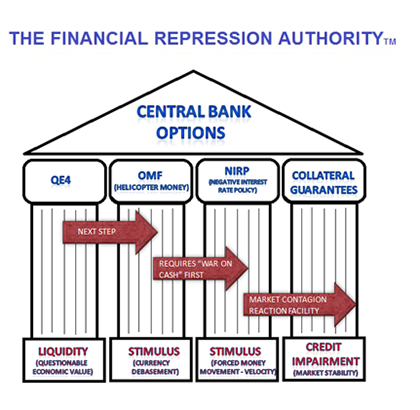
Disclaimer: The views or opinions expressed in this blog post may or may not be representative of the views or opinions of the Financial Repression Authority.


10/30/2015 - Chris Casey: The Austrian Case for Inflation

Special Guest: Chris Casey – Managing Director, WindRock Wealth Management


FRA Co-Founder, Gordon T. Long interviewed Chris Casey of Windrock Wealth Management on the concept of inflation and other applications of Austrian economics to investment theory.  Mr. Casey, an Austrian economist, is a frequent speaker and writer on macroeconomic topics and their related investment implications.

WHAT IS AUSTRIAN ECONOMICS AND WHY DOES IT MATTER?

The Austrian school offers the “most realistic interpretation” of society and economics according to Mr. Casey.  Gordon agrees in noting that “mathematical models are only as good as their assumptions.”  While equations and models may be useful as a construct to frame concepts, any social science cannot be scientifically tested due to the inability to control the countless variables at work.  As such, Mr. Casey prefers the Austrian approach which “looks at basic self-evident axioms as it relates to mankind in nature and then uses deductive reasoning to describe how the real world works.”  According to Mr. Casey, the unique Austrian explanations of inflation and the business cycle (recessions) have direct applications to practical investment ideas.

THE AUSTRIAN EXPLANATION OF RECESSIONS

Most mainstream economists believe recessions are inherent to capitalism since their repeated cycles largely began during the industrial revolution.  The Austrian school recognizes a different causation occurring at the same time: fiat money with or without central banking.  By artificially increasing the money supply through fiat money, interest rate levels are temporarily lowered.  This incents businesses and individuals to make investment decisions they would not otherwise have made: in short, malinvestments.  Recessions to liquidate the inevitably follow monetary mischief.

THE AUSTRIAN EXPLANATION OF INFLATION

The Keynesian school of economics has two theories of inflation which fail to comport with reality and are theoretically faulty.  Their “demand-pull” explanation requires full employment and full capacity in an economy, but Mr. Casey demonstrates that fails to account for a doubling of prices during the 1970’s during economic weakness.

The “cost-push” theory is equally wrong.  By blaming a particular price increase in a commodity such as oil for all price increases, it would have predicted pronounced inflation and deflation over the last 15 years as the oil price gyrated wildly.  In addition, it is theoretically faulty as more money spent on oil means less money is spent on other goods and services – which lowers their prices and renders the overall price level largely unaffected.

“Prices are merely a function of the supply and demand for money” states Mr. Casey.  More supply means dollars are worth less while higher demand lowers prices as people seek to increase cash balances by selling goods and services through lower prices.

WHEN WILL WE EXPERIENCE INFLATION?

Mr. Casey believes that “once we have another downturn, the Fed . . . will step right in.  Once we have that . . . we’ll really start to see the inflation take off.”

What will the Federal Reserve’s next move be?  They have other options besides another round of quantitative easing.  Mr. Casey notes they may stop paying interest on excess reserves held by commercial banks at the Federal Reserve, and they may also lower the reserve requirement which could have a pronounced and immediate impact on increasing the supply of money.

WHAT SHOULD INVESTORS DO?

“Timing is everything, so utilize investments which pay well now, but in an inflation will be a home run.”

CLICK to Download Article pdf

10-30-15-FRA-Casey-00-Cover-3-420


10-30-15-FRA-Chris_Casey-4-420


Disclaimer: The views or opinions expressed in this blog post may or may not be representative of the views or opinions of the Financial Repression Authority.


10/30/2015 - Robert Blumen: The Core Tenets of the Austrian School of Economics

Special Guest: Robert Blumen – Follower of the Austrian School of Economics


FRA Co-Founder, Gordon T. Long interviewed Robert Blumen, noted follower of the Austrian School of Economics, on the Core Tenets of the Austrian School and the Key Elements for investing in an Era of Financial Repression.

CORE TENETS

1. All economic understanding must be based on individual action
2. Subjective valuation drives prices
3. Marginal utility
4. Entrepreneurship
5. Time preference as the basis of interest and profit
6. The role of capital in production
7. Savings is required to create capital
8. Price Theory:  – prices determine costs, not the other way around
9. Money as an evolutionary solution the problem of barter
10. Precious metals as an evolutionary solution to the choice of the best money
11. The purchasing power of money as a price that balances money supply and money demand
12. Non-neutrality of money  (Cantillon effects)
13. The importance of money prices
14. Money is a good, and like any good, money does not have constant purchasing power.   Stable money does not mean stable prices.
15. Mises’ “critique of intervention”:  one thing leads to another
16. The “impossibility” of socialism (central planning)
17. Macro-Economics must be founded on micro economics
18. Macro-economics is based on Say’s law.
19. The rejection of the Keynesian revolution in macro.
20. Money and money substitutes (bank deposits, bank notes).
21. Banking with 100% gold reserves
22. Fractional reserve banking.  The Austrian critique of fractional reserve banking
23. Central banking.  The Austrian critique of central banking.

24. Austrian business cycle theory – the theory of unsustainable booms drive by fractional reserve banking and central banking.

  1. Inflation is not just rising prices, it distorts production as well.
    b.    Distortions are unsustainable
    c.     The “crack up bust” as one possible ending to the unsustainable boom

25. Deflation:

  1. Deflation has been demonized by the Keynesians.
    b.    Natural slow deflation is the result of increasing production.
    c.     Deflation is the correction process from inflation.
    d.    Deflation is not a mouse trap that the economy gets stuck in and cannot escape.

26. An Austrian understanding of recessions and depressions through Say’s Law, entrepreneurship, and market price theory


KEY ELEMENTS IN AN ERA OF FINANCIAL REPRESSION

1. Entrepreneurs create wealth by employing scarce resources in production within the context of the price system.

This requires real markets with real prices.

2. Central planning can not replace market prices.

3. Central bankers have it backwards.  Counter-cyclical policies create the business cycle.

4. Interest is not a number you can set to anything you like for “policy” reasons.  It is a price and it cannot be zero.

5. Attempting to keep interest rates at zero creates unsustainable distortions in the productive part of the economy.

6. Something that is unsustainable must stop  – at some point.

7. In the end there are two choices – market prices or destruction of the monetary system

8. Investors think in terms of money, but money itself is unstable.

9. The path from fake prices to real prices will be difficult.


Disclaimer: The views or opinions expressed in this blog post may or may not be representative of the views or opinions of the Financial Repression Authority.


10/23/2015 - John Butler – Investing Based on the Austrian School of Economics

Special Guest: John Butler, Amphora Commodities Alpha


FRA Co-Founder Gordon T. Long discusses the Austrian School of Economics with John Butler and how its methodologies can be applied to the current global economy. John Butler has 18 years’ experience in the global financial industry, having worked for European and US investment banks in London, New York and Germany.

Prior to launching the Amphora Commodities Alpha Fund he was Managing Director and Head of the Index Strategies Group at Deutsche Bank in London, where he was responsible for the development and marketing of proprietary, systematic quantitative strategies for global interest rate markets. Prior to joining DB in 2007, John was Managing Director and Head of European Interest Rate Strategy at Lehman Brothers in London, where he and his team were voted #1 in the Institutional Investor research survey. In addition to other research, he publishes the Amphora Report newsletter which appears on several major financial websites

THE AUSTRIAN SCHOOL OF ECONOMICS

“It is the no free lunch school of economics.”

The Austrian school believes that economics systems are ultimately information systems. Some of those systems use information more efficiently and effectively than others, and in particular systems of which authorities of various kinds meddle with the market. Authorities may do this by extracting capital from the market via tax rates or even by manipulating the money of that market through some sort of artificial interest rate policy.

“From the Austrian schools point of view, anything that impedes the free price information flow of an economic system will result in a sub optimal economic outcome.”

Without the rule of law, without the ability to strongly enforce property rights, without the ability to prosecute fraud, and various other legal frameworks; the Austrian economic model cannot work.

“Our goal is to make sure economic information flows as efficiently as possible within a solid legal structure.”

HOW THE AUSTRIAN SCHOOL CAN BE APPLIED IN INVESTING

Austrianism teaches us that the future is unpredictable. The economy is made up of the billions of people in the world, with each person making transactions almost every day. Each decision is an individual’s choice, and each decision, even the decision not to spend your money has some effect on the economy.

“Austrian school provides you a way to identify distortions, a powerful way that is caused by a fiscal and monetary policy set such as interest rate or fiscal policy manipulation. Austrians are able to look at these policies and be able to see how they are impacting the investment environment. This gives you a sense of where the distortions are. In theory you get an idea of where you should be overweight and underweight from an investor’s point of view.”

CURRENT EVENTS AMPHORA IS FOCUSED ON

“Currently we are seeing a general overvaluation of risky assets that has been caused by truly an unprecedented set of highly expansionary monetary and fiscal policies throughout most of the world.”

Income growth has not kept up; assets are expensive relative to incomes. So the correct strategy is not simply to short assets, which is dangerous; but if indeed they do look for ways to stimulate aggregate demand more directly rather than through the banking system.

The correct strategies to have today are those that will perform if incomes begin to catch up to asset prices, it could be asset prices declining towards incomes or vice versa. It is impossible to know which one is going to happen, but it is highly likely looking forward that a conversion of the two will happen.

POSSIBILITY OF NEGATIVE NOMINAL INTEREST RATES

“Policy makers have become almost pathological; they have a relentless attitude to make their policies work.”

“Problem with this is, once you get to this point, you can no longer question your original set of assumption. Austrian school of economics knows that the original sets of Keynesian assumptions that have gone into forming this unconventional and aggressive policy mix are themselves flawed. We are on this course where if it were left to run itself, policy makers will operation in these counter-productive directions because they will not question whether their assumptions are wrong.”

“Banning cash will prevent people from making even the simplest transaction in their own neighborhoods; it will lead to complete riot and chaos.”

“Putting a ban on cash is a terrible idea. It is terrible for them and for the economy as a whole. Sadly, with the way things are going, policy makers are going to teach everyone a very hard lesson about blindly accept anything the bureaucracy tells you to do.”

CENTRAL BANKS ROLE IF ASSET CORRECTION OCCURRED

“If you do get a major correction in asset markets that causes collateral problems in financial markets, the policy makers are out of options. The only thing they could do is begin capital controls”

Prevent investors being able to freely liquidate or withdraw funds from their existing investments. This of course is very anti-capitalist, very inti-market. It goes directly against everything that a free enterprise economy should stand for; but when you follow these policies you will eventually get to a dead end.

Abstract written by Karan Singh karan1.singh@ryerson.ca

10-16-14-FRA-John_Butler-00-Cover-4-420


Disclaimer: The views or opinions expressed in this blog post may or may not be representative of the views or opinions of the Financial Repression Authority.


07/10/2015 - Joseph Salerno on Bail-Ins & “The-War-on-Cash”

Special Guest: Joseph Salerno – Austrian Economist, Professor of Economics, PACE University, VP Academic MISES Institute


Professor Joseph Salerno is a noted Austrian Economist who spoke with the Financial Repression Authority on Financial Repression and his growing concerns with what is referred to as “the War-On-Cash”, which he sees leading America and other developed countries in the wrong direction. He sees it as presently gaining momentum in senior policy levels around the world as global debt problems become more acute.

FINANCIAL REPRESSION

“A combination of Deliberate Inflation and very low Interest Rates. Interest rates which are kept low by a variety of what are called “Unconventional Monetary Policies“.

“There is talk now of having:

  • Negative Nominal Rates,
  • Governments taking over Pension Funds,
  • Varies ‘privileging’ of government debt as part of bank capital.

..so it (Financial Repression) is a series of interferences in the financial markets by government with the end being to push interest rate lowers so they can inflate away their debt! They do that by having interest rates even lower than the rate of inflation.”

“What Financial Repression does is transfer surreptitiously resources and coming wealth from savers and retirees to the government and its crony banks. I think it exists, it is dangerous and I think many people are being hurt by it!”

WAR-ON-CASH – GETTING TO NEGATIVE NOMINAL BOND RATES

Professor Salerno believes the government wants Negative Nominal Rates but as he points out: “The only way they can do that is to lock peoples deposits into the banking system – that is where the War-on-Cash comes in! They would love to restrict or even abolish the use of cash within the United States if they could. That means they would have to use deposits.”

“This is another way of propping up a very unsound and dangerously flawed banking system!”

Professor Salerno has spoken out extensively on this subject, most recently at the Mises Circle event in Stamford, Connecticut

Governments, at least modern western governments, have always hated cash transactions. Cash is private, and cash is hard to tax. So politicians trump up phony reasons like drug trafficking and money laundering to win support for bad laws like the Bank Secrecy Act of 1970, which makes even small cash transactions potentially reportable to the Feds.

Today cash is under attack like never before. Ultra low interest rates are the norm for commercial bank accounts. In Europe, as the ECB ventures into negative nominal interest rates, certain banks threaten to charge customers for depositing cash. Meanwhile, certain European bonds now pay negative yields, effectively turning them into insurance products rather than financial assets. And some economists now call for the outright abolition of cash, which shows just how far some will go in their crazed belief that economic prosperity can be commanded by forcing us to spend rather than save.

The War on Cash is real, and it will intensify.

PUBLIC FOREIFEITURE

Both bank deposits and withdrawals of cash are now carefully scrutinized by banks and police agencies across America. Safety deposit boxes are seeing increasing restrictions on what can be held in them in the way of cash. People depositing cash often find themselves facing public asset forfeitures and seizures by the police. In some cases when cleared as being innocent then have serious difficulty in getting their seized assets returned. Professor Salerno expounds on this and other troubling new developments in America.

….there is much, much more in this fact filled 29 minute Video.

07-01-15-FRA-Bail-Ins-420

Disclaimer: The views or opinions expressed in this blog post may or may not be representative of the views or opinions of the Financial Repression Authority.


06/01/2015 - Thorsten Polleit PhD – The Natural Interest Rate

Special Guest: Thorsten Polleit PhD – Polleit & Riechert Investment Management


The “Natural Interest Rate” Is Always Positive and Cannot Be Negative

Some economists have been arguing that the “equilibrium real interest rate” (that is the “natural interest rate” or the “originary interest rate”) has become negative, as a “secular stagnation” has allegedly caused a “savings glut.” The idea is that savings exceed investment, and that a negative real interest rate is required for bringing savings in line with investment. From the viewpoint of the Austrian school, the notion of a “negative equilibrium real interest rate” doesn’t make sense at all.

The market interest rate is the outcome of the supply of and demand for savings in the market place. It can be observed, for instance, in the deposit, bond, or loan market for different maturities and credit qualities. The originary interest rate is a category of human action, saying that acting man values goods available at present more highly than goods available in the future. In other words: Future goods trade at a price discount relative to present goods. For instance, 1 US$ available today is preferred over 1 US$ available in one year’s time.

If 1 US$ to be received in one year’s time is valued at, say, 0.909 US$, the originary rate of interest is 10 percent. (1 US$ divided by 0.909 minus 1 gives you 0.10, or 10 percent, for that matter.) 10 percent is here the originary interest rate (disregarding any other premia).

The “Originary Interest Rate” Reflects a Value Differential

The originary interest rate is expressive of a value differential, which results from so-called time-preference. The term time-preference denotes that acting man prefers an earlier satisfaction of wants over a later satisfaction of wants. Time-preference is always and everywhere positive, and so is the originary interest rate. This is, first and foremost, what common sense would tell us.

The notion that time-preference and the originary interest rate could be zero, does not only sound absurd, it is also a logical impossibility: Positive time-preference and a positive originary interest rate are logically implied in the irrefutably true “axiom of human action.”

Human action is purposive behavior, implying the use of means to achieve ends. Action requires time (it is impossible to think otherwise). Thus, time is an indispensable and scarce means for achieving ends. As such, it must be economized, which necessarily implies that an earlier satisfaction of wants is preferred over a later satisfaction of wants.

For (praxeo-)logical reasons, therefore, time preference and the originary interest rate cannot fall to zero, let alone become negative. The implications of a negative originary interest rate cannot even be conceived by the human mind: A zero originary interest rate already implies no action ever into eternity.

The End of the Market Economy

Should a central bank really succeed in making all market interest rates negative in real terms, savings and investment would come to a shrieking halt: as time preference and the originary interest rate are always positive, “capitalistic saving” — the accumulation of goods designed for improving the production process — would come to an end.

Capital consumption would ensue, throwing mankind back into poverty. It would be the end of the market economy.

The True Purpose of Negative-Interest-Rate Policy

For some reason, those who argue that the originary interest rate has become negative seem to overlook that the originary interest rate is a phenomena which is not confined to credit markets. It pervades all markets in which present goods are exchanged for future goods. For instance, the originary interest rate prevails at each stage of the economy’s time-consuming roundabout production. The originary interest rate also exists in the stock market, where investors exchange present money against a claim on future money (that is a firm’s dividend payment).

If they wanted to be consistent, the believers in a negative originary interest rate would have to call for a policy that does not only make interest rates negative in real terms in the credit market, but also in the markets for, say, stocks and housing.

However, a policy that advocates destroying firms’ values and peoples’ housing wealth wouldn’t be taken too kindly by the public at large; and those economists recommending it couldn’t expect being cheered.

The consequence of a policy of a negative real market interest rate should have become obvious by now:

It is an actually perfidious policy for debasing the real value of outstanding debt; and it is a recipe for wreaking havoc on the economy.

Disclaimer: The views or opinions expressed in this blog post may or may not be representative of the views or opinions of the Financial Repression Authority.


05/19/2015 - Mark Thornton PhD Talks Financial Repression

Special Guest: Mark Thornton PhD – Senior Fellow Mises Institute


ACCUMULATION OF DEBT

Debt levels are now at critical levels:

    • Excess accumulation of debt has become a critical burden to the productive capacity of the global economy,
    • Significant levels of global investment is presently malinvestment,
    • Excess global capacity has been used to produce none-productive assets,
    • Lack of Price Discovery and Mispricing of Risk are distorting economies and investment behavior,
    • Many parts of the economy are fragile and a recssion is now knocking on the door of the US,
    • …. and more

AUSTRIAN PRESCRIPTION

      • The Federal Reserve needs to get out of the interest rate markets and allow the markets to work properly,
      • The Federal Government needs to balance budgets and cut back spending tremendously,
      • The Government needs to signal to markets particpants that they are not going to see their taxes increased significantly,
      • The Government needs to demonstrate they are going to do something about the national debt and unfunded liabilities.

These policy positions would begin to incent investment very quickly.

The Central Problem is Unsound Money

FINANCIAL REPRESSION

“A financial scam of the government over the private economy … It is aimed at taking advantage of their citizens, savers and investors.“

Government authorities are:

  • Printing money,
  • Issuing enormous amounts of debt,
  • Suppressing interest rates,

.. all with the intention of exploiting the worker and inflating the value of the goods they buy, as wages fail to keep up. Savers are now receiving negative real rates of returns which is the government extracting resources for themselves at the expense of the common man.

WAGING WAR ON SAVERS

05-19-15-Winners-Losers

WINNERS: The policies of Financial Repression help:

  • Banks
  • Large Corporations,
  • Government,
  • Large Borrowers,

LOSERS: The losers are:

  • Savers,
  • Consumers,
  • Producers,
  • Laborers,
  • Entrepreneurs

POLICIES: The world wide economy is suffering as a result of the policies which include:

  • Inflation,
  • Zero Interest Rates
  • Quantitative Easing,
  • Heavy Regulation (Healthcare and Banks)

This is an enormous problem in the modern context.

Disclaimer: The views or opinions expressed in this blog post may or may not be representative of the views or opinions of the Financial Repression Authority.


03/23/2015 - Professor Guido Hulsmann Talks Financial Repression

Special Guest: Professor Guido Hulsmann – Professor of Economics, University of Angers, France


FINANCIAL REPRESSION

“Financial Repression is the name we give to all the different government interventions in which governments seek to improve their own bargaining position with financial markets.”

“As a consequence of Financial Repression (that is of government intervention) people use their savings differently than they would otherwise have used. Therefore different people benefit from those savings (most probably the government itself) to a greater extent than otherwise would have been the case.”

FINANCIAL REGULATION

“The most surprising developments have been regulation, like the Dodd-Frank Act, Basel III, FATCA. They are pretty intrusive. These regulations have been sold to the public as necessary to control the financial markets, which is certainly the case but this is one side, the other is precisely the cause. Governments control the markets and can force Insurance Companies, Banks, Investment Trusts to use their funds in a certain way that governments are then ready to benefit from. This is very often at the expense of the savers.”

EXPECTED TRENDS

INCREASED REGULATIONS

The amount of paperwork and red tape that will be required to comply with expanding regulations is already growing dramatically. “We already require by law in Europe, for example, for an Investment Fund to have a Risk Officer who reports directly to the Ministry of Finance. It is absolutely mind boggling and it makes it very difficult for people to continue doing business profitably – it makes it quite miserable unless you are a big firm!” “These rules boil down to squeezing all small and even medium sized businesses out of business!”

‘FORCED LENDING TO THE STATE OF FORCED SAVINGS‘

“I expect a trend that will become much larger and more important in the future is what I call “Forced Lending to the State of Forced Savings!” Professor Hulsmann sees Pensions as being a particularly attractive target for this sort of trend.

PRICE RIGGING

We have already seen this most evidently in the area of Precious Metals price rigging. “This is because they are the natural alternative to hold savings outside of Financial Markets and Real Estate Markets! Both are artificially bloated thanks to central bank policy.”… “it is natural that people turn to Precious Metals because there is no counterparty risk”.

LEGAL PRIVILEGE

“Under a fiat money standard, governments (or their central banks) may obligate themselves to bail out, with increased issues of standard money, any bank or any major bank in distress. In the late nineteenth century, the principle became accepted that the central bank must act as the “lender of last resort”, which will lend money freely to banks threatened with failure. Another recent American device to abolish the confidence limitation on bank credit is “deposit insurance”, whereby the government guar­antees to furnish paper money to redeem the banks’ demand li­abilities. These and similar devices remove the market brakes on rampant credit expansion.

According to Hülsmann, there are four groups of legal privileges granted by the state (usually more than one is granted):

  • Legalized Counterfeiting – the promises of banks are allowed to be more “elastic”. For example, a coin marked “an ounce of gold” will be allowed to have any amount of gold or none, and can have any meaning. Banknotes were named “promises to pay”, but were obscure on the details.
  • Monopoly – only some monetary products may be produced by law, like a specific metal; or only the banknotes or coins of a certain bank. This limits the freedom of choice of users of money and benefits the producers and first recipients at the detriment of others.
  • Legal Tender is a money, that must be accepted in exchanges under a predefined price. Some monies may be driven out of the market due to Gresham’s Law.
  • Legalized Suspension of Payments allows banks to avoid paying their obligations, while receiving payments from their debtors. If a bank is freed from contractual obligations to redeem its money and it is also legal tender, its banknotes become genuine paper money.

With legal privileges the banks are allowed to behave more irresponsibly, which increases moral hazard.

PERMANENT POSITIVE PRICE INFLATION RATE

“Without a Fiat Currency system it is impossible to create a permanent positive price inflation rate. With the gold standard the tendency for the price level was generally deflationary… a constantly declining price levels.”

“If you have declining prices then there is a very strong incentive for savers to not worry about any financial investments at all, but to just save in the form of cash … when you have constantly increasing prices… holding cash becomes suicidal for savers. You then have only two choices. Buy Real Estate or Financial Titles. You get promises of remuneration for your savings so you are partially compensated for the lose of purchasing power.”

“Deflationary Recessions are a healing process – it is what precisely gets the economy back in touch with the real world and allow you to move forward event more forcibly!

Please link to the page of our Austrian research seminar:

AND ask your readers to get in touch with me (jgh@guidohulsmann.com) to make a donation. All donations are tax-deductable.

Disclaimer: The views or opinions expressed in this blog post may or may not be representative of the views or opinions of the Financial Repression Authority.