01/20/2016 - Eric Sprott: “Think About How to Mitigate Your Losses!”

FRA Co-Founder Gordon T. Long deliberates with Eric Sprott about the outlook for the global economy in 2016. Eric Sprott is a Canadian hedge fund manager and founder of Sprott Asset Management. He became a billionaire on paper with the initial public offering of Sprott Inc, the parent of his Sprott Asset Management firm. In August 2011, Sprott was acknowledged by Bloomberg as a ‘hidden billionaire.’ The publication estimated Sprott’s worth at $1.3 billion, largely based on his publicly disclosed holdings in Sprott Inc. and Sprott Physical Gold Trust. Sprott started his career as an analyst at Merrill Lynch covering everything but commodities. He eventually became known as a natural-resources and energy investor.

In 1981, Eric Sprott founded Sprott Securities Ltd. (now Cormark Securities Inc.), an institutional brokerage firm focused on small-to-mid capitalization companies, servicing Canadian corporate and institutional investors. In the year 2000, Eric Sprott made the decision to focus solely on the investment management business. Accordingly, the “investment management division” of Sprott Securities Inc which became one of Canada’s largest independently owned institutional brokerage firms. In 2000, Eric divested his entire ownership of SSI to its employees and chose to focus his sole attention on the investment management business and he formed Sprott Asset Management. In 2006, Eric was awarded the Ernst & Young Entrepreneur of the Year Award for Ontario.

In late 2009, Sprott published a well circulated white paper titled, “Is it all just a Ponzi scheme?” The document dug into who was actually purchasing recent Federal Reserve U.S. Treasury auctions and concluded that the biggest new buyer versus the previous year was the U.S. government.

Eric’s approach to philanthropy is straightforward.  He wants to help society change for the better. He is also constantly studying how to best serve his community through the foundation’s philanthropic donations. He believes that “the world needs true leadership to deal with unrecognized problems.”

2016: WHAT LIES AHEAD

“There is nothing constructive to say about the financial ponzi we have gone through since QE and negative interest rates were initiated.”

By knocking interest rates down to zero and in some cases they’re negative, savers are getting crucified. They get no return on their money. They have to buy the slimiest of assets, US bonds receiving 2%.

QE, printing of money will not do anything for the economy. We saw this with japan for the last 30 years. QE was only in place to inflate assets prices and we are all going to pay the consequences for that. It’s shocking that the market has held up as long as it has, and even more shocking is that during this whole process policies are so irresponsible that precious metals are not getting enough attention. I feel like a lone wolf believing that people should be in precious metals to protect themselves against this recession.

THE FOCUS FOR INVESTORS

“The most important thing is that roughly 97% of stocks are in bear markets throughout the world.”

Originally only a few stocks in the US were holding things up, and now they’re all getting crushed. In 3 months it would be no surprise to see every stock in the world being in a bear market. Furthermore it’s unbelievable to think you have a stable economy when oil prices are under 30. There are so many areas of falling prices; hitting or nearing all-time record lows.

“I do not have much hope for the economy right now; the stock markets are reflective of that.”

The whole issue of medical care in the US is being swept under the carpet; there are significant expenses for too many people. We need to be very careful about equity and bond investments. If you begin with the premise that the US is broke, you have $85 trillion of unfunded liabilities and a GDP of 18 trillion that says enough right there; it’s a joke.

This is why I preach to own precious metals because they will survive a financial meltdown. Risk mitigation is critical, but you have to understand all the elements of risk. It is phenomenal the risk that you will be taking in turn for the yield you’re expecting.

PRECIOUS METALS

precious_metal_bg

Not to put a number on it, but I believe for the last 15 years the demand for gold has been well above supply and central banks have superficially provided the extra supply. The physical gold market may overwhelm the paper market, if or when it does you can imagine a recession or depression or even a currency crisis which is happening throughout the world.

BLACK GOLD

Oil-Price-Fall

For oil, when you ask questions about markets that are dominated by paper and the influence of central planners it is difficult to give an answer that makes much sense. Ultimately oil should be going back up; very few entities can produce at $30/barrel. Sooner or later we will see shutdowns, and once that happens it will be highly unlikely for a restart until prices are at a profitable amount.

CANADIAN DOLLAR

falling dollar

“Government revenues are going to plunge coupled with stocks falling; 2016 is not looking very bright.”

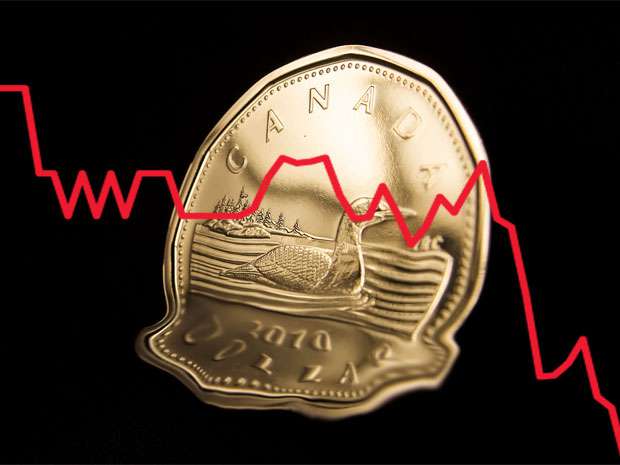
It is a very tough situation because of oil prices are so devastating for everyone but particularly devastating for US and Canada. People are going to take all sorts of losses and reclaiming former capital. It is a dark hole where weaknesses are being amplified unless there is an outside influence to turn things around.

CLOSING STATEMENTS                 

“Seeing all the previous crisis happening from the Dot.com to the 2008 crisis you can see what is likely to happen here; it has just been postponed. But I suspect it will be worse, it will be global and it will not be as easy to fix as it was in 2008 because now it will have to be coordinated.”

It is a question of whether people believe or don’t believe in the market. Everyone realizes after what has happened is that there is a vulnerability in the market that people didn’t expect. Hopefully we will see signs of precious metals going up that will indicate the importance of focusing on the real issue in the financial system is today.

“All indicators are telling you that there is no recovery happening here anytime soon. It may just keep going down and potentially get violent. In the midst of all this the key thing is to focus on mitigating your losses.”

LINK HERE to info on SprottMoney

Abstract written by, Karan Singh

Karan1.singh@ryerson.ca

Disclaimer: The views or opinions expressed in this blog post may or may not be representative of the views or opinions of the Financial Repression Authority.


01/17/2016 - Pension Is Famine

“Financial repression is a term used to describe measures used by governments to boost their coffers and/or reduce debt. These measures include the deliberate attempt to hold down interest rates to below inflation, representing a tax on savers and a transfer of benefits from lenders to borrowers. The resulting effect means funds are channeled to the government that would otherwise flow elsewhere.”[1]

It is an approach that indebted governments resort to, as a final measure to service their debt. Unfortunately it is the very thing that has been crippling the lives of seniors and/or anyone approaching retirement. The cost of living is increasing every year, pension payments are either insufficient or not being paid at all, money set aside from a lifetime of saving is inadequate and economic data being released by governments is skewed. In the midst of all this, how can pensioners enter a comfortable retirement? How can they survive on a $900/month pension when property taxes alone are double, triple and in the case of New Jersey, even quadruple that? They answer is, they can’t. Pension is just not enough.

In a recent publication, Charles Hugh Smith outlines a demographic issue; the weak purchasing power that pension funds will provide due to an inefficient ratio between full time workers and retirees:

“Today we are living nearly 20 years longer, and yet the ratio between full time workers and retirees has dropped to 2:1. There are 115 million full time workers and 57 million people drawing social security benefits, this is an unsustainable ratio. Two full time workers cannot support a retiree drawing medicare and social security.”[2]

A major mistake that came with the creation of pension funds was that the government did not account for an increase in life expectancy. In an era of low returns, and an increase in an individual’s life span, the promises that were made decades ago can no longer be kept today.

Financial repression cuts income to seniors and makes pension funds, a once reliable source of revenue, ineffective and unsustainable. This forces retirees to eat into their savings, which places pressure on welfare programs for the elderly and requires the government to spend more money to fulfill pension guarantees.
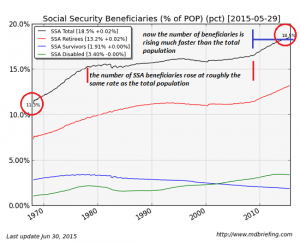
pic 1[3]

Above is a chart taken from Charles Hugh Smith in his article, The Coming Era of Pension Poverty. The chart shows the relationship between time and the percentage of the population receiving social security benefits. From the late 1970s until 2008, the number of people receiving these benefits grew at rate similar to that of the total population.  This constant growth was halted by a major event; the 2008 financial crisis. As a method to push the economy out of a recession, the Federal Reserve adopted a sustained low interest rate policy, but implementing this policy came at a severe time. It was during this time that the economy saw the largest workforce demographic shift, as the core workforce population, the baby boomers began to enter retirement.

The Pension Gap

Canada is facing a large disconnect in pension benefits between public and private sector employees. According to Canada’s Two-tier Retirement[4] a report by the Canadian Federation of Independent Business (CFIB), two-thirds of Canadians working in the private sector, or 80% of the country’s employees, do not have a company pension plan, whereas 87% of public sector employees have workplace pension plans which ensure benefits. To replace 70% of their working income in retirement, federal government employees currently contribute about 7% of their salary. To yield the same result, private sector workers would have to contribute up to 21% of their income.[5]

The CFIB illustrates the data by using an example with two characters, Mary, a public worker, and Jane, an employee in the private sector. They start working at the same time, earning the exact same annual salary over 35 years and making the same pension contributions. However, by the time they both retire in 2029 at age 65, Jane will have saved only $605,000 for retirement, while Mary will have accumulated roughly $1.38 million. This variance is because Mary receives greater contributions from taxpayers and she has a defined benefits plan which guarantees her benefits even in the instance of her pension plan performing poorly. This example clearly highlights a major unjust advantage of being a government employee. With millions of Canadians in the private sector having no workplace pension plan, even those with an employer-sponsored plan cannot hope to retire nearly as comfortably as government employees. The only way for retirees to increase their yields is to either continue working, or take on far riskier investments where seeing any return is bleak.

Pension Liabilities

Pension liabilities are the difference between the total amount owed to retirees and the actual amount of money the company has on hand to make those payments. A pension liability will only occur within defined benefits. These are traditional pensions where workers and their employers agree to contribute a certain amount into the pension fund over time for a guaranteed source of retirement income. Liabilities arise from 3 main sources:

  1. Direct Funding. Organizations do not usually pay a pension directly. Instead, instead they buy annuities to pay the pensioner over the course of a lifetime. However the amount of money the organization needs to fund a guaranteed pension can fluctuate from year-to-year which can prove to be problematic.
  2. Diverted funding intended for pension contributions but diverted elsewhere. Organizations may divert money scheduled for pension contributions to other areas of spending, while promising to fund the pensions at a later date.
  3. Number of pensioners. A large amount of workers hitting retirement age at roughly the same time (the current case for Baby Boomers) represents a potential shortfall in the ability to meet pension obligations.

Canadians have known for a long time that the public sector pension scheme is unfair to taxpayers and small business owners, but it is also becoming clear that many public plans are structurally unbalanced and in need of immediate change. According to Statistics Canada, the unfunded shortfall for public pension plans across the country likely exceeds $300 billion. [6]

Governments have placed too much reliance on solving their pension problems through the revenue route, asking taxpayers to contribute more to compensate for shortfalls. Public sector pensions are seemingly unaffordable, increasing tax costs, further adding to public employees already high pension contribution obligations, or forcing governments to divert resources away from public services toward paying for retired employees.

With public sector earners collecting 8-17% more in wages per year than private sector earners in the same kinds of jobs[7], and pension entitlements that generously treadle off past retirement earnings, it is time to deal with the cost side of pension.

Miscalculated Living

For years the real purchasing power of social security benefits has been falling. In other words, the benefits seniors receive are considerably less than what their parents received decades prior.

The Bureau of Labor Statistics (BLS) uses a cost-of-living adjustment called CPI-W each year to calculate how much social security benefits should grow to keep up with inflation. The problem is CPI-W underestimates how much the cost-of-living for seniors increases each year and furthermore it distorts weights of goods within the basket.  To fix that, the BLS created a new index called CPI-E (E for elderly). Yet despite this addition social security benefits are still calculated using CPI-W.

An appropriate alternative to CPI is called the Chapwood Index. The components of this index were selected based the prices of the 500 most commonly purchased items on which Americans spend their after tax dollars on. The Chapwood Index found was that through CPI, the government completely underestimates the real cost of living increase for Americans. According to Ed Butowsky, founder of the Chapwood Index, “this is the main reason that more people are falling financially behind, and why more American’s rely on government entitlement programs.”[8]

“The data solidly supports what all Americans have suspected for years. The CPI no longer measures the true increase required to maintain a constant standard of living. Unfortunately, this negative trend has been in place for 28 years and has resulted in creating a crucial situation where most Americans need to start their own personal austerity measures by reducing their expenditures while demanding more from their savings and financial advisors.”[9]

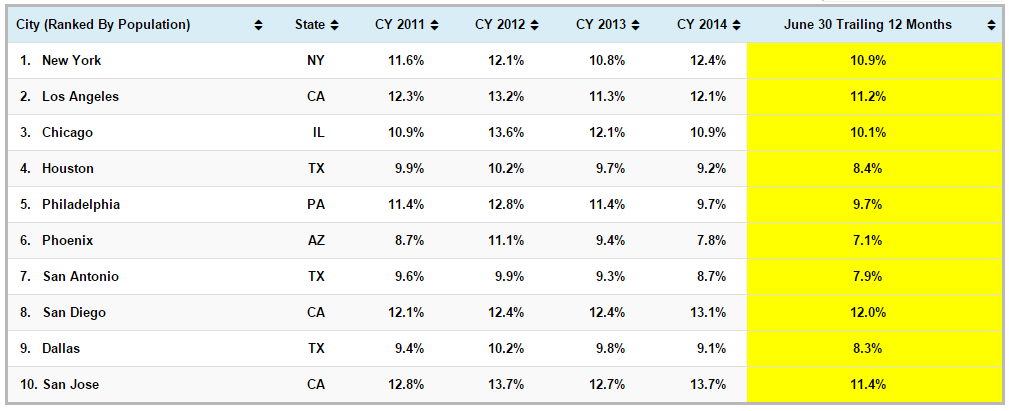
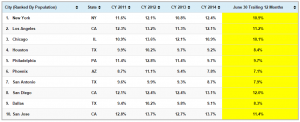
Chapwood Index: Top 10 US Cities by Population[10]
pic 2

The Chapwood index reveals that the combined Trailing 12 Month average for the top 10 U.S. cities was 9.7%; far more than the rate of the Bureau of Labor statistics CPI published. San Diego (12.0%) and San Jose (11.4%) top the list of U.S. cities with the highest cost of living increase nationwide, while Phoenix (7.1%) and San Antonio (7.9%) have the lowest.

The goal of the Chapwood Index is to shine light on a growing pandemic being fueled by the government. Information obfuscation and misrepresentation has been the cause of mass financial suicide. People need to take their finances in their own hands an impose austerity measures on themselves. Blind acceptance of statistics reported by the government is a problem which creates a false perception of reality and prohibits people from making appropriate financial decisions within their best interest.


The Means Test

Means testing is a controversial method for determining whether someone qualifies for a financial assistance program. Means testing was originally proposed for child benefit and is now being suggested for a wider range of benefits, particularly for retirees.

Means testing does not justly compensate the interest of the most disadvantaged people. The screening process involved to determine who is worthy of receiving government assistance is flawed. Large numbers of people miss out on benefits from either not knowing about them, not realizing they are eligible for them and most importantly, they are reluctant to claim them.[11] This is because of societal stigmas associated with receiving benefits flag people as being dependent. This is a common situation amongst retirees and can result in them encountering health and other problems from under claiming, leading to increased costs.

The drawback of means-testing gets even worse when it comes to how the policy shapes financial decisions. Means-testing entitlement benefits punish the very people who work the hardest and save the most. Majority of the population does not have the liberty to choose how many hours to work. For the majority, the choice is out of necessity and it is to work a full-time job (40 hours per week). Furthermore, because of the complicated ways in which federal welfare programs and taxes correlate, the effective marginal tax rates can be nearly impossible to decipher; their implicit negative externalities thus become difficult to act upon. The result is that most people in the prime of their working years will work as much as they can, regardless of marginal incentives.[12] Gracious retirement for our elderly should be a chief aim. Pensions are dwindling, and despite the assortment of retirement plans available, people still can’t save enough for a comfortable retirement.

In Closing 

The current system in place to ensure comfortable retirement is obsolete. Pension, this ingenuous allowance from the government is not nearly enough to even make ends-meat with. Lack of information combined with distribution of biased data prevents people from making financially responsible decisions. If you are like the most of us and are not a government employee, consider all your fruitful retirement plans gone. As mentioned in the earlier example, public sector workers receive from return from their savings and higher wages. But not just wages; it also includes benefits such as pensions, health, dental, and job security.

 

pic 3

Harold Meyerson of The Washington Post proposes a simple plan; require employers to put a small percentage of their revenue, and a small percentage of their workers’ wages, into a private, portable, defined-benefit pension plan. To offset the increased costs, transfer the costs of paying for workers’ health care from employers and employees to the government, and pay for the increased costs to the government with the kind of value-added tax that most European nations charge. [13]

Additionally, allowing early access of pension benefits to middle income earners would encourage greater contribution. The thought of people having their money confiscated for many decades, with no access to it even in an emergency, often repels people from the entire notion of pensions. Allow people to access their own contributions but not the tax relief or employer contribution, which would be left to grow until retirement. End the transition to defined contribution plans. These plans are more confusing, expensive and less reliable than defined benefit plans, leading in most cases to inadequate pensions. Find ways to share the risk between employers and employees.

An immediate and drastic transformation is long overdue. With time the problem has only been getting worse as more and more people are entering retirement, and the portion of the population in retirement age increasing. The current pension crisis is a problem which affects everyone, regardless of age. Whether it will affect you or not is not a question of ‘if’ but rather, ‘when?’ Options are available and solutions do exist, but nothing can be done until more information on the issue is shed, for action cannot be done if a problem seemingly does not exist. Under the current structure it is without a doubt that pension is famine.

Karan Singh, Financial Repression Authority Columnist

email – karan1.singh@ryerson.ca


References

[1] http://lexicon.ft.com/Term?term=financial-repression

[2] Smith, Charles Hugh. “The Coming Era of Pension Poverty.” Web log post. Oftwominds.com. N.p., 2 July 2015. Web.

[3] iibd

[4] Petkov, Plamen. Canada’s Two-Tier Retirement. Rep. no. 5. Pension Research Series.

[5] Dodge, Laurin and Busby: The Piggy Bank Index: Matching Canadians’ Saving Rates to Their Retirement Dreams. C. D. Howe Institute, 2010.

[6] Statistics Canada. Table 280-0007 – Trusteed pension funds, funds and members by sector, type of plan

and contributory status, occasional (number), CANSIM (database). (accessed: 2015-12-26)

[7] Canadian Federation of Independent Business, Wage Watch: A comparison of public-sector and private

sector wages, Dec 2008. http://www.cfib-fcei.ca/cfib-documents/rr3077.pdf

[8] http://www.chapwoodindex.com/

[9] iibd

[10] iibd

[11] Lawson, Richard C., Noel Card, Heather Jerbi, and Craig Hanna. Means Testing for Social Security. Rep. Washington: American Academy of Actuaries, 2004.

[12] Brewer, M., Saez, E., & Shephard, A. (2010). Means-testing and tax rates on earnings. Dimensions of tax Design: the mirrlees Review, 90-173.

[13] Meyerson, Harold. “Steering America Toward a More Secure Retirement.” The Washington Post 26 Mar. 2013


Disclaimer: The views or opinions expressed in this blog post may or may not be representative of the views or opinions of the Financial Repression Authority.


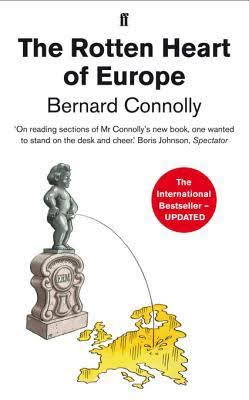
12/16/2015 - Yra Harris: Read “The Rotten Heart of Europe”!

Yra Harris: Read “The Rotten Heart of Europe”!

FRA co-founder Gordon T. Long deliberates with Hedge Fund Manager, Yra Harris about the effects of financial repression and the imminent credit event. Harris is a macro Global Trend Trader and publisher of the Blog Notes From the Underground.

Yra Harris is a recognized Trader with over 32 years of experience in all areas of commodity trading, with broad expertise in cash currency markets. He has a proven track record of successful trading through combination of technical work and fundamental analysis of global trends; historically based analysis on global hot money flows. He is recognized by peers as an authority on foreign currency. In addition to this he has Specific measurable achievements as a member of the Board of the Chicago Mercantile Exchange (CME). Yra Harris is a Registered Commodity Trading Advisor, Registered Floor Broker and a Registered Pool Operator.

Yra Harris is a recognized global trader who is a regular guest analysis on Currency & Global Interest Markets on Bloomberg and CNBC. He has been interviewed for various articles in Der Spiegel, Japanese television and print media, and is a frequent commentator on Canadian Financial Network, ROB TV.

FINANCIAL REPRESSION

“The way governments repay the interest on their debt.”

When governments borrow money, they do not want to pay back the money at any real market rate, instead they artificially hold rates down to pay off creditors. It is about the size of the government debt and being able to debase it; pay it off in less value.

“Financial repression has led to serious inequalities.”

It begins with Tim Geithner, bailing out Wall Street and banks as opposed to bailing out main street. Financial repression has focused its effects on the savers, the people who have been saving for retirement are being seriously damaged and forced to go into the stock market.


A recent paper, The Hidden Cost of Zero Interest Rate Policies by, Thomas Coleman and Laurence Siegel report “Zero interest rates cost $5 trillion per year, or rather 5% of GDP from savers that is being transferred to other entities.[1]”

“When there is too much debt, all financial authorities have a chief goal, and that is to create inflation.”

Many people have called Geithner out on his ill-advised actions. Everybody fell in line with the ‘you have to protect Wall Street’ way of thinking, and to a certain degree that is true. The first QE was mandatory because you had to prevent the mass liquidation of assets. The lessons from the 1930s boldly taught us that the US cannot take such an immense liquidation of assets. People need to begin equating what is the real return on their money, which is the true financial repression because all zero interest rates do is culminate into inflation; the best friend of debtors.

FUTURE RAMMIFICATIONS WITH THE FED

“The French are tired of being ‘Germanized’”

The proof will be what will happen in the yield curve. If the curve were to flatten further the equity markets will retaliate. What the yield curve does, what the dollar does and finally what gold does when the Fed raises rates will be the three indicators we must keep an eye on.

Is it going to be the German euro or the French euro? Germans are hard money advocates because they are savers, and right now what is happening in Europe is the ultimate financial repression. German savers are being severely hurt in order to bail out the rest of Europe. The euro was at 82 cents in 2001 and 2002 because the Germans needed a weak euro in order to get all the labor reforms that were being put in place. They played this card upon the ECB and they got what they wanted.

THE IMPENDING EVENT

“There is something right now eating at the debt markets. It may be in the mining or energy sector, but this market right now is scared of some credit event that it lurking out there.”

There is a credit event somewhere going on, it is evident by how the markets are acting. What is dangerous is that it is taking place now, during the holidays and anything that happens will therefore be magnified. The stock markets are off, if you look at the coordination of them, they are all out of place.

The Fed is aware of this so they must ask what it is that they are not seeing. I will not be surprised if come this Wednesday, they will not raise rates. If the Fed does not raise rates on Wednesday, the stock markets will have a high sell off because people will think what it is that the Fed knows.

Richard Cue has done great work, he has recently written about recent debt developments throughout the world. The debt structure which is supposed to be handled hasn’t been dealt with at all, and the greatest error you can make; borrowing to buy back your stock.

As soon as corporation free cash flows starts to erode, that debt becomes a major issue. We have had a run on this fictitious financial engineering of buybacks that will boomerang and it may be violent. There are symptoms of debt overhang, and global slowdown will reveal to us the weak players that took on too much debt.

images


[1] Thomas Coleman and Laurence Siegel. The Hidden Cost of Zero Interest Rate Policies, Sept 28 2015.


Subscribe to our Youtube Channel to watch our Program Show – click on the red Youtube button to subscribe:

Disclaimer: The views or opinions expressed in this blog post may or may not be representative of the views or opinions of the Financial Repression Authority.

12/11/2015 - AUSTRIAN SCHOOL FOR INVESTORS with Ronald-Peter Stöferle

FRA Co-Founder Gordon T. Long discusses the Austrian School of Economics with German Finance bestselling author, Ronald-Peter Stöferle. Ronald is a Chartered Market Technician (CMT) and a Certified Financial Technician (CFTe). During his studies in business administration and finance at the Vienna University of Economics and the University of Illinois at Urbana-Champaign, he worked for Raiffeisen Zentralbank (RZB) in the field of Fixed Income/Credit Investments. After graduation, he participated in various courses in Austrian Economics.

12-07-15-FRA-Ronnie_Stoeferle-00-3


In 2006, he joined Vienna-based Erste Group Bank, covering International Equities, especially Asia. In 2006, he also began writing reports on gold. His six benchmark reports called ‘In GOLD we TRUST’ drew international coverage on CNBC, Bloomberg, the Wall Street Journal and the Financial Times.

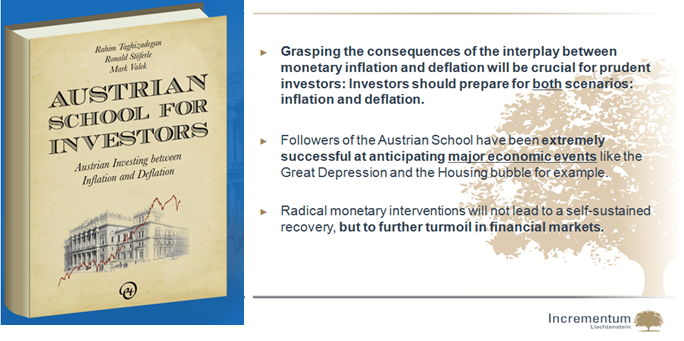
He was awarded 2nd most accurate gold analyst by Bloomberg in 2011. In 2009, he began writing reports on crude oil. Ronald managed 2 gold-mining baskets as well as 1 silver-mining basket for Erste Group, which outperformed their benchmarks from their inception. In 2014 he published a book on Austrian Investing, Austrian School for Investors – Austrian Investing Between Inflation & Deflation.

AUSTRIAN INVESTING BETWEEN INFLATION & DEFLATION

“For an investor it is critical to understand we are not in a cyclical crisis; we are in a systemic crisis.”

Well I have to admit I am not an economist which is why I am open to the Austrian school of economics Complex econometric models that try to forecast future models simply do not work, the 2008 financial crisis is an example of that. The Austrian school of economics simply described is “common sense economics.”

As a practitioner we are writing about the theory of the Austrian school of economics. It is a book dedicated to the practitioners of the Austrian school. What I want to point out is that the Austrian school has a completely different view when it comes to inflation and monetary systems.

For Keynesian economists inflation is simply a rise in prices. There is no point in discussing the details of inflation, however for Austrian economists it is an increase in the money supply.

The Austrian school shows the new monetary system which began august 1971, when President Richard Nixon suspended the convertibility of the dollar into gold. Since this was done we have seen major misallocation of capital.

“This interplay between inflation and deflation is crucial to understand, this refers to the term, monetarytectonics.”

“If you have an Austrian mindset, you have a great advantage.”

You are able to understand other currencies, thinking outside the fiat money system and as an investor focus on the real results not the nominal results you make.

THE CHANGING CREDIT CYCLE

 “In 2016, we very well may face a recession.”

For an Austrian a recession is something that’s normal, it is like a fitness program that prepares the economy for the next stage up. Trying to avoid such a recession will be difficult as QE, fiscal stimulus, monetary stimulus and low interest rates only make the situation more severe.

“The credit cycle leads the business cycle and therefore the fed will have a hard time fighting this falling trend in economic activity.”

To fight against it, negative rates in the US might be implemented. Many academic studies in the US say that evidence from Europe shows that negative interest rates work. The Fed may very well consider implementing negative interest rates. We will see increasing fiscal stimulus. There are many voices saying we should introduce helicopter money, but rather is it now called The People’s QE.

INVESTING ADVICE FROM THE BOOK

  1. To have a nonfragile portfolio, and investing in your own skill set offers a great yield.
  1. A good investor separates from a bad one in times of crisis.
  1. Become an entrepreneur, the Austrian school greatly encourages entrepreneurship.
  1. The Austrian school is very modest in saying we cannot predict the future but be prepared for all scenarios.
  1. It is highly recommended to read Austrian School for Investors – Austrian Investing Between Inflation & Deflation. Many people have interpreted it as a philosophical book that attempts to cultivate and establish this Austrian mindset. It is a pragmatic school of thought which offers great benefits if implemented, and this book is the perfect guide to it.

Abstract written by Karan Singh karan1.singh@ryerson.ca


Disclaimer: The views or opinions expressed in this blog post may or may not be representative of the views or opinions of the Financial Repression Authority.