06/27/2016 - Peter Boockvar: BREXIT: “THIS IS ALSO EXPOSING A LOT OF FAULT LINES WITHIN THE EU WITH BUREAUCRACY & THE PUSH BACK AGAINST THE ‘RULING CLASS’!
FRA Co-founder Gordon T. Long is joined by Peter Boockvar in discussing the aftermath of Brexit and the effects on the future economy.

Peter is the Chief Market Analyst with The Lindsey Group, a macro economic and market research firm founded by Larry Lindsey.

Prior to joining The Lindsey Group, Peter spent a brief time at Omega Advisors, a New York based hedge fund, as a macro analyst and portfolio manager. Before this, he was an employee and partner at Miller Tabak + Co for 18 years where he was an equity strategist and a portfolio manager with Miller Tabak Advisors. He joined Donaldson, Lufkin and Jenrette in 1992 in their corporate bond research department as a junior analyst. He is also President of OCLI, LLC and OCLI2, LLC, farmland real estate investment funds.

Peter graduated magna cum laude with a B.B.A. in finance from George Washington University.

BREXIT

The shock is going to lead into some chaotic-type thinking, but while this is a gigantic inconvenience and reason for continued economic slowdown, over time the UK will adjust and trade with Europe the same way Norway and Switzerland does. For the rest of Europe, this raises the question of other countries deciding to leave.

“I think having the Euro is something they want to be a part of, but that is a major risk, no question.”

This is also exposing a lot of fault lines within the EU with bureaucracy and the pushback against the “ruling class”. The failure of the EU in Brussels to address the refugee problem is a major concern, but immigration was a short term emotional decision.

“Certainly, if it wasn’t for the immigration issue,  I think it’s pretty obvious that they would’ve voted to remain.”

EU BANKING STRUCTURE

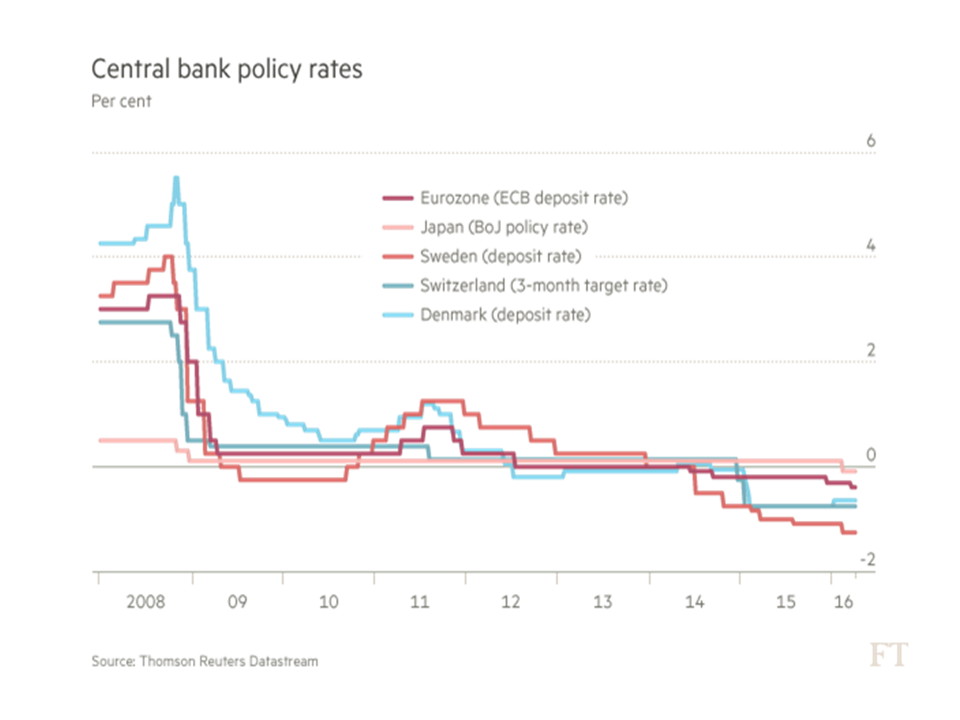
“On a bank to bank basis, they’re being crushed by the ECB and the negative interest rates. That’s the biggest threat to the European banking system, and their overleveraged banking sheets with too many nonperforming loans. Not the UK vote.”

We should remember what the underlying fundamentals are that we’re faced with every day. That is, slowing economic growth globally. In the US that is falling earnings, falling profit margins, a loss of credibility on the part of all central bankers and the Fed. On top of this is an asset price bubble over the last six years that leaves us with no margin of safety in order to face all these headwinds.

The European Union can adjust to it, because this is a gigantic wake-up call and they have two choices: they either let this bleed away or they say, you know, we have to change our ways, and some things for the better may come from that.”

“The global growth story remains very challenged, asset prices remain very expensive, and central bankers have lost credibility. Those are the risks that people should be mostly focussed on right now.”

China’s been slowing for years. Who doesn’t know that China’s going through challenges? Even the Chinese stock market is down 50% from where it was in 2007. It’s still part of a broader picture of slow growth.

DOLLAR AND YIELD

Past the very short term knee-jerk reactions – sell the Euro, sell the Pound – the Dollar has its own issues. The Fed is stuck at 37½ basis points throughout this economic cycle. They likely won’t raise rates until the expansion after the next recession. So it’s easy to sell other currencies to buy the Dollar right now, the Dollar has its own issues.

“The fair answer to that question is which is going to be the currency left standing? And the only answer to that is going to be gold and silver, and that’s obviously being reflected today. The dollar is getting a knee-jerk bounce here, but I’m not a believer in a strong Dollar because I think it itself is facing major headwinds.”

The Fed isn’t raising interest rates, and the US economy is slowing. Going from current growth to recession is not that far of a leap. The determinant of that is what asset prices do, actually. If the S&P500 goes back to 1800, then the odds of a recession increase.

The reason the stock market is used as the swing factor is because the last two recessions were led by a decline in asset prices, tech stocks, and housing prices. We have our third bubble in front of us. Tt’s mostly been manifested in credit markets, but if you do get a decline in asset prices, as it reprices to the global economic reality, that in itself could tip us over. In the US, the consumer is the only thing keeping us from a recession, and a decline in asset prices could tip the consumers over from a psychological standpoint.

LOOKING FORWARD

“The Fed has no policy right now… They were so clear on how they were going to ease, and they’ve been in the clouds on how they’re going to exit… they’re stuck, they’re trapped, and they essentially are writing policy with their fingers crossed.”

The US growth will likely continue to slow, we saw durable goods today that were very weak, we saw core capital spending within that is at a five year low, at a level last seen 10 years ago, and this was before the greater unknowns now coming out of Europe. Growth will continue to slow and asset prices will continue to decline.

In an election season and campaign, this is when peoples’ voices are heard. Where that goes socially, who knows. It’ll depend on a lot of different things. People are making their voices heard, and hopefully the ruling class is listening.

“I think the whole commodity space has bottomed out. I think investors need to look where it is most painful to look. That remains emerging markets that have already gone through a five year bear market and have much better valuations than the rest of the world.”

In Europe right now, you’re going to see carnage, but there’s probably going to be some opportunity there. There might be opportunities in the UK where selling is occurring due to the weaker pound.

“I’m very nervous about the US stock market, which happens to be one of the most, if not the most, expensive in the world.”

Abstract by: Annie Zhou a2zhou@ryerson.ca

Min Jung Kim minjung.kim@ryerson.ca
Disclaimer: The views or opinions expressed in this blog post may or may not be representative of the views or opinions of the Financial Repression Authority.


06/22/2016 - Graham Summers: “DURING THE NEXT CRISIS ENTIRE COUNTRIES WILL GO BUST!

FRA Co-founder Gordon T. Long is joined by Graham Summers in discussing

Graham Summers, MBA is Chief Market Strategist for Phoenix Capital Research, an investment research firm based in the Washington DC-metro area.

Graham’s sterling track record and history of major predictions has made him one of the most sought after investment analysts in the world. He is one of only 20 experts in the world who are on record as predicting the 2008 Crash. Since then he has accurately predicted the EU Meltdown of 2011-2012 (locking in 73 consecutive winners during this period), Gold’s rise to $2,000 per ounce (and subsequent collapse), China’s market crash and more.

His views on business and investing has been featured in RollingStone magazine, The New York Post, CNN Money, Crain’s New York Business, the National Review, Thomson Reuters, the Fox Business, and more. His commentary is regularly featured  on ZeroHedge and other online investment outlets.


RECENT HISTORY REPEATS ITSELF

What we’ve seen since 2009 has been kind of this grand delusion. We did have a bit of a recovery from 2009-2011 where the economy and the financial markets snapped back from the very deep recession in 2008. But since about 2012, the real economy hasn’t really progressed. What you’re actually seeing is a financialization of the economy in the sense that asset markets have boomed but real economic activity has stagnated. Throughout this time we have central banks engaging in massive monetary programs which have effectively been a transference of private debt onto the public sector’s balance sheet.

The very policies that bankrupted Wall Street and resulted in the 2008 crisis, those policies have now been shifted onto the public sector’s balance sheet. And as a result of this, most countries are sporting worse fundamentals from a debt to GDP perspective and when the next crisis hits, we’re going to see a severe cycle of default begin, that will eventually be sovereign. The real fireworks have yet to fit.

“If you want to use 2008 as a proxy, we’re currently in the late 2007-early 2008 stage of the cycle.”

LEVERAGE BUBBLES AND CENTRAL BANKS

“Everything post-2009 has effectively been academic central bankers implementing what their economic models suggest would work, but what works in an Excel spreadsheet doesn’t work in reality a lot of the time.”

If you simply want to refer to leverage bubbles, Lehman Brothers was leveraged 30:1 when it went bankrupt. You now have the Fed leveraging something like 70:1, the European central bank is leveraged at nearly 30:1, so you now have central banks sporting leverage ratios on par with Wall Street. To those that say it’s different because the Lehman Brothers couldn’t print currency, central banks have gone bust throughout history. The US Federal Reserve is the third central bank the US has had, and there’s no reason a central bank cannot go broke, because whether you’re going for a hyperinflationary collapse or a deflationary collapse, it’s the same thing. It’s the loss of actual value relative to nominative terms.

“The issue we believe is going to start unfolding is because central banks have spent so much money… propping the markets up over the last 6-7, we’re going to see some sort of implosion.”

Even if central banks engage in what we would call nuclear levels of intervention going forward, that in of itself would result in some kind of systemic event. You can’t have trillions of dollars of intervention without things breaking. We actually had a taste of this in April 2013, when the Bank of Japan launched the largest QE program in history, their famous Shock and Awe program. They announced their program equal to almost 25% of Japan’s GDP, and when they did this there was a brief period in the following week where the Japanese government bond market almost broke and had to be halted several times.

“Even if one were to say, well, we can’t have central banks go bust, they’ll just do a larger program, the problem is eventually the program becomes large enough that either you run out of assets to buy or the system simply can’t handle it.”

We had a brief taste of that with Japan. If central banks go nuclear when the next crisis hits, we’ll probably get another taste of it. They’ll probably close the stock market, to be honest, but how exactly the details will play out remains to be seen.

The other thing to consider is that the political landscape has changed. At some point there’s going to be a popular revolt where people don’t put up with central banks’ meddling to the level they are. There’s a lot of things in the air about how things will play out, but we’re very close to the edge.

THE 2008 TRADE SETUP

“You have to find these kinds of easy ideas for people to latch onto. You can talk about leverage, you can talk about complicated sort of financial metrics, but the reality is that you have to put it in terms that people are going to grasp and helps them realize what’s happening.”

We see an opportunity similar to 2008 today in terms of the discrepancy between economic realities and asset level pricing.

“The idea is that when something breaks and the asset prices begin to readjust to more in line with economic levels, you’re going to see a sharp move… During periods like that, you can see a very large return if you position properly.”

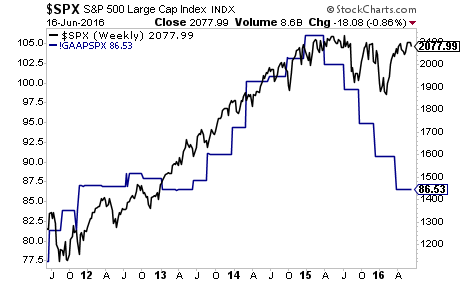
If you compare the S&P500’s GAAP earnings to the S&P levels today, earnings are back to where they were in 2012 but the stocks are 70% higher. Just that alone, for stocks to fall back in line with their actual earnings, you can see a very large percentage collapse.

GPC617162

IS THE FED BUYING STOCKS TO PROP UP THE MARKET?

What we do know financially is that the futures markets have a program through which central banks can buy stocks. We also know that the Swiss National Bank and the Bank of Japan directly intervene in the stock market.

“It’s not a far stretch to assume that the Federal Reserve is also playing around with this, and it makes perfect sense.”

We know they’re intervening in the markets on a regular basis. Somebody is trying to hold the markets up. Whenever the markets begin to break down on a very aggressive fashion and they hit a key inflection point, for some reason ‘buyers’ move in very aggressively and start buying the heck out of the market. Real buyers don’t do that. When an institution puts in an order to buy stocks, they put in these orders over a span over a couple weeks because they don’t want to adjust the price and lose the value.

We also have some corporate buybacks driving the markets higher, cash flows are flowing, and buybacks should be halting. Retail investors have been selling, and so far the only buyers are corporate buybacks and some form of intervention from central banks.

ECONOMIC TURNING POINTS

It’s very hard to find these turning points. Investors have been crushed so many times by central bank interventions that they’re loathe to put a lot of money into the markets and go hard short. Your average investor, when the market turns against them and they’re short, it’s very hard for them to sit on that position. If you actually look at investment fund managers, the ones who can and want to go short don’t want to because they’re afraid they’ll be crushed by central bank interventions.

At which point does the actual selling begin? It’s impossible to guess, but what you can do is look at the warning signs, the selling pressure, but the specifics are impossible to guess.

INVESTMENT STRATEGIES FOR THE FUTURE

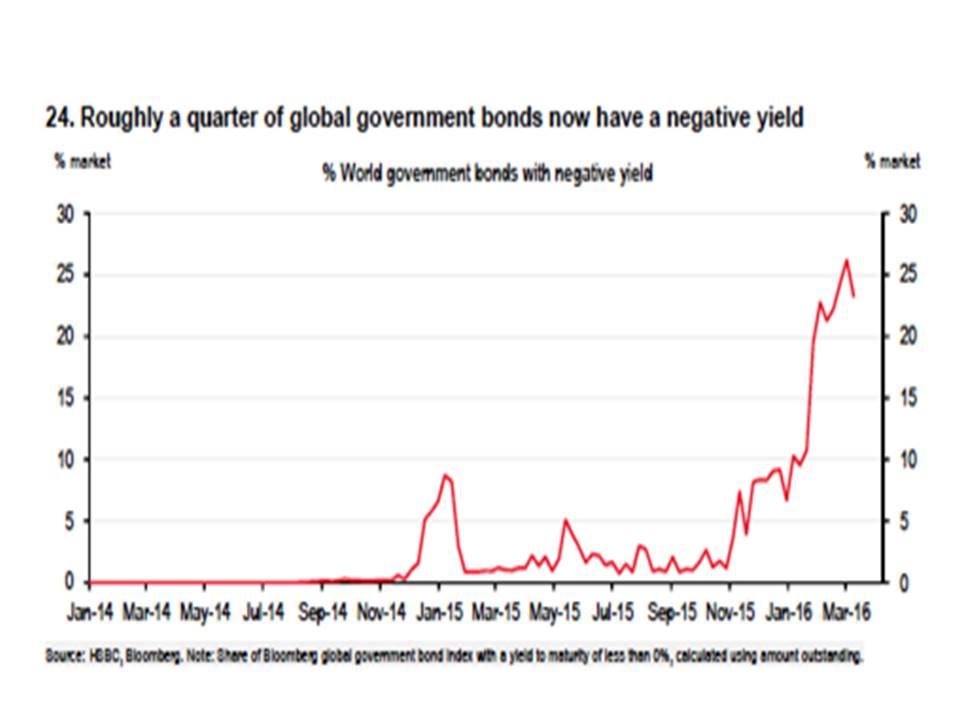
US Treasury yields have had a significant breakdown. Globally we now have $10T of bonds with negative yields, but Treasuries still remain positive.

“From a financial and economic perspective, the US is on at least a sound a footing as Europe and Japan.”

That begs the question of why our Treasuries rallying instead of pushing their yields lower. It’s likely that there’s going to be a move in Treasuries that’s going to have yields falling to all-time lows.

There’s a big question as to whether the dollar is about to begin another leg up in a bull market, or if it’s just going to continue to consolidate. Something happened in the last four months where the dollar really sold aggressively. A theory is that the Fed formed the Shanghai Accord to devaluate the dollar in order to prop the markets up. Since QE300, stocks and the dollar have been in a trading range.

If another round of serious deflation hits, will gold sell-off with the commodity complex or will it hold up? Currently in the last year, we see gold and the dollar rallying, which doesn’t often happen. The question is whether gold will become a fair trade or if it would be a commodity trade.

“The S&P500 is just a couple of percentage points away from all-time highs, but based on earnings and other fundamentals it could fall over 40%. To us, it seems the downside potential is higher than the upside risk.”

Abstract by: Annie Zhou <a2zhou@ryerson.ca>

Disclaimer: The views or opinions expressed in this blog post may or may not be representative of the views or opinions of the Financial Repression Authority.


06/09/2016 - Erik Townsend: “YOU EITHER ACCEPT FINANCIAL REPRESSION AND YOUR WEALTH WILL ERODE, OR YOU BECOME A SPECULATOR!”

FRA Co-founder Gordon T. Long is joined by Erik Townsend in discussing what it means to be an American entrepreneur and his perspective as a global traveler, along with the impact of the upcoming election.

Erik Townsend is a retired software entrepreneur turned hedge fund manager. Throughout his career, Erik has capitalized on his ability to understand complex systems and anticipate paradigm shifts far in advance of the mainstream. By the mid-1980s, Erik had invented an approach to distributed system design that is now widely known as Service-Oriented Architecture (SOA). In 1992 Erik founded the Cushing Group, a boutique consultancy focused exclusively on bringing advanced distributed application computing technologies to market. The Cushing Group’s work with Wells Fargo Bank in the early 1990s paved the way for Wells Fargo to become the world’s first Internet Bank by early 1995. After selling the Cushing Group to Ciber, Inc. (NYSE: CBR) in 1998, Erik briefly engaged a well-known investment bank to manage his assets, but was profoundly disappointed with their services.

Erik has become a passionate world traveler. He moved to Hong Kong in 2009 to get a better perspective on changing global economics. While living in Hong Kong, several hedge fund professionals he met there observed that through his own passionate trading activities, Erik was “already doing all the work of running a hedge fund except for picking up the phone and calling a lawyer and turning it into a fund”.

Erik eventually took his Hong Kong friends’ advice to heart, and founded Fourth Turning Capital Management, LLC in 2013. Through that asset management company, he launched a Global Macro-strategy hedge fund in July 2013. In February 2016, in a joint effort with Nathan Egger, Erik launched Macro Voices, a new weekly financial podcast program which will target professional finance, high net worth, and other “sophisticated” investors who desire financial content at a level of sophistication and complexity above what the retail investment-focused podcasts on the Internet presently offer. Erik continues to live a very international lifestyle, and presently has homes in Hong Kong, Mexico and the United States.

AS AN ENTREPRENEUR

Being an American entrepreneur was kind of a hero story. It was understood in America that the people who launch small business and innovate new ways of doing things are the heroes that make America strong, and made it what it once was. It’s in decline, unfortunately. In 2008 I wanted to get back into technology entrepreneurship, bur there were barriers to entry and it was so easy to watch the reckless monetary policy and get into trading instead. The government is desperate and doing crazy things. We’re in very unprecedented times, and if you can understand that picture, it’s not too hard to be successful in trading. It’s much easier to make money by understanding how reckless the government is being.

“I help rich people get richer while watching the country that I’m very proud to be from, in my eyes, fall apart at the seams. Being an entrepreneur was a much more responsible and honorable thing to do with one’s life.”

There’s a huge financial incentive to trade markets and take advantage of the huge inefficiencies that are created by reckless actions of government.

TECHNOLOGY IN ENTREPRENEURSHIP

“I don’t know that entrepreneurship is necessarily stronger in other places, compared to what the United States used to have.”

There is no place that begins to compare with what America used to be. We see America in decline today. It’s gone from being head and antlers above the rest of the world down to still one of the better countries. I don’t know that there’s anything that’s dramatically better in terms of opportunities for entrepreneurs starting their own companies.

“I think that Americans who don’t travel a lot have no idea how much things have changed.”

Technologically, every place was behind the United States. But that was during the 80s. Today, America is run down and broken. The systems in the United States don’t work very well. Asia is shiny and new.

For example, Hong Kong’s octopus card. It has an RFID chip in it and can be used on every form of public transit as an electronic cash card. This was in service and working in 1997. That was 19 years ago and there’s nothing like it in the United States today. Gigabit internet is standard around most of the world now, yet it’s next to impossible to find. Hundred megabit is “unheard of fast” in the United States, but that’s really slow service in most of the world now. What makes this infuriating is that all of the underlying technology that makes this possible was invented in the United States.

“Why is it that the United States is last in terms of adoption of technology that we ourselves invented? I think it’s the failure of government. They have created so many barriers to entrepreneurs taking technology and using it to change society for the better that entrepreneurs are going and doing it elsewhere where governments are cooperating with them.”

That said, the way things are done elsewhere is according to procedure with no deviation from the standard policy. The way Americans think and innovate is still culturally not accepted in most of the world, so we still have that advantage.

In a lot of cases, we’re seeing a lot of American entrepreneurs move overseas because there are better opportunities there. The American government used to recognize that its job was to promote and endorse that kind of innovation, but now they’ve basically been sold out. Entrepreneurs can’t afford lobbyists, but large corporations can. It doesn’t matter how innovative you are; if your government prevents you from being successful, the most innovative people will find other parts of the world.

“I think that if the government continues to prevent American entrepreneurs from succeeding, they’re going to go elsewhere and they’re going to bring their talent to help other countries to be competitive.”

FROM ENTREPRENEUR TO HEDGE FUND MANAGER

Dealing with executives of Fortune 100 companies, you need to prove your ethics and morality and loyalty to them before they’re willing to give a small company a chance. In Wall Street, the boxing analogy is what you have to wrap your head around.

“What you see on Hollywood movies about business being cutthroat, it doesn’t really work that way in most of corporate America. On Wall Street, it’s worse than that.”

Entrepreneurs are people who make things happen, who get things done, and that’s what makes us successful. But investing is the opposite of that. They watch and make decisions based on what other people do. Entrepreneurs also don’t have to listen to stupid people, and you can’t do that in investing. If you focus on what should happen in the economy, you’re going in the wrong direction. You want to be learning how the people who are actually in power think.

“During my work week I have to learn how to think like the people who are in charge do, and it’s not based on common sense.”

THE PROBLEM OF CENTRAL BANKS

Governments are taping over our problems and addressing symptoms with printed money. The root cause of the 2008 crisis was too much debt. The solution governments proposed was more debt, and they’re trying to stimulate credit markets in order to get banks lending again so people can go back to spending beyond their means. There’s no focus on saving and investments. A lot of people have said this is unsustainable.

“The truth of the matter is that central banks, with a deflationary backdrop like it is now, can continue to print money.”

They can keep getting away with addressing symptoms as long as we have a deflationary backdrop that permits money printing to occur without causing runaway inflation. Once we get to runaway inflation, central banks will have no choice but to tighten in order to arrest the inflation, and then things will come crashing down.

We’re printing all this money to benefit Wall Street; it’s not benefiting hardworking Americans, it’s supporting financial markets.

“Wouldn’t it be better, if quantitative easing has to happen, if it were helicopter money that helped everyday people?”

When inflation hits the stage, that’s when central banks have to fold their cards. What happens in the meantime, almost everyone thinks that negative interest rates are coming to the United States. As we do get back toward a worsening economic situation, we’re going to see an uprising. Americans might not understand the problem, but they know there’s a problem and they’re angry about it. If there’s going to be more quantitative easing, there’s going to be very strong political pressure that it should be to help Main Street, not Wall Street.

“I think the next president, the one elected this year in 2016, could very possibly be the most important president in the nation’s history because I think the fiscal situation is likely to come to a head.”

People around the world don’t envy the USA the way they used to. They’re angry. The world is getting very pissed off at Americans. Hilary Clinton is talking tough with Russia. Donald Trump is talking tough with China. When you start picking fights with Russia, with China, these are places who have the ability to end humanity on Earth with the push of a nuclear button, just like the US does.

“All of the candidates, I think, are very dangerous in terms of their very tough-guy attitudes that they’re taking toward other countries. So I’m very concerned about where we’re headed in terms of American hegemony offending people that are able to defend themselves.”

THOUGHTS TOWARD THE FUTURE

You’re better off not being a speculator, but in an era of financial repression that gives negative returns. So you either accept financial repression and that your wealth will erode slower than other people, or you become a speculator.

“I think the opportunity is coming to buy energy, hand over fist.”

You have to watch the action of central bankers, and recognize that the smartest people in the room are saying that the global economy does not support current asset prices. What does support current asset prices is that the Fed is going to be accommodative and continue to prop up asset prices. The longer this goes on, the harder the fall will be.

If you wanted to own something long term, precious metals will definitely behave very well. But buying and holding long term in the stock market is not recommended. We’re in an environment where asset prices have been artificially propped up, they’re supposedly taking the punch bowl away and if they do, I think that we could see a very precipitous drop.

PODCAST HOST EXPERIENCES

“I wanted there to be a de facto place where you could go online and collaborate and share investing ideas with other smart people.”

If you look at what’s there in terms of discussion forums on the internet, it’s childish. So where do the adults go for discussion? So I created a podcast that specifically targets high net worth individuals, family offices, accredited investors, basically sophisticated investors living in financial repression and understand that they have to speculate to avoid a negative real rate of return. And that means collaboration.

“The idea behind MacroVoices is to create that podcast, get that discussion going in the podcast, and then have a listener discussion forum where we can discuss the topics and continue the conversation, bring that global community of sophisticated investors together.”

There are other platforms like Twitter, which are starting to gain a huge amount of market share. We’re participating on Twitter through the MacroVoices handle, as well as having our own listener discussion forums. The idea is to just get smart people talking to one another.

“I get to interview the smartest people on Earth about financial topics, and what we tell them all off the air is what we’re doing different here is please do not dumb it down to a retail level. We want you to speak on a professional level.”

So we keep the guest interview on a professional level, and then add a conversation to explain any issues that might have been confusing to the retail component of the audience. We thought we were going to offend the retail audience, but it’s the opposite. The more that they don’t get it, the more interested they are, and the more they post questions and ask other listeners to help them understand.

“Not dumbing it down is the best thing that we’ve done.”

Abstract by: Annie Zhou a2zhou@ryerson.ca

Video Editor:   Min Jung Kim minjung.kim@ryerson.ca
https://youtu.be/io9MFXncY6k

Disclaimer: The views or opinions expressed in this blog post may or may not be representative of the views or opinions of the Financial Repression Authority.


05/25/2016 - YRA HARRIS: WE’RE IN A WHOLE NEW BALLPARK – THE FED’S OWN MECHANISM MAY BE BROKEN!

FRA Co-founder Gordon T. Long discusses with Yra Harris about the yield curve of US Treasury bonds along with the G7 meeting and the effect of Germany and ECB on the rest of the world.

Yra Harris is a recognized Trader with over 32 years of experience in all areas of commodity trading, with broad expertise in cash currency markets. He has a proven track record of successful trading through combination of technical work and fundamental analysis of global trends; historically based analysis on global hot money flows. He is recognized by peers as an authority on foreign currency. In addition to this he has Specific measurable achievements as a member of the Board of the Chicago Mercantile Exchange (CME). Yra Harris is a Registered Commodity Trading Advisor, Registered Floor Broker and a Registered Pool Operator.

He is a regular guest analysis on Currency & Global Interest Markets on Bloomberg and CNBC. He has been interviewed for various articles in Der Spiegel, Japanese television and print media, and is a frequent commentator on Canadian Financial Network, ROB TV.

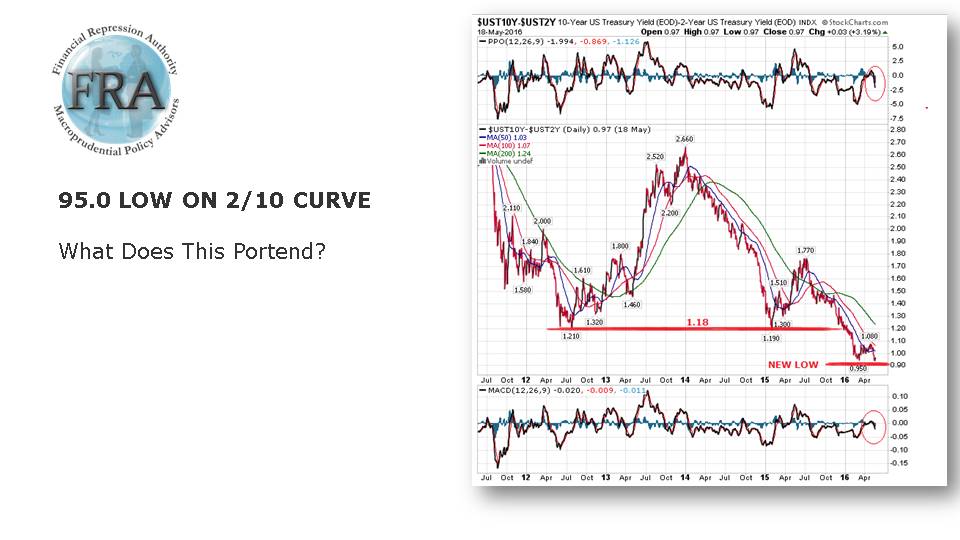
LOW ON 2/10 YIELD CURVE

Slide1It looks like we have another temporary bottom. After we took out that previous level we were talking 120 basis points, but now we’re trading at 95. The big problem is going to be the 75 basis point area, but we’ve already taken out the lows that were made in 2007-2008. What it reflects is that the Fed is flattening as they’re talking about raising rates.

Usually with this flattening of the curve, the 2/10 which is called the “investor’s curve” instead of the “speculator’s curve”, indicates one of two things. Firstly, rates are either too high or going too high on the short end relative to what the market perceives is its potential growth in the future. They’re getting nervous.

“Usually I would say this is a very solid indicator and that the Fed has really waited too long to do anything. Which flies in the face of everything we’ve heard in the last two weeks.”

There is a dynamic in play in the global markets. With the vast amount of central bank purchases, they have skewed the markets so badly that the markets are trying to get a read on what this all means. Because everything is relative value, 60% of the developed market bonds are in negative territory. That skews everything, so we can’t get a real feel for what this curve means. If that’s the reason the curve is flattening, then we’re in a whole new ballpark because it’s a global phenomenon at a level we’ve never seen before and that’s going to affect everything. It breaks the Fed’s own mechanism.

“Bond markets need to be a signally mechanism to be effective, and if you’ve broken the signalling mechanism, well, we’re flying here in uncharted territory… then it becomes a question of, who’s in the pilot’s seat?”

That’s what the world is trying to figure out: do the people in the pilot’s seat know what they’re doing and have confidence in what they’re doing or are we really flying blind here?

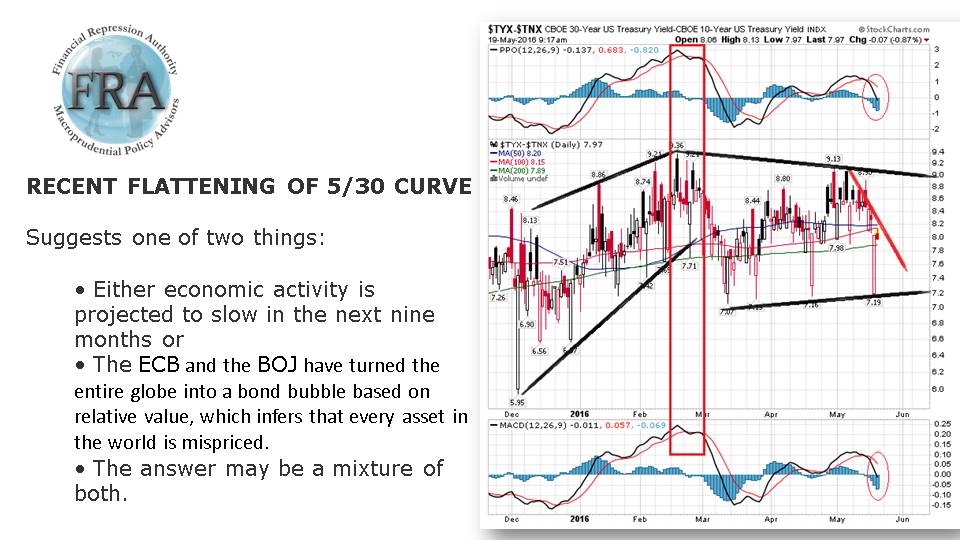
5/30 CURVE FLATTENING

Slide3The 5s30s is where speculators like to play and that curve is actually flattening more as they seem to be able to exert more pressure, but that might be reflective of relative value. In a yield-starved world, yield-starved because central banks have so dynamically shifted everything everything through their massive purchases, people are stuck having to really reach for things.

“The 5/30 is more dynamically telling me that the Fed may be erring in raising rates, that they waited too long.”

People in Europe have 3/10% of GDP yield. It’s not even enough to cover their budget situations. Europe is in a very difficult situation here. That might mean the Fed has waited too long.

THE PREVIOUS G7 MEETING IN SHANGHAI

“I don’t think anything major came out of Shanghai because I’ve been around this business for a long time and nothing could’ve kept that quiet.”

Maybe something did take place, but then we consider June of 1998, when the Chinese were much more concerned, and two weeks before Bill Clinton goes to China, Bob Rubin makes a speech about the strength of the Dollar and the US Treasury started buying Yen and selling Dollars contrary to what Rubin said. The Chinese were very upset with the weakening of the Yen and put pressure on the US to try and correct it. Now in Shanghai, we get the sense that the Chinese were displeased with the recent 30% depreciation of the Japanese Yen and made their voices known.

If you tied that into Shanghai, you can see that the Japanese sent a signal saying, ‘when we have displeasure, and since we’re an autocratic government, we can move in a very quick, dynamic fashion. And when we move, we’ll disrupt the markets, so you better take care of this situation cause we believe the Yen is too weak against the Yuan.’ So now the Japanese are unhappy, so this will get interesting. The Japanese have voiced their concern with this one sided depreciation.

SPECULATION ON RESULTS OF THE G7 MEETING

The Japanese could seriously weaken the Yen if they started buying other countries’ bonds. So there was a conservative effort by the BOJ to buy US treasuries and European debt.

“Any time a central bank intervenes or starts to buy some of these assets in an aggressive manner, it’s being done to weaken your currency. There’s no better way to word it.”

Slide4The Swiss are actively intervening in the market, the Norwegians are maintaining stability. If the BOJ were to start buying US Treasuries, the Dollar-Yen would weaken dramatically cause that would be a central bank policy to directly weaken their currency by buying other countries’ assets. They will be warned against doing that, but the Japanese retail investors and pension funds are under a lot of pressure to deliver some modicum of return with negative rates in Japan hampering their ability to achieve a positive return.

“What I think the biggest issue the G7 will speak to is what I call the Larry Summers Agenda… he’s trying to get a global fiscal stimulus.”

He wants everyone to bring forward all their infrastructure spending now. It would make the Chinese very happy, but it certainly seems to be a desire to craft some type of global fiscal stimulus to take the pressure off the fiscal monetary policy.

People talk about the Chinese, but the Germans are much more a propagator of current account surpluses, but they save and save and save.

“We are totally opposed to nations using their currencies to gain a trade advantage. There will be a lot spoken about the need for fiscal stimulus.”

THE PROBLEM OF EUROPE

Europe is 27 different situations looking for a common policy, and that just can’t possibly happen. Germany has full employment and budget surplus, current account surplus, and it sits there with negative interest rates, then everything you’ve told me is wrong. What has to happen is you get very robust inflation in Germany, cause you’re keeping rates way below whatever metric is used.

“Your work is in financial repression. Nobody in the world right now is more financially repressed than the German people.”

We have the German constitutional court ruling against these OMTs and the ability of the ECB to actually perform fiscal policy through their monetary policy.

The markets are complacent. The European bond markets have yields that are preposterous.

“Germany is Europe’s credit card; the ECB, yes, they can print money but they have no credibility without the German credit card.”

No one would buy German debt without someone guaranteeing it. There is no Euro bond. It doesn’t exist. People keep saying they need it, but in order to do that there has to be someone guaranteeing that credit, and that’s the Germans. European debt is at 8-9% and this is going to be the wild card. They have swallowed the concept that the ECB is some sort of brilliant organization with credibility. It has x amount of balance sheet assets which are growing tremendously.

The ECB would be equivalent to the Great Depression in 1932 Austria, when the credit gestalt went under. The ECB sits in that role. If the Germans say they’re not going to be a part of this, the world blows apart financially. They’re hoping to pile all this on so the world will tell the Germans they can’t leave. This is such a surreptitious way of forcing them to be the guarantors.

Meanwhile the ECB is buying 80b more Euro’s worth of credit every month. They don’t even have to buy it. They’re doing it because they need product. They’re in a hurry to keep piling all this debt on the ECB, who kept saying ‘we’ll do whatever it takes’ and the market accepted that, and over the course of this “whatever it takes” they kept piling on this debt.

“If you want to see an accord, there’s going to be a fiscal stimulus accord.”

Abstract by: Annie Zhou: a2zhou@ryerson.ca

Video Editor: Min Jung Kim: minjung.kim@ryerson.ca

Disclaimer: The views or opinions expressed in this blog post may or may not be representative of the views or opinions of the Financial Repression Authority.


05/18/2016 - Kristin Tate: WHAT THIS ELECTION TELLS US ABOUT HER MILLENNIAL GENERATION

FRA Co-founder Gordon T. Long is joined by Kristin Tate in discussing her book and the outlook of Millennials on the upcoming US election.

KRISTIN TATE is is a political columnist and author of “Government Gone Wild”.

In her book she says D.C. politicians are shipping our friends and family overseas to fight in wars we shouldn’t be fighting. They monitor our emails, record our phone calls, and peer into our snail mail. They spend our hard-earned cash on things no disciplined family would buy. They tell us who we can marry and what we can put in our bodies. They throw us in overcrowded prisons for smoking pot. They take lavish trips around the world, staying in five-star hotels… and it comes straight out of our paychecks. This isn’t freedom?

Government Gone Wild is a brash, bold ride through the carnival of absurdities that our broken system has become. This isn’t about Democrats vs. Republicans… it’s about inspiring hard working Americans to give a damn so we can take our country back. This is your wakeup call. You’re not anywhere near as free as you think you are – but you can be. We’re not as prosperous as we once were – but we can be.

GOVERNMENT GONE WILD

“You could really open my book on any random page and start reading and not be confused.”

If you want Millennials to not be apathetic you have to get their attention in a way that will let you keep their attention. They grew up with technology and have a shorter attention span, so it’s unrealistic to expect a young person who’s not already politically involved to pick up some long boring book.

The book takes the reader through various topics; everything from social issues to taxes to foreign affairs.

“The main message throughout this book is that whenever too much government gets involved, usually our freedoms are eroded.”

Once you get young people interested, once you get the conversation going, it’s usually easier to keep their attention. The battle’s getting their attention initially.

The book is a really light read, filled with a lot of shocking facts that a lot of people don’t know about our government, but it’s presented in a very fun way.

“One thing I really try to show Millennials is how we really need to start demanding accountability from our politicians.”

We’re scraping to get by and all this money we’re using to pay our taxes are going toward these sanctimonious politicians to live like kings and queens. There’s a lot of things we can do to turn this country around, but you’ve got to show young people why they have to care and why they need to demand accountability from our politicians.

ON THE SPECTRUM BETWEEN BERNIE SANDERS AND DONALD TRUMP

Poll after poll shows that Millennials tend to be more socially accepting of diverse lifestlyles, so maybe more socially to the left, but we’re also fiscally conservative. It’s kind of libertarian.

“I would say that I tend to be a representation of that – socially more liberal and fiscally conservative. It’s kind of libertarian.”

Even if they don’t know what the word ‘libertarian’ means, if you ask them about these issues many young people want the government to stay out of our personal lives and out of our wallets.

A few decades ago, something like gay marriage was very controversial, but this generation has grown up with these social issues and they are a little closer to home than previous generations.

“I see the future of the Republican party as being a little bit more libertarian, and if these older Republicans don’t start understanding that you’re going to keep seeing younger Millennials flock to the Democrats because they really see these social conservative issues as deal-breakers.”

CURRENT ELECTION ISSUES

You have a record number of Millennials living with their parents, the job market is awful, and you do have a lot of young people who do have college degrees working low wage jobs. We’re depressed, and that’s why Bernie Sanders is doing so well. He’s sending a message that sounds positive to young people about the future, even though socialism would destroy this generation. A lot of young people don’t realize that when they hear him talk about income inequality and wealth distribution.

“If the Republicans or Hilary Clinton want to grab some of this Millennial vote, they need to start showing young people how their policies will lead to jobs… and how their policies will bring prosperity to all Americans. That’s what young people care about.”

They get these soundbites of positivity from Bernie and that sounds better than anything else they’ve heard. That’s why they’re so excited about Bernie. It’s depressing, but young people are all about bumper sticker politics; if you want to get their attention you need to spread your message in catchy, easy to understand ways. Bernie Sanders doesn’t really need to show young people how he’s going to make these things a reality because right now he’s the only one giving them any hope at all.

“There’s a lack of understanding of what capitalism is, but the fact that young people say they like free enterprise gives me home that fiscal conservatives can still spread their message to young people effectively.”

The movements behind Bernie and Trump are very similar. People are fed up with the Republicans and the Democrats. The voters are fed up with these establishment bureaucrats who do not look out for the people, on both sides of the aisle. That’s why they flock to Bernie Sanders.

“Although I don’t love Trump or Bernie, the fact that both of them are so popular does give me hope because they’re both outsiders and it shows me that people want something new and that they understand that the system is broken.”

LOOKING FORWARD

If Hilary gets the nomination, young people will continue to be frustrated. Hopefully they’ll start to understand once they get into the job market, they’ll understand that we need more capitalism and less socialism.

“I do think that politics as we know it is changing forever in the US. I think this whole notion of having two establishment parties is crumbling… I see more apathy than ever, but I also see in some other way more awareness of what’s going on.”

It’s easier to hold people more accountable because of technology, and this increased awareness of what our politicians are doing and this connectiveness because of technology will only make the two party system crumble even more. We’re seeing this huge movement toward outsiders, toward politicians who are not career bureaucrats, and we’ll continue to see that in future elections.

“More government involvement is not what we need; we have too much socialism right now… capitalism is our friend, the job market is our friend, a great corporate environment is our friend. I want Millennials to wake up to this stuff and hopefully vote in a way that would lead to these for a free market policy down the road.”

Abstract by: Annie Zhou: a2zhou@ryerson.ca

Video Editor: Min Jung Kim minjung.kim@ryerson.ca
Disclaimer: The views or opinions expressed in this blog post may or may not be representative of the views or opinions of the Financial Repression Authority.


05/12/2016 - Satyajit Das: DISCUSSES FINANCIAL REPRESSION & THE AGE OF STAGNATION

FRA Co-founder Gordon T. Long is joined by Satyajit Das in discussing the consequences of financial repression and current policy making, along with the effects of the Chinese economy.

SATYAJIT DAS is an internationally respected expert in finance, with over 35 years’ experience. Das presciently anticipated many aspects of the global financial crisis in 2006. He subsequently proved accurate in his warnings about the ineffectiveness of policy responses and the risk of low growth, sovereign debt problems (anticipating the restructuring of Greek debt), and the increasing problems of China and emerging economies. In 2014 Bloomberg nominated him as one of the fifty most influential financial thinkers in the world.

Mr. Das is the author of a number of key reference works on derivatives and risk management. Das is the author of two international bestsellers, Traders, Guns & Money (2006) and Extreme Money (2011). His latest book is A Banquet of Consequences (2015) (published in North America as Age of Stagnation).

He was featured in Charles Ferguson’s 2010 Oscar-winning documentary Inside Job, the 2012 PBS Frontline series Money, Power & Wall Street, the 2009 BBC TV documentary Tricks with Risk, and the 2015 German film Who’s Saving Whom.

VIEWS ON FINANCIAL REPRESSION

Slide1It started around 2008 and prices relate to debt. Fundamentally, the way the surprises were dealt with were in a very old fashioned way to grow and inflate their way out of debt. As we know, this process hasn’t really worked, and there’s really only two choices left. One of them is to default, which is hugely unpalatable because writing off peoples’ savings like that has consequences for future consumption, and a huge amount of wealth loss in the world. The other option is financial repression, which is a way of managing excess debt. The most common way is by very high levels of taxation.

“I don’t think people, when talking about financial repression, are talking about taxation as being something that shouldn’t happen.”

There’s obviously a point of taxation which is to run social services and infrastructure and government, but at some point under the condition of high debt it starts to bring taxation rates up for the simple reason of using the state to absorb everyone’s debt, in other words socialize the debt and then try to use the taxes to pay it off. That can be hugely unproductive for the economy but we’re starting to see it happen around the world.

The next stage is what we call financial repression, where we start to devalue the debt. The most important way we can see that is through a period of low interest rates.

“People forget that since 2008, we’ve had over 600 interest rate cuts globally. Interest rates are pretty much around zero around the world.”

Slide2Roughly 30% of global government bonds are trading at negative yields. Either you have nominal yields that are positive but below the rate of inflation to use that to try and ease the purchasing power of debt. Alternatively as we’re now finding that because inflation is low and the debt levels are so high, we’ve gone to negative interest rates. There’s something perverse about negative interest rates because people get very technical about it. This is actually a way of writing down the debt, and are very dangerous, as the market’s reaction to the negative interest rates in Japan and Europe have proven.

Firstly, there’s no real proof that these types of policies are going to create growth or inflation. They’ve been put in place to write down the debt. First we have -5% interest rates, and after ten years we’ve written off half the debt. That’s now a sort of stealth tactic the central banks and policy makers have put in place. Everybody knows that they said, look, in the next crisis we’re going to cut interest rates and interest rates are so low that we’re going to have to go to negative territory, but we all know that if we go to negative territory people are just going to take money out of the bank and just hold the cash.

“They’re going to have to stop people from taking out cash, and the interesting way that’s being channeled by policy makers is that they’re pretending that banning cash is necessary to prevent criminality or terrorism.”

There are also other forms of financial repression as well, like redirecting investment. There’s a whole variety of these measures that we see come into play, and it all has to do with the fact that they try to use these measures to deal with the debt crisis.

“I would argue that it’s not going to be able to be dealt with, and it creates enormous social and political pressures… What we’re going to see is a period of financial repression, which is very, very dangerous.”

POLITICAL EXTREMISM AND POLICY MAKING

We’re starting to see signs of this via the political extremism that’s starting to come about. The reason these popular extremist policies are being promoted in the United States and elsewhere is because financial repression and the lack of honesty of dealing with the world’s financial and economic problems.

If you look at this period of history and the way the Europeans have deal with the European Debt Crisis, it’s almost single-handedly created parties like Ciudadanos in Spain, but in Germany these policies would never have gotten any sort of traction. Even the German Finance Minister has said that these parties are really the creation of the economic policies that people are playing around with, and that’s setting up this confrontation we see in play between Germany and the European Central Bank.

“I honestly don’t know how it’s going to end. In the 1920s and 1930 when similar pressures built up, it didn’t actually have a very good ending.”

THOUGHTS FOR THE NEXT YEAR (12-14 MONTHS)

“I think, fundamentally, we know what the problems are: it’s debt.”

It built up in the system, it’s not properly funded, we know the global imbalances are unsustainable, and add on top of that the financialization of the economy where people are rewarded for trading claims on real cash flows and real assets.

“You have financial institutions which are too big to fail but too big to jail, and frankly, too big to regulate or too big to manage.”

So all of those we know, and on top of that there’s climate issues, resource scarcity, so we’ve got a very toxic set of problems. Things are going to play out in one of three scenarios. One is the ‘Lazarus economy’, where all the skeptics are wrong and everything goes back to normal. It’s not likely, but it might happen. The most likely one is a period of stagnation, which might happen with a 70% chance. What happens is we’re stuck in this environment of very low growth, disinflation, the debt keeps building up, we use policies like financial repression and low interest rates in a predominant way, and we stretch this out for as long as we possibly can. One lesson we learned from Japan is that we can’t do this for a very long time. The policy makers are going to try to keep this game going for as long as possible. The problem is that it’s not sustainable.

Slide3The last scenario is the one with the 30% chance, which is the crash. The question is whether that happens suddenly, or if we get gradually to where the system breaks down. You have all these nodes of instability going on and it’s all held together by chicken wire, which is basically central banks putting more and more money in and coming up with more and more far fetched and less effective schemes.

The crucial thing that people forget is that this is the ultimate act of faith. The central bankers who completely misread things in the lead-up to 2007 and contributed to the crisis have suddenly after that becomes the saviors.

“At some point in time it’ll turn into, ‘oh dear, the emperor has no clothes, they don’t actually know what they’re doing’.”

What people need to keep in mind is that it’ll be very different from 2007-2008. The problem is much bigger, and the emerging markets that were a source of strength in 2008 and provided demand for the people in advanced economies, along with abundant savings that helped push the problem, are no longer a source of strength. The third thing is the fact that the policy makers are all wrong. The social and political pressures are in a much worse place than 2007-2008 and socially the tensions are starting to build up.

“Whatever happens now will be far more difficult to control than they were in 2007-2008 and I think essentially we are at a very dangerous inflection point… And the one thing I do know is if something cannot go on, it won’t go on, and if something happens it happens suddenly.”

The central banks have this under control for the moment, but in complex systems they tip over extremely suddenly and extremely quickly, and none of us know what the trigger will be, but there will be a trigger and in hindsight it would be obvious it was the trigger.

“Everyone now is chasing risky assets because it’s the only way they can feed themselves.”

INVESTMENT DIRECTION AND PREPARATION

“In this crazy world of the 1980s onward, we sort of reversed priority and put capital gains first, income next, and security of capital last.”

You have to think about how to recover, rather than worry about capital gain. One of the key things is to find things that people need: food, oil, scarce resources, and guns (security).

“You’re looking for areas that are absolutely crucial in the terms of the actual needs of ordinary people, and that will be protected.”

The policies are hugely repressive because they’re forcing people to take risks with their savings, and intentionally they’re going to go broke or grow poorer over time.

“I’m actually astonished, when you mentioned pitchforks earlier, that investors haven’t picked up their pitchforks and gone after some of these policy makers, though given time I suspect that’s going to happen.”

VIEWS ON CHINA

The pre-2008 period was very sound, but after that the Chinese Public Bureau placed a strong emphasis on social stability and launched a program to create employment opportunities. What that’s done is increased the amount of debt in China. In 2000 the amount of debt was $2T. In 2007 it went to $7T. In 2014 it’s $28T. It’s gone up by a factor of 14 times.

“You can’t have that kind of growth being leveraged by debt in a financial system without consequences.”

Slide4If you look at where the money’s gone, it’s this massive overcapacity in their industries, there’s a lot of real estate; about 15-20% of China’s GDP is tied up in real estate. It’s inevitable that they’re going to have some problems. The last few debt crises that happened in China, the States stepped in, created asset management companies, bought the bad loans to the banks, selected government guarantees on some bonds, and sold it back to the same banks and let time to take care of the problem.

The problem now is the bad debt problem is much larger, and they’re not going to have the same GDP growth that they had. The way that they’re trying to deal with this is by keeping deposit rates low and the system very liquid so the banks can gradually absorb these losses.

“I think the best case is that China becomes like Japan, which is putting all these bad debts on their balance sheet and gradually slowing down.”

The problem is if they miscalculate, the problem is bigger and comes upon them in a way that is much quicker that you could potentially get a banking meltdown. The problem with that is that would spread from China out very quickly because there’s about a trillion dollars of exposure that far end lenders have to Chinese banks and Chinese companies.

Abstract by: Annie Zhou <a2zhou@ryerson.ca>

Video Editor: Min Jung Kim minjung.kim@ryerson.ca
Disclaimer: The views or opinions expressed in this blog post may or may not be representative of the views or opinions of the Financial Repression Authority.


04/27/2016 - Michael Hudson: “THE WALL STREET ECONOMY HAS TAKEN OVER THE ECONOMY & IS DRAINING IT!”

FRA Co-founder Gordon T. Long is joined by Professor Michael Hudson in discussing his concept of the FIRE economy and its influence on the production and consumption economy, along with some of his writings.

Michael Hudson is President of The Institute for the Study of Long-Term Economic Trends (ISLET), a Wall Street Financial Analyst, Distinguished Research Professor of Economics at the University of Missouri, Kansas City and author of Killing the Host (2015), The Bubble and Beyond (2012), Super-Imperialism: The Economic Strategy of American Empire (1968 & 2003), Trade, Development and Foreign Debt (1992 & 2009) and of The Myth of Aid (1971), amongst many others.

ISLET engages in research regarding domestic and international finance, national income and balance-sheet accounting with regard to real estate, and the economic history of the ancient Near East. Michael acts as an economic advisor to governments worldwide including Iceland, Latvia and China on finance and tax law.

FIRE ECONOMY

FIRE is an acronym to the Finance, Insurance, and Real Estate sector. Basically that sector is all about assets, not production and consumption. Most people think of the economy as being producers making goods and services and paying labor to produce them, and then labor is going to buy the goods and services. But this production and consumption is rife in the asset economy of who owns assets and who owns other things.

The Finance, Insurance, and Real Estate sector is dominated by finance. For instance, 70-80% of bank loans in North America and Europe are mortgage loans against real estate. The only way of buying a home or commercial real estate is on credit, so the loan to value ratio goes up steadily, banks lend more to the real estate sector, and real estate is worth whatever banks are willing to lend against it.

As banks loosen credit terms, lower interest rates, take lower down payments and basically lower amortization rates, interest only loans, they’re going to lend more hand more against property.

“Property’s bid up on price, but all of this rise in price is debt leverage.”

A financialized economy is a debt leveraged economy, whether it’s real estate or insurance or just living, and debt leveraging means a larger portion of assets are represented by debt, raising debt-equity ratios, but also that more and more of people’s incomes and tax revenue is paid to creditors. So there’s a flow of revenue from the production and consumption economy into the financial sector.

WE’RE STILL IN CAPITALISM, NOT CREDITISM

There’s a huge amount of gross savings, about 18-19% of the US economy, coded in part in debt. The savings that are lent out to borrowers are debt. So you have the 1% lending out their savings to the 99%, but the gross savings are higher.

“Every economy is a credit economy.”

“The IMF has this Austrian theory that pretends money began as barter and capitalism operates on barter, and this is a disinformation campaign. This is a very modern theory that is basically used to say “oh, debt is bad”, an what they really mean is that public debt is bad, the government shouldn’t create money or deficit, and you should leave it all to the banks who should somehow run off debt and in-debt the economy”.

“You can usually ignore just about everything the IMF says, and if you understand money you’re not going to be hired by the IMF.

They impose austerity programs that they call “stabilization programs” that are actually destabilization programs, almost wherever they’re imposed.

“When you have an error repeated year after year, decade after decade, it’s not really insanity doing the same thing thinking it’ll be different. It’s sanity. It’s doing the same thing thinking the result will be the same again and again.”

The result will be austerity programs making the budget deficit even worse. The successful era of monetarism is to force countries to have self-defeating policies that end up having to privatize their natural resources, public domain, public enterprise, their communications and transportation, and sell it off.

Everything that the classical economists saw and argued for – public investment, bringing costs in line with the actual cost of production – that’s all rejected in favor of a rentier class evolving into an oligarchy. Financiers in the 1% are going to pry away the public domain from the government and privatize it so that they get all of the revenue for themselves. It’s all sucked up to the top of the pyramid, impoverishing the 99%.

“As long as you can avoid studying economics, you know what’s happened. Once you take an economics course you step into the brainwashing of an Orwellian world.”

KILLING THE HOST

Finance has taken over the industrial economy. Instead of banks evolving from usurious organizations that leant to governments, finance was going to be industrialized. They were going to mobilize savings and flow it back into financing the means of production, starting with heavy industry. In Germany in the late 19th century, banks worked with government and industry in a kind of triangular process. But that’s not what’s happening now. After WW1 and especially after WW2, finance reverted to its pre-industrial form and instead of allying themselves with industry, they allied with real estate and monopolies because they realized they can make more money off real estate.

You had David Ricardo arguing against the landed interest in 1817. Now the banks are all in favor of supporting land rent, knowing that today people can buy and sell property, renters are paying interests, and they’re going to get all of the rent.

“You have the banks merge with real estate against industry, against the economy as a whole, and the result is that they’re a part of the overhead process, not part of the production process.”

THE WALL STREET ECONOMY

“The Wall Street economy has taken over the economy and is draining it.”

Instead of the circular flow between producers and consumers, you have more and more of this flow being diverted to pay interest and insurance and rent. In other words, to pay the FIRE sector, most of which is owned by the 1%. The agency is active politicking by the financial interests and the lobbyists on Wall Street to obtain all of the growth of income and wealth for themselves, and that’s what happened in America and Canada since the late 1970s.

INVESTMENT STRATEGIES FOR TODAY

What all the billionaires and heavy investors do is they’re simply trying to preserve their wealth. They’re not trying to make money, they’re not trying to speculate, and if you’re an investor you’re not going to outsmart the billionaires because the markets are basically fixed. It’s the George Soros principle.

“If you have so much money, billions of dollars, you can break the Bank of England. You don’t follow the market, you don’t anticipate it, you actually make the market and push the market up.”

You have to be able to control the prices and you have the insiders making money but the investors are not going to make money.

The Canadians don’t buy stocks until they’re up at the very top and then they lose all the money, and finally when the market’s all the way at the bottom the Canadians begin selling because they can see a trend, and then they miss the upswing.

“J” IS FOR JUNK ECONOMICS

“It begins as a dictionary of terms just so I can provide people with a vocabulary. The vocabulary that is taught to students today, used by the mass media and government spokesmen, is basically a set of euphemisms. Almost all the words we get are kind of euphemisms to conceal the actual dynamics that’s happening. For instance, “business cycles”. Nobody in the 19th century used “business cycle”. They spoke about “crashes”. They know that things go up slowly and then plunge very quickly. It was a crash, not the sine curve you have in Josef Schachter’s business cycle. A cycle is something that is automatic, and if it’s a cycle then you’d think “oh, okay, everything that goes up will come down and everything that goes down will come up, just wait your turn.” And that means you should be passive. That is the opposite of everything that’s said in classical economics in the progressive era, when they realized that economies don’t recover by themselves”.

“You need the government to step in, you need something exogenous, as the economists say. You need something from outside the system to revive it.”

This idea of the business cycle analysis is, somehow you leave out the whole role of government. If you look at neoliberal and Austrian theory, there’s no role of government spending or public investment. And the whole argument of privatization, for instance, is the opposite of what was taught in American business schools in the 19th century.

The first professor of economics at the Wharton School of Business, Simon Patten, said public infrastructure is a fourth factor of production but its role isn’t to make a profit. It’s to lower the cost of public services and basic inputs to lower the cost of living and cost of doing business to make the economy more competitive.

“The privatization of this adds in interest payments, dividends, managerial payments, stock buybacks, and merges and acquisitions, and obviously bills all of these financialized charges into the price system and raises the cost of living and doing business.”

MORE ON FIRE ECONOMICS

We’re going into a debt deflation and the key is to look at debt. If the economy has to spend more and more money, then the reason he economy isn’t recovering isn’t simply because this is a normal cycle.

“It’s not because labour is paid too much, it’s because people are diverting more and more of their income to paying their debts, so they can’t afford to buy goods.”

Markets are shrinking, so real estate rents are shrinking, and profits are shrinking. Instead of using earnings to reinvest, hire more labor to increase production, companies are using their earnings for stock buybacks and dividend payouts to raise the share price so that the managers can take their revenue in the form of bonuses and stocks and live in the short run.

“They’re all setting up to take the money and run, leaving the companies are bankrupt shells, which is pretty much what hedge funds do when they take over companies.”

The financialization of companies is the reverse of everything classical economists were saying. They can get wrap themselves in this cloak of classical economics by dropping history of economic thought from the curriculum. Following the banks and the Austrian school of the banks’ philosophy, that’s the road to serfdom. That’s the road to debt serfdom.

“It lets universities and its government be run by the neoliberals, and they’re a travesty of what real economics is all about.”

Abstract by: Annie Zhou: a2zhou@ryerson.ca

Disclaimer: The views or opinions expressed in this blog post may or may not be representative of the views or opinions of the Financial Repression Authority.


04/21/2016 - Mish Shedlock: “EXCUSE ME MR. PRESIDENT, IS THAT A JOKE?”

FRA Co-founder Gordon T. Long is joined by Mish Shedlock in discussing the rigging of gold and silver by Deutsche Bank and the reliability of so called “casino banks” and the state of global banking institutions.

Mike Shedlock / Mish is a registered investment advisor representative forSitkaPacific Capital Management. Sitka Pacific is an asset management firm whose goal is strong performance and low volatility, regardless of market direction. He is also a contributing “professor” on Minyanville, a community site focused on economic and financial education.

POST G20 MEETING

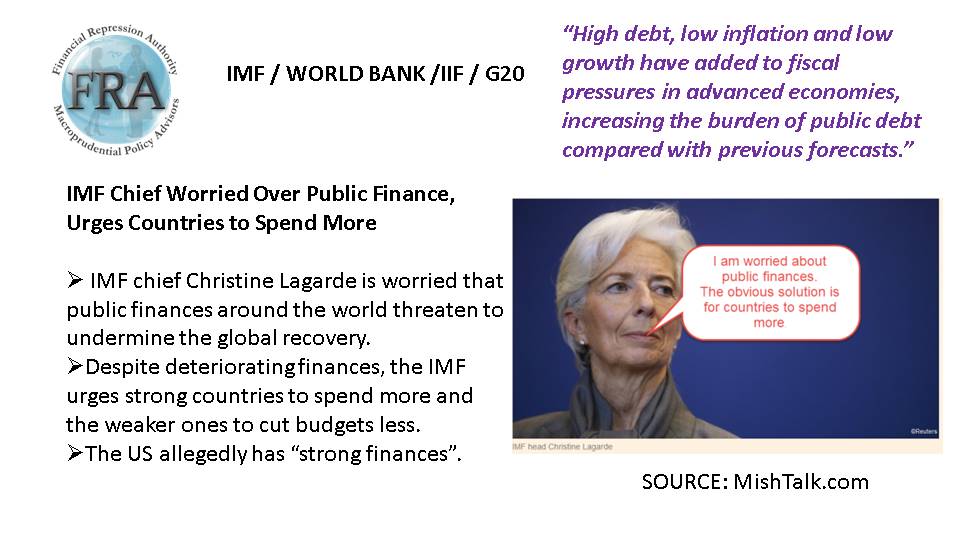
Slide2Christine Lagarde is worried about public finance and declared  the need to get public finance in order. At the same time, she wants countries to spend more.

She said the “strong” countries need to spend more and used the US as an example, but the US deficit projections don’t look very good. In fact, we can’t find anybody anyplace that does look good.

“It is just a bunch of hooey attempting to show concern while giving countries another reason to go deeper in debt.”

There’s all these emergency meetings happening and causing a lot of rumors.

French President François Hollande had a public meeting recently. He said, “I think things are getting better”, and was interrupted by a journalist who said “Excuse me, Mr. President, is that a joke?”

“That’s just what we need journalists in the US to do; ‘Excuse me Mr. President, is that a joke?'”

All the big Italian banks were gathered and told to chip in to bail out these other banks that were in trouble. What they came up with was a plan to increase the capital on these small banks by €5B Euros. Supposedly this would fix €360B in non-performing loans. There’s also roughly another €180B in bad loans.

“They’re supposed to fix this huge problem with the Italian banking system with €5B. That doesn’t work.”

DEUTSCHE BANK RIGGING GOLD & SILVER

Everyone suspected that they were cheating on gold trading, and they admitted manipulating the gold and silver market in a court of law. It’s like someone commits $100B worth of fraud and get fined $50B and promises to never do it again. That’s not even like paying the full price.

“My position all along was, yes, they’ve been cheating, but where isn’t there cheating… I’m quite positive it’s in both directions.”

Has there been this overall price suppression on gold and silver? Gold got up to €1900/ounce, and silver got to €44-46/ounce, and is now sitting at €15-16. Was there pressure applied by all the banks? Is gold really down or was there manipulation because the banks were generally on the other side of the trade?

“Is gold about where it would be without this manipulation? I don’t know, and nor does anyone else.”

“CASINO BANKS”

What we saw was Deutsche Bank had €500B+ in derivative profits and roughly €480B in current losses, so roughly €20B ahead. On another page they outline all their derivatives positions and it amounted to €21T. That’s a profit of €20B from €21T in notional values. These are values way out of the money and some of it is genuinely off.

“When you’ve got a €21T casino on your balance sheet, it just goes to show you how much banks aren’t banks.”

This has nothing to do with core bank policies and procedures and lending. It’s a derivatives casino and it’s rigged. They admitted rigging gold and silver, they admitted rigging LIBOR, they admitted rigging Euribor.

For all the rigging, they got caught on gold and silver. Their commodities portfolio of derivatives was only a tiny piece of that €21T, compared to €15T in interest rates derivatives or €5T in currency derivatives. Something is clearly wrong with all these casino banks.

The international swaps marketplace is approximately $600T, compared to the US economy of $25 GPD a year. Most of the magnitude is more than the entire global economy. The risk is way greater than everyone thinks, especially with these credit default swaps.

ATLANTA VS NEW YORK FED GDP REPORT

Slide3The Atlanta Fed projected 0.1% growth and revised it up to 0.3% but NY Fed says it’s more like 1%.  Originally it used to be 1.1% vs 0.1% and now it’s 1% vs 0.3%, and we don’t know which one is right. However, the New York Fed model has all kinds of nebulous things in it that can’t be explained.

Inflation is probably a lot higher in a lot of places than the CPI admits.

When 24% of the CPI is Owner’s Equivalent Rent, that doesn’t make sense. Rents in Cleveland and Illinois have nothing to do with rents in Seattle, or places where the economy is doing a lot better. They average it out and supposedly this is some sort of aggregate number that tells you it only goes up by 1.7%. I don’t believe these prices can aggregated because there is no basket that we can define as suitable for everyone, but this is what the Fed does and everyone hinges on these numbers.

“We’ve got too much inflation, too much wealth concentrated in the hands of all the people making the money, while the average guy is losing out.”

RETAIL CHARTS AND AUTO INVENTORIESSlide4

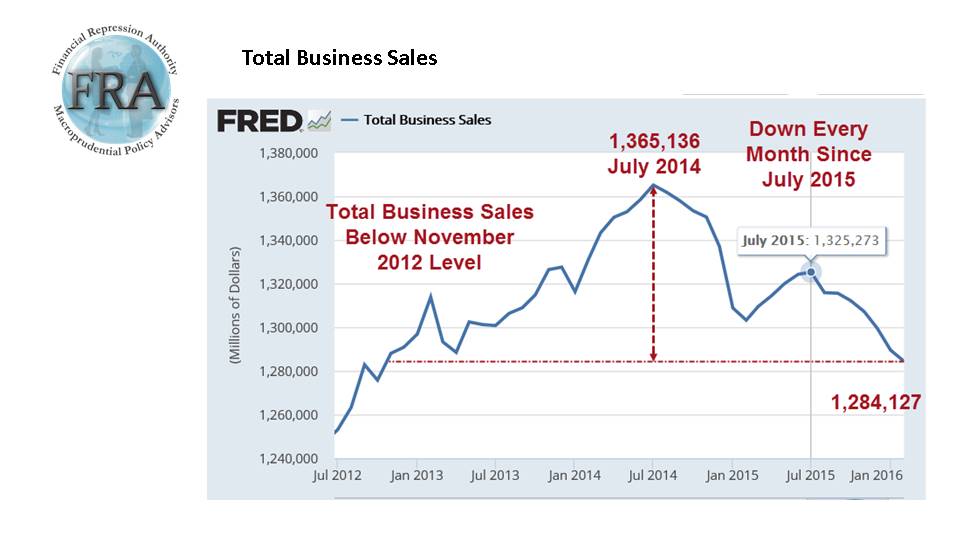
A lot of these charts peaked around November 2014, then there was a little rise back that didn’t recover all of it, and another plunge. Factory sales are down 13 out of the last 16 months, and there’s more things participating now. For instance, auto sales are down 3-4 months in a row. Inventories are at an all-time high. Everyone’s traded in their car; used car inventories are at an all-time high.

35% of all autos sold are on lease, and the residual value of used cars are plummeting. Someone has to take a massive write down since they’re all traded as ABS in the shadow banking system. The US government are the biggest owner of used car assets with $1.1T since they buy all the collateralized loan obligations etc. that go through the government.

LIKLIHOOD OF A RECESSIONSlide10

“I am still sticking with my forecast that says the recession started in December 2015. I see no reason to revise that.”

We might not know for a year, especially if it’s a small recession. The official harbinger is the NBER, and they get to call when we get it, but we’ve had a recession that ended before they called it. They’re always late. Nothing is coming out of these reports that indicate the call was wrong.

“We’re certainly not in a very strong economy, and there’s no reason to believe it’s going to get any stronger.”

Abstract by: Annie Zhou a2zhou@ryerson.ca

Video Editor: Sarah Tung sarah.tung@ryerson.ca

https://youtu.be/rYioJaaB3Yw

Disclaimer: The views or opinions expressed in this blog post may or may not be representative of the views or opinions of the Financial Repression Authority.


04/13/2016 - Jeff Berwick: “THEY’RE TRYING TO BRING EVERYONE INTO THE BANKING SYSTEM SO THEY CAN ESTABLISH A ONE-WORLD CENTRAL BANK & TAXATION SYSTEM!”

FRA Co-founder Gordon T. Long is joined by Jeff Berwick in discussing the article Central banks beat Bitcoin at own game with rival supercurrency, the central banking system, and blockchain technology.

Jeff Berwick is the founder of The Dollar Vigilante, CEO of TDV Media & Services and host of the popular video podcast, Anarchast.  Jeff is a prominent speaker at many of the world’s freedom, investment and gold conferences including his own, Anarchapulco, as well as regularly in the media including CNBC, Bloomberg and Fox Business.

Jeff’s background in the financial markets dates back to his founding of Canada’s largest financial website, Stockhouse.com, in 1994. In the late ‘90s the company expanded worldwide into 8 different countries and had 250 employees and a market capitalization of $240 million USD at the peak of the “tech bubble”.  To this day more than a million investors use Stockhouse.com for investment information every month.  He has since started numerous businesses including TDV Offshore and TDV Wealth Management to help others internationalize their assets.

FIAT CURRENCIES AND BITCOIN

There’s going to be a lot of chaos this year, beginning in January with the worst first month of the world stock market in history. A lot of financial leads have been warning about it, even saying this is a debt jubilee and will end up in utter collapse if people aren’t careful.

“I think by 2018 they’ll be bringing in a one world currency… All Fiat currencies, including the US Dollar, are going to collapse sometime between 2015-2020.”

The market came up with a solution. Launched in 2009, Bitcoin is a free market currency, and one of the ways that we can avoid this total collapse.

RESPONSE TO AMBROSE-EVANS PRITCHARD

“It looked like a propaganda piece, like it was written by the Bank of England as a press release.”

In no way does this new central bank crypto-currency compete or defeat Bitcoin in any way. In fact, central banks are extremely worried about Bitcoin. They’re trying to bring everyone into the banking system so they can establish a one-world central bank and taxation system. They planned to create a system that impoverishes people to get the wealth into the hands of the 0.0001%.

They want to collapse the entire system so they can bring in a new system. We’re reaching the end of that plan, when every government is insolvent with debt. The US Federal Reserve has essential kept interest rates at zero for eight years, because if interest rates rise the US government would quickly be insolvent.

“With $19T worth of debt, if the interest rate rose to 10%, a very low level, that’d be almost $2T a year in interest payments alone.”

They’re trying to delay that and get everyone into the banking system first. If you try to open a new bank account, it’s very difficult and they want to know every detail because it’s going into a central database so no one can evade taxes. Then they’re going to go even further with negative interest rates and really impoverish people.

If people start getting into Bitcoin, they can’t control it. The only way would be to turn off the internet or the power.

BITCOIN

Bitcoin is an internet-based currency that’s completely decentralized. To get rid of it, they’d have to remove it from the millions of computers around the world, and that’s almost impossible. If you control the money supply, you control the governments. That’s what the Federal Reserve and all central banks do.

“The governments do not control the big decisions. It’s the people behind the scenes who control the money, who tell the government what they want done, and that’s been going on for decades.”

Bitcoin cannot be fraudulent because it’s open-source software. Anyone who wants to can look at the code. There’s no CEO, there’s no central office, and it’s on so many computers they can’t stop it. Central banks want to tax everything and control the economy.

“I don’t call things like Bitcoin a revolution so much as an evolution. It’s creating something that circumvents the entire system completely.”

BLOCKCHAIN TECHNOLOGY

Blockchain type technology could change everything, and goes beyond just money. This could be where everything is based. This technology is also starting to being used be for governance, starting in Africa, as a system of private property. Eventually it could be used to replace the government.

“Your average person still doesn’t know what a big deal is going on behind the scenes, but this is going to revolutionize the world… There’s going to be so many things built on top of this technology that it’s going to change the world.”

BACK TO THE ARTICLE – RSCOIN

Central banks will get rid of fiat currency and use RSCoin instead, but since it’s a crypto-currency it can be tracked even more. The population will likely use it, but it does not “beat Bitcoin at its own game”.

RSCoin will supposedly be good as it gives the government and central bank more control over the money system, and this will apparently make us less prone to boom-bust cycles. However, the central bank’s control over interest rates is what creates boom-bust cycles in the first place.

THOUGHTS FOR THE FUTURE

You want to get your assets out of the banking system, especially anti-system sorts of investments and trades and speculations, ad moving assets out of your own country.

“You want to get assets internationalized. That’s the new diversification in my opinion: not stocks, bonds, or cash, it’s where your assets are, in what countries are they, and under what structures are they.”

We’re headed for a collapse, and how it plays out is anyone’s guess. This is going to be a time talked about in history for centuries, after the collapse happens. We have a global fiat currency that is just computer bits controlled by central bankers with no intrinsic value, and they will return to that.

“Do your own research. There’ a lot more going on out there than most people know.”

Abstract by: Annie Zhou a2zhou@ryerson.ca

Video Editor: Min Jung Kim minjung.kim@ryerson.ca

Disclaimer: The views or opinions expressed in this blog post may or may not be representative of the views or opinions of the Financial Repression Authority.


04/06/2016 - Jordan Eliseo: “CENTRAL BANK DEMAND & EMERGING MARKET DEMAND ARE, TO ME, THE BID UNDER THE GOLD MARKET!”

FRA Co-founder Gordon T. Long is joined by Jordan Eliseo in discussing the value of precious metals as an investment.

Jordan Eliseo is a much sought-after and respected financial commentator and economic analyst with close to 20 years experience in the financial sector. After working for some of the biggest names in the global financial marketplace including Deutsche Bank, JP Morgan and AMP Capital, Jordan has amassed a wealth of experience analyzing investment markets.

Jordan not only ‘talks the talk’ but has walked the walk, setting up his own precious metal and mining fund back in 2003, when most people had never even heard of precious metal investment, and is also the founding partner of a national financial advice business, helping Australians take control of their finances and maximize their superannuation. And now he is the Chief Economist of Australasia’s largest independent bullion dealer – ABC Bullion.

Jordan holds a BA in Banking and International Finance from Flinders University and a Graduate Diploma in Applied Finance and Investment from FINSIA. He also holds the Diploma in Financial Planning (Financial Services) with specialist SMSF accreditation.


04-06-16-FRA-Jordan_Eliseo-Slide-1bPRECIOUS METALS: GOLD

It’s been a very impressive quarter for anyone who’s gone long in precious metals, with gold up 16% and silver up 11% for the quarter, welcome respite after the cyclical correction in precious metals that started in 2013. In a world where equity markets are increasingly volatile and central banks are taking more extreme monetary policy positions and decisions, the merits of holding gold as part of a portfolio are high.

In 2013-15 there were hundreds of tonnes of gold diverted from gold ETFs, but that has increased in the last few months.

“People are, if not adopting it as a major holding, openly looking at it and analyzing the merits of including it alongside more traditional assets.”

People long term in gold argue that if there’s any interest in gold ETFs, there might be a shortage of physical gold. But there is several thousand tonnes of gold in London at this point and there’s the better part of 3000 tonnes of organic or freshly mined production being brought to the market every year.

“Central banks demand and emerging market demand are, to me, the bid under the gold market that will support it for the next few years.”

04-06-16-FRA-Jordan_Eliseo-Slide-6

But for gold to move substantially higher, we will need to see western investors adopt it in their portfolio. It doesn’t have to be a major move, just 2-5% of the average western investor’s portfolio, we’d see prices move much higher.

“In a world where we earn less than nothing on cash, when there’s 20 trillion Dollars of sovereign debt… it probably makes sense to hold this asset class.”

EFFECTS OF JAPAN AND NIRP

There’s a lot more discussion on a cashless society ever since Japan announced NIRP, which correlates with the increase in consideration of gold. This has changed the perception around financial market risk and financial markets as a whole, and gold is affected.

A retail investor concerned about QA and bank bail-ins would find the argument for  holding gold strengthened. An institutional investor with a volatility mandate and return objective would be more interested in the potential for gold to deliver alpha in a low rate environment, since gold is uncorrelated to the financial markets.

04-06-16-FRA-Jordan_Eliseo-Slide-2PROBLEM OF LIQUIDITY

If you look at liquidity, it’s drying up in financial markets. In the last twelve months there have been multiple warnings about the waning of liquidity in markets. They’re worried in the liquidity might not be there in the event that investors move to cash and liquidize their bond portfolios. This is extraordinary as bonds are supposedly low risk and highly liquid.

If you’re an institutional investor, you need a large market to go into – gold fits that bill and has the advantage of having 0 credit rising despite its growing size.

PRECIOUS METALS: SILVER

The gold-silver ratio is now roughly 80:1, which indicates that it’s underpriced by many historical measures. In the last twenty years it’s only been even cheaper relative to gold once. We’re at a level now where the last three times we reached this kind of ratio,04-06-16-FRA-Jordan_Eliseo-Slide-3 it really did market to bottom in the gold to silver ratio and silver comfortably outperformed to the outside.


I think there’s a couple reasons why it’s so cheap. In 2015 there was a bloodbath in industrial and energy commodities commodities. Gold has always been considered a pure monetary asset and store of wealth, but silver still has the quasi-monetary quasi-industrial status. So in environments with concerning rates of economic growth, it’s natural for silver to under perform.

But the smaller market means it will take less Dollars to move the price of silver. As a physical asset, silver is very attractive to hold. The future looks very good for silver in particular, even though it’s not getting the recognition that it should have.04-06-16-FRA-Jordan_Eliseo-Slide-4

SOUTH-EAST ASIA AND AUSTRALIA

In South-East Asia, there’s 3 billion people getting wealthier who understand the value of saving and investing. There’s misallocation of capital on a grand scale, especially in certain parts of China, but broadly speaking I’m bullish on the whole area.

If we bring it back to Australia, we’re facing some pretty strong headwinds in the next few years. The worst in the fall in commodity pricing is now behind us, but we will be in a softer real commodity environment for a few years.

“The investment in the money sector breaks 8% of GDP in Australia at one point. The long run average is closer to 2%.”

04-06-16-FRA-Jordan_Eliseo-Slide-5What’s kept the Australian economy going in the last few years was construction. The housing industry thinks that 2015 was the peak for home construction, and it’s going to ease up over the next three years.


Wages are also growing at less than the rate of inflation. While Australia has no sovereign debt issue, we have the high private sector indebtness in the world.

The average person in Australia has very little money in actual savings to spend, has never been more indebted, and is facing an uncertain employment outlook where their real wages are unlikely to keep pace with inflation. The majority of their financial assets are ring-fenced inside of superannuation.

“We will continue to see declines in real incomes, recession-like conditions, and much lower interest rates from the RBA, at least 1.5% if not lower, between now and the middle of next year.”

BACK TO BULLION

This reasserts the importance of owning gold, even for Australian investors, because all the interest rates they’ll earn on cash will decline and fall below zero. Our stock market has an almost unprecedented sector concentration within our stock market where about 45% of the ASX 200 is concentrated in financials, VS 20% MSCI world average. This worked well in the last 25 years, but that cycle is starting to change now.


POSITIVE OUTLOOKS ON THE FUTURE

“Even if we don’t grow at a substantial rate, that doesn’t also mean we’re going to have an absolute collapse in GDP.”

Slide13During the global financial crisis, financial markets fell more than 50% but GDP fell around 2%.The value we put on our output plummeted, but the actual output fell by a small amount. There will not be any major greenshoots on the horizon that are going to help the global economy grow in any meaningful way.

China’s slowing down, and there are huge problems in Brazil and Russia. Europe and Japan are still disasters and even the US is slowing down. There will not be an uptick in global growth, but there is no major reason to panic.

“As an investor, it comes down to making sure the portfolio is well constructed to protect yourself against the overvaluation in financial assets and making sure you protect real wealth  through this more challenging period.”

Abstract by: Annie Zhou a2zhou@ryerson.ca

Video Editor: Sarah Tung  sarah.tung@ryerson.ca

Disclaimer: The views or opinions expressed in this blog post may or may not be representative of the views or opinions of the Financial Repression Authority.


04/01/2016 - Chris Casey: “COST-PUSH INFLATION IS ANOTHER KEYNESIAN CONCEPT THE FED BELIEVES IN – They’re Wrong!”

FRA Co-founder Gordon T. Long is joined by Christopher P. Casey in discussing the decrease in oil price and its potential effect on the global economy.

Mr. Casey is the Managing Director of WindRock Wealth Management, a registered investment advisor and wealth management firm that subscribes to the Austrian school of economics. Mr. Casey is a frequent speaker before a number of organizations and conferences, including USA Watchdog, GoldMoney, Freedom Fest, and various bar associations and radio shows, including weekly financial and economic commentary on The Edge of Liberty (WNJC 1360, Philadelphia).  His writings have appeared in a variety of publications and websites including The Ludwig von Mises Institute, Zero Hedge, Family Business, Casey Research, and Laissez Faire Books.  He is a board member of the Economics Development Council with the University of Illinois, a Policy Advisor for The Heartland Institute’s Center on Finance, Insurance, and Real Estate, and a Chartered Financial Analyst charterholder (CFA®)

COST PUSH INFLATION

oil1Cost push inflation is a Keynesian concept that was developed to explain inflation during inflation; if any important commodity’s price rises, all other prices of goods and services rise. As we pay more, the standard of living would go down and inflation would creep in. But this actually puts downward pressure on other goods and services, so in the end the price level itself is largely unchanged.

“The price level is a function of the demand and supply of money itself, not of any individual commodity.”

It used to be that minor shifts in the oil price had profound impact on the economy, but that isn’t the case right now. Oil went from about $25 in 2003 to $140 in 2008, back down to $30 in late 2008, and $140 a couple of years ago. But have we ever seen a price level that rose or decreased according to the oil prices over the last fifteen years? The answer is no. The issue is that the Federal Reserve does believe in cost-push inflation, and they do think that deflation could be caused by lower oil prices.

“The great danger here is that they, in their mistaken belief that low oil prices could put a cap on any inflationary moves they do, as far as printing money, is that they could overshoot and end up causing more inflation than they intend.”

oil2EFFECT OF LOWER OIL PRICES

“Lower oil prices are good for the economy, but not for the reasons people cite on mainstream media.”

There’s a possibility that this could spike interest rates, or mitigate a downfall in interest rates.

STATE OF THE OIL MARKETS


Lower energy prices used to be considered good for the economy, since people have more money to spend. But that’s going toward servicing debt; it’s not actually consumption, it’s going toward debt payments. There are also some real dangers that aren’t being discussed by mainstream media.

Oil production has increased about 85% since 2008, but what isn’t mentioned is how oil imports have decreased. It’s down from approximately 12% of total imports to 5% today, not just in Dollar terms but overall volume.

Toil4he price has dropped 60% in the last five years. Oil producing nations are making less Dollars from the US customer. This is a problem because there are limited options for what they can do with those Dollars, so the US’ major trading partners and oil producing countries hold a massive amount of US treasuries. If they reduce their purchase of US treasuries, that could increase interest rates.

“Interest rates would have fallen further, but for the selling or lack of demand from these oil producing countries.”

SAUDIA ARABIA PEG

The Riyadh is pegged to the US Dollar at 3.75 Riyadh to the US Dollar, but their economy is under strain and their deficit is staggering. In any fixed exchange rate, the only way to keep it is through manipulation of the currency market by active buying and selling of Riyadh and US Dollars, but that is only making them go bankrupt faster. This could ultimately affect US interest rates as well.

OIL SUPPLY & DEMAND

oil3With multiple countries putting out as many barrels of oil a day as possible, there’s pressure to keep the oil supply up and maybe keeping oil prices down. But if the world economy falls off significantly, there will be a decrease in demand and then cut backs and lots of capital not invested. Then if demand rises there won’t be much capacity, which makes the market volatile. The banks are holding out in the hopes of a rebound, because they have so much debt outstanding to the oil industry. Eventually this will either create incredible inflation or a banking crisis.

“The banks cannot put up with this kind of strain . . . it’s kind of like being a patient and your doctor, who would be the central bank, is subjecting you to stimulants and depressants whether its quantitative easing or negative interest rates.”

FEDERAL RESERVE’S MISCONCEPTIONS

Regarding the nature of growth, history shows that the key is a high level of savings and decreasing government intervention. Another is the idea of deflation being bad; for example, the US experienced experienced two 30-40 year periods where the price level fell by half, but it was also the greatest period of growth in US history. The Federal Reserve also has misconceptions about inflation’s impact on unemployment, and interest rates, which could cause a banking crisis.

ADVICE FOR INVESTORS

If people believe that the oil market will create a banking crisis in the future, then they need to look at assets outside of the banking system. Gold and silver should absolutely be considered as part of their portfolio since it’s much safer than a number of currencies, as it has alternative value. Farmland is also an excellent inflation hedge and pays a dividend, unlike precious metals.

“A lower oil price, although all things being equal is good, there are some real dangers: there is the danger it could increase interest rates, there is the danger it could increase inflation levels… and there is the danger it could induce a banking system crisis.”

Abstract by: Annie Zhou: a2zhou@ryerson.ca

Video Editing by: Min Jung Kim <minjung.kim@ryerson.ca

Disclaimer: The views or opinions expressed in this blog post may or may not be representative of the views or opinions of the Financial Repression Authority.