10/21/2016 - The Roundtable Insight: Yra Harris on Deutsche Bank, Systemic Risk and the U.S. Elections

FRA is joined by Yra Harris in discussing the impact of the potentially failing Deutsche Bank on the global economy, along with the state of US markets as election day draws closer.

Yra Harris is a recognized Trader with over 32 years of experience in all areas of commodity trading, with broad expertise in cash currency markets. He has a proven track record of successful trading through combination of technical work and fundamental analysis of global trends; historically based analysis on global hot money flows. He is recognized by peers as an authority on foreign currency. In addition to this he has Specific measurable achievements as a member of the Board of the Chicago Mercantile Exchange (CME). Yra Harris is a Registered Commodity Trading Advisor, Registered Floor Broker and a Registered Pool Operator.

He is a regular guest analysis on Currency & Global Interest Markets on Bloomberg and CNBC. He has been interviewed for various articles in Der Spiegel, Japanese television and print media, and is a frequent commentator on Canadian Financial Network, ROB TV.

DEUTSCHE BANK

We don’t know if Deutsche Bank is a buy-in opportunity. It’s based on the fact that the EU and Germany will not allow Deutsche to fail. This extensive systemic risk because of the fact that Deutsche Bank is one of the world’s largest notional derivative books – of about $46T at the end of last year – represents a lot of risk in terms of derivatives meltdown between counterparties. While the ECB balance sheet has grown from €2T to €3.4T in just 18 months, there’s only about €7.5T outstanding Eurozone sovereign debt. It represents a challenge going forward in a very quick period of time, in terms of the overall systemic risk to the European banking system.

Its risk profile is based on Deutsche’s own models, so we don’t really know what the exposure is. It ought to be a higher risk rating than they reveal.

CAN’T LET DEUTSCHE FAIL – WHAT THEN?

It would be extremely difficult to bail Deutsche out or bail it in. If you want to see financial repression, watch what the ECB is doing to the savers in Germany. They’re bearing the bailout of the entire European project. If there was a bail-in, that would cause even more political angst. If that balance sheet grows big enough, no one can escape the EU ever, and the German taxpayers will be on the hook for this forever.

The German government is boxed in. It could go in the direction of a bailout of 100M to potentially a bail-in, as part of financial repression where there’s a wealth confiscation of assets that take place at the capital structure layers, anywhere from bank depositors to senior secure bond holders. It could happen either way or a combination of both. Or you could have both, or have the European Central Bank step in and monetize a lot of the bailout in terms of assistance for quantitative easing programs.

Mario Draghi would like to increase QE, but there’s no chance of that happening. He’s under a lot of pressure, and wants to build that balance sheet up bigger and bigger. Central bankers are running out of tricks and ammo.

The US equity market has now broken out of the uptrend. The equity market is fairly valued, but vulnerable to a sell-off. Wall Street would prefer Hillary, but she will certainly raise capital gains or the holding period in which you can obtain capital gains. People who have been in this market and have long term capital gains will likely sell that which they can before the end of the year, which makes this market vulnerable. Corporations have piled up so much debt that it weighs on this market dramatically. The amount of debt piled on the balance sheets around the world is just enormous.

The markets are vulnerable from the perspective of overvaluation measures and overhanging debt, but also from the potential of helicopter money for doing projects like infrastructure to provide a stimulus to the financial markets as well as the economy. The asset markets will have to go down significantly to some level to prompt fiscal authorities to bring the political will together to create fiscal stimulus. With increasing central bank buying of stocks, that will likely artificially support stock markets.

US PRESIDENTIAL RACE

Trump makes the markets nervous, because they don’t like unknowns translating into high volatility in the markets. Trump might be anti-trade, which could affect international companies, but Clinton might bring geopolitical events that could negatively affect the markets as well.

Several people have laid out the possibility that if Trump pulls out a surprise upset victory on election night, there would likely be calls to say this was Russian tampering and that election results should be put on hold until it could be determined if foreign interests undermined the election. This will likely provide a great deal of social unrest, which could translate into a lot of economic uncertainty. There’s a lot happening outside of North America that could work to propel the US markets higher with a strengthening dollar.

US DOLLAR STRENGTHENING

Last week we saw, for the first time since February, the US dollar move above 97.50 on the dollar index. It’s starting to look like the makings of an upside break-out in the dollar index. When you look at the problems around the world, it’s hard to believe the Euro is still above par. The Yen is still 20% higher on the year. The dollar ought to be higher, but it’s not. The central bankers are working to manage the stability of currencies relative to each other, but overall we’re looking at the decline of purchasing power of money regardless of currency.

This is about global assets – they’re all somewhat in trouble here.

PORTFOLIO CONSTRUCTION AND ASSET ALLOCATION

Treat everything as short term trades. If you can turn it into a profit, go ahead, and go on to the next one. It’s very difficult to say in a medium or long term sense because of the strong tug of war between inflation and deflation type forces. We have strong deflationary forces that are naturally happening in the financial system being counterbalanced by the very inflationary forces provided by central banks. It could go either way in a medium term. It would be difficult to quickly change your portfolio, but perhaps a diversified portfolio in the medium-long term with this short term trading strategy.

Another way is looking at companies with little or no debt, high discounted free cash flow with little or no leverage.

Abstract by: Annie Zhou <a2zhou@ryerson.ca>

Provide your email below and we will send you The Report on Gold: The Risk-Mitigated Way To Own & Store Gold – – this paper brief goes through 15 market, credit and operational risks and how to mitigate those risks when investing and storing gold. A must read for today’s investor in precious metals.

Once you get our free white paper, you will have access to information and contact details for the solution partners offering not only gold & silver products but also storage services in some of the best jurisdictions of the world.

Gold_Bars

(Your contact information will remain confidential and will not be given or sold to any individual, company or agency.)

Email *

First Name

Last Name

Notes

 
* Required Field

(more…)

Disclaimer: The views or opinions expressed in this blog post may or may not be representative of the views or opinions of the Financial Repression Authority.


10/17/2016 - FINANCIAL REPRESSION IS NOW “IN-PLAY”!

FINANCIAL REPRESSION IS NOW “IN-PLAY”!

china-minsky-5

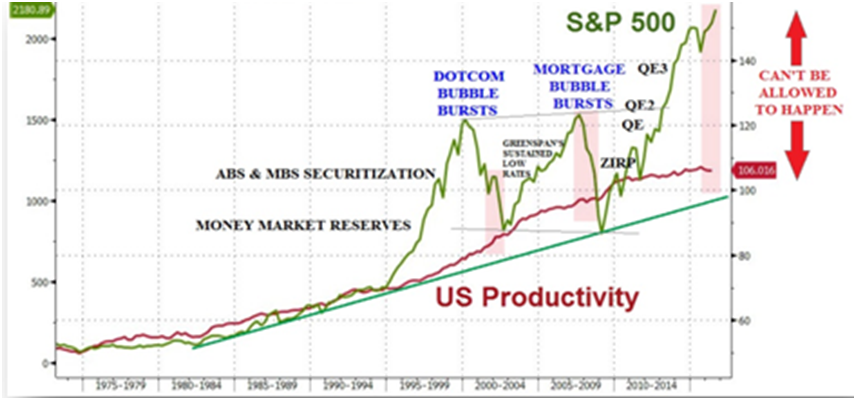
A FALLING MARKET CANNOT BE ALLOWED – at any cost!

The Central Bankers have clearly painted themselves into a corner as a result of their self-inflicted, extended period of “cheap money”.  Their policies have fostered malinvestment , excessive leverage and a speculative casino approach to investments. Investors forced to take on excess risk for yield  and scalp speculative investment returns, must operate in an unstable financial environment ripe for a  major correction.  A correction because of the  high degree of market correlation that likely would be instantaneously contagious across all global financial markets.

Any correction more than 10% must be stopped. As a result of the level of instability, even a 10% corrective consolidation could get quickly out of control, so any correction becomes a major risk. What the central bankers are acutely aware of is:

  • If Collateral Values were to fall with the excess financial leverage currently in place, it would create a domino effect of margin calls, counter-party risk and immediate withdrawals and flight to areas of perceived safety.
  • The already massively underfunded pension sector (which is now beginning to experience the onslaught of baby boomers retiring) would see their remaining assets impaired. This could lead to social and political pressures that would be simply unmanageable for our policy leaders.
  • A falling stock market is the surest way of alarming consumers and signalling that things are not as “OK” as the media mantra  has continuously brain washed them into believing. In a 70% consumption economy, a worried consumer almost guarantees a further  economic slowdown and a potential recession.

As our western society continues to consume more than it produces, productivity is not increasing at the rate that justifies the developed nations standard of living as well as the current levels of equity markets. A possible corrective draw-down to the degree shown in this chart is simply “out of the question”!  The central bankers acutely aware of this.

triggers-october-f2-6

MARKETS TEMPORARILY HELD UP

The markets are presently, temporarily held up due primarily to three factors:

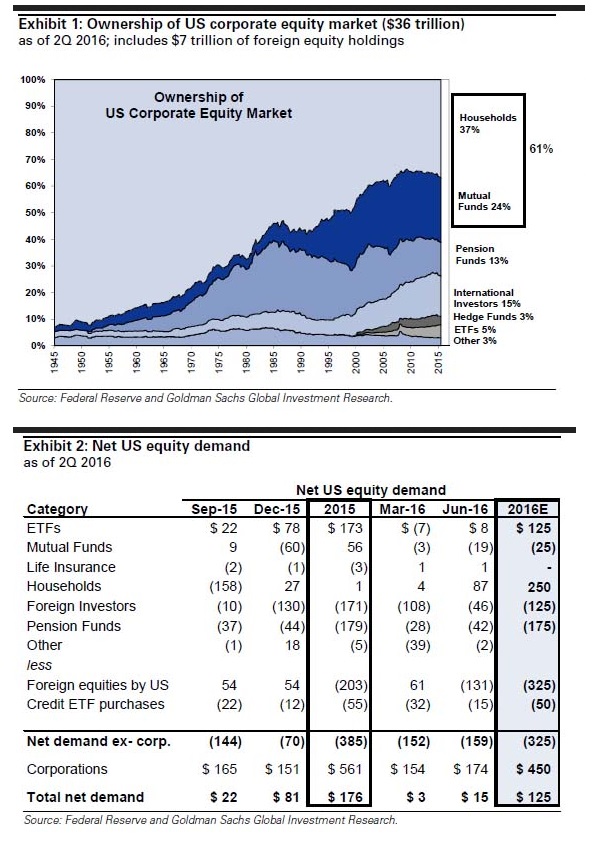
  • Historic levels of Corporate Stock Buybacks,
  • The chasing of dividend paying stocks for investment yield in a NIRP environment,
  • Unusual Foreign Central Bank buying (example: SNB)

Professionals, institutions, hedge funds etc have been steadily lightening up on equity markets (or simply leaving completely) leaving the public holding the bag.

It is estimated that the $325B that will leave the US equity markets in 2016 will be replaced by an artificial $450B of corporations buying their stocks. With corporate cash flows now falling and debt burdens triggering potential credit rating downgrades, this game is quickly slowing. The central bankers are aware of this.

gs-buyback-9_0

TECHNICALS INDICATING AN END TO THE DEBT SUPPER CYCLE

The Market Technicians of all persuasions are almost unanimously calling for a major correction. What is most troubling here is that their indicators are not just short and intermediate term measures but critical long term indicators.

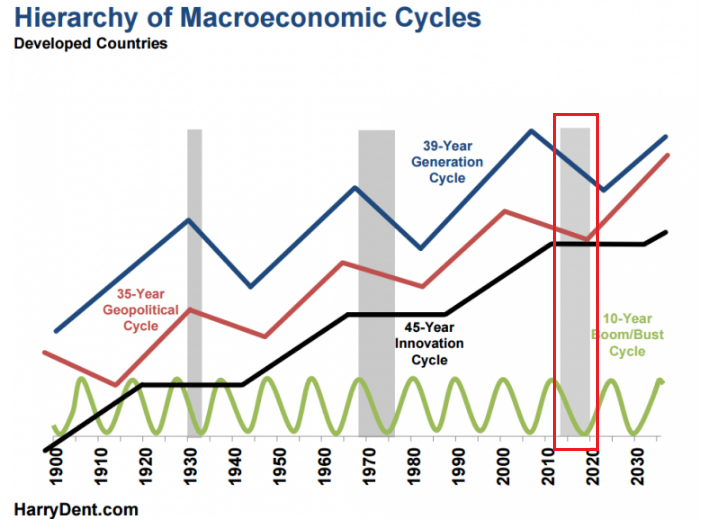
  • KONDRATIEFF CYCLE: The 55 Year generational Kondratieff Cycle  shows an overdue major downturn with a cleansing of debt as part of the end to what has been termed the “Debt Supper Cycle”,
  • DEMOGRAPHIC CYCLES: Harry Dent has done some major  work on Demographic Cycles and cycles overall. I interviewed him for the Financial Repression Authority where you can find the video and he lays out the seriousness of the shifting demographics and how it overlays of many different types of cycles he has studied.

10-17-16-mata-risk-harry_dent

  • ELLIOTT WAVE

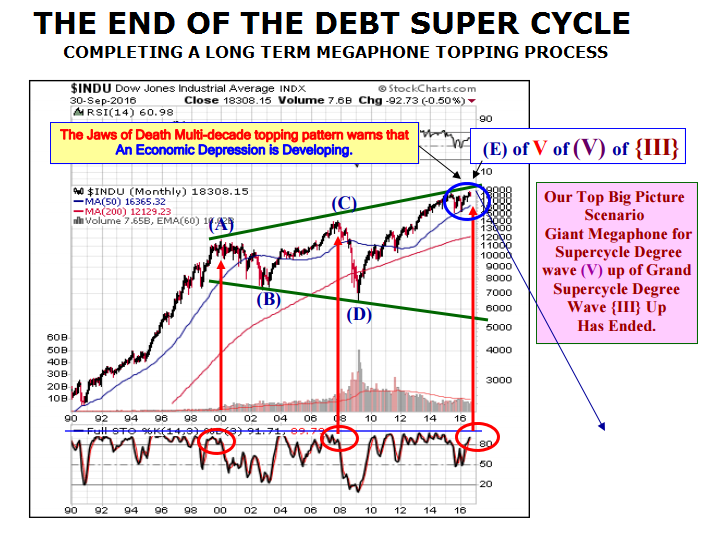
The technicians who study Elliott Wave see clear evidence that we are now completing a multi-decade topping pattern in the form of a classic megaphone top.

10-08-16-mata-highlights-key-charts-2

Chart courtesy of Robert McHugh

The central bankers are aware of this.

  • TECHNO-FUNDAMENTALS

I could keep on illustrating the types of warnings we are seeing, but let me share what the central bankers are likely most concerned about regarding Correlation, Liquidity and Volatility ETPs.

The markets have become so correlated (think of this as everyone on the same side of the boat) with asset correlations not only being higher, but the correlations themselves are becoming more correlated. While traditionally rising cross-asset volatility has resulted in volatility spikes, that is no longer the case due to outright vol suppression by central banks. While central banks may have given the superficial impression of stability by pressuring volatility, they have also collapsed liquidity in the process, leading to less liquid markets, a surge in “gaps”, and “jerky moves” that are typical of penny stocks.

The greater the cross asset correlation, the lower the vol, the greater the repression, the more trading illiquidity and wider bid ask-spreads, and ultimately increased “gap risk”, which becomes a feedback loop of its own. Global central banks are now injecting a record $2.5 trillion in fungible liquidity every year – in the process further fragmenting and fracturing an illiquid market which  is only fit for notoriously dangerous “penny stocks.”

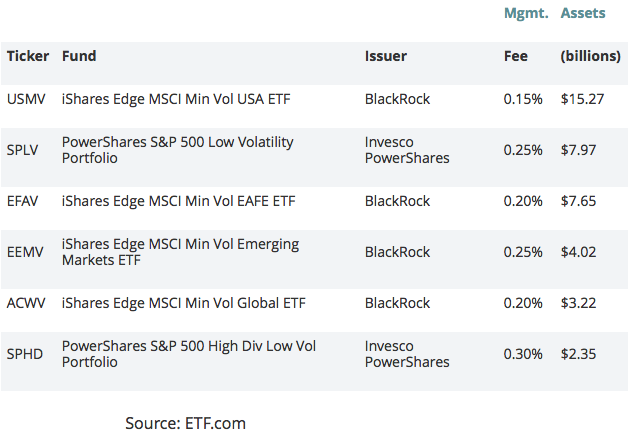
“More than $50 billion has poured into low-volatility indexed exchange-traded funds over the past five years or so, in the wake of the 2008-09 market meltdown. There are now 14 “lo-vol” ETFs with assets exceeding $100 million each, and many more with less. Whenever the market hits a pothole, these ETFs enjoy a bump-up in assets.”

screen-shot-2016-10-12-at-2-16-26-pm

Even more concerning are Volatility ETPs (Exchange Traded Products) which are derivative of some underlying asset. Volatility ETFs are particularly strange animals since you’re buying a derivative (ETF) on a derivative (the futures contract) which itself is based on a derivative (the implied volatility of options) and those options themselves of course are derivatives which themselves are based on the S&P 500. Getting the picture? The folks at Capital Exploits warn:

….everyone is on the low volatility side of the boat, because the central banks have managed to create a sense of calm in the markets exhibited by record lows in volatility and  investor have used linear thinking extrapolated well into the future assuming ever greater risk ignoring market cycles and extremes at their peril.

Every time you sell volatility you get paid by the counter-party who is typically hedging the volatility (going long) of a particular position and paying you for the privilege. This is not unlike paying a home insurance premium where the insurer takes the ultimate risk of your house burning down and you pay them for the privilege. The difference however between selling volatility in order to protect against an underlying position and selling volatility in order to receive the yield created is enormous. And yet this is the game being played.

The central banks have managed to create a sense of calm in the markets exhibited by record lows in volatility and for their part Joe Sixpack investor has used linear thinking extrapolated well into the future assuming ever greater risk ignoring market cycles and extremes at their peril.

Again, none of this is going unnoticed by the increasingly worried central bankers.

THE NEXT FED POLICY SHIFT

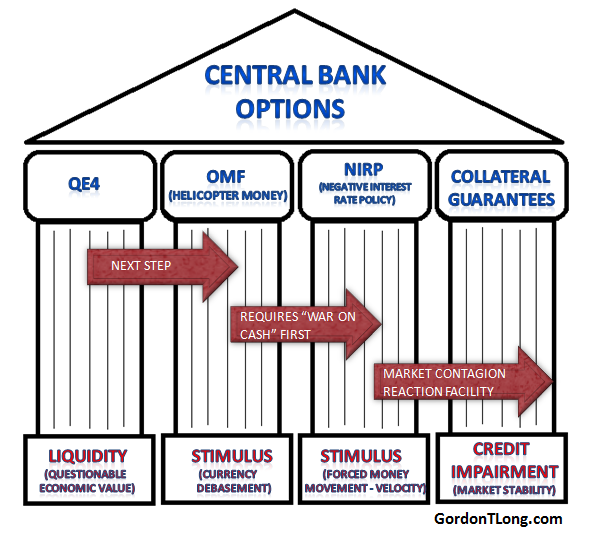
So what can the central bankers be expected to do? We laid out this road-map at the Financial Repression Authority well over a year ago. We anticipated in our macro-prudential research much of what has now become mainstream discussion:

  • Helicopter Money (now openly discussed)
  • Fiscal Infrastructure Stimulus (has become part of all candidates election platforms)
  • Collateral Guarantees
    • Buying Corporate Bonds – DONE (ECB, BOE)
    • PLUS more on Collateral Guarantees

9-monetary-experiments

We now believe the Central Bankers and Federal Reserve specifically is preparing for more in the way of Collateral Guarantees.

We believe it will actually take the form of direct buying the US stock market similar to what the Bank of Japan is  already doing with ETFs.

THE “MINSKY MELT-UP”

My long time Macro Analytics Co-Host, John Rubino concludes in his most recent writing “Flood Gates Begin to Open“:

Individual countries have in the past tried “temporarily higher rates of inflation,” and the result has always and everywhere been a kind of runaway train that either jumps the tracks or slams into some stationary object with ugly results. In other words, the higher consumption and investment that might initially be generated by rising inflation are more than offset by the greater instability that such a policy guarantees.

But never before has the whole world entered monetary panic mode at the same time, which implies that little about what’s coming can be said with certainty. It’s at least probable that a combination of massive deficit spending and effectively unlimited money creation will indeed generate “growth” of some kind. But it’s also probable that once started this process will spin quickly out of control, as everyone realizes that in a world where governments are actively generating inflation (that is, actively devaluing their currencies) it makes sense to borrow as much as possible and spend the proceeds on whatever real things are available, at whatever price. Whether the result is called a crack-up boom or runaway demand-pull inflation or some new term economists coin to shift the blame, it will be an epic mess.

And apparently it’s coming soon.

It is our considered opinion that the monetary policy setters are presently even more worried about the current global economic situation than we are – if that is possible?

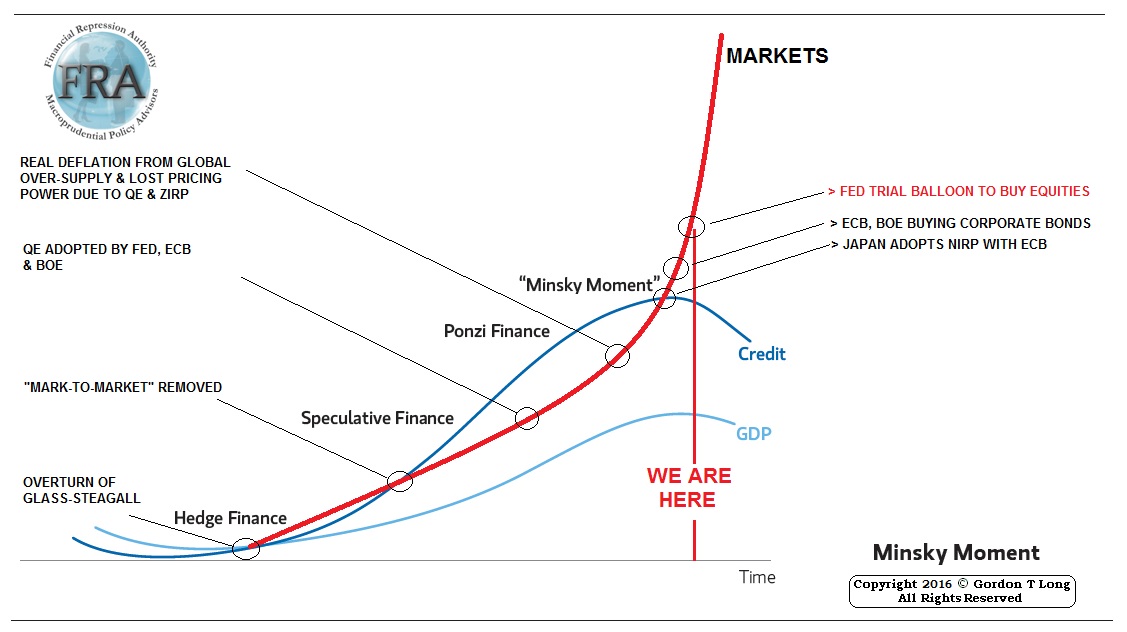
This is evident because over the last 14 days Fed Chair Janet Yellen, former Treasury Secretary Lawrence Summers and JP Morgan have all been out talking openly and publicly about the possible consideration of policy changes that would allow the Federal Reserve to buy US equities. These releases must be seen as trial balloons to condition expectations.

Japan and Switzerland amongst others are already doing it (as we previously reported) , while the ECB is also floating its own trial balloon on the same subject.

If you want to know what could create a Minsky Melt-up, this is it!

Here is our latest Financial Repression Authority Macro Map  illustrating what we see unfolding. We believe the dye has been cast!

The US Federal Reserve can soon be expected  to get congressional approval for equity purchases.  

Of course this will take a post election scare and a new congress to receive.


china-minsky-5

Disclaimer: The views or opinions expressed in this blog post may or may not be representative of the views or opinions of the Financial Repression Authority.


10/16/2016 - Bill Gross: Martingale Strategies Of Central Banks Are Destroying Capitalism

“This Cannot End Well” Bill Gross* Warns

“Low/negative yields erode and in some cases destroy historical business models which foster savings/investment and ultimately economic growth .. Central bankers cannot continue to double down bets without risking a ‘black’ or perhaps ‘grey’ swan moment in global financial markets. At some point investors — leery and indeed weary of receiving negative or near zero returns on their money, may at the margin desert the standard financial complex, for higher returning or better yet, less risky alternatives. Bitcoin and privately agreed upon blockchain technologies amongst a small set of global banks, are just a few examples of attempts to stabilize the value of their current assets in future purchasing power terms. Gold would be another example — historic relic that it is. In any case, the current system is beginning to be challenged .. It is capitalism itself that is threatened by the ongoing Martingale strategies of central banks. As central bank purchases grow, and negative/zero interest rate policies persist, they will increasingly inhibit capitalism from carrying out its primary function — the effective allocation of resources based upon return relative to risk .. Central bankers have fostered a casino like atmosphere where savers/investors are presented with a Hobson’s Choice, or perhaps a more damaging Sophie’s Choice of participating (or not) in markets previously beyond prior imagination. Investors/savers are now scrappin’ like mongrel dogs for tidbits of return at the zero bound. This cannot end well.”
LINK HERE to the monthly outlook

Disclaimer: The views or opinions expressed in this blog post may or may not be representative of the views or opinions of the Financial Repression Authority.


10/16/2016 - Yra Harris: Global Politics Will Keep Volatility Elevated

“Increased volatility is not debatable. It will be the outcome of the uneasiness of global politics. It seems that the present state of affairs reflects the vast chasm between those who have benefited from GLOBALIZATION and those who have seen their lives and incomes being disrupted by a world experiencing dynamic change. Brexit was a vote of the nationalists versus the Davos crowd, or those seeking the comfort of the world they know versus those who have profited mightily from the first mover advantage of being prepared for the post Berlin-wall global economy. The central banks’ efforts to prevent a massive liquidation of global assets and harm that would have befallen the global economy has left many participants in a state of financial repression. The outcome of the maintenance of ZIRP–and now NIRP–has been an increased amount of global debt as businesses, consumers and governments add more and more debt in an effort to keep the economic growth expanding. The efforts of the central banks have pushed the structure of global finance into very dangerous over-leveraged situation.”
– Yra Harris
LINK HERE to the commentary

Disclaimer: The views or opinions expressed in this blog post may or may not be representative of the views or opinions of the Financial Repression Authority.


10/14/2016 - New SEC Regulatory 270-2a-7 Has Pushed Nearly $1T Prime Money Markets into Government Funds, Treasuries & Agencies

ADVANCING FINANCIAL REPRESSION


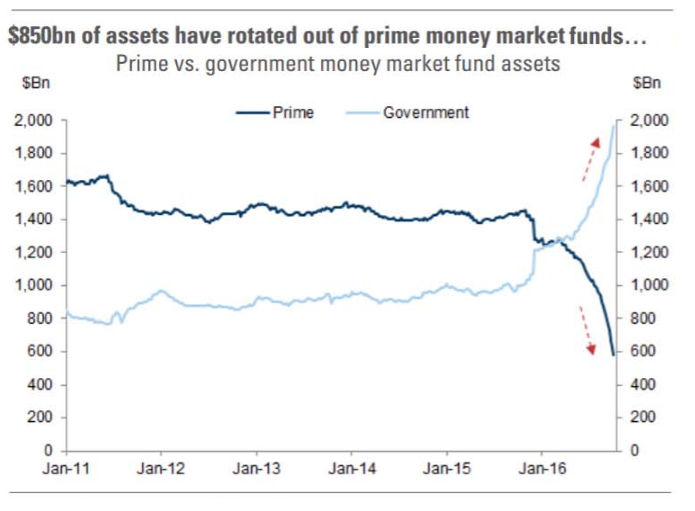
New SEC Regulatory 270-2a-7 Has Pushed Nearly $1T Prime Money Markets into Government Funds, Treasuries & Agencies

The SEC’s 2a-7 money fund reform adopted in 2014 has now gone into affect.

REGULATORY “REFORM”

  • Requires prime money market mutual funds which invest in non-government issued assets such as short-term corporate and municipal debt to float their net asset value.
  • Prime MMFs are allowed to delay client withdrawals under adverse market conditions.

The intent of the regulation according to the SEC’s final ruling was to prevent the sort of chaos that hit the money market after Lehman Brothers Holdings Inc.’s 2008 bankruptcy.


GOAL

  • Give investors a way to monitor a fund’s health by tracking its fluctuating net asset value and
  • To contain the fallout that could be caused by many investors cashing out at once

RESULT

  • Many Prime MMFs are and have been converting their assets to government funds,
  • Are not buying CDs anymore and
  • Moving into Treasury’s and Agencies.

10-14-16-fiancial_repression-sec-270-2a-7

Nearly $1 trillion in assets have rotated out of prime money markets into government funds. – ZeroHedge

According to the WSJ, the new money-market fund rules “have made life more difficult for corporate treasurers and chief financial officers” because they face a sometimes unfamiliar array of investment options as they seek both to preserve and earn some return on their collective trillions.

SEC’s changes make it possible for some money funds to lose value, limit redemptions, undermining their appeal  –  WSJ

LIBOR rates are now through the roof, to the highest level since the financial crisis, with consequences that have yet to be determined.

Disclaimer: The views or opinions expressed in this blog post may or may not be representative of the views or opinions of the Financial Repression Authority.


10/13/2016 - INDONESIA Forced Defensively to Aggressively Adopt Financial Repression.

INDONESIA Forced Defensively to Aggressively Adopt Financial Repression.

NOTE FROM FRA:  Gordon T Long

  1. NOTE: “Starting in 2016, the government (Indonesia) now requires non-bank institutions to increase the proportion of government bonds in their portfolios to at least 10-20 percent in 2016 and to 20-30 percent in 2017.” 
  2. NOTE: “Separately, the government has also lowered various interest rates by force. This year, the micro lending rate has been squeezed down to 9 percent and is expected to be slashed further to 7 percent in 2017.” This tells us that lending and borrowing is primarily about Currency risk.
  3. NOTE: “Indonesia might be tempted to utilize cheap funds provided from some countries like China and Japan that have systematically used financial repression but are now at the end of the cycle struggling to boost global demand by exporting capital. But the government must understand the aim of these countries is to create artificial demand so trade protections must be carefully considered. We can see how aggressive Japan and China export capitals have been to Indonesia ranging in many forms from China-led Asian Infrastructure Investment Bank loans to a series of acquisition by Japanese banks.”  Is this one of the real reasons for the creation of the $55T AIIB?

SOURCE: 10-13-16 The Jakarta Post by PT Samuel Sekuritas Indonesia Economist – Rangga Cipta

Financial repression policy to maintain economic growth

The end of the commodity boom that peaked in 2011 has forced the government to consider more sustainable ways to cultivate economic growth. With the mining sector struggling mightily, it is easy to fathom why the manufacturing sector is now the government’s favored sector. Most of the recently released regulations aimed at supporting producers at the cost of consumers.
With declining revenues from commodity exports, growth has been sluggish since 2011. Direct investment has become less attractive without sufficient US dollar liquidity to import capital goods.

Private consumption, contributing 55 percent to the gross domestic product (GDP), is usually the stronghold of growth, but government regulatory tendencies are repressing rather than stimulating private consumption. Government spending has been the savior of economic growth, but shrinking state revenues has reduced room for fiscal stimulus.

The budget deficit has consistently widened since 2011, forcing the government to seek alternative sources of income, ranging from tax intensification and extension to the tax amnesty program.

Even with the additional revenue from the tax amnesty program, an increase in outstanding government debt is inevitable to finance aggressive infrastructure spending. To compensate for the remaining revenue shortfall, a form of hidden taxation known better as financial repression, is already well under way.

Financial repression policies include forced lending to governments by domestic financial institutions, interest-rate caps, capital controls, macro-prudential policies and other policies that are aimed to capture and under-pay domestic savers (McKinnon 1973).

The unconventional monetary policy called Quantitative Easing of the US Federal Reserve, European Central Bank , Bank of Japan and Bank of England is also considered financial repression since the goal is to keep interest rates low and create captive domestic audiences (Reinhart 2011).

Starting in 2016, the government now requires non-bank institutions to increase the proportion of government bonds in their portfolios to at least 10-20 percent in 2016 and to 20-30 percent in 2017.

Separately, the government has also lowered various interest rates by force. This year, the micro lending rate has been squeezed down to 9 percent and is expected to be slashed further to 7 percent in 2017.

Additionally, the government has also set the maximum level of time deposit rates for certain banks to only 75-100 basis points (bps) above the 12-month policy rate (previously the Bank Indonesia rate) arguing that currently banks are enjoying too high margins.

This policy is clearly an effort to subsidize the borrower and tax both the lenders and savers, while at the same time encouraging the acquisition of more government bonds. This can also be seen as an attempt to soothe the crowding out effect resulting from the soaring public debt.

The growing middle-income segment could also provide additional strength since the bedrock of the strategy is to provide abundant cheap capital as well as labor. But again to attract foreign direct investment (FDI) and increase competitiveness at the same time, the government must maintain productivity growth running faster than inflation adjusted wage growth.

Starting this year, the government has set a legal formula for the fair amount of annual labor wage adjustment to prevent excessive increases. Labor unions are unlikely to be placated by wage increases being restrained as such so we can expect to witness more angry demonstrators on Labor Day years ahead.

To complete the export-led capital investment growth model, the government has launched numerous economic policies mostly aimed to lure FDI and boost export competitiveness. Mining sector wise, the government has set rules to discourage raw commodity exports, including minerals and crude palm oil (CPO), and is attempting to keep more resources such as coal for domestic needs. But this could mean mining producers receiving lower prices than what global markets can offer.

BI, besides maintaining foreign currency reserves in excess of US$100 billion, is also promoting tighter restrictions on international financial flow, ranging from the mandatory use of the rupiah for domestic transactions to the maximum purchase of foreign currencies. This is another clear example of financial repression. BI argues that the policy is crucial to maintain the stabilization of the rupiah.

In short, financial repression and the export-led capital investment strategy will push growth away from reliance on consumers toward producers instead. The benefits are obvious; Indonesia can escape from the curse of being reliant on natural resources while grabbing a larger share in global supply chains. FDI can more easily be attracted with Indonesia becoming a strategic and efficient production base.

But to be successful, this policy must be accompanied by a realistic long-term industrialization plan with export promotion as the main theme. China, Japan, and South Korea have taken this path and become large and efficient exporters of manufactured goods and have transformed themselves from net capital importers to exporters.

Yet some risks are unavoidable. It is important to note that financial repression goes against the law of economics by preventing adjustment of many macro variables such as interest rates, wages and exchange rates. Like the commodity based growth, this export-led capital investment growth model can easily lead to chronic economic imbalances. Global imbalances helped fuel the 1997 Asian Financial Crisis, even though it was not the initial primary cause. Grasping what went wrong in previous crises could be a good start as a precaution.

Indonesia might be tempted to utilize cheap funds provided from some countries like China and Japan that have systematically used financial repression but are now at the end of the cycle struggling to boost global demand by exporting capital.

But the government must understand the aim of these countries is to create artificial demand so trade protections must be carefully considered. We can see how aggressive Japan and China export capitals have been to Indonesia ranging in many forms from China-led Asian Infrastructure Investment Bank loans to a series of acquisition by Japanese banks.

Moreover, in most cases, a financial repressor country will support trade protection and at the same time promote an undervalued currency not only to maintain competitiveness but also as another way to discourage the demand for imported goods although this can’t be likened to import substitution-industrialization policy.

This could nourish a great systematic risk in the future considering what misery exchange rate controls can bring to Indonesia, a country with huge foreign currency liabilities. To avoid this situation in the future, the speed of how the government can raise the onshore participation in domestic financing is crucial.
______________________________

The writer is an economist at PT Samuel Sekuritas Indonesia. The views expressed are his own.

Disclaimer: The views or opinions expressed in this blog post may or may not be representative of the views or opinions of the Financial Repression Authority.


10/03/2016 - Allianz’s CIO Andreas Utermann says: Expect to Suffer a Generation of Financial Repression

Andreas Utermann, Allianz’s Global CIO was commended recently by Tom Keene on Bloomberg’s Surveillance for  willing to even mention Financial Repression on a public broadcast, a subject it appears that is frowned upon in polite, well connected Wall Street circles.

What comes out in this short video interview by Bloomberg is that Allianz’s CIO expects Financial Repression to be around for the next generation. It simply isn’t about a few more years but rather about the next generation learning to live with it.

“It isn’t a question of years but about generations!”

He firmly believes it has become quite evident that the current policy targets aimed at increasing inflation to 2% are not working. Policy makers just don’t know how to solve the problem. However, this will not stop the Macroprudential policies of Financial Repression.

Maybe most significant in the Bloomberg interview is that Utermann is willing to state publicly that he believes the Federal Reserve is intentionally behind the curve. The Fed want’s rates to rise behind increasing rates of inflation.

The Federal Reserve is intentionally behind the curve.

Because of Financial Repression the Fed want’s rates to rise behind increasing rates of inflation. 

Listen to how Allianz believes you solve today’s yield problem …

Utermann: Suffering a Generation of Financial Repression

Andreas Utermann, global chief investment officer at Allianz Global Investors, discusses the factors holding back global central banks from normalizing interest rates, differing economic philosophies in the Eurozone, and dealing with chronic financial repression. He speaks on “Bloomberg Surveillance.”

Disclaimer: The views or opinions expressed in this blog post may or may not be representative of the views or opinions of the Financial Repression Authority.


09/28/2016 - CHART: Why the Central Banks must minimally print $200B/Mo.

CHART: Why the Central Banks must minimally print $200B/Mo.

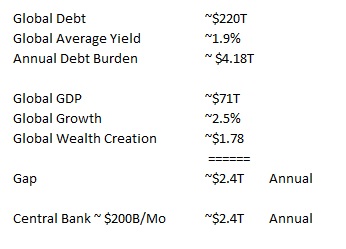
Expect more as Debt rises and GDP falls further.

09-28-16-macro-monetary-back_of_envelope

Disclaimer: The views or opinions expressed in this blog post may or may not be representative of the views or opinions of the Financial Repression Authority.


09/28/2016 - FINANCIAL REPRESSION & A CHRONIC UNEMPLOYMENT PROBLEM

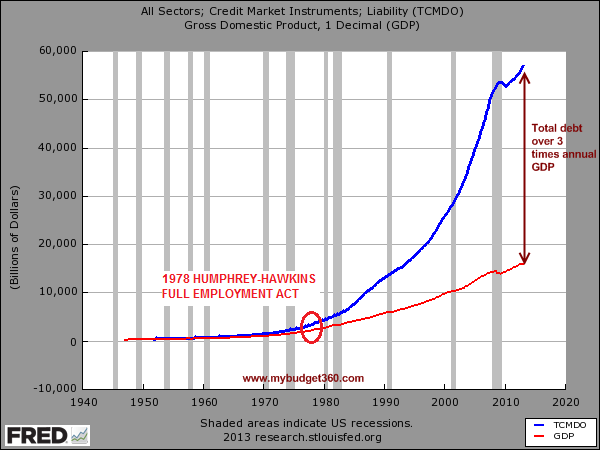
What is little appreciated today is that the Humphrey Hawkins Full Employment Act in 1978 assisted in “birthing”  Financial Repression and placing us firmly on the Monetary policy path the Federal Reserve is presently imprisoned by.

Deep State planners fully understood then that employment would become an increasingly larger problem in America and within the developed  nations as leveraged buyouts with immediate “downsizing”, “rightsizing” and “outsourcing” were beginning to dominate the financial engineering game of the day.

Driven by the political concerns in the late 1970s about rising unemployment, the Humphrey-Hawkins legislation in 1978 fundamentally compelled the U.S. central bank to drive interest rates progressively lower (see chart below).

Casual observers of the Fed speak of a “dual mandate” for U.S. monetary policy incorporating full employment and price stability, but careful reading of the Humphrey-Hawkins law shows that the former is paramount and must be satisfied by the Fed before price stability may be considered. Federal Reserve chairs have followed the single mandate of full employment to its logical conclusion, namely zero interest rates and the expropriation of private income.

With the peak in nominal rates in the late 1970’s the Fed switched priorities and became focused on the single mandate of full employment. This policy fixation on targeting at least nominal employment had significant costs, including a steady level of underlying inflation that has slowly undermined consumer purchasing power (thus, today’s discussion of “income inequality”). The single mandate of full employment also facilitated periodic financial bubbles and crises resulting from the manic swings in Fed policy.

09-28-16-thesis-2013-humphrey-hawkins

WHAT THEN FOLLOWED

09-28-16-thesis-2013-humphrey-hawkins-1

I found the remarks presented by Christopher Whalen of Kroll Bond Rating Agency (KBRA), at the Central Banking Series sponsored by the Global Interdependence Center in Dublin, Ireland and Madrid, Spain, September 29 and October 3, 2016 to be particularly supportive of the Financial Repression Authority’s position. As Chris Whalen highlights in Navigating an Uncertain Global Economy in the Age of Financial Repression, Financial Repression has fostered deflation and crippled income growth.

Central to any new approach to monetary policy must be the realization that the secular decline of interest rates, which is the centerpiece of financial repression, necessarily also drives deflation. Today, the Federal Open Market Committee frets over whether to raise the benchmark rates for federal funds and bank reserves a mere quarter of a percentage point. Yet anyone looking at the bond markets and, in particular, at bond credit spreads knows that there is not yet sufficient demand for credit to justify an increase in interest rates. Without a sustained increase in the yield on investment assets, the world faces a protracted period of low or no growth and the eventual destruction of public and private financial institutions that depend upon investment returns.

Just as many organizations used to rely upon the returns on investments to bolster profitability in particular, today the global economy is suffering from a diminution of income as a result of more than 30 years of financial repression. The trillions of dollars annually that is transferred from private organizations and individuals to public sector institutions via negative interest rates and quantitative easing (QE) ranks among the most regressive, anti-growth policies ever witnessed in peacetime.

….

Since the 2008 financial crisis, global growth has slowed and the overall level of debt has grown. Individuals in many nations have made an attempt to reduce their level of indebtedness, but in aggregate since 2008 nations have gone on a debt-fueled spending binge encouraged by the fact that the cost of servicing public sector debt has fallen. Open market purchases of public and private debt have been employed by global central banks to push interest rates down to zero or lower, this in an overt effort to stimulate asset prices, shift investor risk preferences, and thereby, it is hoped, stoke higher levels of aggregate demand.

Stepping back, we can see that in 20th century America, credit has been used to increase sales as opposed to forcing consumers to save sufficient cash to purchase an automobile or home in the future.

The judicious use of credit increased demand for goods and services, and employment. Today, however, the policy of using ever cheaper credit to pull tomorrow’s demand into the present day seemingly has lost its efficacy. With most nation-states unwilling or unable to use fiscal expansion to stoke short-term demand, global central banks acting alone have been asked to somehow address the burdens of global over-capacity, excessive debt, rising unemployment and slack consumer demand – simply an impossible feat!

THE ROADMAP OF HOW FINANCIAL REPRESSION WAS FURTHER SUSTAINED VIA  REGULATORY LEGISLATION

08-26-16-macro-monetary-distortions

Disclaimer: The views or opinions expressed in this blog post may or may not be representative of the views or opinions of the Financial Repression Authority.


09/28/2016 - McAlvany Financial: Negative Interest Rates & Cash Control To Address Debt

Straight From The Horse’s Mouth: 
“We Will Eliminate Your Cash” 
McAlvany Commentary

McAlvany Financial .. Negative interest rates and cash control seen as best way to slough off debt over to you .. Who’s the Patsy?—If you don’t know it’s probably YOU .. TRUMP Terrifies the Establishment…Proof?…Bush Sr. supports Hillary! .. 48 minutes

Disclaimer: The views or opinions expressed in this blog post may or may not be representative of the views or opinions of the Financial Repression Authority.


09/23/2016 - Charles Hugh Smith: The ZIRP/NIRP Gods & Their PhD Priesthood Have Failed

“Let’s start with the Fed Funds Rate, which the Federal Reserve has pinned near zero for years. This Zero Rate Interest Policy (ZIRP) is the god the PhD economists in the Fed and other central banks worship as the supreme force in the Universe, along with its even more severe sibling god, NIRP (negative interest rate policy), which demands that banks and depositors must pay for the privilege of holding cash .. Precisely what have ZIRP and NIRP fixed in the global economy? The short answer is ‘nothing.’ Instead of fixing what’s broken, ZIRP and NIRP have pushed a broken system further along the path of self-destruction. The priesthood’s insane obsession with forcing people to spend their savings by punishing savers with ZIRP/NIRP has failed spectacularly for a simple reason: it completely misunderstands human psychology. Now that ZIRP and NIRP have destroyed the income that was once earned on savings, the only rational response is to save more, not less, despite the priesthood’s policy of negative rates .. The priesthood is absolutely blind to another key aspect of human psychology.The policy of negative interest rates is so extreme and so destructive that it proves the priesthood and its Keynesian Cult have completely lost their way, yet their grip on power only increases. The Keynesian Cult Priesthood is not just clueless–it is forcing everyone to drink its toxic Kool-Aid. Like the crazed dictator in the Woody Allen comedy, the Keynesian Priesthood may well order us all to wear our underwear on the outside of our clothing, if they reckon that would boost ‘aggregate demand.'”
– Charles Hugh Smith*
LINK HERE to the essay

Disclaimer: The views or opinions expressed in this blog post may or may not be representative of the views or opinions of the Financial Repression Authority.


09/20/2016 - Economist Ken Rogoff: Advocates Banning Cash

A Ban On Paper Currency

Rogoff’s new book The Curse of Cash proposes a ban on paper currency .. “It’s terrifying piece of work, for several reasons .. the cashless society, which Rogoff proposes in order to make it easier for the U.S. government to confiscate private wealth, in effect, amounts to an admission that Washington can’t pay back its debts.” .. even Rogoff himself admits that cash is a problem for central banks & governments to carry out their financial repression for addressing the escalating challenges of government debt: “In principle, cutting interest rates below zero ought to stimulate consumption and investment in the same way as normal monetary policy .. Unfortunately, the existence of cash gums up the works.” . the essay points out that “the fact that Rogoff, Ben Bernanke and others are proposing negative rates despite the considerable evidence that they will do no economic good suggests that they believe that the U.S. government cannot pay back its debts – that it is already insolvent.”
link here to the essay

Disclaimer: The views or opinions expressed in this blog post may or may not be representative of the views or opinions of the Financial Repression Authority.


09/20/2016 - David McAlvany: All Markets Are On Monetary Life Support

Wall St For Main St .. discussion about the cashless society, war on cash, financial repression & negative interest rate policy that academic PhD Keynesian Economists & central bankers are discussing & implementing .. what negative interest rates & trying to eliminate cash means (way less freedom for everyone) & how desperate governments are now & how they will become more desperate .. 47 minutes

Disclaimer: The views or opinions expressed in this blog post may or may not be representative of the views or opinions of the Financial Repression Authority.


09/19/2016 - Intensifying Financial Repression as a New Global Bond Cycle Kicks Off

Deutsche Bank Predicts Intensifying Financial Repression as a New Global Bond Cycle Kicks Off

The signs abound from the current political rhetoric that trade and financial protectionism is in the wind. This is a major problem, especially with weak economic growth, central banks committed to higher inflation and stagnant (and even falling) productivity in the developed economies.

This has the potential to reverse 35 years of the “Bankers’ Bond Bonanza” and further intensify advancing Financial Repression.

09-19-16-macro-global-macro-economic-outlook-3

Deutsche Bank Strategist Jim Reed concludes:

An oncoming lurch towards trade and financial protectionism — combined with aging populations and weak worker output — will intensify financial repression as a new multi-decade-long economic cycle kicks off this year.  

……

Central bank bond-buying and stronger financial regulation in recent years, forcing financial institutions to up their domestic bond purchases, highlight how financial repression is in full swing. It’s going to get a lot worse

…….

“Maybe it will be more difficult in today’s integrated world to limit international capital flows in the same ways as after WWII (the last time Financial Repression was used to solve a US sovereign debt problem), so perhaps the cushion will come from a long period ahead of money printing and bond purchasing to ensure that there is no run on debt markets given the likely negative real returns.”

SOURCE 09-09-16 Deutsche Bank via ZeroHedge

Deutsche Bank: Bond Investors Are About to Get Crushed as a New Global Cycle Kicks Off

Weak growth, higher inflation, and stagnant productivity in developed countries will roil bond investors in the decades to come, as the benign global forces that have buoyed returns on financial assets for the past 35 years stage a sharp reversal. That’s the big-picture call from Deutsche Bank AG analysts who predict an oncoming lurch towards trade and financial protectionism — combined with aging populations and weak worker output — will intensify financial repression as a new multi-decade-long economic cycle kicks off this year.

“In our opinion we’re getting closer to a binary outcome for the global economy and financial markets,” the strategists, led by Jim Reid, wrote in a report on Thursday.

Now, there’s an inflection point in the global economy that is poised to create a perfect storm for bond investors: higher inflation, and strengthening political incentives to erode high debt burdens by hitting bond holders with effective haircuts, the bank argues.

The strategists paint two scenarios for bond holders going forward:

Scenario 1 – The best case

Put bluntly the best realistic scenario for financial stability in the new era is that bond holders around the world see a slow real adjusted haircut over several years, probably over at least a couple of decades. The best example of this through history was the post WWII period where government debt was at similar levels to that currently seen. Over the next 35 years this debt was successfully eroded by a long period where nominal GDP was notably above bond yields. So bond holders took a large real haircut.

Scenario 2 – The hard break

 Rather than an artificial reflation and slow successful non-systemic deleveraging, there is a genuine risk of a more binary outcome where a major country (countries) see(s) a hard default on its debt taking a lot of other debt with it domestically and possibly internationally. This is probably most likely to happen via politics – especially in Europe if a country decides to leave the single currency.

Under this scenario, non-core government bond markets could see huge losses as the central bank backstop bid is removed.

A slew of analysts have warned bond investors in the coming years will be hit by negative real returns, citing stretched valuations, the prospect of rising price pressures from a low base, and monetary tightening in the U.S. Yesterday, DoubleLine Capital Chief Investment Officer Jeffrey Gundlach recommended that bond investors gear up for higher inflation and higher bond yields, saying, in a webcast, “This is a big, big moment” for financial markets, citing the prospect of rising rates. Japan’s sovereign debt market is embroiled in its biggest rout in 13 years with the 10-year benchmark climbing to minus 0.025 percent on Friday (compared with minus 0.06 percent on Wednesday, after a record-low of minus 0.3 percent in July) while the German 10-year benchmark rose to minus 0.010 percent as of 8:42 a.m. in New York. The 30-year note is at its highest level since June, after the Eurpoean Central Bank downplayed the need for more stimulus on Thursday.

ECB inaction is also the catalyst that has triggered a slide in 10-year U.K. gild and U.S. Treasury prices.

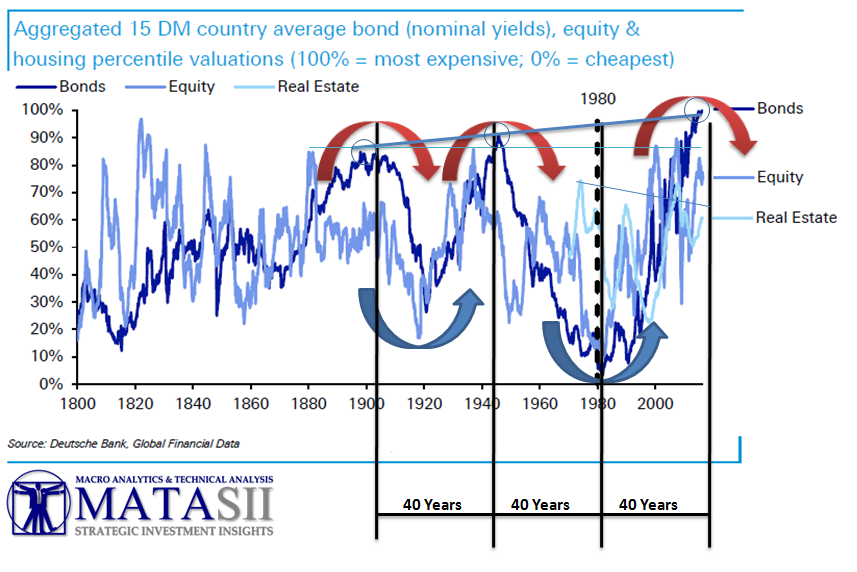
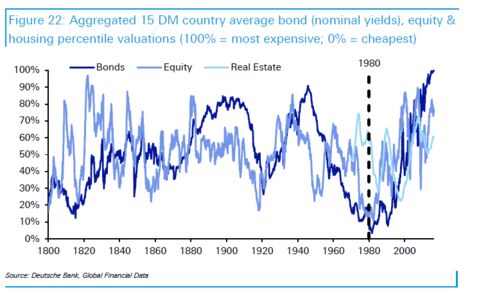
The Deutsche analysts take a structural view for fixed-income prospects with a sweeping sketch of the economic landscape, drawing upon a detailed data set going centuries back that suggest current asset valuations in 15 developed markets have hit their cyclical peak, after a bull run from the 1980s onwards. Valuations for housing and bonds relative to their historic inflation-adjusted prices now look stretched. The bank calculates that’s the case for equities too, relative to nominal GDP.

Deutsche Bank AG

Benign globalization and demographic forces have tamed inflation in recent decades fueling stunning real returns in fixed income from the 1980s, while equities, despite the higher returns on offer, saw a much smaller level of outperformance in this period.

Central bank bond-buying and stronger financial regulation in recent years, forcing financial institutions to up their domestic bond purchases, highlight how financial repression is in full swing. It’s going to get a lot worse, the analysts say, though the counterpoint from some economists is that monetary policy is appropriately calibrated to the underlying natural rate of interest and beefier regulations are designed to make the financial system safer.

The Deutsche analysts say:

“It seems the status quo can’t hold for much longer. Monetary policy can’t be used as the predominant policy tool to the exclusion of the alternatives. Inequality surely can’t continue much further without a political backlash. Globalization and perhaps free movement/immigration can’t continue in its current form without a similar such social/political response.”

They conclude:

“Maybe it will be more difficult in today’s integrated world to limit international capital flows in the same ways as after WWII, so perhaps the cushion will come from a long period ahead of money printing and bond purchasing to ensure that there is no run on debt markets given the likely negative real returns.”

While equities will likely outperform bonds in the decades to come, the bank argues that the data suggests stocks will still lag their long-term return average. Although the prospect of lower real GDP in advanced economies is bad for both financial and real-economy assets, there’s at least one quantum of solace: Real wages are likely to rise amid a decline in populations of working age, the analysts conclude.

Deutsche Bank’s warnings follow Bank of America Corp. analysts last month, who reckon that financial assets are poised to underperform real-economy assets — such as commodities and collectible items — citing high financial-market valuations, and the prospect of looser fiscal policy, trade protectionism and wealth redistribution in developed countries. The bearish prognostications are premised on one big call, of course: there will be no positive productivity shock in advanced economies in the coming decades.

Disclaimer: The views or opinions expressed in this blog post may or may not be representative of the views or opinions of the Financial Repression Authority.


09/16/2016 - Thorsten Polleit: Central Banks May Choose Helicopter Money Over Negative Rates

Free market economist Thorsten Polleit sees policymakers as realizing that the policy of 0% interest rates is not working .. “Central banks are quite unlikely to abandon the idea of pushing real — that is inflation-adjusted — interest rates into the negative. What they might have in mind is allowing for “somewhat higher” nominal interest rates, accompanied by ‘somewhat higher’ inflation, making sure that real interest rates remain in, or fall into, negative territory.” .. references the Federal Reserve of San Francisco paper published on 15 August 2016 that monetary policy should rethink & possibly allow for an inflation of more than 2% … “Inflation — be it 2, 4, or more percent — doesn’t make a society better off. On the contrary. For instance, inflation corrupts economic calculation, thereby causing entrepreneurs to make the wrong decisions. The stimulus inflation initially is due to the errors which it produces .. Consider a case in which the central bank promises an inflation rate of 2 percent. After people have entered into their contracts, the central bank increases inflation to 4 percent. People will learn and expect future inflation to be 4 or even 5 percent. The central bank, if it wants to stimulate again the economy, has to bring inflation further up .. This kind of policy would ultimately lead to high or even hyperinflation — which has been observed in many countries around the world.” .. Polleit says this policy will help governments to manage their massive debt levels .. “It would be surprising if governments and their central banks will not opt at some stage for higher inflation in an attempt to escape the problems their policies and the issuance of unbacked paper money has caused in the first place. Alas, it wouldn’t be the first time in monetary history that unbacked paper money would be deliberately debased.”
LINK HERE to the essay

Disclaimer: The views or opinions expressed in this blog post may or may not be representative of the views or opinions of the Financial Repression Authority.


09/14/2016 - Carmen Reinhart: Financial Repression Requires A Captive Audience

McAlvany Commentary .. The opaque transfer of wealth using negative interest & regulation .. Inflation is hidden by making the same priced potato chip bag even smaller .. Never underestimate the Government’s ability to create a “captive audience” .. about 1 hour

Disclaimer: The views or opinions expressed in this blog post may or may not be representative of the views or opinions of the Financial Repression Authority.


09/13/2016 - Tim Price: Investing In The Era Of Financial Repression

Tim Price – A New Approach Is Required
For Investing In 
The Age Of Financial Repression

In his latest missive, Tim Price analyzes the “permanent portfolio” from Harry Browne .. this portfolio managed to survive the stagflationary 1970s, the crash of 1987 & even the death of communism .. “But it has been dealt a devastating blow by the financial repression of the past eight years, which has effectively dismantled two of its four pillars.” .. bonds are negative yielding & cash is targeted for being abolished .. the 2 that still make sense: “Stocks because there can be no investment rationale for owning negative-yielding bonds – and because stocks offer fractional ownership of real, productive businesses .. Gold because there is still every reason to expect further inflationism and monetary debauchery from the world’s major central banks. But nominal assets make no sense when nominal rates are the plaything of increasingly desperate policy makers, and heading inexorably below what was previously thought to be an absolute lower bound constrained at the level of zero.”
LINK HERE to the missive in PDF

Disclaimer: The views or opinions expressed in this blog post may or may not be representative of the views or opinions of the Financial Repression Authority.


09/13/2016 - Negative Interest Rates: Not Without Consequences

Essay highlights the unintended negative consequences of financial repression on investors .. “An important criticism of the low-rate environment we are in is that many people who want to save their money in a bank to gain interest wind up paying the price—particularly when inflation is factored in. Instead of earning interest on their deposits, they are essentially charged money to keep it in the bank!” .. negative interest rates are making the situation worse .. “The negative rates are shrinking bank profit margins and thus, making them reluctant to lend. Many people who would normally deposit their money in the bank now simply keep their cash in safe deposit boxes or under the floorboards. The lack of interest earnings make people who are not able to invest the money elsewhere feel that they are financially disadvantaged. Many pension funds are in trouble since the safety they sought from government bonds normally held in their portfolios has not been earning any yield to speak of, and some are forecasting they will not be able to meet their obligations to pensioners in this prolonged low-rate environment. The result is a search for yield among those institutional investors, leading them to more toward risky bonds and equities. This, some observers fear, could lead to another financial market bust if the risky investments come home to roost .. we must be mindful of the macro developments engendered by unconventional central bank policies which could have unforeseen consequences for many investors.”
LINK HERE to the essay

Disclaimer: The views or opinions expressed in this blog post may or may not be representative of the views or opinions of the Financial Repression Authority.


09/06/2016 - Central Banks Are Continuing With Financial Repression

Central Banks Hit the Panic Button

“Central banks are screwed. They’re out of bullets. They know it. And they also know the rest of the world will catch on soon enough .. They’ve cut interest rates 667 times since Lehman Brothers collapsed .. They’ve also purchased $25 trillion of financial assets. That’s larger than the gross national product of the U.S. and Japan, the first and third largest economies in the world, respectively .. And through their sadistic negative interest-rate schemes, there’s now $8 trillion of negative-yielding sovereign debt. That’s 54% of all sovereign debt. And $13 trillion in negative yielding global bonds. That’s 28% of all bonds .. The markets have been flooded with historic torrents of liquidity to supposedly spur economic growth. But none of these experiments have prevented the world’s developed economies from flatlining .. Look at the numbers .. The developed economies are failing .. And even China’s world-beating economy is now sucking fumes .. Now that NIRP is destroying European banks and creating mass cash hoarders in Japan, central bankers will go for ‘helicopter money’ next .. Central bankers are simply trying to extend the credit bubble as long as they can so it doesn’t burst on their watch. They are politicians after all. They only care about naked power .. So, ladies and gentlemen, we are in the real life Matrix—billions of people hooked to feeding tubes waiting for someone to turn the lights out at night .. And all this is happening while the major economies that drive global growth get weaker each day.”
– Michael Covel
link here to the essay

Disclaimer: The views or opinions expressed in this blog post may or may not be representative of the views or opinions of the Financial Repression Authority.


09/06/2016 - How Much Of The S&P 500 Stock Index Is Due To Central Bank Stimulus?

Deutsche Bank Calculates 
How Much Of The S&P’s Value 
Is Due To Central Banks

Deutsche Bank’s Dominic Konstam writes over the weekend, “various Fed officials have raised the issue of financial stability in the context of the reach for yield and riskier products to make up for low rates. This is part of financial repression. The logic might be that once the Fed has normalized, elements of that reach for yield and risk would be unwound and this could lead to disruptive financial market volatility.” .. the worry is that once interest rates go up, stocks will crash .. “We can illustrate this aspect of financial repression in terms of the equity market. In the post crisis world, all assets seem closely correlated to breakevens and real rates but with varying betas. We note that the equity market recently looks very expensive even to these rates through the shift in the beta on inflation expectations – so despite low inflation expectations, equities have done even better than otherwise warranted by low real rates. This shows up as a fall in the equity risk premium and defines well the hunt for yield in a repressive financial regime. How does the decompsition of performance look visually: we can illustrate the extent to which this is unprecedented with the historical performance of the equity market. Decomposing equity returns into earnings growth, changes in P/E and changes in the risk premium shows that the bulk of equity performance is best captured by the shunt lower in equity risk premium .. Central bank policies are directly responsible for approximately 40% of the ‘value’ in the market, and any moves to undo this support could result in crash that wipes out said ERP contribution, leaving the S&P500 somewhere in the vicinity of 1,400.”
LINK HERE to the article

Disclaimer: The views or opinions expressed in this blog post may or may not be representative of the views or opinions of the Financial Repression Authority.